


 by Tom Gurney
Tom Gurney BSc (Hons) is an art history expert with over 20 years experience
Published on June 19, 2020 / Updated on December 14, 2025
Email: tomgurney1@gmail.com / Phone: +44 7429 011000
Antonio Canova's sculpture, Psyche Revived by Cupid's Kiss, captures a moment of breathless stillness, where marble seems to soften into flesh as love itself revives the soul.
Introduction
The sculpture is considered a masterpiece of Neoclassical style but also has the mythological elements of emotional lovers, a clear sign of the emerging movement of Romanticism.
Rather than presenting mythological figures as distant ideals, Canova captures Cupid and Psyche at the instant of awakening, transforming an ancient story into a deeply human experience.
A piece of beauty, carved from a challenging block of white carrara marble, the composition unfolds in a graceful spiral of intertwined bodies. It demonstrates Canova's ability to suggest softness, movement and emotional warmth within stone.
This page explores the sculpture's mythological origins, artistic techniques, symbolic meaning and critical reception. Collectively, it reveals why Psyche Revived by Cupid's Kiss remains one of the most celebrated works of modern sculpture and a key contribution to Neoclassicism sculpture.
- Artist: Antonio Canova (1757-1822)
- Title: Psyche Revived by Cupid's Kiss
- Date: 1787-1793
- Medium: Carrara marble
- Movement: Neoclassicism
- Height: 155 cm
- Location: Richelieu Wing, Louvre Museum, Paris
- Subject: Cupid awakening Psyche with a kiss
Background in Mythology
The myth comes from Book VI of Apuleius's Metamorphoses. The winged male figure here is that of god Eros (or Cupid in Latin) and is recognizable by his wings and the arrows in his quiver.
The girl has been identified as Psyche. She is punished by Venus and has to carry out a series of trials. The final test relates to this sculpture - she opens a forbidden box containing “the Sleep of the Underworld” and collapses.
The plot has it that Cupid mother Venus, represented the goddess of beauty, commanded Psyche to bring back a flask, but strictly forbade her from opening it. Out of curiosity, Psyche opened it and inhaled poisonous fumes that put her into a heavy, comalike sleep.
When Cupid found her lying motionless, he touched her carefully with the tip of his arrow to see if she was still alive.
Cupid, having forgiven her, wakes her with a kiss and she responds to his tenderness. This is this precise moment that Antonio Canova freezes in marble — a moment of reconciliation, forgiveness and divine love. He lifts his beloved Psyche in a tender embrace of love.
Canova's Multiple Versions of Cupid and Psyche
There are two versions of Canova's Psyche Revived by Cupid's Kiss, to be found in the Louvre, Paris, France and the Hermitage Museum, Saint Petersburg, Russia. There is also a full-scale model of the Russian version in the Metropolitan Museum of Art, USA.
The theme continued with Cupid and Psyche Standing, also produced in two versions, which again are spread between the Louvre and the Hermitage. This design features a more straight forward composition, which perhaps was chosen by the sculptor to counter some of the critics of his existing work on Psyche Revived by Cupid's Kiss, from some who had seen it in development in his studio.
Description
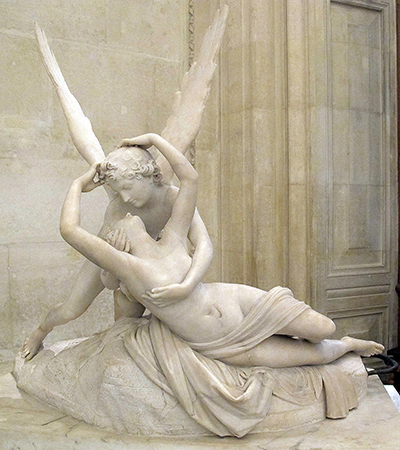
She also lets herself sink slowly backward, languorously taking her lover's head between her hands. The sculpture was designed perfectly and it can be looked at from different angles. The sculpture has a powerful impression of aliveness and shows remarkable subtlety and how he perfectly worked on the marble surface.
Also visible are deliberately toothed chisel marks left on the rock surface. There are also a difference in texture between the folds of the fabric on the ground and the filmy muslin clinging to Psyches thighs.
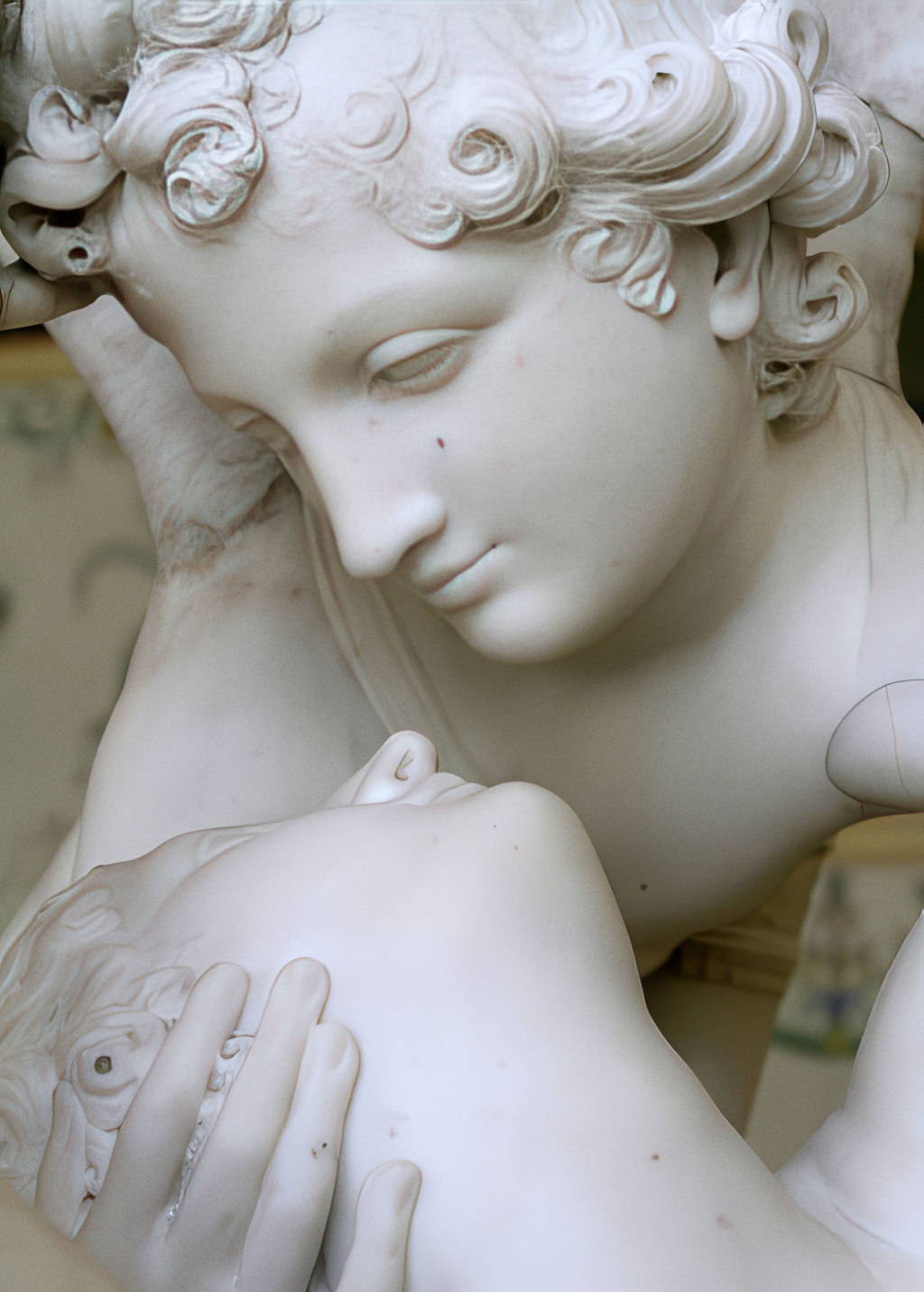
The skin has a very smooth texture which was achieved by using a finer filling technique as can be clearly seen from Cupid's face. The flask is on a separate location and its particular polishing is highly likely from turning and use of polish powder. It must have been lustered, and without doubt, waxed to give it the look of a valuable metal.
Also, Cupid's wings were fixed in his back with such great accuracy. The wings are surprisingly thick and vivid, yet when backlit by the sun they become translucent, with a splendid golden hue.
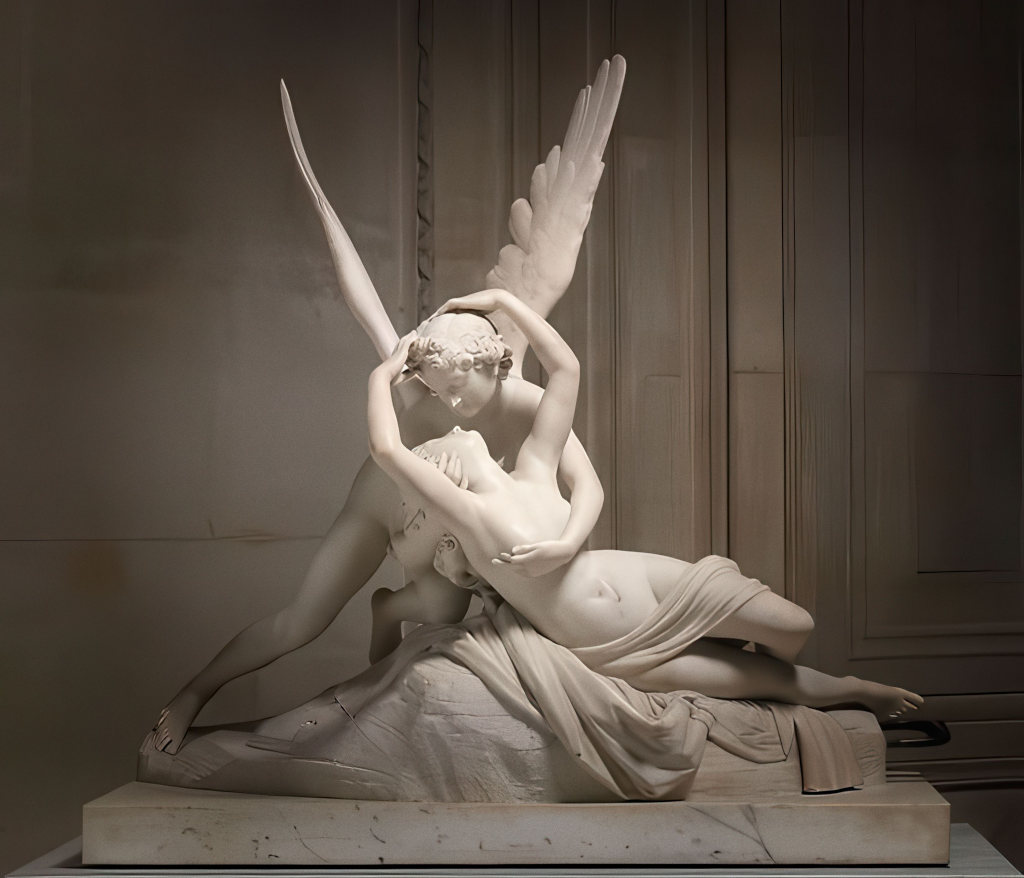
Photograph of Psyche Revived by Cupid's Kiss Antonio Canova
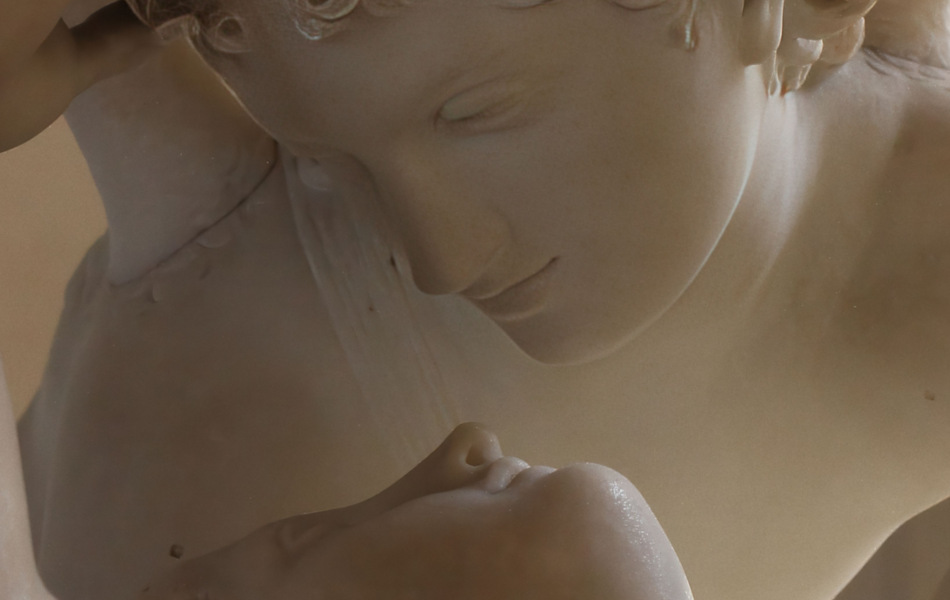
Close Detail of The Kiss Sculpture
Kiss of Cupid and Psyche by Canova Hermitage Museum Version
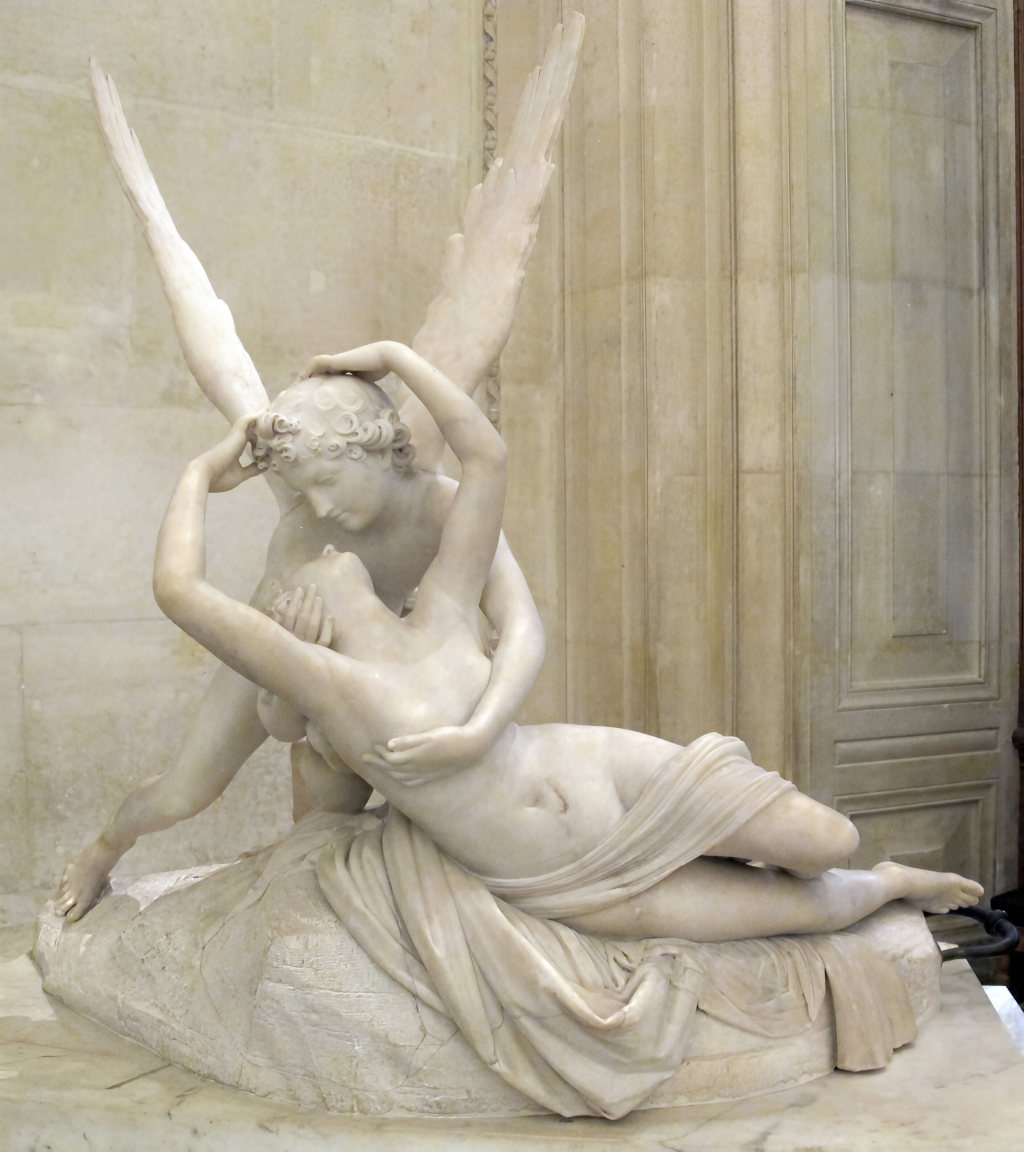
Sculpture in the Louvre
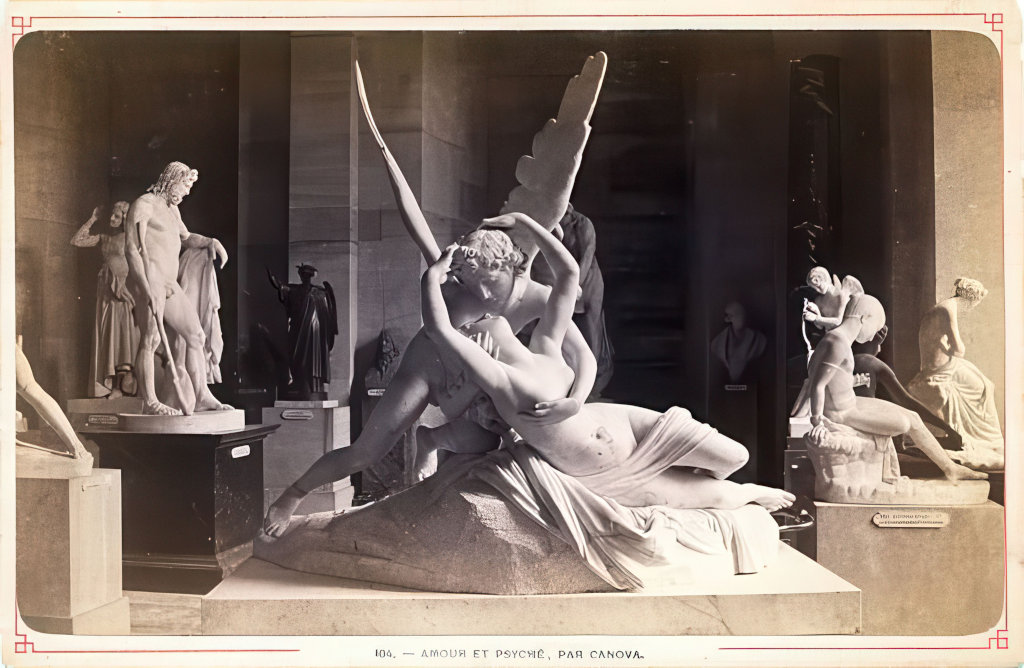
Cabinet photograph of the sculpture Cupid and Psyche by Antonio Canova, Rome, Italy, circa 1880
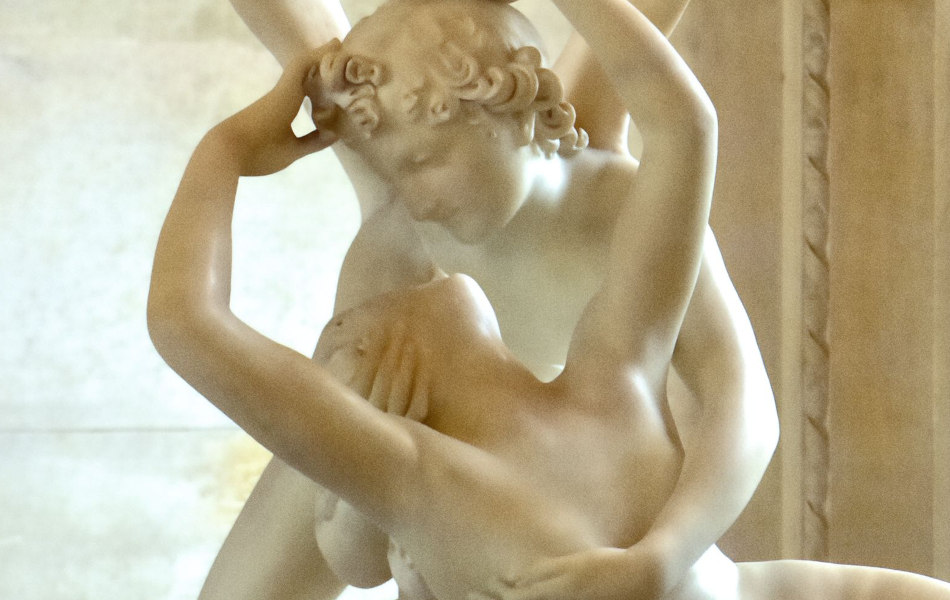
Alternative Angle Close Up Detail of Sculpture
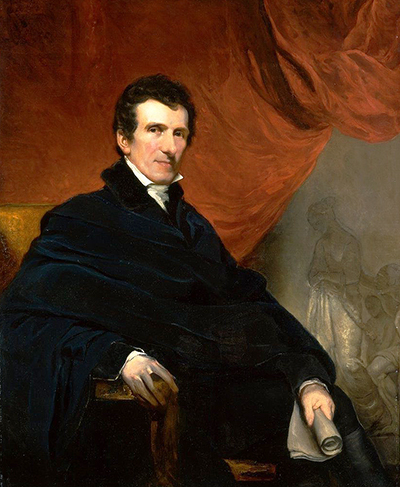
I have sought ideal beauty, not copied from nature, but formed in my own imagination.
Influence on Canova
His father Pietro Canova, a stone cutter, had some impact on Antonio Canova's ambition in the art world.
However, it was his paternal grandfather, Pasino Canova, who was a stonemason, owner of a quarry, and was a sculptor specializing in late Baroque style who had a profound influence on Antonio Canova. He led Antonio into professional sculpting art. Canova's other work includes Perseus Triumphant between 1804 to 1806, Napoleon as Mars the Peacemaker between 1802 to 1806, Venus Victrix 1805 to 1808, and The Three Graces between 1814 and 1817. He was also highly proficient in painting and drawing too, though he will always be remembered first and foremost as a sculptor.
Psyche Revived by Cupid's Kiss is just over a metre and a half in height. It was constructed entirely in marble, and this would become the preferred medium for Canova when working within the discipline of sculpture. There are two versions in existence, with the first creation now being found at the Louvre in Paris, with a followup piece on display in St Petersburg in Russia.
It was common for this artist to produce several iterations of the same design, when working within sculpture. His original moulds can also be found too, and these hold a considerable value of their own.
The marble must appear like living flesh.
Inspiration and Meaning
Cupid and Psyche comes directly from Lucius Apuleius's Latin novel The Golden Ass, which is also sometimes known as Metamorphoses. It was released in 1650 and inspired many painters and sculptors.
Cupid and Psyche alone have appeared in countless artistic oeuvres, including famous contributions from the likes of François Gérard, Raphael, Anthony van Dyck, Luca Giordano and Edward Burne-Jones to name just a few. In this example we find a young man with wings who lands besides a girl who lies motionless.
Canova's sculpture illustrates when Cupid gently awakens Psyche after she has fallen into a deep sleep. His raised wings and leaning pose create a downward flow of motion, guiding the viewer's eye to Psyche's upward arch and outstretched arms.
His quiver with arrows helps to identify him as the god Eros, known by many as Cupid instead. Psyche is the girl lying besides him. The tale describes the importance of a small flask and this detail is featured within the sculpture, though can only be seen from some angles. Additionally, the butterfly carved beneath Psyche — an ancient symbol for the soul — reinforces the idea that this moment represents a spiritual rebirth.
The sculpture's meaning is centred on the triumph of love over death. Psyche (which translates as "soul") is revived not by force, but by tenderness. Canova turns a myth about suffering into a more positive vision of harmony and emotion, where perfect bodies express a form of spiritual truth.
Critical Reception
In general, Canova's Psyche Revived by Cupid's Kiss was highly regarded upon its unveiling. There would already have been quite a buzz within the industry, with a number of critics having already seen the work at various points in its development, sometimes even giving their own advice and thoughts, some of which Canova would take note of.
Prominent German art historian, Johann Joachim Winckelmann, praised works of this kind for their "noble simplicity and calm grandeur." It seemed that this sculpture captured the preference of the time for balancing classical form with emotion and energy. By the 18th and 19th centuries, critics would start to appreciate different elements of the sculpture, with Canova remaining in high regard and the subject of many academic studies.
The most controversial element of this sculpture has proven to be how its composition ensures it can be experienced from many different angles - and critics have classed this as a positive and negative. Some have been left unsure as to where to stand, describing it as "de-centered", whilst others appreciate this multi-faceted experience.
Specific Criticism during Canova's Era
Quatremère de Quincy, an influential art writer, warned Canova about following too closely to the work of Bernini, or an Antique Bernini, as he phrased it. He also suggested that Cupid and Psyche reclining would become one of Canova's lesser known works. He also made suggestions for improvements to the drapery, and this comment was taken on-board by the artist.
Karl Ludwig Fernow was a consistent critic on Canova's work and he disapproved strongly with the composition of this particular sculpture:
One can never arrive at a satisfying view of the work, from whichever side one looks at it. One has to leap around it, looking at it now from above, now from below, getting lost in the individual partial views, without ever getting an impression of the whole.
Additionally, Fernow claimed that the wings of Cupid reminded him of a windmill and also compared the piece to historical sculptures which has themselves fallen out of favour at the time.
Canova had, at this stage, learnt to pay attention to his critics, but equally not be led too strongly by them, either - he understood that some would continue to criticise his work, whatever he did, whilst others may have something more constructive to add.
Neoclassicism: Why This Sculpture Became a Defining Work
Psyche Revived by Cupid's Kiss is one of the most iconic achievements of Neoclassical sculpture. Canova moves away from the Baroque era, bringing ideal proportion and balance, whilst also innovating around angle and composition.
There is a combination of classical, smooth surfaces along with a contemporary energy. It is exciting, and avoids merely replicating Bernini, as critics had warned him against. Aside from the multiple viewing positions, other innovations in this piece, which helped to spearhead the Neoclassicsm era, were the beautifully crafted wings and an impressive handling of marble.
Provenance
The Louvre sculpture is believed to have been worked on between the years of 1787-1793, with the item then being sold at around the turn of the century, just a few years later. It has remained within the collection of the Louvre since around 1824, though this is not unusual for the impressive art museum which has owned much of its collection of paintings and sculptures for several centuries.
Location
The most famous version of Psyche Revived by Cupid's Kiss by Antonio Canova is housed in the Louvre Museum, Paris. It can be found in the Richelieu Wing, Ground Floor (Cour Khorsabad / Salle des Caryatides area), at the time of writing. The curators have sensibly allowed space all around the piece, so that it's different angles can be appreciated by visitors.
The Wing itself is typically filled with related artworks from the Baroque and Neoclassicism era, with Canova's sculpture being amongst the biggest draws in the part of the museum.
Louvre Museum,
75001 Paris,
France
FAQs
References
- Warm Flesh, Cold Marble, Canova, Thorvaldsen and their Critics, David Bindman, PP69-79
- Antonio Canova and the Politics of Patronage in Revolutionary and Napoleonic Europe, Johns, C.M.S. (1998), Berkeley, CA: University of California Press, p. 149.
- Antonio Canova (Wikipedia)