

 Buy Art Prints Now
from Amazon
* As an Amazon Associate, and partner with Google Adsense and Ezoic, I earn from qualifying purchases.
 by Tom Gurney
Tom Gurney BSc (Hons) is an art history expert with over 20 years experience
Published on June 19, 2020 / Updated on September 28, 2026
Email: tomgurney1@gmail.com / Phone: +44 7429 011000
Introduction
Edgar Degas (1834–1917) made some of the most recognisable images of nineteenth-century Paris: dancers waiting to rehearse, jockeys gathering before a race, women ironing, and bathers absorbed in everyday routines. Their cut-off figures and unexpected angles can make them feel like glimpses caught by chance. But Degas planned, drew, transferred, revised and returned to his subjects for years. His art asks what a fleeting moment looks like when it has been carefully constructed. [1][2][9] [27]
He worked in oil paint, pastel, drawing, monotype, other printmaking techniques and sculpture. His training came from the Louvre, academic drawing and Italian art; his mature subjects came largely from modern urban life. He helped organise the exhibitions later called Impressionist, while resisting the label and giving line, artificial light and studio work an unusual place within that group. His interest in movement extended from a hand pressing an iron to a horse turning, a dancer stretching or a performer suspended above a circus ring. [1][2][4]
Edgar Degas at a Glance
- Full nameHilaire-Germain-Edgar Degas
- Lived1834–1917
- NationalityFrench
- TrainingAcademic drawing, Louvre copying and extended study in Italy
- Principal mediaOil painting, pastel, drawing, prints and monotypes, sculpture
- Recurring subjectsBallet and theatre, horse racing, portraiture, modern work, bathers
- Exhibition circleSeven of the eight independent exhibitions now known as Impressionist, 1874–1886
- A way into his artLook at where a figure is placed, what the picture cuts off, and how the marks were built up
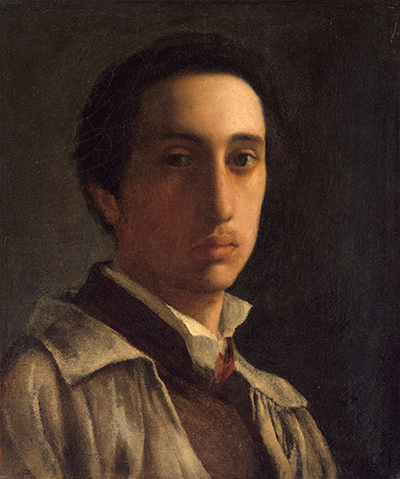
The young artist in Self-Portrait with White Collar, painted around 1857, looks out from a narrow field of brown and black. Light strikes one side of his face; much of the other remains in shadow. Even at this small scale, the image tests how a few shifts of tone and a sharply placed glance can command a composition. The National Gallery of Art in Washington identifies it as oil on paper mounted on canvas, rather than an oil painted directly on canvas. It is a useful opening image for an artist who would keep testing the boundary between drawing and painting. [12]
Degas in time and context
Academic study and Italy
1853–59Collecting intensifies
1890sIndependent group exhibitions
1874–86Edgar Degas
1834–1917Édouard Manet
1832–1883Camille Pissarro
1830–1903Mary Cassatt
1844–1926Four stages of Degas’s career
Learning through earlier art
Degas obtained permission to copy at the Louvre in 1853, studied with Louis Lamothe, and spent substantial periods in Italy in 1856–59. Portraiture and history painting tested his command of line and arrangement.
Paris, war and New Orleans
Portraits and history painting gave way to racecourses, theatres and urban work. He served in the National Guard in 1870–71 and visited family in New Orleans in 1872–73, where he made A Cotton Office in New Orleans.
A different kind of modern painter
Degas took part in seven of the eight independent exhibitions held from 1874 to 1886; he did not show in 1882. Painting, pastel, printmaking and sculpture offered different ways to return to movement and modern subjects.
Experiment, collecting and change
Pastel and other media remained central while Degas collected art with particular intensity in the 1890s. After 1898 his antisemitic, anti-Dreyfus position damaged long friendships. A forced move in 1912 disrupted his working life; the exact date of his last work is not established.
Timeline and career-stage sources: Met chronology, exhibition records, collection study, Dreyfus account; work dates follow the linked owning institutions.
Essential works
The Dance Class
1874 · Rehearsal becomes a study of different gestures across one room.
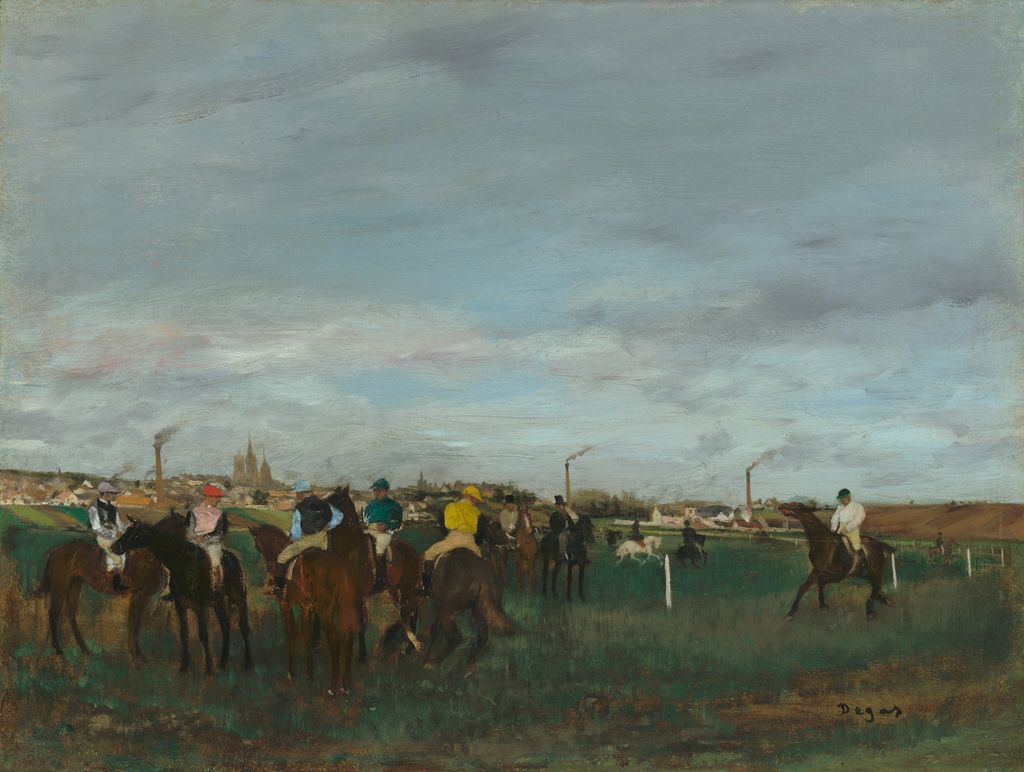
The Races
1871–72 · Riders gather beneath a wide sky at the edge of modern Paris.
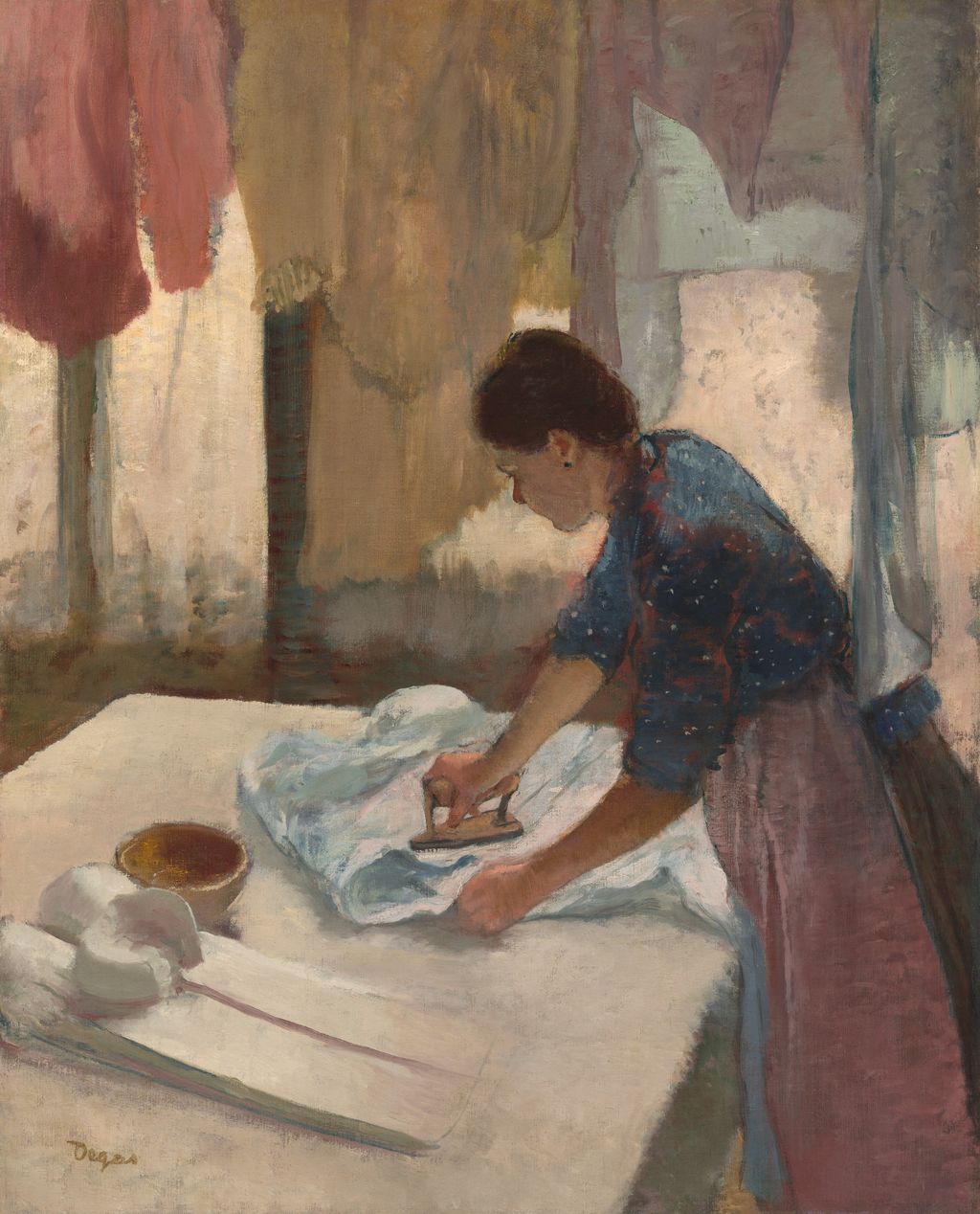
Woman Ironing
begun c. 1876 · A moment of physical labour was revised over many years.
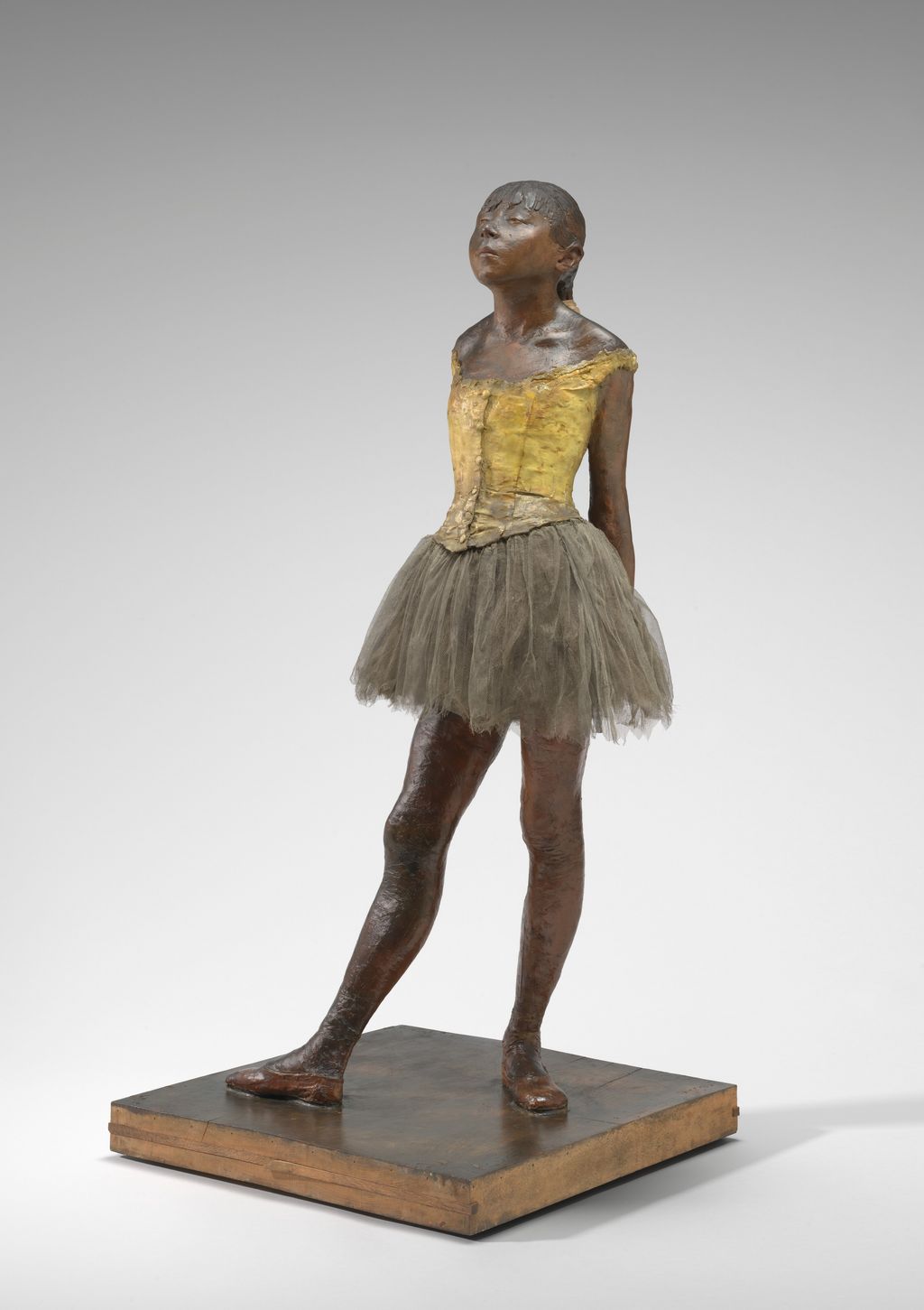
Little Dancer Aged Fourteen
1878–81 · The original wax combines modelling with real textiles and hair.
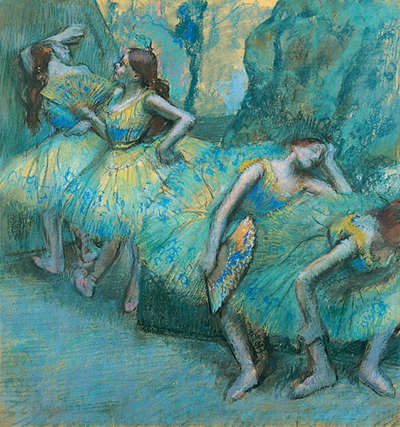
Ballet Dancers in the Wings
c. 1890–1900 · Pastel colour and repeated poses animate a waiting group.
Contents
- Edgar Degas at a Glance
- Learning from the Past
- Scenes of Modern Life
- Painting, Pastel and Drawing
- Collecting, Conflict and the Later Years
- How to Look at a Degas Picture
- Explore Degas's Work
Learning from the Past
Degas was born into a Parisian banking family and received an education that made earlier art readily available to him. He copied Renaissance paintings at the Louvre and learned academic drawing from Louis Lamothe. Between 1856 and 1859 he spent long periods in Italy, where he studied art and members of his family. The disciplined line of his later work was neither an accidental survival from youth nor a style he left behind when he turned to modern life. It remained a resource he could bring to new scenes. [1][2][3]
His early ambitions included historical painting and portraiture. The Bellelli Family, known in the Musée d'Orsay collection as Portrait de famille, is an ambitious example of the latter. Degas shows his aunt Laure, her husband and their daughters in a room whose doors, framed picture and furniture divide the family into separate spaces. Orsay dates the large oil canvas broadly between 1858 and 1869, a reminder that its making cannot be reduced to one visit or one moment. The family's posture and the carefully organised interior already show how Degas could make a picture about relationships through placement, distance and looking. [13]
In the 1860s he increasingly used these skills to picture his own time. The shift did not mean he stopped studying older art. It changed what his training could address: racecourses, cafés, theatres, city interiors and people whose work placed them in public view. A modern subject did not require an unplanned image. Degas could observe a gesture, draw it again, move it within a composition and make its setting part of the meaning. [1][2][9]
A Painter Among the Impressionists
Degas helped form and organise the independent exhibitions associated with Impressionism. He appeared in seven of the eight shows held between 1874 and 1886: those of 1874, 1876, 1877, 1879, 1880, 1881 and 1886. He did not exhibit in the 1882 show. Musée d'Orsay states the seven-of-eight count, and the French Ministry of Culture's participant lists support the individual years. The National Gallery of Art's artist profile gives a conflicting count of six; the exhibition and participant records provide the firmer basis for the count used here. [4][5]
The association matters because Degas shared the group's interest in present-day subjects and in seeing familiar scenes differently. It does not make every Impressionist method his own. As Ruth Schenkel explains for the Metropolitan Museum of Art, he preferred “Realist” or “Independent” to “Impressionist.” He worked extensively with interiors and artificial light and retained a strong commitment to drawing. Musée d'Orsay likewise sets his interest in staged movement and indoor illumination beside the outdoor painting important to many of his colleagues. The difference is visible in what a Degas picture asks us to notice: a body caught between positions, a rehearsal rather than a performance, or an edge that seems to cut across a scene before we can settle into it. [2][4]
His independent stance did not place him outside the group. He helped make its exhibitions possible and showed with fellow artists over more than a decade. Nor did studio work mean a lack of observation. Degas examined how people stood, bent, waited and worked. He was interested in the visual problem of carrying such observations into a picture whose arrangement could be revised. [1][2]
Sources of a Modern Viewpoint
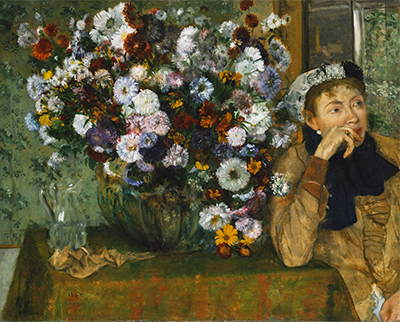
Accounts of Degas's unusual framing often mention Japanese prints and photography. Both belong to the visual culture he knew, but neither should become a universal answer to how his compositions were made. Schenkel notes his interest in Japanese prints and also points to sixteenth-century Italian Mannerist painting as another tradition of cropped figures and unexpected placement. A Woman Seated beside a Vase of Flowers, painted in 1865, pushes the woman toward the right edge so that the flowers occupy the centre. The effect is a compositional choice that can be described directly; identifying one unique printed model would require different evidence. [2]
The vase picture also changes how we read a portrait. A sitter is present, but a high cluster of flowers first claims attention and the woman's body enters almost as a margin. Her position makes us aware that a portrait can reveal someone while withholding the easy centrality we expect. Degas would continue to unsettle the apparent subject of a work in this way. In a dance picture, architecture or another performer may interrupt our view; in an urban interior, an expanse of floor can become as forceful as a face. These effects arise from arrangements we can see on the surface, even when the artist's reasons for choosing them remain open. [2]
Degas also explored photography, yet a picture that seems photographic need not be a photograph translated into paint. A steep view or an abrupt edge can arise through drawing, changes of scale, a study transferred to another support, and successive revisions. His work rewards attention to how an effect was made as well as to what it resembles. This is particularly useful when an image feels instantaneous: the appearance of an instant can be the outcome of a long sequence of choices. [1][2][9]
Scenes of Modern Life
Degas's subjects are often grouped as ballet dancers, bathers and horses. Those labels help us find works, but they can hide how varied the situations are. A dancer may be practising at the barre, resting in the wings, being watched by a teacher or appearing in the glare of a stage. A racing picture may show jockeys before the start rather than a dramatic finish. An ironer is shown through a repeated, strenuous movement, not as a decorative figure placed in a room. A portrait may depend as much on the sitter's relation to the surrounding space as on facial likeness. [1][2][16]
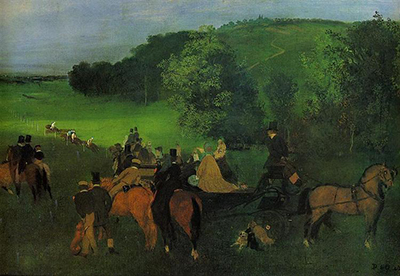
In the National Gallery of Art's The Races, painted in 1871–72, the riders occupy a low strip beneath an immense sky. Some cluster near the left; another enters from the right. Factories and buildings stand on the horizon. The painting gives us a pause in the activity around a race, with modern outskirts as part of the scene. Its open space works differently from Degas's crowded theatre interiors, yet both make the placement of figures a subject in itself. The picture is oil on wood, a small surface whose broad sky makes the gathering of horses feel more concentrated below. [15]
Degas visited family in New Orleans in 1872–73 and painted A Cotton Office in New Orleans. The painting belongs to a different commercial world from Parisian performance or leisure. Its family connections and the cotton trade deserve more than a passing caption; the biography and painting's own page take up the visit and its setting. Here it shows the reach of his interest in rooms where gestures, attention and work create a social arrangement. [3][20]
Ballet, Performance and the View from the Side
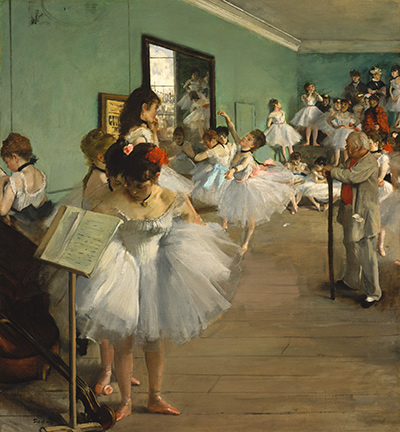
Ballet became one of Degas's most persistent subjects, but many dance pictures are about preparation. In the Metropolitan Museum of Art's The Dance Class of 1874, dancers occupy a rehearsal room rather than a finished theatrical scene. Figures rest, adjust and attend to the teacher; the room extends around them. Degas gives no single performer the whole picture. The eye moves through a group whose individual gestures have different tempos. This is the Met painting, accession 1987.47.1; the similarly titled dance-class painting in Musée d'Orsay is a separate work and has its own page in this collection. [14]
The repetition of dancers across drawings, oils, pastels and sculpture did not simply multiply a popular subject. It let Degas test a pose from different positions and in different materials. A graphite and chalk Dancer Adjusting Her Slipper in the Met is squared for transfer: its surface records a step in moving this image into the 1874 pastel Dancers Resting, as the museum's record explains. A late pastel may lay colour over a figure in a way that makes line and mass hard to separate. The works give evidence of a practice that could revisit rather than merely repeat. [2][6][22]
Performance was broader than ballet. In Miss La La at the Cirque Fernando, now in London's National Gallery, Degas turned to an aerial circus performer. The subject demanded a view up into the architecture of the ring, with the figure suspended far above the spectator's position. The picture is a reminder that his interest in movement was also an interest in how a viewer is placed: below a performer, beside a dancer, or at a distance from a group. The detailed history of the performer and the painting belongs with Miss La La. [21]
It is easy to call these pictures candid because a figure may be cropped or turned away. Yet the look of a glimpse can be an artistic choice. Degas repeatedly used asymmetry, oblique views and cut-off forms, as Schenkel observes. In The Dance Class, the varied postures and depth of the room make rehearsal seem to continue beyond any one dancer. In The Races, the lateral spread of the group and the much larger sky produce another sort of anticipation. Neither picture needs to be treated as a direct copy of a photograph or a Japanese print to explain the force of its framing. [2][14][15]
Work, Portraits and Bathers
Woman Ironing makes labour visible through a body leaning into a task. The worker's hand presses the iron while the other controls cloth on the table; hanging garments partly screen the light. The National Gallery of Art dates the canvas as begun around 1876 and completed around 1887. That long span is important: a moment of physical effort became the subject of extended pictorial work. The arrangement of arm, iron, shirt and table draws our attention to the action while the surrounding fabric shapes the light and colour. [16]
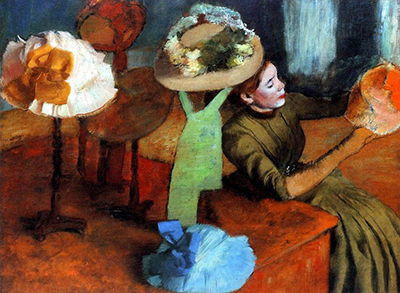
Degas made other images of laundresses and milliners, but an account of those trades needs to consider the people and conditions beyond the painted gesture. His pictures show choices made by an artist looking at labour; they are not unmediated records of a worker's experience. The ballet, portraiture and other subject pages develop the differences between depicted work, performance and the viewer's position. [1][16]
His portraits range from family members and friends to figures encountered in Parisian life. Their settings matter. The Bellelli interior frames people who occupy the same household without appearing to share a single emotional space. In later urban pictures, partial views and off-centre placement can likewise define a relationship between a figure and a room. Degas's bathers offer yet another viewing problem: the body may be shown turned away, bending or absorbed in washing. The bathers page takes up the questions of looking and privacy that a short introduction cannot settle. [2][13]
Painting, Pastel and Drawing
Painting did not disappear from Degas's practice when pastel became more prominent. His early family portraits and history subjects led to oils of racing, rehearsal, circus performance and modern work. He could paint on canvas, wood or paper; he could leave an area thinly worked or revise an image over time. Reff's study of his methods traces a painter willing to use supports and combinations that resisted a neat separation between painting and drawing. The late oil Four Dancers, dated around 1899 by the National Gallery of Art, is a clear check on any claim that he simply abandoned oil at one moment. [1][9][19]
In Four Dancers, bodies gather to one side while a landscape opens beside them. Their repeated gestures and close orange bodices make a pattern, yet each dancer has a slightly different turn of head, shoulder or arm. The painting can be looked at as a late response to a problem Degas had carried through decades: how to arrange near-similar bodies so that variation, not sameness, becomes visible. Its oil medium matters because the colour and broad surrounding space could be worked on a canvas even as pastel was becoming central elsewhere in his practice. [19]
Pastel became especially important in his later career. Musée d'Orsay describes it as almost exclusive from about 1888–90, while also recording Degas's use of pastel with oil, tempera and monotype. The sticks could be applied dry, mixed with water, crushed, rubbed or worked with steam. Those are possibilities across his practice, not a recipe that explains every sheet. Pastel let him build colour with marks that still have the directness of drawing and to return to a composition without treating its surface like a single, fixed layer of oil paint. [6]
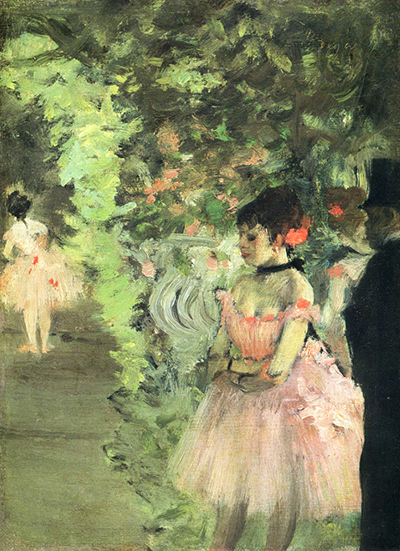
In Ballet Dancers in the Wings, a pastel held by the Saint Louis Art Museum, the subjects wait away from the centre of performance. Four figures stretch or adjust their shoes in a diagonal sequence. The museum suggests that they may represent one dancer at successive moments, an interpretation rather than a settled identification of four sitters or one. Layers of blue, green and yellow through the tutus show why pastel suited Degas's examination of changing pose and colour. The pastels page follows this medium's role and its fragile surfaces; individual work pages stay with exact objects and their records. [23]
Drawing was both a discipline and a place for experiment. Degas copied earlier art, studied figures, tested arrangements and made sheets that stand on their own. The Met's Dancer Adjusting Her Slipper of 1873 is graphite heightened with black and white chalk on paper that has faded from pink; the sheet is squared for transfer. That material description tells us something more precise than “a sketch for a painting.” It records a constructed working surface and one means by which a figure could move into another composition. But this sheet should not make us assume that every Degas drawing was a preparatory transfer. [22]
Reff also documents counterproof and tracing among Degas's methods. Such procedures can repeat a figure in reverse, preserve a promising arrangement or create a surface that can be worked over. Degas's repeated poses thus invite a question about process. Sometimes a familiar figure is a fresh drawing; sometimes it belongs to a chain of studies and transfers. The drawings page makes those distinctions with specific sheets. [9]
The Monotype and the Printed Image
In the mid-1870s Degas began making monotypes. Ink was worked on a metal plate and pressed onto paper, often yielding one principal impression. MoMA describes how he used the process to explore texture, reversal, repetition and further working in other media. A print could become a starting surface rather than an endpoint. Degas also added pastel to some monotypes, allowing printed tone and drawn colour to occupy the same image. [6][7]
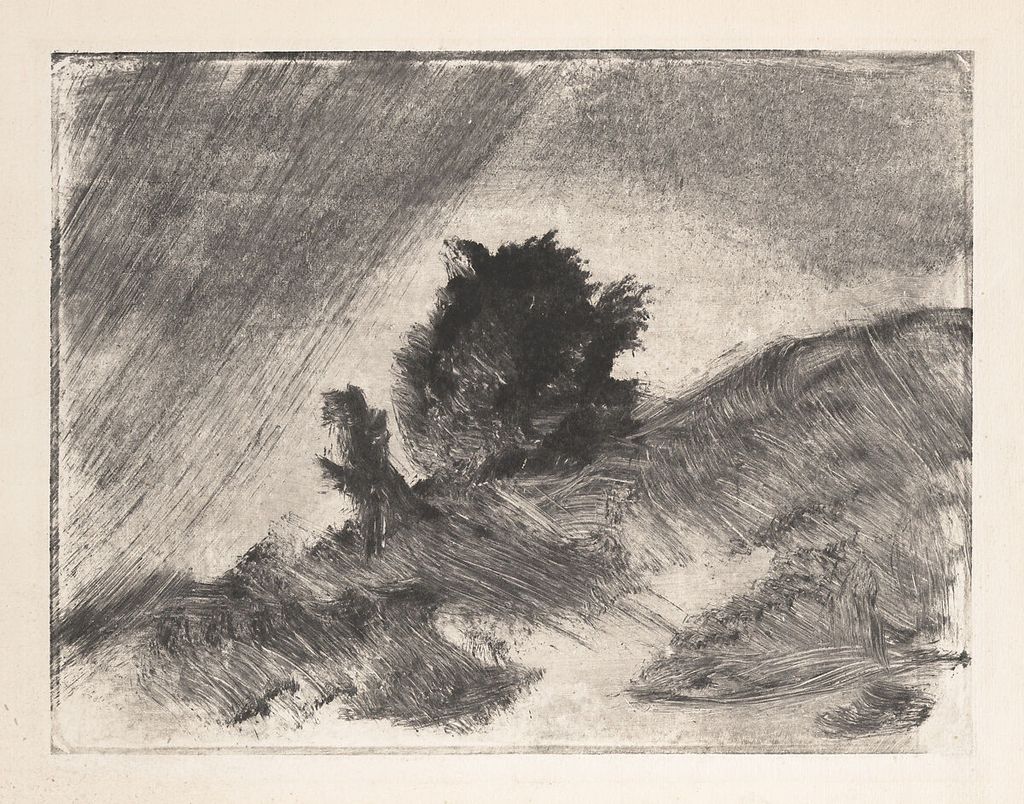
The Met's Landscape, a monotype of about 1877–79, has dark ink dragged into a windswept hillside and slanting weather. It is far from the familiar rehearsal room. Its shifting black marks show how a printed surface could suggest movement without a dancer or horse. This small work broadens the story of Degas's experiments and offers a bridge to the prints and monotypes page. [18]
Sculpture: A Working Model and a Public Challenge
Degas's sculpture was another way to investigate a body in space. The most famous case is Little Dancer Aged Fourteen, made between 1878 and 1881 and shown in the 1881 independent exhibition. It was the only sculpture he exhibited publicly. The original at the National Gallery of Art in Washington is not a bronze: it combines pigmented wax, clay, an internal armature and real textiles and hair. Its dressed body brought materials associated with ordinary life into a work that contemporary viewers expected to belong to fine art. [8][17]
Many people know the figure through bronze casts produced after Degas's death. Those casts are part of the work's later history, but they were not cast by him as the exhibited original. More than a hundred other sculpture models were found in his studio after he died. A photograph of the surviving wax Little Dancer lets us look at Degas's own object while the sculpture page explains the relation among his models, the original wax and the later bronzes. [8][17]
Watch: Edgar Degas
Explore his paintings, drawings and sculpture in three short videos.
Degas, The Dance Class
Look closely at Degas’s off-duty dancers and his unusual view into the rehearsal room.
Watch on YouTubeCollecting, Conflict and the Later Years
Degas's attention to earlier and contemporary art continued through his own collecting. Ann Dumas's study of his private collection shows that he acquired works before the 1890s and collected particularly intensively in that decade. Ingres and Delacroix held a central place, but his holdings also included work by contemporaries. Purchases, gifts and exchanges connected collecting to his artistic relationships and to the market for his own work. Owning a picture does not prove that it supplied the model for a particular Degas composition. It does show that looking at other artists' work was an active part of his later life. [10]
Recognition changed during that career. The National Gallery of Art describes criticism of Degas's working-class figures alongside support from writers who valued his account of modern life; by the late 1880s it places him among major Parisian artists. Dumas adds that the 1890s market gave him greater resources for collecting. These accounts help explain why the collection grew most intensively later, while also reminding us that the public standing of the artist and the later fame of a subject such as the dancer are not the same story. [1][10]
The common image of Degas as a secluded man throughout the 1890s misses much of that activity. Dumas describes continuing visits to dealers, auctions and artistic circles before the forced move from his rue Victor Massé rooms in 1912. The move, failing health and weakening sight altered his circumstances. Family and artist letters already mention problems with his eyes in 1872, so a story in which trouble begins only in old age is too simple. The surviving evidence does not justify assigning a precise medical diagnosis or treating a change in colour or line as the direct symptom of one disease. [3][10]
His later life also includes conduct that should be stated plainly. During the Dreyfus Affair Degas took an antisemitic, anti-Dreyfus position. It damaged friendships, including relationships with Jewish friends. Musée d'Orsay's Isabelle Cahn documents that position and its effects; the biography follows the events and sources in detail. The fact does not supply a shortcut for interpreting every picture, but an introduction to the artist should not omit it. [11]
Degas died in 1917. His studio contained a large body of his own work, while the art he had collected formed another substantial group. They entered different posthumous sales: Dumas records three sales of the collection in 1918 and five sales of studio works in 1918–19. The distinction matters. The works we see in museums today have histories of keeping, exchange, sale and later interpretation, as well as the histories of their making. [10]
How to Look at a Degas Picture
Start at the edge rather than automatically at the centre. In The Bellelli Family, a small dog is cut off at the lower right and a doorway opens a possible route away from the family group. The arrangement refuses a tidy, closed portrait. In The Dance Class, an eye moving between dancer and teacher also has to travel through a room of interruptions and pauses. These are different paintings from different periods, yet each makes the space around the figures do important work. [13][14]
Then ask what stage of an action Degas chose. The Races holds the jockeys before or between bursts of movement; the distance between the clustered horses and the rider at the right gives the eye room to cross. Woman Ironing chooses the pressure of work rather than its completed result. Even Little Dancer Aged Fourteen holds a standing pose that suggests discipline and fatigue without making a performance of it. A Degas figure often occupies an interval: waiting, preparing, adjusting, or recovering. This observation can guide looking, although it should not be turned into a rule that explains every work. [15][16][17]
Finally, look at the material. The deep sky and small riders of The Races were made in oil on wood. The light around the ironer was built on canvas over a long period. A pastel's coloured strokes remain visible as strokes, while a monotype begins with ink worked on a plate and printed. The wax, textiles and hair of Little Dancer place actual materials where a viewer might expect an illusion of them. Different media do not merely repeat one subject in different colours; they change what can be revised, touched, transferred or seen. [6][7][15][16][17]
Explore Degas's Work
The biography follows his life, artistic relationships and the evidence behind the difficult late-career questions. For the materials, start with paintings, pastels, drawings, sculptures or prints and monotypes. Each medium changed what Degas could do with a recurring gesture or arrangement.
For subjects, follow ballet and dancers, horses and racing, bathers and portraiture. Exact works make the differences easier to see: the Met's The Dance Class is not the Orsay dance-class painting; the original wax Little Dancer Aged Fourteen is not a later bronze; and the single figure in NGA Woman Ironing is not the two women of Orsay's Women Ironing. These distinctions are a good way into Degas: a familiar title or subject is often the beginning of looking, not its conclusion. [14][16][17]
Artworks directory
A selected index of documented works, combining owner records with entries sampled across Michel Schulman’s digital catalogue raisonné. It is not a complete catalogue. View the full catalogue
Discussion
Reader Insights
Which edge or interruption changes how you read a Degas scene?
How does an exact object record change a familiar title?
Which medium makes movement most visible to you?
Join the Conversation
Share your reading of Degas’s work below.
References
- National Gallery of Art, “Edgar Degas,” artist profile, accessed 27 September 2026. View source
- Ruth Schenkel, “Edgar Degas (1834–1917): Painting and Drawing,” Heilbrunn Timeline of Art History, Metropolitan Museum of Art, 1 October 2004. View source
- Jean Sutherland Boggs, Douglas W. Druick, Henri Loyrette, Michael Pantazzi and Gary Tinterow, Degas, Metropolitan Museum of Art, New York, 1988, chronology pp. 47–52, 59–60 and 496–98. Met publication and full scan. View source
- Marina Ferretti and Xavier Rey, “Degas, an impressionist painter?” Musée d'Orsay exhibition account, 2015. View source
- Jeannette Ivain, “Expositions impressionnistes,” French Ministry of Culture / Joconde, 2004, participant lists for 1874–86. View source
- Musée d'Orsay, “Degas The Pastel Artist,” 2023 exhibition article. View source
- Jodi Hauptman, Karl Buchberg, Heidi Hirschl and Richard Kendall, “Edgar Degas: A Strange New Beauty,” Museum of Modern Art exhibition overview, 2016. View source
- Suzanne Glover Lindsay, Daphne S. Barbour and Shelley G. Sturman, Edgar Degas Sculpture, National Gallery of Art, online publication overview, 2011. View source
- Theodore Reff, Degas: The Artist's Mind, Metropolitan Museum of Art, New York, 1976, introduction pp. 9–11 and ch. VII, “The Artist as Technician,” pp. 270–303. View source
- Ann Dumas, “Degas and His Collection,” in The Private Collection of Edgar Degas, Metropolitan Museum of Art, New York, 1997, pp. 3–12. View source
- Isabelle Cahn, “Les artistes du musée d’Orsay et L’affaire Dreyfus,” Musée d'Orsay, updated 25 June 2026, Degas section. View source
- National Gallery of Art, Self-Portrait with White Collar, c. 1857, oil on paper on canvas, accession 1995.47.7. View source
- Musée d'Orsay, Portrait de famille / La famille Bellelli, 1858–69, oil on canvas, RF 2210. View source
- Metropolitan Museum of Art, The Dance Class, 1874, oil on canvas, accession 1987.47.1. View source
- National Gallery of Art, The Races, 1871–72, oil on wood, accession 1942.9.18. View source
- National Gallery of Art, Woman Ironing, begun c. 1876, completed c. 1887, oil on canvas, accession 1972.74.1. View source
- National Gallery of Art, original Little Dancer Aged Fourteen, 1878–81, mixed media including wax, accession 1999.80.28. View source
- Metropolitan Museum of Art, Landscape, c. 1877–79, monotype, accession 2024.387. View source
- National Gallery of Art, Four Dancers, c. 1899, oil on canvas, accession 1963.10.122. View source
- Musée des Beaux-Arts de Pau, “Edgar Degas,” institutional account of the New Orleans visit and A Cotton Office. View source
- National Gallery, London, Miss La La at the Cirque Fernando, collection record, NG4121. View source
- Metropolitan Museum of Art, Dancer Adjusting Her Slipper, 1873, graphite with black and white chalk on faded pink paper, squared for transfer, accession 29.100.941. View source
- Saint Louis Art Museum, Ballet Dancers in the Wings, c. 1890–1900, pastel, object 24:1935. View source
- Metropolitan Museum of Art, Manet/Degas visiting guide, 2023, for the documented artistic relationship and the limits of surviving correspondence. View source
- National Gallery of Art, Degas/Cassatt exhibition overview, 2014, for their friendship, exhibition participation and artistic exchange. View source
- National Gallery of Art, “Mary Cassatt, the Daring Printmaker”, 2026, for the unrealised Le Jour et la Nuit print project with Cassatt and Pissarro. View source
- Splash image: Edgar Degas, Self-Portrait with White Collar, c. 1857, oil on paper mounted on canvas. National Gallery of Art, Washington, 1995.47.7. Collection record. View source