

 Buy Art Prints Now
from Amazon
* As an Amazon Associate, and partner with Google Adsense and Ezoic, I earn from qualifying purchases.
 by Tom Gurney
Tom Gurney BSc (Hons) is an art history expert with over 20 years experience
Published on June 19, 2020 / Updated on September 28, 2026
Email: tomgurney1@gmail.com / Phone: +44 7429 011000
Degas Woman Seated Beside A Vase Of Flowers: Introduction
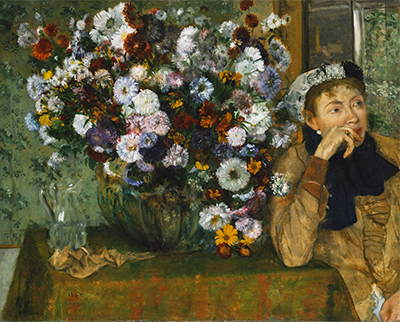
A vase of flowers claims the middle of the canvas. To its right, a woman sits close to the edge, her head turned away and one hand raised toward her mouth. Edgar Degas makes these unequal parts share a painting. The bouquet is abundant, bright and almost insistently present; the woman is quiet and partly crowded out. A Woman Seated beside a Vase of Flowers asks us to look from one to the other. Is this a portrait interrupted by a still life, or a still life whose human neighbor changes its meaning? The composition refuses to settle comfortably into either category. [1] [5]
The painting belongs to the Metropolitan Museum of Art, New York, accession 29.100.128. It is an 1865 oil on canvas measuring 73.7 × 92.7 cm. The Met's full title adds “(Madame Paul Valpinçon?)”, retaining a question mark around the sitter's identity. The museum says she is probably the wife of Degas's schoolboy friend Paul Valpinçon. “Probably” matters: a reader can learn the leading identification without treating it as a signed name on the canvas. [1]
At a glance
- ArtistEdgar Degas
- TitleA Woman Seated beside a Vase of Flowers (Madame Paul Valpinçon?)
- Date1865
- MediumOil on canvas
- Dimensions73.7 × 92.7 cm
- CollectionMetropolitan Museum of Art, New York, 29.100.128
- SitterProbably Madame Paul Valpinçon, according to the Met
Contents
- Introduction
- At a Glance
- A portrait pushed to the edge
- A still life that will not stay separate
- A calculated casual view
- Color, clothing and the direction of attention
- The possible Valpinçon setting
- An early Degas composition
- From a private collection to the Met
- Looking once more
The Met's current description makes the figure's distracted gaze and the enormous bouquet central to its account. Its audio poses the same problem another way: can we call the picture a portrait, a still life, or both? Degas did not provide a formal, centered likeness with a neat vase at the side. He gave nearly equal visual importance to a person and an arrangement of cut flowers, while allocating them strikingly unequal space. That decision makes the painting feel accidental at first glance, then increasingly deliberate as one follows its edges. [1]
A portrait pushed to the edge
The woman occupies the right of the scene. Her body is clipped by the frame, and she does not return the viewer's gaze. Her hand near her mouth gives her pose an unguarded quality. It might be tempting to say she is bored, anxious or lost in a particular memory. The picture does not give us her own words or a documented moment of feeling. What it gives us is a person who seems absorbed elsewhere while the flowers command our attention. We can describe that visible tension without pretending to read her private mind. [1]
Her placement is not a minor novelty. In a conventional portrait, the sitter tends to receive central space and a clear visual introduction. Here the bouquet does. The woman is squeezed between flowers and the right edge. The Met's essay on Degas observes that part of her left hand is barely visible near the lower corner. That cropping keeps us aware of what falls outside the canvas. We do not see a complete, carefully posed body; we meet a partial presence beside a botanical display that seems almost too large for her. [1][2]
The imbalance creates movement for the viewer. The flowers attract us first through scale and color. Then we discover the face to the side, follow its gaze off the picture, and return to the bouquet. The eye does not rest in a centered portrait arrangement. It makes a loop among objects, sitter and frame edge. This is one reason the composition can feel like a chance glimpse even though the Met's audio emphasizes Degas's careful planning. The sensation of accident is an artistic effect, not proof that he painted the scene without preparation. [1]
The possible identity of the woman adds another layer, but it should not solve the picture too quickly. The Met thinks she was probably Madame Paul Valpinçon, whose family Degas knew and whose country home at Ménil-Hubert he enjoyed visiting. That context gives a plausible social setting for a portrait of a familiar person. It does not establish an exact sitting day or explain what she was thinking. The question mark in the museum's title is a useful editorial instruction: use her possible name to orient the reader, and leave the uncertainty visible. [1]
A still life that will not stay separate
The vase holds an exuberant collection of blossoms that spreads into the upper and middle parts of the painting. Small changes in color and form keep the bouquet from reading as one flat mass. White, red, purple, orange and yellow notes appear among leaves and shadows. The arrangement has the visual weight usually reserved for a principal subject. Yet it sits immediately beside a person. The flowers do not remain a self-contained study of decorative forms; they affect how we see her scale, posture and quietness. [1]
The Met suggests dahlias, asters and gaillardias in the bouquet and says their season would point toward a late-summer visit to Ménil-Hubert. That is an informed museum interpretation rather than a dated appointment in Degas's calendar. Another Met discussion of gardens notes fashionable blooms such as marigolds and dahlias in works of this period. Different texts emphasize different flowers, so a page should avoid making an overconfident botanical inventory from a web image. The secure point is that the cut flowers are plentiful and colorful enough to dominate the composition. [1][3]
Their scale also changes the logic of the portrait. A sitter placed beside a vase might normally be flattered by its beauty or framed by it. Here the bouquet threatens to displace her altogether. It seems to take over the central position she could have occupied. The Met audio asks whether the woman has almost become part of the still life. That question is provocative because her body is not literally an object like the vase. It asks us to notice how composition can momentarily treat a person and a floral arrangement as equal pictorial problems, while their human meanings remain different. [1]
The table adds a quieter base to this contest of attention. It holds the vase and leads across the picture toward the sitter. The flowers rise above it in a restless spread, while the seated woman stays lower and narrower at the side. If one follows the table edge, these unlike subjects occupy one shared interior space. If one follows the color, the bouquet overwhelms it. Degas lets structural connection and visual competition happen at once. [1]
This is why the picture works as more than a clever reversal. A simple joke would put flowers in front and a portrait behind, then end once we noticed. Here the flowers keep rewarding close looking, and the woman keeps drawing us back through the direction of her face and hand. Neither subject cancels the other. The canvas makes us reconsider what a portrait includes: not just a face, but the circumstances and objects through which a person appears to us. [1]
A calculated casual view
The Met's audio notes that some writers have interpreted the unusual layout as if Degas added the woman to a finished flower painting. The same commentary stresses that he often worked carefully to produce scenes that seemed to arise by chance. A pencil drawing of the woman, also dated 1865, is recorded in the Fogg Museum. That study shows preparation for the figure, though it does not, on its own, supply a complete sequence for every stage of the oil. The seemingly offhand composition should be read as a considered artistic choice. [1]
An older Met bulletin reported an X-ray-based claim that the woman was added after the still life. That historical statement is more definite than the wording of the current audio, which describes an interpretation proposed by writers. Without revisiting the technical evidence and its later assessment, this page does not state a firm paint order. Whether Degas altered the picture during making is a separate question from the visible effect of an off-center person beside a dominant bouquet. The latter can be understood directly; the former belongs to technical art history and needs its own evidence. [1][4]
Degas's use of averted gaze deepens the casual effect. A sitter who looks straight at us can make a portrait feel like an intentional encounter. This woman looks beyond the frame, so we appear to come upon her without her participation. Her hand near her mouth reinforces the impression of an interval between formal poses. Yet even that apparent intimacy has been arranged for us. The artist selected the crop, relative scale and directions that make it possible. We should not confuse the image's invitation to observe with proof that we witnessed an unplanned private moment. [1]
The Met's general essay treats this picture as an early example of the asymmetrical framing that would recur in Degas's work. Later dancers and other figures can be cut off by a picture edge or viewed from unusual angles. That comparison helps locate the 1865 canvas in his development without pretending it is merely a rehearsal for ballet scenes. The flowers and probable sitter make it a work with its own subject; its off-center organization also reveals a formal interest that Degas would carry into other settings. [2]
Color, clothing and the direction of attention
The bouquet's colors arrive all at once, while the sitter's clothes are more subdued. This difference makes her less immediately conspicuous despite her human face. A viewer might miss her briefly when first encountering a small reproduction. Then the face at the right becomes hard to ignore. Degas uses color to control entry into the picture and cropping to prevent the person from reclaiming conventional centrality. We move between a splendid arrangement of flowers and a human figure who appears unwilling to perform for us. [1][2]
Her gaze carries attention beyond the right edge. We cannot see what she sees or whether she is focused on any external object at all. That unknown destination gives the composition an open ending. The bouquet fills the field physically, but the sitter's eyes lead us out of it. The two subjects pull in different directions: one holds us among dense forms, the other points toward absent space. The painting's apparent imbalance is also a balance of visual forces. [1]
The clothing helps the woman merge into the darker area beside the flowers. She is not presented through a dazzling costume that would rival their color. That restraint makes her expression and pose more significant, though still not transparent. We can notice the hand, head and angled body without converting them into a fixed emotion. The picture's interest in an ordinary, apparently candid instant comes from these relations of form and attention, not from a story of exactly what interrupted her. [1]
In its 1865 setting, the painting's combination of a person and a large still life is unusual enough to complicate standard labels. The Met audio explicitly asks whether it is a still life or portrait. Each label directs the viewer differently. Call it a portrait, and the flowers may seem to threaten the sitter. Call it a still life, and her presence introduces a person whose gaze and body refuse to be background decoration. The best account may allow both kinds of looking to remain active. [1]
Watch: Edgar Degas
Explore his paintings, drawings and sculpture in three short videos.
Degas, The Dance Class
Look closely at Degas’s off-duty dancers and his unusual view into the rehearsal room.
Watch on YouTubeThe possible Valpinçon setting
Degas knew Paul Valpinçon from school, according to the Met, and enjoyed visits to the family's country house at Ménil-Hubert. The suggested flower species suit late summer, making such a visit plausible as context for the painting. These details connect the image to a social world beyond its canvas. They do not prove that the vase stood in a specific room on a specific day or that the woman was captured without posing. A country-house context can be responsibly described as a museum inference and biographical association, not as a fully reconstructed scene. [1]
The probable sitter's identification should also avoid turning a married designation into all we know of her. The current object record names her through her husband, as its parenthetical title shows. It does not provide a fuller biography in the short text used here. We can acknowledge that limitation rather than inventing her character from the painted hand and distant gaze. The uncertainty of the name and the opacity of the expression are separate: a person can be identified and still not disclose her thoughts. [1]
The Fogg pencil study dated 1865 adds a concrete link to preparation. It indicates that Degas considered the woman as a figure to draw before or alongside the final oil. The available Met summary does not give the drawing's detailed relationship to every painted contour, so it should not become a step-by-step recipe. Its importance for this page is simpler: the apparent casualness of the final composition did not exclude focused study. A person positioned at the edge could still be the subject of sustained attention. [1]
An early Degas composition
The painting predates many of Degas's best-known ballet and bather works. Its approach to framing already challenges an orderly, frontal presentation. The Met's essay connects such asymmetry to artistic traditions Degas studied, including Japanese prints and sixteenth-century Italian Mannerist compositions. Those are broader influences on his practice, not proof that one particular print or painting dictated this vase and sitter. The exact innovation here lies in how Degas uses an overflowing still life to push a probable portrait subject to the edge. [2]
Later works often seem to catch figures midway through action or turn them partly away from us. This canvas creates a comparable impression in a quieter interior. The sitter remains seated; the bouquet does not move. Yet the off-center view feels fleeting because our access to her is incomplete. We see only a slice of a person beside a massive arrangement. The picture can suggest time passing without representing a dramatic event. That ability to make an incomplete view feel alive is one reason the work belongs within Degas's larger compositional story. [1][2]
Historical titles can add another source of confusion. Met publications have called the picture A Woman with Chrysanthemums. The current object title is A Woman Seated beside a Vase of Flowers (Madame Paul Valpinçon?). The older name points to its striking bouquet, but it should not make a reader assume that every bloom has been securely identified as a chrysanthemum. The museum's present title and object number give a stable reference while older labels remain part of the painting's reception. [1][4]
From a private collection to the Met
The painting entered the Met through the 1929 bequest of Mrs. H. O. Havemeyer from the H. O. Havemeyer Collection. Its accession number, 29.100.128, identifies the same canvas under both the current title and older flower-focused names. The Met's image shows why each name has appeal: the bouquet dominates the space, while the partly obscured sitter remains essential to the composition. [1]
Looking once more
First look at the flowers without the sitter. Notice how much of the canvas they fill and how varied the colors are. Then shift right to her face and follow the direction of her eyes out of the frame. Finally, return to the table that places her and the vase in one interior. This path makes clear why neither “portrait” nor “still life” completely contains the work. The subjects are unequal in area but interdependent in effect. [1]
A Woman Seated beside a Vase of Flowers makes an apparently casual scene from a rigorous arrangement of looking. Its probable sitter remains slightly uncertain in name and private feeling, while the bouquet is present in almost overwhelming detail. Degas lets the viewer experience both the abundance of the still life and the human presence that unsettles it. The exact Met object, dated 1865, offers an early and vivid instance of the off-center compositions that became central to his art. For related approaches, see Degas's portraits and his paintings. [1][2]
Artworks directory
A selected index of documented works, combining owner records with entries sampled across Michel Schulman’s digital catalogue raisonné. It is not a complete catalogue. View the full catalogue
Discussion
Share what you notice in Degas’s woman seated beside a vase of flowers.
Reader Insights
Why does the bouquet receive the center of the picture?
How does the cropped figure change a conventional portrait?
What can the painting show without proving the sitter’s thoughts?
Join the Conversation
Share your reading of these works below.
References
- Metropolitan Museum of Art, A Woman Seated beside a Vase of Flowers (Madame Paul Valpinçon?), 29.100.128, collection record and audio transcript, accessed 27 September 2026. View source
- Metropolitan Museum of Art, “Edgar Degas (1834–1917): Painting and Drawing”, collection essay, accessed 27 September 2026. View source
- Metropolitan Museum of Art, “Seeds of Impressionism: Public Parks, Private Gardens with Author Colta Ives”, interview, accessed 27 September 2026. View source
- Metropolitan Museum of Art, Bulletin 27, no. 1 (1968) and Bulletin 28, no. 5 (1970), historical title and technical claim noted in the research map. View source · View source
- Splash image: Edgar Degas, A Woman Seated beside a Vase of Flowers (Madame Paul Valpinçon?), 1865, oil on canvas. The Metropolitan Museum of Art, 29.100.128. Collection record. View source