

 by Tom Gurney
Tom Gurney BSc (Hons) is an art history expert with over 20 years experience
Published on June 19, 2020 / Updated on August 8, 2026
Email: tomgurney1@gmail.com / Phone: +44 7429 011000
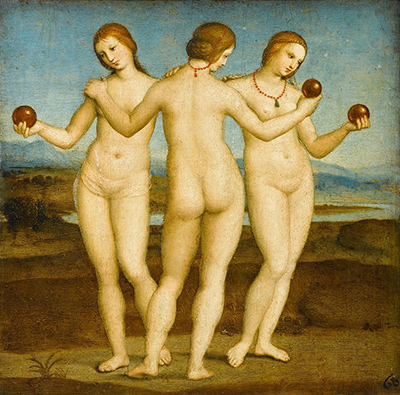
Raphael made complexity feel welcoming. In his paintings, a crowded assembly can remain lucid, a gesture can carry an argument, and a face can hold public rank and private attention at once. His most famous rooms unite philosophy, poetry, theology, law, history and the ambitions of Renaissance Rome without losing the viewer inside their learning. Major collection accounts rightly stress how rapidly his work expanded from Urbino formation to papal service and the study of antiquity.[8]
That clarity was not effortless. It grew through drawing, transfer, measurement, revision and collaboration. Raphael studied older art with unusual openness, changed rapidly as he moved through central Italy, Florence and Rome, and built a studio able to work across fresco, oil painting, tapestry, print, architecture and the recovery of antiquity.
This is why a single idea of Raphael is never enough. He is the young Umbrian altarpiece painter and the designer of the School of Athens; the maker of small Madonnas and the architect responsible for St Peter's; the intimate portraitist and the director of vast decorative teams. His achievement lies not in choosing between grace and labour, but in making labour take the form of grace.
At a Glance
- NameRaffaello di Giovanni Santi, commonly Raphael
- Lifeborn at Easter 1483 in Urbino; died 6–7 April 1520 in Rome
- Main centresUrbino, Città di Castello, Perugia, Florence and Rome
- Independent statusdocumented as a master in 1500, aged about seventeen
- Romesummoned to Julius II's court in 1508
- Major patronsPopes Julius II and Leo X, Agostino Chigi and a wide network of Italian and European clients
- Fieldspainting, fresco, drawing, tapestry design, print design, architecture and study of ancient remains
- Best-known ensemblethe Raphael Rooms in the Vatican Palace
- Architect of St Peter'sfrom 1514
- Important collaboratorsthe painters Giulio Romano and Giovan Francesco Penni, decorative specialist Giovanni da Udine, the younger Perino del Vaga and engraver Marcantonio Raimondi
- Diedafter a short illness at thirty-seven
- Buriedin the Pantheon, Rome
- Essential cautionlate works often unite Raphael's design with substantial studio execution
Contents
- Why Raphael?
- Where to begin
- The Vatican rooms
- The School of Athens
- Theology, poetry and law
- Drama after the Segnatura
- Madonnas: variation within familiarity
- Altarpieces and original places
- Portraits: rank as relation
- Women and unstable names
Why Raphael?
Raphael has been praised for harmony so often that the word can become a barrier. Harmony sounds passive, as if figures simply arrived in agreeable positions. His compositions are better understood as fields of relation.
A hand points and another body answers. An empty interval lets a crowd breathe. Architecture measures a group and makes an idea inhabitable. Colour links figures across distance. A head turns just enough to connect an inner event with the viewer.
Raphael's art is calm where calm serves meaning and dramatic where disruption is necessary. The serenity of the School of Athens is not the same as the divine violence of the Expulsion of Heliodorus, the intimate pressure of a papal portrait or the divided world of the Transfiguration.
Where to begin
There is no single correct first Raphael. Different paths reveal different strengths.
Begin with the Vatican frescoes to see him organise public knowledge at architectural scale. Begin with the Madonnas to watch him vary touch, gaze and foreknowledge within a familiar subject. Begin with portraits to encounter his social intelligence. Begin with drawings to see the searching beneath apparent ease.
Tapestries and prints show ideas translated by other makers. Architecture and antiquarian study reveal that he thought beyond the bordered picture. The biography then connects these fields through a career that lasted barely two decades.
The Vatican rooms
The four rooms bearing Raphael's name were decorated between 1508 and 1524, extending beyond his death and involving an expanding studio. They should not be treated as one uniformly autograph block.[1]
The Stanza della Segnatura contains the most concentrated early statement. Its walls give distinct visual forms to theology, philosophy, poetry and justice. The Stanza di Eliodoro turns toward miracle, crisis and papal protection. The Stanza dell'Incendio depends much more on assistants. The Sala di Costantino was largely realised after 1520 from the studio's designs and inheritance.
Read room, wall and date together. “Raphael Rooms” identifies a historic enterprise; it does not settle the hand responsible for every passage.
The School of Athens
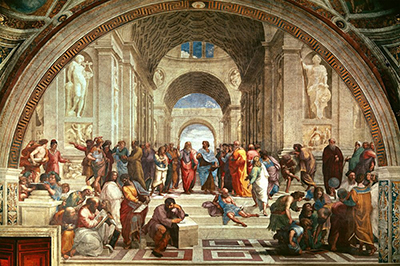
The School of Athens is famous because it makes thought visible without reducing it to labels. Plato and Aristotle walk from the centre, but the fresco's meaning extends through people reading, calculating, demonstrating, listening and reflecting.
Its grand architecture draws on the culture surrounding Bramante and the new St Peter's. Groups gather at different depths while the central pair remains legible. The extreme-right figure in a black beret is identified by the Vatican as Raphael's self-portrait.[2]
The fresco invites identification, but a list of names is not its final purpose. Its deeper subject is knowledge as disciplined encounter.
Theology, poetry and law
The other Segnatura walls prevent philosophy from becoming the room's only measure. In the Disputation of the Holy Sacrament, heavenly and earthly communities converge around the Eucharist. Parnassus gathers ancient and modern poets around Apollo and the Muses. The legal wall connects virtues with acts of civil and canon law.
Raphael does not flatten these fields into one doctrine. He gives each a different spatial behaviour. Revelation descends; philosophical inquiry advances; poetry occupies a musical landscape; justice divides into ethical qualities and historical judgements.
The room's harmony comes from coordinated difference.
Drama after the Segnatura
The Stanza di Eliodoro proves that Raphael was not confined to serene balance. Mounted force erupts through the temple in the Expulsion of Heliodorus. Miraculous light breaks the prison darkness in the Liberation of Saint Peter. In the Mass at Bolsena, private doubt becomes public sacrament.
These walls respond to the pressures of Julius II's reign while remaining sacred narratives. Papal portraits enter historical time; architecture becomes unstable; spectators witness intervention they cannot control.
The change is developmental, not a rejection of earlier clarity. Raphael uses legibility to make crisis more immediate.
Madonnas: variation within familiarity
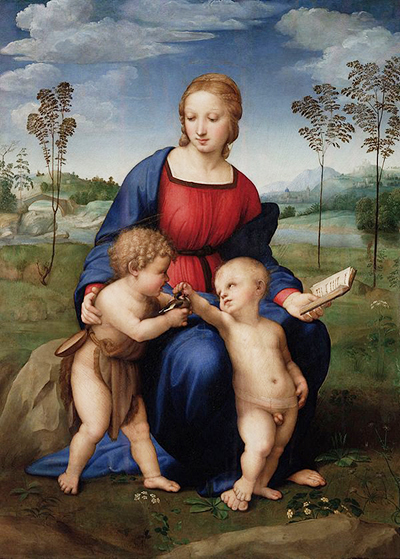
Raphael returned repeatedly to the Virgin and Child, often with the young Baptist or additional saints. Repetition gave him a field for invention rather than a formula.
In the Florentine Madonnas, bodies interlock through triangular arrangements, but the emotional sequence changes. A goldfinch, cross, book or reaching hand points toward Christ's future. Landscape opens around intimacy. The Virgin protects while already seeming to understand that protection cannot be permanent.
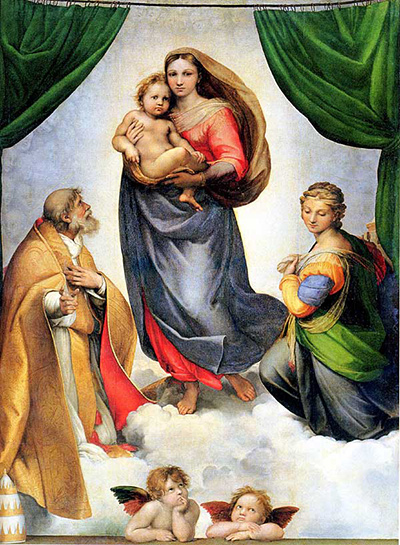
Later Roman examples change scale and pressure. The circular Madonna of the Chair encloses mother and children in a dense embrace; the Sistine Madonna advances as a public apparition. Familiar figures can carry radically different relations to the viewer.
Altarpieces and original places
Many Raphael paintings now encountered in museums were made for altars, chapels and distant cities. Their present frames, heights and neighbouring objects may differ from the first setting.
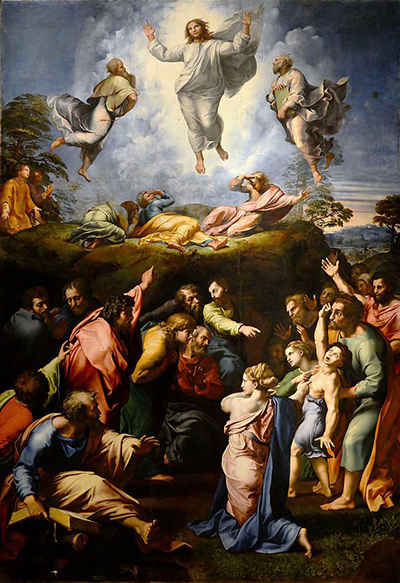
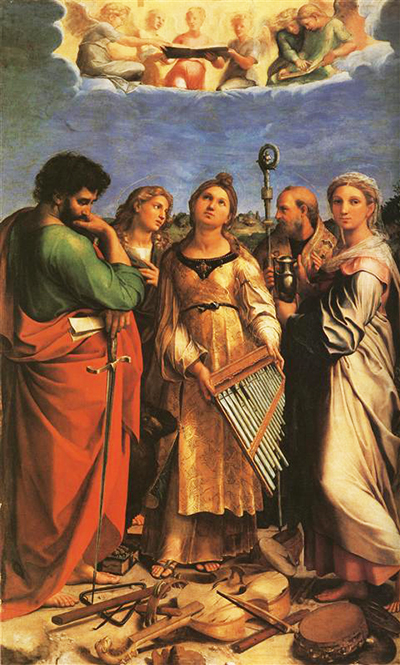
The Ansidei Madonna once belonged to a framed ensemble with a predella. The Deposition joined sacred mourning to Baglioni family commemoration. Saint Cecilia addressed a Bolognese chapel. The Sistine Madonna was made for San Sisto in Piacenza. The Transfiguration was intended for Narbonne, though it never reached that destination in Raphael's lifetime.
Recovering original place restores scale and purpose. A museum masterpiece was first a commissioned object expected to work within worship, memory or civic identity.
Portraits: rank as relation
Raphael's portraits do not disclose a sitter's soul like an open book. They construct conditions of approach.
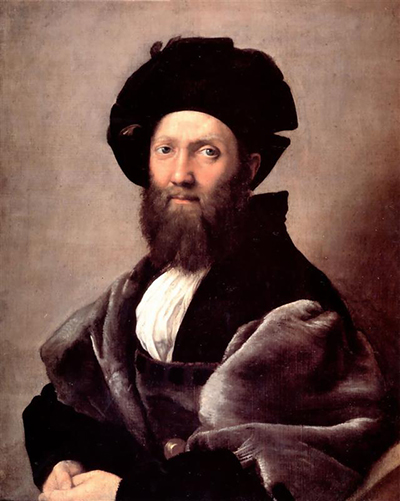
Julius II sits at an angle with lowered eyes, making papal power feel physically burdened. Leo X examines an illuminated book between two cardinals, surrounded by red textiles and guarded attention. Baldassare Castiglione meets the viewer through a quieter field of greys, fur and folded hands.
Raphael adjusted turn, background, costume, gaze and distance to each social encounter. His courtly portraits are compelling because ceremony and presence remain in tension.
Women and unstable names
Several female portraits carry traditional titles that sound more certain than their evidence. La Fornarina has been linked to Raphael's lover; La Velata is sometimes identified as the same woman; La gravida is named for an apparent pregnancy; the Lady with a Unicorn acquired its animal and identity through changes over time.
These histories call for precision rather than disappointment. Uncertain biography does not diminish the paintings. It directs attention toward how dress, veil, jewellery, hands and exposed skin create different public and private identities.
The sitter should not become merely a clue in a romance about the painter.
Drawings: where ease is tested
Raphael's drawings range from quick searches to highly finished presentation sheets and full-size cartoons. They study hands, heads, drapery, architecture and entire compositions.
A line may be repeated as a limb finds its position. A sheet may combine alternatives. Squaring or pricked contours can prepare transfer. A studio copy can preserve a lost design without being by Raphael himself.
Drawings are not simply preliminary versions of famous paintings. They reveal functions, exchanges and abandoned possibilities. They are where Raphael's intelligence is most visibly unfinished.
How a design moved
Renaissance painting often began through paper. A composition could progress from small sketch to detailed study, then to a full-size cartoon. Outlines might be transferred by pouncing—dusting charcoal through pricked holes—or by tracing. Geometry, rulers and compasses could establish spatial frameworks.[3]
Transfer did not end invention. Technical examination shows Raphael changing features, drapery and even architectural arrangements after a design reached the painted support.[3]
This sequence matters to attribution. Assistants could work from Raphael's cartoon, and a copied design could travel beyond the studio. Invention and execution are related but not identical acts.
Paint as material
Raphael's colour has a physical history. Early examined panels commonly have gesso and a pale priming beneath drying-oil paint. Natural ultramarine, red glazes, lead-tin yellow, metals and other materials were layered for particular effects.[3]
Supports also differ. Wood panel, original canvas, transferred canvas and plaster do not age in the same way. Some colours fade or become more transparent; varnish yellows; abrasion and repainting alter surfaces.
What viewers see is both a sixteenth-century act and the result of five centuries of material change.
Fresco and the wall
Painting on fresh plaster ties the surface to a building. Work proceeds in planned daily areas, and a room's doors, windows, vault and viewing height shape the design.
Raphael's Vatican achievements depend on this architecture. Figures are not illustrations pasted onto walls; they calibrate the viewer's body within real space. At the Villa Farnesina, mythological scenes answer a different domestic and garden setting.
Wall painting also required teams. Cartoons, plaster sequence, specialist ornament and changes of hand make exact attribution essential.
Tapestries and translation
For Leo X, Raphael designed scenes from the Acts of the Apostles to be woven for the lower walls of the Sistine Chapel. The full-size cartoons travelled to Pieter van Aelst's workshop in Brussels, where specialists reversed and translated them into wool, silk and metal-wrapped thread.[4]
The woven works belong to Raphael's invention and to the weavers' material intelligence. Texture and shimmer do things painted paper cannot; the cartoons preserve colour and scale but are not the finished tapestries.
This collaborative chain is one of the clearest examples of Raphael thinking beyond his own touch.
Prints and wider circulation
Raphael worked closely with Marcantonio Raimondi and other engravers to circulate designs in print. Engraved line translated bodies, shadow and surface into a portable black-and-white medium.
Some prints relate to paintings; others develop independent designs. A reversed direction or engraver's modelling can change the experience of a composition. “After Raphael” identifies a design relation, not Raphael's hand on a copper plate.
Print multiplied access. Artists and collectors who never saw the Vatican could study Raphael's inventions, helping his art become international during his lifetime.
Architecture
Raphael designed chapels, palaces, a villa and church projects. In 1514 he succeeded Bramante as architect of St Peter's, working within a construction history later transformed by other architects.[5]
The Chigi Chapel joins centralised space, tombs, sculpture and mosaic. Villa Madama links rooms, terraces, garden, views and antique precedent. Lost or altered palaces show a playful handling of classical façades.
Because buildings continue after a designer's death, authorship must be especially careful. A Raphael design may survive through later construction without making every present stone his.
Antiquity
Ancient Rome was not a complete stylebook. It survived as fragments, buried interiors, damaged structures and reused stone. Raphael studied it as evidence.
Fabio Calvo translated Vitruvius into Italian for him. Draughtsmen recorded remains, and the text known as the Letter to Leo X, linked with Castiglione, proposed systematic description and lamented destruction.[6]
This work connects Raphael's painted architecture to measurement, history and preservation. Classical form was not only beautiful; it had to be understood.
The workshop
Raphael's Roman studio expanded as commissions multiplied. Its painters included Giulio Romano, Giovan Francesco Penni and the younger Perino del Vaga; Giovanni da Udine brought exceptional decorative skill. Marcantonio Raimondi extended the field through engraving.
The studio was neither an anonymous factory nor a room full of passive hands. Raphael supplied direction, designs and authority; collaborators interpreted, developed and painted. The balance varies from work to work.
Precise labels respect this history. An autograph work, a painting made collaboratively, a studio execution of Raphael's design and a later copy all describe different creative relationships, not a simple ladder from good to bad.
A very short life
Raphael was born at Easter 1483 in Urbino. His father, the court painter and poet Giovanni Santi, gave him his first artistic world. Orphaned by eleven, he continued within family and professional networks. In 1500 he was already called a master.[5]
He worked for Città di Castello and Perugia, learned decisively from Perugino and moved repeatedly among central Italian centres. From about 1504 or 1505, Florence brought sustained study of Leonardo, Michelangelo and earlier Tuscan art.
Summoned to Rome in 1508, he served Julius II and Leo X, built a large studio and broadened into architecture and antiquarian study. He died after a short illness on the night of 6–7 April 1520. The exact diagnosis is unknown.[5]
Perugino without the tidy apprenticeship
The conventional life says Raphael entered Perugino's workshop as a child and then surpassed him. Modern evidence requires a finer account.
Raphael's earliest works relate strongly to Giovanni Santi. From about 1502 to 1504 or 1505, his close modelling on Perugino and probable direct contact are beyond serious doubt. Whether a formal apprenticeship began much earlier remains disputed.[5]
This does not reduce Perugino's importance. It replaces a neat succession story with a more plausible network of family training, professional exchange and concentrated stylistic learning.
Raphael and Michelangelo
The two artists worked in extraordinary proximity at the Vatican. Competition, patronal politics and differences of temperament encouraged later stories of opposition.
Raphael clearly studied Michelangelo's anatomy and monumentality, just as he absorbed Leonardo and antique sculpture. He also redirected what he learned. In his hands, muscular force often joins broader social composition rather than remaining a solitary bodily event.
Rivalry can produce attention. Treating the artists as permanent enemies hides the visual conversation recorded in their work.
The myth of effortless genius
Raphael's courtly ease became part of his fame. Vasari praised his gracious conduct and contrasted it with more difficult artistic personalities. The works seem to support the story because finished compositions hide their preparation.
Drawings and technical evidence tell the fuller truth. Raphael revised poses, changed architecture, transferred cartoons and relied on planning and specialists. Ease was an achieved effect.
This distinction matters because it makes the art available to thought. Harmony becomes a sequence of decisions rather than an inexplicable gift.
Death and the stories around it
Raphael died at thirty-seven after a brief feverish illness. Vasari later blamed sexual excess and misguided treatment, a morally shaped story that cannot establish a medical cause.
Early testimony describes widespread mourning and burial in the Pantheon. The Transfiguration was associated with his body during the funeral observances, joining last work and lost artist in a powerful public memory.[7]
The symmetry between customary birthday and death date helped create a perfect life pattern. The exact birth day remains less certain than the pattern suggests.
What happened next
The studio continued parts of the Sala di Costantino and Villa Madama. Yet Leo X died in 1521, Giulio Romano left for Mantua in 1524, and the Sack of Rome in 1527 shattered the world in which the enterprise had grown.[5]
Raphael's influence did not depend on the studio remaining intact. Prints, drawings, tapestry cartoons, copies and travelling pupils spread it. Academies later treated his compositions as models of design and decorum.
Admiration sometimes hardened the artist into a rule. Nineteenth-century resistance, modern conservation and new attribution research have since revealed a more experimental and collaborative figure.
How to look at a Raphael
Start with relation rather than beauty. Follow where hands point and eyes turn. Notice which figure receives open space and which is compressed. Ask how architecture controls the pace of looking.
Then identify the object. Is it panel, canvas, fresco, cartoon, drawing, tapestry or print? Was it made for a chapel, palace, domestic room or collection? Has its support or setting changed?
Finally, read the attribution exactly. A design realised by the studio may carry Raphael's intelligence powerfully without claiming his brush in every passage.
How not to flatten the work
Do not use “graceful” as a complete analysis. Name the spacing, turn, colour or gesture that creates the effect.
Do not assume a museum title proves a sitter's identity. Traditional names can preserve history and uncertainty at once.
Do not make every work a chapter in a rivalry with Michelangelo. Raphael had patrons, collaborators, sources and problems extending far beyond that pair.
Do not mistake current appearance for original condition. Paintings and buildings have material lives.
The early works are not a prelude to skip
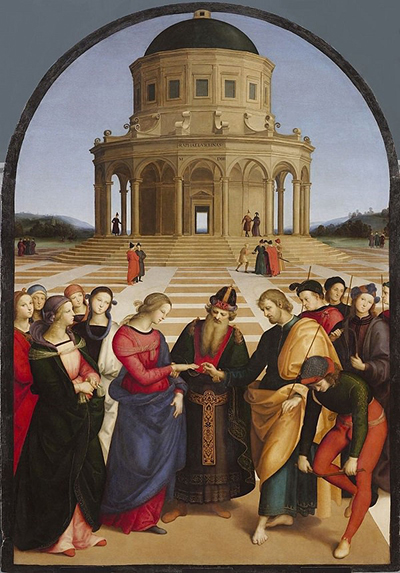
Raphael's Città di Castello and Perugia years show an artist solving public problems before the fame of Rome. The damaged and dispersed Baronci altarpiece was contracted in 1500, when he was about seventeen. The Mond Crucifixion, Marriage of the Virgin and early banners and altarpieces establish his command of balance, landscape and devotional address.
These works are close to Umbrian practice, especially Perugino, but closeness is not absence of personality. Raphael adjusts interval and pressure: a figure looks across a wider gap, architecture gathers a square more decisively, or a gesture activates an otherwise quiet symmetry.
Beginning here makes the Roman art less miraculous and more impressive. Monumental fluency grows from years of exact looking at how a sacred composition guides attention.
Florence as a laboratory
From about 1504 or 1505 to 1508, Raphael spent substantial but intermittent time in Florence while continuing to travel. The city exposed him to Masaccio and Donatello as well as living challenges from Leonardo, Michelangelo and Fra Bartolommeo.
His response appears in the movement of bodies. Leonardo's interlocking groups encouraged more active exchanges of gaze and touch. Michelangelo sharpened the study of anatomy, contrapposto and physical force. Fra Bartolommeo offered monumental sacred grouping and broad drapery.
Raphael did not choose one influence. He used drawing to test what each could contribute. The resulting art is recognisable because selection was part of invention.
Patrons shaped possibilities
Renaissance art was made through commissions, sites and relationships. Julius II gave Raphael walls on which knowledge and papal authority had to coexist. Leo X asked for images that could extend through rooms, tapestries, architecture and spectacle. Agostino Chigi opened domestic and funerary spaces beyond the Vatican.
Patronage did not dictate every gesture, nor was it a blank cheque for autonomous genius. Subject, destination, timetable, politics and material cost set conditions. Raphael's skill included discovering forms that satisfied those conditions while exceeding a patron's most literal need.
Smaller patrons matter too. Florentine couples, religious women, confraternities, monastic communities and distant church officials gave rise to portraits, predellas and altarpieces that reveal different Raphaels.
Julius II and Leo X
The two papal reigns form the spine of Raphael's Roman career. Julius II's forceful programme transformed the Vatican, St Peter's and the public meaning of Rome. Under him, Raphael established the Segnatura and developed the drama of the Heliodorus room.
Leo X inherited those projects but changed their scale and cultural setting. The Medici pope commissioned the Sistine tapestries, extended Vatican decoration and entrusted Raphael with architectural and antiquarian work. The studio expanded to meet that demand.
It is tempting to give each pope one style—Julius as severe, Leo as luxurious. The art is less tidy. Projects overlap, assistants change, and Raphael's own interests develop across the transition.
The Farnesina and secular invention
At Agostino Chigi's villa, now the Farnesina, Raphael entered a setting of entertainment, poetry, garden and elite display. The Triumph of Galatea turns classical myth into coordinated motion: sea bodies surge around a central figure whose twisting pose stabilises the rush.
The later Loggia of Cupid and Psyche expands myth across a decorated ceiling. Raphael supplied the governing design while the studio, notably including Giulio Romano and Giovanni da Udine, played major roles. Fruit, foliage, gods and feigned architecture turn the loggia into a permeable border between interior and garden.
The site shows why medium and place matter. These are not detached mythological panels; their meaning unfolds as bodies move through a villa.
The final altarpiece
The Transfiguration combines Christ's revelation on the mountain with the apostles' failure to heal a boy below. Its divided illumination and converging gestures are sometimes treated as a departure from Raphael's harmony.
They are better understood as harmony under extreme pressure. The upper group is suspended in radiant order; the lower field is crowded with fear, argument and need. Hands point between zones without allowing an easy physical bridge.
The work was associated with Raphael's funeral and became inseparable from the story of his death. Looking at it only as a final prophecy, however, hides its commission, competition with Sebastiano del Piombo and possible studio contribution.
The young self-image
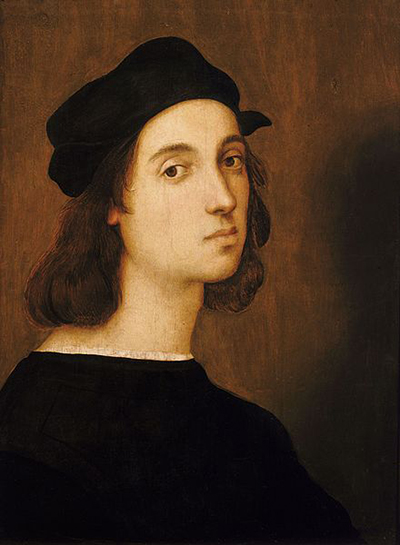
Raphael appears at the edge of the School of Athens, looking outward from a gathering of ancient thinkers. The portable self-portrait in the Uffizi presents a related youthful face in dark cap and robe against a quiet ground.
Neither likeness offers unfiltered personality. Each is an act of placement. In the Vatican, the artist enters a monumental intellectual community without occupying its centre. In the panel, simplicity of dress and refined surface frame the identity of a cultivated working painter.
Comparison helps establish identity, but format changes meaning. A face within fresco history and a face made for portable possession do not perform the same social task.
Copies, versions and lost works
Raphael's fame produced copies early. Some preserve compositions now lost; some record earlier states; some were once promoted as originals. Printed designs created further branches.
Loss also shaped the record. The Baronci altarpiece survives in fragments. Palazzo Branconio is known through drawings and descriptions. The celebrated Czartoryski Portrait of a Young Man disappeared during the Second World War and remains missing.
Absence should not be filled by certainty. A black-and-white photograph can document a lost painting without reproducing its colour or surface. A copy can carry information without becoming the missing object.
Conservation changes the question
Conservation is sometimes imagined as making a work look new. Its more responsible task is to understand and stabilise the historical object while distinguishing, where possible, original material from later change.
Raphael's paintings have been cleaned, transferred from panel, cradled, relined, abraded and repainted in different periods. Frescoes have suffered building movement, moisture and interventions. Tapestries respond to light, gravity and handling.
The present surface is neither a pure window onto 1510 nor a worthless ruin. It is evidence with layers. Conservation history helps explain why two works once described in similar colours may now look very different.
Why institutions sometimes disagree
Dates, titles and attributions can vary among catalogues because evidence permits different conclusions. One museum may emphasise traditional naming; another may foreground uncertainty. A broad date such as about 1505–06 can become a single year in a popular summary.
Disagreement should be mapped, not averaged away. Exact-object records govern dimensions, support, inventory and present attribution. Broader biographies help with chronology. Technical publications explain what imaging or samples can actually show.
The strongest account makes the level of confidence visible. “Traditionally identified,” “probably,” and “documented” are not evasions; they are tools for honest looking.
Raphael's continuing usefulness
For centuries, artists studied Raphael to learn how a composition holds together. Academies prized his clarity, and collectors elevated his name. That admiration sometimes produced formulaic descendants and confident misattributions.
Later artists resisted the academic Raphael, but resistance also testified to his reach. Today, drawings and technical research make his practice newly useful. He offers a model of creativity that is neither solitary inspiration nor impersonal production.
His strongest work shows judgement moving through relation: between past and present, patron and maker, design and material, leader and collaborator, figure and crowd.
Artist Up Close
Raphael's most remarkable ability may have been his openness without loss of identity. He could study Perugino, Leonardo, Michelangelo, Bramante and antiquity closely, yet the result rarely feels like a pile of quotations.
He understood what could be joined. Bodies become groups; groups become walls; walls become rooms. Drawings become cartoons, tapestries or prints. A workshop becomes capable of carrying one design through many skills.
That power of relation is also the reason his art repays slow looking. The first impression is coherence. The deeper experience is discovering how many differences the coherence contains.
Frequently Asked Questions
Discussion
What detail most changes how you read Raphael?
Reader Insights
Which source detail gives the page its strongest anchor?
Which visual or historical distinction should readers keep in mind?
How does this page change the wider picture of Raphael's career?
Join the Conversation
Share your reading below.
References
- Vatican Museums, “Raphael's Rooms.” View source.
- Vatican Museums, “School of Athens.” View source.
- National Gallery, London, “Studying Raphael.” View source.
- Victoria and Albert Museum, “Raphael Cartoons.” View source.
- National Gallery, London, “Raphael,” in Carol Plazzotta and Tom Henry, The Sixteenth Century Italian Paintings, Volume IV: Raphael, online catalogue biography, 2022, updated 2025. View source.
- Metropolitan Museum of Art, “Raphael and Antiquity.” View source.
- National Gallery, London, “A Brief Introduction to Raphael's Life and Times.” View source.
- National Gallery of Art, Washington, “Raphael.” View source.