

 by Tom Gurney
Tom Gurney BSc (Hons) is an art history expert with over 20 years experience
Published on June 19, 2020 / Updated on August 21, 2026
Email: tomgurney1@gmail.com / Phone: +44 7429 011000
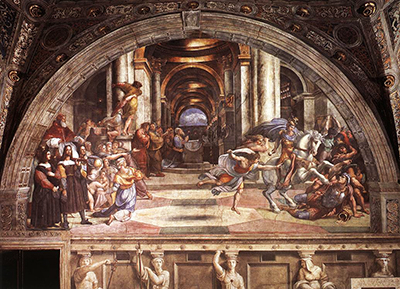
Raphael's Expulsion of Heliodorus from the Temple turns a sacred interior into two simultaneous worlds. At the centre, the high priest Onias kneels in prayer before the altar. On the right, a heavenly horseman and two airborne youths hurl themselves upon Heliodorus, who has come to seize the Temple treasure. On the left, women and children recoil, point and climb for a better view. The central prayer is still; divine intervention arrives with crushing speed.[1][3]
Pope Julius II watches from a sedan chair in the left foreground, an impossible witness to the ancient episode. The portrait makes the fresco a claim about the present as well as the biblical past: God protects sacred patrimony when worldly power threatens it. Raphael gives that political message extraordinary visual force, but he also complicates it by placing the pope among spectators rather than at the source of the miracle.[1][2]
At a Glance
- ArtistRaphael, with workshop participation
- Dateabout 1511–12
- LocationRoom of Heliodorus, Vatican Palace, Vatican City
- Mediumfresco
- Biblical source2 Maccabees 3
- Principal figuresHeliodorus, the high priest Onias, a divine horseman and two heavenly youths
- Patron portraitPope Julius II in a sedan chair at lower left
- Identified chair bearersMarcantonio Raimondi at left and Raphael at right
- Room functionpapal audience chamber
- Programmemiraculous divine protection of the Church, especially its patrimony in this scene
Contents
- Heliodorus enters the Temple
- A centre of prayer, an edge of violence
- Heliodorus brought down
- Onias and the unseen source of power
- Julius II in the sedan chair
- Raphael and Marcantonio Raimondi in the foreground
- Women, children and the act of seeing
- Architecture as a theatre of intervention
- The Room of Heliodorus
- Fresco, design and collaboration
Heliodorus enters the Temple
The story appears in 2 Maccabees. King Seleucus IV sends Heliodorus to Jerusalem after receiving a report about wealth kept in the Temple treasury. The high priest Onias explains that the deposits include funds entrusted for widows and orphans and property associated with Hyrcanus. Heliodorus nevertheless proceeds to inventory and seize the treasure.[3]
The attempted confiscation brings the city into distress. Priests prostrate themselves, women crowd the streets, and all pray that entrusted property will remain secure. When Heliodorus enters the treasury, a magnificently equipped horse appears with a terrible rider, accompanied by two powerful young men who scourge him. He falls helpless and must be carried away.[3]
Raphael selects the punishment while preserving the prayer that causes it. Onias remains far back at the altar; Heliodorus collapses close to the right foreground. The physical distance between request and answer makes divine causation architectural. No ordinary messenger crosses the space.
The fresco's title names expulsion, but the action is more than removal. Heliodorus's body is overwhelmed at the moment he attempts to convert sacred trust into royal possession. The horseman and youths make protection visible as irresistible force.
A centre of prayer, an edge of violence
The composition initially seems divided between calm architecture and eruptive action. A long nave recedes toward the altar, its central axis occupied by Onias. The right foreground breaks that symmetry as the horse surges into the scene and the two youths descend upon Heliodorus.[1]
Raphael refuses to place the most dramatic event in the middle. That decision preserves the distinction between cause and effect. Prayer, rather than violence, occupies the sacred centre. The divine agents act at the edge, as if arriving from outside ordinary space to enforce the order established at the altar.
The empty stretch of pavement between central and right groups gives speed somewhere to travel. Heliodorus does not merely pose beneath a horse; the group appears to burst across the foreground. Diagonal limbs, flying drapery and the animal's thrust create a collision too rapid for surrounding figures to absorb.
At the left, motion is different. Women and children twist upward, cluster and look. One figure climbs or is raised at the architectural boundary, turning the audience's desire to see into part of the fresco. Their vertical agitation balances the horizontal charge on the right without duplicating it.
Heliodorus brought down
Heliodorus is defined by reversal. He enters with royal authority and attendants but falls beneath a higher force. His body is pushed toward the ground while the horse and heavenly youths occupy the space above him. Political command becomes physical vulnerability.
The biblical account describes terror and darkness surrounding the intruder, but Raphael stages the intervention in a brilliantly legible interior.[3] He translates supernatural dread into bodies whose weight and momentum can be felt. The miracle is credible within the fresco because its agents obey a heightened physical logic.
The horseman's armour and mount evoke martial power, yet he is not part of an ordinary army. His sudden arrival is unbound by the Temple's procession. The two youths amplify the assault through complementary poses, turning one divine command into a coordinated action.
Raphael does not make Heliodorus a distant villain. The collapsing figure is near enough to command attention, and the punishment is severe. The viewer may understand the moral logic and still feel the violence. That double response gives the fresco more than triumphal simplicity.
Onias and the unseen source of power
Onias is visually small but structurally decisive. He kneels at the far centre before the altar, surrounded by the vertical order of the sanctuary. His prayer does not look physically powerful. Its effect is visible elsewhere.[1][3]
This separation makes faith an action whose force cannot be measured by bodily scale. Julius II, Heliodorus and the divine horseman occupy the foreground, but the high priest establishes the meaning of everything they do. Without him, the attack might resemble arbitrary celestial vengeance.
The altar also fixes the Temple as more than a storehouse. Deposited wealth belongs to a sacred and social trust, and Onias's role is protective rather than possessive. The biblical text's reference to widows and orphans prevents the treasure from being reduced to institutional luxury.[3]
Raphael's centre asks the viewer to look past spectacle. The eye is drawn to the horse, then returned along architecture toward prayer. Repeated viewing recreates the relation between visible intervention and its invisible source.
Julius II in the sedan chair
Julius II appears at lower left, seated in a ceremonial chair carried on men's shoulders. The Vatican Museums explicitly identify the commissioning pope as a witness to the scene.[1] His presence makes historical time porous: a sixteenth-century pontiff observes an event from Jewish sacred history.
The insertion serves the Room of Heliodorus's political programme. The Vatican describes the room as an audience chamber decorated with episodes of miraculous protection bestowed upon the Church. In this wall, Church patrimony is threatened and supernaturally defended. The theme answered Julius II's ambition to restore papal temporal power during conflict in Italy.[2]
Yet Raphael does not portray Julius directing the miracle. The pope arrives as witness and beneficiary of its lesson. Onias prays; God sends defenders. Julius's authority is legitimised by analogy only insofar as it stands within the protected sacred order.
The chair also introduces a second procession. On the right, the divine horseman moves inward with explosive speed. On the left, the pope is carried into view with ceremonial slowness. Heavenly and papal motion answer one another across the floor, but their difference remains clear.
Raphael and Marcantonio Raimondi in the foreground
The Vatican Museums identify the left chair bearer as Marcantonio Raimondi, engraver and friend of Raphael, and the bearer at right as Raphael himself.[1] These portraits place two makers of Renaissance images inside a scene about witnessing and transmission.
Marcantonio's presence is particularly resonant because his prints after Raphael's designs helped carry the artist's inventions far beyond their original sites. Fresco is fixed to a wall; engraving travels. The collaboration and commercial arrangements around those prints transformed Raphael's reputation across Europe.[5]
Raphael's self-insertion is quieter than a signature. He supports the chair from which Julius views the miracle. The pose acknowledges service to papal patronage while placing the artist at the threshold between painted history and the room's actual audience.
The two bearers look outward in ways that help connect spectators to the fresco. They belong to the papal entourage but also function as intermediaries. Raphael's art makes the ancient miracle available; their painted bodies carry a viewer into it.
Women, children and the act of seeing
The left crowd gives the event a human register absent from a purely official image. Women gather with children, react to danger and strain toward knowledge. The biblical text describes public distress, including women in the streets and prayer throughout the city.[3]
Raphael transforms that collective anxiety into a ladder of poses. Seated, kneeling, standing and elevated figures direct attention upward and across. Their group makes the wall's edge feel crowded, as if the wider city presses into the Temple.
Children intensify vulnerability. The dispute concerns treasure, but the text explains that deposited resources include provision for people dependent on protection.[3] The presence of families prevents “patrimony” from sounding like an abstract institutional asset.
The crowd also models spectatorship. Some see the horseman directly; others respond to neighbours; one seeks height. A viewer in the papal chamber joins this chain, looking past the painted witnesses toward the miracle they reveal.
Architecture as a theatre of intervention
The Temple is imagined through Renaissance monumental architecture rather than reconstructed archaeologically. Columns, arches and a deep central nave provide a measured order against which supernatural disruption can register. Raphael's Jerusalem speaks the architectural language of papal Rome.
That translation is not carelessness. Sacred history becomes present by inhabiting a form intelligible to the commission's audience. The building evokes permanence, authority and ritual, qualities threatened by Heliodorus's intrusion.
The central perspective does not dictate a centrally placed climax. Raphael uses it to create a stable moral axis, then pushes action to the side. This strategy allows the real architecture of the wall and the movement of spectators to participate in the design.
The painted space also appears continuous enough for the heavenly horse to enter at speed without revealing an ordinary doorway. Miracle is represented as a breach of narrative expectation rather than a breach of compositional coherence.
The Room of Heliodorus
The chamber was used for private papal audiences and decorated immediately after the Stanza della Segnatura. Its programme moves from an intellectual synthesis of faculties to urgent episodes of protection. Faith, the pontiff, the Church's site and its patrimony each face danger and receive divine aid.[2]
The Mass of Bolsena answers doubt about the Eucharist; the Liberation of Saint Peter protects the person represented as foundational to papal succession; the Encounter of Leo the Great and Attila defends Rome; the expulsion of Heliodorus protects sacred wealth.[2]
These themes made the room politically charged without making it a newspaper in fresco. Historical and biblical episodes supply analogies, not literal pictures of contemporary campaigns. Julius II's portraits activate those analogies, while the sacred narratives retain their own sources and meanings.
The older ceiling decoration has a separate history. The Vatican notes surviving work associated with Luca Signorelli, Bramantino, Lorenzo Lotto and Cesare da Sesto from an earlier campaign, alongside Old Testament episodes attributed to Raphael.[2] The room is thus a layered commission, not a surface born all at once.
Fresco, design and collaboration
The wall belongs to Raphael's growing Roman workshop. Its large scale, complex architecture and numerous figures required planning through drawings and cartoons, transfer to fresh plaster and staged execution. Raphael's responsibility encompassed invention and supervision as well as direct painting.[4]
Technical study can distinguish working sections, transferred outlines, revisions and different material behaviours. Such evidence is more reliable than assigning hands by intuition alone. The Vatican's research programme on Raphael in Rome stresses the importance of style, technique and conservation being considered together.[4]
The fresco's clarity shows how successfully the design survived collaborative production. Multiple crowds and temporal registers remain legible. The wall can be grasped from across the room and investigated at the level of portrait and gesture.
Raphael's method here differs from the equilibrium of the Segnatura. Asymmetry, speed and emotional contrast are more pronounced. The change responds to the new room's subjects and suggests an artist expanding his dramatic range.
Political meaning without a single code
The Vatican explicitly connects the room to Julius II's programme of freeing Italy from foreign occupation and restoring threatened papal temporal power.[2] Heliodorus, an agent of a Syrian king, could therefore resonate as an image of external power attempting to seize what belongs to the sacred institution.
That contemporary relevance need not turn every biblical figure into a disguised portrait of one political opponent. Analogy works at the level of structure: invasion, threatened patrimony, prayer and divine reversal. Its flexibility made the scene useful across changing circumstances.
The pope's presence asks audiences to recognise his cause in the ancient event, while his position as witness keeps the miracle from becoming his personal achievement. Raphael flatters and disciplines papal power at once.
The fresco also operates within a room of audiences, where diplomacy and petition unfolded before the pontiff. Visitors stood beneath images asserting that the Church and its leader enjoyed divine protection. The architecture of reception turned pictorial meaning into political atmosphere.
Sacred treasure and public trust
The word “treasure” can make the conflict sound like a contest between two wealthy institutions. The biblical account resists that simplification. Onias states that the deposits include provision belonging to widows and orphans as well as other entrusted property.[3] Heliodorus threatens a sacred place, but also the trust placed in it by people whose resources require protection.
Raphael does not inventory coins, vessels or storage rooms. He represents the social meaning of the treasury through the community at left and the high priest's prayer. Women and children are not decorative witnesses to someone else's wealth. Their presence gives threatened patrimony a human constituency.
This distinction sharpens the political analogy. Protection of institutional property can serve self-interest, but the fresco frames legitimate possession as stewardship. Onias does not clutch the treasure; he appeals to God. Julius II does not fight Heliodorus personally; he watches a judgement whose source lies beyond him.
The divine assault therefore defends a boundary between custody and seizure. Seleucid power treats deposited wealth as available to royal command. The miracle declares that political force cannot redefine trust simply because it can enter the building. In a papal audience room, that lesson was both theological and unmistakably governmental.
Raphael's visual economy keeps this ethical structure from becoming a lecture. The money itself is nearly irrelevant to what the spectator sees. Prayer, public fear and violent reversal reveal what is at stake more effectively than heaps of gold would have done.
Violence, justice and restraint
The horseman and youths make divine justice look terrifying. Their movement is beautiful in design but brutal in effect. A reading that celebrates protection must still account for the body beneath the horse and the whips or blows descending upon it.[1][3]
The biblical narrative continues beyond the attack. Heliodorus is left near death; his companions ask Onias to intercede, and the high priest offers sacrifice. The heavenly youths then instruct Heliodorus to give thanks to God, and he returns to testify to divine power.[3] Punishment produces recognition rather than ending only in destruction.
Raphael's chosen instant does not show that recovery, but knowledge of it changes the scene. Onias's prayer initiates both expulsion and eventual restoration. The high priest who defends the treasury also intercedes for the invader. Divine force establishes the limit; priestly mercy prevents the limit from becoming annihilation.
This wider arc also qualifies a purely political reading. If Heliodorus were only a convenient emblem of Julius II's enemies, his later testimony and rescue would be awkward. As a biblical figure, he undergoes a conversion in knowledge. The fresco captures the crisis through which that change becomes possible.
The composition itself balances extremity with control. No blood dominates, and the architecture does not collapse. Violence is concentrated in one zone while the sanctuary remains ordered. Raphael makes judgement overwhelming without allowing chaos to possess the whole wall.
Movement and suspended time
The scene contains actions occurring at different speeds. Onias kneels in liturgical stillness. Julius II advances at the pace of a ceremonial procession. Women climb and turn in waves. The divine agents move faster than any ordinary body could enter. Heliodorus is caught at the fraction of a second when forward intention becomes backward fall.
Fresco cannot literally animate these speeds, so Raphael differentiates them through pose and spacing. Long stable verticals surround Onias; crowded diagonals gather around the attack. Open pavement creates an interval that the eye crosses quickly. The pope's chair establishes a slower horizontal weight.
The viewer supplies duration by moving among zones. Looking first to the horse makes prayer seem prior; returning to Onias after the attack makes it seem continuous. Julius II's arrival appears to unfold outside the biblical instant, a Renaissance procession entering ancient history.
This layered time is one reason the wall feels larger than one illustration. It contains cause, intervention, witness and implied aftermath. Raphael does not freeze a single photographic moment; he composes an intelligible sequence within simultaneous space.
The spectator inside the Temple
Raphael's foreground does not behave like a distant stage. The divine horseman appears to enter almost at the spectator's level, while Heliodorus falls close to the painted boundary. The result is confrontational: supernatural defence seems capable of breaking out of biblical space and into Julius II's audience chamber.
The pope's procession strengthens that threshold. Chair bearers occupy the same near zone as the room's actual visitors, and the identified likeness of Raphael turns one of them into a mediator between maker, patron and audience.[1] Painted witness and living witness become adjacent roles.
The central nave offers a different invitation. Its receding pavement gives the eye a path toward Onias, but no painted figure simply walks down that axis. The viewer receives an unobstructed visual approach to the altar even while bodily action gathers at the sides. Raphael reserves the centre for contemplation rather than traffic.
This organisation would have been especially effective during a papal audience. A visitor approaching Julius II encountered the painted pope arriving as witness, the artist carrying him, and divine force defending sacred property. The wall converted ordinary acts of entering, waiting and looking into echoes of its narrative.
The spectator is therefore not neutral. The left crowd teaches how to seek a view, the central architecture teaches where to locate cause, and the right-hand assault demonstrates the consequence of violating the sacred trust. Looking becomes a guided moral itinerary.
Raphael after the Segnatura
The fresco is often discussed as evidence of change after the serene synthesis of the Stanza della Segnatura. That comparison is useful when it remains specific. Raphael has not abandoned clarity; he has made clarity serve crisis. The composition is readable precisely because sharply different kinds of movement occupy separate zones.
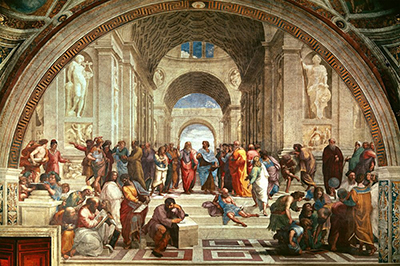
Bodies have also gained a more forceful relation to the frame. In the School of Athens, groups inhabit an ideal architecture whose order seems to precede them. Here the divine horseman appears to strain the capacity of the foreground, and figures at left press against the edge. Architecture is no longer only a setting for community; it is the stable thing an invasion and a rescue test.
The shift responds to function. Julius II's library required a durable image of knowledge in ordered relation. His audience chamber required histories capable of speaking about danger, intervention and papal survival. Raphael altered his visual rhetoric without losing the intelligence that made a crowd coherent.[2][4]
Colour, foreshortening and extreme pose participate in this rhetoric, but none functions as display alone. The horse's thrust, the youths' flight and Heliodorus's collapse make divine protection physically imaginable. Drama is an interpretive instrument.
This adaptability helps explain Raphael's rapid authority in Rome. He could absorb a new programme, a different architectural field and a more urgent political atmosphere, then create a style fitted to them rather than applying one successful formula.
How to look at the Expulsion of Heliodorus
Begin at the distant altar, not the horse. Identify Onias and hold his still prayer as the causal centre. Then let the long pavement carry your gaze to the collision at right.
Compare the two processions. Julius II advances slowly on human shoulders; the heavenly rider arrives with impossible force. Raphael makes ceremony and miracle occupy a shared foreground without confusing them.
Study the left crowd as more than balance. Their upward movement, children and efforts to see translate public distress into bodily variety. Find the chair bearers identified as Marcantonio and Raphael.[1]
Finally, step back to feel the asymmetry. The fresco's apparent imbalance is its engine. A stable sanctuary is protected by an intervention that cannot be calm.
Why the fresco matters
The Expulsion of Heliodorus shows Raphael mastering dramatic simultaneity. Prayer, attack, papal witness and public reaction occur in distinct zones yet remain parts of one event. The viewer understands not only what happens but how different participants know it.
It is also one of Raphael's most sophisticated statements about patronage. Julius II enters sacred history, but he does not command God. The artist enters too, carrying the pope and facing the audience. Power, art and miracle are joined through carefully graded roles.
The fresco's political confidence is inseparable from its formal daring. Its centre is quiet, its climax displaced and its edges crowded. Raphael abandons perfect equilibrium in order to represent protection arriving at the instant of crisis.
The wall also insists that protection is a relation rather than an ornament. Onias must pray, the community must endure fear, divine agents must act, and even the defeated intruder will depend on intercession. Raphael's spectacle remains accountable to a complete moral narrative.
Its lasting power comes from this refusal to separate clarity from complexity. The invader is stopped, but force alone does not define justice; the pope is honoured, but does not cause the miracle; the artist is present, but appears in service. Every hierarchy is made visible and then placed inside a larger one.
Artist Up Close
Look at the space between Onias and Heliodorus. It is not empty background; it measures the distance across which prayer becomes intervention.
Notice how the horse's movement continues through the two youths. Three divine agents act like one force, while Heliodorus's attendants scatter into fragments.
At left, find Raphael beneath Julius II's chair. The self-portrait places the artist inside the machinery of papal vision and at the boundary of the spectator's room.
Frequently Asked Questions
Discussion
What detail most changes how you read The Expulsion of Heliodorus from the Temple?
Reader Insights
Which source detail gives the page its strongest anchor?
Which visual or historical distinction should readers keep in mind?
How does this page change the wider picture of Raphael's career?
Join the Conversation
Share your reading below.
References
- Vatican Museums, “Expulsion of Heliodorus from the Temple,” official object record. View source.
- Vatican Museums, “Room of Heliodorus,” official room and programme record. View source.
- Holy See, New American Bible, 2 Maccabees 3, official Vatican text. View source.
- Barbara Agosti and Silvia Ginzburg, foreword to Raphael in Rome: Style, Technique, Conservation, Edizioni Musei Vaticani, English edition. View source.
- The Metropolitan Museum of Art, thematic resources on Raphael, Marcantonio Raimondi and reproductive print culture. View source.