by Tom Gurney
Tom Gurney BSc (Hons) is an art history expert with over 20 years experience
Published on June 19, 2020 / Updated on November 20, 2026
Email: tomgurney1@gmail.com / Phone: +44 7429 011000
Introduction
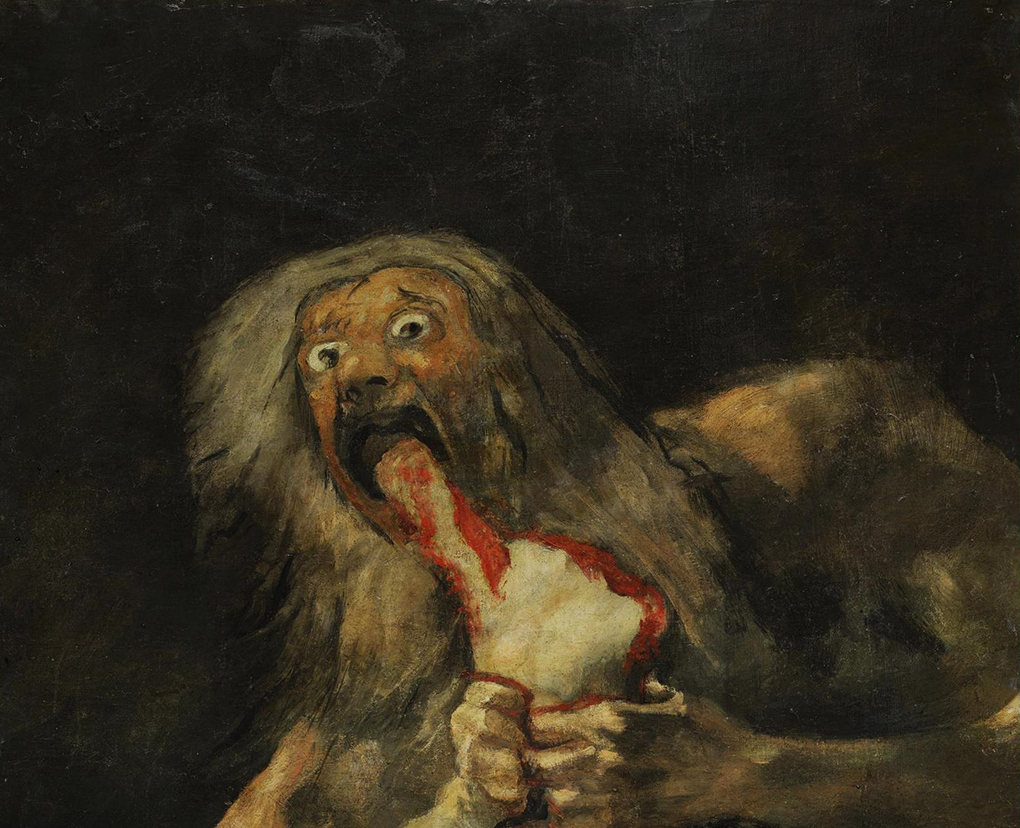
Saturn's hands meet in the middle of the painting. His fingers dig into a pale back, and small red strokes show between them. Follow the edge of the body up towards his mouth and the contour breaks at the shoulder. Follow it down and the slender legs are lost against the shadow of his knees. A few strokes of grey pick out his hair, one shoulder and a bent leg. Around him lies a dark field with room for little explanation. There is no obvious floor, no witness and no indication of where he could have come from. [1]
Francisco de Goya painted this figure on a wall of the Quinta del Sordo, his house outside Madrid, around 1820–1823. The painting now at the Museo Nacional del Prado, inventory P000763, is 143.5 × 81.4 cm according to the museum's measurements. Fundación Goya en Aragón catalogues it as Saturno devorando a un hijo, or Saturn Devouring One of His Children, and gives a width of 81.5 cm. It lists the technique as oil on plaster transferred to canvas. The Prado describes the support and technique more broadly as mixed technique on a transferred wall coating. Both accounts describe a painting made as part of a room and now carried on fabric. [1] [2]
At a Glance
Works across Goya’s career
The Parasol
1777The Nude Maja
1795–1800Saturn Devouring His Son
c. 1820–23The Dog
c. 1820–23Milkmaid of Bordeaux
c. 1827The hands and the eyes
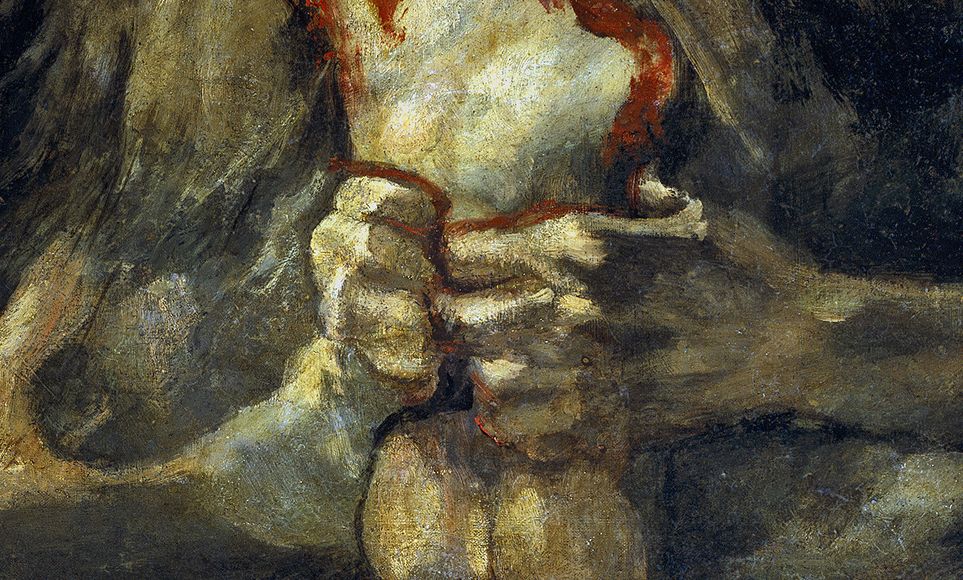
The largest area of light falls on the smaller figure. The back faces us, exposed from shoulder to hip, and its surface is broadly modelled with pale colour. Saturn's flesh varies much more in tone. His forearms go from dull brown to grey, with brighter marks at the knuckles and along the ridges where his hands fold over the body. The fingers look disproportionately long. Their jointed outlines are among the sharpest in the picture, so you can follow the points of contact even where the rest of the larger figure loses definition. The grip fixes the body in the light. [1]
The two figures also give different accounts of weight. Saturn hunches, his shoulders rise unevenly, and his legs make two large angles in the otherwise upright composition. The smaller figure hangs close to the vertical. Its hips and legs appear slack, while the area caught in Saturn's fingers is held tight. The size difference helps sustain the traditional subject, but relative scale is only one of the visual cues. The legs and torso look elongated beside the plump infant in Rubens's earlier painting of the same story. With the head absent and much of the body hidden or damaged, age, sex and identity remain open. In the title, the word child chiefly tells us about the relationship involved. [1] [3]
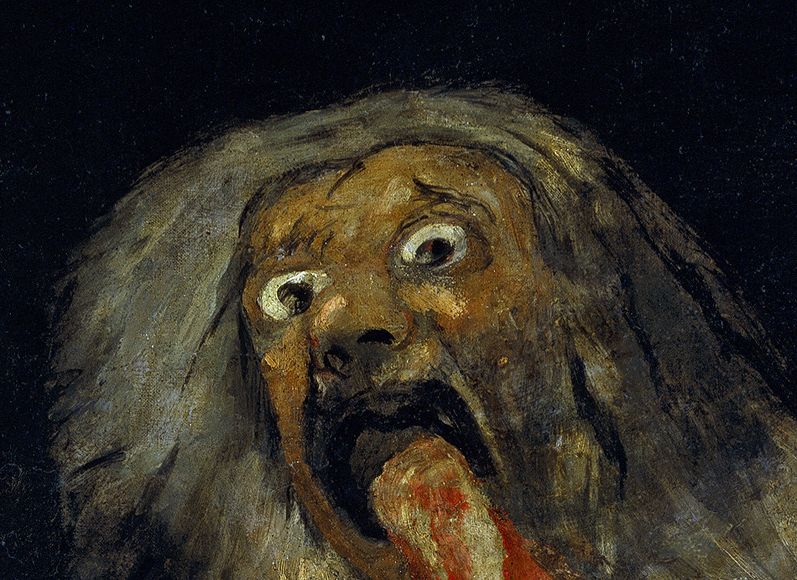
The face is high and left of the hands. The open mouth points down towards the shoulder, while the wide eyes seem to look out of the action. A few small, bright areas around the pupils carry an extraordinary amount of emphasis. If you trace the gaze, there is nothing within the picture that clearly answers it. He might register as fearful, alert or startled. There is enough detail to see the conflict between the gaze and the action of the mouth, and very little to resolve the expression into a distinct emotion. The range of readings is part of the picture's effect. [1]
Distance shifts the emphasis. From far enough away to take in the height of the canvas, the giant's pale eyes, the smaller back and the flare of red stand out in sequence. At close range the marks in the hair become broken strokes, the light on the fingers becomes irregular, and the shadows between the limbs are hard to assign to either the body or the ground behind it. There are no architectural edges to tell us how deep the space is. Even brushing past the giant's outline with our eyes offers few clues. On one side the hair fans out, and on the other the leg and elbow lose their boundaries. The painting gives just enough information to make the bodies press against one another, while leaving their surroundings almost entirely to darkness. [1]
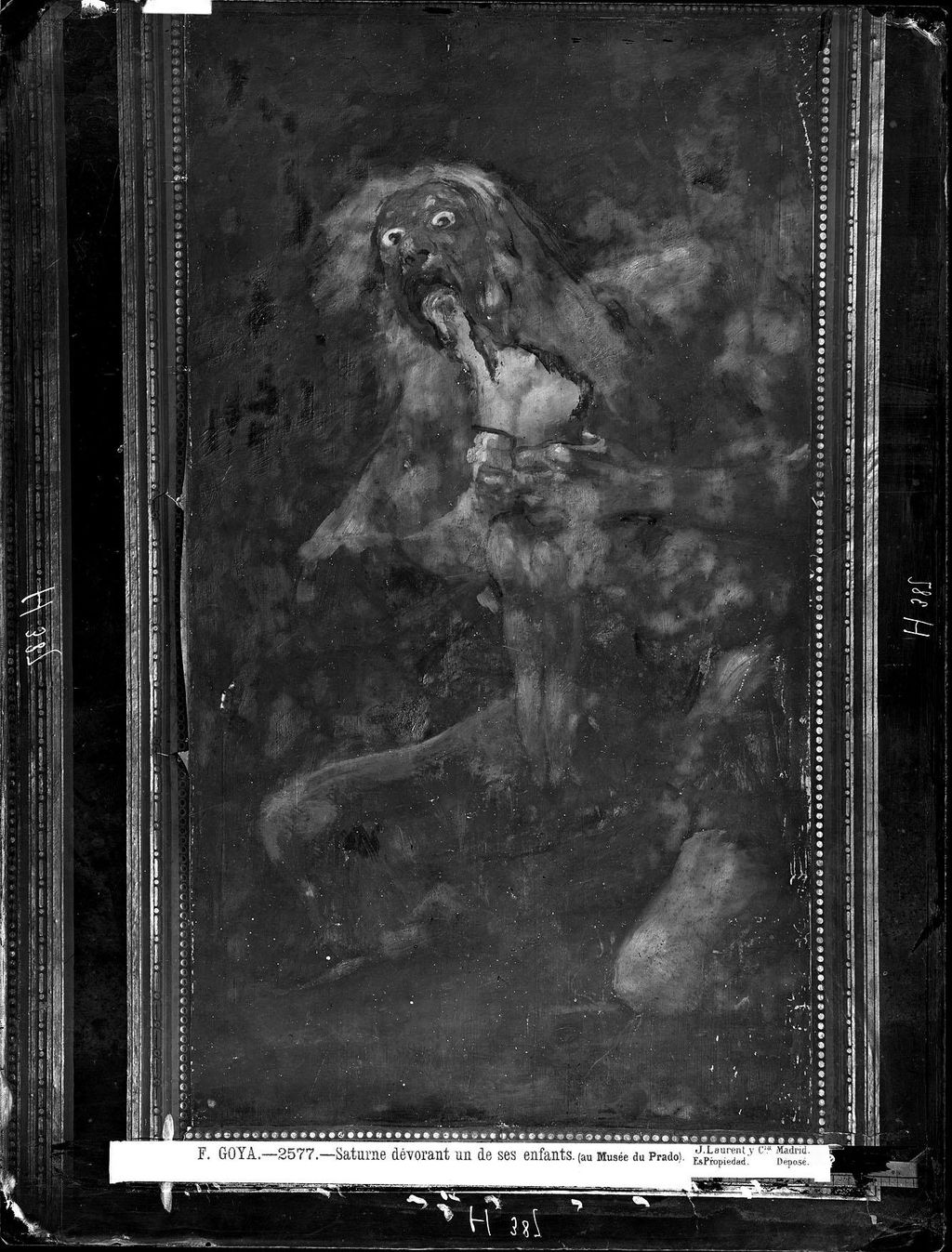
Those details belong to the surface in Madrid. An earlier photograph provides a second view of the same basic arrangement, and research on the transferred surface has identified extensive losses around the head. The expression now familiar from reproductions therefore has a material history of its own. For the moment, the eye, the mouth and the grip can guide the initial encounter. Their relationship becomes especially clear beside a version of the subject where the painter supplied much more about the characters and their world. [4] [5]
Annotated Details from Saturn Devouring His Son
Follow the eyes, the hands and the fragments of light on the two figures. The details show the surviving Prado canvas.
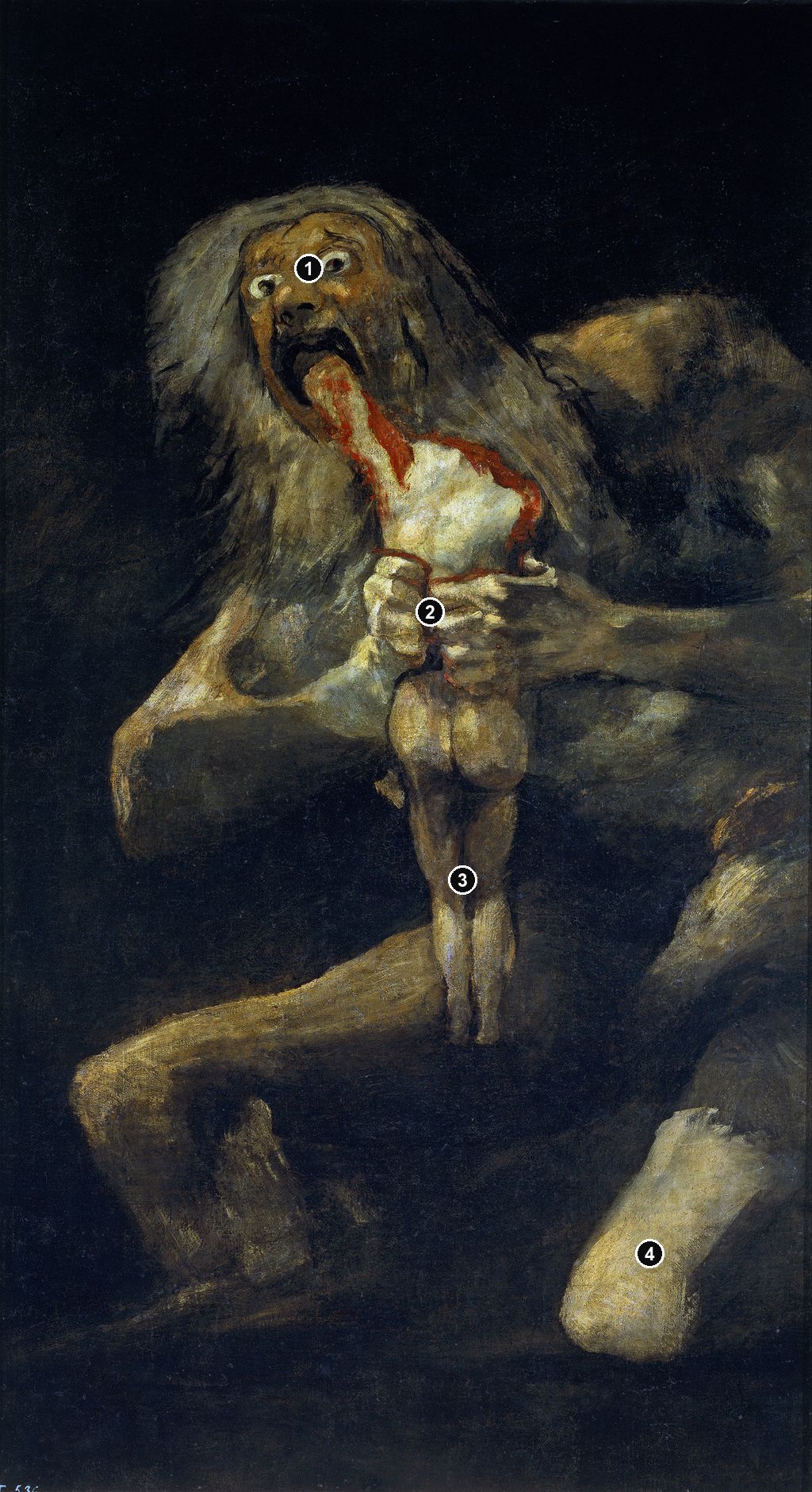
Details from SATURN DEVOURING HIS SON
Compare the edges of the figures where the light catches them or lets them merge with the surrounding dark.
Eyes in a dark field
The pale eyes and open mouth are among the first details to become legible. The dark behind the hair leaves few clues to a setting.
The grip
The hands close around the body from both sides. The light catches edges of fingers and knuckles, compressing the pale forms into a narrow space.
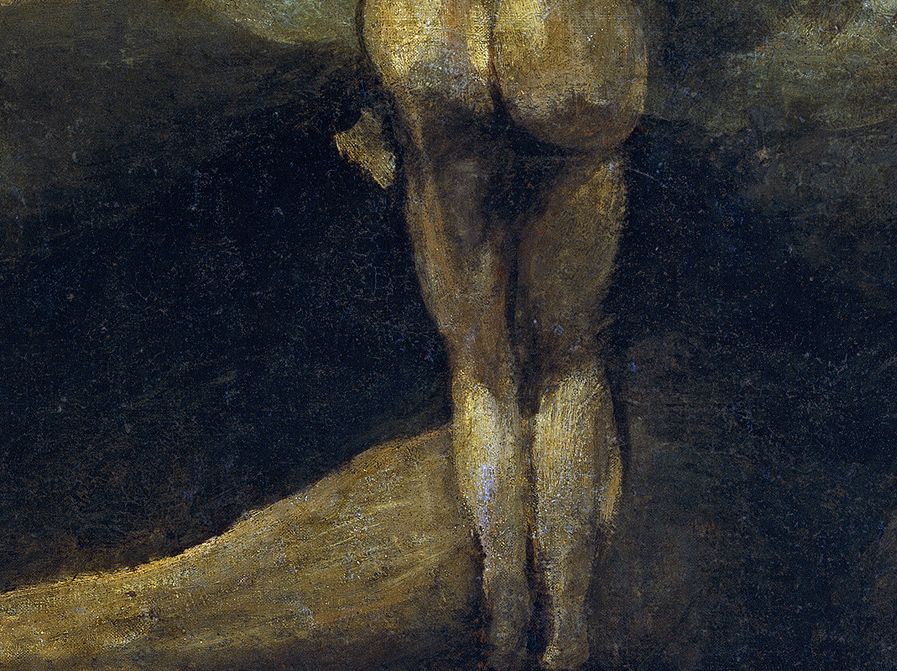
A hanging pair of legs
The line of the hanging legs interrupts a broader diagonal formed by Saturn’s bent leg. The two bodies remain distinct even where the paint is dark.
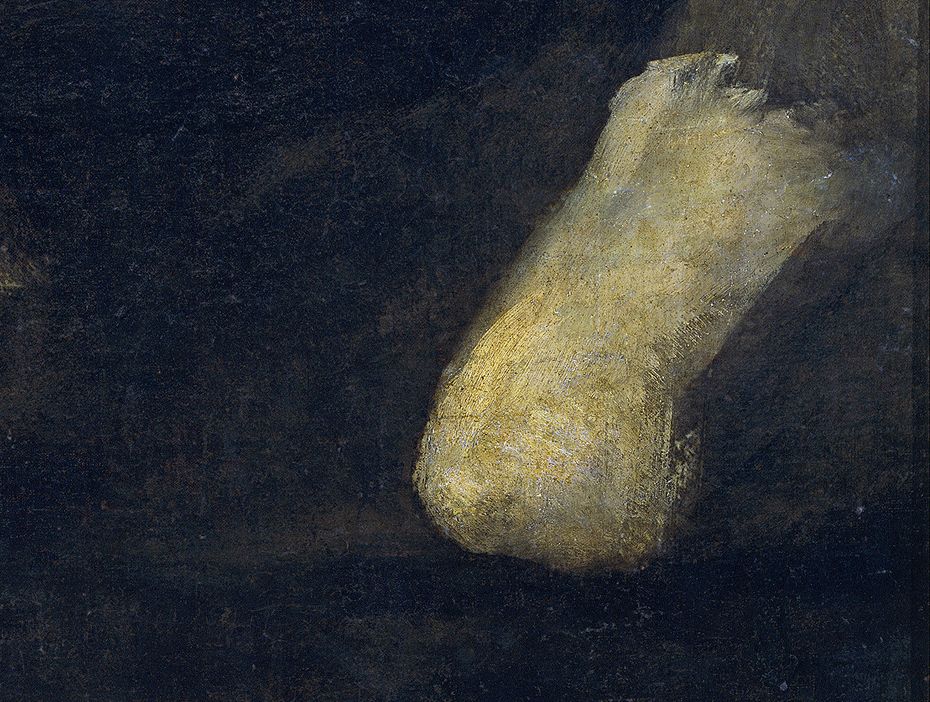
Light across the lower figure
A broad patch of light draws the lower limb forward. The surrounding shadow gives little information about the ground beyond it.
What happened to Kronos's children?
In Hesiod's Theogony, Kronos is one of the Titans and the ruler of an earlier generation of gods. He learns from Earth and Sky that he is destined to be overtaken by a child of his own. As Rhea gives birth he swallows Hestia, Demeter, Hera, Hades and Poseidon. When Zeus is about to be born, Rhea asks her parents for help. She gives birth in Crete and offers Kronos a stone in swaddling clothes. He gulps it down. Zeus grows out of his father's reach, and Kronos eventually brings up the stone and the children. The episode sets in motion the succession that gives Zeus his power. [6]
The word translated as swallow matters. In his commentary for Harvard's Center for Hellenic Studies, classicist Leonard Muellner discusses the verb katapinō, which suggests gulping something down whole. The stone is a test of the verb as much as a test of the father's vigilance. It can take the place of the infant because he swallows without chewing, and the swallowed children can return because the action has kept them inside him. Muellner reads the swallowing as part of a sequence of attempts to suppress or conceal the next generation, answered by Rhea's concealment of Zeus. Goya's image brings cutting, pressure and visible injury to the foreground, where the story depends on concealment and the possibility of release. [6] [7]
Saturn is the Roman god identified with the Greek Kronos. The names Kronos and Chronos, the latter associated with time, came to overlap in the visual tradition. Father Time consequently acquired attributes that can also signal Saturn, including a scythe. Other pictures make that allegorical identity explicit with wings or an hourglass. The association explains why the image of a god who devours his own children can suggest the effects of time. Goya's figure has no timepiece or blade, and the dark space gives no place for a sign of rank. The action itself does nearly all the work of identification. [1] [8]
The established title Saturn Devouring His Son thus carries information the surface cannot settle on its own. The inventory associated with Antonio de Brugada gives the short title Saturno. The longer Saturno devorando a un hijo names the act and allows English translators to say One of His Children. An introductory talk recorded by RTVE also notes the appearance of that Spanish wording in the Prado's 1900 catalogue. An earlier stage in the circulation of the title survives on Laurent's negative, where a French caption gives the subject as Saturn devouring one of his children. These labels show how consistently viewers have understood the scene through the myth even as the wording has shifted across catalogues and languages. [1] [4] [9]
Rubens and the signs of Saturn
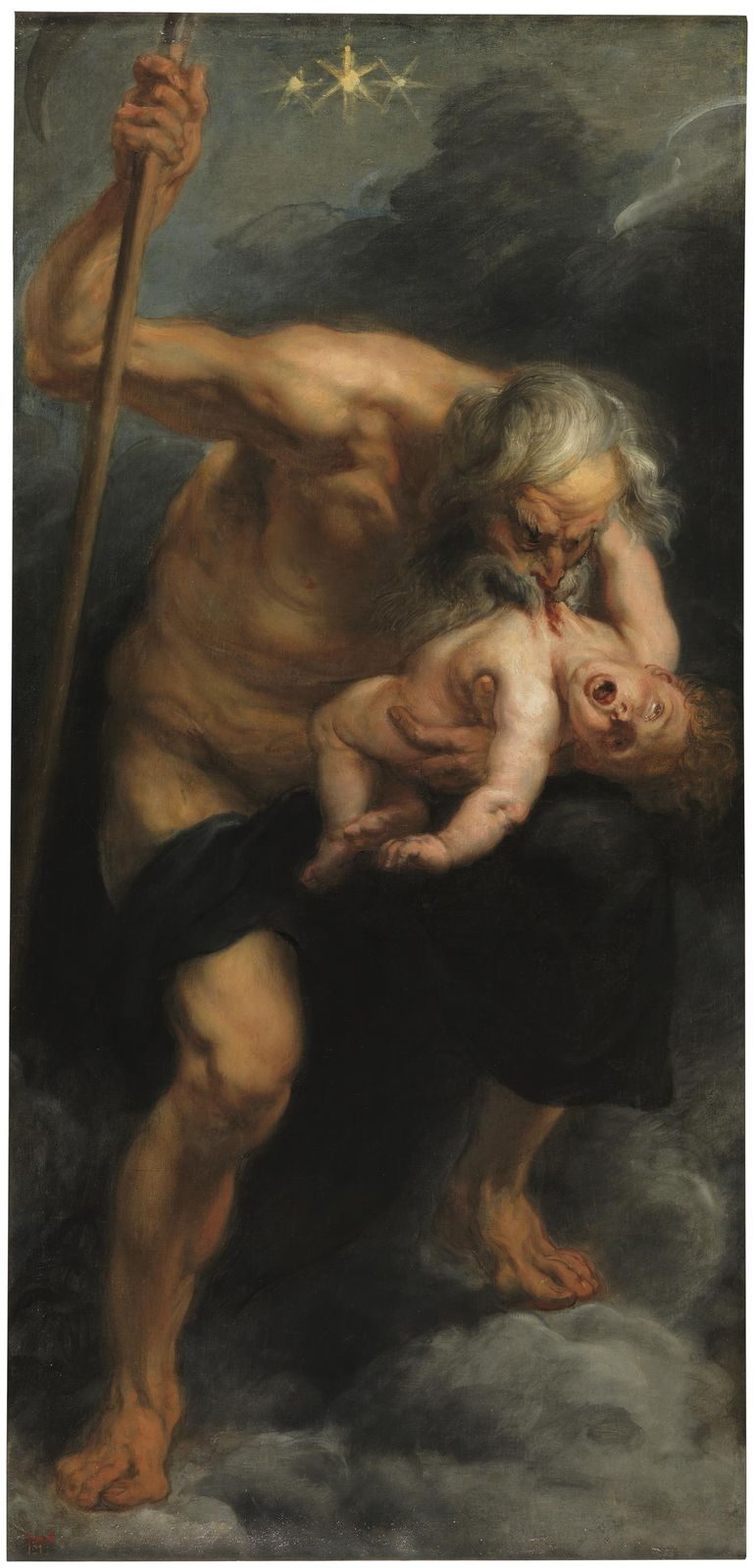
Peter Paul Rubens painted his Saturn Devouring One of His Children in the 1630s for Philip IV's Torre de la Parada, a royal hunting lodge near Madrid. The exact Prado canvas is P001678, a narrow oil painting about 180 cm tall. The Prado places the work within a much larger commission of mythological pictures. The painting holds signs of several kinds of authority at once. The ancient god has the body of an immensely strong old man, one hand carries the scythe, and above him a cluster of three points of light refers to the planet that shares his name. The Museo Galileo connects their arrangement to Galileo's description of Saturn as appearing to consist of three bodies. In that interpretation even the small lights contribute to the subject. [3] [10] [11]
Rubens's man stands tall. Light runs over the grey hair and the large muscles of his back and upper arm. The infant curves away in the crook of one arm, with the mouth open and the face visible. The light marks both the smooth roundness of the child and the sinew of the old man. Clouds give the standing figure an atmosphere, and the shaft of the scythe gives the upright painting a second long line beside his body. Rubens makes the victim's reaction as legible as the adult's action. The child's face adds an expression and an implied sound to the scene. [3]
Both paintings place the bite high in a narrow rectangle, yet the relationship between the visible bodies changes. Goya brings the smaller body upright and turns its surviving surface away from us. The pale back seems broad in the light even though it is held between enormous hands. Goya needs both of those hands for the action that Rubens gives to one arm. That leaves the giant with no free hand for a scythe. Where the Rubens offers a clearly legible young face and the outward movement of a struggling body, the Goya puts all the visible expression on the attacker and much of the movement into the way he braces himself. Neither canvas reproduces Hesiod's swallow whole. Their positions along the same tradition make these changes easier to measure than a comparison of atmosphere alone would. [1] [3] [6]
Fundación Goya en Aragón draws the comparison with Rubens, and art historian Rosa López Torrijos places it alongside Goya's earlier use of Saturn as an allegory of Time. Goya's 1778 print series after paintings by Velázquez in the Royal Palace gives a documented instance of his access to the Spanish royal collections. The Gazeta de Madrid named the palace as the location of the originals when it announced the prints. That access makes comparisons with an object from the royal collection historically plausible. The composition of the mural still leaves open when or in what form the Rubens entered Goya's thinking. The strongest evidence for the comparison is the precision with which the two pictures give different jobs to comparable parts: the position of the victim, the hands, the light in the eyes, and the room allowed to the sky. [1] [12] [13]
Before the mural, Goya had tackled the myth in a drawing in red chalk and black pencil, dated around 1797 and now at the Prado (D03941). The drawing puts two small figures in the giant's hands and crops his body to concentrate on the head, shoulders and reach of the arms. One hand brings a body to his mouth while the other keeps hold of the second child. The sheet makes it possible to see the action as part of a sequence. Someone is being bitten, and another figure is still in danger. In the mural the hands close on a single body, and the bends in the giant's legs keep the action suspended within the taller field. The comparison shows how much the final image owes to the isolation of this one physical act. [24]
Putting the two bodies back in the room
Rubens gives a viewer a way to name the scene through the infant and the scythe. A body twisted into a steep diagonal carries much of the movement, and the surrounding pictorial space still contains signs that situate the act in a myth. Goya makes the older body fill the view and gives the victim a different scale. The scythe disappears. The visible hands take over from the attributes in supplying clues to who has power and what he has done. The head and the mouth also have different relationships to the remaining body in each picture. That shift makes it useful to place the paintings beside one another even though resemblance by itself cannot establish how Goya prepared his version. [11] [26]
The earlier picture was made for the Torre de la Parada, where a mythological episode could be seen among other subjects drawn from classical tradition. The Quinta put Goya’s image into a contrasting social and physical setting. Laurent’s photograph and reconstructions of the ground-floor arrangement help recover at least the proportions of its wall field. A person moving around the room could have caught the outlying stare or the flash of pale flesh before bringing the figures into focus. Their closeness to the front of the image makes sense even from an oblique position. [11] [26]
The act also changes the surrounding space in each painting. In Rubens one can follow an arm or a leg out into an area that helps explain the figure’s posture. Around Goya’s Saturn, the dark makes parts of the older body hard to place. The violence is easy to recognise while the physical position of the aggressor remains unsettled. That combination helps explain why a close comparison with Rubens is more revealing than a search for a single modern meaning. Goya made a recognisable story work with fewer identifying attributes, and the change affects where a visitor looks first. [11] [26]
There is an additional change of scale when the two paintings are compared as things on walls. Rubens’s upright canvas belongs to a royal programme and gives the scene a field bounded from the outset by a movable support. Much of the surviving evidence for Goya’s format depends on tracing the mural inside the room and later reconstructing the limits of the detached field. A museum display can bring the two upright pictures close together. It makes differences between the figures easy to observe while also making the shape of their current supports seem more alike than the circumstances in which they were first seen. [11] [26]
Goya on film
Five films explore Goya’s portraits, prints, Black Paintings and painting techniques.
The Duke of Wellington by Goya
The portrait, its military decorations and its later theft.
Watch on YouTubeSaturn on the wall of the Quinta
Goya bought the Quinta del Sordo in 1819. The Black Paintings occupied two rooms of the house, one on the ground floor and another upstairs. Each wall offered different dimensions, and the surviving paintings include both broad gathering scenes and tall, narrow subjects. A group such as The Pilgrimage to San Isidro could unfold across a long wall. A picture like Saturn could occupy one of the smaller fields on an end wall. The arrangement put pictures of different scales within the same field of movement as somebody entered or crossed the room. [14] [15]
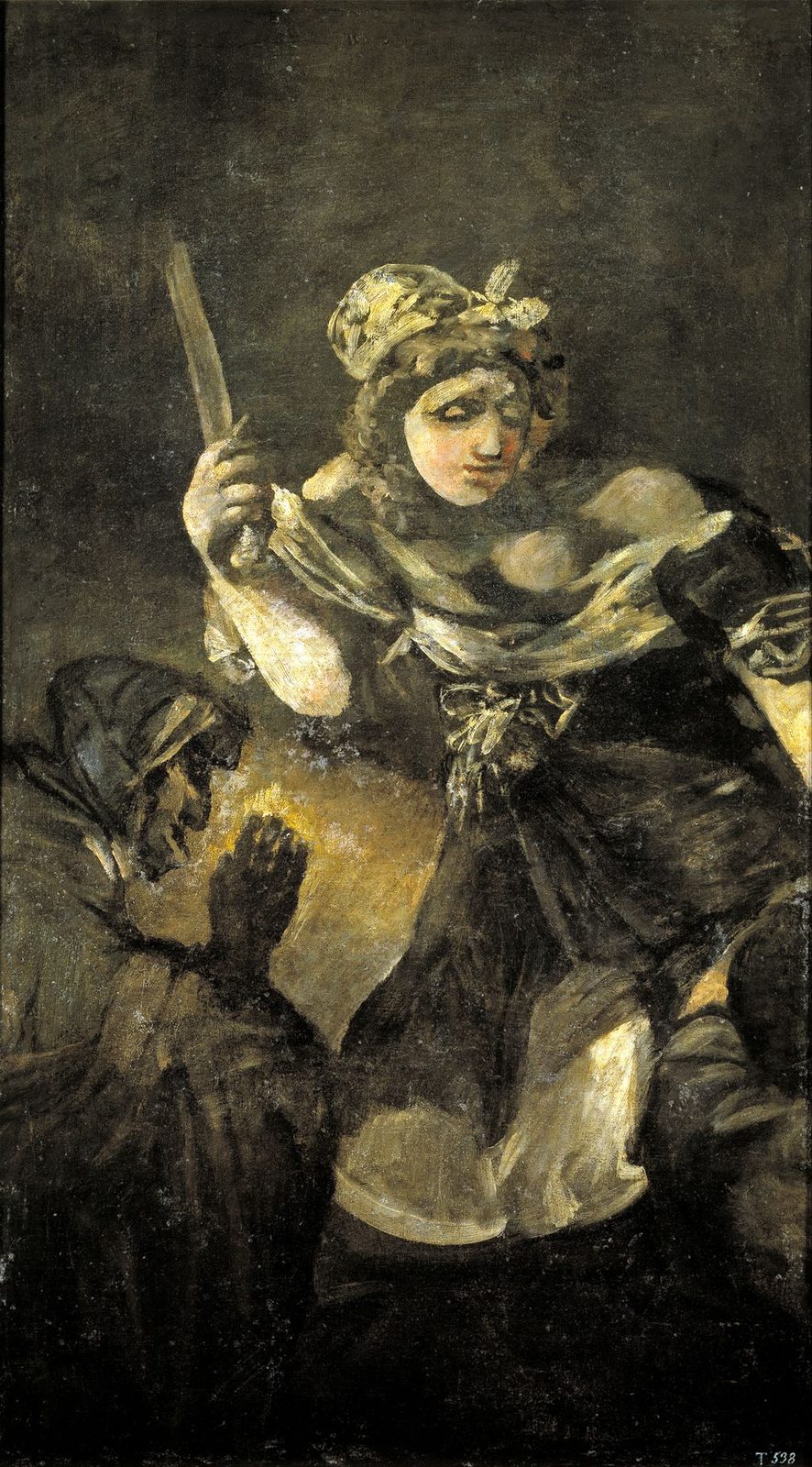
Charles Yriarte described the house in 1867. He placed Saturn and Judith and Holofernes together at the far end of the ground-floor room, opposite the end with La Leocadia and Two Old Men. The account gives the pairing more securely than it determines the place of each picture on the wall. Nigel Glendinning used the brighter right edge of the moulding in Laurent's photograph to support a position for Saturn opposite Two Old Men. Artificial lighting, which Laurent used in photographing interiors, complicates what that brightness can establish about the position of a nearby opening. The photograph has considerably more to say about the fact of a moulding than the exact approach to it across the room. [1] [15]
Yriarte's pair is worth looking at even with that uncertainty. In Judith, the raised blade and Judith's illuminated head and sleeve are where the eye first settles. Holofernes is difficult to make out in the darkness below. Both murals bring a violent act close to the picture surface and let much of its setting fall away, but the blade raised in one and the grasp in the other carry the action in opposite ways. Judith's blade remains conspicuous while the man it was used against almost disappears. Saturn's hands pin the smaller figure where it remains visible. An observer standing in the room could look from a scene in which a town is rescued by killing a powerful man to one in which a powerful figure tries to preserve his rule by attacking his own family. That relationship is available to a viewer of the pair, whether or not Goya designed it to bear that particular meaning. [5] [14] [15]
Accounts of the room have encouraged readings of the figures as a group. Folke Nordström treated Saturn's traditional association with melancholy as an organising idea for the room. Carlos Foradada proposed a political reading, in which the consumed figure personifies the constitutional order, and drew attention to the hands of the staff-bearing figure in Two Old Men and those that close on Saturn's victim. Looking across the room allows both proposals to be tested against particular forms. A staff approached as a sign of authority is a different starting point from the recurrence of aged bodies. Each reading still makes inferential steps between the images, the spectator's place in the room and the culture in which the murals were made. [1] [16]
The surviving documents offer their own history. The description and inventory associated with Antonio de Brugada have long informed reconstructions, but their dating and transmission have been debated. Glendinning's response to Juan José Junquera drew on accounts published in 1834 and 1838 that attribute murals in the house to Goya. He also pointed to Pedro de Madrazo's 1872 catalogue, which describes works at the Quinta before the paintings entered the Prado. These notices have different levels of detail. Yriarte's recognition of the Saturn and Judith subjects is especially helpful because it connects the specific images to positions in the room before they became portable objects. [15] [17]
A photograph taken before the transfer
Jean Laurent's glass negative VN-03194 records Saturn while the paint was still on the wall. Accounts date the exposure differently. Raquel Esteban Vega gives 1874, following Carlos Teixidor, while Carlos Foradada places it in a range between 1866 and 1873. The visible surround establishes that Laurent photographed the mural before it was detached. [4] [16] [18]
Look past the painted figure and the rectangle of the image continues into a narrow moulding and a patterned wall covering. These borders show where the picture ended and the room resumed. They also give the black field inside the painting a limit that a reproduction cropped to the painted surface can hardly convey. A label below the image calls the work Saturne dévorant un de ses enfants and also names the Prado. The record accompanying the digitised negative identifies the museum wording as a later addition to the negative. The border within the photograph and the printed information added to it are records of different stages of its history. [4] [18]
The photograph is a witness to the mural many years after Goya's period of ownership. It shows the distribution of light and dark as Laurent's process registered it and the figure as it then stood, some decades into the history of the house. It omits the colour difference between the pale back and the red at the fingers. It also translates shadows and damaged areas into values that can be difficult to disentangle. Comparison with the present image is most informative when it begins with local shapes such as an eyelid or the angle of a limb. The same challenge occurs in the photograph of The Dog, where the patterned surround offers architectural evidence and details inside the field call for a separate assessment of the marks. [4] [18] [19]
From plaster to canvas
Baron Émile d'Erlanger bought the Quinta in 1873 and commissioned the Prado restorer Salvador Martínez Cubells to transfer the murals. Raquel Esteban Vega's study of the restorer's records identifies an entry on 11 August 1874, with further entries in 1875 and 1876. The first establishes work on the project, although the record leaves open whether that day's intervention was detachment or workshop treatment and which wall it concerned. The transferred paintings went to the 1878 Universal Exhibition in Paris. Martínez Cubells registered fourteen of Goya's canvases for further treatment in July 1881, and the state accepted d'Erlanger's donation by royal order on 20 December of that year. Díez Esteban dates their public display at the Prado from 1889. [18] [19]
The restoration history matters because the operation changed what physically held the image together. The paint had adhered to a prepared wall surface. Transfer replaced the architectural support with canvas and required work on areas that had lost material. The record of a further campaign in 1881 makes the sequence more complex than one day of removal followed by immediate museum display. Local differences between the photograph and painting can therefore suggest intervention without showing at which point it occurred. [5] [18] [20]
Glendinning compared Laurent's photograph with the canvas and drew attention to changes around the eyelids, the balance of pupil and white, the distribution of the highlights on the cheeks, and the modelling of the smaller figure's back. He also raised the possibility that an anatomical detail in the shadow between Saturn's legs had been modified, while acknowledging that the photograph is indistinct there. His reading of the eyes is especially revealing because that is where a tiny adjustment can change how someone reads the whole expression. Foradada subsequently argued, on the basis of a digital examination of Laurent's image, for extensive reconstruction of the head. The degree of reconstruction belongs to the individual scholar's reading. Separate evidence of damage comes from what the Prado found beneath the visible surface. [21] [22]
What the Prado found beneath Saturn
In the Prado's 1984 technical study, Carmen Garrido Pérez published a visible-light detail and an X-ray of Saturn's head. She identified extensive losses of original material, with the visible eyes corresponding to gaps in paint. The overall radiograph revealed another composition underneath the giant. Garrido described a landscape with horizon lines, mountains and sky and read the figure set against it as a man in a pose suggestive of dancing. The landscape showed strongly in the radiograph, while the familiar scene of Saturn showed very little contrast by comparison. The disparity between the X-ray and the picture you see in the gallery is therefore itself informative. A dark area in the visible picture can carry legible evidence of both the earlier design and the later work on the surface. [5]
Garrido also examined tiny samples from different sites. The cross-section taken in a red area against the background showed a layer containing vermilion and lead white above a mixture containing Prussian blue, lead white and carbon black. It is a local finding with a spatial consequence for close looking. One stroke of red that appears suspended against darkness sits on a succession of layers that a photograph from the front cannot describe. The exact mix recorded there belongs to that sampling point. The legs, face and fingers have their own histories and require evidence at their own locations. [5]
The Prado commissioned a further record of the Black Paintings in 2014. Factum Arte used a non-contact scanner to capture surface relief and made high-resolution composite colour photographs. The project brought these records together with the museum's X-rays, infrared and ultraviolet documentation and Laurent's photographs. The relief record preserves small variations in the surface of today's canvas, while the historical photograph shows the earlier mural within its borders. The value of bringing the two together lies in the ability to ask more precise questions about specific marks. The scan captures a surface that has already undergone transfer, repairs and later treatment. Those traces have evidential value in their own right. [20]
The Prado brought the Rubens and the Goya together in its Reencuentros display. That comparison is possible because both are now portable canvases. Looking at them together, the eye can return from Rubens's scythe to Goya's two occupied hands and from the infant's open mouth to the silent pale back. Laurent's record offers another kind of encounter. It moves the same painted embrace back into a room where Judith stood close by and where there was a patterned surround outside the dark rectangle. The work of a restorer can be hard to separate from an original stroke on a transferred object, but the room, the actions and the layers each still have evidence to offer. [3] [4] [23]
The paintings also draw different responses to what the brush makes visible. Looking at Saturn at the Prado in 2025, the critic Jerry Saltz singled out the sophistication of its handling and argued that its repellent action can coexist with a new conception of beauty. His account directs attention to the painting as something made, an image that sets a very few bright marks against a large dark field to make the weight and pressure of two bodies felt. The same marks that prompt such a response can carry evidence of the nineteenth-century transfer. The eyes that arrest a visitor are also the eyes whose placement Garrido examined on the X-ray. [5] [25]
Artworks directory
| Name | Date | Medium |
|---|---|---|
| And There’s No Help for It, Plate 15 | Printed 1863 | |
| Asmodea | c. 1820–23 | Wall painting transferred to canvas |
| Boys Inflating a Bladder | 1777–78 | Tapestry cartoon |
| Boys Picking Fruit | 1778 | Tapestry cartoon |
| Bullfight in a Divided Ring | 1825 | Lithograph |
| Card Players | 1777–78 | Tapestry cartoon |
| Card Players (sketch) | 1777–78 | Painted sketch |
| Dance on the Banks of the Manzanares | 1777 | Tapestry cartoon |
| Duel with Cudgels | c. 1820–23 | Wall painting transferred to canvas |
| Heads in a Landscape | c. 1820–23 | Easel painting |
| Judith and Holofernes | c. 1820–23 | Wall painting transferred to canvas |
| Leocadia | c. 1820–23 | Wall painting transferred to canvas |
| Maja and Cloaked Men | 1777 | Tapestry cartoon |
| Maja and Cloaked Men (sketch) | 1777 | Painted sketch |
| Majo Clapping in Time to the Music | 1777 | Drawing |
| Men Reading | c. 1820–23 | Wall painting transferred to canvas |
| Out Hunting for Teeth, Plate 12 | 1799 | Etching, burnished aquatint and burin |
| Picnic in the Countryside (sketch) | 1776–78 | Painted sketch |
| Picnic on the Banks of the Manzanares | 1776 | Tapestry cartoon |
| Pilgrimage to San Isidro | c. 1820–23 | Wall painting transferred to canvas |
| Preparatory study for The Sleep of Reason Produces Monsters | c. 1796–97 | Drawing |
| Procession of the Holy Office | c. 1820–23 | Wall painting transferred to canvas |
| Quarrel at the Cockerel Inn (sketch) | 1777 | Painted sketch |
| Quarrel in the New Tavern | 1777 | Tapestry cartoon |
| Saturn Devouring His Son | c. 1820–23 | Wall painting transferred to canvas |
| Seated Majo Smoking | c. 1776 | Drawing |
| The Dog | c. 1820–23 | Wall painting transferred to canvas |
| The Drinker | 1777 | Tapestry cartoon |
| The Fates | c. 1820–23 | Wall painting transferred to canvas |
| The Great He-Goat | c. 1820–23 | Wall painting transferred to canvas |
| The Kite | 1777–78 | Tapestry cartoon |
| The Parasol | 1777 | Oil on canvas, tapestry cartoon |
| The Second of May 1808 | 1814 | Oil on canvas |
| The Sleep of Reason Produces Monsters, Plate 43 | 1799 | Etching and aquatint |
| The Third of May 1808 | 1814 | Oil on canvas |
| Thou Who Canst Not, Plate 42 | 1799 | Etching and burnished aquatint |
| Three Figures | 1776 | Drawing (lost) |
| Two Old Men | c. 1820–23 | Wall painting transferred to canvas |
| Two Old Men Eating Soup | c. 1820–23 | Wall painting transferred to canvas |
| Two Women and a Man | c. 1820–23 | Wall painting transferred to canvas |
| Universal Language: The Author Dreaming | 1797 | Drawing |
| The Family of Charles IV | 1800 | Oil on canvas |
| Witches’ Sabbath (Osuna painting) | 1797–98 | Oil on canvas |
| The Nude Maja | 1795–1800 | Oil on canvas |
| The Clothed Maja | 1800–07 | Oil on canvas |
| Self-Portrait (Drawing) | c. 1796 | Brush and carbon black ink on laid paper |
| The Swing, Madrid Album B.21 | 1795–97 | Brush and carbon black washes |
| Majas Fighting, a Majo Observing, Madrid Album B.15 | 1796–97 | Brush, grey and black washes on laid paper |
| Majos and Majas Conversing, Madrid Album B.16 | c. 1794–97 | Ink wash on paper |
| Weeping Woman and Three Men, Madrid Album B.17 | 1795–97 | Brush, carbon black washes and black chalk |
| Maja Seated on a Chair and Two Companions Behind, Madrid Album B.18 | 1795–97 | Brush and carbon black washes |
| Girl and Bull, Madrid Album B.23 | 1796–97 | Brush and carbon black washes |
| Lovers Sitting on a Rock, Madrid Album B.24 | 1796–97 | Brush and carbon black washes |
| Mariano Ceballos Riding a Bull | 1825 | Crayon lithograph and scraper |
| Landscape (lifetime impression) | c. 1807–10 | Etching and aquatint |
| Self-Portrait (1815), Prado canvas | 1815 | Oil on canvas |
| Self-Portrait (1815), Academy panel | 1815 | Oil on panel |
| Self-Portrait with Dr Arrieta | 1820 | Oil on canvas |
| Christ Crucified | 1780 | Oil on canvas |
| The Last Communion of Saint Joseph of Calasanz | 1819 | Oil on canvas |
| Christ on the Mount of Olives | 1819 | Oil on panel |
| The Flower Girls, or Spring | 1786–87 | Oil on canvas |
| The Grape Harvest, or Autumn | 1786–87 | Oil on canvas |
| The Snowstorm, or Winter | 1786–87 | Oil on canvas |
| The Threshing Ground, or Summer | 1786–87 | Oil on canvas |
| Picnic on the Banks of the Manzanares | 1776 | Oil on canvas |
| The Kite | 1777–78 | Oil on canvas |
| Dance on the Banks of the Manzanares | 1777 | Oil on canvas |
| A Fight at the Venta Nueva | 1777 | Oil on canvas |
| Blind Man’s Bluff | 1788 | Oil on canvas |
| Dogs on a Lead | 1775 | Oil on canvas |
| Hunting with a Decoy | 1775 | Oil on canvas |
| Hunter Loading His Rifle | 1775 | Oil on canvas |
| The Angler | 1775 | Oil on canvas |
| The Hermitage of San Isidro on His Feast Day | 1788 | Oil on canvas |
| The Meadow of San Isidro | 1788 | Oil on canvas |
| The Straw Manikin | 1791–92 | Oil on canvas |
| Witches’ Flight | c. 1797–98 | Oil on canvas |
| A Scene from ‘The Forcibly Bewitched’ | 1798 | Oil on canvas |
| The Duchess of Alba in Black | 1797 | Oil on canvas |
| The Duchess of Alba in White | 1795 | Oil on canvas |
| Charles III in Hunting Dress | c. 1786 | Oil on canvas |
| The Duke and Duchess of Osuna and Their Children | 1787–88 | Oil on canvas |
| Manuel Osorio Manrique de Zúñiga | 1787–88 | Oil on canvas |
| The Marquesa de Pontejos | c. 1786 | Oil on canvas |
| Equestrian Portrait of the 1st Duke of Wellington | 1812 | Oil on canvas |
| The Duke of Wellington | 1812–14 | Oil on wood |
| Portrait of Ferdinand VII of Spain | 1814 | Oil on canvas |
| Gaspar Melchor de Jovellanos | 1798 | Oil on canvas |
| María Tomasa Palafox y Portocarrero | 1804 | Oil on canvas |
| Señora Sabasa García | c. 1806–11 | Oil on canvas |
| Don Juan Bautista de Muguiro | 1827 | Oil on canvas |
| Doña Isabel de Porcel | Before 1805 | Oil on canvas |
| The Colossus | After 1808 | Oil on canvas |
| The Burial of the Sardine | 1808–12 | Oil on panel |
| The Madhouse | 1808–12 | Oil on panel |
| A Procession of Flagellants | 1808–12 | Oil on panel |
| Portrait of Jacques Galos | 1826 | Oil on canvas |
| Portrait of Mariano Goya, the Artist’s Grandson | 1827 | Oil on canvas |
| Milkmaid of Bordeaux | c. 1827 | Oil on canvas |
| Portrait of Don Juan Antonio Cuervo | 1819 | Oil on canvas |
| María Luisa of Parma (Naples version) | c. 1800 | Oil on canvas |
| The Countess of Baena | 1819 | Oil on canvas |
| The Family of the Infante Don Luis | 1783–84 | Oil on canvas |
| The Holy Family | c. 1787 | Oil on canvas |
| Saint Barbara | c. 1773 | Oil on canvas |
| Saints Justa and Rufina | 1817 | Oil on canvas |
| El Tío Paquete | c. 1819–20 | Oil on canvas |
| The Forge | c. 1815–20 | Oil on canvas |
| Majas on a Balcony (Metropolitan Museum version) | c. 1800–10 | Oil on canvas |
| Maja and Celestina on a Balcony | c. 1808–12 | Oil on canvas |
| The Water Bearer | 1808–12 | Oil on canvas |
| Time and the Old Women | c. 1810 | Oil on canvas |
Frequently Asked Questions
Discussion
Look again at the images and ideas explored in Saturn Devouring His Son. These editorial prompts invite your observations.
Cover Saturn's eyes and look at the hands. Where do you see him exerting the most pressure? When you uncover his face, does his expression change how you understand the grip?
Reader Insights
How does the narrow light change which parts of the figure you see first?
What changes when you compare Goya’s figure with the Saturn painted by Rubens?
Join the Conversation
Share a detail, comparison or question about Saturn Devouring His Son below.
References
- Fundación Goya en Aragón, Saturno devorando a un hijo, catalogue entry 660. View source.
- Museo Nacional del Prado and Gobierno de Aragón, 2021 agreement, list of Goya objects, entry P763, published in the Boletín Oficial del Estado. View source.
- Stéphane Lojkine, Aix-Marseille Université, Saturne dévorant ses enfants (Cycle de la Torre de la Parada), Utpictura18 object record for Rubens, Prado P001678. View source.
- Jean Laurent, pre-transfer photograph of Saturn, Fototeca del Instituto del Patrimonio Cultural de España, glass negative VN-03194 and metadata. View source.
- Carmen Garrido Pérez, ‘Algunas consideraciones sobre la técnica de las Pinturas Negras de Goya’, Boletín del Museo del Prado 5, no. 13 (1984), pp. 4–40, especially pp. 22–23, figs. 43–46, and sample B/2, 763/1. Digitised copy. View source 1. View source 2.
- Hesiod, Theogony, lines 453–506, Center for Hellenic Studies. View source.
- Leonard Muellner, ‘The Narrative Sequence of the Hesiodic Theogony’, in The Anger of Achilles, especially note 42, Center for Hellenic Studies. View source.
- Banco de España, The Triumph of Love and Eternity over Time, catalogue discussion of Father Time and Erwin Panofsky's interpretation. View source.
- RTVE, Mirar un cuadro: Saturno devorando a su hijo (Goya), account of the title history. See also the earlier Prado catalogue entry, archived copy. View source 1. View source 2.
- Museo Nacional del Prado, Espacios barrocos, resources on the Torre de la Parada. View source.
- Museo Galileo and Palazzo Strozzi, Peter Paul Rubens, Saturn devouring one of his children, exhibition object entry. View source.
- Rosa López Torrijos, ‘Goya y la iconografía barroca’, in Francisco de Goya y Lucientes. Su obra y su tiempo (Institución Fernando el Católico, 1997), especially pp. 164–165. View source.
- Fundación Goya en Aragón, Philip III. King of Spain, catalogue entry on Goya's etchings after Velázquez and the notice in the Gazeta de Madrid. View source.
- Fundación Goya en Aragón, Black Paintings series catalogue, La Leocadia, and Judith and Holofernes, P000764. View source 1. View source 2. View source 3.
- Carlos Foradada, ‘El interior de la Quinta del Sordo’, with discussion of Yriarte's 1867 account and subsequent room reconstructions. View source.
- Carlos Foradada, ‘El entorno político y social en los contenidos de las Pinturas negras’, in Goya y su contexto, especially pp. 198–200. View source.
- Nigel Glendinning, ‘Las Pinturas Negras de Goya y la Quinta del Sordo. Precisiones sobre las teorías de Juan José Junquera’, Archivo Español de Arte 77, no. 307 (2004), pp. 233–245. View source.
- Raquel Esteban Vega, ‘Las fotografías de J. Laurent de las Pinturas negras de Goya’, especially pp. 413–417 on the restoration registers and photographic evidence. View source.
- Celia Isabel Díez Esteban, ‘La fotografía histórica como fuente de información de la obra de arte: J. Laurent y El perro semihundido de Goya’, pp. 153–162. View source.
- Factum Arte and Museo Nacional del Prado, 3D and Colour Recording of Francisco de Goya’s Black Paintings, project report, 2014–2015. View source.
- Nigel Glendinning, ‘The Strange Translation of Goya’s “Black Paintings”’, The Burlington Magazine 117, no. 868 (1975), pp. 464–479, especially p. 473. View source.
- Carlos Foradada, ‘Las Pinturas negras de Goya recuperadas en la digitalización de las fotografías de Laurent’, in Re_visiones sobre arte, patrimonio y tecnología en la era digital, especially the discussion accompanying fig. 1. View source.
- Museo Nacional del Prado, Reencuentros. Parada V. Una Corte a nuestro encuentro, programme information. See also RTVE's report on the two paintings on display. View source 1. View source 2.
- Fundación Goya en Aragón, Saturno devorando a sus hijos, catalogue entry for the Prado drawing. View source.
- Jerry Saltz, comments in ‘Esto es una máquina de éxtasis: el crítico de arte favorito de internet pasea por el Museo del Prado’, El País, 3 April 2025. View source.
- Carlos Teixidor Cadenas and F. Javier Laguna, Institución Fernando el Católico, Las Pinturas negras en la Quinta de Goya. Reconstrucción de la planta baja. View source.