


 by Tom Gurney
Tom Gurney BSc (Hons) is an art history expert with over 20 years experience
Published on June 19, 2020 / Updated on November 20, 2026
Email: tomgurney1@gmail.com / Phone: +44 7429 011000
Introduction
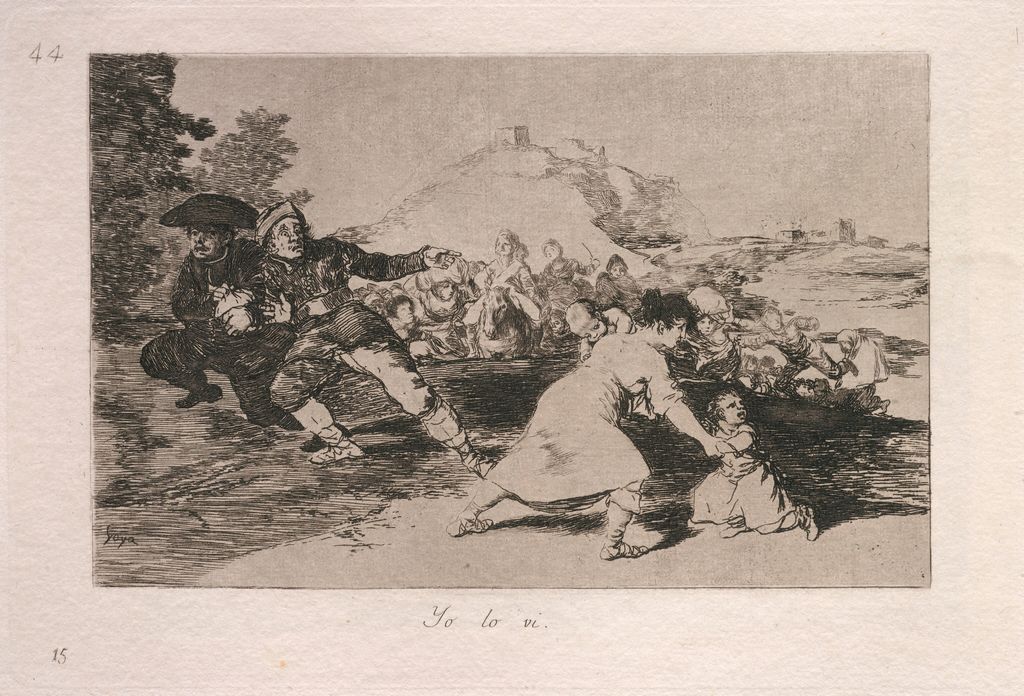
Francisco de Goya could make a coat look pale in an etching simply by leaving room for the paper to show. In Yo lo vi (I Saw It), the woman carrying a child stands out because the folds of her clothing are drawn with relatively few dark marks. Around her, the lines gather into knots of people and baggage. The Metropolitan Museum of Art’s proof of this print, Plate 44 of The Disasters of War, makes it possible to study those marks before the plate was lettered with the words that give the work its title. Those words appear in the first edition, printed in Madrid in 1863. Here the image on the paper preserves two moments in the life of the copperplate. [1] [2]
Etching gave Goya a way to draw on copper, and aquatint let him distribute darkness across it in broad patches. He could also incise a line by hand, polish an area to coax light out of it or leave a thin film of ink when wiping the plate. These actions can produce superficially similar effects on paper. Comparing identified impressions makes it easier to see what changed and to understand which marks the copper itself could account for. [3] [4]
At a Glance
- EtchingAcid bites lines exposed by a needle through a protective ground on a copperplate.
- Aquatint and lavisAcid also makes passages of tone. Aquatint uses a granular ground. Lavis creates a wash-like effect by biting exposed metal directly.
- Drypoint and burinThese tools work directly on the copper. A drypoint burr can print a velvety edge. An incision made with a burin can print a clean, controlled line.
- BurnishingSmoothing worked metal reduces the ink it holds and can bring light back into a shadow.
- Impression, state and editionAn impression is one printed sheet. A state describes the plate at a particular stage of its working. An edition is an issue of impressions published together. [3] [5]
From copper to paper
In 1778 Goya made an etching after Velázquez’s portrait of the Count-Duke of Olivares on horseback. In the Met’s first-edition sheet (31.31.15, Harris 10 III.1), etched lines carry much of the design. Look from the compact dark lines around the rider and horse towards the distant action. The people and horses of the battle take less space in the print than they do in the painting, with stretches of copper left unworked. Where sparse strokes give way to dense hatching, the image changes in value even though the individual marks remain visible. Goya used the spacing of the lines and the extent of the intervening paper to give the rider greater presence. The Met’s online record lists etching for this sheet and its collection catalogue also records drypoint. [6] [18]
The first place to imagine these lines is in the ground. This acid-resistant coating covered the copper. Goya drew into it with a needle, exposing metal along the route taken by the point. Acid bit the exposed copper and left the protected surface intact. He could cover lines already bitten with stop-out varnish and allow the exposed work to bite further. A deeper line could hold more ink and print more strongly. Biting gave him another chance to control the emphasis of a stroke after drawing it. [3]
The design could begin on a separate sheet. Conservators at the National Gallery of Victoria have examined preparatory drawings where the edge of a plate left a mark on the paper. Goya could lay a chalk drawing face down and pass it through the press against the prepared plate. Chalk transferred to the ground gave him a guide for the needle. The transfer reversed the drawing on the copper. Printing reversed the copper image on the paper. Comparing one of these drawings with its print can show which contours survived the journey and which Goya simplified or strengthened as he worked. The page on Goya’s drawings follows those sheets as drawings in their own right. [7]
After biting, the ground came off and the printer worked ink into the recesses. Wiping cleared ink from the flat surface to the degree the printer wanted. Then a roller press forced damp paper into the worked areas to pick up the ink. Pressure could also leave a rectangular indentation where the sheet met the plate edge. That indentation is the plate mark. It records the contact between paper and copper and can have different dimensions from the depicted scene and from the whole sheet. A tightly cropped reproduction often loses the margin where it is easiest to recognise. [3]
What the line can tell you
Goya could return to the bitten design and work directly on the copper. A drypoint needle scratches the metal and pushes up a ridge called a burr. The burr traps ink beside the scratched line, producing a soft fringe. Burr can wear down during printing, and Goya sometimes burnished it off when he wanted a discreet alteration. A burin, pushed into the plate, cuts a V-shaped groove and can give a sharply defined stroke. Goya could use it to reinforce a line that was already etched. Look at several marks together before reading a feathered edge as drypoint or a sharp one as burin. Ink, the condition of the copper and the quality of the reproduction all affect how those edges appear. [3] [8]
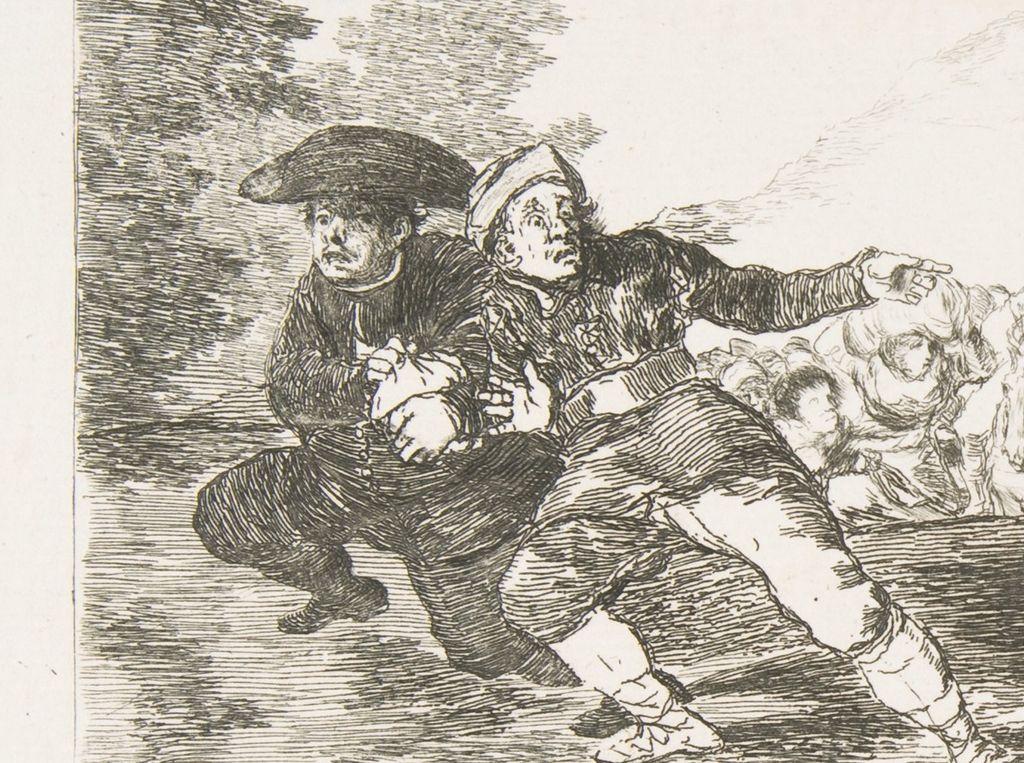
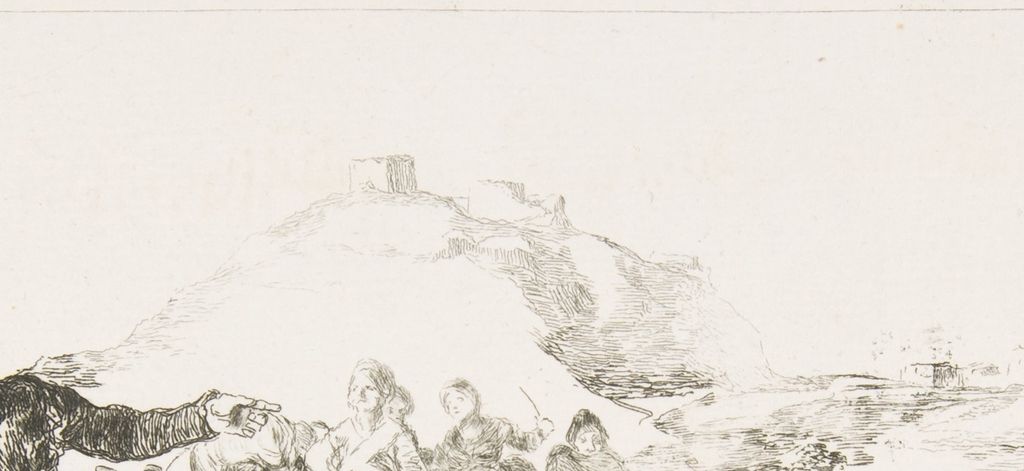
In the Met’s proof of Yo lo vi (32.62.2), the woman’s clothing gives the eye a little open space amid the accumulation of thinner, darker strokes. Farther back, weave your eye through the people and animals where the marks crowd together. On a close view, parts of what initially look like patches of darkness resolve into individual strokes. The Met and the Real Academia de Bellas Artes de San Fernando both identify etching, drypoint and burin in their respective impressions. That identifies the techniques present. The clothing and crowd show their overall effect on the scene, and a viewer can follow that effect without assigning every mark to a particular tool. [1] [2]
When the letters appeared on Plate 44
Start at the foot of the plate. The Met calls 32.62.2 a proof before lettering. The Academy’s 1863 impression, R-3550-1, has Yo lo vi below the scene. The title that a museum gives a proof on its website can come from the published print, so check the image and inscription fields before assuming the title is carried on the sheet. The Academy also transcribes the numbers 44 and 15 and the name Goya in its first-edition record. Its catalogue groups the Met sheet with several examples of the same pre-lettering state, including the impression in Goya’s album for Juan Agustín Ceán Bermúdez. It also identifies a proof before the lettering and numbering in Paris. The terms describe stages of working with greater precision than the word ‘proof’ alone. [1] [2]
A first edition is dated by publication. Goya made the image in his lifetime and the Academy’s first edition was printed by Laurenciano Potenciano’s workshop in 1863, after Goya’s death. The Academy’s copy belongs to that issue and its paper has a José García Oseñalde watermark. In this case the lettering records a change in the copper and the printing record situates the sheet within an edition. A difference in overall darkness requires other evidence. Conservators at the National Gallery of Victoria describe substantial surface tone in the first edition of the Disasters. Ink remaining on the surface after wiping can print grey over areas where the copper retained few incisions. An image-wide grey cast, on its own, gives little basis for dating an impression or identifying aquatint. [2] [5] [4]
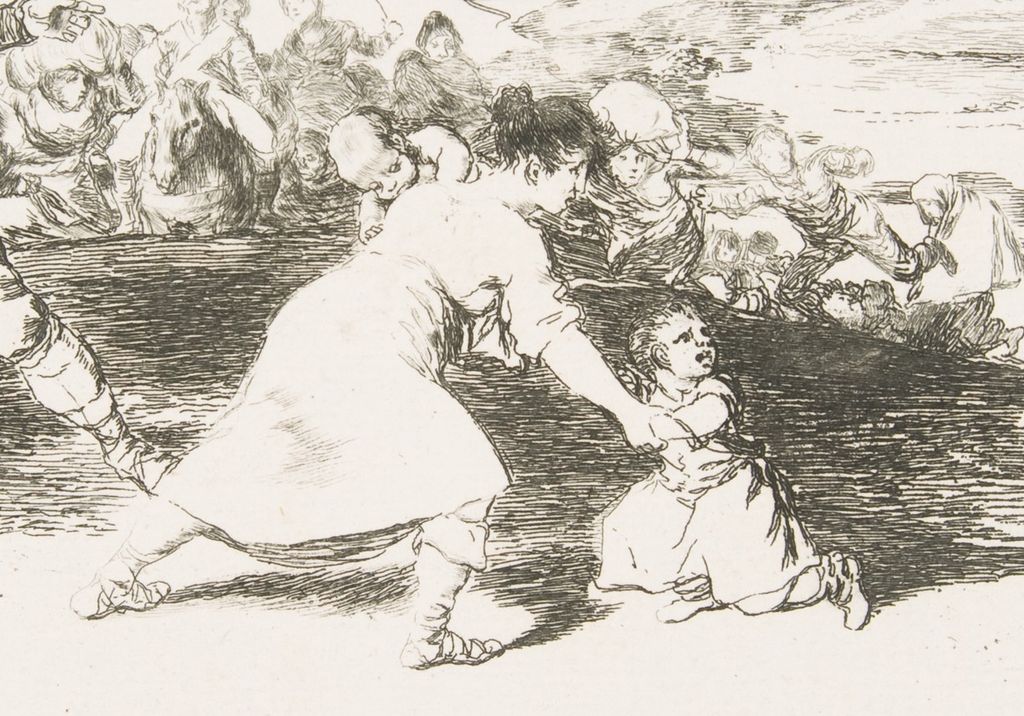
Annotated Details from I Saw It, proof before lettering
Follow the dark lines through the foreground and look at the unlettered area beneath the scene.
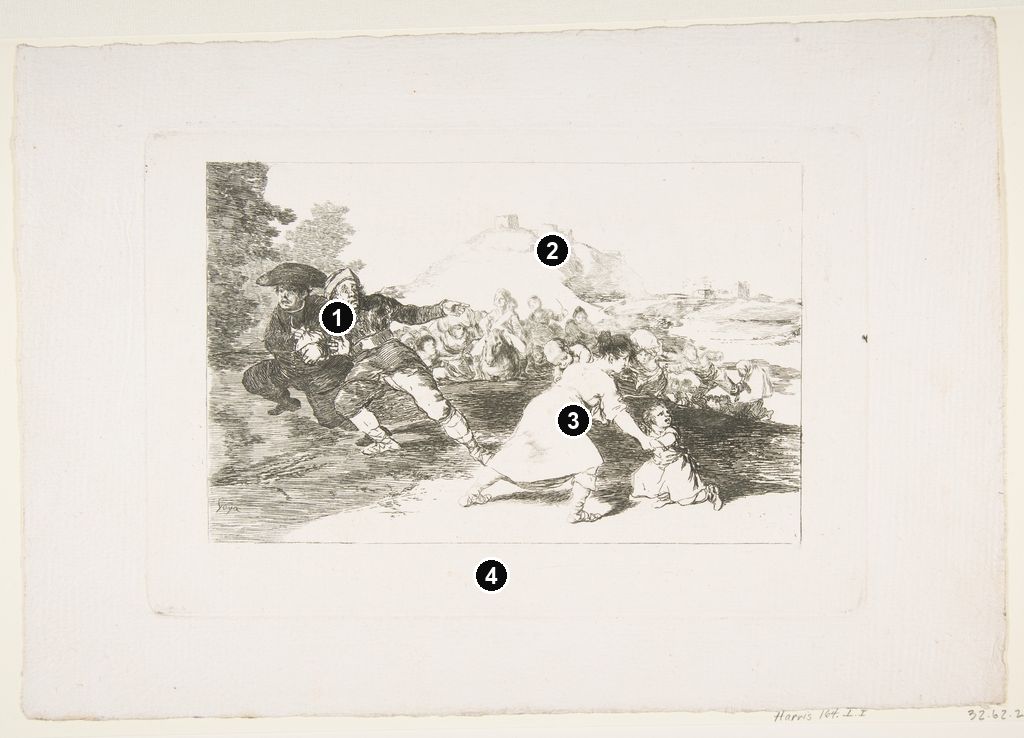
Details from I SAW IT, PROOF BEFORE LETTERING
Details from the proof impression in the Metropolitan Museum of Art (32.62.2).
Dark line and light paper
Intersecting dark lines give the two figures’ clothing weight. The paper left bare between marks creates the lighter creases.
The distant hillside
The lightly marked hillside makes a contrast with the densely worked tree and clothing.
A pale foreground figure
The pale dress breaks across the dark strokes behind it. Narrow lines define parts of the hem and the extended arm.
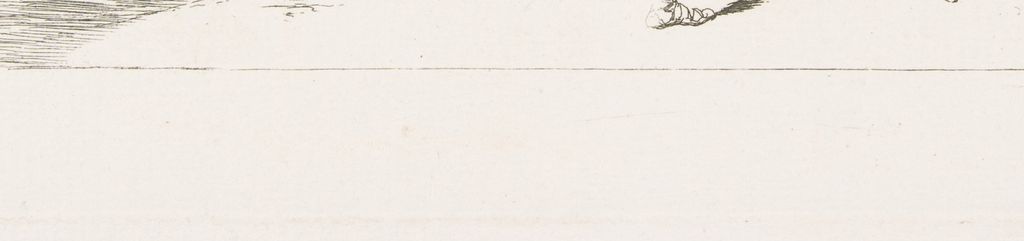
The area left unlettered
The paper under the scene carries no printed title here. Its lower plate mark is faintly visible beyond the image edge.
Goya on film
Five films explore Goya’s portraits, prints, Black Paintings and painting techniques.
The Duke of Wellington by Goya
The portrait, its military decorations and its later theft.
Watch on YouTubeHow Goya made a shadow
In aquatint, particles of resin are fused to the copper. Acid bites around these protected specks, leaving a fine network of recesses to hold ink. Printed together, the tiny marks read as an area of tone. A short bite can make a light tone and further biting can deepen unprotected areas. The grain also changes with the size of the particles. Burnishing brings the tone in the opposite direction. By smoothing a pitted area Goya could reduce its capacity to hold ink and produce a highlight within a passage he had already darkened. In Los Caprichos, NGV conservators identify this action on the donkey’s hind leg in Plate 38, ¡Brabísimo!. The light around that leg was worked back into the copper through areas of both etching and aquatint. [3] [9]
Lavis offers another way of biting tone. The term comes from the French for wash. With no granular ground in the way, acid on the bare metal makes a wash-like patch. For a documented example, look at the grey field surrounding the pale bonnet and dress in the NGV’s first-edition impression of Lo peor es pedir (The Worst Is to Beg), Plate 55 of the Disasters. The gallery’s conservators identify lavis in the background. The technique is worth distinguishing from ink retained during wiping. Lavis changes the metal. Surface tone can change at the next inking. [10] [4]
From a working proof to the published Plate 69
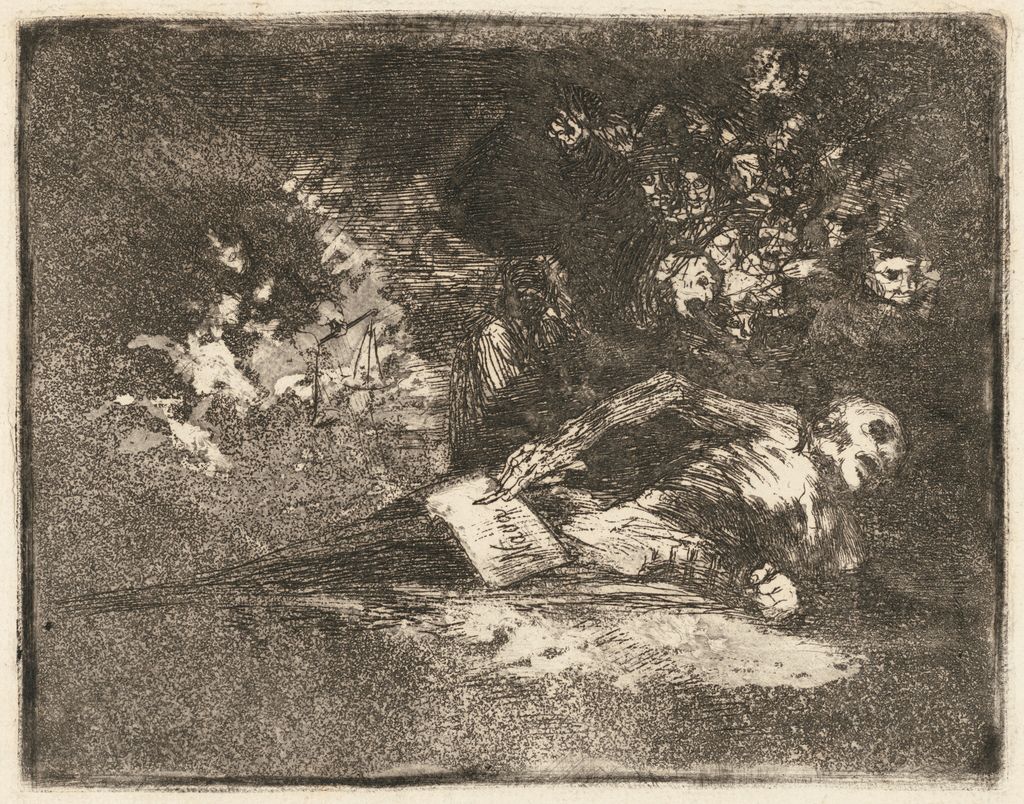
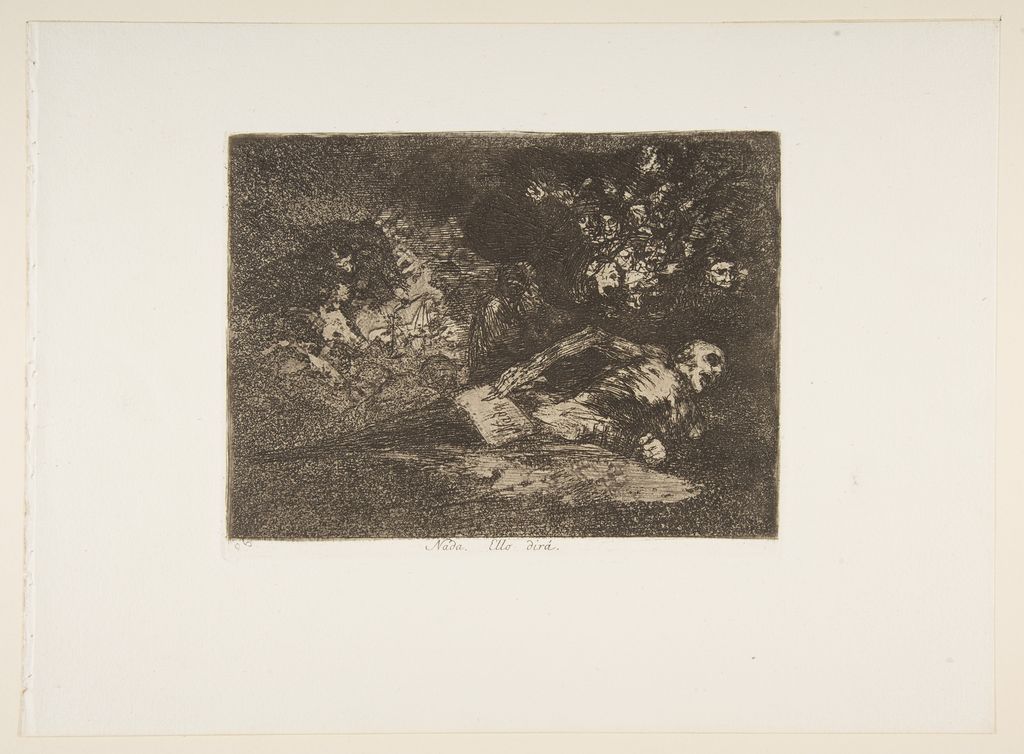
In Nada (Nothing), a corpse sprawls low in the image with a writing surface at its hand. Dark forms press in behind it. The National Gallery of Art in Washington identifies its early impression 1943.3.4718 as Harris 189, state I(2), a working proof on laid paper. Its medium line includes etching, aquatint, lavis and burnishing. Set it alongside the Met’s impression from the 1863 publication, 22.60.25(69). Start with the pale body and the dark cluster behind and above it, then come down to the inscription beneath the image. The placement of the lights and darks belongs to the proof as well as to the publication. The Met also lists drypoint and burin in the published sheet. The Calcografía’s matrix record traces several intermediate impressions, documenting a sequence in which tone and further incisions were added. Those records provide firmer evidence of the sequence than variations in the black levels of two digital images. [11] [12] [13]
At the left, look for the scales and the figure holding them. Fundación Goya en Aragón identifies the figure as a possible allegory of Justice. It records that she is clear in the earliest proof and recedes as Goya builds up the aquatint. The developing darkness makes a detail that once read readily harder for the viewer to find. [14]
Notice where Nada appears within the image, then look for Nada. Ello dirá under it in the published sheet. The first is part of what the figure presents to the viewer. The complete phrase beneath the scene also belongs to the history of publication. Fundación Goya en Aragón records Goya’s handwritten Nada. Ello dice in the Ceán album and the Academy’s use of the future tense dirá on the plate for the first edition. One formulation gives the figure’s statement the force of something already said. The other points towards what will be told. The matrix catalogue identifies the preparatory drawing as Prado D004170. The drawing, working proof, handwritten album caption and engraved publication allow different questions about the work to be answered from different objects. [12] [13] [14]
How a landscape became two war plates
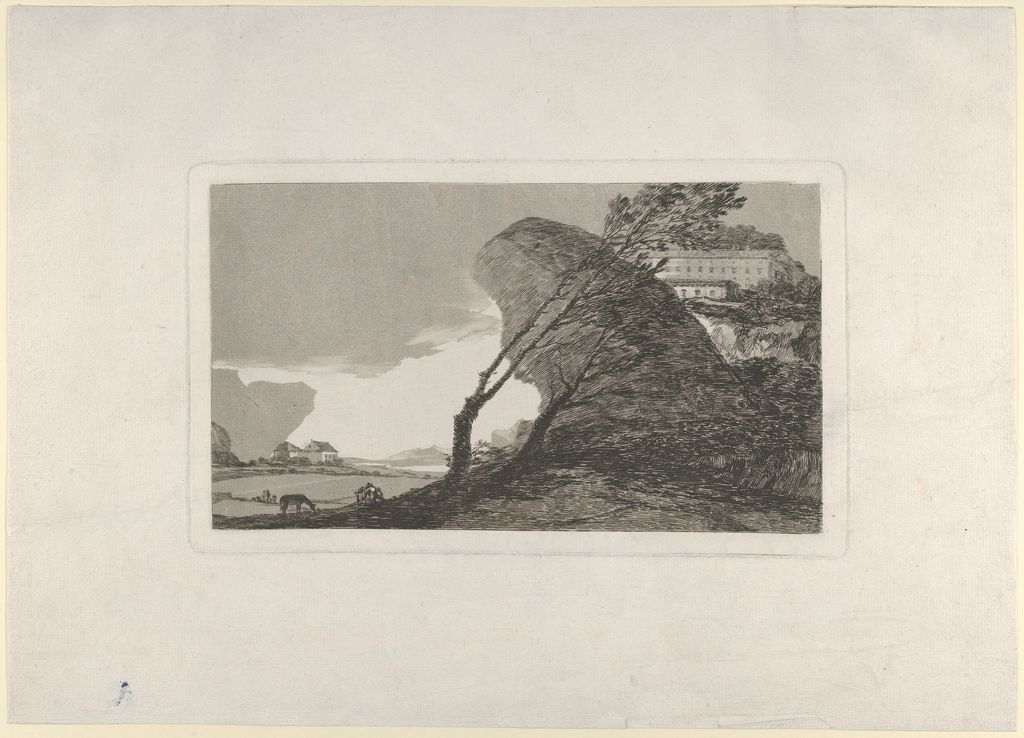
Buildings and small figures sit below looming forms in the Met’s Landscape (2015.539), an etching and aquatint made around 1807–10. Its wide view exists intact on this lifetime impression. By about 1810 Goya had cut the copperplate in two. On the back of one half he made Amarga presencia (Bitter to Be Present), Plate 13 of the Disasters. The reverse of the other half became Plate 15, Y no hai remedio (And There’s No Remedy). The Met and NGV conservators identify the halves. The Met proposes a shortage of copper near the start of the Peninsular War as the likely reason for the reuse. The old landscape and the two war scenes occupied opposite faces of the same metal. [15] [16]
Around 1920 the halves were temporarily fitted together to print the landscape again. The Met points to British Museum impression 1975,1025.32 as evidence of the cut: the join interrupted the printed view. The line was a consequence of the plate’s physical history, even though the landscape design itself was far older. Still later preservation work has its own chronology. The Academy describes metal coatings applied after Goya’s lifetime to protect matrices used for repeated printing. Its conservation programme addresses corrosion associated with the contact between the copper and some of those coatings in humid conditions. A surviving plate can therefore bear evidence of Goya’s tools, later printing and subsequent preservation on the same piece of metal. [15] [17]
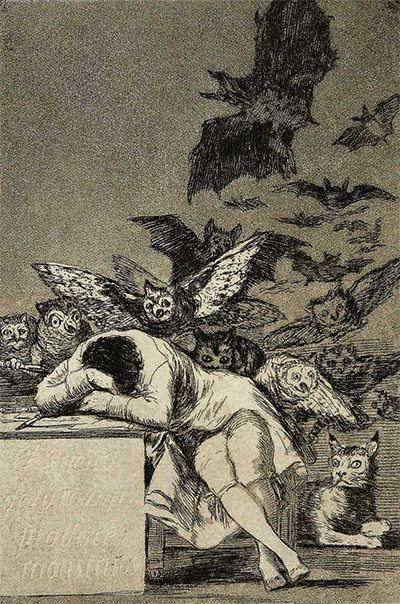
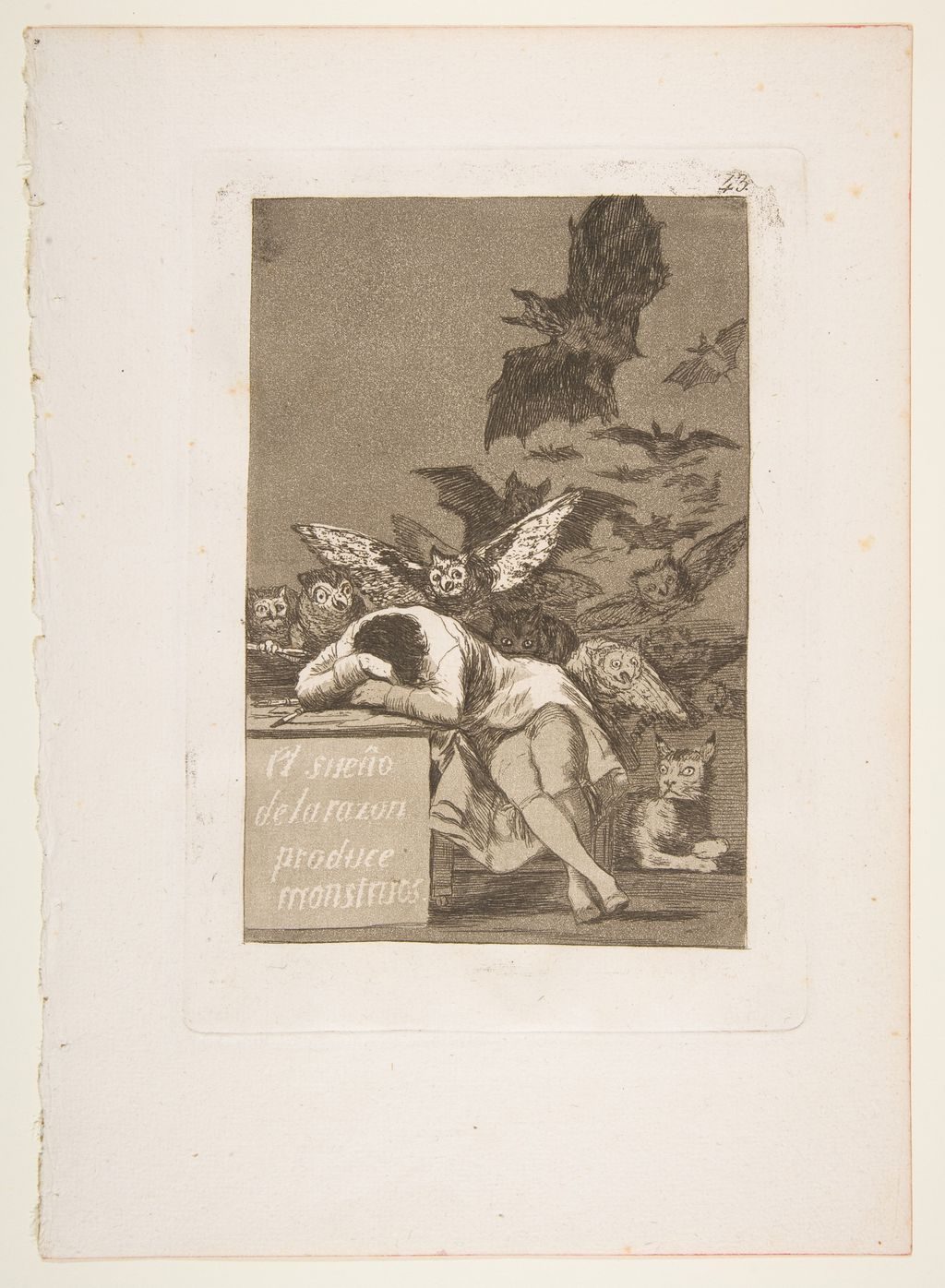
For a wider view of the series and the move into lithography, see Goya’s prints. The Sleep of Reason Produces Monsters offers another close look at the way etched lines emerge from aquatint.
Related print series
Artworks directory
| Name | Date | Medium |
|---|---|---|
| And There’s No Help for It, Plate 15 | Printed 1863 | |
| Asmodea | c. 1820–23 | Wall painting transferred to canvas |
| Boys Inflating a Bladder | 1777–78 | Tapestry cartoon |
| Boys Picking Fruit | 1778 | Tapestry cartoon |
| Bullfight in a Divided Ring | 1825 | Lithograph |
| Card Players | 1777–78 | Tapestry cartoon |
| Card Players (sketch) | 1777–78 | Painted sketch |
| Dance on the Banks of the Manzanares | 1777 | Tapestry cartoon |
| Duel with Cudgels | c. 1820–23 | Wall painting transferred to canvas |
| Heads in a Landscape | c. 1820–23 | Easel painting |
| Judith and Holofernes | c. 1820–23 | Wall painting transferred to canvas |
| Leocadia | c. 1820–23 | Wall painting transferred to canvas |
| Maja and Cloaked Men | 1777 | Tapestry cartoon |
| Maja and Cloaked Men (sketch) | 1777 | Painted sketch |
| Majo Clapping in Time to the Music | 1777 | Drawing |
| Men Reading | c. 1820–23 | Wall painting transferred to canvas |
| Out Hunting for Teeth, Plate 12 | 1799 | Etching, burnished aquatint and burin |
| Picnic in the Countryside (sketch) | 1776–78 | Painted sketch |
| Picnic on the Banks of the Manzanares | 1776 | Tapestry cartoon |
| Pilgrimage to San Isidro | c. 1820–23 | Wall painting transferred to canvas |
| Preparatory study for The Sleep of Reason Produces Monsters | c. 1796–97 | Drawing |
| Procession of the Holy Office | c. 1820–23 | Wall painting transferred to canvas |
| Quarrel at the Cockerel Inn (sketch) | 1777 | Painted sketch |
| Quarrel in the New Tavern | 1777 | Tapestry cartoon |
| Saturn Devouring His Son | c. 1820–23 | Wall painting transferred to canvas |
| Seated Majo Smoking | c. 1776 | Drawing |
| The Dog | c. 1820–23 | Wall painting transferred to canvas |
| The Drinker | 1777 | Tapestry cartoon |
| The Fates | c. 1820–23 | Wall painting transferred to canvas |
| The Great He-Goat | c. 1820–23 | Wall painting transferred to canvas |
| The Kite | 1777–78 | Tapestry cartoon |
| The Parasol | 1777 | Oil on canvas, tapestry cartoon |
| The Second of May 1808 | 1814 | Oil on canvas |
| The Sleep of Reason Produces Monsters, Plate 43 | 1799 | Etching and aquatint |
| The Third of May 1808 | 1814 | Oil on canvas |
| Thou Who Canst Not, Plate 42 | 1799 | Etching and burnished aquatint |
| Three Figures | 1776 | Drawing (lost) |
| Two Old Men | c. 1820–23 | Wall painting transferred to canvas |
| Two Old Men Eating Soup | c. 1820–23 | Wall painting transferred to canvas |
| Two Women and a Man | c. 1820–23 | Wall painting transferred to canvas |
| Universal Language: The Author Dreaming | 1797 | Drawing |
| The Family of Charles IV | 1800 | Oil on canvas |
| Witches’ Sabbath (Osuna painting) | 1797–98 | Oil on canvas |
| The Nude Maja | 1795–1800 | Oil on canvas |
| The Clothed Maja | 1800–07 | Oil on canvas |
| Self-Portrait (Drawing) | c. 1796 | Brush and carbon black ink on laid paper |
| The Swing, Madrid Album B.21 | 1795–97 | Brush and carbon black washes |
| Majas Fighting, a Majo Observing, Madrid Album B.15 | 1796–97 | Brush, grey and black washes on laid paper |
| Majos and Majas Conversing, Madrid Album B.16 | c. 1794–97 | Ink wash on paper |
| Weeping Woman and Three Men, Madrid Album B.17 | 1795–97 | Brush, carbon black washes and black chalk |
| Maja Seated on a Chair and Two Companions Behind, Madrid Album B.18 | 1795–97 | Brush and carbon black washes |
| Girl and Bull, Madrid Album B.23 | 1796–97 | Brush and carbon black washes |
| Lovers Sitting on a Rock, Madrid Album B.24 | 1796–97 | Brush and carbon black washes |
| Mariano Ceballos Riding a Bull | 1825 | Crayon lithograph and scraper |
| Landscape (lifetime impression) | c. 1807–10 | Etching and aquatint |
| Self-Portrait (1815), Prado canvas | 1815 | Oil on canvas |
| Self-Portrait (1815), Academy panel | 1815 | Oil on panel |
| Self-Portrait with Dr Arrieta | 1820 | Oil on canvas |
| Christ Crucified | 1780 | Oil on canvas |
| The Last Communion of Saint Joseph of Calasanz | 1819 | Oil on canvas |
| Christ on the Mount of Olives | 1819 | Oil on panel |
| The Flower Girls, or Spring | 1786–87 | Oil on canvas |
| The Grape Harvest, or Autumn | 1786–87 | Oil on canvas |
| The Snowstorm, or Winter | 1786–87 | Oil on canvas |
| The Threshing Ground, or Summer | 1786–87 | Oil on canvas |
| Picnic on the Banks of the Manzanares | 1776 | Oil on canvas |
| The Kite | 1777–78 | Oil on canvas |
| Dance on the Banks of the Manzanares | 1777 | Oil on canvas |
| A Fight at the Venta Nueva | 1777 | Oil on canvas |
| Blind Man’s Bluff | 1788 | Oil on canvas |
| Dogs on a Lead | 1775 | Oil on canvas |
| Hunting with a Decoy | 1775 | Oil on canvas |
| Hunter Loading His Rifle | 1775 | Oil on canvas |
| The Angler | 1775 | Oil on canvas |
| The Hermitage of San Isidro on His Feast Day | 1788 | Oil on canvas |
| The Meadow of San Isidro | 1788 | Oil on canvas |
| The Straw Manikin | 1791–92 | Oil on canvas |
| Witches’ Flight | c. 1797–98 | Oil on canvas |
| A Scene from ‘The Forcibly Bewitched’ | 1798 | Oil on canvas |
| The Duchess of Alba in Black | 1797 | Oil on canvas |
| The Duchess of Alba in White | 1795 | Oil on canvas |
| Charles III in Hunting Dress | c. 1786 | Oil on canvas |
| The Duke and Duchess of Osuna and Their Children | 1787–88 | Oil on canvas |
| Manuel Osorio Manrique de Zúñiga | 1787–88 | Oil on canvas |
| The Marquesa de Pontejos | c. 1786 | Oil on canvas |
| Equestrian Portrait of the 1st Duke of Wellington | 1812 | Oil on canvas |
| The Duke of Wellington | 1812–14 | Oil on wood |
| Portrait of Ferdinand VII of Spain | 1814 | Oil on canvas |
| Gaspar Melchor de Jovellanos | 1798 | Oil on canvas |
| María Tomasa Palafox y Portocarrero | 1804 | Oil on canvas |
| Señora Sabasa García | c. 1806–11 | Oil on canvas |
| Don Juan Bautista de Muguiro | 1827 | Oil on canvas |
| Doña Isabel de Porcel | Before 1805 | Oil on canvas |
| The Colossus | After 1808 | Oil on canvas |
| The Burial of the Sardine | 1808–12 | Oil on panel |
| The Madhouse | 1808–12 | Oil on panel |
| A Procession of Flagellants | 1808–12 | Oil on panel |
| Portrait of Jacques Galos | 1826 | Oil on canvas |
| Portrait of Mariano Goya, the Artist’s Grandson | 1827 | Oil on canvas |
| Milkmaid of Bordeaux | c. 1827 | Oil on canvas |
| Portrait of Don Juan Antonio Cuervo | 1819 | Oil on canvas |
| María Luisa of Parma (Naples version) | c. 1800 | Oil on canvas |
| The Countess of Baena | 1819 | Oil on canvas |
| The Family of the Infante Don Luis | 1783–84 | Oil on canvas |
| The Holy Family | c. 1787 | Oil on canvas |
| Saint Barbara | c. 1773 | Oil on canvas |
| Saints Justa and Rufina | 1817 | Oil on canvas |
| El Tío Paquete | c. 1819–20 | Oil on canvas |
| The Forge | c. 1815–20 | Oil on canvas |
| Majas on a Balcony (Metropolitan Museum version) | c. 1800–10 | Oil on canvas |
| Maja and Celestina on a Balcony | c. 1808–12 | Oil on canvas |
| The Water Bearer | 1808–12 | Oil on canvas |
| Time and the Old Women | c. 1810 | Oil on canvas |
Frequently Asked Questions
The first edition dates an issue of prints. Goya lived to publish Los Caprichos in 1799. The Academy published the first edition of The Disasters of War in 1863, after his death. The earliest published impressions of that series belong to the later date, even though proofs of individual plates were pulled in Goya’s lifetime. [2] [7]
Follow the dark passage at the scale of the entire image and then move closer. A hatched area resolves into separate strokes, often crossing or running alongside each other. Aquatint commonly resolves into grain. Both can occur in the same passage. A digital image may smooth fine marks or exaggerate texture, so use the medium and technical notes for the particular impression alongside what you see. [3]
It describes an impression pulled at a stage when the lettering in question had yet to be added to the plate. A proof can already carry numbers or marks, or have writing added by hand on the paper. Plate 44 is catalogued both before lettering and, at an earlier stage, before lettering and numbering. [2]
Discussion
Look again at the images and ideas explored in Goya’s etchings. These editorial prompts invite your observations.
Put the two versions of Yo lo vi side by side. Where does your eye go first when the space for the caption is blank? When you can read the caption, does the first-person voice change how you look at the figures?
Reader Insights
Which part of a print can help you identify its state?
How does the same impression use line and tone to direct your eye?
Join the Conversation
Share a detail, comparison or question about Goya’s etchings below.
References
- The Metropolitan Museum of Art. Yo lo vi, Plate 44, proof before lettering, 32.62.2. View source.
- Calcografía Nacional, Real Academia de Bellas Artes de San Fernando. Yo lo vi, first edition, 1863, R-3550-1, with related proofs and records. View source.
- Museo Nacional del Prado and National Gallery of Victoria. Goya: Drawings from the Prado Museum, glossary of technical terms. View source.
- National Gallery of Victoria. Impossible Monsters, ‘Printing: Ink’. View source.
- National Gallery of Victoria. Impossible Monsters, ‘Editions’. View source.
- The Metropolitan Museum of Art. Gaspar de Guzmán, Count Duke of Olivares on horseback, after Velázquez, 1778, 31.31.15. View source.
- National Gallery of Victoria and Museo Nacional del Prado. Goya: Drawings from the Prado Museum, exhibition text on preparatory drawings and etching. View source.
- National Gallery of Victoria. Impossible Monsters, ‘Drypoint’. View source.
- National Gallery of Victoria. Impossible Monsters, ‘Highlighting Techniques: Burnishing’, fig. 28. View source.
- National Gallery of Victoria. Impossible Monsters, ‘Direct Etching (Lavis)’, fig. 27. View source.
- National Gallery of Art, Washington. Nada, Plate 69, Harris 189 I(2), working proof, 1943.3.4718. View source.
- The Metropolitan Museum of Art. Nada. Ello dirá, Plate 69, published 1863, 22.60.25(69). View source.
- Calcografía Nacional, Real Academia de Bellas Artes de San Fernando. Nada. Ello dirá, copperplate M-3575, related states and preparatory drawing. View source.
- Fundación Goya en Aragón. Nada. Ello dirá, catalogue no. 839, caption in the Ceán album. View source.
- The Metropolitan Museum of Art. Landscape, c. 1807–10, lifetime impression, 2015.539. View source.
- National Gallery of Victoria. Impossible Monsters, ‘Copperplate supply’, figs. 4–5. View source.
- Real Academia de Bellas Artes de San Fernando. ‘Conservación de las láminas de Goya’. View source.
- The Metropolitan Museum of Art. Goya in The Metropolitan Museum of Art, collection checklist under ‘Etchings After Velázquez’. View source.







