


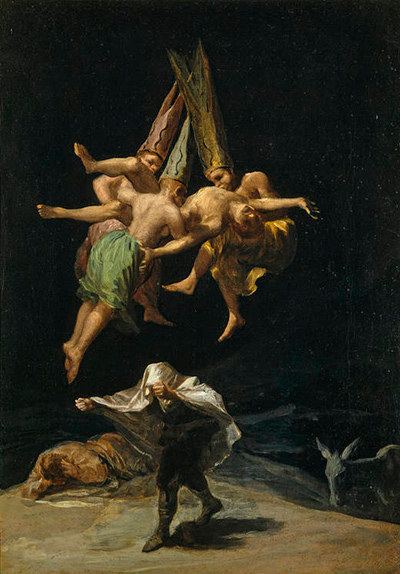
 by Tom Gurney
Tom Gurney BSc (Hons) is an art history expert with over 20 years experience
Published on June 19, 2020 / Updated on November 20, 2026
Email: tomgurney1@gmail.com / Phone: +44 7429 011000
Introduction
A small heart, drawn with two arteries and a network of vessels, opens a letter Francisco de Goya sent from Madrid to his friend Martín Zapater on 10 November 1790. Goya had just come home to find his young son stricken with smallpox. He asked his friend, “Can you imagine how I feel?” Beneath the signature he wrote that forty days would have to pass before he could enter the palace. On one sheet of paper, a father’s alarm and the practical restrictions on a royal painter take up almost the same space. The boy, Javier, recovered and was the only child of Goya and Josefa Bayeu to survive his parents. [1] [2]
Following Goya’s career through records like this one brings into view the people who taught him, paid him, nursed him, sat for him and printed his work. The registers are particularly good at telling us when a rank changed. A partly used notebook or a set of engravings can tell us something else about the time a painter made for his own projects. Several kinds of work ran alongside each other throughout Goya’s life. In 1799, for instance, he offered a set of satirical prints for sale in Madrid and attained the highest rank among the king’s painters. [2] [3]
At a Glance
- LifeBorn on 30 March 1746 in Fuendetodos, Aragón. Died on 16 April 1828 in Bordeaux, France. [4]
- TrainingApprenticed to José Luzán in Zaragoza, trained with Francisco Bayeu and studied in Italy before returning to Spain in 1771. [2] [5]
- Royal appointmentsPainter to Charles III in 1786, painter of the chamber to Charles IV in 1789 and first painter of the chamber in 1799. [3]
- Working mediaOil paintings for weaving, walls and easels, drawings and prints, including the etchings and aquatints of Los Caprichos and the lithographs of The Bulls of Bordeaux. [2] [6] [7]
- Last yearsTravelled to France on royal leave in 1824. Made Bordeaux his principal home and returned to Spain for visits. [2] [3]
Goya in context
Neoclassicism
c. 1750–1850 [47]Romanticism
c. 1800–1850 [48]Francisco de Goya
1746–1828 [49]Saint Barbara
c. 1773Dogs on a Lead
1775The Angler
1775The Drinker
1777The Parasol
1777The Kite
1777–78Christ Crucified
1780The Flower Girls, or Spring
1786–87The Grape Harvest, or Autumn
1786–87Charles III in Hunting Dress
c. 1786The Marquesa de Pontejos
c. 1786The Snowstorm, or Winter
1786–87The Holy Family
c. 1787The Straw Manikin
1791–92Self-Portrait (Drawing)
c. 1796The Swing, Madrid Album B.21
1795–97Witches’ Flight
c. 1797–98The Nude Maja
1795–1800The Clothed Maja
1800–07Doña Isabel de Porcel
Before 1805Señora Sabasa García
c. 1806–11The Colossus
After 1808Maja and Celestina on a Balcony
c. 1808–12The Water Bearer
1808–12Time and the Old Women
c. 1810The Duke of Wellington
1812–14The Burial of the Sardine
1808–12The Madhouse
1808–12A Procession of Flagellants
1808–12The Forge
c. 1815–20Asmodea
c. 1820–23Duel with Cudgels
c. 1820–23Heads in a Landscape
c. 1820–23Judith and Holofernes
c. 1820–23Leocadia
c. 1820–23Men Reading
c. 1820–23Pilgrimage to San Isidro
c. 1820–23Procession of the Holy Office
c. 1820–23Saturn Devouring His Son
c. 1820–23The Dog
c. 1820–23The Fates
c. 1820–23The Great He-Goat
c. 1820–23Two Old Men
c. 1820–23Two Old Men Eating Soup
c. 1820–23Two Women and a Man
c. 1820–23El Tío Paquete
c. 1819–20Bullfight in a Divided Ring
1825Milkmaid of Bordeaux
c. 1827Four stages of Goya’s career
Zaragoza, Rome and Parma
The Italian Notebook preserves preparatory work for the Hannibal competition picture as well as notes written after Goya returned to Spain. [2]
The workshop and the court
The royal tapestry workshop gave Goya a setting for paintings designed to be woven. His appointment as first painter of the chamber came in 1799. [2]

Changing patrons and audiences
Goya painted the royal family and later made canvases and prints responding to the occupation of Spain and the war. [2]


Fuendetodos, Zaragoza and the years of training
The Fuendetodos baptism entry is unusually clear about the first two days of Goya’s life. On 31 March 1746, the vicar José Jimeno recorded baptising a boy born the preceding day to Joseph Goya and Gracia Lucientes. The parents were resident in the parish at the time and were described as people of Zaragoza. The boy was registered as Francisco Joseph Goya. The two places in the entry matter because Goya grew up and found his first teachers in the city, even though the family was in his mother’s village at his birth. The Fundación Goya en Aragón suggests that building work on the family house in Zaragoza may help explain their temporary stay. The baptism establishes their presence in Fuendetodos and leaves the motive open. [2] [3]
His father gilded altarpieces. Gilding belonged to the larger business of fitting out church interiors, work in which painted, carved and gilded surfaces had to be completed to an agreed design. Goya’s elder brother Tomás followed their father into that trade. The young Francisco took up painting at the workshop of José Luzán Martínez, whose family also had professional ties to Goya’s father. Goya recalled late in life that he had spent four years with Luzán, learning the principles of drawing by copying prints his teacher supplied. That account explains the exercise more securely than it fixes the first day of training. Javier later said his father had started at thirteen, close to the conventional dating of the apprenticeship to around 1760. Copying a print gave a student a composition already arranged on paper and the task of resolving its proportions, outlines and shading with his own hand. [2] [3] [5]
The Fundación’s biography places his first entry for a Madrid Academy competition in late 1763. The dates used for that venture can reflect the call for applicants and the subsequent adjudication. He tried again in 1766 and failed to secure an award on either occasion. By this time another Zaragoza painter was making a career at court. Francisco Bayeu had gone to Madrid to work under Anton Raphael Mengs in the royal service. In 1783, giving testimony for the marriage of one of Bayeu’s sisters, Goya said that he had known her for about twenty years through learning his profession in Francisco’s house. That is evidence of the connection from Goya himself. The extent and continuity of his early work under Bayeu are harder to reconstruct, even though the two men would later deal with each other as professional colleagues and brothers-in-law. [2] [3] [5]
Rome, Parma and the Italian Notebook
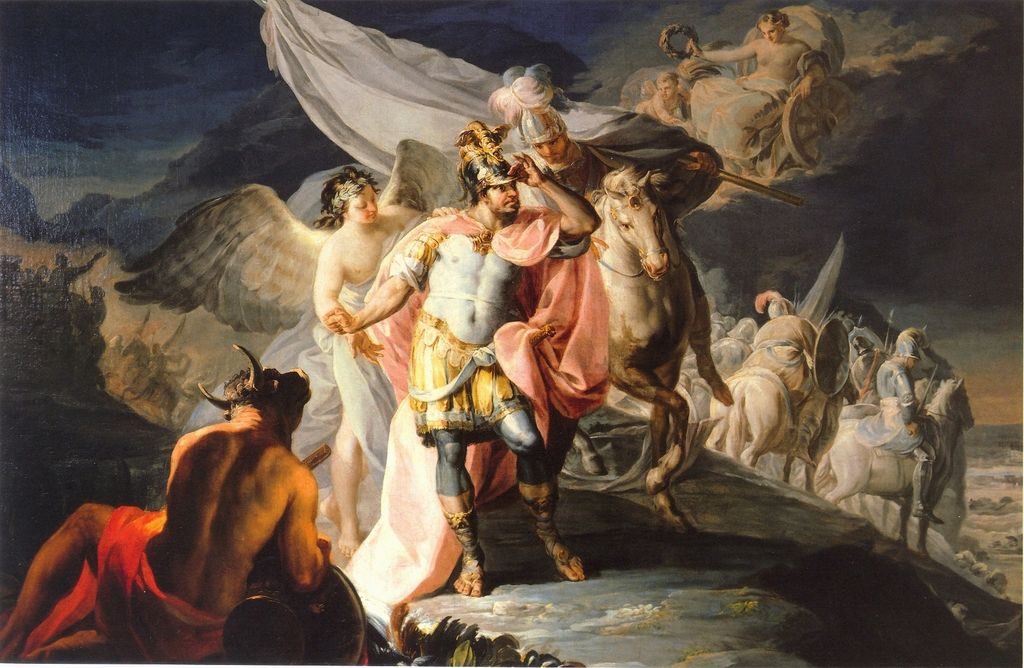
Goya travelled to Italy without the Madrid Academy pension. The Thyssen places the journey in 1770, while the Spanish archives’ authority record gives 1769–71 for his Italian travels. His exact date of departure is uncertain. A firmer date comes from the correspondence for the Parma Academy competition. Writing from Rome on 20 April 1771, Goya informed the Academy’s secretary, Carlo Gastone Rezzonico, that he had handed his painting over to the post. The Academy had announced the subject the previous year. Entrants were to show Hannibal looking down on Italy from the Alps for the first time. A foreign competitor could work outside Parma under the supervision of an appropriate academician. Thus Goya’s entry establishes that he was working in Rome and sending a picture to Parma. [4] [5] [8] [9]
The award followed on 27 June 1771. Paolo Borroni won, and Goya received an honourable mention. A notice printed in January 1772 describes Goya’s entry as the second prize and dates the award ceremony to the preceding June. The Fundación Goya catalogue and chronology distinguish the winner from Goya’s honourable mention. Rosanna Cioffi’s study of the Parma records traces how the judges singled out the handling of the paint and the expressiveness of Hannibal, while finding shortcomings in the composition and colour. Those are different dates in the history of the same competition. The April letter gives us Goya’s own account of the submission, even though the Fundación Goya’s chronology places the dispatch on 20 March. Goya’s painting would itself disappear from the account for a long time. Fortunato Selgas bought it in Madrid in the nineteenth century as an Italian picture. Jesús Urrea identified it in 1993, and it appeared at the Prado the following year. The Fundación Amigos del Museo del Prado purchased and donated it in 2020. It formally presented the gift in 2021. The complete competition canvas belongs to the Prado. The Museo de Zaragoza’s associated oil study is a separate object. [8] [9] [10] [11] [12]
Drawings for the picture survive in the Italian Notebook, which the Prado presented with the rediscovered painting in 1994. In the drawing now catalogued on page 37, a study of a fountain mask overlaps work on Hannibal’s composition. On the finished canvas, the commander reaches the ridge and an allegorical figure directs attention outward. In the foreground, a figure with a bull’s head rises beside a vessel representing the waters of the Po. The river and the view into the distance make Italy present in the picture before Hannibal has set foot in the plain. Taken together, the studies and canvas let a reader follow the preparation of a prescribed subject, including choices Goya made within the terms of the competition. [10] [11] [13] [14]
The notebook travelled back to Spain and remained in use there. Among the sketches are entries for births, alongside expenses and practical notes about supplies. Its connection with the marriage and the household is visible on the same paper that preserves the studies made for a foreign academy. This continuing use places limits on the dates that may be inferred from its pages. There are drawings from Goya’s Italian years and others related to commissions in Spain, and a sheet can contain more than one project. A sketch’s position in the book is only one clue to when he made it. Federica Cappelli compared the place names on the notebook’s back endpaper with the old postal road from Piacenza towards Tortona. Their order suggests a route through northern Italy. This is evidence for a possible journey alongside the more securely dated facts established by the Parma letter. [13] [14] [15] [16]
Marriage, church commissions and the tapestry workshop
By October 1771 Goya was back in Zaragoza, where the authorities of the Basilica of El Pilar were considering him for a fresco on the vault of the small choir. The resulting work, usually called The Adoration of the Name of God, was completed in 1772. It offered him work on a much larger scale than the Hannibal canvas. At the nearby Carthusian monastery of Aula Dei he went on to paint episodes from the life of the Virgin in oil on the walls. The original cycle comprised eleven compositions. These large religious works placed the young Goya in projects where the building governed the shape and position of a scene, and where the institutions administering the work could judge plans before paint went on the wall. [2] [3] [17]
On 25 July 1773, Goya and Josefa Bayeu married in the parish church of Santa María in Madrid. Their first child was born the next year in Zaragoza. Javier was born in Madrid on 2 December 1784. Josefa’s brothers Francisco and Ramón were painters, and the marriage linked two families already acquainted through their work in Zaragoza. Surviving accounts and letters can show when Francisco vouched for or supervised Goya, and individual jobs tell us more about the limits of that support than the marriage record can. Francisco was central to Goya’s entry into work for the royal tapestry factory. The men would also disagree publicly about standards for a fresco. [2] [3] [17]
Goya was submitting invoices for paintings destined for El Escorial by May 1775. His first group for the royal tapestry enterprise consisted of hunting subjects prepared under Bayeu’s direction. Mengs supervised the wider programme for the Crown. In a letter to Zapater of 9 January 1779, Goya distinguished between the design of a little sketch, which he credited to Francisco, and the execution, which he claimed for himself. That distinction helps explain how the factory work could be assigned and divided. In the later groups Goya had scope to devise his own subjects for particular rooms. His accounts list the pictures and their prices. Later bills also record colours, timber stretchers and labour, costs that disappear when the cartoons hang as framed paintings. [2] [3] [6]
A cartoon in this setting is the full-scale painted design to be translated into a woven tapestry. The Parasol of 1777, destined for the dining room of the Prince and Princess of Asturias at El Pardo, is an oil on canvas. The green parasol casts a cool shadow over the face of a seated woman. Its large, clean shape is particularly legible against the sky and the brightly lit costume. The Pottery Vendor, for which Goya presented his account in January 1779, came from a later group for the same palace. The street seller’s wares lie at the level of his customers, with a passing carriage behind. The accumulation of pots, fabrics and figures gave the weavers a substantially different problem from translating the broad planes of The Parasol. The placement, format and eventual manufacture of these works are part of their history as paintings. Goya put a group of prints after Velázquez’s paintings on sale in 1778. He was then making images for two forms of reproduction, designing cartoons on a scale suited to a palace interior and reworking paintings from the royal collection for buyers who could handle the resulting sheets. [3] [6] [18] [19] [9]
Goya returned to the Academy of San Fernando as an established working painter. He submitted Christ Crucified, a life-size figure against a dark background, and was elected an academician of merit on 7 May 1780. The picture isolates the anatomy, the head and the contour of the body. The committee could assess his handling of the figure without the competing effect of a crowd or setting. The questions posed by his next job at El Pilar were different. There he was required to show the Virgin surrounded by martyrs in the dome known as Regina Martyrum, with figures to be read from far below. [3] [17] [20]
The works at El Pilar should be kept apart. The small choir had given Goya his early opportunity. The second project ended in a conflict in 1781 over the dome fresco and the designs for its pendentives. Francisco Bayeu held a supervisory role and the building authorities expected Goya to submit his work for scrutiny. Their letters show the painter having to balance a claim to professional judgement with the requirements of the commission. After mediation Goya agreed to make revisions and sought payment for the work. The letters also show how authority travelled through several hands in a major church project, even when the commission had reached the artist through personal relationships. [2] [3] [17]
A letter in the middle of the workshop years
A letter to Martín Zapater dated 20 October 1781 can be read alongside the pictures Goya made for the royal residences. The Prado preserves it as a material object, with its own date and survival history. Such a letter gives a point on a much finer chronology than the dates of court appointments. It catches Goya still writing to a friend in Zaragoza while his commissions increasingly linked him to institutions in Madrid. The two geographies overlapped. Contact with Aragón continued as he entered court employment and began to receive work from patrons whose commissions were independent of the tapestry factory. [52] [53]
The workshop made demands on Goya that a picture intended for a church or for a private wall did not. A cartoon had to convey a design for a room, with figures and colour masses that another trade could render in yarn. The Prado’s account of the cartoons follows the commissions across different royal residences and gives a way to date artistic choices more precisely than the general description of Goya as a court painter. A lively incident such as the one at the Venta Nueva could belong to a programme sharing walls with scenes of leisure. The success of a single picture was partly a question of how it joined the others at the scale and distance of a furnished room. [52] [53]
Reading official work records and personal letters together also helps explain why Goya's career can appear discontinuous. A royal record measures a delivery, a payment or an appointment. A letter is written for a reader who already knows parts of the writer’s story and often leaves those parts unstated. Where an early biography moves quickly from one commission to the next, looking at the different documents recovers the ties that persisted between jobs. Goya’s letters to Zapater and his surviving designs for El Pardo let the reader follow two of those ties independently. [52] [53]
The record of the letter also survives at the scale of the folded or handled sheet. Its value differs from that of a later extract gathering Goya’s views on painting. A series of dates and recipients can show how long he maintained a relationship while the commissions around him changed. That is a point worth carrying into the years of self-directed work. A model in which Goya leaves one network whenever he finds another obscures how often older friends and professional connections continue to appear. The surviving paper gives a way to follow one of those strands across the divisions of a career. [52] [53]
Portraits, the Banco de San Carlos and the royal appointments
The portraits Goya made for the Infante Don Luis show what the world of a single patron could offer. Don Luis was a younger brother of Charles III, living with his family at Arenas de San Pedro. On 20 September 1783, Goya told Zapater that he had returned from Arenas and had painted individual portraits of the infante, his wife, their son and their daughter. A subsequent visit in 1784 is associated with the large group portrait now at the Fondazione Magnani Rocca. The people assembled around the table include children and members of the household. María Teresa, in white, has her hair attended to, Don Luis handles the cards, and Goya appears beside a big canvas on the left. A single candle lights part of the gathering. The holding collection uses household records to weigh possible identifications of the less securely named sitters. The appearance of a court musician on a payroll gives a reason to consider him among the figures, but leaves the visual identification open. [3] [21]
The Banco de San Carlos offers a different record of how a portrait came about. On 30 October 1784 Goya subscribed for fifteen shares in the bank. In April 1785 its books record 2,328 reales de vellón paid to Juan Agustín Ceán Bermúdez, one of its employees and a friend of Goya, for the portrait of José de Toro-Zambrano y Ureta. The entry names the man reimbursed, while the surviving canvas, bank records for the programme and the history of its attribution together identify the painter. Goya’s purchase of shares is an investment on a separate date. It tells us about his role as a shareholder, leaving the process by which he secured the job open. [3] [15] [22] [23] [24]
The bank commissioned six portraits from Goya between 1785 and 1788, including the king, Charles III, and the Count of Altamira. Its successor, the Banco de España, later acquired additional paintings by him. An oil portrait hanging in the bank’s collection today can therefore have several institutional histories. The six early pictures tell us something unusually concrete about the people a new institution chose to commemorate. The full-length portrait of Francisco Cabarrús was recorded at 4,500 reales in 1788. The bank’s catalogue relates its higher price to the larger format. The account for the king, Altamira and the Marquis of Tolosa gives a combined payment for the three portraits and a separate one for gilding their frames. The painter’s work was one cost in securing finished objects for display. [15] [22] [24]
The commission for Altamira also connects the bank’s collection to the family portraits. The Metropolitan Museum of Art’s Condesa de Altamira and Her Daughter, María Agustina (1787–88) is one of four Goyas depicting members of that family. The child sits high on the mother’s lap, beside the long fall of expensive fabric. The closeness of their placement keeps the eye moving between the two faces and the differences in the way they hold themselves. Goya knew how to give a child distinctive behaviour without losing the material and social specificity of the setting. The bank’s portrait of the count supplied an image of a director for a corporate collection. The group of portraits associated with his family also gave Goya a chance to vary poses, formats and the relationship of each sitter to the viewer. [15] [25]
Three appointments set the pace of his rise at court. On 25 June 1786, under Charles III, Goya and Ramón Bayeu were named painters to the king. Goya wrote to Zapater about the appointment and the 15,000 reales attached to it. Charles IV made Goya painter of the chamber on 25 April 1789. Goya took the oath at Aranjuez five days later and wrote to Zapater on 2 May that he had kept the same salary. The promotion changed his standing and duties. One of his first recorded tasks in the new rank was to help assess the works of art left by Charles III. The existing tapestry work also continued. The third step came on 31 October 1799, when an official letter informed him that he had been named first painter of the chamber with an annual salary of 50,000 reales de vellón. These were appointments in the royal household. His positions at the Academy followed a separate timetable. [3] [17] [26]
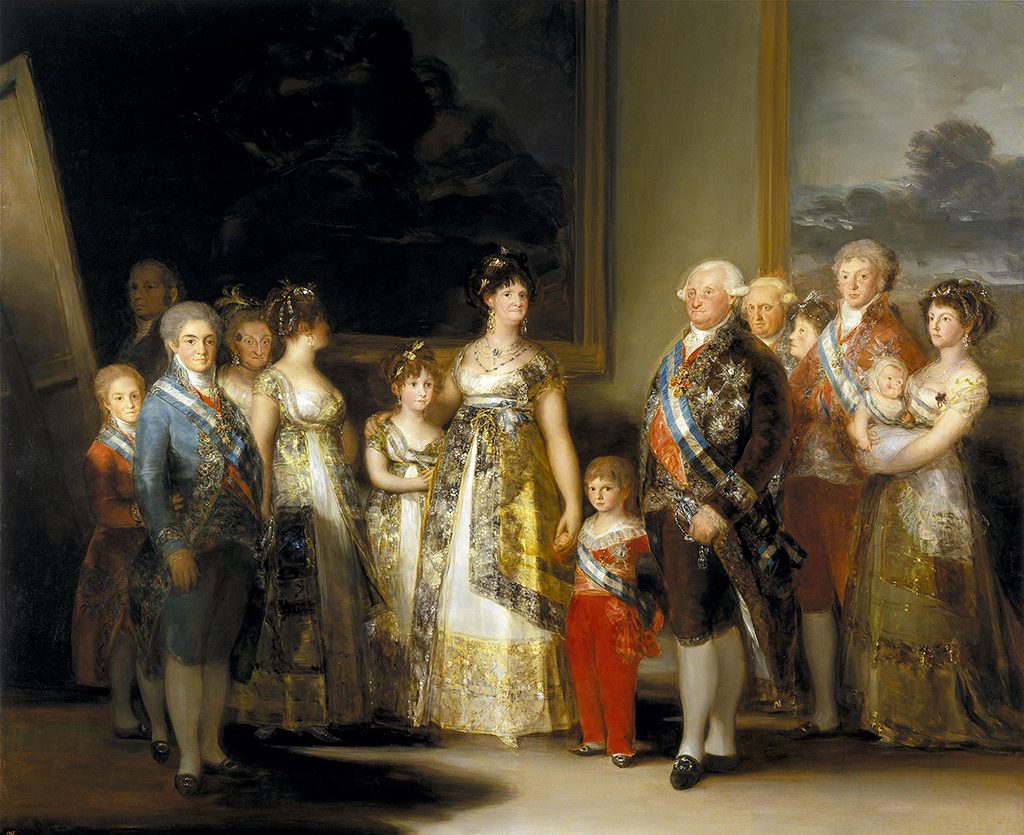
The group portrait The Family of Charles IV followed the final appointment. In a letter from Aranjuez of 14 June 1800, Queen María Luisa told Manuel Godoy that Goya had painted her portrait and was working on the king’s. The preparatory likenesses allowed him to study individual members of the household for the group composition. In the Prado canvas the queen stands near the centre with the younger children, the king slightly forward to the right, and the future Ferdinand VII in blue towards the left. The artist is visible beside his canvas in shadow. Comparing this self-placement with the portrait at Arenas and with Velázquez’s Las Meninas helps explain how Goya made the painter’s work part of a dynastic picture. The correspondence about the sittings puts that art-historical comparison in the context of a royal household with an active interest in the results. [3] [21] [27]
Goya on film
Five films explore Goya’s portraits, prints, Black Paintings and painting techniques.
The Duke of Wellington by Goya
The portrait, its military decorations and its later theft.
Watch on YouTubeA severe illness and work on his own account
In the autumn of 1792, while the Academy considered a common course of instruction for its students, Goya set out his views in a report dated 14 October. Painting had “no rules”, he wrote, arguing against obliging students to follow a single course. He assigned great importance to observing nature and asked that the Academy provide help according to the needs of individual students. The report belongs to an institutional discussion. It was written by a painter who had learnt through copying and had entered the Academy through a highly finished demonstration of skill. His experience of those practices gives weight to his argument that a single prescribed route could obstruct the development of a painter. [3] [26]
Goya fell gravely ill around the turn of 1792–93 while travelling in Andalusia and convalesced in Cádiz in the house of Sebastián Martínez. Goya had painted Martínez the preceding year. In the portrait at the Met, the sitter’s fingers hold a print with only a corner of its image visible. Goya wrote his name and the date on the painted sheet of paper and identified himself as Martínez’s friend. Martínez collected prints, books and paintings. The portrait gives that activity a quiet place in the composition, and the correspondence of the following year shows him looking after the painter who had signed it. [2] [28] [29]
On 19 March 1793 Martínez wrote to Pedro Arascot to ask how best to obtain an extension of Goya’s leave, explaining that the painter had been unable to leave the house. In a letter of 29 March to Zapater, Martínez said that Goya could manage the stairs again as his sight and balance improved. His deafness and the noise in his head persisted. He returned to Madrid that spring. His hearing loss endured, and the surviving descriptions leave the cause of the illness uncertain. In 1795, after Francisco Bayeu died, Goya became director of painting at the Academy. By April 1797 he was seeking to be released from the work on account of his deafness. Correspondence and institutional records let us see a lasting change in communication and a practical effect on his teaching duties. [2] [3] [17] [26] [29]
Returning to painting after illness meant finding work he could manage as well as resuming obligations. On 4 January 1794 he sent a letter to the Academy’s vice-protector, Bernardo de Iriarte, about a group of small cabinet pictures. Goya explained that making them had occupied his imagination while he was suffering, and that selling them could help compensate for the expenses of his illness. The project had also let him try observations for which the ordinary demands of commissions gave him little room. The surviving pictures associated with this enterprise include scenes of bullfighting and The Strolling Players, alongside works with subjects such as shipwreck and confinement. A small support that could be worked on at close quarters offered opportunities far removed in scale from the dome at El Pilar. In The Strolling Players, several costumes and gestures are presented at once in the space of a makeshift stage. The painter could decide on the choice of entertainment and the relationship between performers and audience. [3] [29]
Goya’s letters and working drawings also help explain how he made room for invention. The 1790 letter with the drawn heart makes a quick change between an image and the written news of his son. Private albums developed at greater length some of the encounters for which he became known as a printmaker. In the 1790s drawings, possible subjects for plate-making ranged from figures double-crossing each other to more elusive human and animal forms. The Prado and the National Gallery of Victoria have presented preparatory drawings with finished impressions, where a change of caption or placement can change the direction of a joke. Comparing a drawing with a related print shows how Goya revised an incident for readers who would encounter it as one image in a series. [1] [30] [31]
On 6 February 1799 the Diario de Madrid announced that buyers could obtain Los Caprichos at a shop in the building where Goya lived, in Madrid’s Calle del Desengaño. A receipt records four complete sets acquired by the Duchess of Osuna on 17 January, before the public advertisement. The opening self-portrait identifies the author, then a succession of captions draws buyers into scenes of bad instruction, human vanity and predation. In The Sleep of Reason Produces Monsters, the folded figure at the desk is almost overtaken by bodies entering from behind and above. Goya’s move from drawings to published impressions made a private act of composition available to customers who could handle and compare a whole series. Later, in 1803, he transferred the plates and remaining sets to the Crown and obtained a pension for Javier. By then he had been first painter of the chamber for nearly four years. [2] [3] [6] [30] [31]
War, the restored monarchy and the Quinta del Sordo
In March 1808 the Academy commissioned a portrait of Ferdinand VII, newly on the throne after the abdication of Charles IV. France’s intervention then overturned that succession and Napoleon’s brother Joseph Bonaparte took the throne. Much of Goya’s official work during the war was in Madrid. He also went to Zaragoza in the autumn of 1808 at the invitation of General José de Palafox to see the city after the first siege. He swore allegiance to Joseph in December 1809 and addressed a formal petition to him in 1811, and the documents survive alongside records of work for other patrons during the same years. These are traces of the positions in which Goya worked, under successive governments and as a painter who had patrons outside the palace. They give only partial evidence of his private politics. [2] [3] [17]
One commission makes those changes of regime visible on the surface of a single object. In 1810 Goya painted the Allegory of the City of Madrid for the municipal authorities. The city is personified by a woman beside an oval that originally contained the likeness of Joseph. When French control lapsed in 1812, the oval was altered to refer to the Constitution. When Joseph returned later in the year, the likeness was restored by Goya’s pupil Felipe Abás. Goya’s January 1813 correspondence concerns payment for that operation. Further repainting followed. In its surviving state the oval commemorates 2 May. The changeable message in that reserved area of the canvas shows just how quickly public commissions could call for a different allegiance to be visible. [3] [32]
The war years also brought a change in Goya’s household. Josefa died in 1812, and an inventory drawn up in connection with the division of their property lists paintings by subject or description. As evidence for the identity of the objects, it can be frustratingly terse. Identifications have depended in some instances on matching inventory marks painted on pictures to the surviving list. For biography, the existence of the inventory shows that the two spouses’ property was subject to division with Javier. It offers an unusually detailed view of the materials and work that could be counted as part of a family estate. [2] [3] [33]
On 24 February 1814 Goya approached the Regency with a proposal to paint episodes connected to the resistance to Napoleon. On 9 March Juan Álvarez Guerra wrote to the finance secretary conveying the Regency’s approval and arranging for costs, with Goya to receive 1,500 reales a month while the work lasted. We recognise the undertaking in The Second of May 1808 and The Third of May 1808. Goya’s proposal is a surviving act of initiative. The correspondence names the general undertaking and leaves the precise appearance and presentation of the two canvases to be reconstructed through other evidence. Under Ferdinand VII, Goya’s pay as court painter resumed and examination of his service under Joseph ended with his exoneration in 1815. He also continued to receive commissions depicting the king. In 1814, for example, the Diputación of Navarre arranged with him for a half-length likeness. [2] [3] [34]
In the prints known as The Disasters of War, Goya developed a different way of representing the conflict and its aftermath. The small sheets could show scenes of famine and injury without a named participant or a readily located street. The surviving set of proofs connected to Ceán Bermúdez gives evidence of an arrangement from Goya’s lifetime. The first published edition appeared in 1863, decades after his death, with eighty prints. Dates assigned to the making and revision of the plates describe something different from the date on the first edition. His Tauromaquia, by contrast, was offered for sale during his lifetime, in 1816. [3] [17] [35] Goya also began the prints known as the Disparates in the years after the war. Eighteen appeared as Proverbios in 1864, when the Academy issued the first edition. [36]
On 27 February 1819 Goya bought the property beyond the Manzanares known as the Quinta del Sordo. That August, his signed Last Communion of Saint Joseph of Calasanz was installed at an altar of the Piarist church in Madrid. An elderly man kneels among his brethren, the focus of the picture narrowing to his lifted face and the hand about to give him communion. Late in the same year Goya suffered another dangerous illness. In 1820 he painted Self-Portrait with Dr Arrieta, now in Minneapolis, which names Eugenio García Arrieta and dates the illness in a painted inscription of thanks. Goya shows himself supported by the doctor and struggling to drink. Arrieta’s body and arms occupy much of the lit centre of the picture. The Minneapolis Institute of Art draws attention to the resemblance to an ex-voto, an offering of thanks for surviving danger. The inscription supplies a date, a relationship and the artist’s attribution of his recovery to the doctor’s care. [3] [17] [37] [38]
Between about 1820 and 1823, Goya used rooms on two floors of the house to paint the group now known as the Black Paintings. They were painted in oil on the walls, and technical evidence for earlier work underneath some of the compositions shows that the rooms changed while they were decorated. The precise sequence of the paintings within the campaign is uncertain. The ownership document is more precise. On 17 September 1823 Goya transferred the property to his grandson Mariano. That deed fixes the change of owner. The deed gives affection for Mariano as the reason for the gift. The timing during a period of political change has prompted other interpretations, but the document does not resolve them or give a date for any of the murals. [3] [39] [40]
Visitors to the Prado see the fourteen transferred pictures as canvases. The photographer Jean Laurent recorded them in the house in the nineteenth century, before Salvador Martínez Cubells transferred the paintings to canvas at the direction of a later owner, Baron Émile d’Erlanger. Celia Isabel Díez Esteban’s study of the photograph of The Dog shows why the negatives matter. The frame of the photograph preserves information about how the picture met the surrounding decoration, and features faint or absent in the transferred work can be examined in the earlier record. The photographs and the technical studies therefore help to recover something of the changes between Goya’s house and the museum gallery. An image such as Saturn Devouring His Son was once encountered as a painting occupying a particular portion of a furnished interior. [39] [40]
Bordeaux, old friends and the last work
Goya’s departure for France left a paper trail. On 19 February 1824 he gave Gabriel Ramiro authority to collect his court salary on his behalf. On 2 May he petitioned Ferdinand VII for permission to take the mineral waters at Plombières for his ailments, asking to keep his pay during a six-month absence. The royal order granting leave is dated 30 May. Goya was in Bayonne by 24 June. He passed through Bordeaux and visited Paris that summer, then settled in Bordeaux in the autumn. The political context was the restoration of Ferdinand VII’s absolute authority and the departure of a number of Goya’s friends from Spain. The administrative record describes a painter travelling with permission. His decision to live mainly in France is the reason this period is often described as exile. [2] [3] [30] [41]
The salary still mattered to him. In a letter from Bordeaux to Javier on 24 December 1824 he worried that the extension of his leave might have been refused and his salary stopped. He was also concerned about an investment negotiated with the help of Don Martín Miguel de Goicoechea and the Bordeaux banker Jacques Galos. He told Javier that liking the town was insufficient reason to abandon his country. His departure starts to look less final when read alongside this correspondence, the extensions of leave and his return to Spain in 1826, when he was granted retirement on his full salary on 22 June. Bordeaux was where he chose to return and where he continued to work. [2] [3] [42]
Goya’s circle in the city included the writer Leandro Fernández de Moratín and the painter Antonio de Brugada. Leocadia Zorrilla and her children lived with Goya in Bordeaux. Moratín had already sat to Goya in Spain and sat to him again in 1824. In the painting in Bilbao, the writer’s right hand hovers over papers bearing Goya’s signature upside down from the viewer’s point of view, as someone opposite him might see the document. The Bilbao museum notes that a pen detectable by X-ray is lost to sight in the painted image. This small adjustment gives the hand the gesture of holding a writing instrument while leaving the spectator to complete the action. In 1826 Goya painted Galos, who had helped him with his finances, and in May 1827 he dated the Prado portrait of Juan Bautista de Muguiro in Bordeaux, signing it as the work of a friend aged eighty-one. [2] [3] [41] [43] [42]
Bordeaux also offered the means to make a new set of prints. Goya worked with the lithographic printer Cyprien Gaulon on The Bulls of Bordeaux, four bullfighting scenes issued in 1825 and among his last prints. Lithography allowed Goya to draw in greasy crayon on stone. In Bullfight in a Divided Ring, an impression of which is at the Met, a barrier cuts across the ring, and a mass of spectators encloses two separate areas of action. He made some of the dense textures by varying the crayon marks and some of the lighter marks by scraping. These processes give the stone-drawn prints a different surface from the earlier etched and aquatinted Tauromaquia. [6] [7] [44]
The Bibliothèque nationale de France records Gaulon’s legal deposits at the Gironde prefecture on 17 and 29 November and 23 December 1825, for an edition of 100 impressions of each lithograph. Museo Goya’s account also gives a run of 100. On 6 December Goya wrote to Joaquín María Ferrer in Paris, explaining that he had sent an example of a bullfight and made three more on the same subject and at the same scale. On 20 December he wrote again, weighing whether local dealers could help him reach people who knew prints. The deposit dates document the edition in Bordeaux, while the letters show Goya trying to find a market beyond it. [3] [6] [7]
In the second Ferrer letter Goya also reported experiments with miniatures on ivory, which he handled with small touches and compared to the brushwork of Velázquez. The old man in the late album drawing captioned Aún aprendo (“I am still learning”) braces himself on two sticks. He can be read as a figure for the artist’s own persistence. The inscriptions on the Muguiro portrait and the records of Gaulon’s editions give less figurative evidence of someone who continued to work across media in old age. One surviving document shows Goya addressing a possible seller, another shows him identifying himself as a friend at the edge of a painting. Each belongs to a different kind of transaction or relationship. [3] [6] [30] [43]
On 26 March 1828 Goya wrote to Javier that he was waiting anxiously for his family’s arrival and wanted his son to visit in the summer. Mariano and his mother Gumersinda reached Bordeaux before the end. Goya died at eighty-two in Bordeaux in the early hours of 16 April 1828. The Spanish consul recorded the death after being told by Mariano and going to the house in the Cours de l’Intendance. By Leocadia’s account, he lost speech temporarily and suffered paralysis on 2 April. On 28 April she wrote to Moratín about Goya’s last illness and named Brugada and José Pío de Molina as witnesses to his death. Goya was buried at La Chartreuse in the family tomb of the Goicoecheas. His remains were subsequently taken to Madrid and reinterred in 1919 at the church of San Antonio de la Florida, whose dome he had painted for Charles IV in 1798. That last transfer brought him back to a building where an important commission from his years in royal service could still be seen in place. [2] [3] [41] [45]
Artworks directory
| Name | Date | Medium |
|---|---|---|
| And There’s No Help for It, Plate 15 | Printed 1863 | |
| Asmodea | c. 1820–23 | Wall painting transferred to canvas |
| Boys Inflating a Bladder | 1777–78 | Tapestry cartoon |
| Boys Picking Fruit | 1778 | Tapestry cartoon |
| Bullfight in a Divided Ring | 1825 | Lithograph |
| Card Players | 1777–78 | Tapestry cartoon |
| Card Players (sketch) | 1777–78 | Painted sketch |
| Dance on the Banks of the Manzanares | 1777 | Tapestry cartoon |
| Duel with Cudgels | c. 1820–23 | Wall painting transferred to canvas |
| Heads in a Landscape | c. 1820–23 | Easel painting |
| Judith and Holofernes | c. 1820–23 | Wall painting transferred to canvas |
| Leocadia | c. 1820–23 | Wall painting transferred to canvas |
| Maja and Cloaked Men | 1777 | Tapestry cartoon |
| Maja and Cloaked Men (sketch) | 1777 | Painted sketch |
| Majo Clapping in Time to the Music | 1777 | Drawing |
| Men Reading | c. 1820–23 | Wall painting transferred to canvas |
| Out Hunting for Teeth, Plate 12 | 1799 | Etching, burnished aquatint and burin |
| Picnic in the Countryside (sketch) | 1776–78 | Painted sketch |
| Picnic on the Banks of the Manzanares | 1776 | Tapestry cartoon |
| Pilgrimage to San Isidro | c. 1820–23 | Wall painting transferred to canvas |
| Preparatory study for The Sleep of Reason Produces Monsters | c. 1796–97 | Drawing |
| Procession of the Holy Office | c. 1820–23 | Wall painting transferred to canvas |
| Quarrel at the Cockerel Inn (sketch) | 1777 | Painted sketch |
| Quarrel in the New Tavern | 1777 | Tapestry cartoon |
| Saturn Devouring His Son | c. 1820–23 | Wall painting transferred to canvas |
| Seated Majo Smoking | c. 1776 | Drawing |
| The Dog | c. 1820–23 | Wall painting transferred to canvas |
| The Drinker | 1777 | Tapestry cartoon |
| The Fates | c. 1820–23 | Wall painting transferred to canvas |
| The Great He-Goat | c. 1820–23 | Wall painting transferred to canvas |
| The Kite | 1777–78 | Tapestry cartoon |
| The Parasol | 1777 | Oil on canvas, tapestry cartoon |
| The Second of May 1808 | 1814 | Oil on canvas |
| The Sleep of Reason Produces Monsters, Plate 43 | 1799 | Etching and aquatint |
| The Third of May 1808 | 1814 | Oil on canvas |
| Thou Who Canst Not, Plate 42 | 1799 | Etching and burnished aquatint |
| Three Figures | 1776 | Drawing (lost) |
| Two Old Men | c. 1820–23 | Wall painting transferred to canvas |
| Two Old Men Eating Soup | c. 1820–23 | Wall painting transferred to canvas |
| Two Women and a Man | c. 1820–23 | Wall painting transferred to canvas |
| Universal Language: The Author Dreaming | 1797 | Drawing |
| The Family of Charles IV | 1800 | Oil on canvas |
| Witches’ Sabbath (Osuna painting) | 1797–98 | Oil on canvas |
| The Nude Maja | 1795–1800 | Oil on canvas |
| The Clothed Maja | 1800–07 | Oil on canvas |
| Self-Portrait (Drawing) | c. 1796 | Brush and carbon black ink on laid paper |
| The Swing, Madrid Album B.21 | 1795–97 | Brush and carbon black washes |
| Majas Fighting, a Majo Observing, Madrid Album B.15 | 1796–97 | Brush, grey and black washes on laid paper |
| Majos and Majas Conversing, Madrid Album B.16 | c. 1794–97 | Ink wash on paper |
| Weeping Woman and Three Men, Madrid Album B.17 | 1795–97 | Brush, carbon black washes and black chalk |
| Maja Seated on a Chair and Two Companions Behind, Madrid Album B.18 | 1795–97 | Brush and carbon black washes |
| Girl and Bull, Madrid Album B.23 | 1796–97 | Brush and carbon black washes |
| Lovers Sitting on a Rock, Madrid Album B.24 | 1796–97 | Brush and carbon black washes |
| Mariano Ceballos Riding a Bull | 1825 | Crayon lithograph and scraper |
| Landscape (lifetime impression) | c. 1807–10 | Etching and aquatint |
| Self-Portrait (1815), Prado canvas | 1815 | Oil on canvas |
| Self-Portrait (1815), Academy panel | 1815 | Oil on panel |
| Self-Portrait with Dr Arrieta | 1820 | Oil on canvas |
| Christ Crucified | 1780 | Oil on canvas |
| The Last Communion of Saint Joseph of Calasanz | 1819 | Oil on canvas |
| Christ on the Mount of Olives | 1819 | Oil on panel |
| The Flower Girls, or Spring | 1786–87 | Oil on canvas |
| The Grape Harvest, or Autumn | 1786–87 | Oil on canvas |
| The Snowstorm, or Winter | 1786–87 | Oil on canvas |
| The Threshing Ground, or Summer | 1786–87 | Oil on canvas |
| Picnic on the Banks of the Manzanares | 1776 | Oil on canvas |
| The Kite | 1777–78 | Oil on canvas |
| Dance on the Banks of the Manzanares | 1777 | Oil on canvas |
| A Fight at the Venta Nueva | 1777 | Oil on canvas |
| Blind Man’s Bluff | 1788 | Oil on canvas |
| Dogs on a Lead | 1775 | Oil on canvas |
| Hunting with a Decoy | 1775 | Oil on canvas |
| Hunter Loading His Rifle | 1775 | Oil on canvas |
| The Angler | 1775 | Oil on canvas |
| The Hermitage of San Isidro on His Feast Day | 1788 | Oil on canvas |
| The Meadow of San Isidro | 1788 | Oil on canvas |
| The Straw Manikin | 1791–92 | Oil on canvas |
| Witches’ Flight | c. 1797–98 | Oil on canvas |
| A Scene from ‘The Forcibly Bewitched’ | 1798 | Oil on canvas |
| The Duchess of Alba in Black | 1797 | Oil on canvas |
| The Duchess of Alba in White | 1795 | Oil on canvas |
| Charles III in Hunting Dress | c. 1786 | Oil on canvas |
| The Duke and Duchess of Osuna and Their Children | 1787–88 | Oil on canvas |
| Manuel Osorio Manrique de Zúñiga | 1787–88 | Oil on canvas |
| The Marquesa de Pontejos | c. 1786 | Oil on canvas |
| Equestrian Portrait of the 1st Duke of Wellington | 1812 | Oil on canvas |
| The Duke of Wellington | 1812–14 | Oil on wood |
| Portrait of Ferdinand VII of Spain | 1814 | Oil on canvas |
| Gaspar Melchor de Jovellanos | 1798 | Oil on canvas |
| María Tomasa Palafox y Portocarrero | 1804 | Oil on canvas |
| Señora Sabasa García | c. 1806–11 | Oil on canvas |
| Don Juan Bautista de Muguiro | 1827 | Oil on canvas |
| Doña Isabel de Porcel | Before 1805 | Oil on canvas |
| The Colossus | After 1808 | Oil on canvas |
| The Burial of the Sardine | 1808–12 | Oil on panel |
| The Madhouse | 1808–12 | Oil on panel |
| A Procession of Flagellants | 1808–12 | Oil on panel |
| Portrait of Jacques Galos | 1826 | Oil on canvas |
| Portrait of Mariano Goya, the Artist’s Grandson | 1827 | Oil on canvas |
| Milkmaid of Bordeaux | c. 1827 | Oil on canvas |
| Portrait of Don Juan Antonio Cuervo | 1819 | Oil on canvas |
| María Luisa of Parma (Naples version) | c. 1800 | Oil on canvas |
| The Countess of Baena | 1819 | Oil on canvas |
| The Family of the Infante Don Luis | 1783–84 | Oil on canvas |
| The Holy Family | c. 1787 | Oil on canvas |
| Saint Barbara | c. 1773 | Oil on canvas |
| Saints Justa and Rufina | 1817 | Oil on canvas |
| El Tío Paquete | c. 1819–20 | Oil on canvas |
| The Forge | c. 1815–20 | Oil on canvas |
| Majas on a Balcony (Metropolitan Museum version) | c. 1800–10 | Oil on canvas |
| Maja and Celestina on a Balcony | c. 1808–12 | Oil on canvas |
| The Water Bearer | 1808–12 | Oil on canvas |
| Time and the Old Women | c. 1810 | Oil on canvas |
Frequently Asked Questions
He and Ramón Bayeu were named painters to Charles III on 25 June 1786. Under Charles IV, Goya was appointed painter of the chamber on 25 April 1789 and first painter of the chamber on 31 October 1799. His work for the royal tapestry factory began about a decade before the first of these appointments. [3] [17]
Goya moved to France in 1824 at a time of political repression in Spain. He travelled on leave granted by Ferdinand VII and subsequently returned to Spain on visits. He made his home among friends in Bordeaux and died there in 1828. “Exile” is often used to describe that residence abroad. [2] [3] [41]
Discussion
Look again at the images and ideas explored in Francisco de Goya. These editorial prompts invite your observations.
Look at how Goya worked a signature into the portraits of Sebastián Martínez and Juan Bautista de Muguiro. Both inscriptions name the sitter and the artist’s friendship. Where does Goya place those words in each portrait, and how does the placement affect the way you encounter them? [28] [43]
The Italian Notebook holds both work for a competition and records of Goya’s household. Compare it with his later letter about the cabinet pictures. What can each document tell you about the circumstances in which he painted, and what can you learn only from looking at the finished pictures? [3] [13] [14]
Continue with Goya’s paintings, drawings or etchings.
Reader Insights
Which surviving document most changes how you see Goya’s work?
How does the work made in Bordeaux compare with the commissions of his Madrid years?
Join the Conversation
Share a detail, comparison or question about Francisco de Goya below.
References
- Fundación Amigos del Museo del Prado, Carta de Goya a Martín Zapater, 10 November 1790, facsimile and transcription. English quotation translated for this article, View source.
- Fundación Goya en Aragón, Biografía, View source.
- Ángel Canellas López, ed., Francisco de Goya. Diplomatario (1981). See especially Register docs. 1, 25, 108, 151, 153, 188–89, 232, 240 and 265–80, and Cartulary docs. I, VI–VII, XXXIX, XLVIII–L, LXVII–LXX, XCIX, CVI, CVIII, CXXIV–CXXIX, CXLV–CXLVI and CLXXVIII–CLXXXI, View source.
- Portal de Archivos Españoles (PARES), Goya, Francisco de (1746–1828), authority record 47218, View source.
- Museo Nacional Thyssen-Bornemisza, Goya, Francisco de, artist biography, View source.
- Bibliothèque nationale de France, Los toros de Burdeos, catalogue record FRBNF42514440, including Gaulon’s legal deposits and Goya’s letters to Ferrer, View source.
- Museo Goya, Fundación Ibercaja, Los Toros de Burdeos, series and impression records, View source.
- Rosanna Cioffi, “Iam tandem Italiae fugientis prendimus oras. Un quadro italiano di Goya”, in Dulcis Labor, Quaderni di Polygraphia 5 (2022), pp. 41–50, including the Parma Academy’s rules, Goya’s letter and the assessment of his entry, View source.
- Fundación Goya en Aragón, Cronología, View source.
- Museo Nacional del Prado, The victorious Hannibal seeing Italy from the Alps for the first Time, 2011 loan announcement and identification history, View source.
- Fundación Goya en Aragón, Aníbal vencedor, que por primera vez miró Italia desde los Alpes, competition canvas and subsequent acquisition, View source. Donor’s record.
- Hugh Stokes, Francisco Goya: A Study of the Work and Personality of the Eighteenth Century Spanish Painter and Satirist (1914), pp. 83–84, English rendering of the January 1772 account reported by Valentín Carderera, View source.
- Fundación Amigos del Museo del Prado, El Cuaderno Italiano de Goya, revised facsimile edition, View source.
- Fundación Goya en Aragón, Aníbal vencedor, que por primera vez mira Italia desde los Alpes (estudio preparatorio), page 37 of the Italian Notebook, View source.
- Banco de España, 2328 reales de vellón. Goya y los orígenes de la Colección Banco de España, exhibition catalogue, View source.
- Federica Cappelli, “Nuove note sul Cuaderno italiano di Francisco Goya”, Cuadernos de Filología Italiana 3 (1996), pp. 239–244, View source.
- Universidad de Zaragoza, Cronología biográfica y pictórica de Goya, View source.
- Fundación Goya en Aragón, El quitasol, catalogue entry for The Parasol, View source.
- Fundación Goya en Aragón, El cacharrero, catalogue entry for The Pottery Vendor, View source.
- Fundación Goya en Aragón, Cristo crucificado, catalogue entry for the Academy submission, View source.
- Fondazione Magnani Rocca, La famiglia dell’infante don Luis, painting, letters and documentation on the sitters, View source.
- Banco de España, La colección de arte, institutional history and origins of the portrait collection, View source.
- Banco de España, El Banco de España desde dentro, fig. 107 and discussion of Goya’s shares and the first payment via Ceán, View source.
- Banco de España, José de Toro-Zambrano y Ureta, collection record and historical accounts, View source.
- The Metropolitan Museum of Art, Condesa de Altamira and Her Daughter, María Agustina, 1975.1.148, View source.
- Real Academia de Bellas Artes de San Fernando, La Academia y Goya, Academy appointments and the teaching report of 14 October 1792. English quotation translated for this article, View source.
- Fundación Goya en Aragón, La familia de Carlos IV, catalogue entry for the Prado painting, View source.
- The Metropolitan Museum of Art, Sebastián Martínez y Pérez, 06.289, View source.
- Galería de las Colecciones Reales, Goya y Lucientes, Francisco de, artist biography, on the illness and the cabinet pictures. Consult the dated records in the Diplomatario for the transfer of the Quinta and Goya’s death, View source.
- Petra Kayser, National Gallery of Victoria, “Goya’s Visions: The Universality of Goya’s Art”, exhibition essay for Goya: Drawings from the Prado Museum, View source.
- Fundación Goya en Aragón, Francisco de Goya y Lucientes, Painter, Plate 1 and publication history of Los Caprichos, View source.
- Fundación Goya en Aragón, Alegoría de la villa de Madrid, catalogue entry and history of alterations, View source.
- Juliet Wilson-Bareau, “Goya and the X Numbers: The 1812 Inventory and Early Acquisitions of ‘Goya’ Pictures”, Metropolitan Museum Journal 31 (1996), View source.
- Manuela B. Mena Marqués, Gudrun Maurer, Carmen Garrido Pérez and colleagues, “Goya: el Dos y el Tres de mayo de 1808 en Madrid. Estudio y restauración”, Boletín del Museo del Prado 27, no. 45 (2009), pp. 129–149, bibliographic record, View source.
- Calcografía Nacional, Real Academia de Bellas Artes de San Fernando, Francisco de Goya, collection of plates and history of the print editions, View source. Contemporary record of the 1863 edition.
- Fundación Goya en Aragón, Disparate femenino, chronology, early proofs and publication of the Disparates, View source.
- Minneapolis Institute of Art, Self-Portrait with Dr. Arrieta, 52.14, painted inscription and discussion of the ex-voto reference, View source.
- Fundación Goya en Aragón, La última comunión de San José de Calasanz, catalogue entry, inscription and original installation, View source.
- Museo Nacional del Prado, La Quinta del Sordo. Philippe Parreno, exhibition record and account of the original interiors and later transfer, View source.
- Celia Isabel Díez Esteban, “La fotografía histórica como fuente de información de la obra de arte: J. Laurent y El perro semihundido de Goya”, pp. 153–162, View source.
- Bilbao Fine Arts Museum, Portrait of the Poet Moratín, 1824, provenance and technical examination, View source.
- Barnes Foundation, Portrait of Jacques Galos, 1826, and Galos’s role in Goya’s affairs, View source.
- Fundación Goya en Aragón, Juan Bautista Muguiro, Museo del Prado painting and transcription of its signature, View source.
- The Metropolitan Museum of Art, Bullfight in a divided ring, lithograph from The Bulls of Bordeaux, and discussion of Goya’s lithographic technique, View source.
- Musée Goya, Castres, Goya, témoin de son temps, account of his death, burial and reinterment, View source.
- Victoria and Albert Museum, Rococo collection and period overview, View source.
- Department for Education, History of Art subject content, historical movements, View source.
- The Metropolitan Museum of Art, Romanticism, View source.
- National Gallery, London, Francisco de Goya, View source.
- Museo Nacional del Prado, El retrato español en el Museo del Prado, p. 27, View source.
- Bibliothèque nationale de France, Los toros de Burdeos, legal deposit and impressions, View source.
- Museo Nacional del Prado, Carta a Martín Zapater de 20 de octubre de 1781. View source.
- Museo Nacional del Prado, Didactic Exhibition: The Prado in Jerez. View source.




