


 by Tom Gurney
Tom Gurney BSc (Hons) is an art history expert with over 20 years experience
Published on June 19, 2020 / Updated on November 20, 2026
Email: tomgurney1@gmail.com / Phone: +44 7429 011000
Introduction
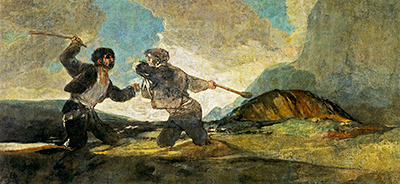
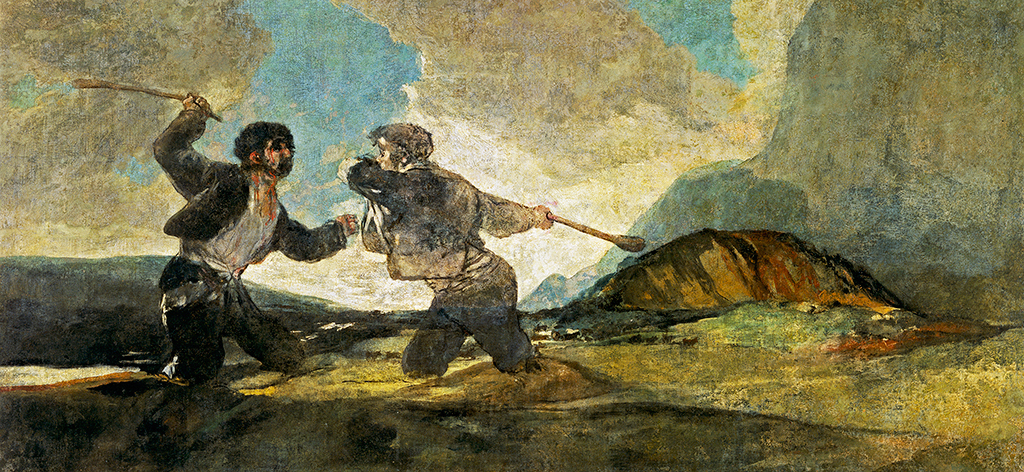
Two men swing wooden clubs at each other in open country. One lifts his weapon high against the sky. The other brings an arm up across his face and holds his club out behind him. On the canvas in the Prado, their legs seem to disappear into the earth. Charles Yriarte, who saw the picture on the wall of Goya’s Quinta del Sordo, described the lower legs as disappearing into grass. A photograph by Jean Laurent, taken before the painting was transferred to canvas, preserves traces of the earlier foreground. A change in that small part of the picture can turn a fight with room to move into one from which neither man seems able to escape. [1] [2] [3]
At a Glance
- Artist and dateFrancisco de Goya, c. 1820–1823. [1]
- Spanish titlesDuelo a garrotazos and Riña a garrotazos. [1]
- Medium and dimensionsMixed technique, including oil on plaster, transferred to canvas. 125 × 261 cm (height × width). [1] [4]
- Present collectionMuseo Nacional del Prado, Madrid, accession P000758. [4]
- Original settingUpper floor of the Quinta del Sordo, Madrid, alongside The Fates. [2] [5]
- Pre-transfer photographJean Laurent, c. 1874, glass negative VN-08122 P, Archivo Ruiz Vernacci, Fototeca del Instituto del Patrimonio Cultural de España. [3] [6]
Works across Goya’s career
The Parasol
1777The Nude Maja
1795–1800Duel with Cudgels
c. 1820–23Saturn Devouring His Son
c. 1820–23The Dog
c. 1820–23How Goya stages the fight
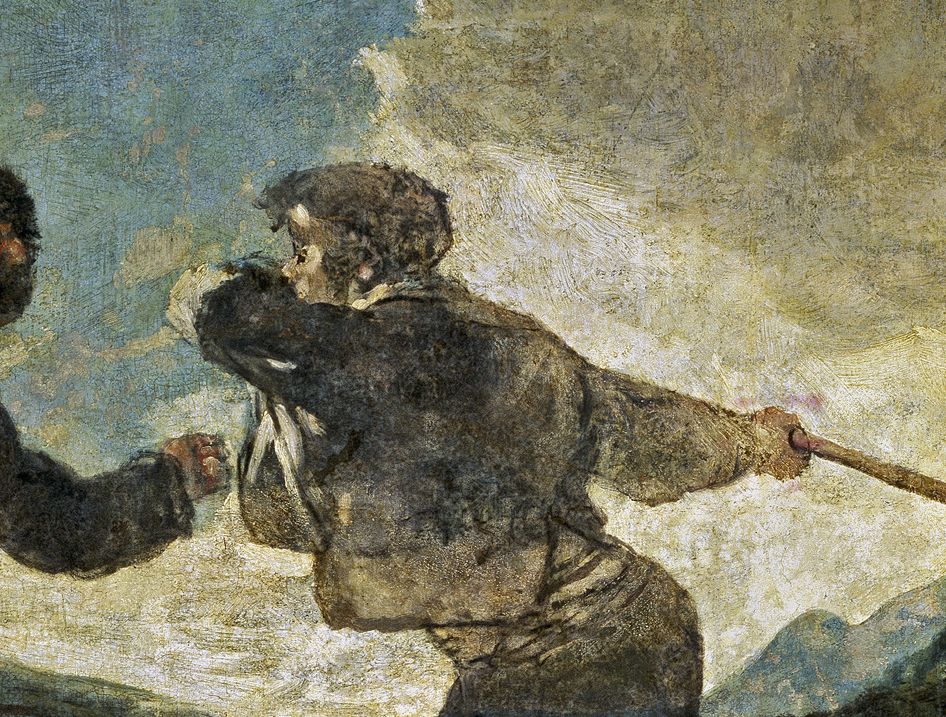
The man on the left raises his cudgel with one hand while his other arm reaches into the gap between the two bodies. His dark jacket falls open over a light shirt. Red marks on his face and chest show that he has already been struck. The man on the right turns across the width of the canvas. His forearm cuts across the lower part of his face and makes his expression harder to read. His other arm extends into the open country on the right. The clubs point outwards, one high into the sky and the other towards the distant ground, while the bent arms meet close to the centre of the action. The painting gives us the preparation and recoil of violence in a single instant. [1] [4]
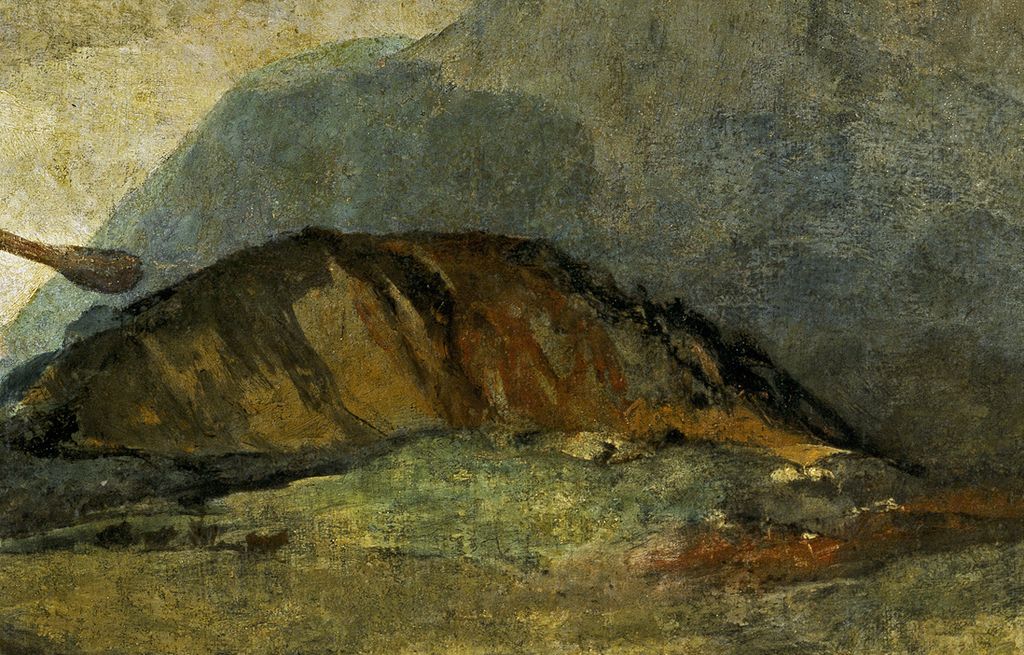
The two figures take up much of the height of the painting but stand left of its centre. To their right a ridge rises in rust and ochre, with a blue-grey slope behind it. Above them, broken patches of blue divide the clouds. A pale band of sky opens near the horizon behind the men, picking out the changes in direction of the shoulders and arms. Across the bottom, broad strokes of green, yellow-brown and deep shadow make the surface look uneven. With the feet hard to locate, the eye jumps between the active upper bodies and a foreground that appears to hold the men in place. [1] [3]
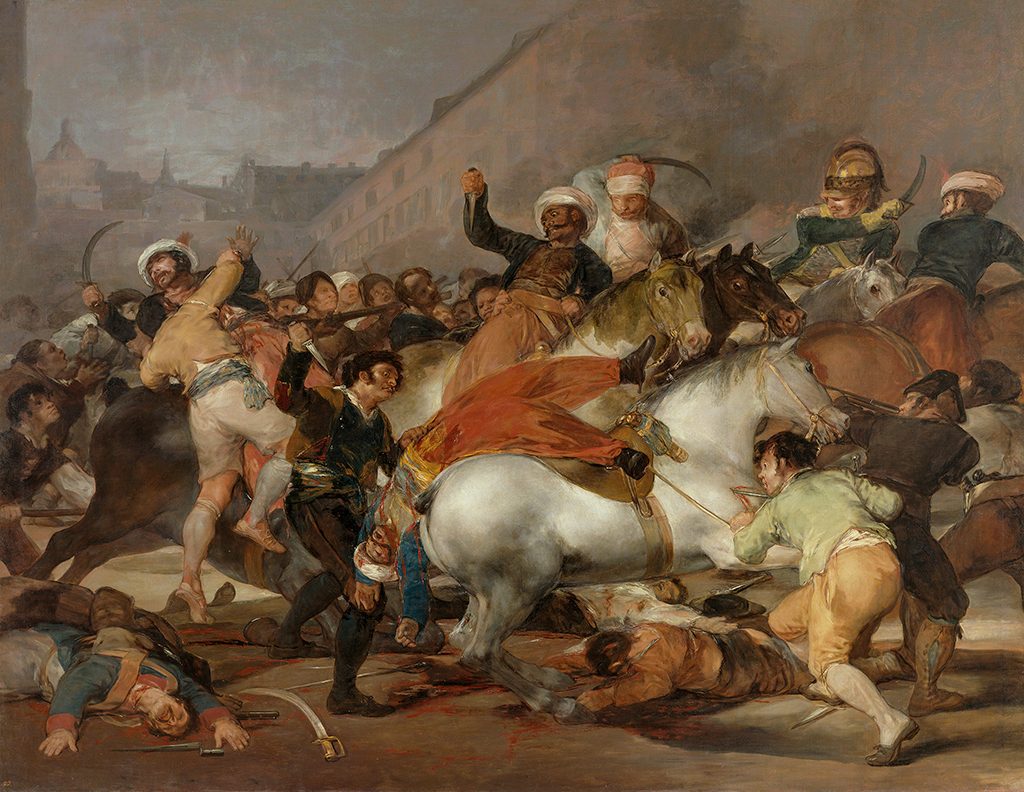
The clothes bring the encounter into a world of ordinary people. The shirt and dark waistcoat on the left stand out against the earthier clothing of the man opposite him. Foradada sees a difference between more urban and more rural dress. Even without fixing either man’s background, the difference affects what we can see. The pale shirt gives the blood an exposed surface and draws attention towards the left-hand man’s face. The raised sleeve of his opponent partially screens the face and merges with the darker clothing. Compare The Second of May 1808, where the many figures, uniforms and horses give the fight a specific historical setting. Here the isolated pair and shared weapon leave the circumstances of the encounter open. [1] [7]
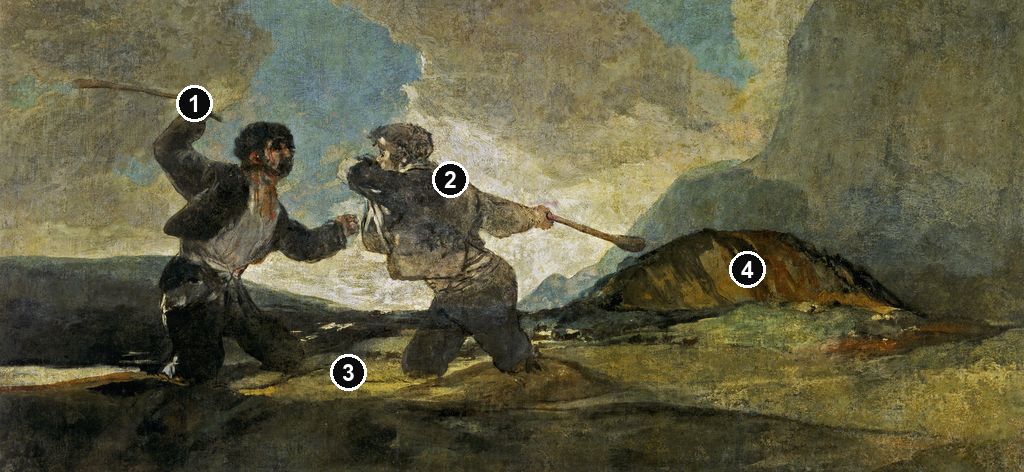
Annotated Details from Fight with Cudgels
Follow the two raised cudgels, then look at the ground beneath the figures.
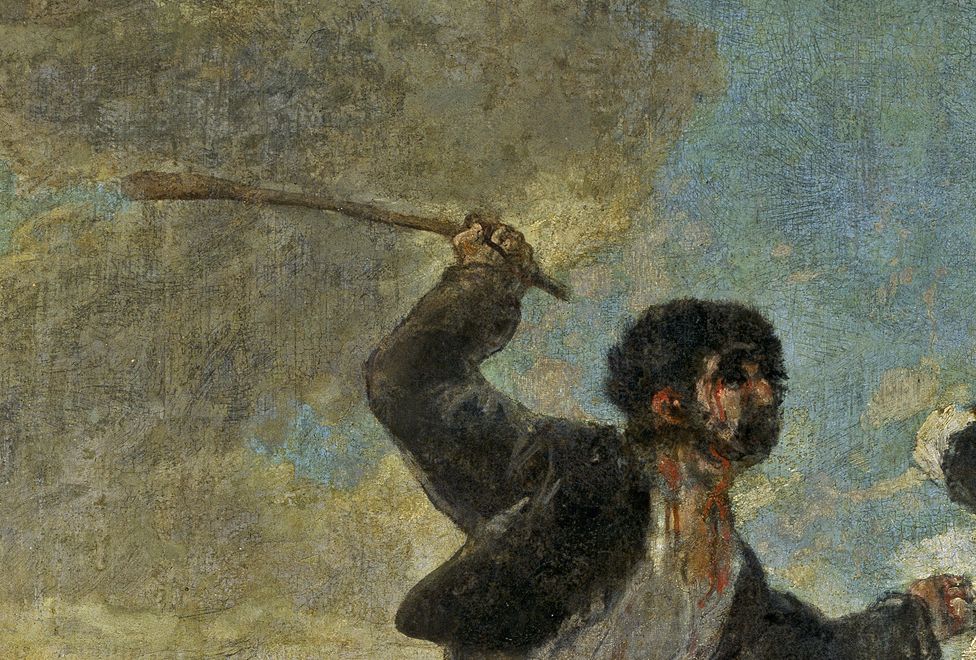
Details from FIGHT WITH CUDGELS
Details from the transferred canvas in the Museo Nacional del Prado (P000758).
The raised cudgel
The raised arm takes the outline of the cudgel into the sky. The dark sleeve turns sharply at the elbow.
Turning away
A turn at the shoulder shows the right-hand figure mainly from behind. His face is partly visible above his lifted arm.
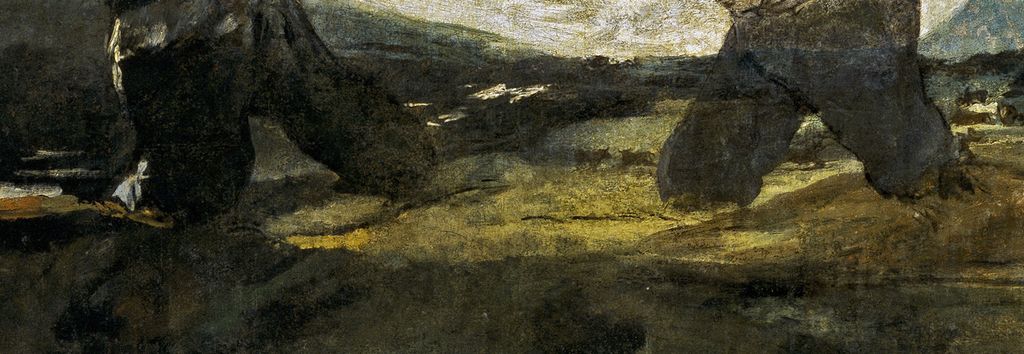
The ground at their knees
Broad strokes of green and brown run across the lower legs on the surviving canvas.
Space beyond the figures
The narrow yellow-brown face of the ridge catches light below the larger blue-grey slope.
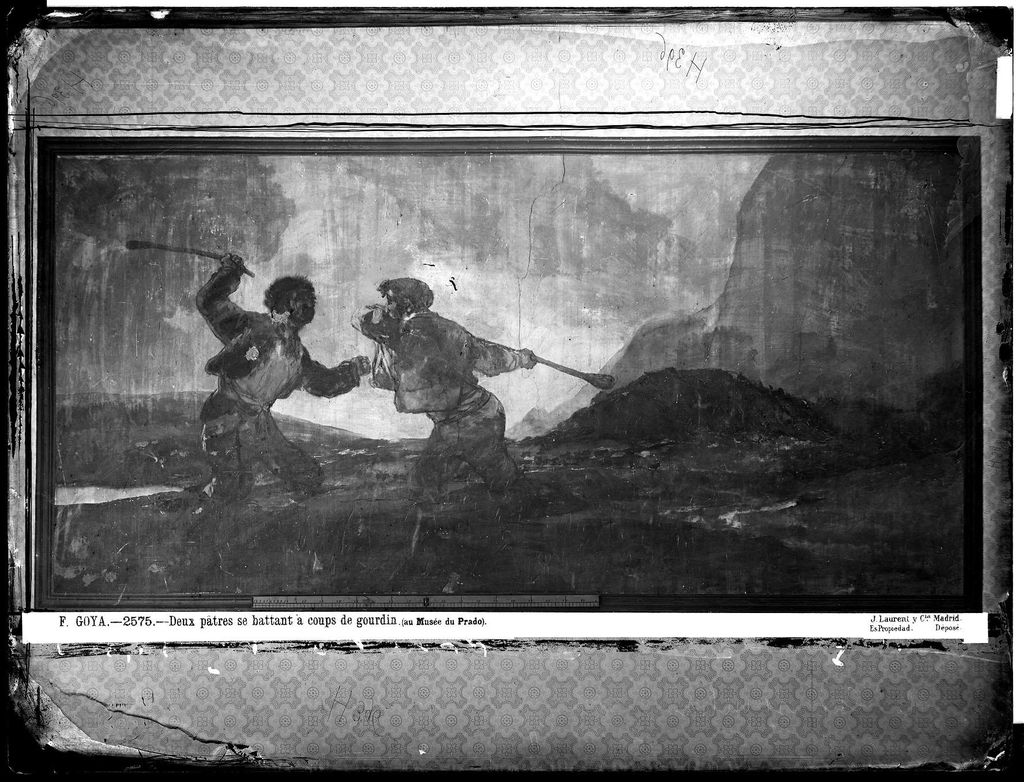
What happened to the foreground?
Yriarte recorded the work in two places in his 1867 monograph. In the chapter on the house, he pairs the painting with The Fates and describes two poorly dressed cowherds fighting furiously with sticks. He reports a tradition that they came from Galicia and identifies distant marks in the plain as grazing animals. In the catalogue at the end of the book, under Les Gardeurs de bœufs, he describes the lower legs as barely indicated and disappearing in the grass. The catalogue passage matters because it names what obscured the legs while they were still on the wall. The men’s occupation and the identification of distant cattle belong to Yriarte’s reading of the scene. [2] [7]
Laurent’s negative VN-08122 P shows the whole wall panel inside a paper border, with patterned wallpaper still visible around it. A large crack runs through the painted field and continues into the surrounding wall. Pale patches register further damage. This is a record made decades after Goya left the Quinta. The words identifying the Museo del Prado were added to the negative later, so they describe the eventual home of the work. The border and the crack record its physical setting at the moment of exposure. [3] [6]
Look just below the fighters in the photograph, then return to the Prado canvas. The photograph shows a more varied foreground beneath both bodies, with thin oblique marks and dark shapes that continue below the apparent level of the knees. In the close view reproduced as figure 2 of his study, Foradada reads one descending contour as part of the right leg of the man on the left of the picture. He interprets the fine strokes beside it as grass bent by that movement. Corinne Cristini also identifies traces of the lower legs in her comparison of the two states. The photograph supports the presence of more leg and grass detail. Reading the exact angle of a foot or the direction in which a man is stepping depends on how those dark and light marks are interpreted. Shadow, repairs to the wall and the lighting used to expose the glass plate all affect the separation of those tones. [3] [6] [7] [8]
The baron Émile d’Erlanger, who bought the Quinta in 1873, commissioned Salvador Martínez Cubells to transfer the murals to canvas. The work entailed detaching paint from its architectural support and treating losses in the resulting surface. Nigel Glendinning compared Laurent’s record with the transferred paintings in his study of how this process changed the group. He found the reproduction of this mural too dark to read parts of the middle distance and foreground with confidence, but identified changes to the clouds, the recession of the hills and the light on the right-hand man’s coat. In Fight with Cudgels, the ground now gives a much more continuous impression immediately below the figures, and the evidence for their footing is harder to follow. The available evidence supports a grassy foreground in the wall painting and a change in the treatment of that foreground during transfer and restoration. The worn wall and monochrome photograph leave room for uncertainty over individual strokes and the handling of each damaged passage. The painting was exhibited in Paris in 1878, and d’Erlanger donated the group to the Prado in 1881. [1] [6] [8] [9]
Goya on film
Five films explore Goya’s portraits, prints, Black Paintings and painting techniques.
The Duke of Wellington by Goya
The portrait, its military decorations and its later theft.
Watch on YouTubeA brawl, a duel or a divided country?
The inventory associated with Antonio de Brugada calls the picture Dos forasteros, or Two Outsiders. This title proposes a relation between the two men and the people among whom they find themselves. Yriarte’s The Cowherds gives them an occupation, and his description of their encounter as a duel without witnesses suggests how much could be read into their isolation even before the transfer. The catalogue title Riña a garrotazos describes a brawl with clubs, while Duelo a garrotazos gives the confrontation a more formal character. The paired figures and similar weapons make a duel plausible as a reading. An older Prado catalogue described the men as buried to the knee in sand or mud to prevent them evading each other. That reading puts a rule around the encounter based on the shape of the lower bodies in the transferred painting. The image itself gives little evidence for an arranged meeting, agreed rules or a set outcome. The figures could as readily have come to blows in an ordinary quarrel. [1] [2] [7] [11]
The idea of two Spains at odds draws on the date of the mural and the way Goya makes each fighter the other’s principal opponent. The period usually assigned to the work overlaps with the Liberal Triennium of 1820–1823, when constitutional government and the claims of royal absolutism divided Spain. Valeriano Bozal considered whether an older, wounded man and a younger opponent could stand for an old Spain and an emerging one, and expressed reservations about imposing that scheme on the painting. Foradada reads the exposed face and urban dress of the man on the left as signs of the liberal cause. He also interprets a light mark at that man’s lapel in Laurent’s photograph as a white flower and gives it a symbolic role. These identifications depend on accepting his reading of the marks, clothes and gestures together. The relationship of the work’s date to the political crisis is firmer than the allegiance of either figure. [7]
Another interpretation compares the scene with emblem 75 of Diego de Saavedra Fajardo’s Empresas políticas, where warriors born from serpent’s teeth turn their weapons on one another. The emblem draws on the story of the Golden Fleece and uses the fighters to consider the consequences of sowing discord. Its illustration shows several armed figures emerging from the earth. This is a striking comparison for the canvas, whose foreground makes the two men look partly buried. The parallel is weaker for the earlier state described by Yriarte, where the men fight in grass. It remains a way to think about why the image has served as an emblem of mutual destruction. [2] [10]
Its place in the Quinta del Sordo
The painting hung upstairs beside The Fates. Yriarte describes it immediately after the mythological scene and calls the two works companions. In the reconstruction by Foradada and colleagues, the panels shared a wall with a window between them. Their broad formats would have been visible on either side of that opening. Both set figures against a distant landscape. In The Fates, the land lies low and the figures are suspended above it. In Fight with Cudgels, the figures’ relationship to the terrain determines how we imagine their next movements. A viewer crossing between the two panels would have moved from an uncertain fate pictured in myth to an uncertain outcome pictured through bodies in motion. The Black Paintings guide follows these relationships across the two rooms. [2] [5]
Artworks directory
| Name | Date | Medium |
|---|---|---|
| And There’s No Help for It, Plate 15 | Printed 1863 | |
| Asmodea | c. 1820–23 | Wall painting transferred to canvas |
| Boys Inflating a Bladder | 1777–78 | Tapestry cartoon |
| Boys Picking Fruit | 1778 | Tapestry cartoon |
| Bullfight in a Divided Ring | 1825 | Lithograph |
| Card Players | 1777–78 | Tapestry cartoon |
| Card Players (sketch) | 1777–78 | Painted sketch |
| Dance on the Banks of the Manzanares | 1777 | Tapestry cartoon |
| Duel with Cudgels | c. 1820–23 | Wall painting transferred to canvas |
| Heads in a Landscape | c. 1820–23 | Easel painting |
| Judith and Holofernes | c. 1820–23 | Wall painting transferred to canvas |
| Leocadia | c. 1820–23 | Wall painting transferred to canvas |
| Maja and Cloaked Men | 1777 | Tapestry cartoon |
| Maja and Cloaked Men (sketch) | 1777 | Painted sketch |
| Majo Clapping in Time to the Music | 1777 | Drawing |
| Men Reading | c. 1820–23 | Wall painting transferred to canvas |
| Out Hunting for Teeth, Plate 12 | 1799 | Etching, burnished aquatint and burin |
| Picnic in the Countryside (sketch) | 1776–78 | Painted sketch |
| Picnic on the Banks of the Manzanares | 1776 | Tapestry cartoon |
| Pilgrimage to San Isidro | c. 1820–23 | Wall painting transferred to canvas |
| Preparatory study for The Sleep of Reason Produces Monsters | c. 1796–97 | Drawing |
| Procession of the Holy Office | c. 1820–23 | Wall painting transferred to canvas |
| Quarrel at the Cockerel Inn (sketch) | 1777 | Painted sketch |
| Quarrel in the New Tavern | 1777 | Tapestry cartoon |
| Saturn Devouring His Son | c. 1820–23 | Wall painting transferred to canvas |
| Seated Majo Smoking | c. 1776 | Drawing |
| The Dog | c. 1820–23 | Wall painting transferred to canvas |
| The Drinker | 1777 | Tapestry cartoon |
| The Fates | c. 1820–23 | Wall painting transferred to canvas |
| The Great He-Goat | c. 1820–23 | Wall painting transferred to canvas |
| The Kite | 1777–78 | Tapestry cartoon |
| The Parasol | 1777 | Oil on canvas, tapestry cartoon |
| The Second of May 1808 | 1814 | Oil on canvas |
| The Sleep of Reason Produces Monsters, Plate 43 | 1799 | Etching and aquatint |
| The Third of May 1808 | 1814 | Oil on canvas |
| Thou Who Canst Not, Plate 42 | 1799 | Etching and burnished aquatint |
| Three Figures | 1776 | Drawing (lost) |
| Two Old Men | c. 1820–23 | Wall painting transferred to canvas |
| Two Old Men Eating Soup | c. 1820–23 | Wall painting transferred to canvas |
| Two Women and a Man | c. 1820–23 | Wall painting transferred to canvas |
| Universal Language: The Author Dreaming | 1797 | Drawing |
| The Family of Charles IV | 1800 | Oil on canvas |
| Witches’ Sabbath (Osuna painting) | 1797–98 | Oil on canvas |
| The Nude Maja | 1795–1800 | Oil on canvas |
| The Clothed Maja | 1800–07 | Oil on canvas |
| Self-Portrait (Drawing) | c. 1796 | Brush and carbon black ink on laid paper |
| The Swing, Madrid Album B.21 | 1795–97 | Brush and carbon black washes |
| Majas Fighting, a Majo Observing, Madrid Album B.15 | 1796–97 | Brush, grey and black washes on laid paper |
| Majos and Majas Conversing, Madrid Album B.16 | c. 1794–97 | Ink wash on paper |
| Weeping Woman and Three Men, Madrid Album B.17 | 1795–97 | Brush, carbon black washes and black chalk |
| Maja Seated on a Chair and Two Companions Behind, Madrid Album B.18 | 1795–97 | Brush and carbon black washes |
| Girl and Bull, Madrid Album B.23 | 1796–97 | Brush and carbon black washes |
| Lovers Sitting on a Rock, Madrid Album B.24 | 1796–97 | Brush and carbon black washes |
| Mariano Ceballos Riding a Bull | 1825 | Crayon lithograph and scraper |
| Landscape (lifetime impression) | c. 1807–10 | Etching and aquatint |
| Self-Portrait (1815), Prado canvas | 1815 | Oil on canvas |
| Self-Portrait (1815), Academy panel | 1815 | Oil on panel |
| Self-Portrait with Dr Arrieta | 1820 | Oil on canvas |
| Christ Crucified | 1780 | Oil on canvas |
| The Last Communion of Saint Joseph of Calasanz | 1819 | Oil on canvas |
| Christ on the Mount of Olives | 1819 | Oil on panel |
| The Flower Girls, or Spring | 1786–87 | Oil on canvas |
| The Grape Harvest, or Autumn | 1786–87 | Oil on canvas |
| The Snowstorm, or Winter | 1786–87 | Oil on canvas |
| The Threshing Ground, or Summer | 1786–87 | Oil on canvas |
| Picnic on the Banks of the Manzanares | 1776 | Oil on canvas |
| The Kite | 1777–78 | Oil on canvas |
| Dance on the Banks of the Manzanares | 1777 | Oil on canvas |
| A Fight at the Venta Nueva | 1777 | Oil on canvas |
| Blind Man’s Bluff | 1788 | Oil on canvas |
| Dogs on a Lead | 1775 | Oil on canvas |
| Hunting with a Decoy | 1775 | Oil on canvas |
| Hunter Loading His Rifle | 1775 | Oil on canvas |
| The Angler | 1775 | Oil on canvas |
| The Hermitage of San Isidro on His Feast Day | 1788 | Oil on canvas |
| The Meadow of San Isidro | 1788 | Oil on canvas |
| The Straw Manikin | 1791–92 | Oil on canvas |
| Witches’ Flight | c. 1797–98 | Oil on canvas |
| A Scene from ‘The Forcibly Bewitched’ | 1798 | Oil on canvas |
| The Duchess of Alba in Black | 1797 | Oil on canvas |
| The Duchess of Alba in White | 1795 | Oil on canvas |
| Charles III in Hunting Dress | c. 1786 | Oil on canvas |
| The Duke and Duchess of Osuna and Their Children | 1787–88 | Oil on canvas |
| Manuel Osorio Manrique de Zúñiga | 1787–88 | Oil on canvas |
| The Marquesa de Pontejos | c. 1786 | Oil on canvas |
| Equestrian Portrait of the 1st Duke of Wellington | 1812 | Oil on canvas |
| The Duke of Wellington | 1812–14 | Oil on wood |
| Portrait of Ferdinand VII of Spain | 1814 | Oil on canvas |
| Gaspar Melchor de Jovellanos | 1798 | Oil on canvas |
| María Tomasa Palafox y Portocarrero | 1804 | Oil on canvas |
| Señora Sabasa García | c. 1806–11 | Oil on canvas |
| Don Juan Bautista de Muguiro | 1827 | Oil on canvas |
| Doña Isabel de Porcel | Before 1805 | Oil on canvas |
| The Colossus | After 1808 | Oil on canvas |
| The Burial of the Sardine | 1808–12 | Oil on panel |
| The Madhouse | 1808–12 | Oil on panel |
| A Procession of Flagellants | 1808–12 | Oil on panel |
| Portrait of Jacques Galos | 1826 | Oil on canvas |
| Portrait of Mariano Goya, the Artist’s Grandson | 1827 | Oil on canvas |
| Milkmaid of Bordeaux | c. 1827 | Oil on canvas |
| Portrait of Don Juan Antonio Cuervo | 1819 | Oil on canvas |
| María Luisa of Parma (Naples version) | c. 1800 | Oil on canvas |
| The Countess of Baena | 1819 | Oil on canvas |
| The Family of the Infante Don Luis | 1783–84 | Oil on canvas |
| The Holy Family | c. 1787 | Oil on canvas |
| Saint Barbara | c. 1773 | Oil on canvas |
| Saints Justa and Rufina | 1817 | Oil on canvas |
| El Tío Paquete | c. 1819–20 | Oil on canvas |
| The Forge | c. 1815–20 | Oil on canvas |
| Majas on a Balcony (Metropolitan Museum version) | c. 1800–10 | Oil on canvas |
| Maja and Celestina on a Balcony | c. 1808–12 | Oil on canvas |
| The Water Bearer | 1808–12 | Oil on canvas |
| Time and the Old Women | c. 1810 | Oil on canvas |
Frequently Asked Questions
They look partly submerged in the transferred canvas. Yriarte described grass obscuring their lower legs, and Laurent’s pre-transfer photograph retains forms consistent with that account. It is possible to read the present foreground as mud or earth while recognising that each reading describes an effect of the canvas now in the Prado. [1] [2] [3]
Discussion
Look again at the images and ideas explored in Fight with Cudgels. These editorial prompts invite your observations.
Compare the ground directly below the left-hand fighter in the Prado canvas, P000758, and Laurent’s negative VN-08122 P. Which marks look like a continuation of the figure, and which belong to the terrain? How does allowing that fighter one more step change your sense of what could happen next? [3] [4]
Reader Insights
How do the turns of the two bodies affect the rhythm of the scene?
How does the photographed foreground affect your reading of the transferred canvas?
Join the Conversation
Share a detail, comparison or question about Fight with Cudgels below.
References
- Fundación Goya en Aragón, Duelo a garrotazos, catalogue entry 664. View source.
- Charles Yriarte, Goya. Sa vie, son œuvre, Paris, Henri Plon, 1867, ‘La maison de Goya’, pp. 91–96, and ‘Les Gardeurs de bœufs’, p. 141. View source.
- Jean Laurent, Duelo a garrotazos before transfer, glass negative VN-08122 P, Archivo Ruiz Vernacci, Fototeca del Instituto del Patrimonio Cultural de España. Digitised archive image reproduced on Wikimedia Commons. View source.
- Museo Nacional del Prado, Duelo a garrotazos, P000758. See also the Prado’s official 2021 inventory schedule in the Boletín Oficial del Estado, which gives the object as P758. View source 1. View source 2.
- Carlos Foradada, Carlos Narbaiza, José Javier Luis and Alfonso Burgos, ‘Las medidas de la casa de Goya y sus Pinturas negras en su entorno original’, ASRI, no. 20 (2021), pp. 53–82, especially fig. 29. View source.
- Raquel Esteban Vega, ‘Las fotografías de J. Laurent de las Pinturas negras de Goya’, in Goya en la Literatura, en la Música y en las Creaciones Audiovisuales, pp. 413–426. View source.
- Carlos Foradada, ‘La observación recíproca. Nueva interpretación de Duelo a garrotazos’, Artigrama, no. 25 (2010), pp. 123–142, especially pp. 128–135 and fig. 2. The article dates the photograph more broadly and earlier than the archive’s c. 1874 identification used here. View source.
- Corinne Cristini, ‘D’un support à un autre. L’apport des photographies de Jean Laurent dans la mise en lumière des Pinturas Negras de Francisco de Goya’, L’Âge d’Or, no. 4, especially fig. 2 and the discussion of Yriarte’s catalogue. View source.
- Nigel Glendinning, ‘The Strange Translation of Goya’s “Black Paintings”’, The Burlington Magazine 117, no. 868 (1975), pp. 464–479. View source.
- Miguel Ángel de la Fuente González and Santiago Sevilla-Vallejo, ‘Tres hipótesis de Duelo a garrotazos, de Francisco de Goya. Acercamiento político, etnológico y mitológico’, Revista de Folklore, no. 457 (2020), section 3 on Saavedra Fajardo’s Empresas políticas, emblem 75. View source.
- Museo del Prado, catalogue entry 758, Duelo a garrotazos, printed p. 144. View source.








