


 by Tom Gurney
Tom Gurney BSc (Hons) is an art history expert with over 20 years experience
Published on June 19, 2020 / Updated on November 20, 2026
Email: tomgurney1@gmail.com / Phone: +44 7429 011000
Introduction
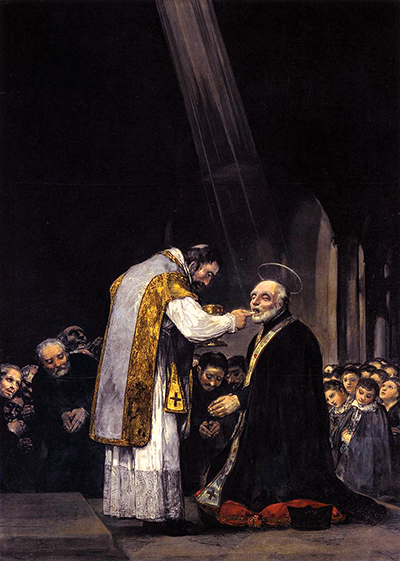
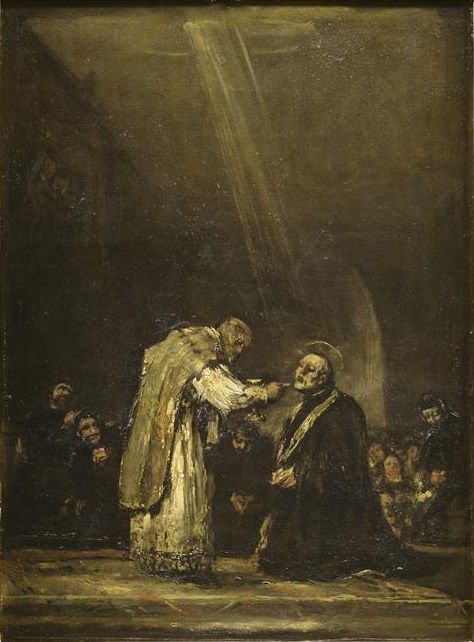
A priest bends towards an elderly man who has knelt to receive communion. The man raises his face and opens his mouth. Close between them, the priest holds a small white wafer. A shaft of light slants out of the darkness towards the kneeling figure, while adults and children gather behind the two men. Francisco de Goya painted this scene in 1819 for the Piarist fathers of San Antón in Madrid. The man receiving the host is the founder of their order, Joseph of Calasanz, in the year of his death, 1648. [1] [2]
At a Glance
- ArtistFrancisco José de Goya y Lucientes (1746–1828). [2]
- Date1819. The signature and date appear at the lower left. [1]
- Medium and dimensionsOil on canvas, 250 × 180 cm in the Fundación Goya en Aragón catalogue. [1]
- CommissionPiarist fathers of the Colegio de San Antón, Madrid. The altarpiece was unveiled on 27 August 1819. [1]
- CollectionPiarist fathers, Museo Calasancio, Madrid. [1]
Works across Goya’s career
The Parasol
1777The Nude Maja
1795–1800Saturn Devouring His Son
c. 1820–23The Dog
c. 1820–23The instant before communion
The priest stands at the left of the central group. His upper body inclines towards Calasanz, who kneels on a red cushion to the right. The saint’s black garment falls in a long sweep towards the floor. Only a narrow band of ornament interrupts that dark shape. The priest’s vestments occupy a broader area of light. Along the gold border and at the bend of the white sleeve, thick touches of paint give the cloth texture. His sleeve leads us to the hand offering the host. It is a tiny object in an altarpiece, and we find it by following a gesture. [1]
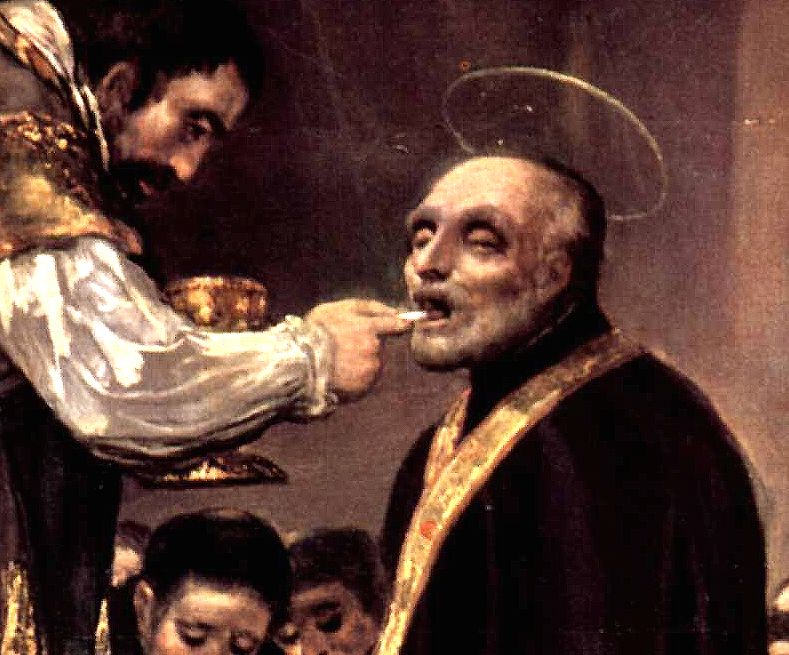
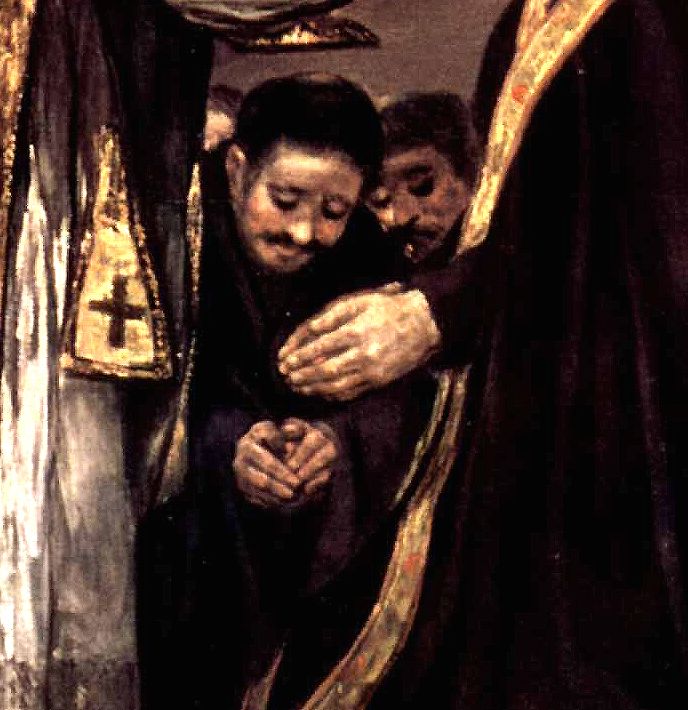
The saint’s face rises to meet that gesture. Light picks out his cheek, beard and forehead. His mouth is open as the host approaches, and a fine oval halo sits above his head. Farther down, his joined hands stand out against the black of his habit. We can follow the movement from those hands to his lifted chin and then to the hand extended by the priest. The figures keep almost all their weight over their feet or knees. A slight movement at the end of the priest’s arm is enough to bring the painting to the point named in its title. [1]
In the Catholic rite, communion received by someone approaching death is called viaticum. The subject explains the care with which Goya paints the space between the host and the saint’s mouth. The priest holds the wafer close enough to show what will happen next. Calasanz still has to lift his head to receive it. The arch on the right, the priest’s clothes and the people awaiting communion place this encounter inside the life of a church. The open mouth and the effort of the kneeling posture make the rite particular to this elderly man. [1] [3]
Annotated Details from The Last Communion of Saint Joseph of Calasanz
Follow the light down to the priest’s hand and the kneeling saint.
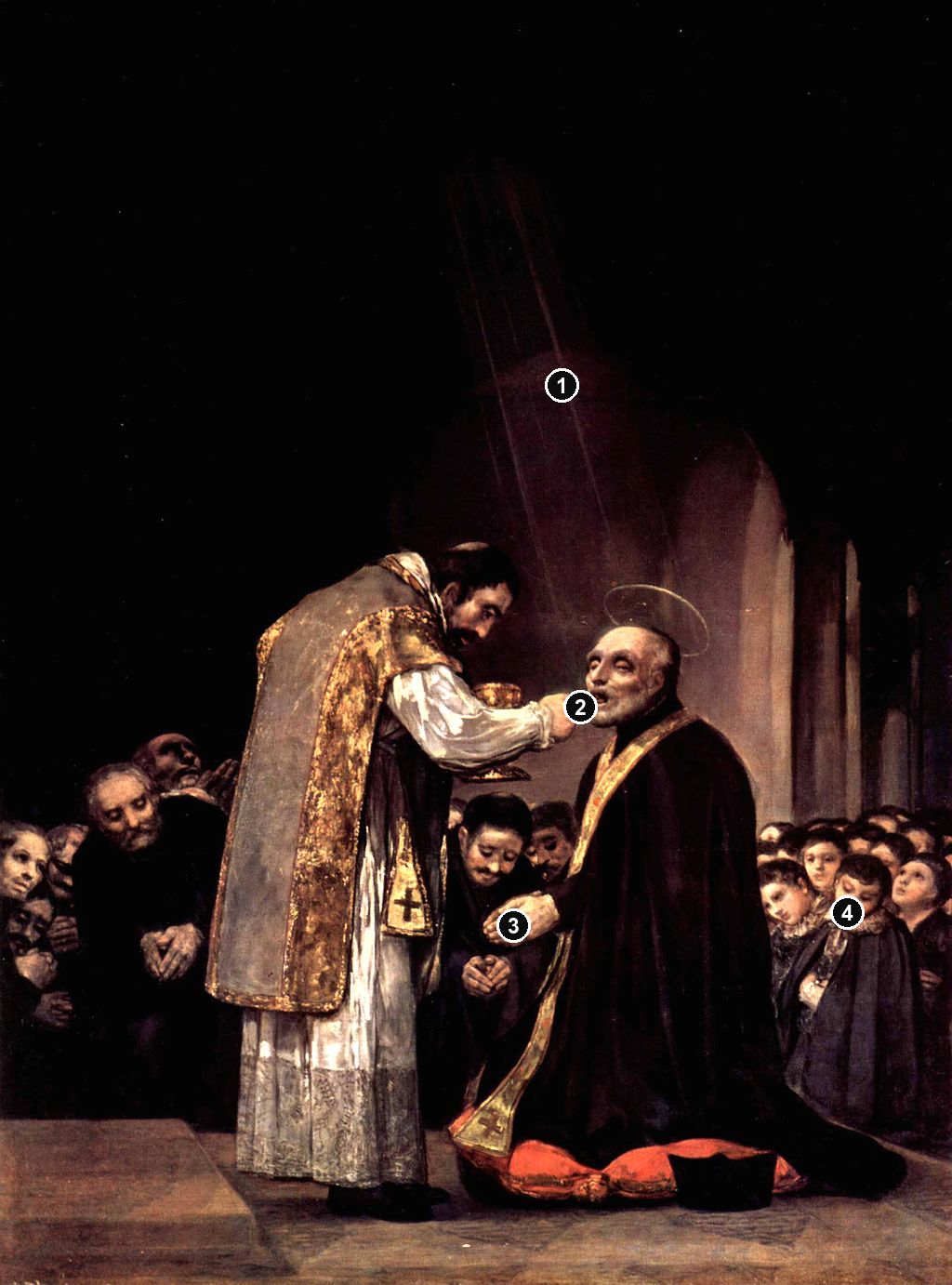
Details from THE LAST COMMUNION OF SAINT JOSEPH OF CALASANZ
Details from the 1819 altarpiece in the Escolapios collection, Madrid.
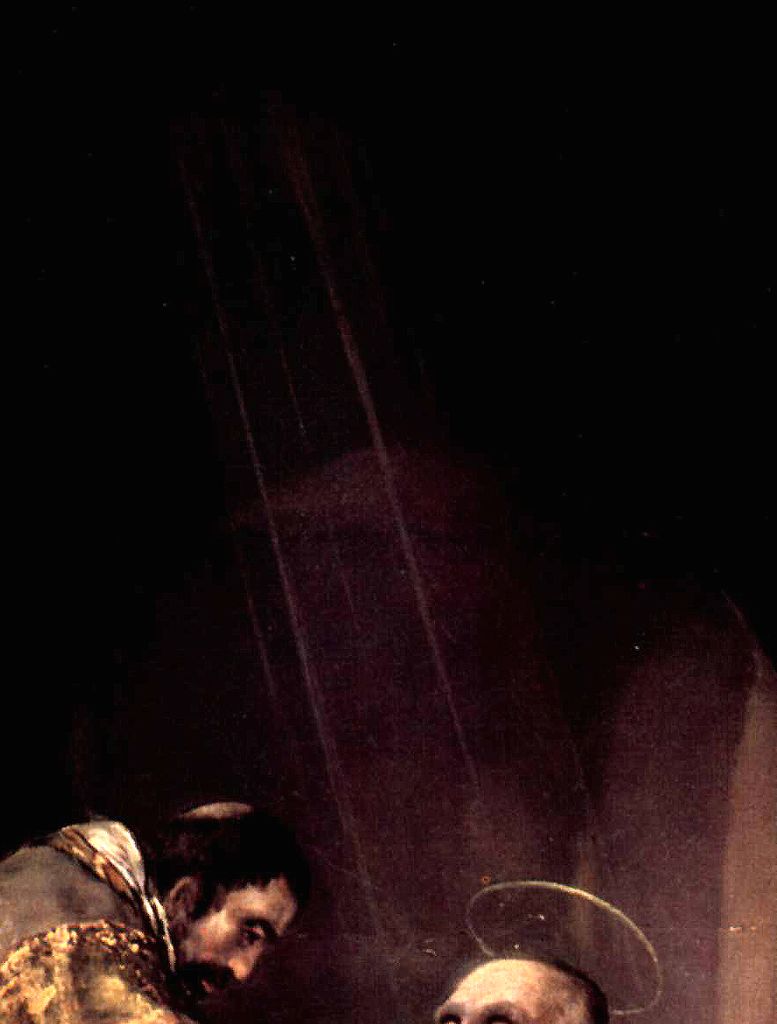
The descending light
Faint diagonal strokes become more visible where they reach the gathering.
The host
The priest extends the host towards the saint’s upturned face.
Clasped hands
Light picks out the joined hands against the saint’s dark habit.
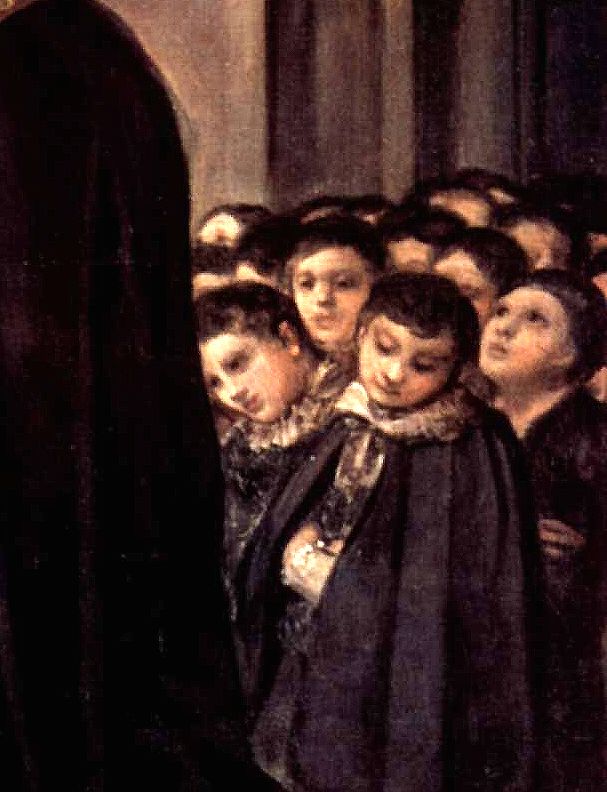
The faces behind
Several faces are fitted closely together to the right of the main figures.
Light and the people who wait
The beam enters near the top of the picture, to the left of the saint, and descends towards him. Much of the upper canvas is dark, with an arcade becoming visible on the right. The beam is especially easy to follow where its parallel strokes cross this open space. Lower down, light takes several forms. It lies in broad passages on the white vestments, catches in broken marks on the gold trim and picks out the saint’s features. The eye can trace a path through the scene before it has enough information to make sense of the church interior. [1]
The other faces spread out in a low band behind the priest and the saint. At the left, an older man lowers his eyes and folds his hands. On the right, the heads of the children appear close together, some turning towards the two men and others looking down or out. Between the priest’s white sleeve and the saint’s black clothing, a face emerges in shadow below the host. These smaller figures give the foreground action witnesses. They also bring the school into the picture. Calasanz founded the Pious Schools to educate poor children, and the pupils are present among the people waiting their turn. The Piarists who commissioned the altarpiece would have seen the work of their order represented alongside its founder. [1] [2]
What San Antón commissioned
The Fundación Goya en Aragón dates the commission to 9 May 1819 and records the unveiling on a side altar in the church of San Antón on 27 August. The price was agreed at 16,000 reales, with 8,000 paid in advance. Goya kept 1,200 of the remaining 8,000 and returned 6,800. In a note transcribed in Ángel Canellas López’s edition of Goya’s documents, the painter frames the return as a gesture in honour of Calasanz, his fellow Aragonese. A separate note addressed to the rector, Pío Peña, speaks of handing over a painting for the community. Both entries are placed in August 1819. [1] [4]
Goya may have attended a Piarist school in Zaragoza as a boy. The Fundación and the Museum of Fine Arts, Boston, treat that connection as a possibility. His note gives us firmer grounds for understanding the gift. In explaining the returned money he invokes the place he shared with the saint. At San Antón the order had commissioned a painting for its own church, and Goya’s recorded gesture gives a personal dimension to that transaction. The scale of the canvas is part of the story too. Above a side altar the viewer would first have seen the tall white figure, the beam and the illuminated face, before picking out the wafer and the fingers around it. [1] [2] [4]
Goya on film
Five films explore Goya’s portraits, prints, Black Paintings and painting techniques.
The Duke of Wellington by Goya
The portrait, its military decorations and its later theft.
Watch on YouTubeAn oil sketch in Bayonne and a drawing in Madrid
A small oil on panel at the Musée Bonnat-Helleu in Bayonne, inventory 11, shows the same encounter in a looser arrangement. The saint raises his face towards the priest, and thick strokes give the figures weight. Warm light spreads across the upper part of the panel. In the Madrid altarpiece it forms a more clearly bounded shaft. The Fundación also points to differences in the waiting figures and to the scant architectural detail in the panel. The Fundación catalogues the panel as a sketch by Goya. A technical study published in 2022 proposes that it was made in Goya’s circle as a small-scale version of the altarpiece. [1] [5] [6]
That study compared X-rays of the Bayonne panel and a version of Christ’s prayer in Gethsemane in the Louvre (RF 1982 28). The growth rings line up across the two supports, which came from the same piece of walnut. Both paintings also have a warm reddish preparation and traces of a painted grey border that was later covered. The researcher, Élisabeth Ravaud, found enough differences in the handling of the paint to suggest that two artists from Goya’s workshop may have painted them. The visual parallels between Bayonne and Madrid can be seen directly. Establishing whether the small panel came first depends on how its authorship and date are understood. [6]
A different sort of evidence comes from the Prado’s Head of a Dying Man (Cabeza de agonizante, D4166), a drawing in black pencil dated 1818. A handwritten annotation attributed to Felipe Arrojo connects the drawn head with the saint in the Piarist painting. The man in the drawing rests on a pillow and wears a band across his forehead. His eyes are partly open and his mouth falls open, a position Goya gives a purpose in the finished canvas by bringing the host towards it. The Fundación considers the drawing likely to have been used for the saint’s face. The date and inscription help trace the link, while the identity of the man drawn remains uncertain. [7] [8]
Two other works from 1819 and 1820
In Christ on the Mount of Olives, Goya also places a kneeling figure in a dark setting and uses a beam to direct attention. The light accompanies an angel with a chalice and paten, towards whom Christ looks with his arms spread. The Museo Calasancio keeps this small 1819 oil on panel in the same collection as the altarpiece. According to the tradition recorded in the panel’s catalogue entry, Goya gave it to the Piarists in connection with the commission. The parallel between the two pictures lies in the way a liturgical object gives focus to a moment of vulnerability. In the garden the vessels appear in a vision before the Passion. At San Antón the host reaches the saint through the hand of a priest in front of a congregation. [1] [9]
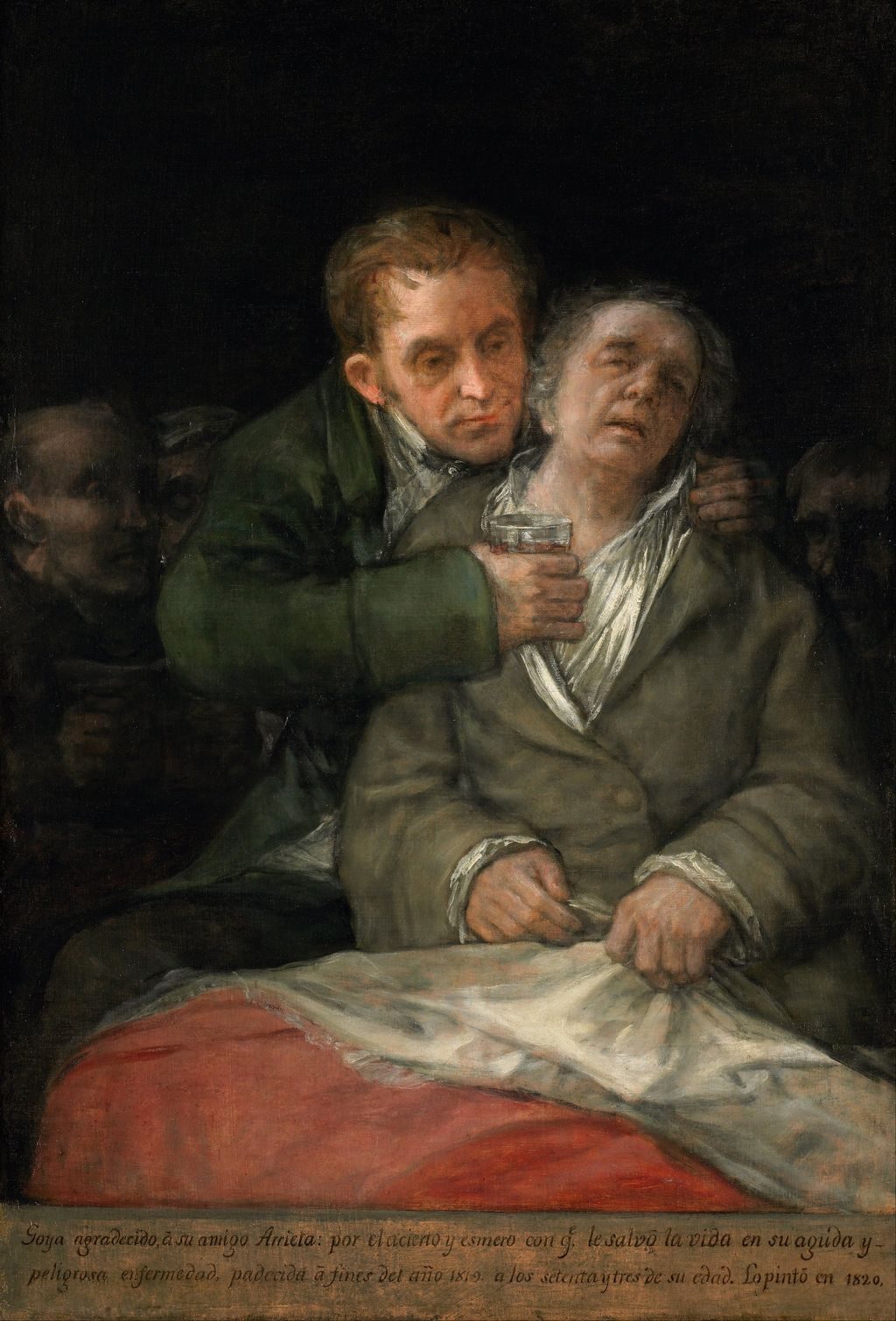
In the 1820 Self-Portrait with Dr Arrieta, darkly painted figures again look on while a man brings something to the mouth of an older person. Arrieta braces Goya across the chest and offers him a glass. Goya’s inscription thanks the doctor for saving his life during a severe illness in late 1819. In the self-portrait the doctor takes the weight of the patient’s body. Calasanz holds himself in prayer while the priest administers the sacrament. Both paintings make us attend to the few inches between the hand that offers and the face that receives. [1] [10]
From the side altar to exhibition
The Museum of Fine Arts, Boston, describes the altarpiece as Goya’s last major religious work. The canvas later passed from the church at San Antón to the Museo Calasancio. The Prado included it in Goya en las colecciones madrileñas in 1983 and records an earlier exhibition in Madrid in 1939. The Prado relates the work’s style and date to Goya’s Black Paintings, a comparison the dark upper canvas helps explain. In this painting the beam gives the darkness a particular function. It draws the eye back towards a small ritual gesture. The altarpiece travelled to the United States for the first time for Goya: Order and Disorder at the Museum of Fine Arts, Boston, which opened in 2014. [1] [2] [11]
Artworks directory
| Name | Date | Medium |
|---|---|---|
| And There’s No Help for It, Plate 15 | Printed 1863 | |
| Asmodea | c. 1820–23 | Wall painting transferred to canvas |
| Boys Inflating a Bladder | 1777–78 | Tapestry cartoon |
| Boys Picking Fruit | 1778 | Tapestry cartoon |
| Bullfight in a Divided Ring | 1825 | Lithograph |
| Card Players | 1777–78 | Tapestry cartoon |
| Card Players (sketch) | 1777–78 | Painted sketch |
| Dance on the Banks of the Manzanares | 1777 | Tapestry cartoon |
| Duel with Cudgels | c. 1820–23 | Wall painting transferred to canvas |
| Heads in a Landscape | c. 1820–23 | Easel painting |
| Judith and Holofernes | c. 1820–23 | Wall painting transferred to canvas |
| Leocadia | c. 1820–23 | Wall painting transferred to canvas |
| Maja and Cloaked Men | 1777 | Tapestry cartoon |
| Maja and Cloaked Men (sketch) | 1777 | Painted sketch |
| Majo Clapping in Time to the Music | 1777 | Drawing |
| Men Reading | c. 1820–23 | Wall painting transferred to canvas |
| Out Hunting for Teeth, Plate 12 | 1799 | Etching, burnished aquatint and burin |
| Picnic in the Countryside (sketch) | 1776–78 | Painted sketch |
| Picnic on the Banks of the Manzanares | 1776 | Tapestry cartoon |
| Pilgrimage to San Isidro | c. 1820–23 | Wall painting transferred to canvas |
| Preparatory study for The Sleep of Reason Produces Monsters | c. 1796–97 | Drawing |
| Procession of the Holy Office | c. 1820–23 | Wall painting transferred to canvas |
| Quarrel at the Cockerel Inn (sketch) | 1777 | Painted sketch |
| Quarrel in the New Tavern | 1777 | Tapestry cartoon |
| Saturn Devouring His Son | c. 1820–23 | Wall painting transferred to canvas |
| Seated Majo Smoking | c. 1776 | Drawing |
| The Dog | c. 1820–23 | Wall painting transferred to canvas |
| The Drinker | 1777 | Tapestry cartoon |
| The Fates | c. 1820–23 | Wall painting transferred to canvas |
| The Great He-Goat | c. 1820–23 | Wall painting transferred to canvas |
| The Kite | 1777–78 | Tapestry cartoon |
| The Parasol | 1777 | Oil on canvas, tapestry cartoon |
| The Second of May 1808 | 1814 | Oil on canvas |
| The Sleep of Reason Produces Monsters, Plate 43 | 1799 | Etching and aquatint |
| The Third of May 1808 | 1814 | Oil on canvas |
| Thou Who Canst Not, Plate 42 | 1799 | Etching and burnished aquatint |
| Three Figures | 1776 | Drawing (lost) |
| Two Old Men | c. 1820–23 | Wall painting transferred to canvas |
| Two Old Men Eating Soup | c. 1820–23 | Wall painting transferred to canvas |
| Two Women and a Man | c. 1820–23 | Wall painting transferred to canvas |
| Universal Language: The Author Dreaming | 1797 | Drawing |
| The Family of Charles IV | 1800 | Oil on canvas |
| Witches’ Sabbath (Osuna painting) | 1797–98 | Oil on canvas |
| The Nude Maja | 1795–1800 | Oil on canvas |
| The Clothed Maja | 1800–07 | Oil on canvas |
| Self-Portrait (Drawing) | c. 1796 | Brush and carbon black ink on laid paper |
| The Swing, Madrid Album B.21 | 1795–97 | Brush and carbon black washes |
| Majas Fighting, a Majo Observing, Madrid Album B.15 | 1796–97 | Brush, grey and black washes on laid paper |
| Majos and Majas Conversing, Madrid Album B.16 | c. 1794–97 | Ink wash on paper |
| Weeping Woman and Three Men, Madrid Album B.17 | 1795–97 | Brush, carbon black washes and black chalk |
| Maja Seated on a Chair and Two Companions Behind, Madrid Album B.18 | 1795–97 | Brush and carbon black washes |
| Girl and Bull, Madrid Album B.23 | 1796–97 | Brush and carbon black washes |
| Lovers Sitting on a Rock, Madrid Album B.24 | 1796–97 | Brush and carbon black washes |
| Mariano Ceballos Riding a Bull | 1825 | Crayon lithograph and scraper |
| Landscape (lifetime impression) | c. 1807–10 | Etching and aquatint |
| Self-Portrait (1815), Prado canvas | 1815 | Oil on canvas |
| Self-Portrait (1815), Academy panel | 1815 | Oil on panel |
| Self-Portrait with Dr Arrieta | 1820 | Oil on canvas |
| Christ Crucified | 1780 | Oil on canvas |
| The Last Communion of Saint Joseph of Calasanz | 1819 | Oil on canvas |
| Christ on the Mount of Olives | 1819 | Oil on panel |
| The Flower Girls, or Spring | 1786–87 | Oil on canvas |
| The Grape Harvest, or Autumn | 1786–87 | Oil on canvas |
| The Snowstorm, or Winter | 1786–87 | Oil on canvas |
| The Threshing Ground, or Summer | 1786–87 | Oil on canvas |
| Picnic on the Banks of the Manzanares | 1776 | Oil on canvas |
| The Kite | 1777–78 | Oil on canvas |
| Dance on the Banks of the Manzanares | 1777 | Oil on canvas |
| A Fight at the Venta Nueva | 1777 | Oil on canvas |
| Blind Man’s Bluff | 1788 | Oil on canvas |
| Dogs on a Lead | 1775 | Oil on canvas |
| Hunting with a Decoy | 1775 | Oil on canvas |
| Hunter Loading His Rifle | 1775 | Oil on canvas |
| The Angler | 1775 | Oil on canvas |
| The Hermitage of San Isidro on His Feast Day | 1788 | Oil on canvas |
| The Meadow of San Isidro | 1788 | Oil on canvas |
| The Straw Manikin | 1791–92 | Oil on canvas |
| Witches’ Flight | c. 1797–98 | Oil on canvas |
| A Scene from ‘The Forcibly Bewitched’ | 1798 | Oil on canvas |
| The Duchess of Alba in Black | 1797 | Oil on canvas |
| The Duchess of Alba in White | 1795 | Oil on canvas |
| Charles III in Hunting Dress | c. 1786 | Oil on canvas |
| The Duke and Duchess of Osuna and Their Children | 1787–88 | Oil on canvas |
| Manuel Osorio Manrique de Zúñiga | 1787–88 | Oil on canvas |
| The Marquesa de Pontejos | c. 1786 | Oil on canvas |
| Equestrian Portrait of the 1st Duke of Wellington | 1812 | Oil on canvas |
| The Duke of Wellington | 1812–14 | Oil on wood |
| Portrait of Ferdinand VII of Spain | 1814 | Oil on canvas |
| Gaspar Melchor de Jovellanos | 1798 | Oil on canvas |
| María Tomasa Palafox y Portocarrero | 1804 | Oil on canvas |
| Señora Sabasa García | c. 1806–11 | Oil on canvas |
| Don Juan Bautista de Muguiro | 1827 | Oil on canvas |
| Doña Isabel de Porcel | Before 1805 | Oil on canvas |
| The Colossus | After 1808 | Oil on canvas |
| The Burial of the Sardine | 1808–12 | Oil on panel |
| The Madhouse | 1808–12 | Oil on panel |
| A Procession of Flagellants | 1808–12 | Oil on panel |
| Portrait of Jacques Galos | 1826 | Oil on canvas |
| Portrait of Mariano Goya, the Artist’s Grandson | 1827 | Oil on canvas |
| Milkmaid of Bordeaux | c. 1827 | Oil on canvas |
| Portrait of Don Juan Antonio Cuervo | 1819 | Oil on canvas |
| María Luisa of Parma (Naples version) | c. 1800 | Oil on canvas |
| The Countess of Baena | 1819 | Oil on canvas |
| The Family of the Infante Don Luis | 1783–84 | Oil on canvas |
| The Holy Family | c. 1787 | Oil on canvas |
| Saint Barbara | c. 1773 | Oil on canvas |
| Saints Justa and Rufina | 1817 | Oil on canvas |
| El Tío Paquete | c. 1819–20 | Oil on canvas |
| The Forge | c. 1815–20 | Oil on canvas |
| Majas on a Balcony (Metropolitan Museum version) | c. 1800–10 | Oil on canvas |
| Maja and Celestina on a Balcony | c. 1808–12 | Oil on canvas |
| The Water Bearer | 1808–12 | Oil on canvas |
| Time and the Old Women | c. 1810 | Oil on canvas |
Frequently Asked Questions
The Piarist collection’s finished oil on canvas is at the Museo Calasancio in Madrid. The account of its 1819 unveiling places it over a side altar in the church of San Antón. [1]
Discussion
Look again at the images and ideas explored in The Last Communion of Saint Joseph of Calasanz. These editorial prompts invite your observations.
Begin with the children at the right edge and then look at the priest’s hand. Where does the painting lead your eye from each starting point? How does the presence of the waiting congregation change the way you see the saint’s final communion?
Reader Insights
Where does the shaft of light direct your attention?
What can you see more clearly in the finished altarpiece than in the Bayonne panel?
Join the Conversation
Share a detail, comparison or question about The Last Communion of Saint Joseph of Calasanz below.
References
- Fundación Goya en Aragón, La última comunión de San José de Calasanz, object record, image, commission and installation history. View source.
- Museum of Fine Arts, Boston, Goya: Order and Disorder, exhibition announcement and commentary on the order and the altarpiece. View source.
- Holy See, Catechism of the Catholic Church, §1524, on communion as viaticum. View source.
- Ángel Canellas López (ed.), Francisco de Goya. Diplomatario, p. 379, documents 256 and 257, August 1819. View source.
- Fundación Goya en Aragón, La última comunión de San José de Calasanz (boceto), catalogue entry for the Bayonne panel, inventory 11. View source.
- Élisabeth Ravaud, “Étude de deux petits panneaux de l’entourage de Goya”, Technè 53 (2022), pp. 86–89, and Bruno Mottin’s object entries. View source.
- Fundación Goya en Aragón, Cabeza de agonizante, catalogue entry for Prado D4166, with transcription of the annotation and analysis. View source.
- Fundación Amigos del Museo del Prado, Cabeza de agonizante, record of the 1983 donation to the Prado. View source.
- Fundación Goya en Aragón, La oración en el huerto, catalogue entry for the 1819 panel in the Museo Calasancio. View source.
- Minneapolis Institute of Art, Self-Portrait with Dr. Arrieta, 52.14, collection record and inscription. View source.
- Museo Nacional del Prado, Goya en las colecciones madrileñas, account of the 1983 exhibition. View source.







