


 by Tom Gurney
Tom Gurney BSc (Hons) is an art history expert with over 20 years experience
Published on June 19, 2020 / Updated on November 20, 2026
Email: tomgurney1@gmail.com / Phone: +44 7429 011000
Introduction
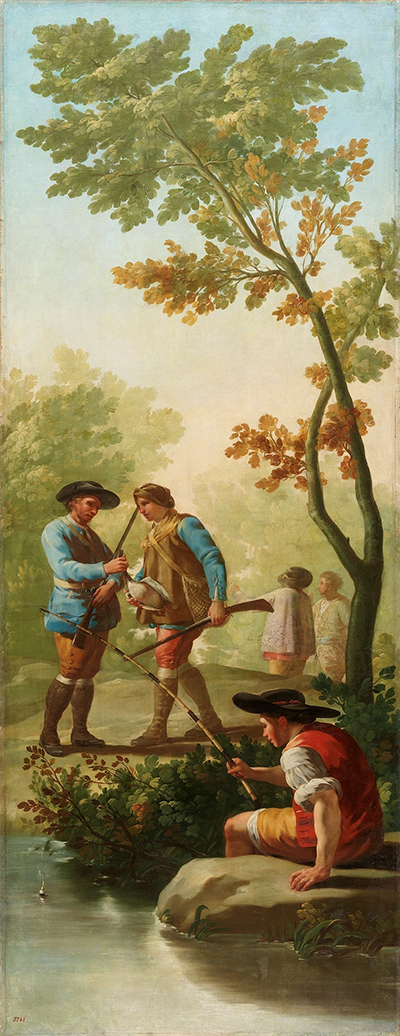
A young angler sits on a flat rock at the water's edge. He leans out beneath the broad brim of his hat, holding a slender rod across the lower part of the landscape. Behind him two hunters stop to examine a dead duck. Francisco de Goya painted The Angler, or El pescador de caña, in 1775 as a full-size design for a tapestry in the royal dining room at El Escorial. The canvas rises almost three metres, giving Goya ample space for the tree that towers above the figures. [1] [2] [3]
At a Glance
- ArtistFrancisco José de Goya y Lucientes.
- Date1775. [1]
- MediumOil on canvas, painted as a tapestry cartoon. [1]
- Size289 × 110 cm, height by width. [1] [4]
- CommissionA narrow hanging for the dining room of the Prince and Princess of Asturias at El Escorial. [1] [4]
- CollectionMuseo Nacional del Prado, Madrid, P005542. [1] [5]
Works across Goya’s career
The Angler
1775The Parasol
1777The Nude Maja
1795–1800Saturn Devouring His Son
c. 1820–23The Dog
c. 1820–23The rod and the guns
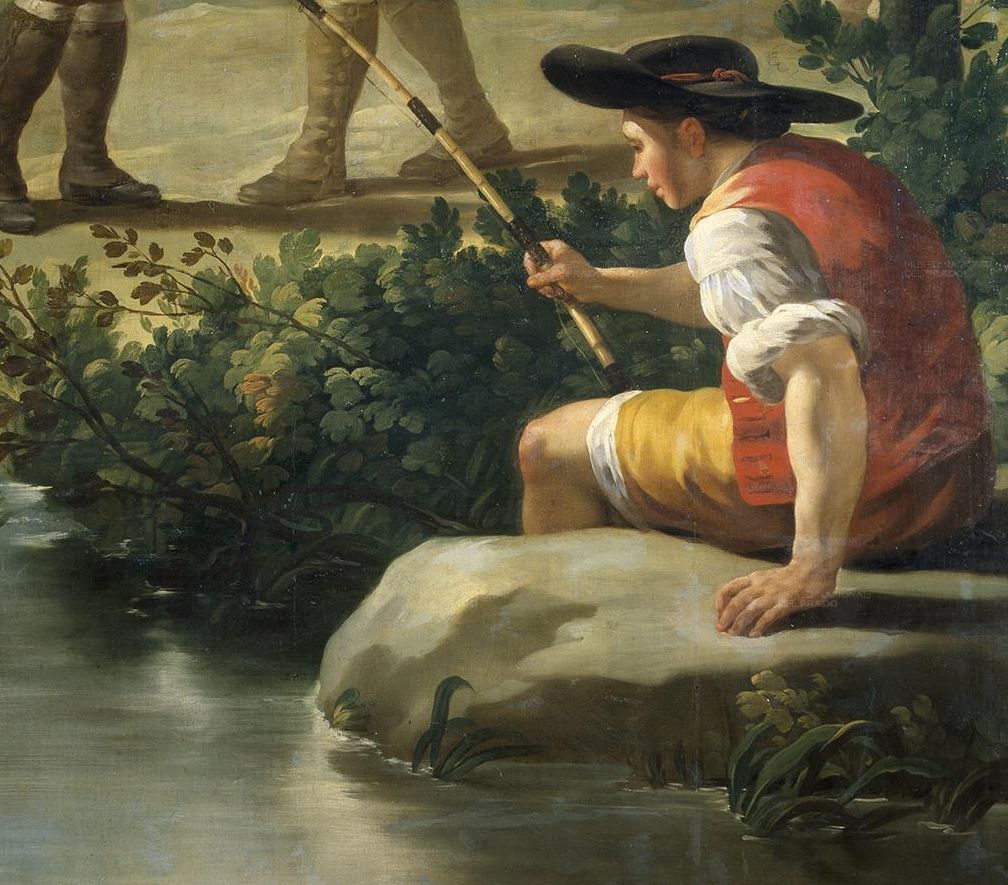
The angler plants one hand on the rock and extends the other towards the water. His head and chest follow the hand holding the rod, while the arm braced against the rock keeps his body steady. The line of his gaze drops towards the small pale mark at the surface at lower left. The warm reds and yellows of his clothing and the light falling on his sleeve make him stand out against the darker leaves behind him. A shadow from the rock spreads into the water. Beyond it, reflections and small ripples are painted with soft, mostly horizontal marks. [2]
The rod points up and left from the angler's hand into the space where two guns angle across the hunters' bodies. These long implements bring the separate groups close together on the surface of the canvas. The hunters' faces and gestures carry the eye in a different direction. Both men are turned towards each other and the bird between them, so attention remains within their small group. The receipt for the cartoons describes the men talking as they inspect a dead duck, with one man holding it and the other lifting it. The document gives a specific action to a passage in which hands, coat sleeves and feathers meet at close quarters. [2] [3]
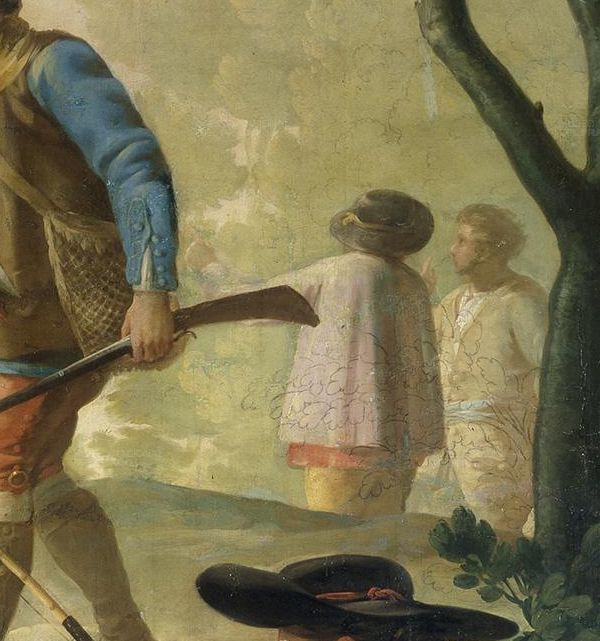
Goya gives the hunters room to stand by placing them on a higher bank. Their boots come down to the light edge of the path, and the bushes below it partly screen the angler. Two smaller figures appear beyond the hunters, on either side of a narrow patch of pale ground. Goya keeps the foreground clothes vivid and gives the distant figures softer outlines and lighter colour. The changes in scale and colour make the bank seem to recede even though there is little room to extend the path sideways. [1] [2]
Annotated Details from The Angler
Follow the composition down from the treetop to the seated fisherman.
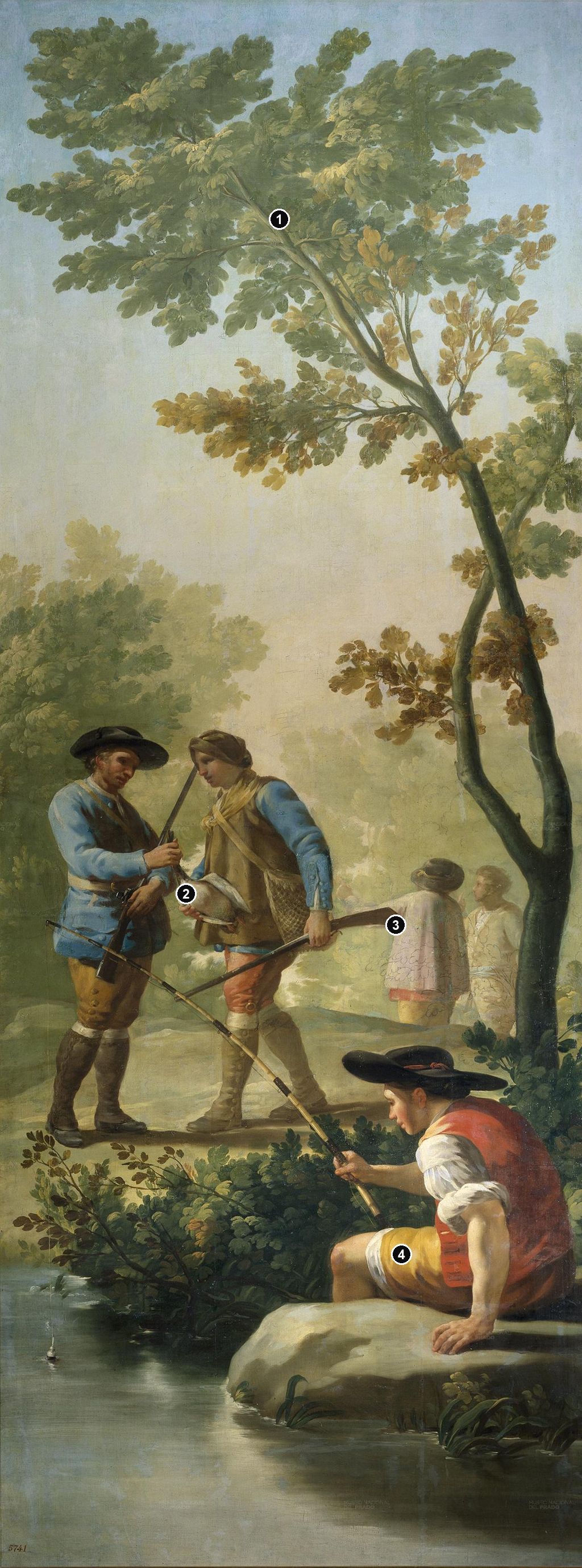
Details from THE ANGLER
Details from the tapestry cartoon in the Museo Nacional del Prado (P005542).
The treetop
Clumps of leaves fill the top of the strip and leave patches of sky between them.
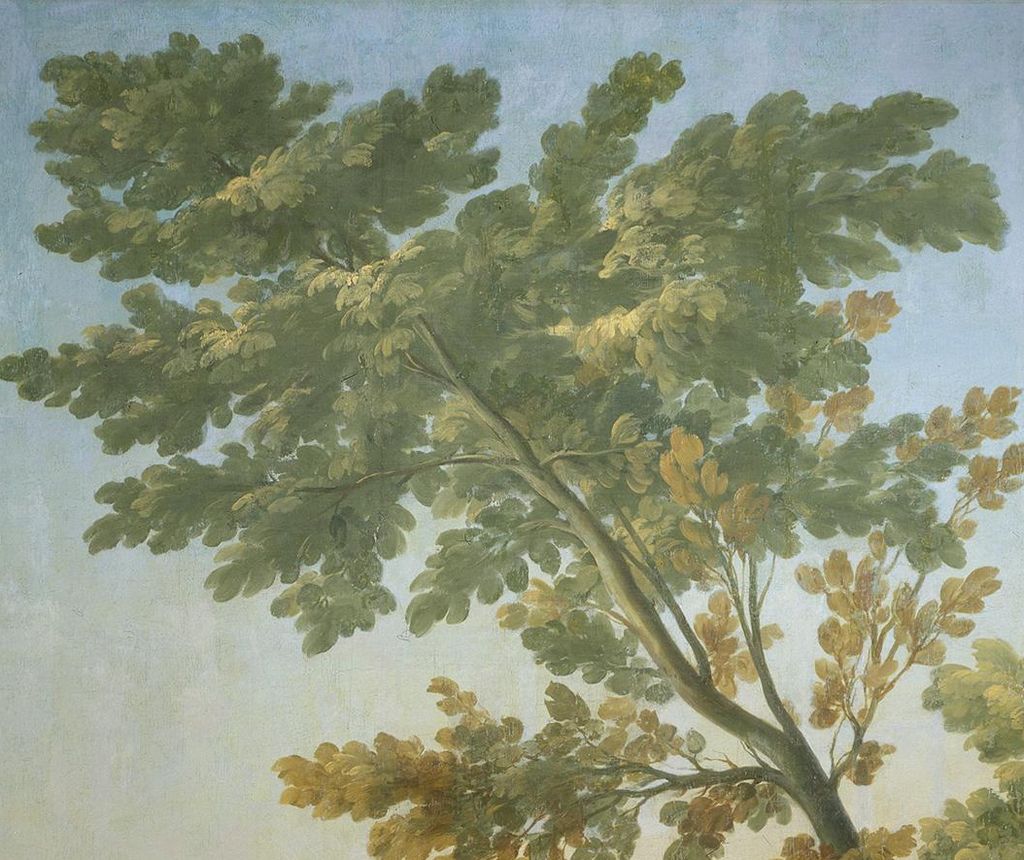
The standing men
Two men face one another on the higher bank, above the seated fisherman.
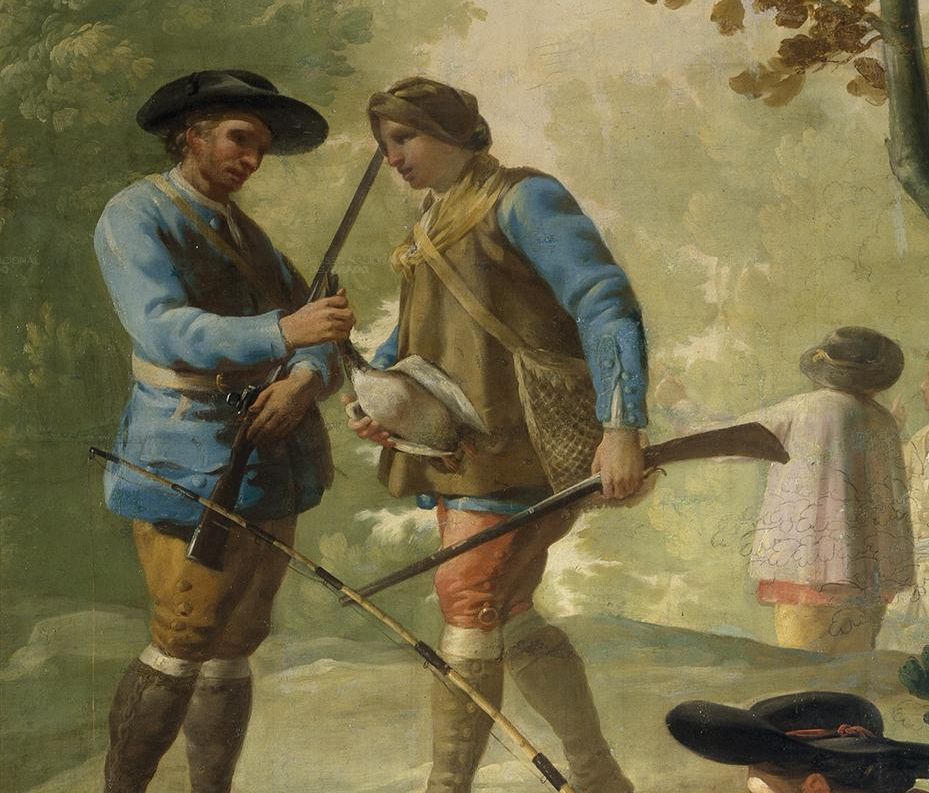
The distant pair
Two more figures stand farther back, near the right-hand tree.
The fisherman
A man sits on a rock with his attention directed towards the water.
From the water to the treetop
The figures occupy the lower portion of the painting. Above them the slender trunk at the right bends inwards, and the upper branches take up most of the width. Patches of sky show through gaps in the leaves. Brown and orange foliage breaks up the vertical rise of the trunk, while the softer tops of the trees at left sit behind the hunters like a second bank of vegetation. The height gives Goya space to vary the size and spacing of these forms. Near the ground the plants overlap the people and make the foreground crowded. Further up, an interval of pale sky opens between the leafy sections. [2]
A related use of space appears in Hunter Loading His Rifle, made for the same dining room. There, too, Goya sets a small group beneath a tree rising well above it. The hunter's gun and ramrod bring attention back to his hands. In The Angler, the rod takes the eye across the foreground towards the spot on the water where the angler is watching. The guns above it then lead into the hunters' conversation. That succession of actions makes the extra width of The Angler count. It gives the solitary figure space for his own occupation even as he shares the bank with the hunters. [2] [4] [6]
Goya on film
Five films explore Goya’s portraits, prints, Black Paintings and painting techniques.
The Duke of Wellington by Goya
The portrait, its military decorations and its later theft.
Watch on YouTubeBetween the balconies at El Escorial
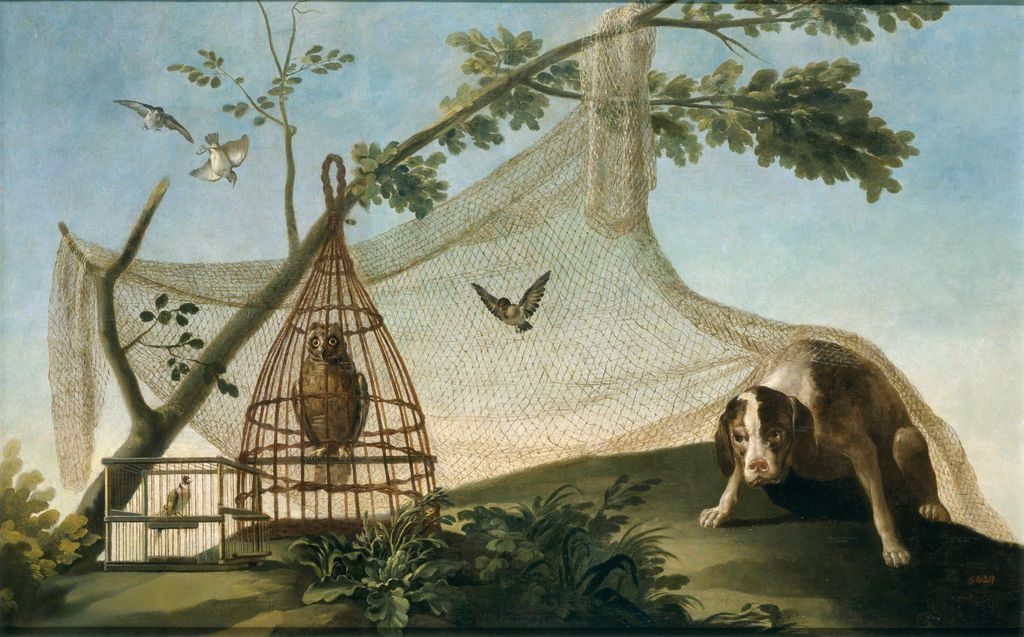
The tapestry was intended for the dining room of the future Charles IV and María Luisa of Parma. Goya's cartoon reached the Royal Tapestry Factory of Santa Bárbara with the second consignment on 30 October 1775. That delivery also included the large Hunting Party, a narrower design of boys trapping birds with an owl, and a still life of dead game for above a doorway. Goya contributed nine designs in all. Ramón Bayeu painted five more for the room, and Francisco Bayeu directed the work. The group required canvases of various shapes because the weavers were making hangings for different parts of the walls. [3] [4] [7]
Jesús López Ortega and Carlos Sanz de Miguel reconstruct the eighteenth-century dining room using records of the decoration and the dimensions of the architectural openings. They propose a place for The Angler between the two east-wall balconies, where the space was narrow because the original openings were wider than they are today. Dogs on a Leash and Hunting with a Decoy would have flanked it above the balconies. In that arrangement, the two horizontal landscapes fill the spaces over the openings, and the painted tree in The Angler gives the tapestry between them a form that can be followed up through almost the full height. The same reconstruction puts Hunter Loading His Rifle nearer the end of the east wall and places Hunting Party, delivered alongside The Angler, beside the fireplace on the north wall. [4]
From paper to canvas and tapestry
The preparatory drawing Two Hunters studied the pair with the duck. Goya used black chalk and white highlights on bluish paper. The Fundación Goya en Aragón records that the sheet was destroyed in the 1936 fire at the Instituto Jovellanos in Gijón. A photograph preserves the composition. The men fill the sheet, with modelling and highlights giving special attention to their faces. The Fundación notes changes in the painted version, including a bag and a headscarf for the hunter on the right. It also records that the reverse of the sheet carried a study for The Picnic, a later tapestry design. A separate sheet also titled Two Hunters, now in the Museum of Fine Arts, Boston, studies principal figures for Hunter Loading His Rifle and Hunter with His Dogs. [8] [9]
On the painted cartoon itself, look at the faint branches outlined over the two smaller people behind the hunters. In a surviving woven version described by the Fundación, vegetation occupies the space of those figures. The catalogue suggests that the weavers probably drew the outlines on the canvas. The faint lines document a choice made between painting and weaving. The people are still visible in the painted distance, while in the tapestry the brushwood extends across the bank behind the two men with the duck. [1] [2]
The painting at the Prado
Factory and royal inventories credited different artists with the El Escorial cartoons. Vicente López listed The Angler under Zacarías González Velázquez when he compiled an inventory for Ferdinand VII's estate in 1834. The canvas passed from the tapestry factory to the Royal Palace in Madrid around 1856 or 1857 and entered the Prado in 1870 under Francisco Bayeu's name. Valentín de Sambricio's study of Goya's tapestries established the attribution of the series. The painting spent 1933 to 1989 on deposit at the Ministry of Education and Science before returning to the Prado. [1] [7]
The Prado's 2014 annual report lists The Angler among works examined by its technical department that year, alongside Hunting Party and Hunter Loading His Rifle. The same report records Almudena Sánchez's treatment of Hunter Loading His Rifle, which the museum explained in its exhibition Goya in Madrid. In that intervention, a strip taken from a cartoon by Matías Téllez was separated from the loading scene. The two works had been joined during an earlier restoration and had come from different rooms at El Escorial. The report also documents a loan of The Angler to the Museum of Fine Arts, Boston, for Goya: Order and Disorder. [4] [5] [6]

Artworks directory
| Name | Date | Medium |
|---|---|---|
| And There’s No Help for It, Plate 15 | Printed 1863 | |
| Asmodea | c. 1820–23 | Wall painting transferred to canvas |
| Boys Inflating a Bladder | 1777–78 | Tapestry cartoon |
| Boys Picking Fruit | 1778 | Tapestry cartoon |
| Bullfight in a Divided Ring | 1825 | Lithograph |
| Card Players | 1777–78 | Tapestry cartoon |
| Card Players (sketch) | 1777–78 | Painted sketch |
| Dance on the Banks of the Manzanares | 1777 | Tapestry cartoon |
| Duel with Cudgels | c. 1820–23 | Wall painting transferred to canvas |
| Heads in a Landscape | c. 1820–23 | Easel painting |
| Judith and Holofernes | c. 1820–23 | Wall painting transferred to canvas |
| Leocadia | c. 1820–23 | Wall painting transferred to canvas |
| Maja and Cloaked Men | 1777 | Tapestry cartoon |
| Maja and Cloaked Men (sketch) | 1777 | Painted sketch |
| Majo Clapping in Time to the Music | 1777 | Drawing |
| Men Reading | c. 1820–23 | Wall painting transferred to canvas |
| Out Hunting for Teeth, Plate 12 | 1799 | Etching, burnished aquatint and burin |
| Picnic in the Countryside (sketch) | 1776–78 | Painted sketch |
| Picnic on the Banks of the Manzanares | 1776 | Tapestry cartoon |
| Pilgrimage to San Isidro | c. 1820–23 | Wall painting transferred to canvas |
| Preparatory study for The Sleep of Reason Produces Monsters | c. 1796–97 | Drawing |
| Procession of the Holy Office | c. 1820–23 | Wall painting transferred to canvas |
| Quarrel at the Cockerel Inn (sketch) | 1777 | Painted sketch |
| Quarrel in the New Tavern | 1777 | Tapestry cartoon |
| Saturn Devouring His Son | c. 1820–23 | Wall painting transferred to canvas |
| Seated Majo Smoking | c. 1776 | Drawing |
| The Dog | c. 1820–23 | Wall painting transferred to canvas |
| The Drinker | 1777 | Tapestry cartoon |
| The Fates | c. 1820–23 | Wall painting transferred to canvas |
| The Great He-Goat | c. 1820–23 | Wall painting transferred to canvas |
| The Kite | 1777–78 | Tapestry cartoon |
| The Parasol | 1777 | Oil on canvas, tapestry cartoon |
| The Second of May 1808 | 1814 | Oil on canvas |
| The Sleep of Reason Produces Monsters, Plate 43 | 1799 | Etching and aquatint |
| The Third of May 1808 | 1814 | Oil on canvas |
| Thou Who Canst Not, Plate 42 | 1799 | Etching and burnished aquatint |
| Three Figures | 1776 | Drawing (lost) |
| Two Old Men | c. 1820–23 | Wall painting transferred to canvas |
| Two Old Men Eating Soup | c. 1820–23 | Wall painting transferred to canvas |
| Two Women and a Man | c. 1820–23 | Wall painting transferred to canvas |
| Universal Language: The Author Dreaming | 1797 | Drawing |
| The Family of Charles IV | 1800 | Oil on canvas |
| Witches’ Sabbath (Osuna painting) | 1797–98 | Oil on canvas |
| The Nude Maja | 1795–1800 | Oil on canvas |
| The Clothed Maja | 1800–07 | Oil on canvas |
| Self-Portrait (Drawing) | c. 1796 | Brush and carbon black ink on laid paper |
| The Swing, Madrid Album B.21 | 1795–97 | Brush and carbon black washes |
| Majas Fighting, a Majo Observing, Madrid Album B.15 | 1796–97 | Brush, grey and black washes on laid paper |
| Majos and Majas Conversing, Madrid Album B.16 | c. 1794–97 | Ink wash on paper |
| Weeping Woman and Three Men, Madrid Album B.17 | 1795–97 | Brush, carbon black washes and black chalk |
| Maja Seated on a Chair and Two Companions Behind, Madrid Album B.18 | 1795–97 | Brush and carbon black washes |
| Girl and Bull, Madrid Album B.23 | 1796–97 | Brush and carbon black washes |
| Lovers Sitting on a Rock, Madrid Album B.24 | 1796–97 | Brush and carbon black washes |
| Mariano Ceballos Riding a Bull | 1825 | Crayon lithograph and scraper |
| Landscape (lifetime impression) | c. 1807–10 | Etching and aquatint |
| Self-Portrait (1815), Prado canvas | 1815 | Oil on canvas |
| Self-Portrait (1815), Academy panel | 1815 | Oil on panel |
| Self-Portrait with Dr Arrieta | 1820 | Oil on canvas |
| Christ Crucified | 1780 | Oil on canvas |
| The Last Communion of Saint Joseph of Calasanz | 1819 | Oil on canvas |
| Christ on the Mount of Olives | 1819 | Oil on panel |
| The Flower Girls, or Spring | 1786–87 | Oil on canvas |
| The Grape Harvest, or Autumn | 1786–87 | Oil on canvas |
| The Snowstorm, or Winter | 1786–87 | Oil on canvas |
| The Threshing Ground, or Summer | 1786–87 | Oil on canvas |
| Picnic on the Banks of the Manzanares | 1776 | Oil on canvas |
| The Kite | 1777–78 | Oil on canvas |
| Dance on the Banks of the Manzanares | 1777 | Oil on canvas |
| A Fight at the Venta Nueva | 1777 | Oil on canvas |
| Blind Man’s Bluff | 1788 | Oil on canvas |
| Dogs on a Lead | 1775 | Oil on canvas |
| Hunting with a Decoy | 1775 | Oil on canvas |
| Hunter Loading His Rifle | 1775 | Oil on canvas |
| The Angler | 1775 | Oil on canvas |
| The Hermitage of San Isidro on His Feast Day | 1788 | Oil on canvas |
| The Meadow of San Isidro | 1788 | Oil on canvas |
| The Straw Manikin | 1791–92 | Oil on canvas |
| Witches’ Flight | c. 1797–98 | Oil on canvas |
| A Scene from ‘The Forcibly Bewitched’ | 1798 | Oil on canvas |
| The Duchess of Alba in Black | 1797 | Oil on canvas |
| The Duchess of Alba in White | 1795 | Oil on canvas |
| Charles III in Hunting Dress | c. 1786 | Oil on canvas |
| The Duke and Duchess of Osuna and Their Children | 1787–88 | Oil on canvas |
| Manuel Osorio Manrique de Zúñiga | 1787–88 | Oil on canvas |
| The Marquesa de Pontejos | c. 1786 | Oil on canvas |
| Equestrian Portrait of the 1st Duke of Wellington | 1812 | Oil on canvas |
| The Duke of Wellington | 1812–14 | Oil on wood |
| Portrait of Ferdinand VII of Spain | 1814 | Oil on canvas |
| Gaspar Melchor de Jovellanos | 1798 | Oil on canvas |
| María Tomasa Palafox y Portocarrero | 1804 | Oil on canvas |
| Señora Sabasa García | c. 1806–11 | Oil on canvas |
| Don Juan Bautista de Muguiro | 1827 | Oil on canvas |
| Doña Isabel de Porcel | Before 1805 | Oil on canvas |
| The Colossus | After 1808 | Oil on canvas |
| The Burial of the Sardine | 1808–12 | Oil on panel |
| The Madhouse | 1808–12 | Oil on panel |
| A Procession of Flagellants | 1808–12 | Oil on panel |
| Portrait of Jacques Galos | 1826 | Oil on canvas |
| Portrait of Mariano Goya, the Artist’s Grandson | 1827 | Oil on canvas |
| Milkmaid of Bordeaux | c. 1827 | Oil on canvas |
| Portrait of Don Juan Antonio Cuervo | 1819 | Oil on canvas |
| María Luisa of Parma (Naples version) | c. 1800 | Oil on canvas |
| The Countess of Baena | 1819 | Oil on canvas |
| The Family of the Infante Don Luis | 1783–84 | Oil on canvas |
| The Holy Family | c. 1787 | Oil on canvas |
| Saint Barbara | c. 1773 | Oil on canvas |
| Saints Justa and Rufina | 1817 | Oil on canvas |
| El Tío Paquete | c. 1819–20 | Oil on canvas |
| The Forge | c. 1815–20 | Oil on canvas |
| Majas on a Balcony (Metropolitan Museum version) | c. 1800–10 | Oil on canvas |
| Maja and Celestina on a Balcony | c. 1808–12 | Oil on canvas |
| The Water Bearer | 1808–12 | Oil on canvas |
| Time and the Old Women | c. 1810 | Oil on canvas |
Frequently Asked Questions
A cartoon is a full-size design for the weavers to follow. In this case the design is an oil painting on canvas. It retains pictorial details, including figures in the distance, that the weavers altered when translating the image into a hanging. [1]
Discussion
Look again at the images and ideas explored in The Angler. These editorial prompts invite your observations.
Start with the angler's braced hand and follow his rod towards the hunters. Where does the painting make you change direction? Then follow the trunk upwards and consider what the ample space over the figures does to the pace of the scene.
Reader Insights
How does the tall canvas lead your attention from the trees to the water?
Which details tell you what the different groups are doing?
Join the Conversation
Share a detail, comparison or question about The Angler below.
References
- Fundación Goya en Aragón, Fisherman with his Rod (El pescador de caña), catalogue entry, series 7/9. View source.
- Fundación Goya en Aragón, photograph of El pescador de caña, Museo Nacional del Prado, P005542. View source.
- Institución Fernando el Católico, Francisco de Goya. Diplomatario, pp. 401–402, extract from the factory's acknowledgement of receipt, 30 October 1775. View source.
- Jesús López Ortega and Carlos Sanz de Miguel, study of the tapestry decoration for the Prince and Princess of Asturias at El Escorial, Librosdelacorte.es 27 (2023), pp. 80–84 and 89–90. View source.
- Museo Nacional del Prado, Memoria de actividades 2014, pp. 124–125, 311–312, 319 and 327–328. View source.
- Museo Nacional del Prado, Restoration: Hunter Loading His Rifle, by Francisco de Goya, with Gudrun Maurer and Almudena Sánchez. View source.
- Fundación Goya en Aragón, Wild Boar Hunt (La caza del jabalí), chronology and early attributions of the series. View source.
- Fundación Goya en Aragón, Dos cazadores, study for The Angler, series 7b/9. View source.
- Fundación Goya en Aragón, Two Hunters (Dos cazadores), Museum of Fine Arts, Boston, 33.1018. View source.







