


 Francisco de Goya.jpg)
 by Tom Gurney
Tom Gurney BSc (Hons) is an art history expert with over 20 years experience
Published on June 19, 2020 / Updated on November 20, 2026
Email: tomgurney1@gmail.com / Phone: +44 7429 011000
Introduction
Don Claudio holds an oil flask at arm’s length, covers his mouth and stares at a flame held out by a horned figure. He believes he will die when the lamp goes out. The people who have persuaded him of this want him to marry. Francisco de Goya painted the encounter in 1798, taking it from Antonio de Zamora’s comedy El hechizado por fuerza. The painting is now in the National Gallery in London, where it is catalogued as A Scene from ‘The Forcibly Bewitched’. It was one of six supernatural subjects Goya supplied to the Duke and Duchess of Osuna for their country estate outside Madrid. [1] [2]
At a Glance
- ArtistFrancisco de Goya
- National Gallery titleA Scene from El Hechizado por Fuerza (‘The Forcibly Bewitched’)
- Other titlesThe Bewitched Man, The Devil’s Lamp, El hechizado, La lámpara del diablo
- Date1798
- MediumOil on canvas
- Dimensions42.5 × 30.8 cm, height before width
- CollectionNational Gallery, London, NG1472, bought in 1896
- Literary sourceAct II of Antonio de Zamora’s El hechizado por fuerza
- Original settingThe Osunas’ estate at La Alameda, near Madrid
Works across Goya’s career
The Parasol
1777The Nude Maja
1795–1800Saturn Devouring His Son
c. 1820–23The Dog
c. 1820–23Don Claudio and the flame
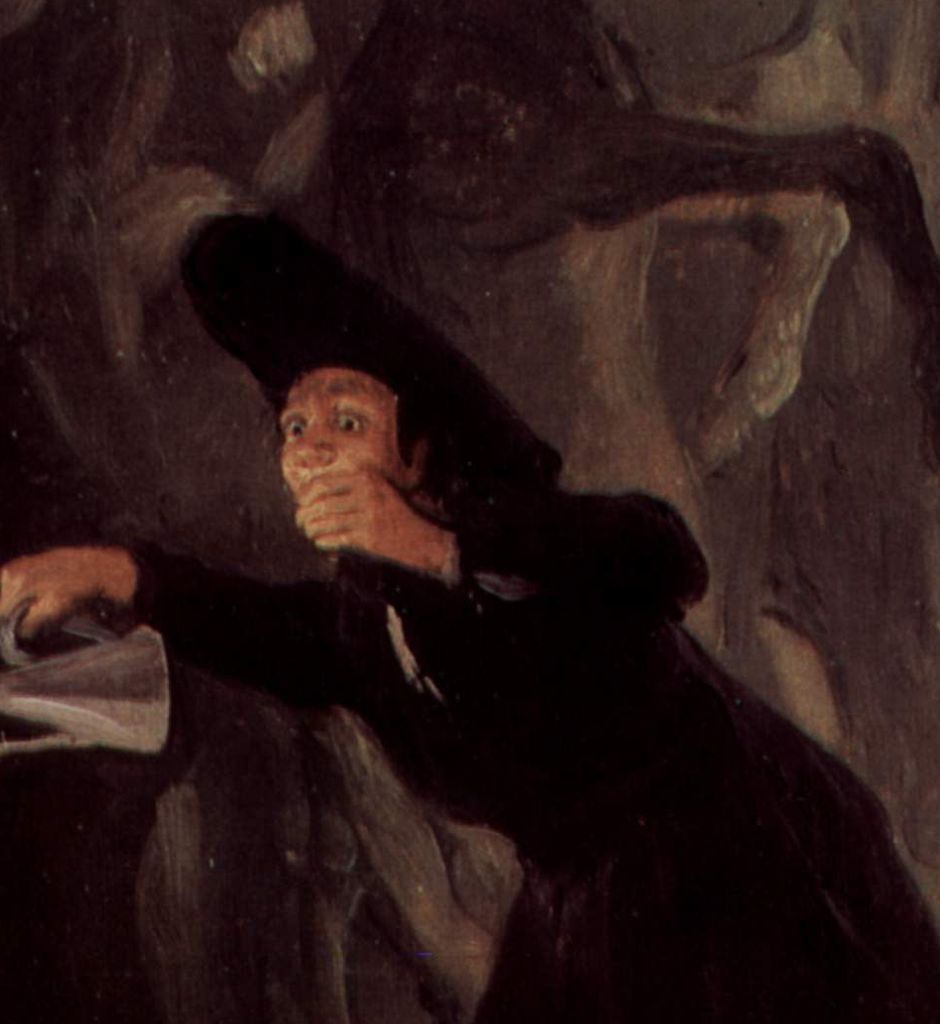
Claudio has to bring the flask close to the flame while keeping the rest of himself as far away as possible. His outstretched arm leads straight to the lamp. His legs are planted wide apart, and his black robe sweeps back towards the right edge. The tilt of his body makes the simple task of pouring oil look like a feat of balance. He keeps his other hand close across his mouth, making his wide eyes the most expressive part of his face. The high, slanting brim of his hat cuts across the wall behind him. Everything about the pose makes it easy to imagine an actor holding it just long enough for an audience to laugh. [1]
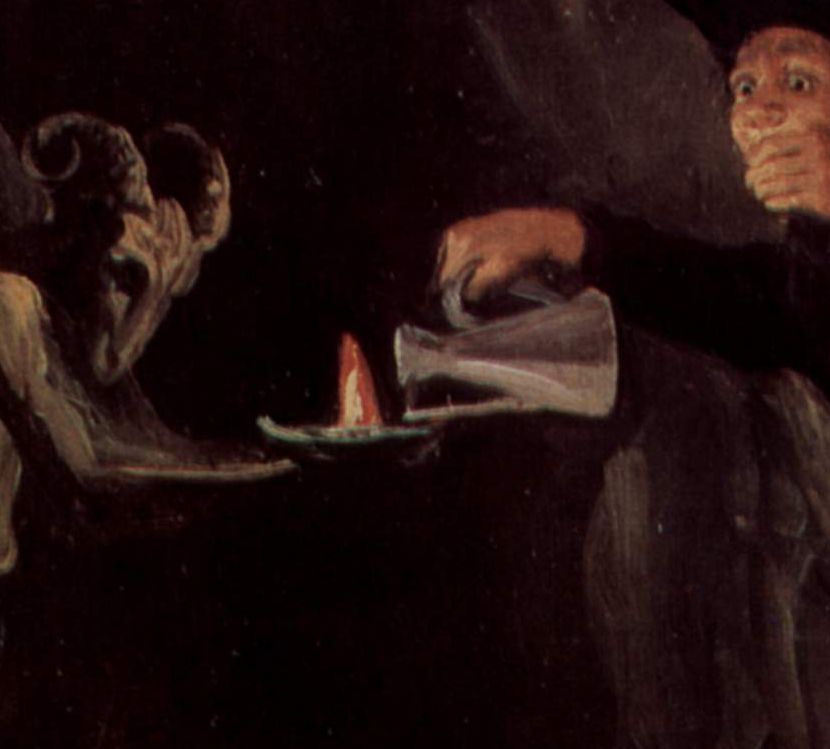
The figure at the left bends forward and extends a thin forelimb beneath the shallow dish. Its attentiveness has something of a servant offering a tray, while its curled horns, long muzzle and bony outline make the gesture unnerving. The National Gallery describes the lamp as having the form of a ram. The Fundación Goya en Aragón interprets the horned figure as the Devil in the guise of a male goat, holding the lamp. What we can distinguish in the painting is a small flame in a dish, supported by an animal-like figure that seems to lean into Claudio’s space. The account of the prank supplies a reason for the sight to be so carefully calculated to alarm him. [1] [2]
The flame is a narrow stroke of orange and pale yellow against a deep brown-black passage. Its colour recurs on Claudio’s face and hands. His black sleeve nearly disappears between the illuminated hand at the flask and the dark mass of his body, so the hand seems to venture out a little farther than the arm can comfortably reach. A cool glint marks the flask’s shape near the flame. Lower down, the broad wash of light across the floor gives both figures a place to stand, and a darker streak below Claudio carries the eye towards the lettering at the right. These alternating patches of light and shade let the eye reconstruct the action in the same order that Claudio attends to it, from the flask to the dish and the flame. [1]
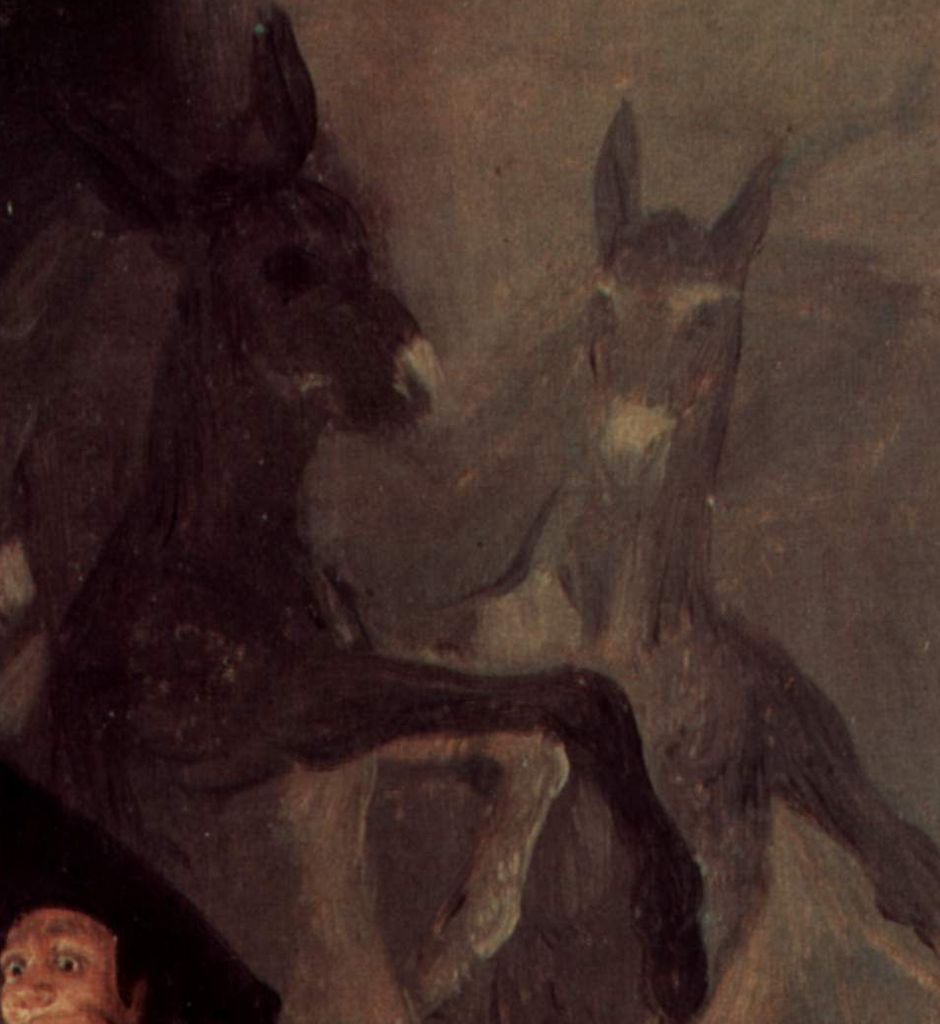
As the eye adjusts to the darkness, three long-eared animals come into view above Claudio. The large middle animal is seen in profile, with one raised foreleg extending across the lighter space to the right. The others are less sharply defined, with pale touches on their muzzles and broad, loose strokes for their bodies. Their apparent movement is part of the joke. Zamora gives Claudio a moment to notice the painted dance of donkeys in the room prepared to trick him. Goya gives the animals enough height and movement to make them look at first like an apparition. Their outline across the back wall becomes easier to read once we know what Claudio has been looking at. [1] [2] [3]
Annotated Details from A Scene from ‘The Forcibly Bewitched’
Look from the small flame to the figure, the donkeys and the words on the floor.
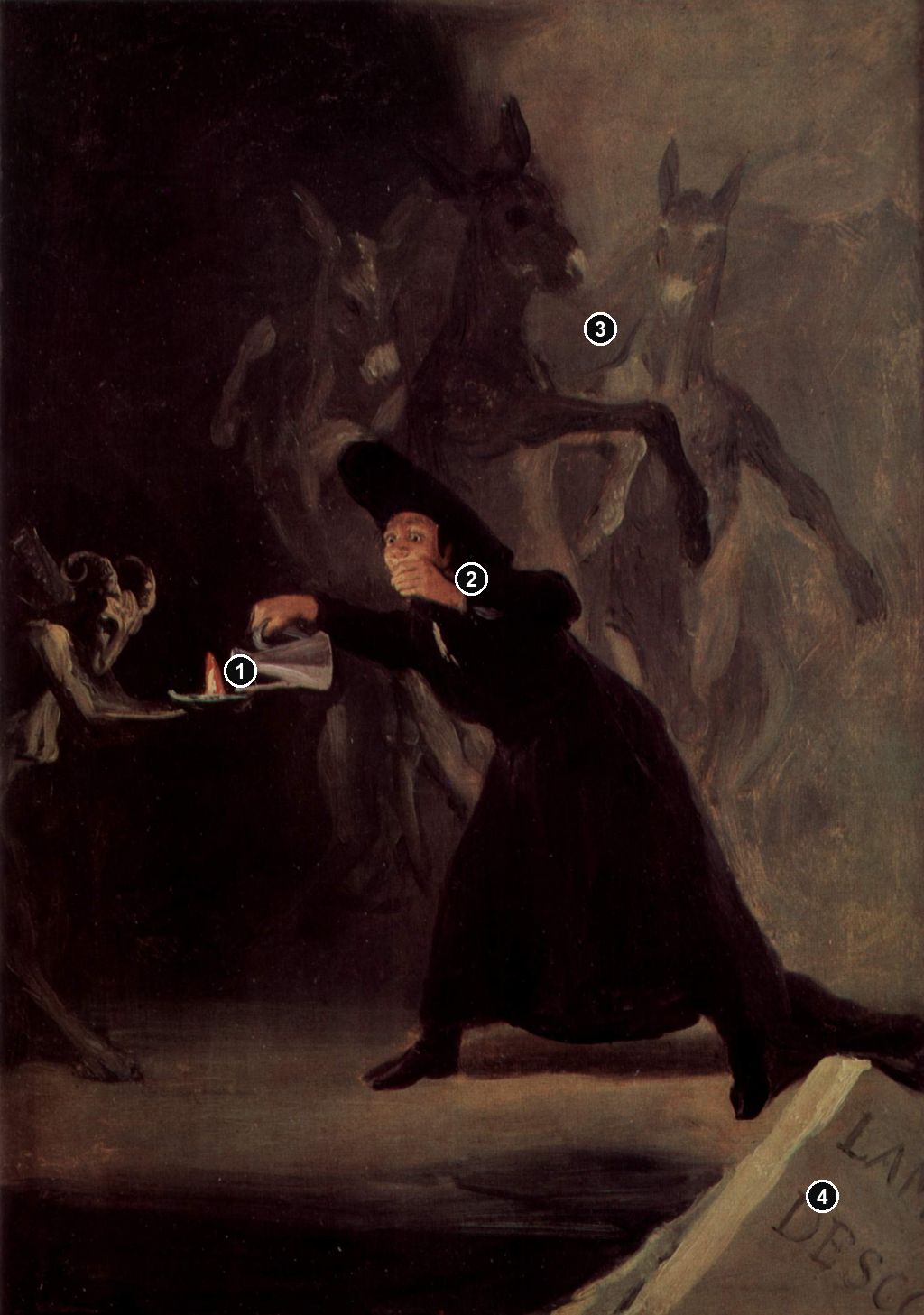
Details from A SCENE FROM ‘THE FORCIBLY BEWITCHED’
Details from the Osuna painting in the National Gallery, London (NG1472).
The lamp
The flame is a bright point just below the pitcher.
The man’s gesture
The man extends one hand while the other rises close to his face.
The donkeys
The long ears and front legs are easier to trace than the dim bodies behind them.
The open book
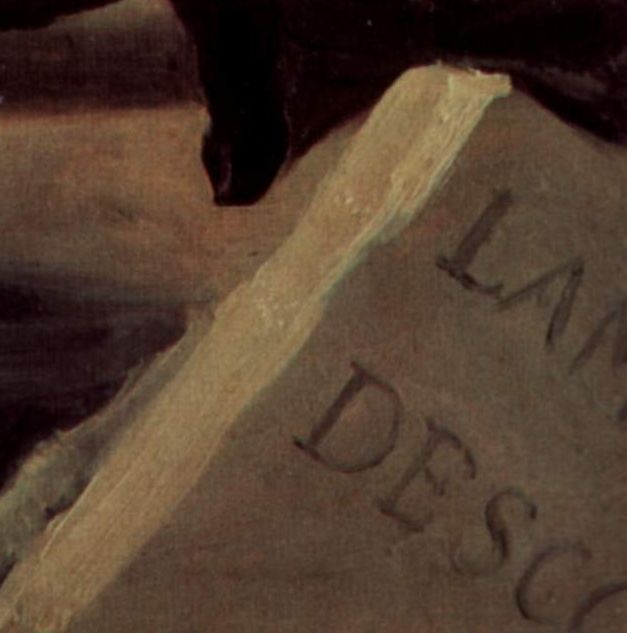
Large letters on the page enter the picture at the lower right.
The play and the words in the corner
Zamora’s play was already about a century old when Goya painted the scene. Don Claudio, an Asturian cleric, is being manoeuvred into marriage with Doña Leonora. He is led to believe that Lucía, an enslaved woman, has cast a spell that binds his life to the flame of the lamp in her room. Near the end of Act II, he enters a space prepared to look as if it belongs to a sorceress. He examines painted horrors and tries to make sense of the donkeys before attending to the oil. When he speaks to the lamp, his speech makes it sound as though the light were sucking the oil from his body. Keeping it supplied is his way of buying a little more time. [1] [2] [3] [4]
Goya left a clue to the exact moment in the lower right. Two lines of painted capitals begin LAM and DESCO, the opening fragments of Lámpara descomunal, roughly ‘monstrous lamp’. Those are the first words of Claudio’s address to the flame. The Fundación describes the inscribed object as a book. The literary historian Leonardo Romero Tobar discusses it as a possible glimpse of the stage prompter’s copy. On that reading, the page sits close to the audience, and Claudio is the actor seen beyond it. Its skewed edge interrupts the bottom corner much as a page held close to the eye might. Even without a firm identification of the object, the fragment connects Claudio’s fixed expression with a specific line of verse. [1] [2] [4]
Onstage the ruse involves more people than Goya shows. Zamora lets others speak and act around Claudio as his fear mounts. There are auditory cues too, including the sound of a chain. The canvas leaves Claudio alone in front of the horned figure and lets the prank register through his posture, the inscription and the painted backdrop. Someone who knows the play can imagine the people just outside the scene, waiting for their arrangements to work. Someone encountering it for the first time can still recognise the contradiction in Claudio’s body. He is desperate to reach the lamp and desperately afraid to go near it. [1] [3] [4]
Goya on film
Five films explore Goya’s portraits, prints, Black Paintings and painting techniques.
The Duke of Wellington by Goya
The portrait, its military decorations and its later theft.
Watch on YouTubeThe Osunas’ six paintings
On 27 June 1798 Goya recorded a charge of 6,000 reales de vellón for six paintings of witch subjects already at La Alameda. The account places the pictures at the Osunas’ country estate and fixes a date by which they had been supplied. The Museo Lázaro Galdiano associates the group with the Sala de países, later known as the library. The National Gallery’s published provenance also regards The Bewitched Man as probably among the fifteen small Goyas recorded in the library by the middle of the nineteenth century. It lists the set’s appearance at Madrid’s Real Academia de San Fernando in 1799 as probable. The painting remained in the family collection until the National Gallery bought it for £51 as lot 88 at the Osuna sale in Madrid on 18 May 1896. [1] [5] [6]
The Fundación identifies the other five works as The Incantation, The Witches’ Kitchen, Don Juan and the Commendatore, Witches’ Flight and Witches’ Sabbath. Romero Tobar connects Don Juan and the Commendatore to a second play by Zamora, in which Don Juan confronts the dead Don Gonzalo de Ulloa. The two subjects invite different responses from audiences familiar with the plays. Claudio is frightened by a trick intended to change his conduct, while Don Juan refuses to show fear in the presence of the dead man. The Osunas’ interest in theatre provides a setting in which references to both comedies could have been recognised. [1] [4] [7]
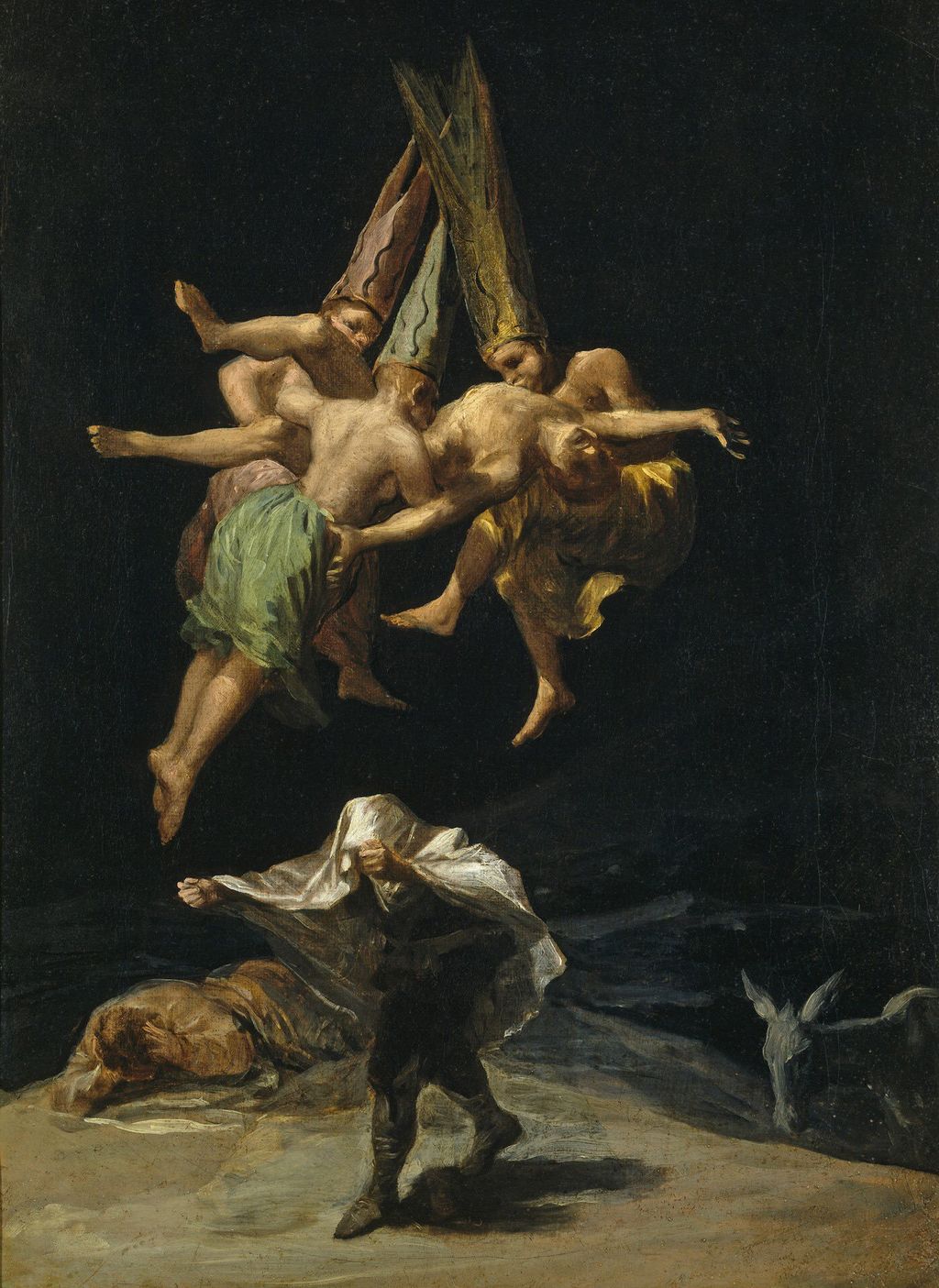
The goat in the Osuna Witches’ Sabbath sits upright at the centre of an outdoor gathering and reaches towards a woman who holds up a child. Its vine crown and the space left around its horns give it the dignity of someone presiding over a ceremony. In The Bewitched Man, the horns belong to a stooping figure at the edge, and the gesture of offering converges on a small dish in an interior. Both pictures make the position of the animal’s limb crucial to the encounter. In the Sabbath the outstretched foreleg draws the people nearest it further into the circle. In the comedy the offered flame makes Claudio reach as his body pulls away. In Witches’ Flight Goya uses another variation on the behaviour of frightened people. Below the group in mid-air, one man hides his head and another covers his ears, while a donkey remains on the ground. Claudio’s hand also goes to his face, but his eyes stay open and his other hand has work to do. [1] [5] [6]
Donkeys and superstition in Los Caprichos
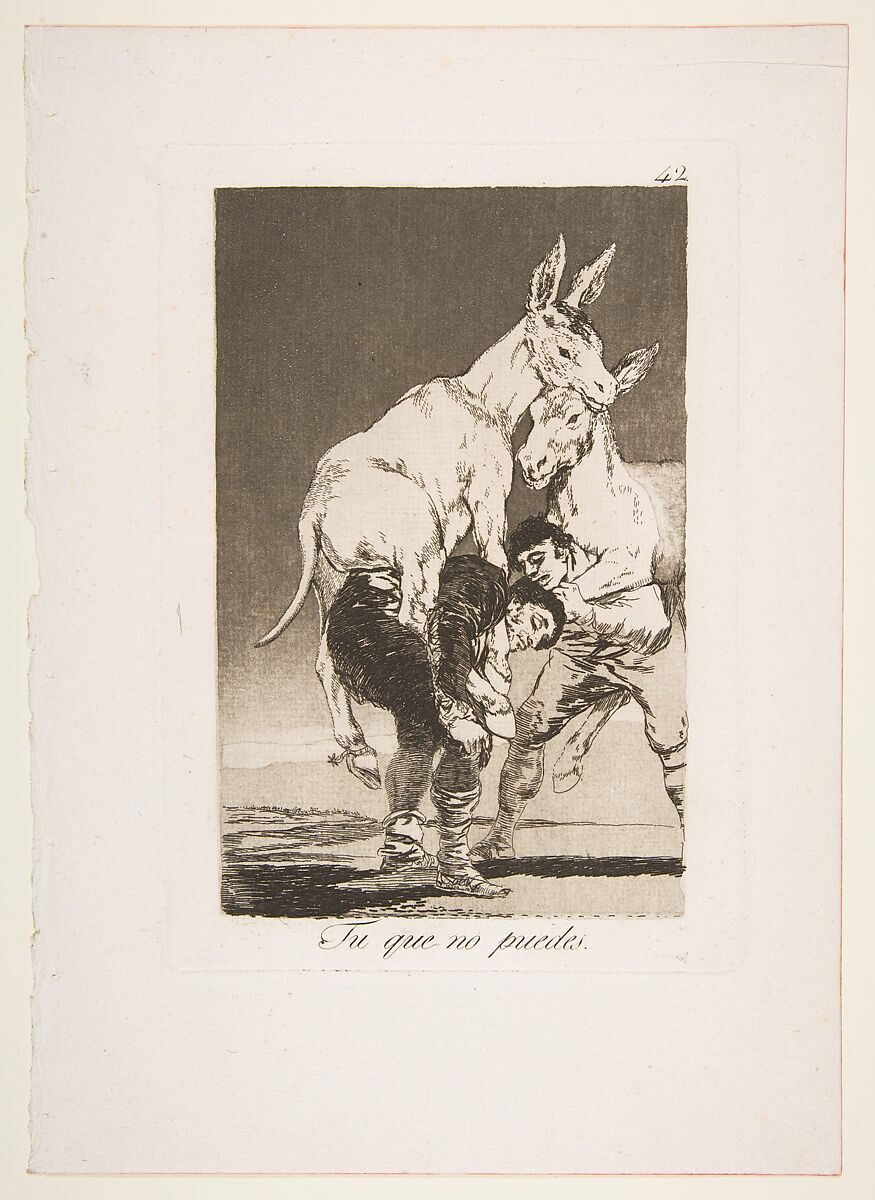
Goya also gave donkeys human roles in Los Caprichos, the print series published in 1799. In plate 42, Thou Who Canst Not (Tú que no puedes), two men struggle forward with donkeys on their backs. Each animal sits quite comfortably as its bearer labours. The caption quotes the opening of a proverb in which someone who can scarcely manage is asked to carry another person. The print puts the joke and its victims at the front of the scene. In The Bewitched Man, the same kind of animal is initially difficult to see, and the written clue identifies something Claudio says. Reading the words changes the scene in both cases. The print gives the familiar saying an absurd physical form, while the painting lets a fragment of verse explain why the man in front of us is so frightened. [1] [8]
The National Gallery suggests that the satire may extend to the Spanish Inquisition and its encouragement of fears about witchcraft. In the play, Claudio’s companions put those fears to use for their own purposes. Claudio thinks he is acting on the evidence of his own eyes, although someone else has chosen the decorations, the story and the place in which he will see them. Goya allows us to share a little of Claudio’s alarm before we can read the room. The darkness that makes the trick work on him also makes its painted enactment persuasive to us. [1] [3] [4]
Artworks directory
| Name | Date | Medium |
|---|---|---|
| And There’s No Help for It, Plate 15 | Printed 1863 | |
| Asmodea | c. 1820–23 | Wall painting transferred to canvas |
| Boys Inflating a Bladder | 1777–78 | Tapestry cartoon |
| Boys Picking Fruit | 1778 | Tapestry cartoon |
| Bullfight in a Divided Ring | 1825 | Lithograph |
| Card Players | 1777–78 | Tapestry cartoon |
| Card Players (sketch) | 1777–78 | Painted sketch |
| Dance on the Banks of the Manzanares | 1777 | Tapestry cartoon |
| Duel with Cudgels | c. 1820–23 | Wall painting transferred to canvas |
| Heads in a Landscape | c. 1820–23 | Easel painting |
| Judith and Holofernes | c. 1820–23 | Wall painting transferred to canvas |
| Leocadia | c. 1820–23 | Wall painting transferred to canvas |
| Maja and Cloaked Men | 1777 | Tapestry cartoon |
| Maja and Cloaked Men (sketch) | 1777 | Painted sketch |
| Majo Clapping in Time to the Music | 1777 | Drawing |
| Men Reading | c. 1820–23 | Wall painting transferred to canvas |
| Out Hunting for Teeth, Plate 12 | 1799 | Etching, burnished aquatint and burin |
| Picnic in the Countryside (sketch) | 1776–78 | Painted sketch |
| Picnic on the Banks of the Manzanares | 1776 | Tapestry cartoon |
| Pilgrimage to San Isidro | c. 1820–23 | Wall painting transferred to canvas |
| Preparatory study for The Sleep of Reason Produces Monsters | c. 1796–97 | Drawing |
| Procession of the Holy Office | c. 1820–23 | Wall painting transferred to canvas |
| Quarrel at the Cockerel Inn (sketch) | 1777 | Painted sketch |
| Quarrel in the New Tavern | 1777 | Tapestry cartoon |
| Saturn Devouring His Son | c. 1820–23 | Wall painting transferred to canvas |
| Seated Majo Smoking | c. 1776 | Drawing |
| The Dog | c. 1820–23 | Wall painting transferred to canvas |
| The Drinker | 1777 | Tapestry cartoon |
| The Fates | c. 1820–23 | Wall painting transferred to canvas |
| The Great He-Goat | c. 1820–23 | Wall painting transferred to canvas |
| The Kite | 1777–78 | Tapestry cartoon |
| The Parasol | 1777 | Oil on canvas, tapestry cartoon |
| The Second of May 1808 | 1814 | Oil on canvas |
| The Sleep of Reason Produces Monsters, Plate 43 | 1799 | Etching and aquatint |
| The Third of May 1808 | 1814 | Oil on canvas |
| Thou Who Canst Not, Plate 42 | 1799 | Etching and burnished aquatint |
| Three Figures | 1776 | Drawing (lost) |
| Two Old Men | c. 1820–23 | Wall painting transferred to canvas |
| Two Old Men Eating Soup | c. 1820–23 | Wall painting transferred to canvas |
| Two Women and a Man | c. 1820–23 | Wall painting transferred to canvas |
| Universal Language: The Author Dreaming | 1797 | Drawing |
| The Family of Charles IV | 1800 | Oil on canvas |
| Witches’ Sabbath (Osuna painting) | 1797–98 | Oil on canvas |
| The Nude Maja | 1795–1800 | Oil on canvas |
| The Clothed Maja | 1800–07 | Oil on canvas |
| Self-Portrait (Drawing) | c. 1796 | Brush and carbon black ink on laid paper |
| The Swing, Madrid Album B.21 | 1795–97 | Brush and carbon black washes |
| Majas Fighting, a Majo Observing, Madrid Album B.15 | 1796–97 | Brush, grey and black washes on laid paper |
| Majos and Majas Conversing, Madrid Album B.16 | c. 1794–97 | Ink wash on paper |
| Weeping Woman and Three Men, Madrid Album B.17 | 1795–97 | Brush, carbon black washes and black chalk |
| Maja Seated on a Chair and Two Companions Behind, Madrid Album B.18 | 1795–97 | Brush and carbon black washes |
| Girl and Bull, Madrid Album B.23 | 1796–97 | Brush and carbon black washes |
| Lovers Sitting on a Rock, Madrid Album B.24 | 1796–97 | Brush and carbon black washes |
| Mariano Ceballos Riding a Bull | 1825 | Crayon lithograph and scraper |
| Landscape (lifetime impression) | c. 1807–10 | Etching and aquatint |
| Self-Portrait (1815), Prado canvas | 1815 | Oil on canvas |
| Self-Portrait (1815), Academy panel | 1815 | Oil on panel |
| Self-Portrait with Dr Arrieta | 1820 | Oil on canvas |
| Christ Crucified | 1780 | Oil on canvas |
| The Last Communion of Saint Joseph of Calasanz | 1819 | Oil on canvas |
| Christ on the Mount of Olives | 1819 | Oil on panel |
| The Flower Girls, or Spring | 1786–87 | Oil on canvas |
| The Grape Harvest, or Autumn | 1786–87 | Oil on canvas |
| The Snowstorm, or Winter | 1786–87 | Oil on canvas |
| The Threshing Ground, or Summer | 1786–87 | Oil on canvas |
| Picnic on the Banks of the Manzanares | 1776 | Oil on canvas |
| The Kite | 1777–78 | Oil on canvas |
| Dance on the Banks of the Manzanares | 1777 | Oil on canvas |
| A Fight at the Venta Nueva | 1777 | Oil on canvas |
| Blind Man’s Bluff | 1788 | Oil on canvas |
| Dogs on a Lead | 1775 | Oil on canvas |
| Hunting with a Decoy | 1775 | Oil on canvas |
| Hunter Loading His Rifle | 1775 | Oil on canvas |
| The Angler | 1775 | Oil on canvas |
| The Hermitage of San Isidro on His Feast Day | 1788 | Oil on canvas |
| The Meadow of San Isidro | 1788 | Oil on canvas |
| The Straw Manikin | 1791–92 | Oil on canvas |
| Witches’ Flight | c. 1797–98 | Oil on canvas |
| A Scene from ‘The Forcibly Bewitched’ | 1798 | Oil on canvas |
| The Duchess of Alba in Black | 1797 | Oil on canvas |
| The Duchess of Alba in White | 1795 | Oil on canvas |
| Charles III in Hunting Dress | c. 1786 | Oil on canvas |
| The Duke and Duchess of Osuna and Their Children | 1787–88 | Oil on canvas |
| Manuel Osorio Manrique de Zúñiga | 1787–88 | Oil on canvas |
| The Marquesa de Pontejos | c. 1786 | Oil on canvas |
| Equestrian Portrait of the 1st Duke of Wellington | 1812 | Oil on canvas |
| The Duke of Wellington | 1812–14 | Oil on wood |
| Portrait of Ferdinand VII of Spain | 1814 | Oil on canvas |
| Gaspar Melchor de Jovellanos | 1798 | Oil on canvas |
| María Tomasa Palafox y Portocarrero | 1804 | Oil on canvas |
| Señora Sabasa García | c. 1806–11 | Oil on canvas |
| Don Juan Bautista de Muguiro | 1827 | Oil on canvas |
| Doña Isabel de Porcel | Before 1805 | Oil on canvas |
| The Colossus | After 1808 | Oil on canvas |
| The Burial of the Sardine | 1808–12 | Oil on panel |
| The Madhouse | 1808–12 | Oil on panel |
| A Procession of Flagellants | 1808–12 | Oil on panel |
| Portrait of Jacques Galos | 1826 | Oil on canvas |
| Portrait of Mariano Goya, the Artist’s Grandson | 1827 | Oil on canvas |
| Milkmaid of Bordeaux | c. 1827 | Oil on canvas |
| Portrait of Don Juan Antonio Cuervo | 1819 | Oil on canvas |
| María Luisa of Parma (Naples version) | c. 1800 | Oil on canvas |
| The Countess of Baena | 1819 | Oil on canvas |
| The Family of the Infante Don Luis | 1783–84 | Oil on canvas |
| The Holy Family | c. 1787 | Oil on canvas |
| Saint Barbara | c. 1773 | Oil on canvas |
| Saints Justa and Rufina | 1817 | Oil on canvas |
| El Tío Paquete | c. 1819–20 | Oil on canvas |
| The Forge | c. 1815–20 | Oil on canvas |
| Majas on a Balcony (Metropolitan Museum version) | c. 1800–10 | Oil on canvas |
| Maja and Celestina on a Balcony | c. 1808–12 | Oil on canvas |
| The Water Bearer | 1808–12 | Oil on canvas |
| Time and the Old Women | c. 1810 | Oil on canvas |
Frequently Asked Questions
It is in the National Gallery in London, accession NG1472. The museum acquired it at the Osuna sale in Madrid in 1896. [1]
Discussion
Look again at the images and ideas explored in The Bewitched Man and the Devil’s Lamp. These editorial prompts invite your observations.
Follow the line from Claudio’s eyes to his flask and the little flame, then look above his hat at the dancing donkeys. When did the scene begin to seem funny to you? How would the timing of that discovery change if the wall were brightly lit? [1]
Reader Insights
What does the light tell you about where Don Claudio is looking?
What changes when you read the painted scene alongside the play?
Join the Conversation
Share a detail, comparison or question about The Bewitched Man and the Devil’s Lamp below.
References
- National Gallery, London, A Scene from ‘The Forcibly Bewitched’, NG1472, including provenance from Neil MacLaren’s The Spanish School, revised by Allan Braham (1988). View source.
- Fundación Goya en Aragón, El hechizado, catalogue entry 529. View source.
- Antonio de Zamora, El hechizado por fuerza, Act II, BITESO digital transcription from the 1744 edition of Comedias de don Antonio de Zamora, based on a Biblioteca Nacional de España copy. View source.
- Leonardo Romero Tobar, ‘Goya y la literatura de su tiempo’, in María del Carmen Lacarra Ducay (coord.), Francisco de Goya y Lucientes. Su obra y su tiempo (Institución Fernando el Católico, 1997), pp. 59–62 on Goya’s theatrical subjects, digital copy at the Universidad de Zaragoza. View source.
- Fundación Goya en Aragón, Vuelo de brujas, catalogue entry 525, including Goya’s account of 27 June 1798. View source.
- Museo Lázaro Galdiano, El Aquelarre, 02006, including Carmen Espinosa’s discussion of the series’ original setting. View source.
- Fundación Goya en Aragón, Asuntos de brujas para la Alameda de Osuna, catalogue of the six paintings. View source.
- Metropolitan Museum of Art, Thou Who Canst Not (Tu que no puedes), 1799, plate 42 of Los Caprichos, 18.64(42). View source.







