


 by Tom Gurney
Tom Gurney BSc (Hons) is an art history expert with over 20 years experience
Published on June 19, 2020 / Updated on November 20, 2026
Email: tomgurney1@gmail.com / Phone: +44 7429 011000
Introduction
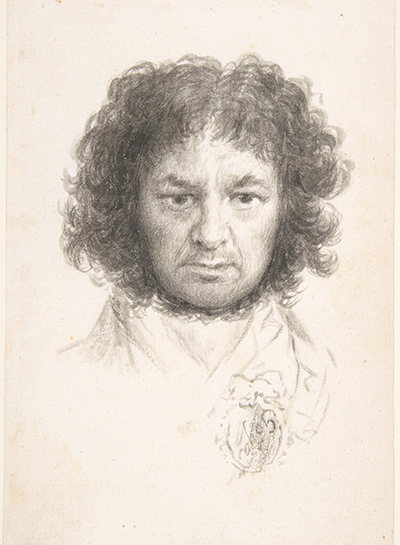
Francisco de Goya faces us squarely from a sheet of paper only fifteen centimetres high. Dark curls enclose the face, and the eyes meet ours from beneath a slight frown. Below his chin the ink thins out, leaving just enough of a collar and a coat to suggest how he is dressed. There is one small detail worth looking for among the pale strokes. A badge attached to his lapel bears the name “Goya”. He has put his name inside the likeness, on something the sitter wears. The Metropolitan Museum of Art dates the drawing to about 1796. [1]
At a Glance
- Artist and sitterFrancisco de Goya y Lucientes (1746–1828). [1]
- DateAbout 1796. [1]
- MediumCarbon black ink, applied with a brush and its point, on laid paper. [1] [2]
- Sheet size15 × 9.1 cm, as recorded in the Met’s object entry. [1]
- CollectionThe Metropolitan Museum of Art, New York, 35.103.1. Acquired in 1935 through the Harris Brisbane Dick Fund. [1]
- Album historyMounted as the opening image of a later compilation of Goya’s drawings. Its original purpose is unknown. [1] [3]
Works across Goya’s career
The Parasol
1777Self-Portrait (Drawing)
c. 1796The Nude Maja
1795–1800Saturn Devouring His Son
c. 1820–23The Dog
c. 1820–23A face in carbon black ink
Goya places the head around the middle of the narrow sheet and gives the hair room to spread almost to either side. The curls are irregular, some edged with thin grey arcs and others compressed into darker masses. There is a wide stretch of paper above them. In that open space, with no wall, furniture or other figure to indicate a setting, the force of the portrait comes from a face that seems very near. The tight crop around the shoulders reinforces that impression even though the drawing itself is small enough to hold in one hand. [1]
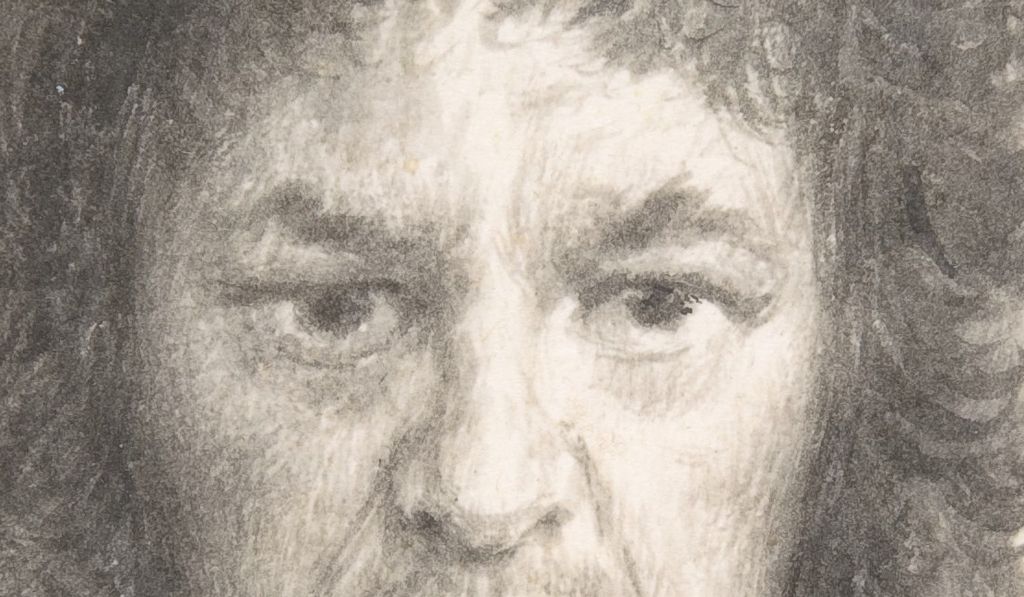
The head is nearly frontal, but the light gives its two sides different weights. On the viewer’s left a broad area of shade runs from the hair down the temple and into the cheek. On the other side a clearer strip of paper carries the light along the cheek beside the nose. Looking in towards the eyes, the transitions get smaller. Short, dark touches define the pupils and upper lids. There are pale areas beneath the eyes, and the brows descend towards the bridge of the nose. The mouth is closed and slightly uneven. Its shadowed corners and the light on the lower lip give the expression some movement, even though Goya holds his head still. [1]
The Met’s description of brush and point of brush is helpful here. The point can place a small dark accent at the eyelid or pull a thin line out into a curl. A more broadly applied wash describes the volume of the face. The material stays the same and the amount of white paper showing through the ink changes. Much of the cloth is suggested by curves and short, angled strokes. At the shoulder on the viewer’s left, the wash fades into the paper. On the right, the shifting edge of the lapel gives the coat some structure, then breaks up as it descends. The drawing leaves open how far Goya meant to carry the clothing. As it survives, these few strokes give the face just enough of a body beneath it. [1] [2]
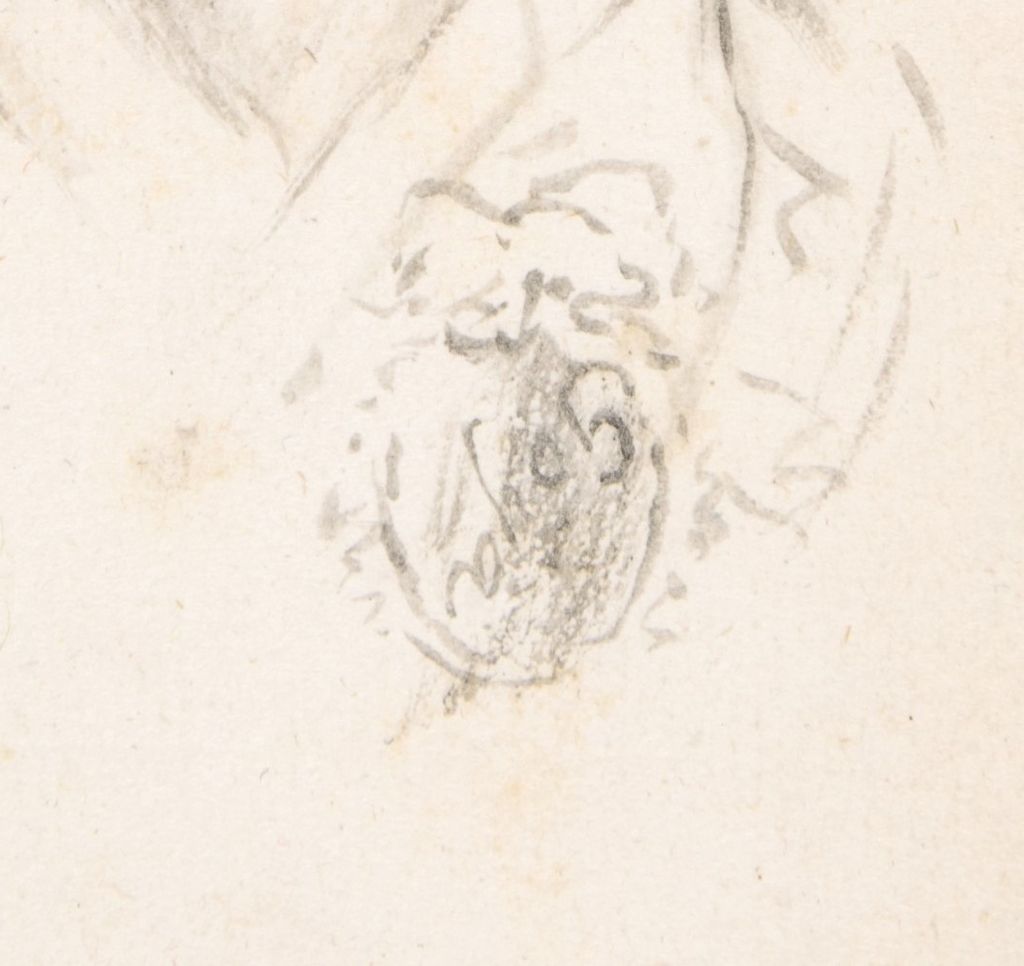
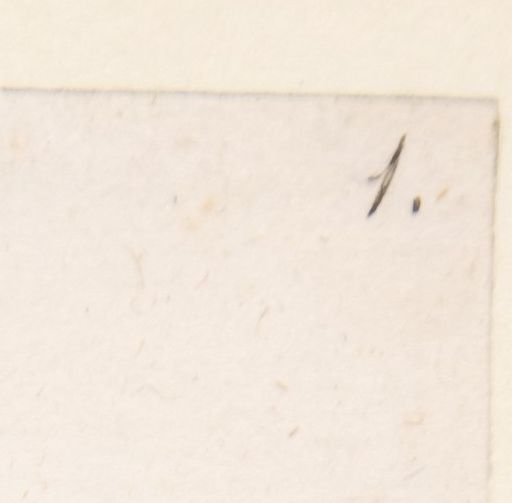
The badge is a further change in scale. It has an oval form, more closely worked than much of the coat, and the marks above it suggest a ribbon. At first it can be easier to register it as an ornament than to make out the name. The Fundación Goya en Aragón also records a separate inscription, a small “1” in dark brown ink at the upper right of the sheet. One detail is part of the image that Goya presents to us. The other sits out near the corner, where a reader might expect to find the number of a page. [1] [4]
Annotated Details from Self-Portrait
Compare the dark brushwork around the face with the lighter marks on the clothing.
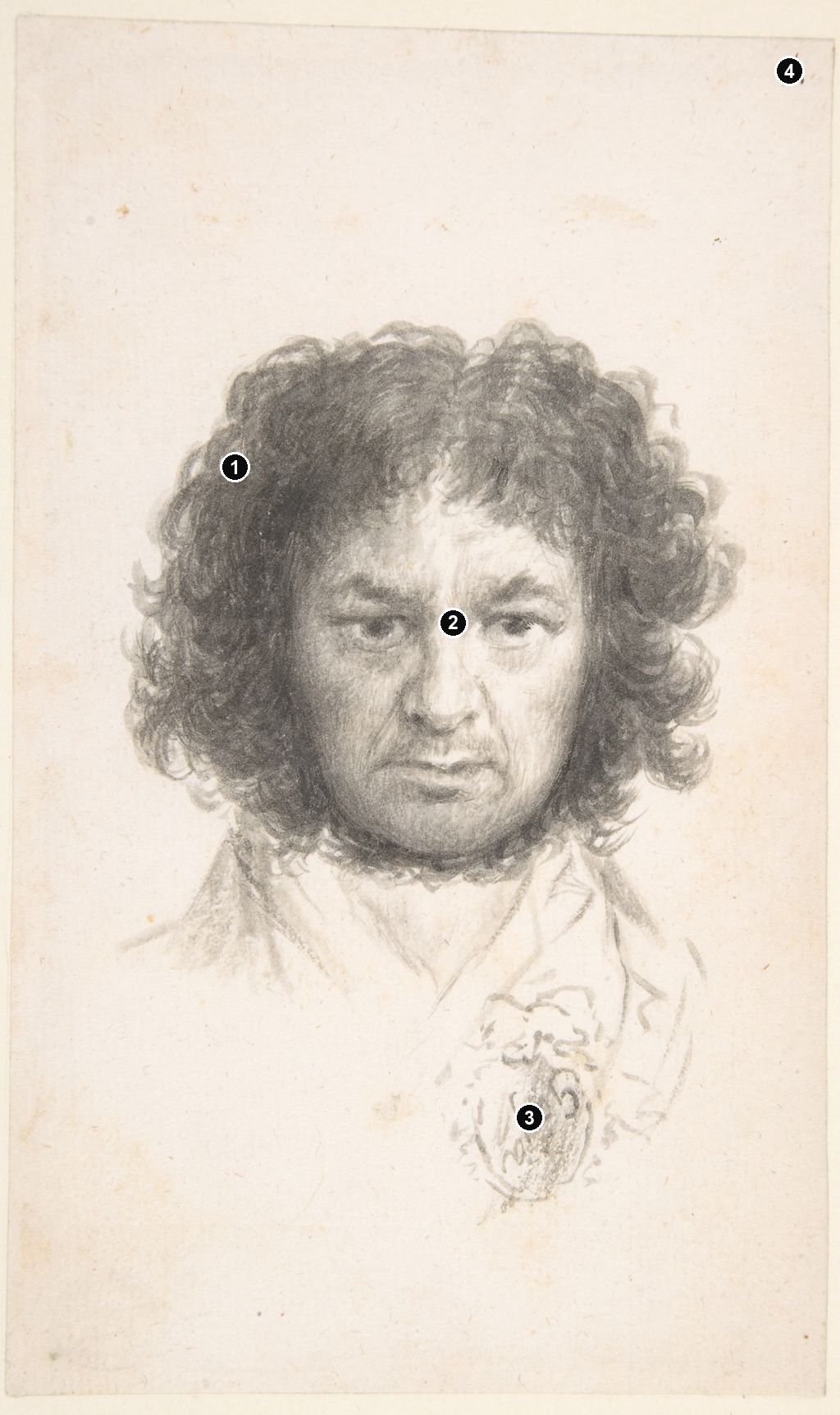
Details from SELF-PORTRAIT
Details from the ink self-portrait in the Metropolitan Museum of Art (35.103.1).
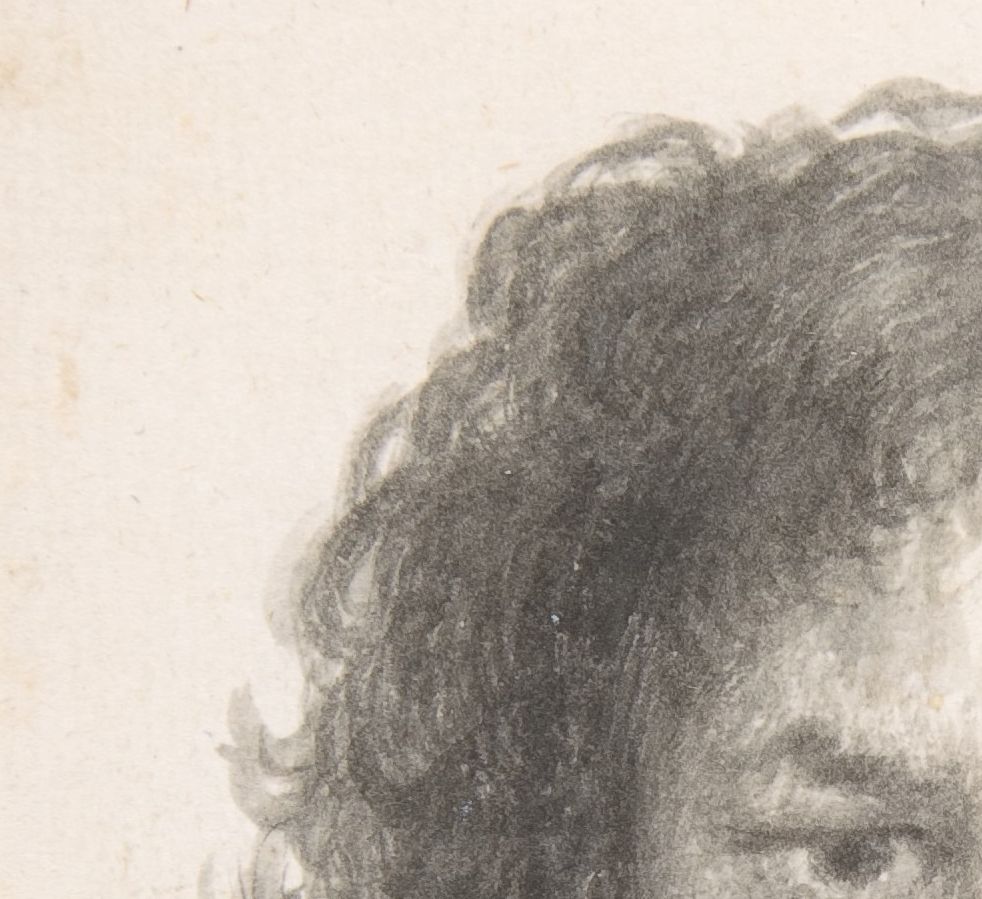
The curls
Curved strokes overlap in the dark mass of hair.
The eyes
Short dark strokes mark the brows above a direct gaze.
The lapel badge
The badge carries Goya’s name among the pale marks that describe the coat.
The marking at upper right
A small numeral sits close to the edge of the paper, well apart from the portrait.
The portrait and the Madrid Album
The number is an invitation to ask which book. Goya’s Madrid Album, also known as Album B, contains drawings from roughly the same period. He used the brush in those drawings for telling details of posture and expression. In Weeping Woman and Three Men, for instance, the hands obscure the woman’s face, so her distress has to be read in the way she bends and covers her eyes. The Met identifies that drawing as folio 17 and records another scene, folio 18, on the reverse. The sheet is about twenty-four centimetres high, considerably taller than the self-portrait. Its two images and their numbering provide evidence of a particular place in Album B. For the portrait, the opening position that can be traced belongs to a later selection of works from several of Goya’s drawing albums. Its original place in the Madrid Album is undocumented. [3] [5] [6]
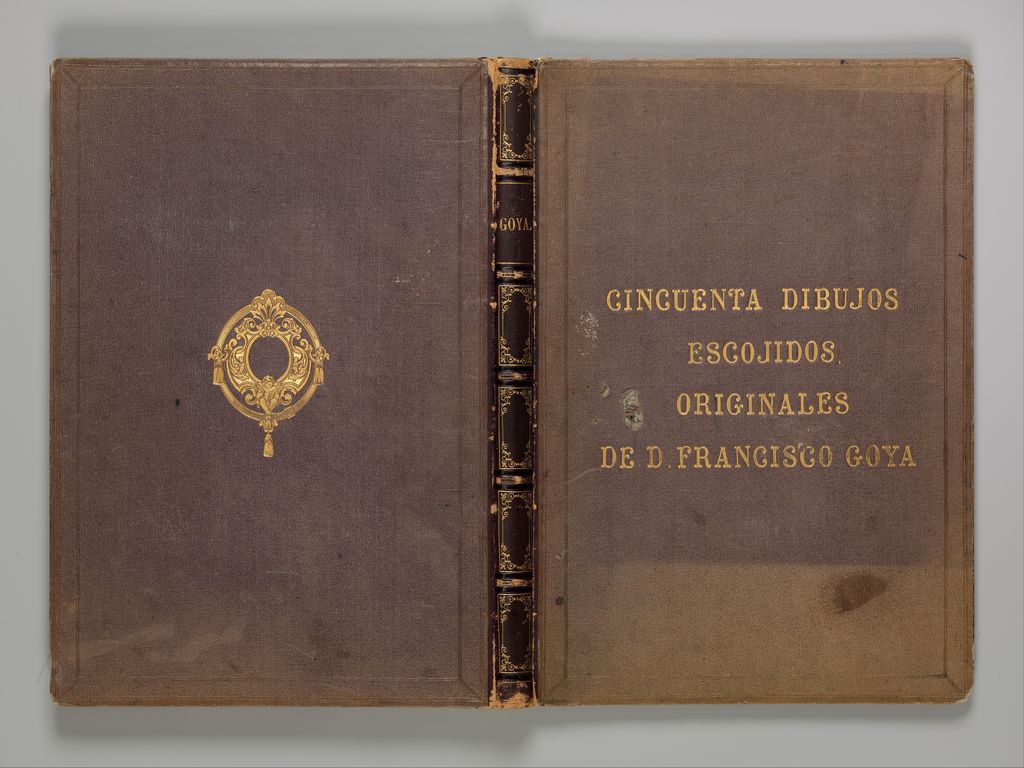
The surviving book helps make this history tangible. The Met dates the brown cloth and leather album to about 1866–68. It measures nearly forty centimetres high and contains forty-two pink leaves. The drawings were removed from them in 1935, the year the museum bought the group of fifty from Mariano Fortuny y Madrazo. An earlier museum account traces the material back through Goya’s son Javier and grandson Mariano. In his study of the albums, José Manuel de la Mano distinguishes the volumes Javier compiled after his father’s death from the later arrangements associated with Federico de Madrazo. The self-portrait headed a volume put together by Javier and again served as an opening image in the Madrazo material. The book acquired in 1935 brought together examples that had first belonged to different sequences, alongside the portrait. [3] [6] [7]
The difference between the dimensions of the drawing and the album gives some idea of what mounting did to the picture. A face already surrounded by open paper acquired another expanse of paper around it. Imagine meeting that gaze at the start of the volume, then turning to scenes filled with figures. The likeness would have introduced the person who had drawn them. Whatever Goya meant the sheet to do when he made it, his successors had found a use for it. [1] [3] [7]
Goya on film
Five films explore Goya’s portraits, prints, Black Paintings and painting techniques.
The Duke of Wellington by Goya
The portrait, its military decorations and its later theft.
Watch on YouTubeGoya introduces Los Caprichos
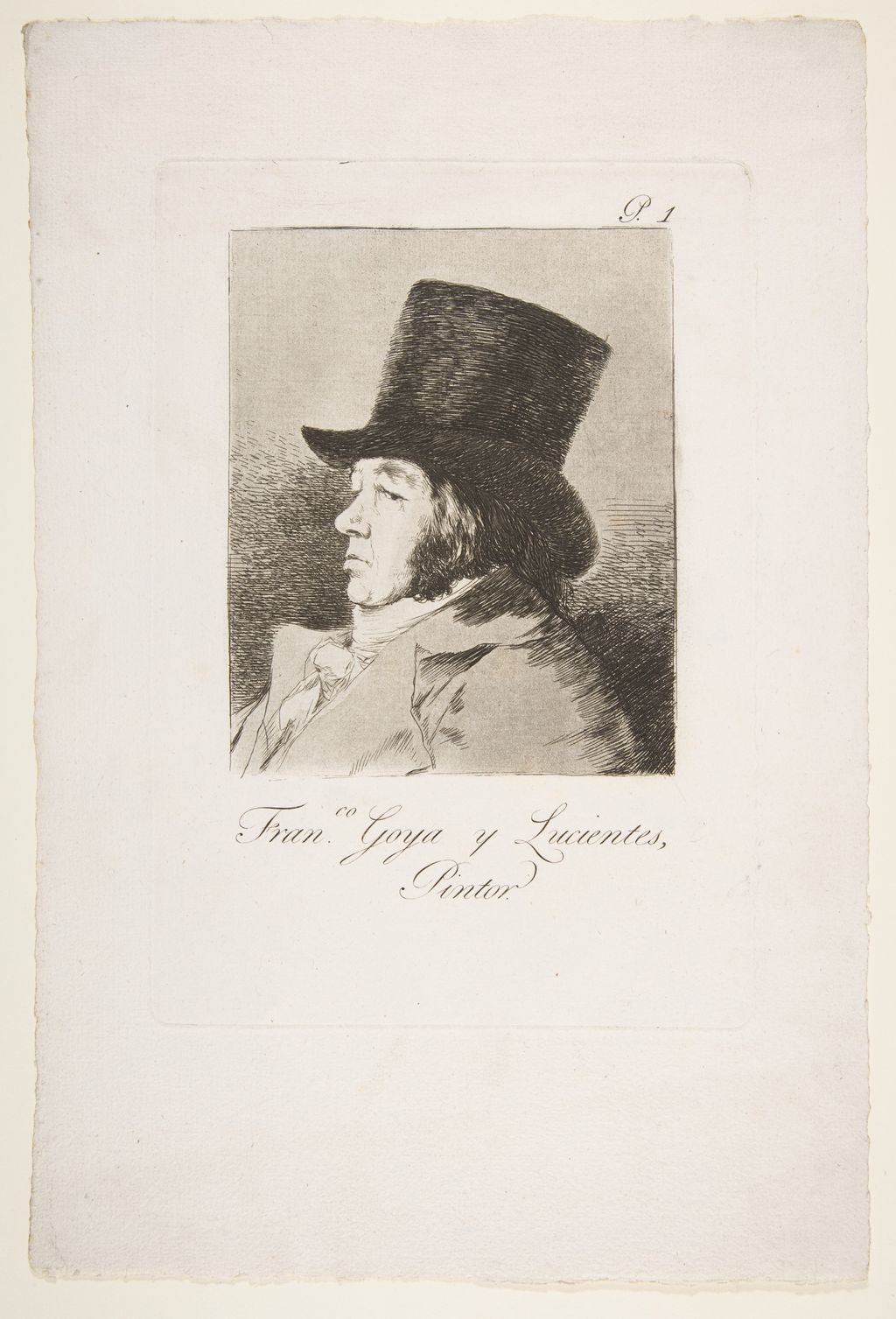
Goya himself used a self-portrait to open Los Caprichos, published in Madrid in 1799. In the Met’s impression of Plate 1, 50.558.33, the high hat, coat and neckcloth are all immediately legible. The body and head turn to the left, and the eyes look sideways from beneath the brim. Goya’s name and profession appear in a line below the image. He presents himself to buyers of the series as the painter who has made the images they are about to see. The slightly compressed mouth and the searching look give some idea of how he might regard the follies and abuses pictured in the plates that follow. [8]
A red-chalk study in the Met, 1972.118.295, has the top hat and turned pose already set within a ruled frame. The reverse holds two further studies of his face. The museum identifies that sheet as the preparatory drawing transferred to the copperplate for Plate 1. Goya then altered the design and used aquatint to print areas of tone, a quality that brings the resulting impression close to wash. The frontal ink likeness uses a similarly delicate range from pale grey to dark, especially across the cheek and below the eyes. With the print, such tones could reach many viewers in separate impressions. With the brush drawing, they remain on the small sheet where Goya placed them. [1] [8] [9]
An earlier idea for the opening of the series puts a third pose in play. The Prado’s 1797 drawing Universal Language. The Author Dreaming shows a figure slumped over a table, with winged creatures and staring eyes behind him. His face is buried in his arms. Goya’s inscription calls him the author and labels the composition “Dream 1”. He went on to revise it as The Sleep of Reason Produces Monsters, Plate 43. The edition thus begins with the top-hatted painter surveying the world and later gives the reader a version of the author overcome by sleep. These changes of pose make the direct look of the small brush drawing especially distinctive. The head can command attention through the simple placement of the eyes, without a hat, a surrounding scene or a caption. [1] [8] [10]
The biography follows the illness of 1792–93 that left Goya profoundly deaf. The Met considers whether the direct scrutiny in the brush drawing reflects his inner life after the illness. The gaze also works as something an artist can make with an economy of marks. A fraction more shadow under a brow or a small shift at the mouth would change how we read the face. The drawing allows us to see the care given to those details, while its intended audience remains open. The museum suggests that it may have been a personal study, a gift for a friend or an idea for a print. [1]
Artworks directory
| Name | Date | Medium |
|---|---|---|
| And There’s No Help for It, Plate 15 | Printed 1863 | |
| Asmodea | c. 1820–23 | Wall painting transferred to canvas |
| Boys Inflating a Bladder | 1777–78 | Tapestry cartoon |
| Boys Picking Fruit | 1778 | Tapestry cartoon |
| Bullfight in a Divided Ring | 1825 | Lithograph |
| Card Players | 1777–78 | Tapestry cartoon |
| Card Players (sketch) | 1777–78 | Painted sketch |
| Dance on the Banks of the Manzanares | 1777 | Tapestry cartoon |
| Duel with Cudgels | c. 1820–23 | Wall painting transferred to canvas |
| Heads in a Landscape | c. 1820–23 | Easel painting |
| Judith and Holofernes | c. 1820–23 | Wall painting transferred to canvas |
| Leocadia | c. 1820–23 | Wall painting transferred to canvas |
| Maja and Cloaked Men | 1777 | Tapestry cartoon |
| Maja and Cloaked Men (sketch) | 1777 | Painted sketch |
| Majo Clapping in Time to the Music | 1777 | Drawing |
| Men Reading | c. 1820–23 | Wall painting transferred to canvas |
| Out Hunting for Teeth, Plate 12 | 1799 | Etching, burnished aquatint and burin |
| Picnic in the Countryside (sketch) | 1776–78 | Painted sketch |
| Picnic on the Banks of the Manzanares | 1776 | Tapestry cartoon |
| Pilgrimage to San Isidro | c. 1820–23 | Wall painting transferred to canvas |
| Preparatory study for The Sleep of Reason Produces Monsters | c. 1796–97 | Drawing |
| Procession of the Holy Office | c. 1820–23 | Wall painting transferred to canvas |
| Quarrel at the Cockerel Inn (sketch) | 1777 | Painted sketch |
| Quarrel in the New Tavern | 1777 | Tapestry cartoon |
| Saturn Devouring His Son | c. 1820–23 | Wall painting transferred to canvas |
| Seated Majo Smoking | c. 1776 | Drawing |
| The Dog | c. 1820–23 | Wall painting transferred to canvas |
| The Drinker | 1777 | Tapestry cartoon |
| The Fates | c. 1820–23 | Wall painting transferred to canvas |
| The Great He-Goat | c. 1820–23 | Wall painting transferred to canvas |
| The Kite | 1777–78 | Tapestry cartoon |
| The Parasol | 1777 | Oil on canvas, tapestry cartoon |
| The Second of May 1808 | 1814 | Oil on canvas |
| The Sleep of Reason Produces Monsters, Plate 43 | 1799 | Etching and aquatint |
| The Third of May 1808 | 1814 | Oil on canvas |
| Thou Who Canst Not, Plate 42 | 1799 | Etching and burnished aquatint |
| Three Figures | 1776 | Drawing (lost) |
| Two Old Men | c. 1820–23 | Wall painting transferred to canvas |
| Two Old Men Eating Soup | c. 1820–23 | Wall painting transferred to canvas |
| Two Women and a Man | c. 1820–23 | Wall painting transferred to canvas |
| Universal Language: The Author Dreaming | 1797 | Drawing |
| The Family of Charles IV | 1800 | Oil on canvas |
| Witches’ Sabbath (Osuna painting) | 1797–98 | Oil on canvas |
| The Nude Maja | 1795–1800 | Oil on canvas |
| The Clothed Maja | 1800–07 | Oil on canvas |
| Self-Portrait (Drawing) | c. 1796 | Brush and carbon black ink on laid paper |
| The Swing, Madrid Album B.21 | 1795–97 | Brush and carbon black washes |
| Majas Fighting, a Majo Observing, Madrid Album B.15 | 1796–97 | Brush, grey and black washes on laid paper |
| Majos and Majas Conversing, Madrid Album B.16 | c. 1794–97 | Ink wash on paper |
| Weeping Woman and Three Men, Madrid Album B.17 | 1795–97 | Brush, carbon black washes and black chalk |
| Maja Seated on a Chair and Two Companions Behind, Madrid Album B.18 | 1795–97 | Brush and carbon black washes |
| Girl and Bull, Madrid Album B.23 | 1796–97 | Brush and carbon black washes |
| Lovers Sitting on a Rock, Madrid Album B.24 | 1796–97 | Brush and carbon black washes |
| Mariano Ceballos Riding a Bull | 1825 | Crayon lithograph and scraper |
| Landscape (lifetime impression) | c. 1807–10 | Etching and aquatint |
| Self-Portrait (1815), Prado canvas | 1815 | Oil on canvas |
| Self-Portrait (1815), Academy panel | 1815 | Oil on panel |
| Self-Portrait with Dr Arrieta | 1820 | Oil on canvas |
| Christ Crucified | 1780 | Oil on canvas |
| The Last Communion of Saint Joseph of Calasanz | 1819 | Oil on canvas |
| Christ on the Mount of Olives | 1819 | Oil on panel |
| The Flower Girls, or Spring | 1786–87 | Oil on canvas |
| The Grape Harvest, or Autumn | 1786–87 | Oil on canvas |
| The Snowstorm, or Winter | 1786–87 | Oil on canvas |
| The Threshing Ground, or Summer | 1786–87 | Oil on canvas |
| Picnic on the Banks of the Manzanares | 1776 | Oil on canvas |
| The Kite | 1777–78 | Oil on canvas |
| Dance on the Banks of the Manzanares | 1777 | Oil on canvas |
| A Fight at the Venta Nueva | 1777 | Oil on canvas |
| Blind Man’s Bluff | 1788 | Oil on canvas |
| Dogs on a Lead | 1775 | Oil on canvas |
| Hunting with a Decoy | 1775 | Oil on canvas |
| Hunter Loading His Rifle | 1775 | Oil on canvas |
| The Angler | 1775 | Oil on canvas |
| The Hermitage of San Isidro on His Feast Day | 1788 | Oil on canvas |
| The Meadow of San Isidro | 1788 | Oil on canvas |
| The Straw Manikin | 1791–92 | Oil on canvas |
| Witches’ Flight | c. 1797–98 | Oil on canvas |
| A Scene from ‘The Forcibly Bewitched’ | 1798 | Oil on canvas |
| The Duchess of Alba in Black | 1797 | Oil on canvas |
| The Duchess of Alba in White | 1795 | Oil on canvas |
| Charles III in Hunting Dress | c. 1786 | Oil on canvas |
| The Duke and Duchess of Osuna and Their Children | 1787–88 | Oil on canvas |
| Manuel Osorio Manrique de Zúñiga | 1787–88 | Oil on canvas |
| The Marquesa de Pontejos | c. 1786 | Oil on canvas |
| Equestrian Portrait of the 1st Duke of Wellington | 1812 | Oil on canvas |
| The Duke of Wellington | 1812–14 | Oil on wood |
| Portrait of Ferdinand VII of Spain | 1814 | Oil on canvas |
| Gaspar Melchor de Jovellanos | 1798 | Oil on canvas |
| María Tomasa Palafox y Portocarrero | 1804 | Oil on canvas |
| Señora Sabasa García | c. 1806–11 | Oil on canvas |
| Don Juan Bautista de Muguiro | 1827 | Oil on canvas |
| Doña Isabel de Porcel | Before 1805 | Oil on canvas |
| The Colossus | After 1808 | Oil on canvas |
| The Burial of the Sardine | 1808–12 | Oil on panel |
| The Madhouse | 1808–12 | Oil on panel |
| A Procession of Flagellants | 1808–12 | Oil on panel |
| Portrait of Jacques Galos | 1826 | Oil on canvas |
| Portrait of Mariano Goya, the Artist’s Grandson | 1827 | Oil on canvas |
| Milkmaid of Bordeaux | c. 1827 | Oil on canvas |
| Portrait of Don Juan Antonio Cuervo | 1819 | Oil on canvas |
| María Luisa of Parma (Naples version) | c. 1800 | Oil on canvas |
| The Countess of Baena | 1819 | Oil on canvas |
| The Family of the Infante Don Luis | 1783–84 | Oil on canvas |
| The Holy Family | c. 1787 | Oil on canvas |
| Saint Barbara | c. 1773 | Oil on canvas |
| Saints Justa and Rufina | 1817 | Oil on canvas |
| El Tío Paquete | c. 1819–20 | Oil on canvas |
| The Forge | c. 1815–20 | Oil on canvas |
| Majas on a Balcony (Metropolitan Museum version) | c. 1800–10 | Oil on canvas |
| Maja and Celestina on a Balcony | c. 1808–12 | Oil on canvas |
| The Water Bearer | 1808–12 | Oil on canvas |
| Time and the Old Women | c. 1810 | Oil on canvas |
Frequently Asked Questions
The head is closely worked and the garments are only lightly drawn. No known account by Goya establishes whether he planned to develop it further. The paper left bare below the collar helps the face and the badge stand out. [1]
Discussion
Look again at the images and ideas explored in Self-Portrait (Drawing). These editorial prompts invite your observations.
Compare the ink portrait’s small name badge with the printed line giving Goya’s name and profession on Plate 1. When do you notice each inscription, and how does its position affect your first impression of the sitter?
Reader Insights
How does the open paper around the face affect the direct gaze?
What changes as the dark ink of the face gives way to the coat?
Join the Conversation
Share a detail, comparison or question about Self-Portrait (Drawing) below.
References
- The Metropolitan Museum of Art, Self-Portrait, 35.103.1, object record and curatorial commentary. View source.
- Rachel High and Mark McDonald, “Fragments of Dreams: Mark McDonald on Goya’s Graphic Imagination”, The Metropolitan Museum of Art, with the drawing’s laid-paper support identified in the caption. View source.
- José Manuel de la Mano, Javier Goya’s Legacy: The Albums of His Father’s Drawings, Madrid, 2021, introduction and chapters I–II. View source.
- Fundación Goya en Aragón, Self-portrait, 35.103.1, provenance and inscriptions. View source.
- The Metropolitan Museum of Art, weeping young woman, Madrid Album B.17, 35.103.4, object record and verso description. View source.
- Colta Ives and Susan Alyson Stein, Goya in The Metropolitan Museum of Art, The Metropolitan Museum of Art, 1995, drawing catalogue and acquisition history. View source.
- The Metropolitan Museum of Art, Empty Album that formerly housed a group of 50 Goya drawings, 35.103.1–.50(1), object record. View source.
- The Metropolitan Museum of Art, Self-Portrait, Plate 1 from Los Caprichos, 50.558.33, object record and curatorial commentary. View source.
- The Metropolitan Museum of Art, Self-Portrait in a top hat, 1972.118.295, preparatory drawing for Plate 1. View source.
- Museo Nacional del Prado, Universal Language. The Author Dreaming, preparatory drawing of 1797 and its relationship to the published Plate 43. View source.







