


 by Tom Gurney
Tom Gurney BSc (Hons) is an art history expert with over 20 years experience
Published on June 19, 2020 / Updated on November 20, 2026
Email: tomgurney1@gmail.com / Phone: +44 7429 011000
Introduction
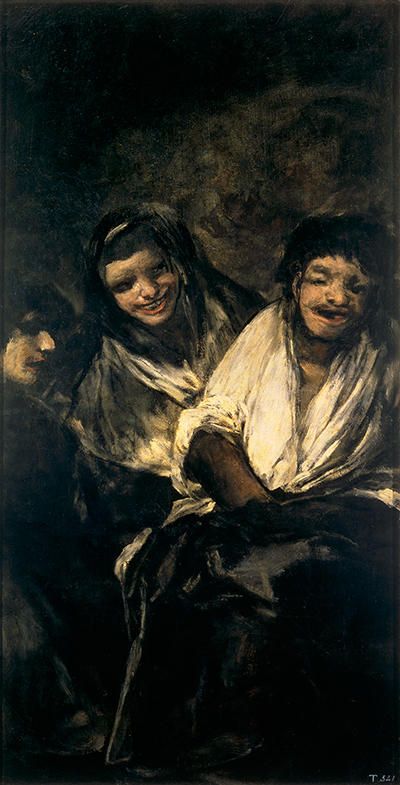
Three faces emerge from the darkness in Francisco de Goya's Two Women and a Man. The woman in the middle bares her teeth in a grin. The man beside her, in an open white shirt, has narrowed eyes and an open mouth. At the far left, a third face appears in profile. The familiar English title, Man Mocked by Two Women, makes the man the target of the laughter. If you start with the faces and follow the figures' arms, the picture gives you several reasons to hesitate. The lower half is difficult to read, and the area around the man's hands changed when the mural became a canvas. [1] [2] [3]
At a Glance
- Artist and dateFrancisco de Goya, c. 1820–1823. [1] [2]
- Spanish titleDos mujeres y un hombre. [1]
- Medium and dimensionsMixed technique on a prepared wall, including oil, transferred to canvas. About 125 × 66 cm. [1] [2]
- CollectionMuseo Nacional del Prado, Madrid, P000765. [1]
- Original settingThe upstairs room of the Quinta del Sordo, paired with The Reading. [2] [4] [5]
Works across Goya’s career
The Parasol
1777The Nude Maja
1795–1800Saturn Devouring His Son
c. 1820–23The Dog
c. 1820–23Two Women and a Man
c. 1820–23Three faces in a narrow space
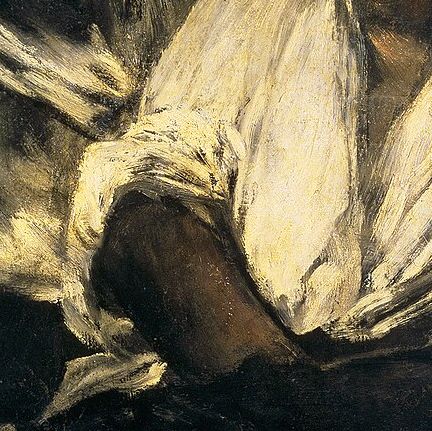
The largest area of light is the shirt, which falls open at the man's neck and gathers in folds around his bent arm. Follow the sleeve down and the light gives way to the dark forearm. The hand is difficult to distinguish from the material across his lap. A pale, irregular strip runs down from the lap towards the lower edge, but the folds and shadows give it an uncertain outline. The shape of the body is clear enough to suggest a person settling his weight. The action at the point where his arm comes to rest is much harder to name. [1] [3]
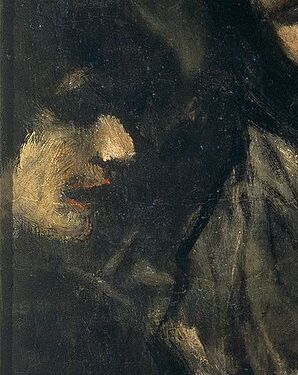
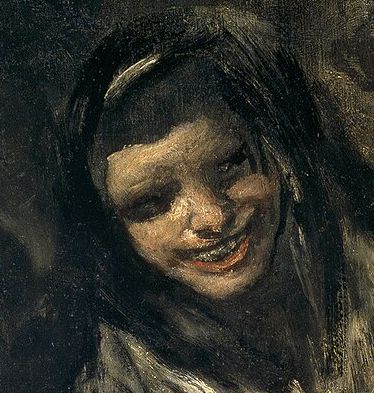
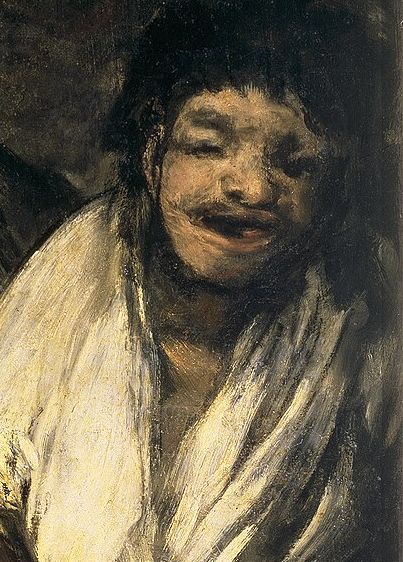
The woman at the centre inclines her head. The light catches her cheeks, the rim of her head covering and the folds of the shawl that crosses her chest. Her mouth reads most readily as laughter. The man's mouth stretches open and the creases of his face make his eyes seem nearly shut. An expression that resembles a grin from a distance can resemble a grimace when seen close up. The woman at the left has much less light. The bridge of her nose and a small touch of colour at the lips are enough to turn her face towards the other figures, but her mouth gives little indication of laughter. The dark background leaves their precise surroundings and the direction of their gazes hard to establish. [1] [6]
Annotated Details from Two Women and a Man
Look at the different angles of the three faces and the patches of light below them.
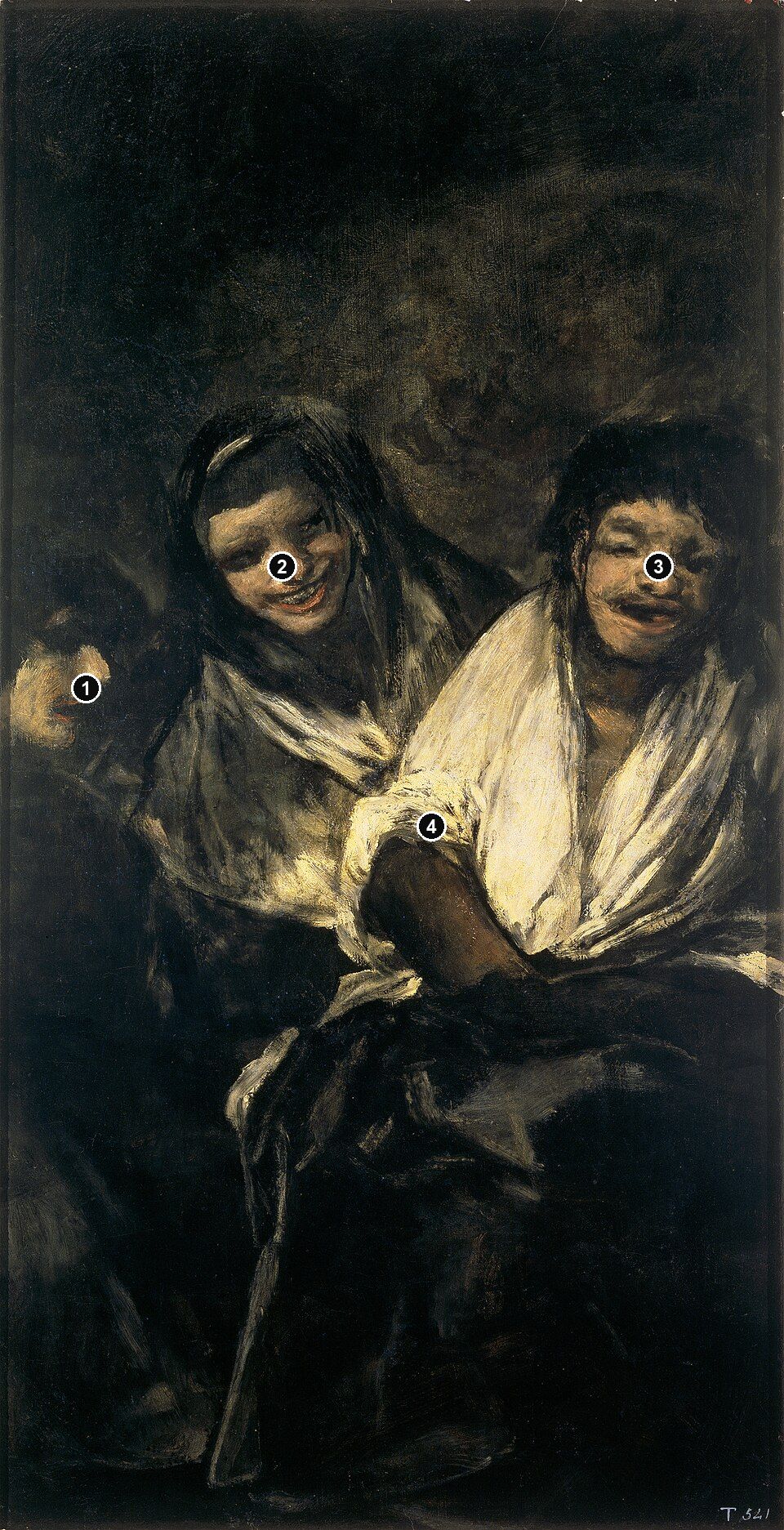
Details from TWO WOMEN AND A MAN
Details from the transferred canvas in the Museo Nacional del Prado (P000765).
A face close to the edge
Light picks out the lower part of the face near the left edge, while much of the head merges into shadow.
The middle figure’s smile
The sharp light on the teeth makes the expression easier to read than the partly shadowed eyes.
The figure at right
The face turns towards the viewer with parted lips. The light cloth below it adds to its prominence.
Light fabric at the elbow
A light sleeve turns sharply at the elbow above the darker arm. Below that point, the contours become harder to distinguish.
What did early viewers call it?
The inventory associated with Antonio Brugada calls the mural Dos mujeres (Two Women). In his 1867 monograph, Charles Yriarte described women bursting into laughter in the upstairs room. His catalogue entry calls the picture Deux femmes riant à gorge déployée, roughly Two Women Laughing Heartily. Yriarte acknowledged that the subject was difficult to define. He was describing a painting that was still on a wall in the house, so uncertainty about the action was already part of its reception before the transfer. [2] [4]
Yriarte said the mural recalled Mejor es holgar, plate 73 of Los Caprichos. In that print a young woman holds a ball of wool in her lap while an older woman holds a skein and a man sits opposite. The Fundación Goya en Aragón reads an erotic suggestion into the young woman's handling of the wool. Yriarte's comparison draws attention to how much a gesture can imply in a group of three, especially when someone's hands are low in the composition. It leaves open what the man in the mural holds or does. [4] [7]
The modern museum title, Two Women and a Man, gives all three figures a place. Women Laughing makes the central woman's expression the starting point. Man Mocked by Two Women supplies both a target and a motive, and invites the viewer to read the left-hand woman's nearly hidden face as complicit. The Fundación catalogue lists a similar title, Dos jóvenes burlándose de un hombre (Two Young Women Mocking a Man). The French caption associated with Laurent's negative, Sorcière jetant un sort (Witch Casting a Spell), shows how differently another nineteenth-century observer could characterise the scene. These names record different encounters with the picture. Goya's own title is unknown. [1] [2] [8]
Goya on film
Five films explore Goya’s portraits, prints, Black Paintings and painting techniques.
The Duke of Wellington by Goya
The portrait, its military decorations and its later theft.
Watch on YouTubeWhat the photograph and radiographs show
Jean Laurent photographed the Black Paintings before Salvador Martínez Cubells transferred them to canvas for Baron Émile d'Erlanger. Carlos Foradada identifies the exposure of Two Women and a Man as Sorcière jetant un sort, no. 08126 in the Archivo Ruiz Vernacci at Spain's Instituto del Patrimonio Cultural. He reproduces it in figures 3 and 4 of his study of the murals' political and social context, and the 2021 reconstruction reproduces Laurent's view on the right in figure 30. The older dating of 1866–1873 appears in Foradada's figure captions. Photographic conservator Raquel Esteban Vega dates the campaign to 1874. The published reproductions provide a traceable comparison. A complete standalone scan of the archive negative could not be verified. [5] [8] [9]
Nigel Glendinning's 1975 transfer study reproduces a related early photograph in figure 64, under Two young people and a Man. It comes from Calleja's 1924 volume, and Glendinning marks the attribution to Laurent with a question mark. The lean of the central woman's head and the pale V of the man's shirt register strongly in both the old image and the canvas. The profile at the left is harder to make out in the early photograph. Glendinning notes glare from that side, and proposes several explanations for the texture it brings out, including the way the ground or an earlier limewash had been brushed onto the wall. A lighter patch in a black-and-white photograph can reflect how the surface was lit. [3] [8]
In his discussion on page 476, Glendinning identifies a heavier outline around the rolled sleeve on the restored canvas and changes around one eye and the central woman's shawl. He also thinks a form near the far right may once have been a woman's hand on the man's shoulder. At the lap, he sees dark lines in the old photograph that might represent writing on a sheet the right hand could be supporting. They are absent from the canvas as he examined it. Figure 64 preserves the larger shapes more legibly than those small marks. The suggestion of writing is Glendinning's reading of the photograph. [3]
Carmen Garrido's Prado technical study provides a separate line of evidence. Her radiographs show what she describes as an underlying landscape with a broad sky and a small figure that might be a woman on a donkey. At the level of the later group, she reports a markedly different left arm and hand on the foreground figure, as well as a right hand with bent fingers in the area now occupied by the forearm. She thought the gesture could be that of someone holding a book, and noted extensive surface retouching in the area. The landscape is evidence of an earlier composition. The different contours of the arm and fingers are evidence that the foreground gesture changed. Identifying an object from those contours remains a matter of interpretation. [10]
A private act or a comic reading?
The Fundación credits Diego Angulo with the familiar interpretation that the man is masturbating. The placement of the forearm, the contraction of his face and the central woman's grin give that reading its force. In the Thyssen-Bornemisza essay on El tío Paquete, Maïté Metz asks whether the man's mouth opens in pleasure or pain. Mar Borobia's catalogue comparison links the laughing woman to the broad, roughly painted face of the identified Madrid singer and guitarist in Goya's separate portrait. The small canvas isolates one expression, whereas the mural sets three faces beside one another and makes each seem like a possible response to the others. The comparison is about how Goya paints laughter and grimacing. There is no documented identification of the mural's man with Tío Paquete. [2] [6] [11]
The early photograph has also supported a very different account of the action. Foradada reads the left-hand woman's arm as reaching for the man's purse while the central woman distracts him, and interprets the group in relation to the political manipulation of the Spanish public. His reading depends on identifying a purse and establishing where the woman's hand is going, both difficult in the dark lower half. Glendinning, who allowed for a sexual reading, also entertained the possibility that the man was holding a paper and the laughter belonged to a comic reading. The two accounts ask different questions of the same passage. Foradada follows the left woman's reach. Glendinning looks for the shape held by the man. Garrido's radiographs give reason to question the present arrangement of the hands, while leaving their purpose open. [3] [8] [10]
Across the upstairs room
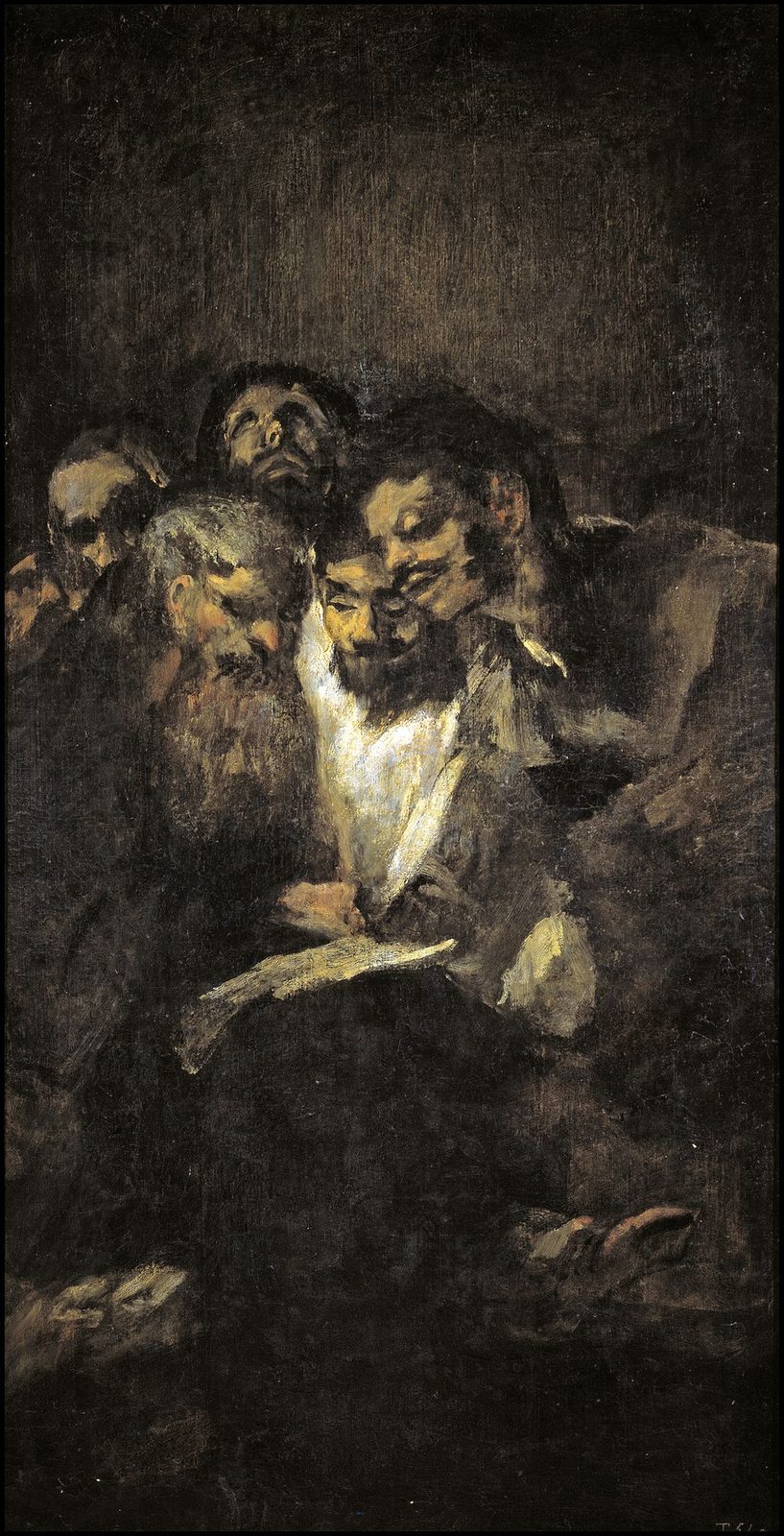
Yriarte identified the laughing group as a companion to the readers he called Les Politiques. Glendinning also cites Pierre Léonce Imbert's nineteenth-century account of the pairing. The upstairs placement and the relationship between the two narrow murals have strong support in the early descriptions. Foradada and colleagues' reconstruction places The Reading on the left as you face the wall opposite the entrance, and Two Women and a Man on the right, with a glazed opening between. That figure is a measured reconstruction. The shape of the glazing and the exact distances on either side are less directly documented than the pairing. [4] [3] [5]
Glendinning notes opposed diagonals in the two tall designs. In The Reading, several heads gather around a sheet, which gives the viewer a place to follow their attention. In Two Women and a Man, the man's shirt and the angle of the central woman's shoulders take the eye down to a lap where the action is much less distinct. If the man once held something written, the two compositions could have offered serious and comic versions of reading. The pairing also works through visible contrasts in facial expression, group size and the clarity of what draws each group's attention. The Black Paintings guide places both murals within the rest of the house. [3] [5]
Artworks directory
| Name | Date | Medium |
|---|---|---|
| And There’s No Help for It, Plate 15 | Printed 1863 | |
| Asmodea | c. 1820–23 | Wall painting transferred to canvas |
| Boys Inflating a Bladder | 1777–78 | Tapestry cartoon |
| Boys Picking Fruit | 1778 | Tapestry cartoon |
| Bullfight in a Divided Ring | 1825 | Lithograph |
| Card Players | 1777–78 | Tapestry cartoon |
| Card Players (sketch) | 1777–78 | Painted sketch |
| Dance on the Banks of the Manzanares | 1777 | Tapestry cartoon |
| Duel with Cudgels | c. 1820–23 | Wall painting transferred to canvas |
| Heads in a Landscape | c. 1820–23 | Easel painting |
| Judith and Holofernes | c. 1820–23 | Wall painting transferred to canvas |
| Leocadia | c. 1820–23 | Wall painting transferred to canvas |
| Maja and Cloaked Men | 1777 | Tapestry cartoon |
| Maja and Cloaked Men (sketch) | 1777 | Painted sketch |
| Majo Clapping in Time to the Music | 1777 | Drawing |
| Men Reading | c. 1820–23 | Wall painting transferred to canvas |
| Out Hunting for Teeth, Plate 12 | 1799 | Etching, burnished aquatint and burin |
| Picnic in the Countryside (sketch) | 1776–78 | Painted sketch |
| Picnic on the Banks of the Manzanares | 1776 | Tapestry cartoon |
| Pilgrimage to San Isidro | c. 1820–23 | Wall painting transferred to canvas |
| Preparatory study for The Sleep of Reason Produces Monsters | c. 1796–97 | Drawing |
| Procession of the Holy Office | c. 1820–23 | Wall painting transferred to canvas |
| Quarrel at the Cockerel Inn (sketch) | 1777 | Painted sketch |
| Quarrel in the New Tavern | 1777 | Tapestry cartoon |
| Saturn Devouring His Son | c. 1820–23 | Wall painting transferred to canvas |
| Seated Majo Smoking | c. 1776 | Drawing |
| The Dog | c. 1820–23 | Wall painting transferred to canvas |
| The Drinker | 1777 | Tapestry cartoon |
| The Fates | c. 1820–23 | Wall painting transferred to canvas |
| The Great He-Goat | c. 1820–23 | Wall painting transferred to canvas |
| The Kite | 1777–78 | Tapestry cartoon |
| The Parasol | 1777 | Oil on canvas, tapestry cartoon |
| The Second of May 1808 | 1814 | Oil on canvas |
| The Sleep of Reason Produces Monsters, Plate 43 | 1799 | Etching and aquatint |
| The Third of May 1808 | 1814 | Oil on canvas |
| Thou Who Canst Not, Plate 42 | 1799 | Etching and burnished aquatint |
| Three Figures | 1776 | Drawing (lost) |
| Two Old Men | c. 1820–23 | Wall painting transferred to canvas |
| Two Old Men Eating Soup | c. 1820–23 | Wall painting transferred to canvas |
| Two Women and a Man | c. 1820–23 | Wall painting transferred to canvas |
| Universal Language: The Author Dreaming | 1797 | Drawing |
| The Family of Charles IV | 1800 | Oil on canvas |
| Witches’ Sabbath (Osuna painting) | 1797–98 | Oil on canvas |
| The Nude Maja | 1795–1800 | Oil on canvas |
| The Clothed Maja | 1800–07 | Oil on canvas |
| Self-Portrait (Drawing) | c. 1796 | Brush and carbon black ink on laid paper |
| The Swing, Madrid Album B.21 | 1795–97 | Brush and carbon black washes |
| Majas Fighting, a Majo Observing, Madrid Album B.15 | 1796–97 | Brush, grey and black washes on laid paper |
| Majos and Majas Conversing, Madrid Album B.16 | c. 1794–97 | Ink wash on paper |
| Weeping Woman and Three Men, Madrid Album B.17 | 1795–97 | Brush, carbon black washes and black chalk |
| Maja Seated on a Chair and Two Companions Behind, Madrid Album B.18 | 1795–97 | Brush and carbon black washes |
| Girl and Bull, Madrid Album B.23 | 1796–97 | Brush and carbon black washes |
| Lovers Sitting on a Rock, Madrid Album B.24 | 1796–97 | Brush and carbon black washes |
| Mariano Ceballos Riding a Bull | 1825 | Crayon lithograph and scraper |
| Landscape (lifetime impression) | c. 1807–10 | Etching and aquatint |
| Self-Portrait (1815), Prado canvas | 1815 | Oil on canvas |
| Self-Portrait (1815), Academy panel | 1815 | Oil on panel |
| Self-Portrait with Dr Arrieta | 1820 | Oil on canvas |
| Christ Crucified | 1780 | Oil on canvas |
| The Last Communion of Saint Joseph of Calasanz | 1819 | Oil on canvas |
| Christ on the Mount of Olives | 1819 | Oil on panel |
| The Flower Girls, or Spring | 1786–87 | Oil on canvas |
| The Grape Harvest, or Autumn | 1786–87 | Oil on canvas |
| The Snowstorm, or Winter | 1786–87 | Oil on canvas |
| The Threshing Ground, or Summer | 1786–87 | Oil on canvas |
| Picnic on the Banks of the Manzanares | 1776 | Oil on canvas |
| The Kite | 1777–78 | Oil on canvas |
| Dance on the Banks of the Manzanares | 1777 | Oil on canvas |
| A Fight at the Venta Nueva | 1777 | Oil on canvas |
| Blind Man’s Bluff | 1788 | Oil on canvas |
| Dogs on a Lead | 1775 | Oil on canvas |
| Hunting with a Decoy | 1775 | Oil on canvas |
| Hunter Loading His Rifle | 1775 | Oil on canvas |
| The Angler | 1775 | Oil on canvas |
| The Hermitage of San Isidro on His Feast Day | 1788 | Oil on canvas |
| The Meadow of San Isidro | 1788 | Oil on canvas |
| The Straw Manikin | 1791–92 | Oil on canvas |
| Witches’ Flight | c. 1797–98 | Oil on canvas |
| A Scene from ‘The Forcibly Bewitched’ | 1798 | Oil on canvas |
| The Duchess of Alba in Black | 1797 | Oil on canvas |
| The Duchess of Alba in White | 1795 | Oil on canvas |
| Charles III in Hunting Dress | c. 1786 | Oil on canvas |
| The Duke and Duchess of Osuna and Their Children | 1787–88 | Oil on canvas |
| Manuel Osorio Manrique de Zúñiga | 1787–88 | Oil on canvas |
| The Marquesa de Pontejos | c. 1786 | Oil on canvas |
| Equestrian Portrait of the 1st Duke of Wellington | 1812 | Oil on canvas |
| The Duke of Wellington | 1812–14 | Oil on wood |
| Portrait of Ferdinand VII of Spain | 1814 | Oil on canvas |
| Gaspar Melchor de Jovellanos | 1798 | Oil on canvas |
| María Tomasa Palafox y Portocarrero | 1804 | Oil on canvas |
| Señora Sabasa García | c. 1806–11 | Oil on canvas |
| Don Juan Bautista de Muguiro | 1827 | Oil on canvas |
| Doña Isabel de Porcel | Before 1805 | Oil on canvas |
| The Colossus | After 1808 | Oil on canvas |
| The Burial of the Sardine | 1808–12 | Oil on panel |
| The Madhouse | 1808–12 | Oil on panel |
| A Procession of Flagellants | 1808–12 | Oil on panel |
| Portrait of Jacques Galos | 1826 | Oil on canvas |
| Portrait of Mariano Goya, the Artist’s Grandson | 1827 | Oil on canvas |
| Milkmaid of Bordeaux | c. 1827 | Oil on canvas |
| Portrait of Don Juan Antonio Cuervo | 1819 | Oil on canvas |
| María Luisa of Parma (Naples version) | c. 1800 | Oil on canvas |
| The Countess of Baena | 1819 | Oil on canvas |
| The Family of the Infante Don Luis | 1783–84 | Oil on canvas |
| The Holy Family | c. 1787 | Oil on canvas |
| Saint Barbara | c. 1773 | Oil on canvas |
| Saints Justa and Rufina | 1817 | Oil on canvas |
| El Tío Paquete | c. 1819–20 | Oil on canvas |
| The Forge | c. 1815–20 | Oil on canvas |
| Majas on a Balcony (Metropolitan Museum version) | c. 1800–10 | Oil on canvas |
| Maja and Celestina on a Balcony | c. 1808–12 | Oil on canvas |
| The Water Bearer | 1808–12 | Oil on canvas |
| Time and the Old Women | c. 1810 | Oil on canvas |
Frequently Asked Questions
His bent arm extends towards his lap. The sexual reading is longstanding. Glendinning proposed that the hand might once have supported a sheet, and Garrido thought the earlier hand position was consistent with holding a book. The evidence establishes a change to the gesture while leaving the action uncertain. [2] [3] [10]
Discussion
Look again at the images and ideas explored in Two Women and a Man. These editorial prompts invite your observations.
Compare the man's mouth with the central woman's, then look at how much of the left-hand woman's expression you can see. If you began with the title Women Laughing, which face would you look at first? Try the same exercise with Two Women and a Man, then compare the lap with the clearly visible sheet in The Reading. [1] [5]
Reader Insights
Which face seems to address the viewer most directly?
How do the different titles change your reading of the three figures?
Join the Conversation
Share a detail, comparison or question about Two Women and a Man below.
References
- Museo Nacional del Prado, Dos mujeres y un hombre, P000765. See also the Prado's work list in the official agreement published in the Boletín Oficial del Estado, P765. View source 1. View source 2.
- Fundación Goya en Aragón, Dos mujeres y un hombre, catalogue entry 666, especially the artistic analysis and conservation sections. View source.
- Nigel Glendinning, ‘The Strange Translation of Goya's “Black Paintings”’, The Burlington Magazine 117, no. 868 (1975), pp. 465–479, fig. 64 and p. 476, including note 35. View source.
- Charles Yriarte, Goya. Sa vie, son œuvre, Paris, Henri Plon, 1867, pp. 94–95 and 141. View source.
- Carlos Foradada, Carlos Narbaiza, José Javier Luis and Alfonso Burgos, ‘Las medidas de la casa de Goya y sus Pinturas negras en su entorno original’, ASRI, no. 20 (2021), pp. 53–82, especially figs. 30 and 32, pp. 78–79. View source.
- Maïté Metz, ‘El Tío Paquete: Goya's Prefiguration of Esperpento’, Museo Nacional Thyssen-Bornemisza, Open Windows 7, pp. 35–36, fig. 24. View source.
- Fundación Goya en Aragón, Mejor es holgar, Los Caprichos, plate 73, catalogue entry 944. View source.
- Carlos Foradada, ‘El entorno político y social en los contenidos de las “Pinturas Negras” de Goya’, in Goya y su contexto, pp. 193–209, especially pp. 201–205, figs. 3 and 4, identifying Laurent's Sorcière jetant un sort, NIM 08126, Archivo Ruiz Vernacci, Fototeca del IPCE. View source.
- Raquel Esteban Vega, ‘Las fotografías de J. Laurent de las Pinturas negras de Goya’, in Goya en la Literatura, en la Música y en las Creaciones Audiovisuales, pp. 413–426. View source.
- Carmen Garrido Pérez, ‘Algunas consideraciones sobre la técnica de las Pinturas Negras de Goya’, Boletín del Museo del Prado 5, no. 13 (1984), pp. 4–40, especially pp. 26–27, figs. 51–57. Digitised article. View source 1. View source 2.
- Mar Borobia, El tío Paquete, Museo Nacional Thyssen-Bornemisza, inv. 165 (1935.8), oil on canvas, c. 1819–1820. View source.







