


 by Tom Gurney
Tom Gurney BSc (Hons) is an art history expert with over 20 years experience
Published on June 19, 2020 / Updated on November 20, 2026
Email: tomgurney1@gmail.com / Phone: +44 7429 011000
Introduction
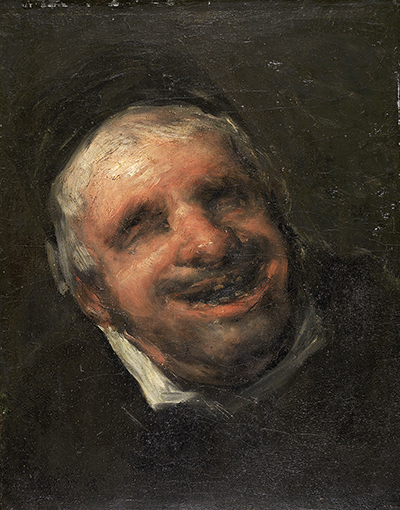
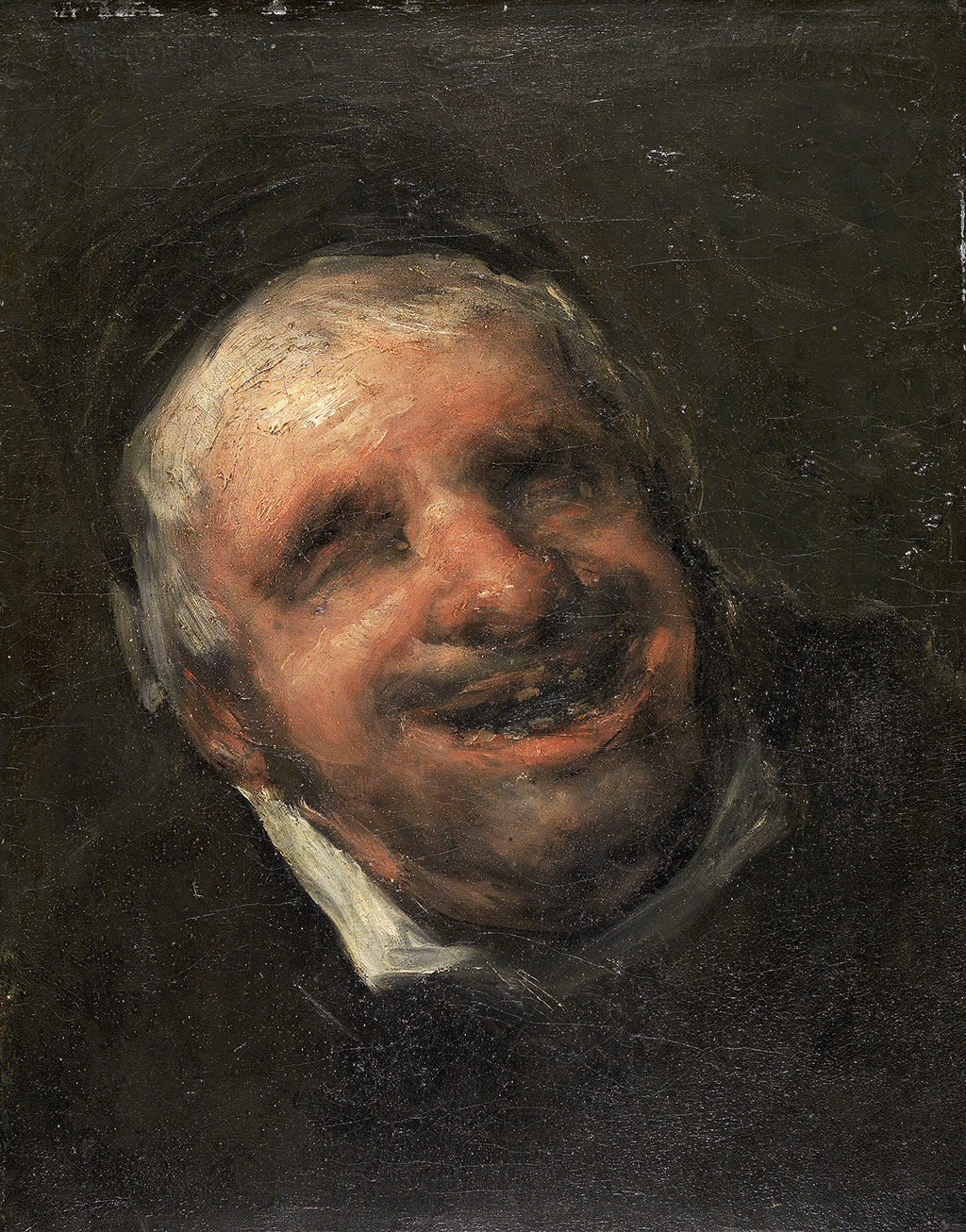
A man tips his head back and opens his mouth. A few pale marks catch the light inside it, while his eyes are almost lost in strokes of brown and pink. The white collar gives the head a foothold in the darkness. Francisco de Goya's subject was a blind singer and guitarist known around the Madrid church of San Felipe el Real. Goya's little canvas gives him a remarkably large presence. At first the expression looks like laughter. The longer you look at the mouth and eyes separately, the harder it is to tell what kind of laughter it might be. [1] [2]
At a Glance
- ArtistFrancisco de Goya y Lucientes
- TitleEl tío Paquete in the museum catalogue
- DateAbout 1819–1820 according to the Thyssen. The Fundación Goya en Aragón gives about 1820–1823.
- Medium and dimensionsOil on canvas, 39 × 31 cm
- CollectionMuseo Nacional Thyssen-Bornemisza, Madrid, inv. 165 (1935.8)
- SubjectTío Paquete, a singer and guitarist associated with San Felipe el Real in Madrid. [1] [2]
Works across Goya’s career
The Parasol
1777The Nude Maja
1795–1800Saturn Devouring His Son
c. 1820–23The Dog
c. 1820–23El Tío Paquete
c. 1819–20Who was Tío Paquete?
The church provides a place to begin. The Thyssen identifies Paquete as a familiar figure in the area of San Felipe el Real. The Fundación Goya specifies the steps, where he solicited money and sang to his own guitar accompaniment. The museum's account describes him as known for his skill as a performer. Those few details give a social setting to a painting that shows only a bust. People passing the church could recognise the musician by where they found him and, presumably, by his voice. Viewers of the portrait have the intimate scale of a single face and the written record that attaches it to a place and a nickname. [1] [2]
In a study for the Thyssen, Maïté Metz relates Paquete to the familiar name Paco. Tío literally means uncle and can be used in a familiar form of address. The title preserves a name by which people knew the man in Madrid. A written description on the original reverse supplies a second trace. According to the Thyssen, the words read El célebre ciego fijo, which the museum translates as “The famous local blind man”. The museum knows the wording from written accounts. It reports that the inscription was lost when the canvas was lined after 1887. Lining adds a supporting fabric to the back of a canvas, so the written record now carries evidence that readers cannot examine on the painting's visible surface. The sources identify a local person. His full name, the circumstances of the sitting and the hand responsible for the inscription remain undocumented in the collection entry. [1] [3]
Annotated Details from El Tío Paquete
Look at the painted surface and the dark openings at the eyes and mouth.
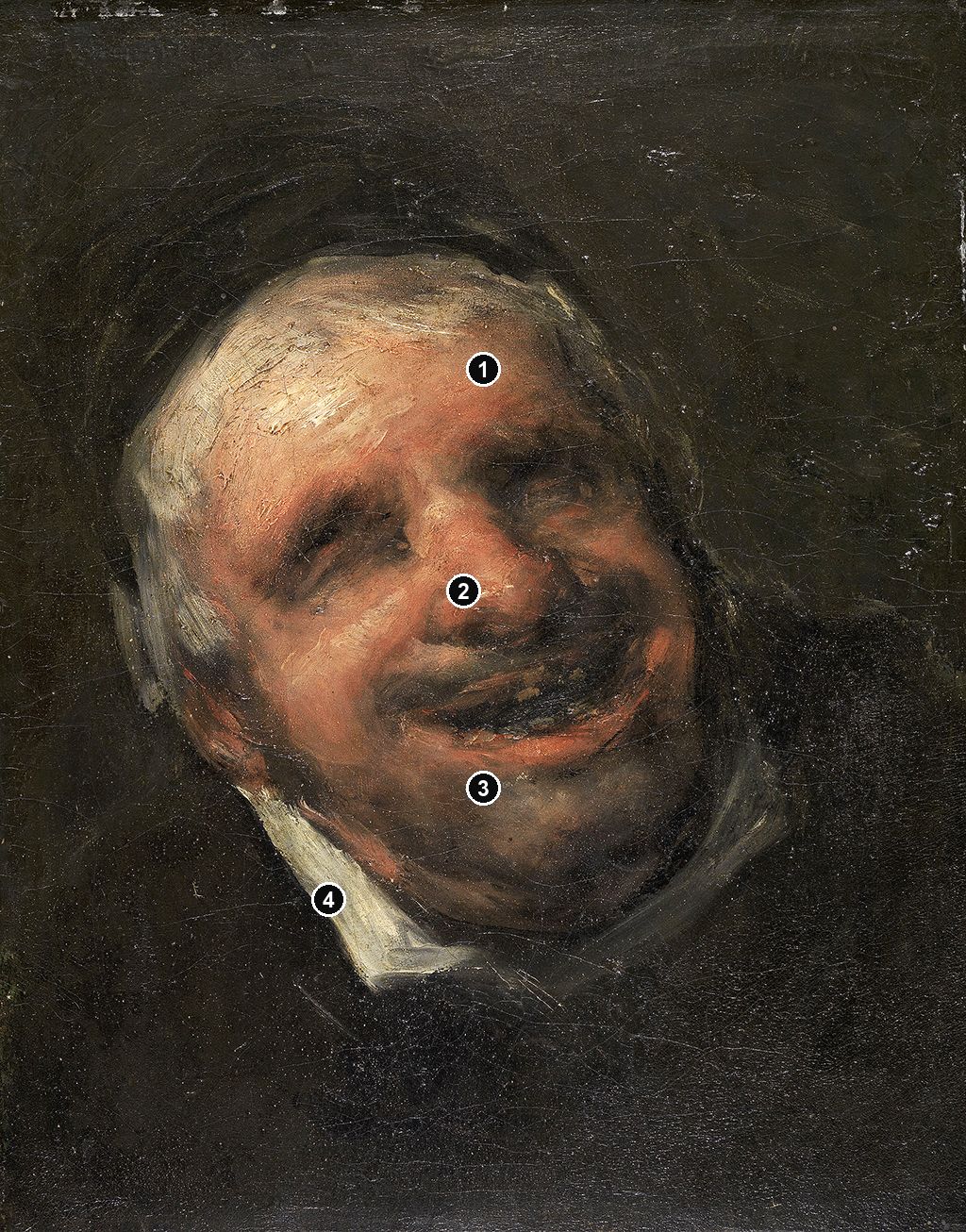
Details from EL TÍO PAQUETE
Details from the Thyssen-Bornemisza canvas (1935.8).
The forehead
Thicker strokes across the brow catch the light.
The narrow eyelids
Pale ridges and dark lines pick out the sloping lids.
The open mouth
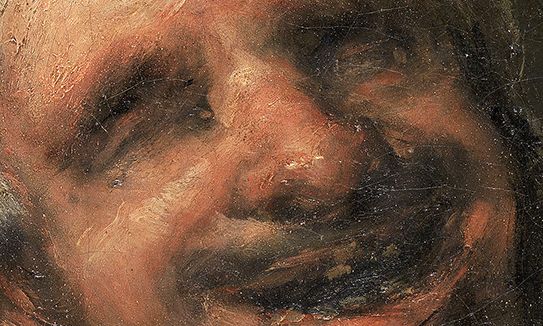
Small lights interrupt the dark oval of the mouth.
The pale collar
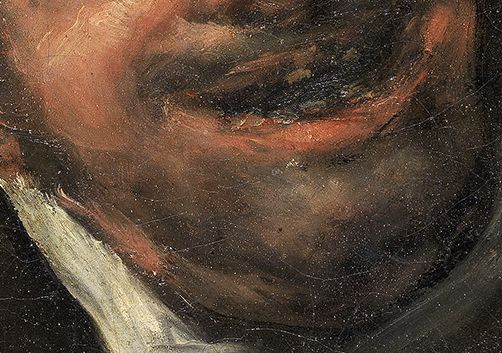
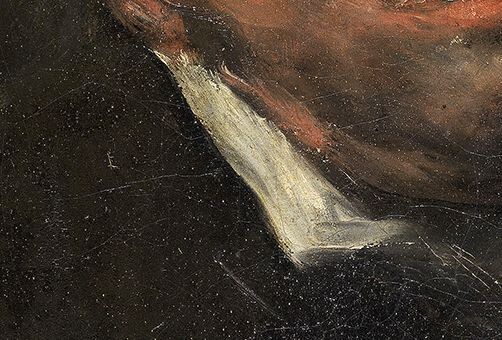
A small strip of lighter paint marks the collar near the lower edge.
Looking at the face
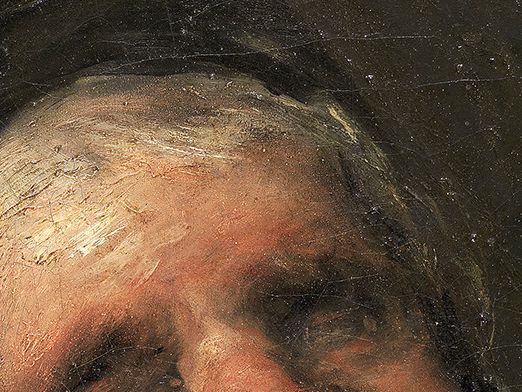
The strongest lights run over the viewer's left side of the forehead and across the hair immediately above it. Creamy touches there sit alongside passages of warmer ochre and red. The brows and lids come together in short dark passages. From a distance the broad forehead and cheeks make the face readable at once. Up close the planes are surprisingly irregular, with abrupt changes of direction where one stroke meets another. Mar Borobia, writing for the Thyssen, draws attention to Goya's impasto, paint laid on thickly enough to have a raised surface. Metz singles out the forehead. The broken light at the top of the face is one place to see how a broad application of paint can suggest both the volume of a head and the unevenness of skin. [1] [3]
The mouth runs up towards the viewer's right. A thin reddish edge catches beneath the dark opening, and uneven pale accents interrupt it. Broad strokes around the cheeks prolong the curve. The eyes have the opposite emphasis. The hollows are dark and the nearly closed lids are only briefly picked out. Those sloping arcs give little indication of where the attention is directed. The effect depends on the two features working at different speeds. The opening of the mouth is immediately legible, and then the eyes take time to come into focus. A grin can seem companionable one moment and strained the next, depending on which part of the face holds the viewer's attention. [1] [3]
The collar beneath the jaw helps to gauge the tilt. On the viewer's left it forms a pointed flare of pale fabric. On the right it turns up into a thinner light edge before disappearing. Follow the point of the collar towards the chin and the head seems to pitch sideways and back. Follow it down and the outline of the shoulders softens into nearly the same range of dark colours as the background. There are faint curved marks above the head, which Metz sees as contributing to the movement of the bust. Taken as a whole, the field gives the eye just enough to place a body under that face. It supplies no clear measure of the space behind him. [3]
The published accounts of the musician's trade make it tempting to hear the open mouth as song. Borobia reads the expression as apparently ironic laughter, and Metz sees the face oscillating between a smile and a grimace. There is room for the latter reading even if one first sees a laugh. The lips part widely while the rest of the face seems to contract. The sources offer different ways to describe the expression but no record of what Paquete was doing when Goya painted him. The absence of a guitar, audience or visible interlocutor keeps those possibilities in play. [1] [3]
Goya on film
Five films explore Goya’s portraits, prints, Black Paintings and painting techniques.
The Duke of Wellington by Goya
The portrait, its military decorations and its later theft.
Watch on YouTubeA portrait beside the Black Paintings
The Thyssen dates the portrait to about 1819–1820, drawing on its colour, handling and subject matter to place it close to the Black Paintings. The Fundación Goya gives a slightly later and broader estimate of about 1820–1823. Both put the work in the late period when Goya painted the walls of the Quinta del Sordo, the house he bought in 1819 near Madrid's Segovia Bridge. The small portrait was painted on canvas. The Black Paintings are fourteen murals that were subsequently removed from the walls and transferred to canvas on the instructions of the property's later owner, Baron Émile d'Erlanger. A picture can resemble those murals in the way it is painted while having a separate material history. [1] [2]
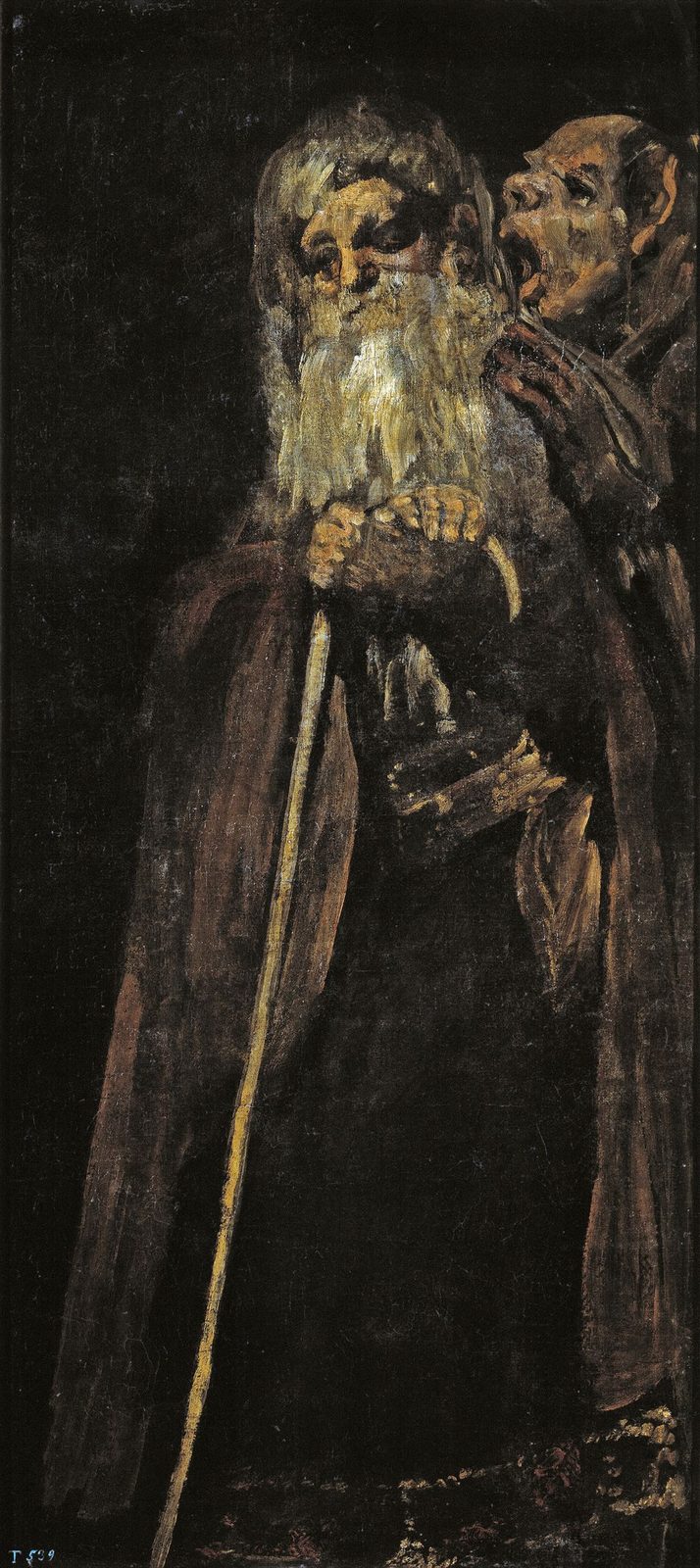
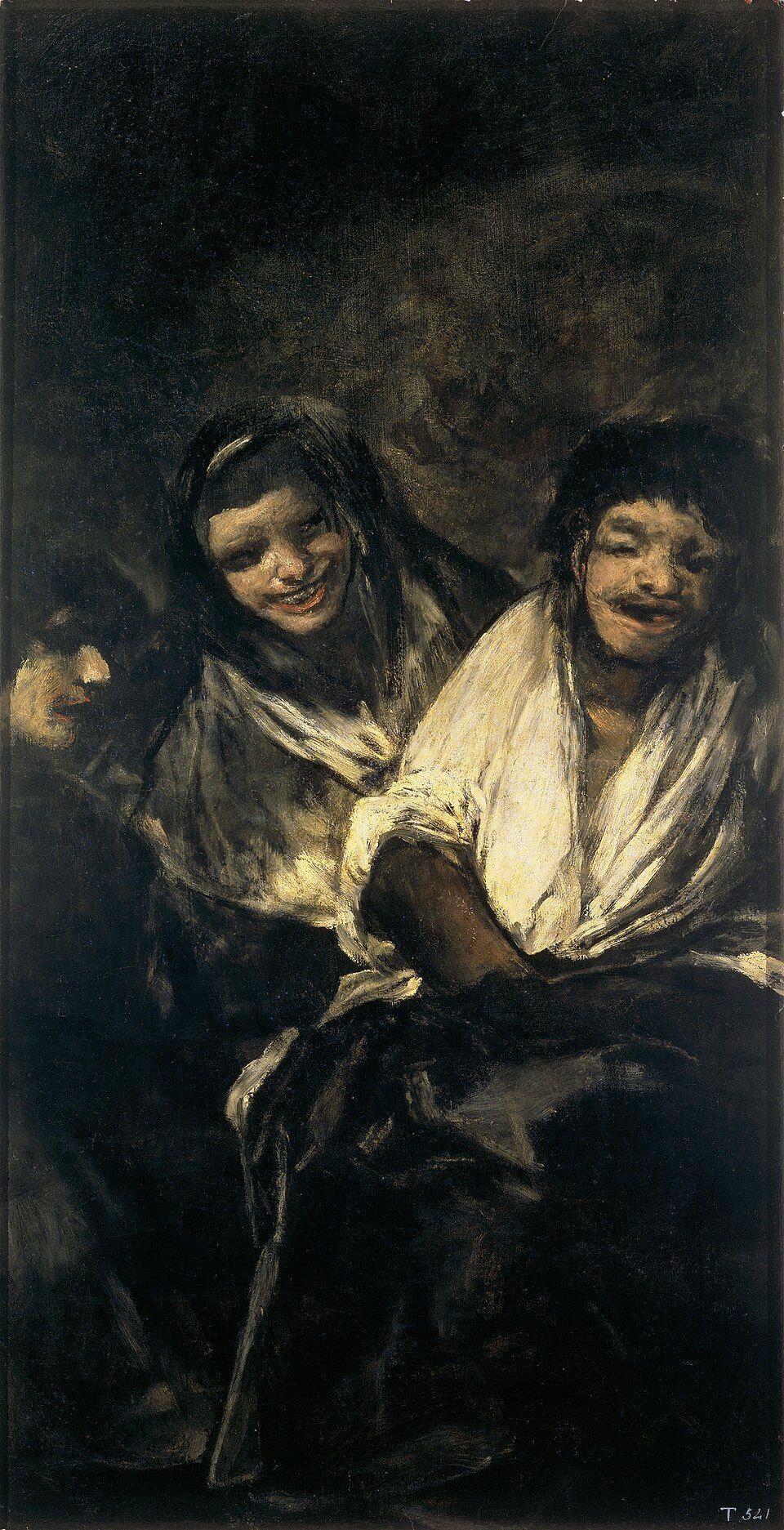
The comparison Borobia makes is with a laughing woman in Two Women and a Man, the mural also known as Man Mocked by Two Women. In that work the faces are close together, and the third figure's body and the women's expressions suggest that something is happening between them. What the three are doing has itself been debated. In the portrait, a similarly forceful mouth belongs to one person alone, and there is no one present to receive the expression or explain it. Looking at the two pictures together shows how Goya could use the uncertain shape of a laugh to build a relationship between figures or sustain the character of a solitary head. [1] [4]
Goya had used the subject of a blind street musician decades earlier. The Blind Guitarist, the subject of a 1778 tapestry cartoon and a related etching, gives the musician a guitar and surrounds him with listeners. In the print at the Metropolitan Museum of Art, heads and bodies turn towards the player, and the position of his hands helps make the sound imaginable. In El Tío Paquete, the concentration on one face leaves the musical association to the sitter's recorded occupation. The two works show Goya finding quite different pictorial possibilities in the subject of a musician in public life. The later canvas lets us consider an individual without showing him at his usual post. [2] [5]
From the Goya family to the Thyssen
Metz suggests that Goya took an interest in Paquete and painted the picture on his own initiative. The suggestion makes sense of the intimate scale and the choice of a local musician. The documented ownership given by the Thyssen begins with Goya's grandson, Mariano Goya y Goicoechea. The museum then places the painting with the Count of Doña Marina, whose collection it was in when shown at the Ministry of Public Education and Fine Arts' Goya exhibition in Madrid in 1900. The entry names the Marquis de Heredia as the last known owner before the picture entered the Rohoncz collection in 1935. It appeared in the collection's 1937 catalogue and later travelled with works from the collection to Rotterdam and Essen in 1959–1960. [1] [3]
The dates of the exhibition and catalogues give the portrait a history as a public object, very different from the scattered evidence for its making. The missing words once on the reverse help recover the association with a particular performer. The nineteenth- and twentieth-century collection record tells us where the painted object went. Goya's image contributes something of its own to the record. He allows the features to move without resolving what the man feels, and limits the information around him so that the movement of the paint holds our attention as much as the sitter's identity. [1] [3]
Artworks directory
| Name | Date | Medium |
|---|---|---|
| And There’s No Help for It, Plate 15 | Printed 1863 | |
| Asmodea | c. 1820–23 | Wall painting transferred to canvas |
| Boys Inflating a Bladder | 1777–78 | Tapestry cartoon |
| Boys Picking Fruit | 1778 | Tapestry cartoon |
| Bullfight in a Divided Ring | 1825 | Lithograph |
| Card Players | 1777–78 | Tapestry cartoon |
| Card Players (sketch) | 1777–78 | Painted sketch |
| Dance on the Banks of the Manzanares | 1777 | Tapestry cartoon |
| Duel with Cudgels | c. 1820–23 | Wall painting transferred to canvas |
| Heads in a Landscape | c. 1820–23 | Easel painting |
| Judith and Holofernes | c. 1820–23 | Wall painting transferred to canvas |
| Leocadia | c. 1820–23 | Wall painting transferred to canvas |
| Maja and Cloaked Men | 1777 | Tapestry cartoon |
| Maja and Cloaked Men (sketch) | 1777 | Painted sketch |
| Majo Clapping in Time to the Music | 1777 | Drawing |
| Men Reading | c. 1820–23 | Wall painting transferred to canvas |
| Out Hunting for Teeth, Plate 12 | 1799 | Etching, burnished aquatint and burin |
| Picnic in the Countryside (sketch) | 1776–78 | Painted sketch |
| Picnic on the Banks of the Manzanares | 1776 | Tapestry cartoon |
| Pilgrimage to San Isidro | c. 1820–23 | Wall painting transferred to canvas |
| Preparatory study for The Sleep of Reason Produces Monsters | c. 1796–97 | Drawing |
| Procession of the Holy Office | c. 1820–23 | Wall painting transferred to canvas |
| Quarrel at the Cockerel Inn (sketch) | 1777 | Painted sketch |
| Quarrel in the New Tavern | 1777 | Tapestry cartoon |
| Saturn Devouring His Son | c. 1820–23 | Wall painting transferred to canvas |
| Seated Majo Smoking | c. 1776 | Drawing |
| The Dog | c. 1820–23 | Wall painting transferred to canvas |
| The Drinker | 1777 | Tapestry cartoon |
| The Fates | c. 1820–23 | Wall painting transferred to canvas |
| The Great He-Goat | c. 1820–23 | Wall painting transferred to canvas |
| The Kite | 1777–78 | Tapestry cartoon |
| The Parasol | 1777 | Oil on canvas, tapestry cartoon |
| The Second of May 1808 | 1814 | Oil on canvas |
| The Sleep of Reason Produces Monsters, Plate 43 | 1799 | Etching and aquatint |
| The Third of May 1808 | 1814 | Oil on canvas |
| Thou Who Canst Not, Plate 42 | 1799 | Etching and burnished aquatint |
| Three Figures | 1776 | Drawing (lost) |
| Two Old Men | c. 1820–23 | Wall painting transferred to canvas |
| Two Old Men Eating Soup | c. 1820–23 | Wall painting transferred to canvas |
| Two Women and a Man | c. 1820–23 | Wall painting transferred to canvas |
| Universal Language: The Author Dreaming | 1797 | Drawing |
| The Family of Charles IV | 1800 | Oil on canvas |
| Witches’ Sabbath (Osuna painting) | 1797–98 | Oil on canvas |
| The Nude Maja | 1795–1800 | Oil on canvas |
| The Clothed Maja | 1800–07 | Oil on canvas |
| Self-Portrait (Drawing) | c. 1796 | Brush and carbon black ink on laid paper |
| The Swing, Madrid Album B.21 | 1795–97 | Brush and carbon black washes |
| Majas Fighting, a Majo Observing, Madrid Album B.15 | 1796–97 | Brush, grey and black washes on laid paper |
| Majos and Majas Conversing, Madrid Album B.16 | c. 1794–97 | Ink wash on paper |
| Weeping Woman and Three Men, Madrid Album B.17 | 1795–97 | Brush, carbon black washes and black chalk |
| Maja Seated on a Chair and Two Companions Behind, Madrid Album B.18 | 1795–97 | Brush and carbon black washes |
| Girl and Bull, Madrid Album B.23 | 1796–97 | Brush and carbon black washes |
| Lovers Sitting on a Rock, Madrid Album B.24 | 1796–97 | Brush and carbon black washes |
| Mariano Ceballos Riding a Bull | 1825 | Crayon lithograph and scraper |
| Landscape (lifetime impression) | c. 1807–10 | Etching and aquatint |
| Self-Portrait (1815), Prado canvas | 1815 | Oil on canvas |
| Self-Portrait (1815), Academy panel | 1815 | Oil on panel |
| Self-Portrait with Dr Arrieta | 1820 | Oil on canvas |
| Christ Crucified | 1780 | Oil on canvas |
| The Last Communion of Saint Joseph of Calasanz | 1819 | Oil on canvas |
| Christ on the Mount of Olives | 1819 | Oil on panel |
| The Flower Girls, or Spring | 1786–87 | Oil on canvas |
| The Grape Harvest, or Autumn | 1786–87 | Oil on canvas |
| The Snowstorm, or Winter | 1786–87 | Oil on canvas |
| The Threshing Ground, or Summer | 1786–87 | Oil on canvas |
| Picnic on the Banks of the Manzanares | 1776 | Oil on canvas |
| The Kite | 1777–78 | Oil on canvas |
| Dance on the Banks of the Manzanares | 1777 | Oil on canvas |
| A Fight at the Venta Nueva | 1777 | Oil on canvas |
| Blind Man’s Bluff | 1788 | Oil on canvas |
| Dogs on a Lead | 1775 | Oil on canvas |
| Hunting with a Decoy | 1775 | Oil on canvas |
| Hunter Loading His Rifle | 1775 | Oil on canvas |
| The Angler | 1775 | Oil on canvas |
| The Hermitage of San Isidro on His Feast Day | 1788 | Oil on canvas |
| The Meadow of San Isidro | 1788 | Oil on canvas |
| The Straw Manikin | 1791–92 | Oil on canvas |
| Witches’ Flight | c. 1797–98 | Oil on canvas |
| A Scene from ‘The Forcibly Bewitched’ | 1798 | Oil on canvas |
| The Duchess of Alba in Black | 1797 | Oil on canvas |
| The Duchess of Alba in White | 1795 | Oil on canvas |
| Charles III in Hunting Dress | c. 1786 | Oil on canvas |
| The Duke and Duchess of Osuna and Their Children | 1787–88 | Oil on canvas |
| Manuel Osorio Manrique de Zúñiga | 1787–88 | Oil on canvas |
| The Marquesa de Pontejos | c. 1786 | Oil on canvas |
| Equestrian Portrait of the 1st Duke of Wellington | 1812 | Oil on canvas |
| The Duke of Wellington | 1812–14 | Oil on wood |
| Portrait of Ferdinand VII of Spain | 1814 | Oil on canvas |
| Gaspar Melchor de Jovellanos | 1798 | Oil on canvas |
| María Tomasa Palafox y Portocarrero | 1804 | Oil on canvas |
| Señora Sabasa García | c. 1806–11 | Oil on canvas |
| Don Juan Bautista de Muguiro | 1827 | Oil on canvas |
| Doña Isabel de Porcel | Before 1805 | Oil on canvas |
| The Colossus | After 1808 | Oil on canvas |
| The Burial of the Sardine | 1808–12 | Oil on panel |
| The Madhouse | 1808–12 | Oil on panel |
| A Procession of Flagellants | 1808–12 | Oil on panel |
| Portrait of Jacques Galos | 1826 | Oil on canvas |
| Portrait of Mariano Goya, the Artist’s Grandson | 1827 | Oil on canvas |
| Milkmaid of Bordeaux | c. 1827 | Oil on canvas |
| Portrait of Don Juan Antonio Cuervo | 1819 | Oil on canvas |
| María Luisa of Parma (Naples version) | c. 1800 | Oil on canvas |
| The Countess of Baena | 1819 | Oil on canvas |
| The Family of the Infante Don Luis | 1783–84 | Oil on canvas |
| The Holy Family | c. 1787 | Oil on canvas |
| Saint Barbara | c. 1773 | Oil on canvas |
| Saints Justa and Rufina | 1817 | Oil on canvas |
| El Tío Paquete | c. 1819–20 | Oil on canvas |
| The Forge | c. 1815–20 | Oil on canvas |
| Majas on a Balcony (Metropolitan Museum version) | c. 1800–10 | Oil on canvas |
| Maja and Celestina on a Balcony | c. 1808–12 | Oil on canvas |
| The Water Bearer | 1808–12 | Oil on canvas |
| Time and the Old Women | c. 1810 | Oil on canvas |
Frequently Asked Questions
The painting belongs to the Museo Nacional Thyssen-Bornemisza in Madrid. Its collection record uses inventory number 165 (1935.8). [1]
Written accounts record El célebre ciego fijo, rendered by the Thyssen as “The famous local blind man”. The museum says the inscription was lost following the lining of the canvas after 1887. [1]
Discussion
Look again at the images and ideas explored in El Tío Paquete. These editorial prompts invite your observations.
Look at the open mouth before you look at the eyes. Then reverse the order. Does the expression change when you begin with the lids and brow? Which marks make you imagine a sound, and what kind of sound would it be if you knew nothing about the sitter's occupation?
Reader Insights
Where does Goya use thick paint to give the face volume?
Compare the smile with the expressions in Two Women and a Man.
Join the Conversation
Share a detail, comparison or question about El Tío Paquete below.
References
- Mar Borobia, Museo Nacional Thyssen-Bornemisza, El tío Paquete. See also the Spanish collection record. View source 1. View source 2.
- Fundación Goya en Aragón, El tío Paquete, Spanish catalogue record. View source.
- Maïté Metz, ‘El tío Paquete: el sentido goyesco del esperpento’, Ventanas 7, Museo Thyssen-Bornemisza, especially pp. 27–30 and fig. 4. See also the English version in Open Windows 7. View source 1. View source 2.
- Fundación Goya en Aragón, Two Women and a Man (Dos mujeres y un hombre), collection entry for the Prado mural and its interpretations. View source.
- Metropolitan Museum of Art, Blind Guitarist, collection record for the etching, 22.63.29, and Fundación Goya en Aragón, The Blind Guitarist (El ciego de la guitarra), catalogue record for the tapestry cartoon. View source 1. View source 2.







