


 by Tom Gurney
Tom Gurney BSc (Hons) is an art history expert with over 20 years experience
Published on June 19, 2020 / Updated on November 20, 2026
Email: tomgurney1@gmail.com / Phone: +44 7429 011000
Introduction
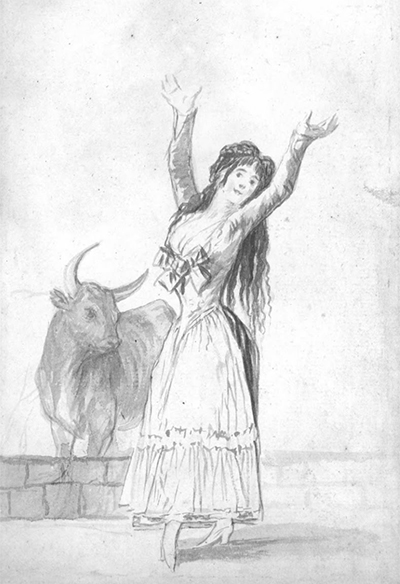
A young woman lifts both arms, stretching towards opposite corners of a narrow sheet. Her long hair falls behind her, and one foot crosses the other beneath the hem of her dress. A bull stands further back, its head and horns rising above a low wall. Francisco de Goya gives the woman most of the height of the page and leaves a broad area of paper around her hands. The Metropolitan Museum of Art describes her as dancing. The gesture is easy to recognise, but the animal’s presence makes the occasion much harder to place. On the back of the same sheet, Goya drew two lovers sitting close together on a rock. [1] [2] [3]
At a Glance
- ArtistFrancisco de Goya y Lucientes (1746–1828).
- WorkGirl and Bull (Joven y toro), Madrid Album B, page 23, recto.
- Date and medium1796–97 in the Met catalogue. Brush and point of brush, carbon black washes, on paper, 23.5 × 14.5 cm.
- CollectionThe Metropolitan Museum of Art, New York, 35.103.7, Harris Brisbane Dick Fund, 1935.
- ReverseLovers Sitting on a Rock, Album B, page 24, Met 35.103.6. [1] [2] [3]
Works across Goya’s career
The Parasol
1777The Nude Maja
1795–1800Saturn Devouring His Son
c. 1820–23The Dog
c. 1820–23The dancer and the low wall
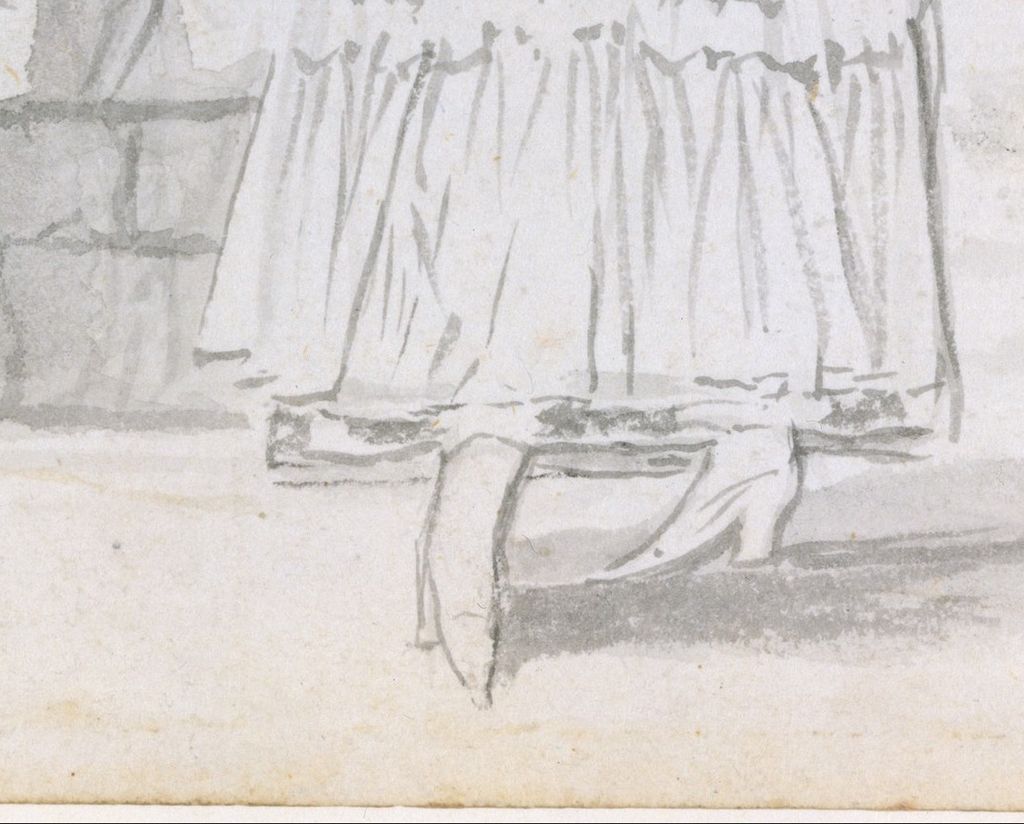
Start at the hem. One narrow shoe points down, while the other extends to the right above the shadow on the ground. The skirt falls in long folds to a gathered flounce, and the bodice opens into a large bow. From the waist the torso inclines to the right, a direction picked up by the arm that stretches diagonally towards the right edge. The other arm rises more steeply, and both hands open into the pale background. Following the figure from the feet to the fingers gives a sense of movement built out of small shifts in angle. The tilt of her head softens the stretch of her arm. The Fundación Goya en Aragón reads the lifted arms, loose hair and expression as signs of delight. [1] [2]
The wall runs across the sheet just above the hem. Look for the joints between the blocks on the left, where they are clearest. They run below the bull’s chest and legs, putting the animal behind the barrier. The woman stands on the nearer side. Her skirt obscures part of the wall and overlaps the animal’s flank in the image, so the two appear close until the wall gives us a way to measure the interval. The arrangement gives the bull a strong place in the composition even though the dancer has more space. Both horns are legible against the pale paper, and the head emerges far enough to show a dark eye and a lighter muzzle. [1] [2]
The strongest darks gather in the woman’s hair and in the folds beside her waist. The finer lines in her bodice, skirt and flounce leave much of the dress light. The bull is drawn in broader areas of grey, with comparatively few sharp accents across its body. The Met’s description of brush and point of brush accounts for that range within a single medium. A pointed tip can pick out the ends of the fingers or the seams of a bow. A wider stroke can fill the chest of the bull or lay out the shadow below the dancer. The same sheet holds both the crisp detail of the foreground and the simpler tones of the animal behind it. [1] [2]
Annotated Details from Girl and Bull
Follow the gesture of the dancer and the lighter washes that mark the bull and its setting.
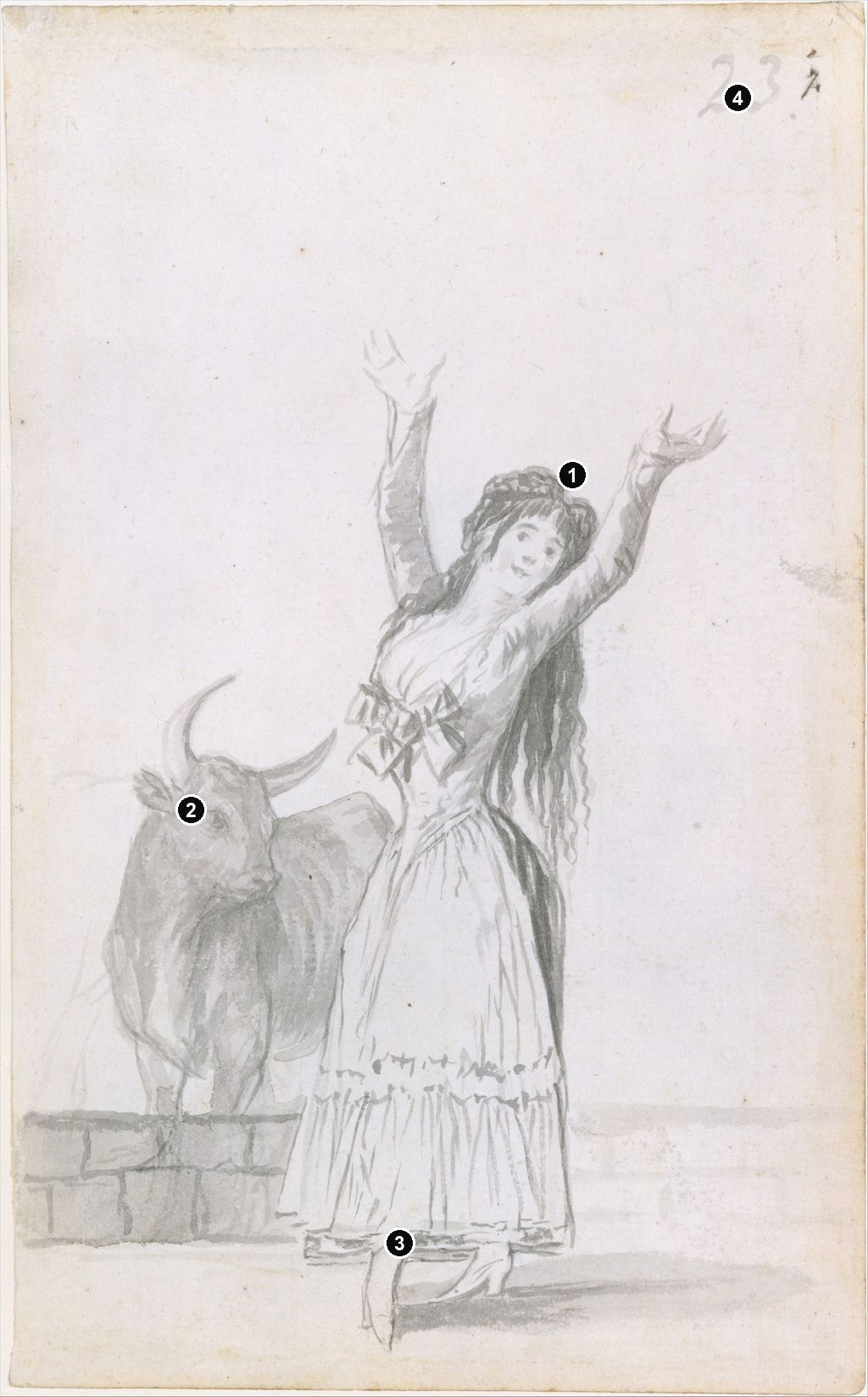
Details from GIRL AND BULL
Details from Madrid Album B.23 in the Metropolitan Museum of Art (35.103.7).
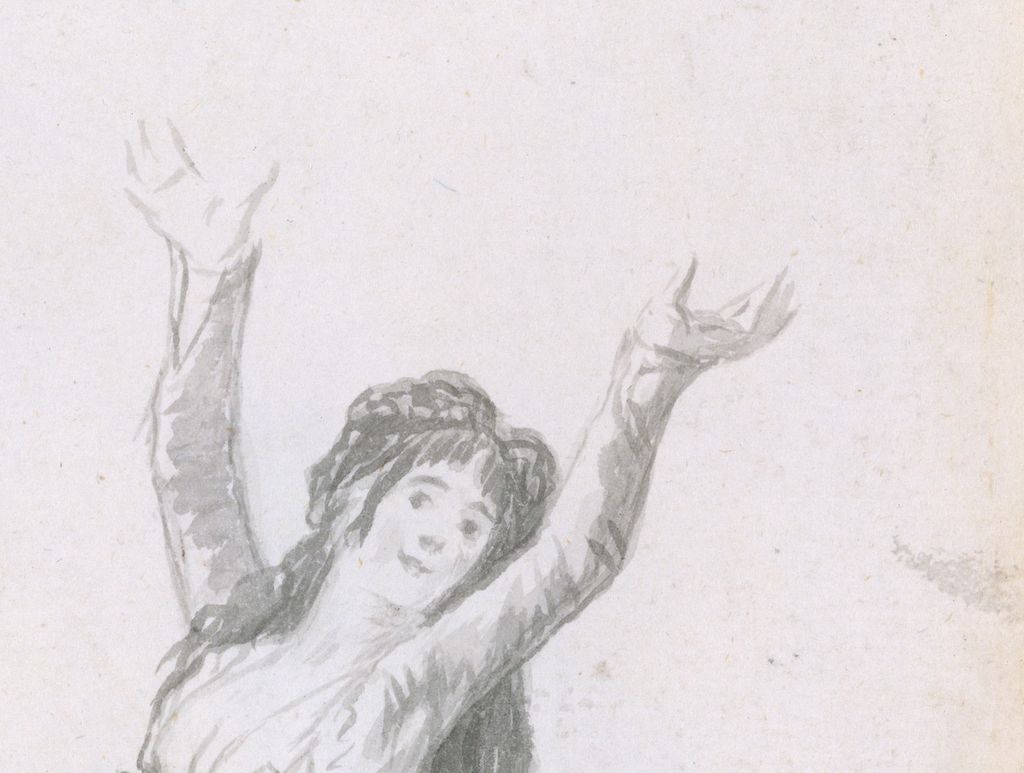
The raised arms
Raised arms bracket the head and spread out into the white paper.
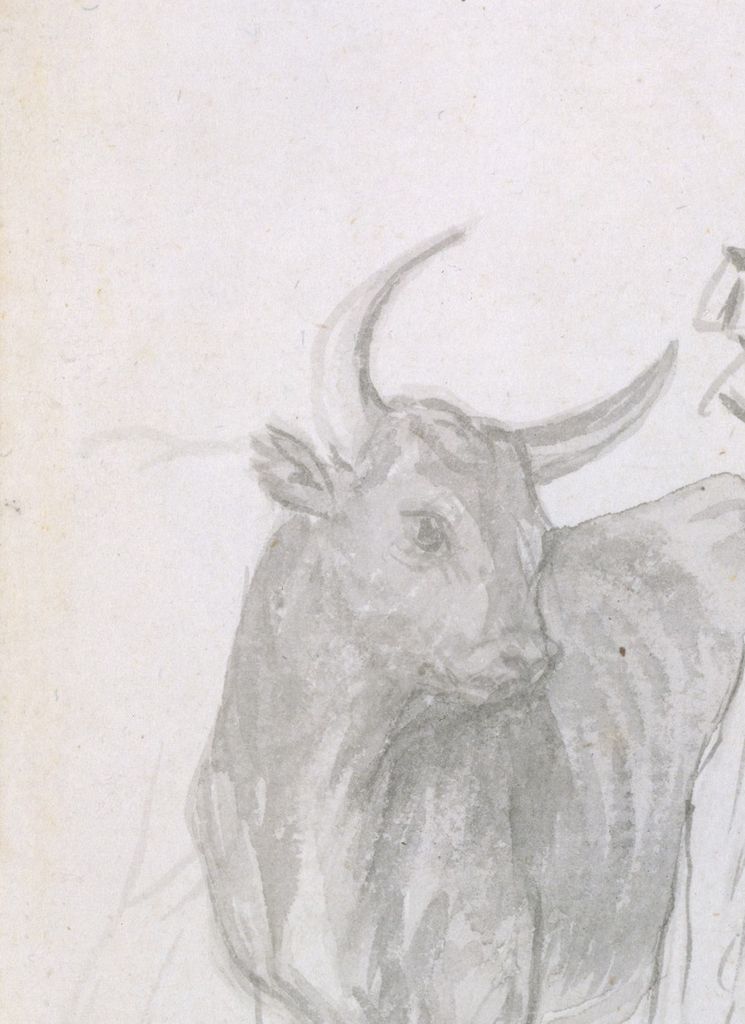
The bull’s head
Light lines trace the horns above a face made with broader wash.
The hem and feet
A foot extends beneath the lightly patterned bands of the skirt.
The folio number
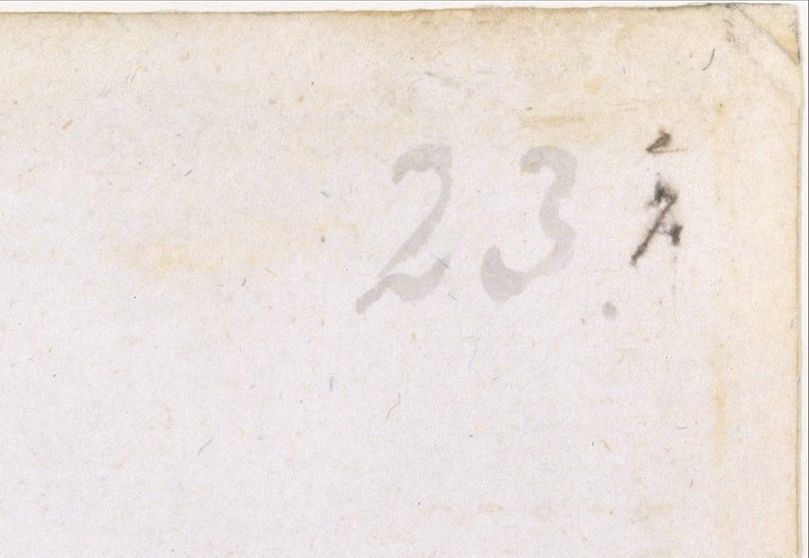
The larger number 23 appears beside a smaller mark at upper right.
Why is the bull there?
The Fundación’s catalogue records two different readings. José López-Rey proposed Pasiphaë, the mythological woman who fell in love with a bull sent by Poseidon. Pierre Gassier and Juliet Wilson understood the scene more broadly as an expression of female sensuality. Gassier also associated the bull with herds around Sanlúcar de Barrameda and the dancing with Andalusia. Each proposal starts from something visible. The bull is a conspicuous companion for a solitary dancer, while the low wall is also recognisable as an ordinary boundary between a person and livestock. A reader can follow the woman’s lifted face and still be unsure whom, if anyone, she is performing for. The inscriptions are numbers, so they leave her identity and the setting open. [1] [2]
The geography matters to the debate about dating. Scholars once tended to place the album around Goya’s stay in Andalusia in 1796 or shortly after his return to Madrid. The Fundación notes that Jesusa Vega argued for an earlier start, partly because any echoes of Andalusia could also recall Goya’s time in Cádiz in 1793. Its catalogue gives B.23 and B.24 a range of about 1794–97. The Met dates both drawings to 1796–97. The narrower date locates the work in the late 1790s, while the broader range reflects disagreement about when Goya began making the album. The bull alone gives us little reason to choose a particular place or year. [1] [2] [3] [4]
Goya on film
Five films explore Goya’s portraits, prints, Black Paintings and painting techniques.
The Duke of Wellington by Goya
The portrait, its military decorations and its later theft.
Watch on YouTubeOn the back of the sheet
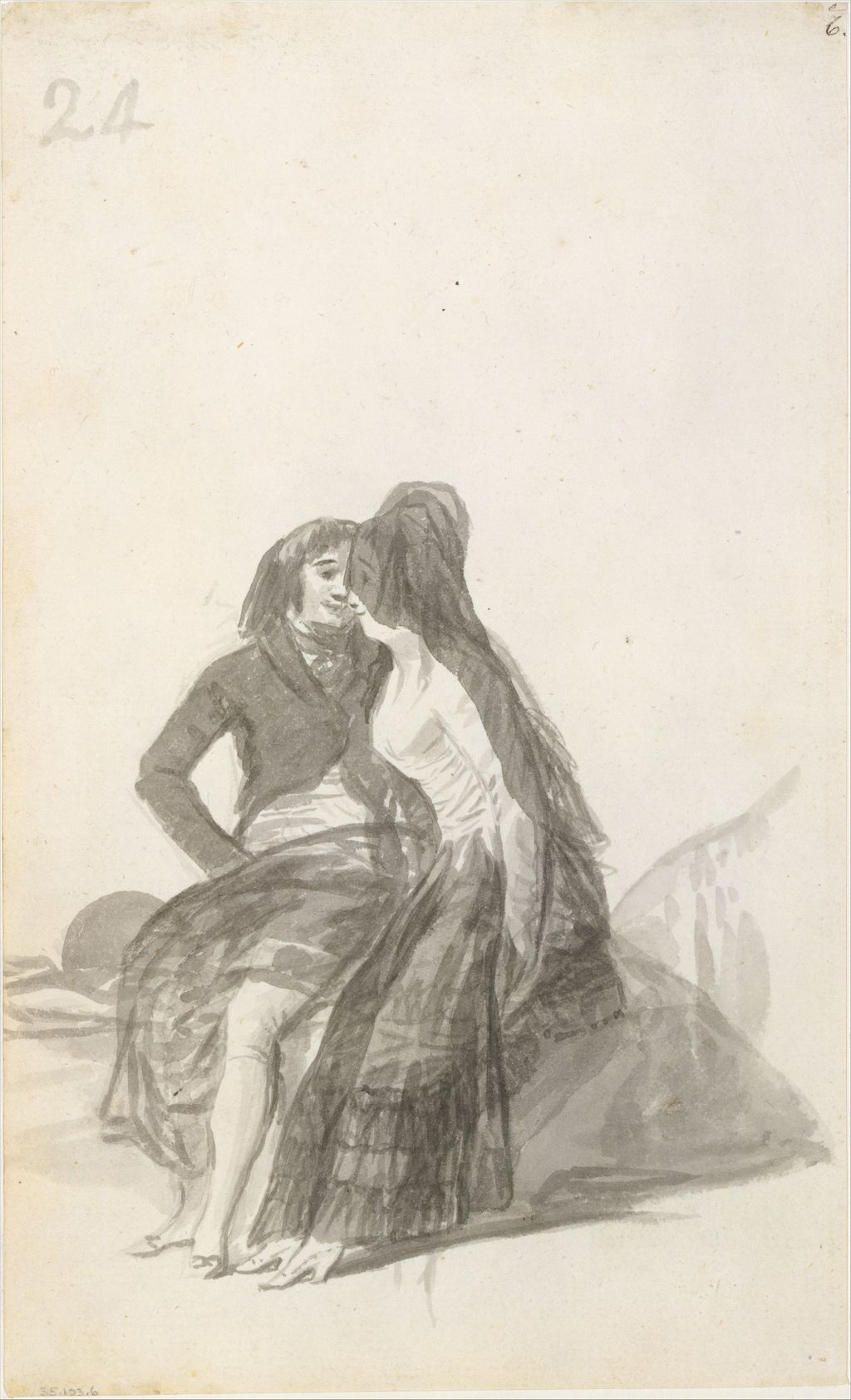
In Lovers Sitting on a Rock, two people sit low on the page, turning their heads towards one another. Their closeness makes a compact, roughly triangular group, with little landscape drawn beyond it. The Fundación calls attention to an especially dark shape crossing the man’s legs, which it describes as a superimposed form resembling a large cloak. Compare where the darkest wash sits in each drawing. On the front it follows the woman up towards her face. On the back it brings the eye down towards the joined mass of the seated figures. A few dark passages make the pair read as a group even when the folds around their legs are hard to disentangle. [1] [3] [5]
The Fundación records an ink 23 at the upper right of the front and 24 at the upper left of the reverse. It also records smaller marks, 7. on the front and 6. on the back, both at upper right, which it attributes to Madrazo. The Met’s accession numbers likewise end in .7 and .6 respectively. Its 1995 exhibition catalogue explicitly pairs the two sides, listing them in album order as pages 23 and 24. They remained together when the album was dismantled and reached the Met in 1935 in a group acquired from Mariano Fortuny y Madrazo. Knowing which side followed which lets us compare the dancer’s separation from the bull with the lovers’ closeness. Any further connection between the scenes depends on how the reader interprets that change. [1] [2] [3] [4] [5] [6]
There is firmer evidence for some connections elsewhere in the album. On B.68 the words above and below a scene of tooth-pulling give the drawing a subject, and the Met identifies it as the basis for plate 33 of Los Caprichos. In B.23 and B.24 the surviving numbers establish their order in the book. They give no dates for the separate acts of drawing or verbal cues to tie the subjects together. The earlier pair can be read as two studies in how near figures stand to one another, with the blank paper around each group making that distance visible. [2] [5] [6] [7]
Raised hands across the Madrid Album
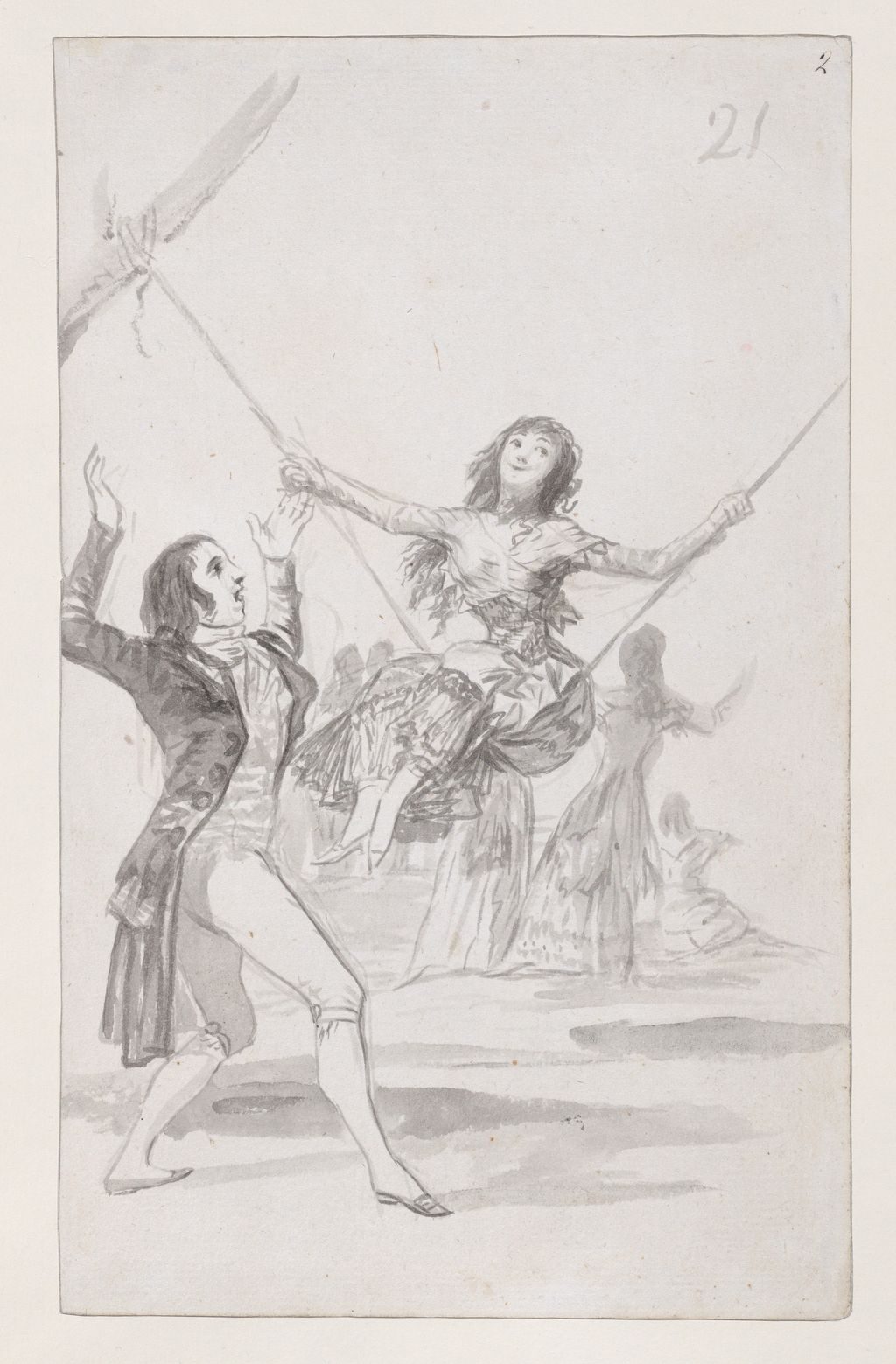
In Weeping Woman and Three Men, page 17, the woman’s hands cover her face and the men close in around her. In The Swing, page 21, the rider’s hands grip the ropes and a man below lifts his own hands towards her. Page 23 gives the dancer open air above both hands. The ropes on page 21 explain where the movement comes from, while the dancer’s posture carries the movement on page 23. The animal behind the wall has its own weight and direction, and the viewer has to decide how much its gaze matters to the scene. Across these drawings, the placement of a hand can change how much we understand about an entire encounter. [1] [8] [9]
Between The Swing and Girl and Bull falls page 22, Maja and an Officer. The viewer reading the bound album would have seen that scene on the left and the dancer on the right, then turned the dancer’s page to reach the seated lovers. The woman with the officer shows only part of her face above her veil. The dancer’s face is open to view. That change would have been visible across a single spread, before the turn revealed a different pair leaning together. [1] [3] [4] [9] [10]
A bull in the album and a bull in the ring
In plate 20 of La Tauromaquia, published in 1816, Goya gives the human and animal figures a shared point of action. Juanito Apiñani vaults on a pole as the bull runs underneath him. The pole meets the ground beside the animal and provides a fixed vertical against the stretched shapes of the man and bull. A barrier holds the spectators back, leaving both principal figures on the arena side. In the album drawing the wall instead separates the woman and animal, and the open space above the gesture belongs entirely to her. The print, made with etching and aquatint, makes the connection between the two bodies immediate. Looking back at the brush drawing makes it easier to see how much uncertainty comes from the particular way Goya divides the space. [1] [2] [11] [12]
Artworks directory
| Name | Date | Medium |
|---|---|---|
| And There’s No Help for It, Plate 15 | Printed 1863 | |
| Asmodea | c. 1820–23 | Wall painting transferred to canvas |
| Boys Inflating a Bladder | 1777–78 | Tapestry cartoon |
| Boys Picking Fruit | 1778 | Tapestry cartoon |
| Bullfight in a Divided Ring | 1825 | Lithograph |
| Card Players | 1777–78 | Tapestry cartoon |
| Card Players (sketch) | 1777–78 | Painted sketch |
| Dance on the Banks of the Manzanares | 1777 | Tapestry cartoon |
| Duel with Cudgels | c. 1820–23 | Wall painting transferred to canvas |
| Heads in a Landscape | c. 1820–23 | Easel painting |
| Judith and Holofernes | c. 1820–23 | Wall painting transferred to canvas |
| Leocadia | c. 1820–23 | Wall painting transferred to canvas |
| Maja and Cloaked Men | 1777 | Tapestry cartoon |
| Maja and Cloaked Men (sketch) | 1777 | Painted sketch |
| Majo Clapping in Time to the Music | 1777 | Drawing |
| Men Reading | c. 1820–23 | Wall painting transferred to canvas |
| Out Hunting for Teeth, Plate 12 | 1799 | Etching, burnished aquatint and burin |
| Picnic in the Countryside (sketch) | 1776–78 | Painted sketch |
| Picnic on the Banks of the Manzanares | 1776 | Tapestry cartoon |
| Pilgrimage to San Isidro | c. 1820–23 | Wall painting transferred to canvas |
| Preparatory study for The Sleep of Reason Produces Monsters | c. 1796–97 | Drawing |
| Procession of the Holy Office | c. 1820–23 | Wall painting transferred to canvas |
| Quarrel at the Cockerel Inn (sketch) | 1777 | Painted sketch |
| Quarrel in the New Tavern | 1777 | Tapestry cartoon |
| Saturn Devouring His Son | c. 1820–23 | Wall painting transferred to canvas |
| Seated Majo Smoking | c. 1776 | Drawing |
| The Dog | c. 1820–23 | Wall painting transferred to canvas |
| The Drinker | 1777 | Tapestry cartoon |
| The Fates | c. 1820–23 | Wall painting transferred to canvas |
| The Great He-Goat | c. 1820–23 | Wall painting transferred to canvas |
| The Kite | 1777–78 | Tapestry cartoon |
| The Parasol | 1777 | Oil on canvas, tapestry cartoon |
| The Second of May 1808 | 1814 | Oil on canvas |
| The Sleep of Reason Produces Monsters, Plate 43 | 1799 | Etching and aquatint |
| The Third of May 1808 | 1814 | Oil on canvas |
| Thou Who Canst Not, Plate 42 | 1799 | Etching and burnished aquatint |
| Three Figures | 1776 | Drawing (lost) |
| Two Old Men | c. 1820–23 | Wall painting transferred to canvas |
| Two Old Men Eating Soup | c. 1820–23 | Wall painting transferred to canvas |
| Two Women and a Man | c. 1820–23 | Wall painting transferred to canvas |
| Universal Language: The Author Dreaming | 1797 | Drawing |
| The Family of Charles IV | 1800 | Oil on canvas |
| Witches’ Sabbath (Osuna painting) | 1797–98 | Oil on canvas |
| The Nude Maja | 1795–1800 | Oil on canvas |
| The Clothed Maja | 1800–07 | Oil on canvas |
| Self-Portrait (Drawing) | c. 1796 | Brush and carbon black ink on laid paper |
| The Swing, Madrid Album B.21 | 1795–97 | Brush and carbon black washes |
| Majas Fighting, a Majo Observing, Madrid Album B.15 | 1796–97 | Brush, grey and black washes on laid paper |
| Majos and Majas Conversing, Madrid Album B.16 | c. 1794–97 | Ink wash on paper |
| Weeping Woman and Three Men, Madrid Album B.17 | 1795–97 | Brush, carbon black washes and black chalk |
| Maja Seated on a Chair and Two Companions Behind, Madrid Album B.18 | 1795–97 | Brush and carbon black washes |
| Girl and Bull, Madrid Album B.23 | 1796–97 | Brush and carbon black washes |
| Lovers Sitting on a Rock, Madrid Album B.24 | 1796–97 | Brush and carbon black washes |
| Mariano Ceballos Riding a Bull | 1825 | Crayon lithograph and scraper |
| Landscape (lifetime impression) | c. 1807–10 | Etching and aquatint |
| Self-Portrait (1815), Prado canvas | 1815 | Oil on canvas |
| Self-Portrait (1815), Academy panel | 1815 | Oil on panel |
| Self-Portrait with Dr Arrieta | 1820 | Oil on canvas |
| Christ Crucified | 1780 | Oil on canvas |
| The Last Communion of Saint Joseph of Calasanz | 1819 | Oil on canvas |
| Christ on the Mount of Olives | 1819 | Oil on panel |
| The Flower Girls, or Spring | 1786–87 | Oil on canvas |
| The Grape Harvest, or Autumn | 1786–87 | Oil on canvas |
| The Snowstorm, or Winter | 1786–87 | Oil on canvas |
| The Threshing Ground, or Summer | 1786–87 | Oil on canvas |
| Picnic on the Banks of the Manzanares | 1776 | Oil on canvas |
| The Kite | 1777–78 | Oil on canvas |
| Dance on the Banks of the Manzanares | 1777 | Oil on canvas |
| A Fight at the Venta Nueva | 1777 | Oil on canvas |
| Blind Man’s Bluff | 1788 | Oil on canvas |
| Dogs on a Lead | 1775 | Oil on canvas |
| Hunting with a Decoy | 1775 | Oil on canvas |
| Hunter Loading His Rifle | 1775 | Oil on canvas |
| The Angler | 1775 | Oil on canvas |
| The Hermitage of San Isidro on His Feast Day | 1788 | Oil on canvas |
| The Meadow of San Isidro | 1788 | Oil on canvas |
| The Straw Manikin | 1791–92 | Oil on canvas |
| Witches’ Flight | c. 1797–98 | Oil on canvas |
| A Scene from ‘The Forcibly Bewitched’ | 1798 | Oil on canvas |
| The Duchess of Alba in Black | 1797 | Oil on canvas |
| The Duchess of Alba in White | 1795 | Oil on canvas |
| Charles III in Hunting Dress | c. 1786 | Oil on canvas |
| The Duke and Duchess of Osuna and Their Children | 1787–88 | Oil on canvas |
| Manuel Osorio Manrique de Zúñiga | 1787–88 | Oil on canvas |
| The Marquesa de Pontejos | c. 1786 | Oil on canvas |
| Equestrian Portrait of the 1st Duke of Wellington | 1812 | Oil on canvas |
| The Duke of Wellington | 1812–14 | Oil on wood |
| Portrait of Ferdinand VII of Spain | 1814 | Oil on canvas |
| Gaspar Melchor de Jovellanos | 1798 | Oil on canvas |
| María Tomasa Palafox y Portocarrero | 1804 | Oil on canvas |
| Señora Sabasa García | c. 1806–11 | Oil on canvas |
| Don Juan Bautista de Muguiro | 1827 | Oil on canvas |
| Doña Isabel de Porcel | Before 1805 | Oil on canvas |
| The Colossus | After 1808 | Oil on canvas |
| The Burial of the Sardine | 1808–12 | Oil on panel |
| The Madhouse | 1808–12 | Oil on panel |
| A Procession of Flagellants | 1808–12 | Oil on panel |
| Portrait of Jacques Galos | 1826 | Oil on canvas |
| Portrait of Mariano Goya, the Artist’s Grandson | 1827 | Oil on canvas |
| Milkmaid of Bordeaux | c. 1827 | Oil on canvas |
| Portrait of Don Juan Antonio Cuervo | 1819 | Oil on canvas |
| María Luisa of Parma (Naples version) | c. 1800 | Oil on canvas |
| The Countess of Baena | 1819 | Oil on canvas |
| The Family of the Infante Don Luis | 1783–84 | Oil on canvas |
| The Holy Family | c. 1787 | Oil on canvas |
| Saint Barbara | c. 1773 | Oil on canvas |
| Saints Justa and Rufina | 1817 | Oil on canvas |
| El Tío Paquete | c. 1819–20 | Oil on canvas |
| The Forge | c. 1815–20 | Oil on canvas |
| Majas on a Balcony (Metropolitan Museum version) | c. 1800–10 | Oil on canvas |
| Maja and Celestina on a Balcony | c. 1808–12 | Oil on canvas |
| The Water Bearer | 1808–12 | Oil on canvas |
| Time and the Old Women | c. 1810 | Oil on canvas |
Frequently Asked Questions
Discussion
Look again at the images and ideas explored in Girl and Bull. These editorial prompts invite your observations.
Cover the bull with your hand and look at the dancer’s raised arms. What changes in her gesture when the bull and the wall come back into view?
Reader Insights
How do the wall and pale wash place the bull in relation to the dancer?
What do the gestures on the two sides of the leaf have in common?
Join the Conversation
Share a detail, comparison or question about Girl and Bull below.
References
- The Metropolitan Museum of Art, A young woman dancing, her arms raised, a bull in the background, B.23 recto, 35.103.7. View source.
- Fundación Goya en Aragón, Joven y toro, B.23, inscriptions, provenance and interpretations. View source.
- The Metropolitan Museum of Art, Lovers Sitting on a Rock, B.24 verso, 35.103.6. View source.
- Fundación Goya en Aragón, Pareja de enamorados en la oscuridad, B.3, Album B chronology, numbering and dispersal. View source.
- Fundación Goya en Aragón, Pareja de enamorados sentados en una roca, B.24, inscriptions and analysis of the verso. View source.
- Colta Ives and Susan Alyson Stein, Goya in The Metropolitan Museum of Art, 1995, pp. 68–69, Album B leaves and acquisition. View source.
- The Metropolitan Museum of Art, A charlatan extracting a tooth from a patient’s mouth, B.68 verso, 35.103.10 and the museum’s commentary on the leaf, identifying the study for plate 33 of Los Caprichos. View source 1. View source 2.
- The Metropolitan Museum of Art, Young woman weeping and covering her face with her hands, accompanied by men, B.17, 35.103.4. View source.
- The Metropolitan Museum of Art, Girl on a swing, a man with his arms raised, B.21, 35.103.2. View source.
- The Metropolitan Museum of Art, Maja and an Officer, B.22 verso, 35.103.3. View source.
- The Metropolitan Museum of Art, The agility and audacity of Juanito Apiñani in [the ring] at Madrid, plate 20 of La Tauromaquia, 21.19.20. View source.
- Biblioteca Nacional de España, Ligereza y atrevimiento de Juanito Apiñani en la de Madrid, first edition and print description. View source.







