


 by Tom Gurney
Tom Gurney BSc (Hons) is an art history expert with over 20 years experience
Published on June 19, 2020 / Updated on November 20, 2026
Email: tomgurney1@gmail.com / Phone: +44 7429 011000
Introduction
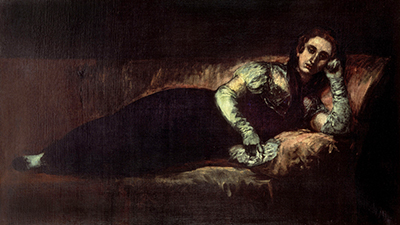
A pale shoe at the left edge of Goya’s canvas is the first clue to the length of the woman’s pose. Follow the line of her black skirt across the sofa and it rises over her legs, then drops towards the gloved hand resting on the seat. At the other end, her head inclines into her raised hand. There is just enough light on her forehead, cheek and sleeves to draw the eye to the right, where her face turns towards us from under a dark mantilla. [1]
The painting is known as The Countess of Baena. It is also catalogued as The Marchioness of Baena, and the identity of the woman remains uncertain. Goya’s name and the year 1819 are written vertically along the left edge. The picture belongs to the Zuloaga Collection. Ignacio Zuloaga, a painter himself, had acquired it by 1901, when he described it in a letter to the French museum curator Paul Lafond. [1] [2]
At a Glance
- ArtistFrancisco de Goya y Lucientes
- TitleThe Countess of Baena (La condesa de Baena), also called The Marchioness of Baena (La marquesa de Baena)
- SitterUnidentified
- Date1819, inscribed with Goya’s name at the left edge
- Medium and dimensionsOil on canvas, 92 × 160 cm (height × width), as catalogued by Fundación Goya en Aragón
- CollectionColección Zuloaga, Madrid, Spain, in the revised Fundación Goya en Aragón catalogue, entry 204. [1]
Works across Goya’s career
The Parasol
1777The Nude Maja
1795–1800Saturn Devouring His Son
c. 1820–23The Dog
c. 1820–23One hand on the cushion, one at the temple
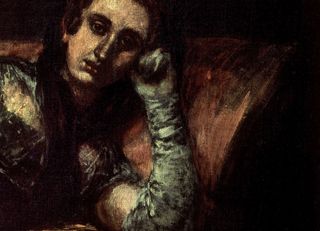
The raised elbow is planted in the cushions at the right. The forearm angles up, and the cheek comes to rest against the fingers. The weight of the head is easy to imagine because the shoulder drops below it and the sleeve bunches where the arm bends. The second arm makes a wider arc down the middle of the canvas. Its hand lies low, beside a pale cluster of strokes that nearly disappear into the patterned fabric of the seat. Take in the two arms together and the pose has a slight twist. The body stretches left along the sofa, but the chest and face are turned towards the viewer. [1]
The woman occupies almost the whole width of the picture. Her high knee makes a broad curve against the sofa back, and the skirt narrows to a point where the shoe emerges. There is a stretch of dark wall above that slope. Goya keeps it visible enough for the sofa back to register as a horizontal line, with a few warm strokes describing its upper edge. The right-hand cushions interrupt that line. Their slant carries the eye from the bottom of the gloved forearm towards the head, so the support for her body also guides the viewer through the painting. [1]
Stand back from the reproduction and the skirt holds together as one large dark shape. Look closer and you can trace where its edge fades into shadow and where a sliver of warm upholstery picks it out again. The sofa has a similar change of emphasis. The fabric under the elbow and beside the lower hand has broken strokes of gold and rust, while the front of the seat drops into darkness. This treatment concentrates the detail in the portion of the sofa she is actually using. Farther left, the small bright mark on the shoe is enough to tell us where the body ends. [1]
Annotated Details from The Countess of Baena
Find the face, hands and long sweep of dark fabric in the reclining portrait.
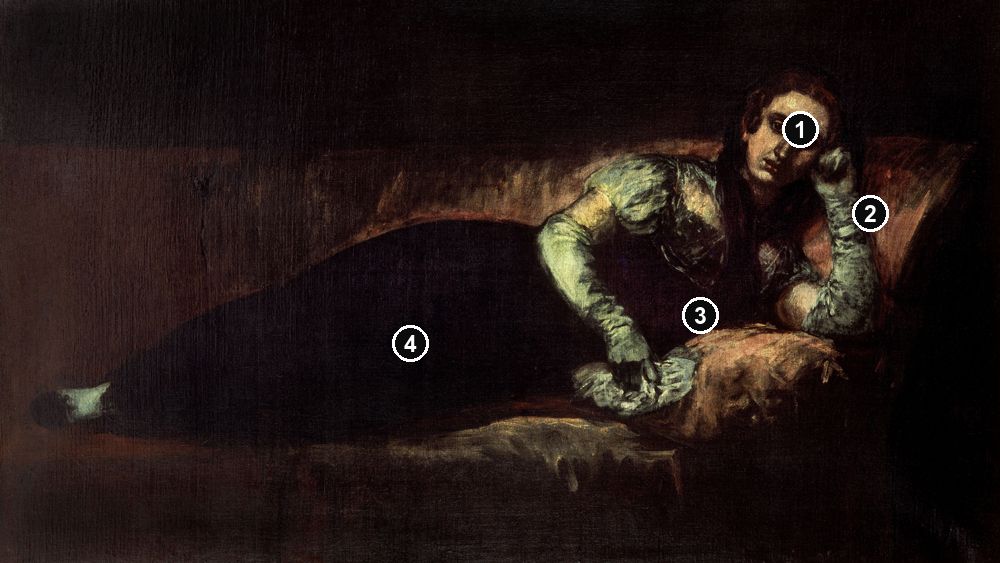
Details from THE COUNTESS OF BAENA
Details from the painting in the Colección Zuloaga.
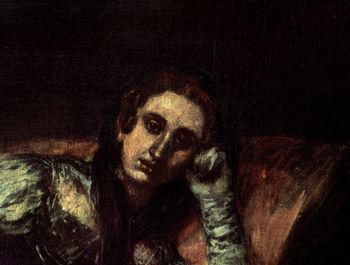
The face against the cushions
Light picks out the face against the cushions and dark background.
The hand supporting the head
The raised hand bends at the wrist beside the face.
The light sleeve
Light fabric and darker brushstrokes pick out the bent arm.
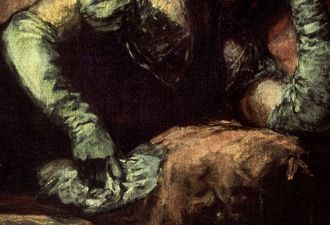
The spread of the skirt
The long dark skirt stretches across the sofa towards the left.
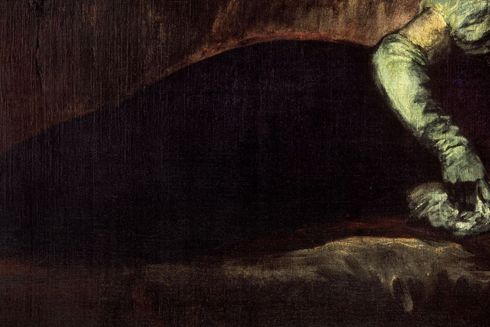
The mantilla, bodice and gloves
The catalogue identifies a black mantilla, a white bodice, long light gloves and slippers, along with the dark skirt. The pale fabric is distributed in small areas around the upper body. There are curling strokes at the shoulder, narrow highlights across the forearm nearest the face and a scalloped light shape around the lower hand. The gloves repeat some of the cool tones of the bodice and sleeves. At the elbow and wrist the paint follows their compression, leaving the raised arm a clear outline even where its colour is close to the cushion behind it. [1]
Look at the mantilla where it meets her face. One edge reads as a narrow shadow near the cheek, then becomes hard to follow where it merges with the darker paint over the chest. The forehead and bridge of the nose stand forward in warmer tones. Goya leaves deep shadows around the eyes, so a comparatively small area of light has to carry the tilt of the whole head. The direction of the gaze is easier to judge once you have followed the line of the nose and the slight turn of the mouth. Her head rests heavily against the hand while her eyes remain engaged with the space in front of her. [1]
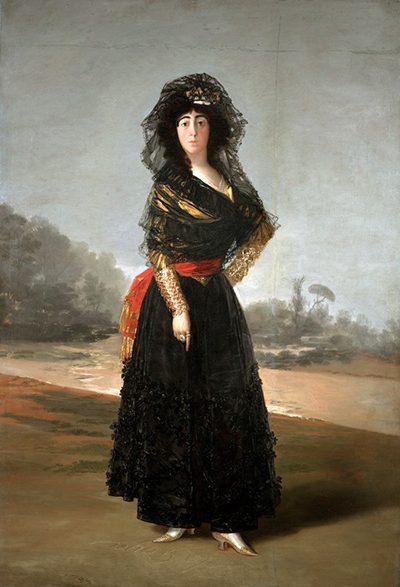
Goya used a black mantilla to different effect in his 1797 portrait of the Duchess of Alba. There, the standing figure is framed against an open landscape, and the hand extended towards the ground directs attention to writing at her feet. In the Baena painting the gloved hands stay close to the sitter’s body, and the dark background encloses the figure and sofa. The two pictures let us see how differently Goya could organise attention around a dark costume. In one, a gesture takes our eye out across the ground. In the other, the bent arm brings us back to the face. [1] [3]
Goya on film
Five films explore Goya’s portraits, prints, Black Paintings and painting techniques.
The Duke of Wellington by Goya
The portrait, its military decorations and its later theft.
Watch on YouTubeThe resemblance to The Clothed Maja
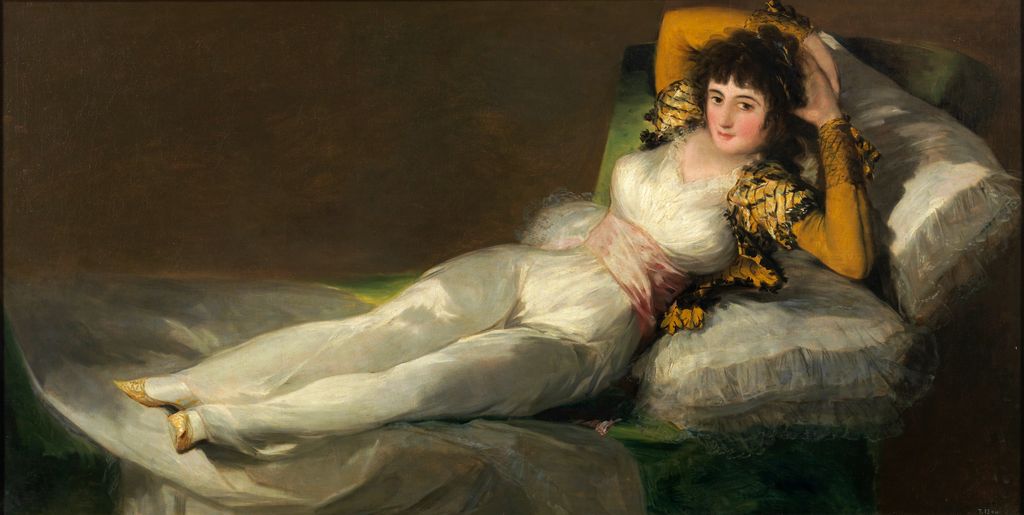
In both paintings the cushions are at the right, the feet extend to the left and the reclining figure looks out towards the viewer. The Clothed Maja, now in the Prado, is dated 1800–1807 and is documented in Manuel Godoy’s collection. There the sitter has both arms behind her head, so the elbows open around the face. The bright dress and pink sash keep her waist in view all the way across the sofa. In the Baena canvas one arm stops near the face and the other leads down to the cushion. The skirt carries the uninterrupted sweep of the pose, and the light dress is concentrated above it. [1] [4]
The supports tell a similar story. The earlier painting sets a stretch of white bedding against the green sofa. It gives the body a light surface against which we can read the bends of both legs. In the 1819 canvas, the sofa’s warm browns and reds pick out the head and the pale gloves, while the skirt is nearly as dark as parts of the seat. The result is a more compact group at the right, balanced by the long, quiet passage of black at the left. The pose is familiar enough to invite comparison, and the handling of the two figures gives each painting its own rhythm. [1] [4]
The title and the inventory
The two titles, Countess and Marchioness, survive as names for the canvas. Fundación Goya en Aragón classifies it as a portrait and explicitly leaves the identification open. The same catalogue suggests a possible match with a work described in the inventory associated with Antonio Brugada as a clothed maja lying down, measuring more than a vara. The long format and reclining pose fit that broad description. Its wording describes a figure and a size, leaving the name of the woman unresolved. The inventory concerns works associated with Goya’s Quinta del Sordo. If the entry refers to this canvas, it would place the painting in a group connected to Goya’s own house. The circumstances of the commission are unclear. [1]
From Domínguez Carrascal to Zuloaga
The documented ownership history names the Domínguez Carrascal collection in Madrid, followed by Ignacio Zuloaga. In a letter of 30 August 1901, Zuloaga told Lafond about a Goya he prized highly and described the woman in black on a red sofa. Historian Jesús Pedro Lorente traces his enthusiasm for the painting through their correspondence. A photograph reproduced in Lorente’s study shows the canvas hanging in Zuloaga’s museum in Zumaia. In the view, published in 1925, the canvas shares a wall with other works by Goya and with paintings attributed to El Greco. [1] [2]
The painting subsequently appeared in Goya exhibitions in Bordeaux in 1951, Madrid in 1961 and Paris in 2013–14. In 2022 it was item 6 in Zuloaga, Goya y Aragón: La fuerza del carácter, a joint exhibition of the city of Zaragoza and Fundación Zuloaga at La Lonja. That exhibition considered Zuloaga’s engagement with Goya through his work as a collector and his own practice as a painter. The Baena canvas was part of that story from early on. His letter singles out the same pairing of skirt and sofa that still makes the long, low composition recognisable in reproduction. [1] [2] [5]
Artworks directory
| Name | Date | Medium |
|---|---|---|
| And There’s No Help for It, Plate 15 | Printed 1863 | |
| Asmodea | c. 1820–23 | Wall painting transferred to canvas |
| Boys Inflating a Bladder | 1777–78 | Tapestry cartoon |
| Boys Picking Fruit | 1778 | Tapestry cartoon |
| Bullfight in a Divided Ring | 1825 | Lithograph |
| Card Players | 1777–78 | Tapestry cartoon |
| Card Players (sketch) | 1777–78 | Painted sketch |
| Dance on the Banks of the Manzanares | 1777 | Tapestry cartoon |
| Duel with Cudgels | c. 1820–23 | Wall painting transferred to canvas |
| Heads in a Landscape | c. 1820–23 | Easel painting |
| Judith and Holofernes | c. 1820–23 | Wall painting transferred to canvas |
| Leocadia | c. 1820–23 | Wall painting transferred to canvas |
| Maja and Cloaked Men | 1777 | Tapestry cartoon |
| Maja and Cloaked Men (sketch) | 1777 | Painted sketch |
| Majo Clapping in Time to the Music | 1777 | Drawing |
| Men Reading | c. 1820–23 | Wall painting transferred to canvas |
| Out Hunting for Teeth, Plate 12 | 1799 | Etching, burnished aquatint and burin |
| Picnic in the Countryside (sketch) | 1776–78 | Painted sketch |
| Picnic on the Banks of the Manzanares | 1776 | Tapestry cartoon |
| Pilgrimage to San Isidro | c. 1820–23 | Wall painting transferred to canvas |
| Preparatory study for The Sleep of Reason Produces Monsters | c. 1796–97 | Drawing |
| Procession of the Holy Office | c. 1820–23 | Wall painting transferred to canvas |
| Quarrel at the Cockerel Inn (sketch) | 1777 | Painted sketch |
| Quarrel in the New Tavern | 1777 | Tapestry cartoon |
| Saturn Devouring His Son | c. 1820–23 | Wall painting transferred to canvas |
| Seated Majo Smoking | c. 1776 | Drawing |
| The Dog | c. 1820–23 | Wall painting transferred to canvas |
| The Drinker | 1777 | Tapestry cartoon |
| The Fates | c. 1820–23 | Wall painting transferred to canvas |
| The Great He-Goat | c. 1820–23 | Wall painting transferred to canvas |
| The Kite | 1777–78 | Tapestry cartoon |
| The Parasol | 1777 | Oil on canvas, tapestry cartoon |
| The Second of May 1808 | 1814 | Oil on canvas |
| The Sleep of Reason Produces Monsters, Plate 43 | 1799 | Etching and aquatint |
| The Third of May 1808 | 1814 | Oil on canvas |
| Thou Who Canst Not, Plate 42 | 1799 | Etching and burnished aquatint |
| Three Figures | 1776 | Drawing (lost) |
| Two Old Men | c. 1820–23 | Wall painting transferred to canvas |
| Two Old Men Eating Soup | c. 1820–23 | Wall painting transferred to canvas |
| Two Women and a Man | c. 1820–23 | Wall painting transferred to canvas |
| Universal Language: The Author Dreaming | 1797 | Drawing |
| The Family of Charles IV | 1800 | Oil on canvas |
| Witches’ Sabbath (Osuna painting) | 1797–98 | Oil on canvas |
| The Nude Maja | 1795–1800 | Oil on canvas |
| The Clothed Maja | 1800–07 | Oil on canvas |
| Self-Portrait (Drawing) | c. 1796 | Brush and carbon black ink on laid paper |
| The Swing, Madrid Album B.21 | 1795–97 | Brush and carbon black washes |
| Majas Fighting, a Majo Observing, Madrid Album B.15 | 1796–97 | Brush, grey and black washes on laid paper |
| Majos and Majas Conversing, Madrid Album B.16 | c. 1794–97 | Ink wash on paper |
| Weeping Woman and Three Men, Madrid Album B.17 | 1795–97 | Brush, carbon black washes and black chalk |
| Maja Seated on a Chair and Two Companions Behind, Madrid Album B.18 | 1795–97 | Brush and carbon black washes |
| Girl and Bull, Madrid Album B.23 | 1796–97 | Brush and carbon black washes |
| Lovers Sitting on a Rock, Madrid Album B.24 | 1796–97 | Brush and carbon black washes |
| Mariano Ceballos Riding a Bull | 1825 | Crayon lithograph and scraper |
| Landscape (lifetime impression) | c. 1807–10 | Etching and aquatint |
| Self-Portrait (1815), Prado canvas | 1815 | Oil on canvas |
| Self-Portrait (1815), Academy panel | 1815 | Oil on panel |
| Self-Portrait with Dr Arrieta | 1820 | Oil on canvas |
| Christ Crucified | 1780 | Oil on canvas |
| The Last Communion of Saint Joseph of Calasanz | 1819 | Oil on canvas |
| Christ on the Mount of Olives | 1819 | Oil on panel |
| The Flower Girls, or Spring | 1786–87 | Oil on canvas |
| The Grape Harvest, or Autumn | 1786–87 | Oil on canvas |
| The Snowstorm, or Winter | 1786–87 | Oil on canvas |
| The Threshing Ground, or Summer | 1786–87 | Oil on canvas |
| Picnic on the Banks of the Manzanares | 1776 | Oil on canvas |
| The Kite | 1777–78 | Oil on canvas |
| Dance on the Banks of the Manzanares | 1777 | Oil on canvas |
| A Fight at the Venta Nueva | 1777 | Oil on canvas |
| Blind Man’s Bluff | 1788 | Oil on canvas |
| Dogs on a Lead | 1775 | Oil on canvas |
| Hunting with a Decoy | 1775 | Oil on canvas |
| Hunter Loading His Rifle | 1775 | Oil on canvas |
| The Angler | 1775 | Oil on canvas |
| The Hermitage of San Isidro on His Feast Day | 1788 | Oil on canvas |
| The Meadow of San Isidro | 1788 | Oil on canvas |
| The Straw Manikin | 1791–92 | Oil on canvas |
| Witches’ Flight | c. 1797–98 | Oil on canvas |
| A Scene from ‘The Forcibly Bewitched’ | 1798 | Oil on canvas |
| The Duchess of Alba in Black | 1797 | Oil on canvas |
| The Duchess of Alba in White | 1795 | Oil on canvas |
| Charles III in Hunting Dress | c. 1786 | Oil on canvas |
| The Duke and Duchess of Osuna and Their Children | 1787–88 | Oil on canvas |
| Manuel Osorio Manrique de Zúñiga | 1787–88 | Oil on canvas |
| The Marquesa de Pontejos | c. 1786 | Oil on canvas |
| Equestrian Portrait of the 1st Duke of Wellington | 1812 | Oil on canvas |
| The Duke of Wellington | 1812–14 | Oil on wood |
| Portrait of Ferdinand VII of Spain | 1814 | Oil on canvas |
| Gaspar Melchor de Jovellanos | 1798 | Oil on canvas |
| María Tomasa Palafox y Portocarrero | 1804 | Oil on canvas |
| Señora Sabasa García | c. 1806–11 | Oil on canvas |
| Don Juan Bautista de Muguiro | 1827 | Oil on canvas |
| Doña Isabel de Porcel | Before 1805 | Oil on canvas |
| The Colossus | After 1808 | Oil on canvas |
| The Burial of the Sardine | 1808–12 | Oil on panel |
| The Madhouse | 1808–12 | Oil on panel |
| A Procession of Flagellants | 1808–12 | Oil on panel |
| Portrait of Jacques Galos | 1826 | Oil on canvas |
| Portrait of Mariano Goya, the Artist’s Grandson | 1827 | Oil on canvas |
| Milkmaid of Bordeaux | c. 1827 | Oil on canvas |
| Portrait of Don Juan Antonio Cuervo | 1819 | Oil on canvas |
| María Luisa of Parma (Naples version) | c. 1800 | Oil on canvas |
| The Countess of Baena | 1819 | Oil on canvas |
| The Family of the Infante Don Luis | 1783–84 | Oil on canvas |
| The Holy Family | c. 1787 | Oil on canvas |
| Saint Barbara | c. 1773 | Oil on canvas |
| Saints Justa and Rufina | 1817 | Oil on canvas |
| El Tío Paquete | c. 1819–20 | Oil on canvas |
| The Forge | c. 1815–20 | Oil on canvas |
| Majas on a Balcony (Metropolitan Museum version) | c. 1800–10 | Oil on canvas |
| Maja and Celestina on a Balcony | c. 1808–12 | Oil on canvas |
| The Water Bearer | 1808–12 | Oil on canvas |
| Time and the Old Women | c. 1810 | Oil on canvas |
Frequently Asked Questions
The sitter’s identity is uncertain. La condesa de Baena and La marquesa de Baena are the two titles recorded in the Fundación Goya en Aragón catalogue. [1]
The painting is dated 1819. Goya’s name and the year are written vertically along the left edge. [1]
Discussion
Look again at the images and ideas explored in The Countess of Baena. These editorial prompts invite your observations.
Compare the hand at the woman’s temple with the hand on the seat. Which tells you more about how she is carrying her weight? Follow the skirt to the small patch of light at the far left and see how that detail changes your sense of the pose.
Reader Insights
Follow the sitter’s hands and the long line of the skirt.
How does the reclining pose differ from The Clothed Maja?
Join the Conversation
Share a detail, comparison or question about The Countess of Baena below.
References
- Fundación Goya en Aragón, La condesa de Baena, illustrated catalogue record 204, Spanish entry revised 20 August 2026. View source.
- Jesús Pedro Lorente Lorente, ‘La pasión por Goya en Zuloaga y su círculo’, Artigrama 25, 2010, pp. 165–183, especially pp. 181–182, note 31 and fig. 6. View source.
- Hispanic Society Museum & Library, The Duchess of Alba, Main Court gallery guide. View source.
- Fundación Goya en Aragón, The Clothed Maja (La maja vestida), catalogue entry 581, Museo Nacional del Prado, P000741. View source.
- Ayuntamiento de Zaragoza, Zuloaga, Goya y Aragón: La fuerza del carácter, publication record for the 2022 exhibition catalogue edited by Margarita Ruyra de Andrade and José Ignacio Calvo Ruata. The object entry is no. 6, p. 162, as indexed by Fundación Goya en Aragón. View source.
- Fundación Goya en Aragón, La condesa de Baena, earlier catalogue record listing the Museo Zuloaga in Zumaia. View source.







