


 by Tom Gurney
Tom Gurney BSc (Hons) is an art history expert with over 20 years experience
Published on June 19, 2020 / Updated on November 20, 2026
Email: tomgurney1@gmail.com / Phone: +44 7429 011000
Introduction
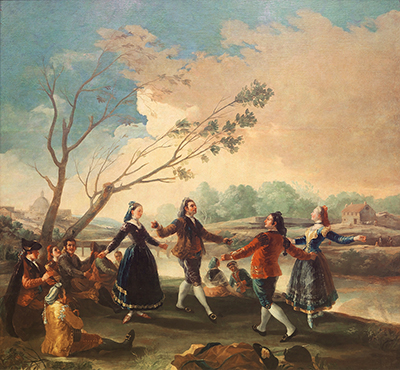
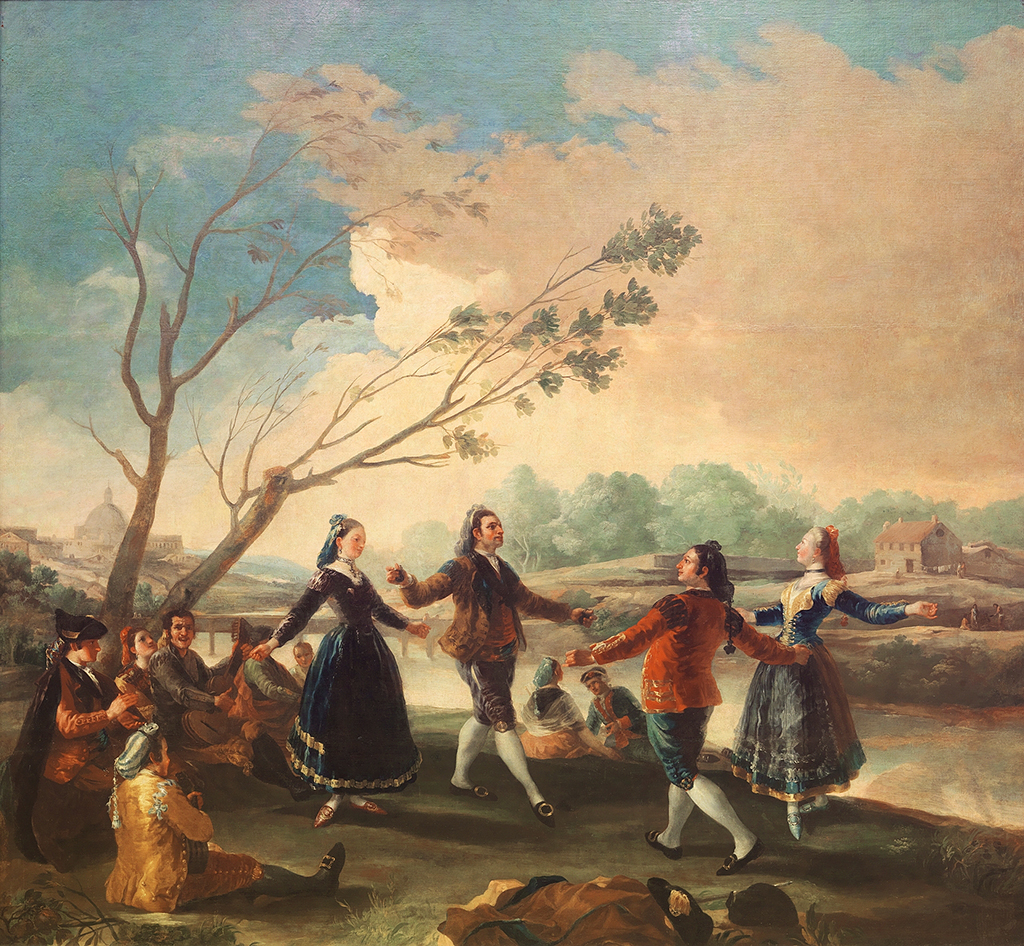
A man in a red coat steps across the grass as the woman beside him lifts a blue shoe from the ground. Two others complete the group, and at the left a seated man brings his hands together to keep time. Beyond the dancers, the Manzanares curves away towards Madrid. Francisco de Goya painted Dance on the Banks of the Manzanares as a full-size design for a tapestry in the royal dining room at El Pardo. In his account of the commission, he named the dance, the instruments and even the discarded hats and cloaks in the foreground. [1] [2] [3]
At a Glance
- ArtistFrancisco José de Goya y Lucientes.
- Spanish titleBaile a orillas del Manzanares. Also known as El baile en San Antonio de la Florida and El baile de ronda. [1] [2]
- Date1776–1777. Delivered to the Royal Tapestry Factory on 3 March 1777. [1] [3]
- Medium and sizeOil on canvas, 272 × 295 cm. [1] [2]
- SeriesTen designs for tapestries for the dining room of the Prince and Princess of Asturias at the Royal Palace of El Pardo. [1] [2]
- CollectionMuseo Nacional del Prado, Madrid, P000769. [1] [2]
Works across Goya’s career
The Parasol
1777The Nude Maja
1795–1800Saturn Devouring His Son
c. 1820–23The Dog
c. 1820–23Two couples dancing a seguidilla
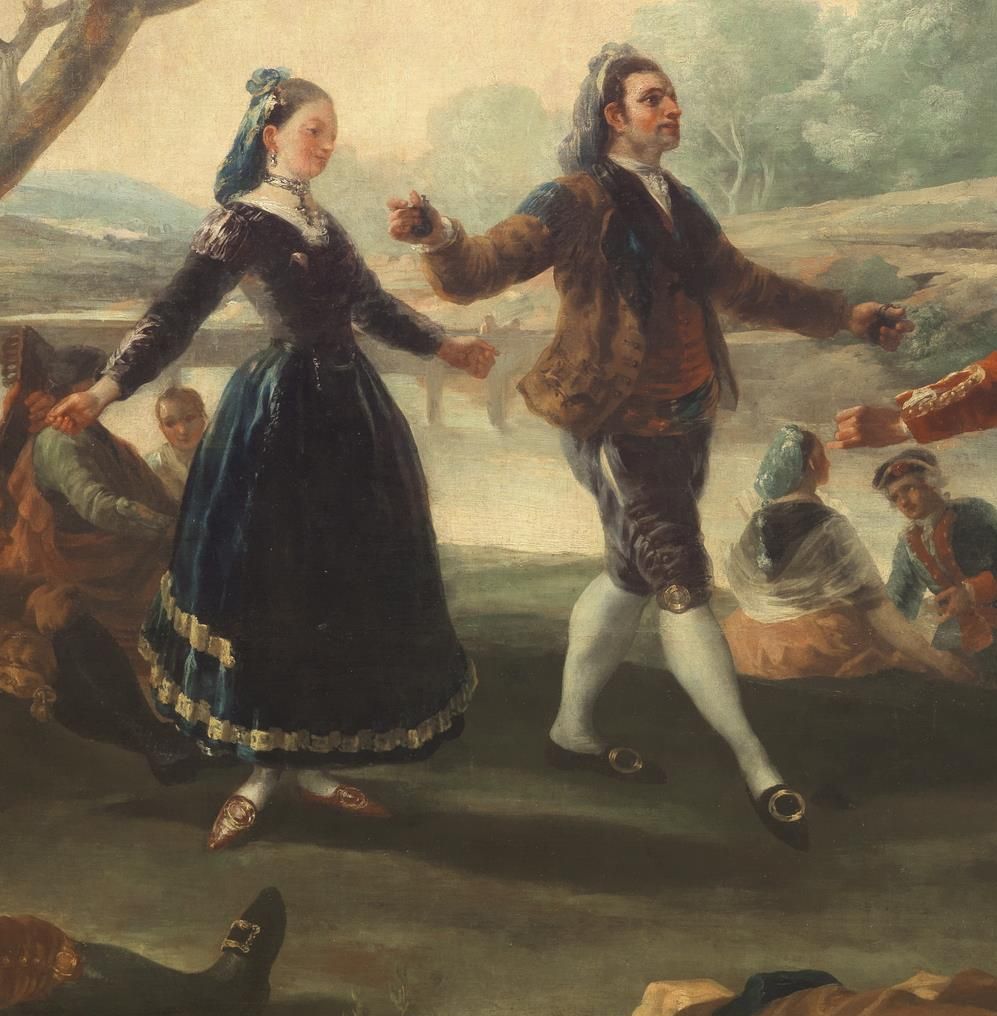
The four dancers are spaced at different depths on the riverbank. The man in red has his back partly towards us and turns his face to the left. The man in brown beyond him lifts his chin and extends both arms, his legs crossing at a different angle. At opposite ends of the group the two women hold their arms out. A gold band follows the hem of the woman’s skirt at the left, while the dancer on the right holds her chin high and turns her face towards the centre. The gaps between elbows, hands and feet help the eye follow the steps. The clearest patch of grass is between the dancers and the pile of clothes at the foot of the canvas. [1] [2]
Goya calls the dancers two majos and two majas, recognisable figures of popular Madrid life whose clothes are part of the spectacle. The men’s decorated coats, knee breeches and pale stockings make their legs easy to follow against the shaded ground. The women’s full skirts carry some of the movement above the ankle. In his account to the royal architect Francisco Sabatini, Goya specified seguidillas, a popular song and dance. The art historian Janis Tomlinson compared the bearing of the dancers to that of a minuet. Music historian Joan Carles Gomis Corell points to the spread arms, the spacing between partners and the castanets he identifies in the men’s hands as features of the seguidilla. [2] [3] [4]
The seguidilla circulated in the theatre as well as at gatherings. In the National Gallery of Victoria’s catalogue, Michael Christoforidis connects Goya’s scene with the tonadilla, a short musical play that drew on everyday life. He reads the dancers as upper-class figures dressed as majos and majas, an interpretation that links their measured gestures and elaborate clothes to the tastes of the royal audience. [4]
Annotated Details from Dance on the Banks of the Manzanares
Trace the joins between the dancers and the lines that lead back to the riverbank.
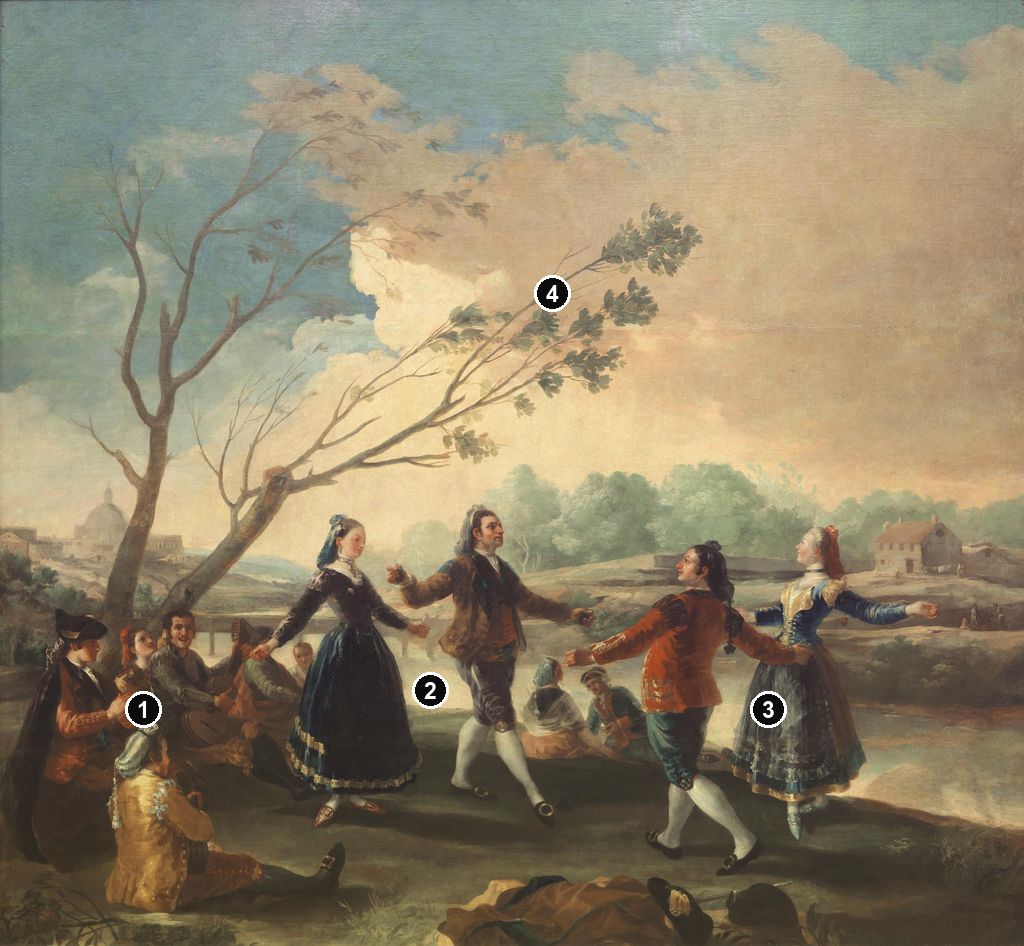
Details from DANCE ON THE BANKS OF THE MANZANARES
Details from the tapestry cartoon in the Museo Nacional del Prado (P000769).
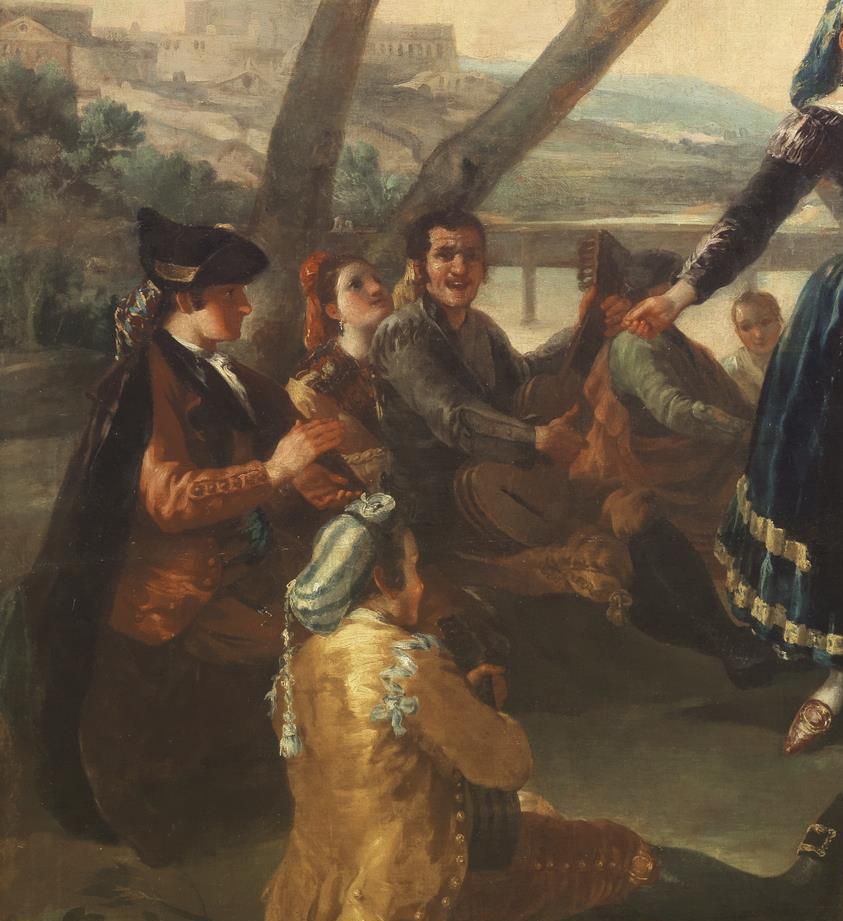
The seated group
The seated people gather under the tree close to the dance.
The dancers in the middle
A bent elbow and an angled foot help make the movement legible.
The open gesture at right
One figure holds out an arm over the lighter riverbank.
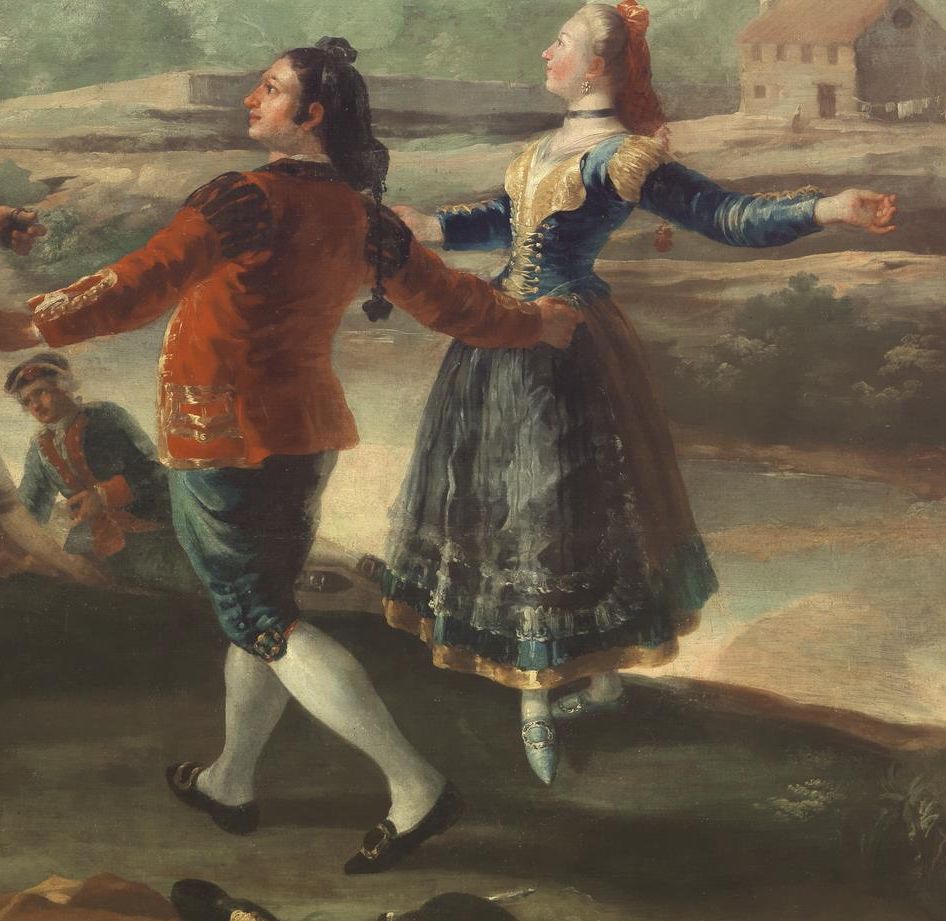
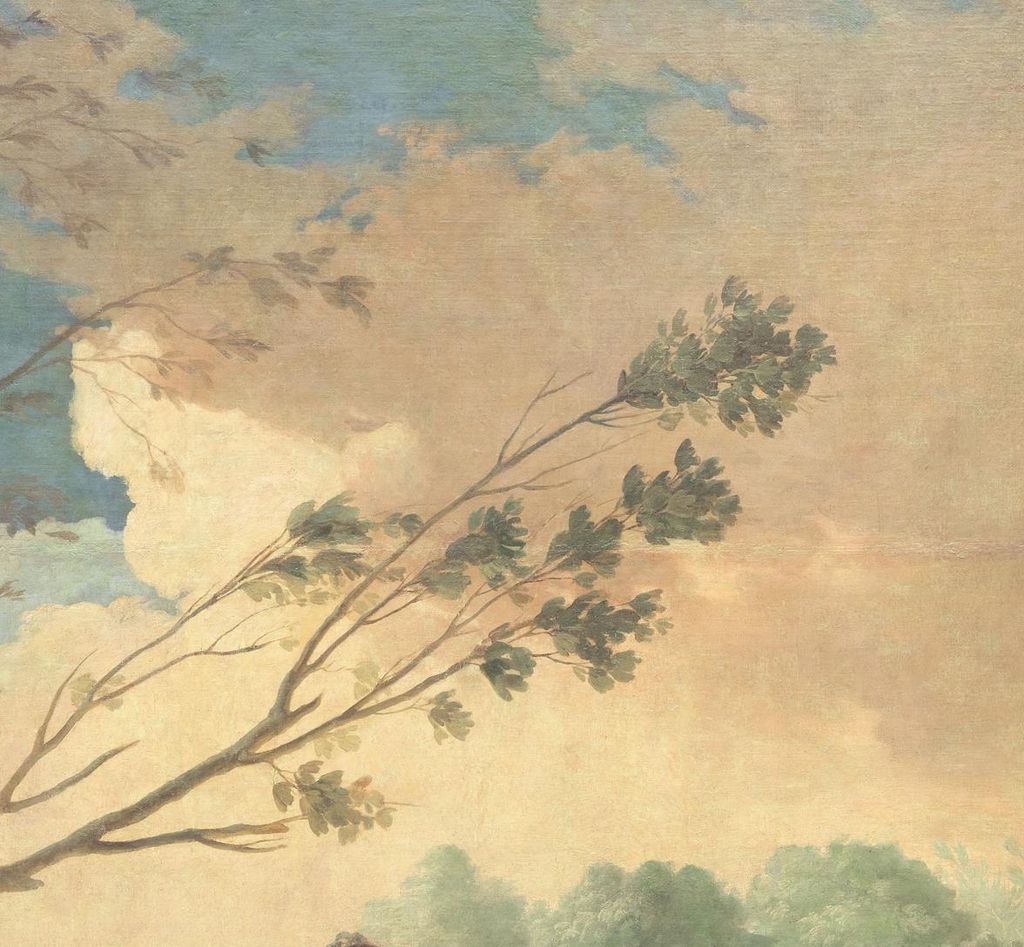
Branches above the dancers
Branches stretch across the sky in the same direction as the figures below.
Guitar, bandurria and clapping
The guitarist sits under the trees on the left. His mouth is open, and his face is turned outwards between the heads of the people around him. In the foreground a seated player in a yellow coat shows us his back. Goya’s account supplies what is harder to see among the overlapping figures. One man sings with the guitar, another accompanies him on the bandurria, a plucked string instrument, and a third marks the beat with his hands. The clapper is at the far left, where Goya sets the hands against the bright cuffs of his coat. The woman behind him looks up, her face catching the light between the men’s hats and shoulders. [1] [3] [4]
Gomis Corell reads the arrangement as a combination of the guitarist’s strummed rhythm, sung verses and a picked melody on the bandurria, with clapping to reinforce the beat. The guitarist’s face and the clapper’s palms are easier to distinguish than the instrument turned partly away in the foreground. The yellow-coated player also closes the near side of the gathering. His outstretched leg points towards the dancers, and the neck of the guitar rises towards the left-hand dancer’s lowered arm. The shapes of the seated musicians lead into the much taller figures on their feet. [1] [4]
Goya on film
Five films explore Goya’s portraits, prints, Black Paintings and painting techniques.
The Duke of Wellington by Goya
The portrait, its military decorations and its later theft.
Watch on YouTubeThe riverbank and the Madrid skyline
Goya moves from the dark grass under the dancers’ feet to a band of pale water and then to the trees and buildings on the far bank. Two trunks lean across the left of the scene, spreading their branches over much of the sky. Where the ground drops away behind the dancers, a woman and a man sit low enough for their heads to appear between the dancers’ arms and legs. Goya’s account identifies a soldier talking with a maja near the water and another woman who has gone to drink at the river. These small incidents give the gathering a life beyond the dance. At the distant right, two tiny figures stand below a building with a pitched roof. [1] [2] [3]
The older Prado catalogue identifies the dome on the far left as San Francisco el Grande, consistent with Goya’s description of a distant glimpse of Madrid by San Francisco. The Prado’s detailed catalogue locates the foreground in the vicinity of the Puente de los Pontones. The Fundación Goya en Aragón places the Casa de Campo across the river at the right and identifies the Royal Palace near the dome. The Fundación also records the traditional title Dance at San Antonio de la Florida. From this distance, the dome is small enough to sit behind the tree trunks, but its rounded outline makes it possible to pick out the city even where the riverbank narrows. [1] [2] [3]
El Pardo and the companion picnic
Goya’s account of 3 March 1777 says that he devised the composition himself and painted it on Sabatini’s orders as a model for the tapestries in the dining room of the Prince and Princess of Asturias. The couple were the future Charles IV and María Luisa of Parma. The canvas was commissioned on 30 October 1776, the date Goya delivered the picnic cartoon. The factory register records receipt of the dance from Goya the following March and payment of 8,000 reales authorised by royal order on 23 April 1777. The finished textile was intended for a lateral wall of the room. Patrimonio Nacional has reproduced a detail of a woven example at the Royal Monastery of San Lorenzo de El Escorial. The painted cartoon passed from the factory to the Royal Palace in Madrid in the 1850s and entered the Prado in 1870. [1] [2] [3] [5]
The Fundación identifies Picnic on the Banks of the Manzanares as the companion design. Both canvases are 295 cm wide, and in both a tree at the left frames people enjoying an outing. In Picnic, the five men sit low around food and drink, and the lifted glasses direct attention to the standing orange seller. In Dance, the strongest accents run across four upright figures. The pale river is more exposed, and its course behind the dancers draws the eye out past their company. Both scenes would have brought details of leisure around Madrid into a royal dining room, including the little things left on the grass, from the picnic plates to the dancers’ hats. [1] [2] [6]
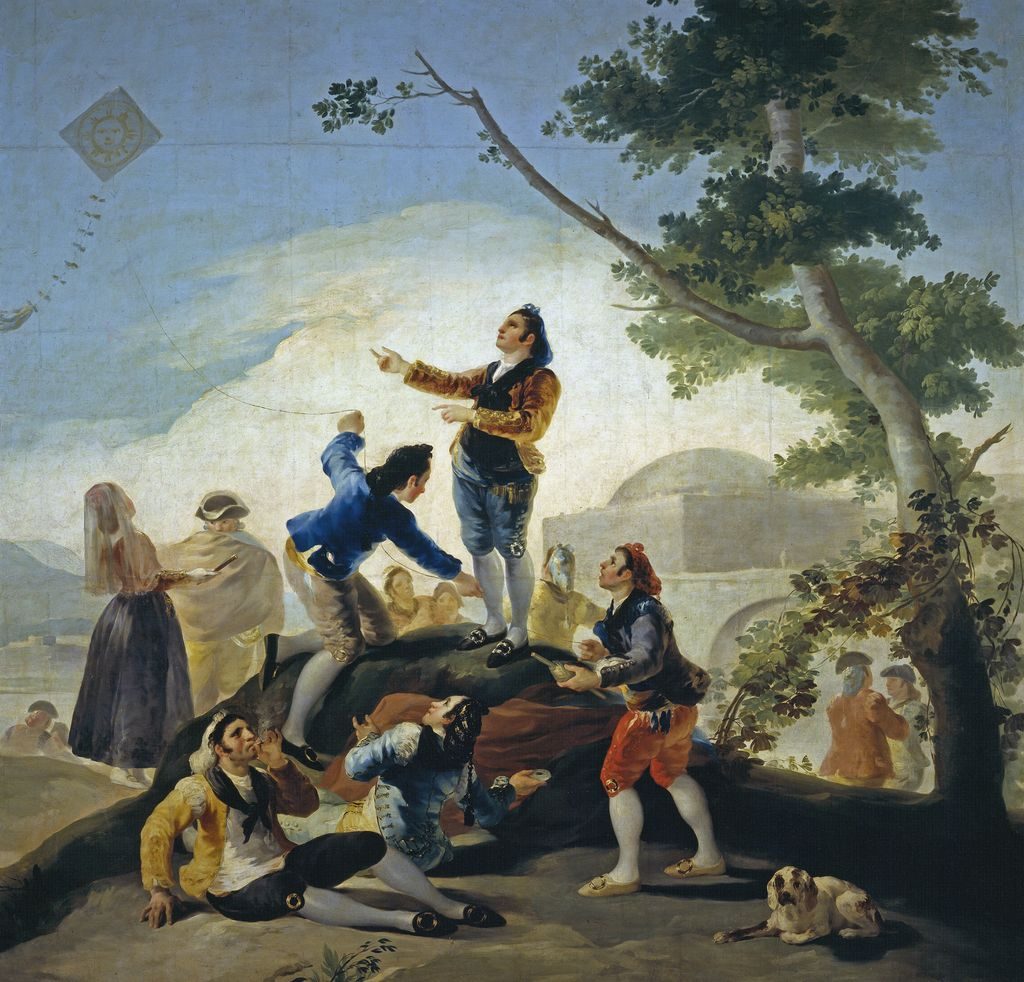
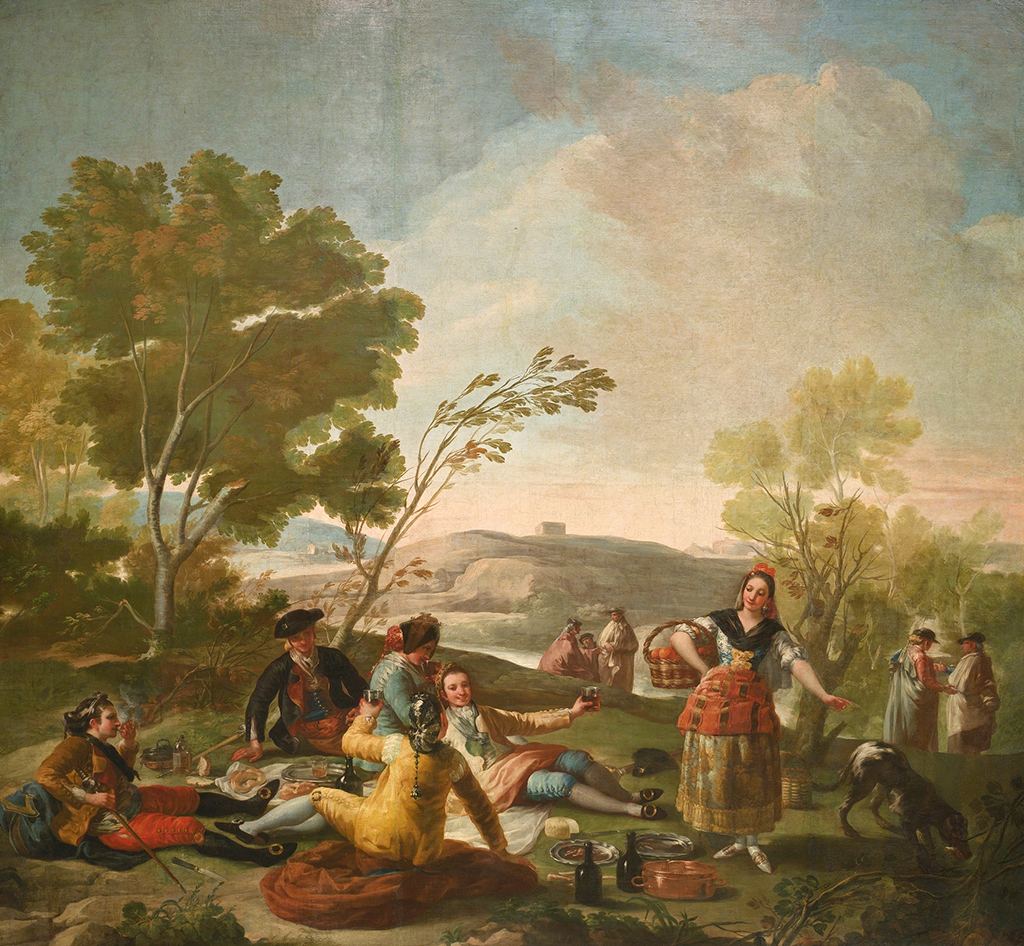
The clapping figure and the possible oil studies
The Prado holds a drawing of the seated man keeping time, Majo llevando el compás con las manos (D04189). Black pencil and light chalk on blue-grey paper give the hands, cuffs and bent arms enough definition to follow the gesture in isolation. The Fundación catalogues the drawing as attributed to Goya and reports that Tomlinson saw the assured strokes and treatment of light and movement as evidence for his authorship. The Fundación also notes how closely the method resembles that of Francisco Bayeu, which helps explain the differences of opinion over drawings of this kind. [1] [7]
The Fundación discusses Country Dance (Baile campestre), a small oil in a private collection attributed to Goya, separately. Goya referred to an earlier sketch in a letter to his friend Martín Zapater, and a later family account described that sketch as showing the church of San Francisco el Grande. The Fundación rules out Country Dance as that particular sketch on the evidence of its landscape, which has no church. The Prado’s detailed catalogue also records a different small oil formerly in the Shaw collection in Buenos Aires. It lists the whereabouts as unknown and describes the work as a reduced version of the design, while recording August L. Mayer’s earlier proposal that it was preparatory. [1] [8]
Artworks directory
| Name | Date | Medium |
|---|---|---|
| And There’s No Help for It, Plate 15 | Printed 1863 | |
| Asmodea | c. 1820–23 | Wall painting transferred to canvas |
| Boys Inflating a Bladder | 1777–78 | Tapestry cartoon |
| Boys Picking Fruit | 1778 | Tapestry cartoon |
| Bullfight in a Divided Ring | 1825 | Lithograph |
| Card Players | 1777–78 | Tapestry cartoon |
| Card Players (sketch) | 1777–78 | Painted sketch |
| Dance on the Banks of the Manzanares | 1777 | Tapestry cartoon |
| Duel with Cudgels | c. 1820–23 | Wall painting transferred to canvas |
| Heads in a Landscape | c. 1820–23 | Easel painting |
| Judith and Holofernes | c. 1820–23 | Wall painting transferred to canvas |
| Leocadia | c. 1820–23 | Wall painting transferred to canvas |
| Maja and Cloaked Men | 1777 | Tapestry cartoon |
| Maja and Cloaked Men (sketch) | 1777 | Painted sketch |
| Majo Clapping in Time to the Music | 1777 | Drawing |
| Men Reading | c. 1820–23 | Wall painting transferred to canvas |
| Out Hunting for Teeth, Plate 12 | 1799 | Etching, burnished aquatint and burin |
| Picnic in the Countryside (sketch) | 1776–78 | Painted sketch |
| Picnic on the Banks of the Manzanares | 1776 | Tapestry cartoon |
| Pilgrimage to San Isidro | c. 1820–23 | Wall painting transferred to canvas |
| Preparatory study for The Sleep of Reason Produces Monsters | c. 1796–97 | Drawing |
| Procession of the Holy Office | c. 1820–23 | Wall painting transferred to canvas |
| Quarrel at the Cockerel Inn (sketch) | 1777 | Painted sketch |
| Quarrel in the New Tavern | 1777 | Tapestry cartoon |
| Saturn Devouring His Son | c. 1820–23 | Wall painting transferred to canvas |
| Seated Majo Smoking | c. 1776 | Drawing |
| The Dog | c. 1820–23 | Wall painting transferred to canvas |
| The Drinker | 1777 | Tapestry cartoon |
| The Fates | c. 1820–23 | Wall painting transferred to canvas |
| The Great He-Goat | c. 1820–23 | Wall painting transferred to canvas |
| The Kite | 1777–78 | Tapestry cartoon |
| The Parasol | 1777 | Oil on canvas, tapestry cartoon |
| The Second of May 1808 | 1814 | Oil on canvas |
| The Sleep of Reason Produces Monsters, Plate 43 | 1799 | Etching and aquatint |
| The Third of May 1808 | 1814 | Oil on canvas |
| Thou Who Canst Not, Plate 42 | 1799 | Etching and burnished aquatint |
| Three Figures | 1776 | Drawing (lost) |
| Two Old Men | c. 1820–23 | Wall painting transferred to canvas |
| Two Old Men Eating Soup | c. 1820–23 | Wall painting transferred to canvas |
| Two Women and a Man | c. 1820–23 | Wall painting transferred to canvas |
| Universal Language: The Author Dreaming | 1797 | Drawing |
| The Family of Charles IV | 1800 | Oil on canvas |
| Witches’ Sabbath (Osuna painting) | 1797–98 | Oil on canvas |
| The Nude Maja | 1795–1800 | Oil on canvas |
| The Clothed Maja | 1800–07 | Oil on canvas |
| Self-Portrait (Drawing) | c. 1796 | Brush and carbon black ink on laid paper |
| The Swing, Madrid Album B.21 | 1795–97 | Brush and carbon black washes |
| Majas Fighting, a Majo Observing, Madrid Album B.15 | 1796–97 | Brush, grey and black washes on laid paper |
| Majos and Majas Conversing, Madrid Album B.16 | c. 1794–97 | Ink wash on paper |
| Weeping Woman and Three Men, Madrid Album B.17 | 1795–97 | Brush, carbon black washes and black chalk |
| Maja Seated on a Chair and Two Companions Behind, Madrid Album B.18 | 1795–97 | Brush and carbon black washes |
| Girl and Bull, Madrid Album B.23 | 1796–97 | Brush and carbon black washes |
| Lovers Sitting on a Rock, Madrid Album B.24 | 1796–97 | Brush and carbon black washes |
| Mariano Ceballos Riding a Bull | 1825 | Crayon lithograph and scraper |
| Landscape (lifetime impression) | c. 1807–10 | Etching and aquatint |
| Self-Portrait (1815), Prado canvas | 1815 | Oil on canvas |
| Self-Portrait (1815), Academy panel | 1815 | Oil on panel |
| Self-Portrait with Dr Arrieta | 1820 | Oil on canvas |
| Christ Crucified | 1780 | Oil on canvas |
| The Last Communion of Saint Joseph of Calasanz | 1819 | Oil on canvas |
| Christ on the Mount of Olives | 1819 | Oil on panel |
| The Flower Girls, or Spring | 1786–87 | Oil on canvas |
| The Grape Harvest, or Autumn | 1786–87 | Oil on canvas |
| The Snowstorm, or Winter | 1786–87 | Oil on canvas |
| The Threshing Ground, or Summer | 1786–87 | Oil on canvas |
| Picnic on the Banks of the Manzanares | 1776 | Oil on canvas |
| The Kite | 1777–78 | Oil on canvas |
| Dance on the Banks of the Manzanares | 1777 | Oil on canvas |
| A Fight at the Venta Nueva | 1777 | Oil on canvas |
| Blind Man’s Bluff | 1788 | Oil on canvas |
| Dogs on a Lead | 1775 | Oil on canvas |
| Hunting with a Decoy | 1775 | Oil on canvas |
| Hunter Loading His Rifle | 1775 | Oil on canvas |
| The Angler | 1775 | Oil on canvas |
| The Hermitage of San Isidro on His Feast Day | 1788 | Oil on canvas |
| The Meadow of San Isidro | 1788 | Oil on canvas |
| The Straw Manikin | 1791–92 | Oil on canvas |
| Witches’ Flight | c. 1797–98 | Oil on canvas |
| A Scene from ‘The Forcibly Bewitched’ | 1798 | Oil on canvas |
| The Duchess of Alba in Black | 1797 | Oil on canvas |
| The Duchess of Alba in White | 1795 | Oil on canvas |
| Charles III in Hunting Dress | c. 1786 | Oil on canvas |
| The Duke and Duchess of Osuna and Their Children | 1787–88 | Oil on canvas |
| Manuel Osorio Manrique de Zúñiga | 1787–88 | Oil on canvas |
| The Marquesa de Pontejos | c. 1786 | Oil on canvas |
| Equestrian Portrait of the 1st Duke of Wellington | 1812 | Oil on canvas |
| The Duke of Wellington | 1812–14 | Oil on wood |
| Portrait of Ferdinand VII of Spain | 1814 | Oil on canvas |
| Gaspar Melchor de Jovellanos | 1798 | Oil on canvas |
| María Tomasa Palafox y Portocarrero | 1804 | Oil on canvas |
| Señora Sabasa García | c. 1806–11 | Oil on canvas |
| Don Juan Bautista de Muguiro | 1827 | Oil on canvas |
| Doña Isabel de Porcel | Before 1805 | Oil on canvas |
| The Colossus | After 1808 | Oil on canvas |
| The Burial of the Sardine | 1808–12 | Oil on panel |
| The Madhouse | 1808–12 | Oil on panel |
| A Procession of Flagellants | 1808–12 | Oil on panel |
| Portrait of Jacques Galos | 1826 | Oil on canvas |
| Portrait of Mariano Goya, the Artist’s Grandson | 1827 | Oil on canvas |
| Milkmaid of Bordeaux | c. 1827 | Oil on canvas |
| Portrait of Don Juan Antonio Cuervo | 1819 | Oil on canvas |
| María Luisa of Parma (Naples version) | c. 1800 | Oil on canvas |
| The Countess of Baena | 1819 | Oil on canvas |
| The Family of the Infante Don Luis | 1783–84 | Oil on canvas |
| The Holy Family | c. 1787 | Oil on canvas |
| Saint Barbara | c. 1773 | Oil on canvas |
| Saints Justa and Rufina | 1817 | Oil on canvas |
| El Tío Paquete | c. 1819–20 | Oil on canvas |
| The Forge | c. 1815–20 | Oil on canvas |
| Majas on a Balcony (Metropolitan Museum version) | c. 1800–10 | Oil on canvas |
| Maja and Celestina on a Balcony | c. 1808–12 | Oil on canvas |
| The Water Bearer | 1808–12 | Oil on canvas |
| Time and the Old Women | c. 1810 | Oil on canvas |
Frequently Asked Questions
They are dancing a seguidilla. Goya names the dance in his account of 3 March 1777 and describes the accompaniment as singing with guitar, bandurria and handclaps to mark the beat. [3]
Discussion
Look again at the images and ideas explored in Dance on the Banks of the Manzanares. These editorial prompts invite your observations.
Which details tell you that the dancers are keeping time together? Try tracing the clapper’s hands, then each pair of feet. Where does your eye go when you follow the river instead?
Reader Insights
Which gestures help you follow the rhythm across the two couples?
What do the musicians and onlookers add to the scene?
Join the Conversation
Share a detail, comparison or question about Dance on the Banks of the Manzanares below.
References
- Museo Nacional del Prado, Dance on the Banks of the Manzanares, P000769, printed catalogue, no. 769 and detailed catalogue entry, reproduced text. View source 1. View source 2. View source 3.
- Fundación Goya en Aragón, El baile a orillas del Manzanares, catalogue and illustration. View source.
- Ángel Canellas López (ed.), Francisco de Goya. Diplomatario, Institución Fernando el Católico, Goya’s account to Sabatini, p. 209, and the factory register, p. 418. View source.
- Joan Carles Gomis Corell, ‘La música de tradición popular en los cartones de Goya. Escenas, instrumentos, significados’, Ars Longa, 9–10 (2000), pp. 119–121. Michael Christoforidis, ‘Goya and Spanish Musical Identity’, in Goya: Drawings from the Prado Museum, National Gallery of Victoria, pp. 140–143. View source 1. View source 2.
- Patrimonio Nacional, Raquel Andueza y La Galanía concert programme, cover illustration and credit identifying the woven Goya design at El Escorial. View source.
- Fundación Goya en Aragón, La merienda, companion cartoon P000768. See also the Prado printed catalogue under no. 768. View source.
- Fundación Goya en Aragón, Majo llevando el compás con las manos, Prado drawing D04189 and attribution discussion. View source.
- Fundación Goya en Aragón, Baile campestre (boceto), attributed oil and discussion of the sketch mentioned by Goya. View source.







