by Tom Gurney
Tom Gurney BSc (Hons) is an art history expert with over 20 years experience
Published on June 19, 2020 / Updated on November 20, 2026
Email: tomgurney1@gmail.com / Phone: +44 7429 011000
Introduction
Francisco de Goya’s The Nude Maja shows a woman stretched out on a green couch, her arms raised behind her head and her eyes turned towards the viewer. Goya painted her in oil on a canvas nearly two metres wide. The work, known in Spanish as La maja desnuda and catalogued in English by the Prado as The Naked Maja, is usually dated 1795–1800. By November 1800 it was in the Madrid residence of Manuel Godoy, the powerful minister of Charles IV. Its companion, The Clothed Maja, was first recorded in Godoy’s collection in a catalogue dated January 1808. [1] [2] [3] [4]
At a Glance
- ArtistFrancisco de Goya y Lucientes.
- Date and medium1795–1800, oil on canvas, 98 × 191 cm.
- CollectionMuseo Nacional del Prado, Madrid, P000742. The painting entered the museum in 1901. [1]
- Companion paintingThe Clothed Maja (La maja vestida), dated 1800–07 by Fundación Goya en Aragón, oil on canvas, 95 × 188 cm, Prado P000741. [2]
- First documented ownerManuel Godoy. Who commissioned the work and who, if anyone, posed for it remain open questions. [3] [5]
Works across Goya’s career
The Parasol
1777The Nude Maja
1795–1800Saturn Devouring His Son
c. 1820–23The Dog
c. 1820–23Milkmaid of Bordeaux
c. 1827The pose, gaze and green couch
The canvas is nearly twice as wide as it is high. The woman’s head and shoulders rise at the right, while her legs run towards the left into a narrower part of the composition. The bent knees introduce a slight rise in the middle of that long descent. One foot overlaps the other, and the thin edge of the sheet under the feet continues nearly to the end of the couch. The raised arms do a different job. They frame the head, leave the torso open and break up the long line of the body with the sharp angles of the elbows. The arrangement looks relaxed and carefully held at the same time. [1]
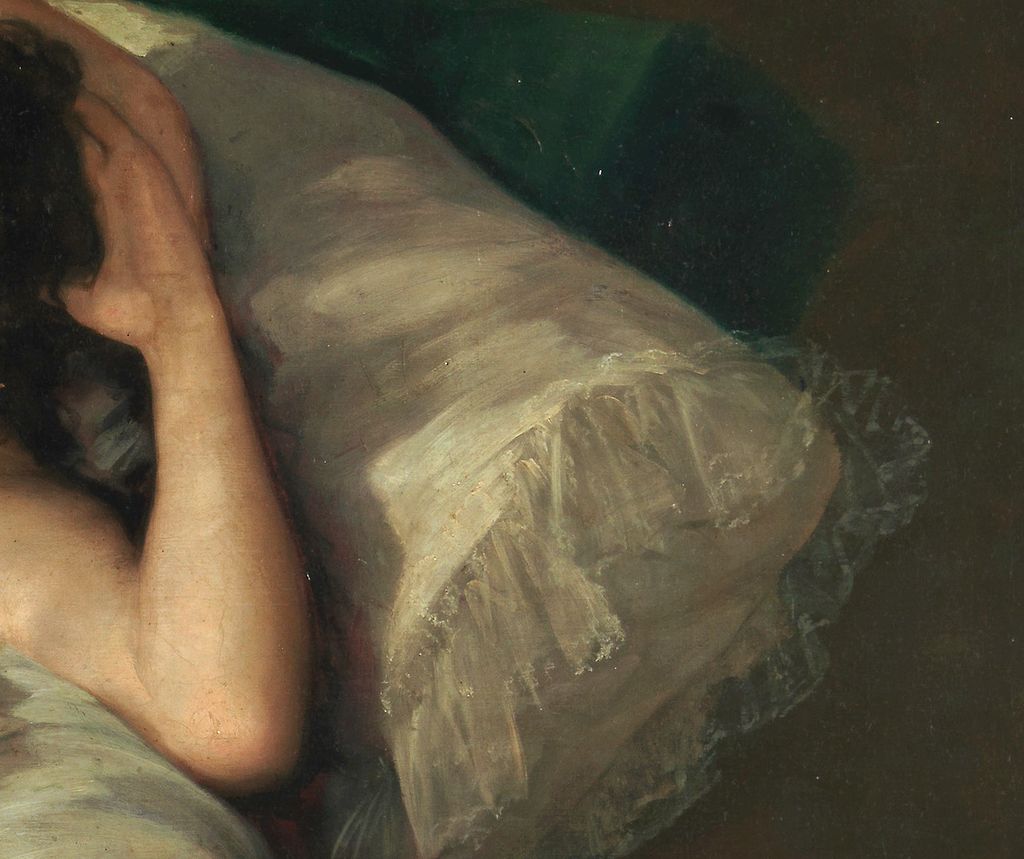
The cushions give that pose weight. Broad, irregular folds gather where the body rests, particularly behind the right shoulder. The white cloth takes on cool grey and blue in the hollows, while the skin holds warmer shades. Their similar brightness lets Goya describe the point where body and linen meet with a narrow shadow. Below them the green upholstery forms a darker band. The little breaks where the cloth hangs down make its weight visible, and the couch edge helps establish the position of the figure in space. Beyond the couch the background offers few clues to the size or character of the room. The viewer can locate the woman on a piece of furniture much more readily than in a particular house. [1] [5]
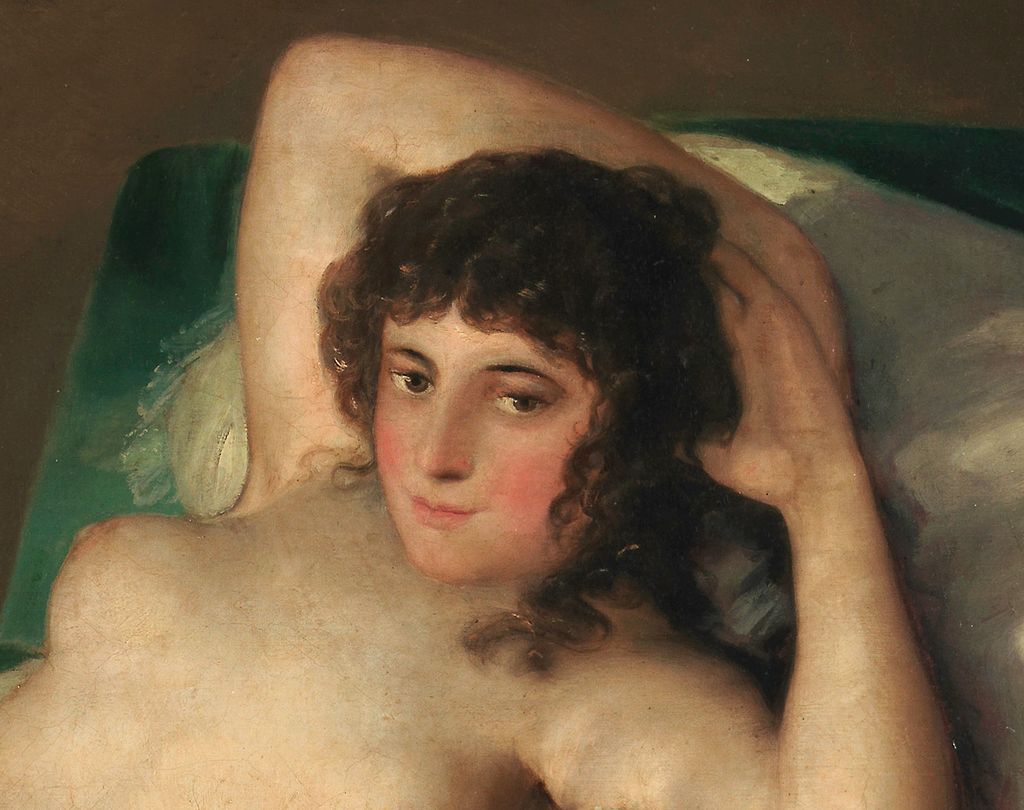
Although her body extends across the picture, the face turns out of it. Her dark hair and brows concentrate attention at the right edge of the pale shapes, where her gaze can catch a viewer who has been following the line of the body. A slight lift at the corners of the mouth may read as amusement, and the frontal gaze can feel assured or watchful. Those impressions come from the placement of the eyes, the tilt of the head and the expression Goya painted. Janis Tomlinson describes the mixture of confrontation and timidity in the figure. The position of the arms exposes the body, while the eyes make the woman seem alert to the attention directed at it. [1] [6]
Goya models the abdomen and thighs with gradual changes of tone and retains a firm edge where the body meets the darker background. The light is broad enough to pick out skin and fabric together. The pubic hair is visible, one particular within an otherwise smoothly modelled figure. There is no Cupid, mirror or other attribute to give the woman a mythological name. The picture’s departure from many images of Venus lies in that combination of familiar pose, direct glance and specific physical detail. An inventory could still call her a Venus, as one did in 1813. The word offered a category for the kind of picture, even when the painting supplied very little of the goddess’s story. [1] [5] [7]
Annotated Details from The Nude Maja
Follow the diagonal from the feet to the face, then look at the bedding around the figure.
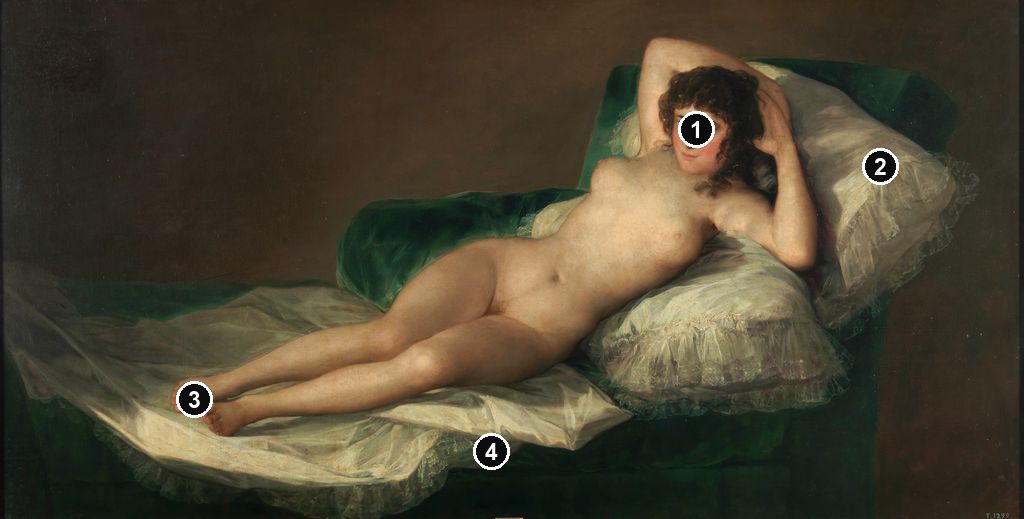
Details from THE NUDE MAJA
Details from the painting in the Museo Nacional del Prado (P000742).
The face and dark hair
The face turns out from the dark hair. The arms frame the head on either side.
The upper cushion
Pale folds follow the diagonal of the cushion. A dark strip of upholstery separates its edge from the background.
Feet against the bedding
The feet mark the end of the long diagonal. The sheet continues below them in shallower folds.
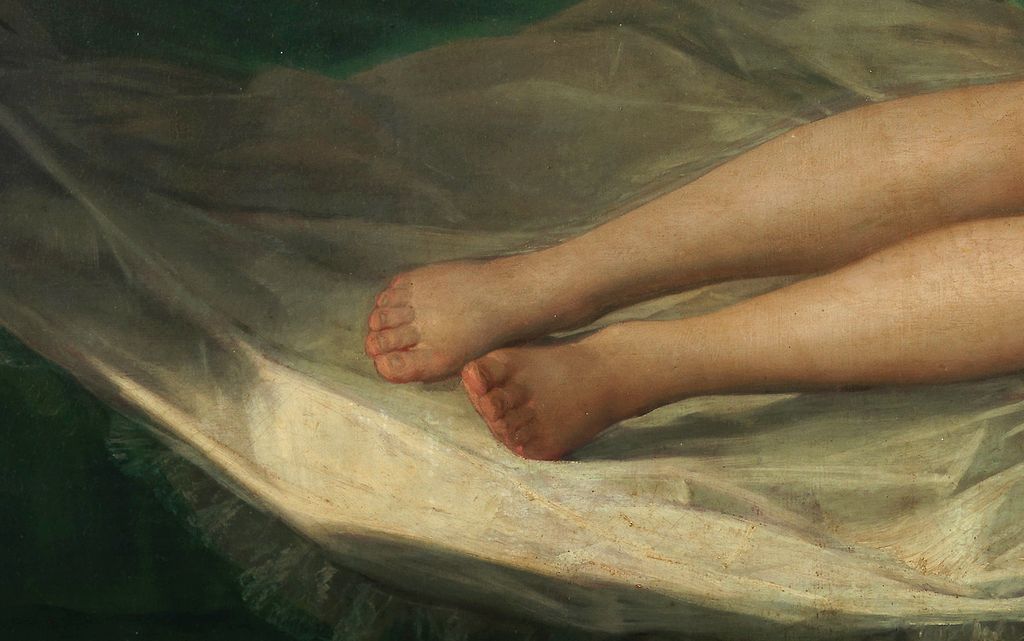
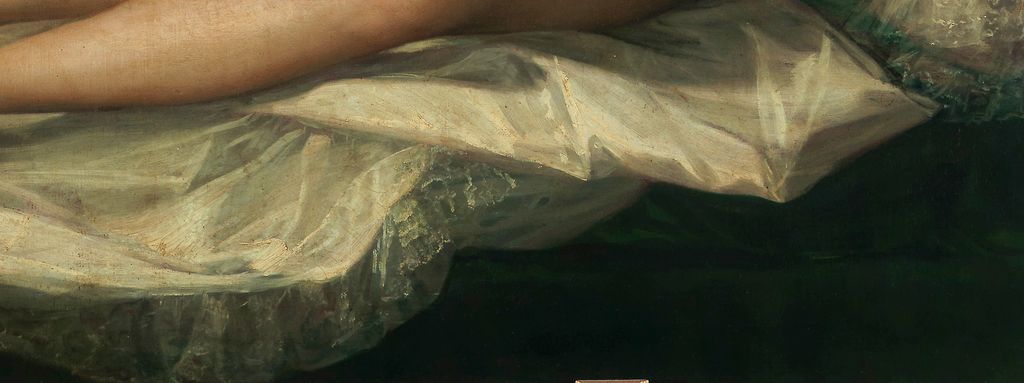
Green couch and pale sheet
The pale edge of the cloth passes across the green upholstery and catches light where it folds over.
How the companion changes the pose
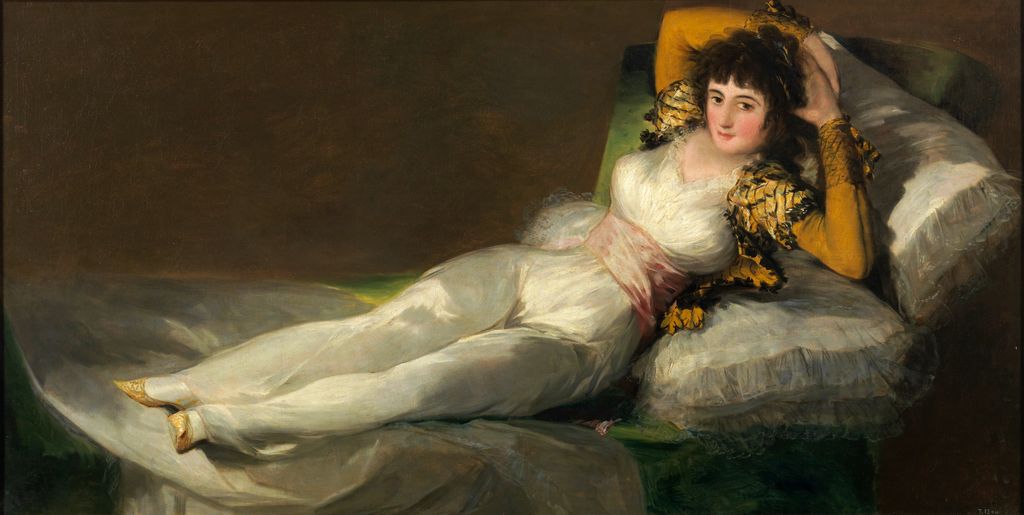
Seen side by side, the two Majas offer the same underlying arrangement. Each figure raises her elbows, extends her legs to the left and looks out from the right. Each is supported by pale bedding and green upholstery. The canvases differ slightly in size, and the alignment is approximate. In The Clothed Maja, pointed shoes lift the far silhouette, and folds travel along the legs in place of the uninterrupted transitions of flesh in the nude. The turned head provides a point of comparison, while the details around it make the two paintings register at different speeds. [1] [2]
The clothed figure’s short yellow jacket sharpens the angles of her shoulders. Her pink silk sash cuts across the waist, while white folds carry the eye out towards her shoes. In the earlier painting a slow shift from light to shadow describes the turn of the waist. In the companion the sash gives that same area a bright, decisive edge. The Fundación’s catalogue characterises the nude as more dependent on drawing and the clothed figure as more freely brushed, with thicker paint articulating the dress. Even the whites behave differently. The nude’s white bedding supports the body, while in the companion the white garment spreads across the body and meets the other whites of the couch. The layering becomes part of the subject. [2] [5]
Maja, the feminine form of majo, evoked an urban Spanish social type marked by dress and bearing. The fashion could travel between social ranks, as Aileen Ribeiro observes in discussing the Duchess of Alba and other elite women who adopted elements of popular Spanish dress. The title is particularly suggestive for the nude because the costume from which a viewer might identify the type is visible only in the companion. Goya also used the maja in Los Caprichos. In Plate 7, Even thus he cannot make her out, a man peers at a maja through a lens. The print gives the viewer an observer whose attempt at close inspection is the subject of the joke. In the painting, the woman’s gaze implicates the spectator directly. [6] [8]
Godoy’s private collection
On 12 November 1800, the medallist Pedro González de Sepúlveda visited Godoy’s house with three companions. An Augustinian chaplain arranged their access. In his diary Sepúlveda describes an inner cabinet with several pictures of Venuses and singles out a nude by Goya. He found fault with its drawing and colour. His criticism is evidence of an individual response at a point when access depended on a private introduction. His account leaves the dressed figure unmentioned. This fits the catalogue date ranges and the view that Goya painted the companion later, although a visitor’s silence alone cannot establish when the second work was made. [2] [3] [5]
The Fundación and American Friends of the Prado describe the nude as an overdoor painting in the 1800 display. The available transcription of Sepúlveda’s diary locates it in an inner room and supplies no particular position on its walls. A later hypothesis holds that The Clothed Maja served as a cover for the nude, an arrangement sometimes elaborated into a story about a cord and pulley. Isadora Rose-de Viejo allows that the companion could have been intended to screen the earlier painting. The similar formats make such an arrangement conceivable, but the diary and catalogues document neither the apparatus nor the way it would have been operated. What survives is a record of access to a private setting and, eight years later, a record of the two canvases in the same collection. [3] [4] [5] [9] [10]
Frédéric Quilliet addressed his survey of 972 paintings to Godoy and dated it 1 January 1808, before the minister fell from power that March. In the third group of the catalogue, he lists two reclining figures by Goya together, one nude and one dressed, labelling each with the Spanish word gitana within the French entry. The 1813 inventory of the seized property instead lists two Venuses together under no. 122. The different descriptions show how readily the works could be recorded under categories rather than stable titles. Quilliet’s terms provide neither names for the women nor independent evidence of their ethnicity. Meanwhile the 1813 description picks out what remained recognisable through changes of ownership and classification, the two versions of a recumbent woman. [4] [7] [10]
Godoy is a plausible commissioner. He acquired and kept both paintings, and in 1801 directly commissioned Goya to paint his portrait as a victorious general. The Academy of San Fernando also attributes the two Maja commissions to him in its catalogue entry for that portrait. Yet ownership, even as early as 1800, does not specify whether Godoy asked Goya to paint the nude, acquired it after it was made or requested a second canvas to match it. The surviving records are more informative about the minister’s collection than about the terms on which either canvas entered it. [3] [4] [10] [11]
Goya on film
Five films explore Goya’s portraits, prints, Black Paintings and painting techniques.
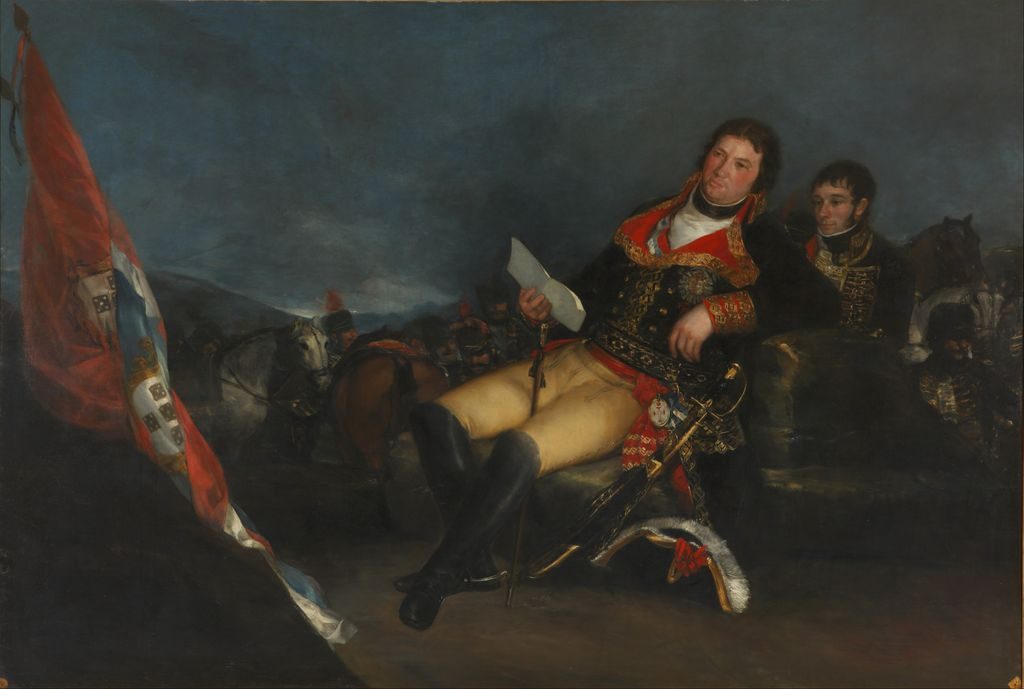
The Duke of Wellington by Goya
The portrait, its military decorations and its later theft.
Watch on YouTubeThe comparison with Velázquez
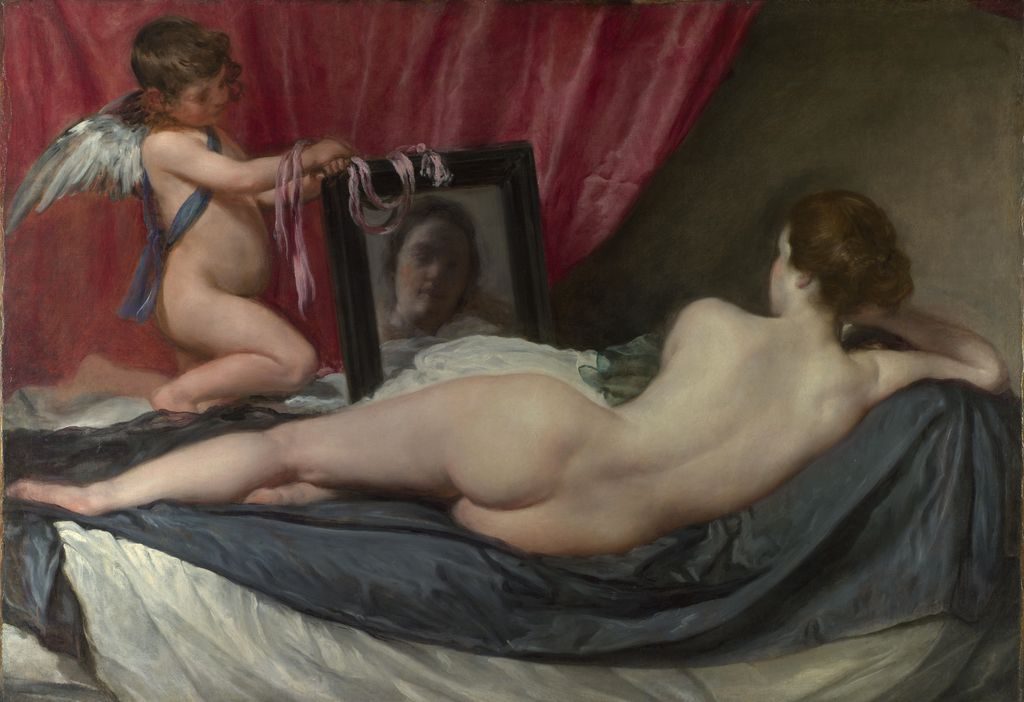
In Diego Velázquez’s Rokeby Venus, painted in 1647–51, the reclining woman turns her back to us. Cupid steadies the mirror in which we see her face. Goya turns the reclining body towards us, raises both arms and gives the figure a direct line of sight. Velázquez’s mirror makes the face smaller and less distinct than the figure it belongs to, while in the Maja the face is an immediate part of the encounter. Both artists stretch an exposed figure across a long canvas and draw attention to the bedding beneath her. They give the viewer quite different ways to meet her eye. [1] [12]
The comparison has a historical foundation as well as a visual one. Sepúlveda describes seeing a celebrated Venus by Velázquez in Godoy’s inner cabinet on the same visit as Goya’s nude and says the Duchess of Alba gave it to Godoy. The National Gallery associates the pictures with Godoy’s private collection, although its formal provenance dates the sale of the Rokeby Venus by the Alba heirs to after the duchess’s death in 1802. The accounts therefore differ on when and how Godoy acquired the Velázquez. Even if the 1800 diary identifies it correctly, the visit dates the presence of the canvases together, without telling us when or where Goya saw the older work. The setting illuminates how a collector or visitor might have read the paintings in relation to each other. [3] [12]
The mirror and the place occupied by the viewer
The mirror in the Rokeby Venus introduces a problem of position. The body is seen from behind, while the face appears in the glass and is difficult to read clearly. Cupid’s arms and the frame carry the eye to that distant point. The woman in Goya’s picture has no similar intermediary. Her face turns towards the position from which the body is being seen. The effect can be tested by looking from the nearest edge of the couch up to the eyes. The gaze seems to occupy the same room as the viewer, even though Goya supplies little to locate that room. [12] [6]
Reading the two pictures as objects in a collection adds a different question. A relationship between them can be established through shared ownership and a Spanish tradition of collecting the nude. The two works supply no comparable record of the exact moment at which Goya used the earlier work as a model. Similarities of scale or outline help sustain a visual comparison. Differences in sightline, orientation and props should carry equal weight. The one painting lets a mythological figure appear to look through a glass. The other gives an unnamed woman a look whose addressee the viewer must supply. [12] [6]
The direct gaze is more pointed beside the clothed picture. There Goya retains the essential arrangement of the arms and the confident direction of attention, while fabric redirects the eye along the body. The two Majas are therefore a better test of how much the exposed body contributes to that encounter. In each the placement of the shoulders and head grants the sitter a degree of initiative. The comparison with Velázquez explains how the venue of the encounter might change. The internal comparison shows how much Goya kept in place while changing one of its most conspicuous conditions. [12] [6]
The National Gallery’s record also gives the Velázquez painting its own custodial history. That independent record becomes particularly valuable where a claim about the two works hangs on when they could have been seen together. An inventory can place two paintings in an owner’s collection without fixing the interval between them on a wall. A comparison of sightlines therefore remains a comparison between the surviving pictures. It can be set alongside the historically documented association, with each kind of evidence carrying the part of the argument it can support. [12] [6]
Who might have posed for Goya?
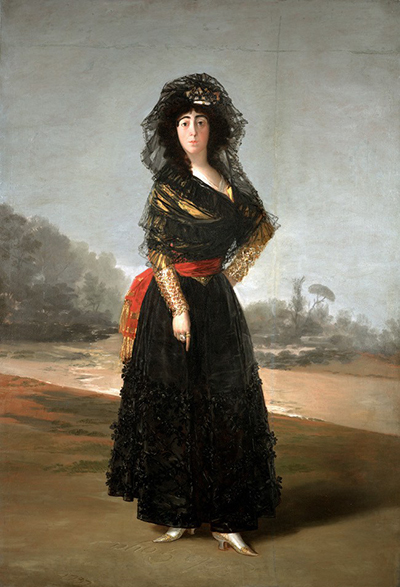
María Cayetana de Silva, the 13th Duchess of Alba, and Josefa ‘Pepita’ Tudó, Godoy’s mistress, are the two best-known suggestions. The case for Alba draws on her association with Goya and his documented portraits of her, including the 1797 full-length portrait in the Hispanic Society. Its black lace and red sash also demonstrate how an aristocratic sitter could adopt the popular dress associated with majismo. The known portraits establish that she sat for Goya and help explain the appeal of the tradition. The connection to the reclining woman in the Prado remains conjectural. [5] [6] [13]
Tudó’s place in Godoy’s life makes her another plausible suggestion. Rose-de Viejo favours the identification while cataloguing it as a question. The 1836 Academy transfer record describes the two figures as the same young woman in the same pose, a reasonable reading of the pair. Its wording reveals how the paintings were understood by then, around a generation after they were first recorded, and leaves the sitter unnamed. Goya’s familiarity with a particular model, an idealised figure or the reuse of a painted pose would all be consistent with some degree of resemblance between the two pictures. The recurrence of the pose is the part the viewer can verify. [5] [10]
The Inquisition, the Academy and the Prado
Godoy’s downfall in 1808, during the uprising at Aranjuez and the abdication of Charles IV, placed his collection under seizure. The detailed provenance supplied by American Friends of the Prado dates the nude’s transfer to the General Depository of Sequestered Property, in the former glass warehouse in the Calle de Alcalá, to 18 December 1813. Rose-de Viejo records a receipt of 22 November 1814 for the handover by Francisco Garibay, depositary of Godoy’s sequestered property, to Clemente de Cavia y Diez, secretary of the Holy Office. The American Friends entry dates the painting’s deposit with the tribunal to 28 November. The two November dates refer to records of the transition into inquisitorial custody, which followed the 1813 transfer to the state depot. [1] [5] [10]
On 16 March 1815, the inquisitorial prosecutor Zorrilla de Velasco proposed that Goya be brought before the tribunal. He described a naked woman on a bed and a woman dressed as a maja on a bed among the pictures taken from the depot. He wanted Goya to confirm authorship, explain his reasons for making the paintings, name whoever had commissioned them and say what they were intended for. The proposal also asked him to examine other confiscated pictures and identify their authors where he could. The document therefore concerns both paintings, including the clothed figure, and places their seizure within a wider enquiry into pictures judged indecent. Legal historian María Jesús Torquemada notes that the file breaks off where Goya’s statement would be expected. Whether he appeared, how he answered and how the case ended remain uncertain. [14] [15] [16]
The Majas passed from inquisitorial custody to the Royal Academy of Fine Arts of San Fernando in April 1836. Their access histories differed. Rose-de Viejo records the dressed painting in the Academy’s public exhibition of 1840, while the nude remained in restricted quarters. Writing in 1867, the French critic Charles Yriarte objected to the Academy’s decision to keep the nude in a dark cabinet and wanted both canvases shown together. Jean Laurent’s photograph from the Academy years offers a second record of this period. Its caption names the Academy, and the old number 442 is visible at the lower right of the painting. Photographs could circulate a view of the nude while access to the canvas itself remained limited. [1] [10] [17] [18]
By 1884 the nude was listed in an anteroom of the Academy library. It was lent to the Madrid Goya exhibition of 1900 and transferred with its companion to the Prado in 1901. Fundación Goya dates their first appearance in the museum’s catalogue to 1910, a separate event from their arrival. A visitor who sees both now has the advantage Yriarte argued for. The two works can be read in relation to each other at their actual size, with the repeated pose making the different treatment of skin, fabric and light easier to see. That comparison places The Nude Maja within the range of Goya’s paintings, where closely related compositions can serve different purposes. [1] [2] [5] [10]
Artworks directory
| Name | Date | Medium |
|---|---|---|
| And There’s No Help for It, Plate 15 | Printed 1863 | |
| Asmodea | c. 1820–23 | Wall painting transferred to canvas |
| Boys Inflating a Bladder | 1777–78 | Tapestry cartoon |
| Boys Picking Fruit | 1778 | Tapestry cartoon |
| Bullfight in a Divided Ring | 1825 | Lithograph |
| Card Players | 1777–78 | Tapestry cartoon |
| Card Players (sketch) | 1777–78 | Painted sketch |
| Dance on the Banks of the Manzanares | 1777 | Tapestry cartoon |
| Duel with Cudgels | c. 1820–23 | Wall painting transferred to canvas |
| Heads in a Landscape | c. 1820–23 | Easel painting |
| Judith and Holofernes | c. 1820–23 | Wall painting transferred to canvas |
| Leocadia | c. 1820–23 | Wall painting transferred to canvas |
| Maja and Cloaked Men | 1777 | Tapestry cartoon |
| Maja and Cloaked Men (sketch) | 1777 | Painted sketch |
| Majo Clapping in Time to the Music | 1777 | Drawing |
| Men Reading | c. 1820–23 | Wall painting transferred to canvas |
| Out Hunting for Teeth, Plate 12 | 1799 | Etching, burnished aquatint and burin |
| Picnic in the Countryside (sketch) | 1776–78 | Painted sketch |
| Picnic on the Banks of the Manzanares | 1776 | Tapestry cartoon |
| Pilgrimage to San Isidro | c. 1820–23 | Wall painting transferred to canvas |
| Preparatory study for The Sleep of Reason Produces Monsters | c. 1796–97 | Drawing |
| Procession of the Holy Office | c. 1820–23 | Wall painting transferred to canvas |
| Quarrel at the Cockerel Inn (sketch) | 1777 | Painted sketch |
| Quarrel in the New Tavern | 1777 | Tapestry cartoon |
| Saturn Devouring His Son | c. 1820–23 | Wall painting transferred to canvas |
| Seated Majo Smoking | c. 1776 | Drawing |
| The Dog | c. 1820–23 | Wall painting transferred to canvas |
| The Drinker | 1777 | Tapestry cartoon |
| The Fates | c. 1820–23 | Wall painting transferred to canvas |
| The Great He-Goat | c. 1820–23 | Wall painting transferred to canvas |
| The Kite | 1777–78 | Tapestry cartoon |
| The Parasol | 1777 | Oil on canvas, tapestry cartoon |
| The Second of May 1808 | 1814 | Oil on canvas |
| The Sleep of Reason Produces Monsters, Plate 43 | 1799 | Etching and aquatint |
| The Third of May 1808 | 1814 | Oil on canvas |
| Thou Who Canst Not, Plate 42 | 1799 | Etching and burnished aquatint |
| Three Figures | 1776 | Drawing (lost) |
| Two Old Men | c. 1820–23 | Wall painting transferred to canvas |
| Two Old Men Eating Soup | c. 1820–23 | Wall painting transferred to canvas |
| Two Women and a Man | c. 1820–23 | Wall painting transferred to canvas |
| Universal Language: The Author Dreaming | 1797 | Drawing |
| The Family of Charles IV | 1800 | Oil on canvas |
| Witches’ Sabbath (Osuna painting) | 1797–98 | Oil on canvas |
| The Nude Maja | 1795–1800 | Oil on canvas |
| The Clothed Maja | 1800–07 | Oil on canvas |
| Self-Portrait (Drawing) | c. 1796 | Brush and carbon black ink on laid paper |
| The Swing, Madrid Album B.21 | 1795–97 | Brush and carbon black washes |
| Majas Fighting, a Majo Observing, Madrid Album B.15 | 1796–97 | Brush, grey and black washes on laid paper |
| Majos and Majas Conversing, Madrid Album B.16 | c. 1794–97 | Ink wash on paper |
| Weeping Woman and Three Men, Madrid Album B.17 | 1795–97 | Brush, carbon black washes and black chalk |
| Maja Seated on a Chair and Two Companions Behind, Madrid Album B.18 | 1795–97 | Brush and carbon black washes |
| Girl and Bull, Madrid Album B.23 | 1796–97 | Brush and carbon black washes |
| Lovers Sitting on a Rock, Madrid Album B.24 | 1796–97 | Brush and carbon black washes |
| Mariano Ceballos Riding a Bull | 1825 | Crayon lithograph and scraper |
| Landscape (lifetime impression) | c. 1807–10 | Etching and aquatint |
| Self-Portrait (1815), Prado canvas | 1815 | Oil on canvas |
| Self-Portrait (1815), Academy panel | 1815 | Oil on panel |
| Self-Portrait with Dr Arrieta | 1820 | Oil on canvas |
| Christ Crucified | 1780 | Oil on canvas |
| The Last Communion of Saint Joseph of Calasanz | 1819 | Oil on canvas |
| Christ on the Mount of Olives | 1819 | Oil on panel |
| The Flower Girls, or Spring | 1786–87 | Oil on canvas |
| The Grape Harvest, or Autumn | 1786–87 | Oil on canvas |
| The Snowstorm, or Winter | 1786–87 | Oil on canvas |
| The Threshing Ground, or Summer | 1786–87 | Oil on canvas |
| Picnic on the Banks of the Manzanares | 1776 | Oil on canvas |
| The Kite | 1777–78 | Oil on canvas |
| Dance on the Banks of the Manzanares | 1777 | Oil on canvas |
| A Fight at the Venta Nueva | 1777 | Oil on canvas |
| Blind Man’s Bluff | 1788 | Oil on canvas |
| Dogs on a Lead | 1775 | Oil on canvas |
| Hunting with a Decoy | 1775 | Oil on canvas |
| Hunter Loading His Rifle | 1775 | Oil on canvas |
| The Angler | 1775 | Oil on canvas |
| The Hermitage of San Isidro on His Feast Day | 1788 | Oil on canvas |
| The Meadow of San Isidro | 1788 | Oil on canvas |
| The Straw Manikin | 1791–92 | Oil on canvas |
| Witches’ Flight | c. 1797–98 | Oil on canvas |
| A Scene from ‘The Forcibly Bewitched’ | 1798 | Oil on canvas |
| The Duchess of Alba in Black | 1797 | Oil on canvas |
| The Duchess of Alba in White | 1795 | Oil on canvas |
| Charles III in Hunting Dress | c. 1786 | Oil on canvas |
| The Duke and Duchess of Osuna and Their Children | 1787–88 | Oil on canvas |
| Manuel Osorio Manrique de Zúñiga | 1787–88 | Oil on canvas |
| The Marquesa de Pontejos | c. 1786 | Oil on canvas |
| Equestrian Portrait of the 1st Duke of Wellington | 1812 | Oil on canvas |
| The Duke of Wellington | 1812–14 | Oil on wood |
| Portrait of Ferdinand VII of Spain | 1814 | Oil on canvas |
| Gaspar Melchor de Jovellanos | 1798 | Oil on canvas |
| María Tomasa Palafox y Portocarrero | 1804 | Oil on canvas |
| Señora Sabasa García | c. 1806–11 | Oil on canvas |
| Don Juan Bautista de Muguiro | 1827 | Oil on canvas |
| Doña Isabel de Porcel | Before 1805 | Oil on canvas |
| The Colossus | After 1808 | Oil on canvas |
| The Burial of the Sardine | 1808–12 | Oil on panel |
| The Madhouse | 1808–12 | Oil on panel |
| A Procession of Flagellants | 1808–12 | Oil on panel |
| Portrait of Jacques Galos | 1826 | Oil on canvas |
| Portrait of Mariano Goya, the Artist’s Grandson | 1827 | Oil on canvas |
| Milkmaid of Bordeaux | c. 1827 | Oil on canvas |
| Portrait of Don Juan Antonio Cuervo | 1819 | Oil on canvas |
| María Luisa of Parma (Naples version) | c. 1800 | Oil on canvas |
| The Countess of Baena | 1819 | Oil on canvas |
| The Family of the Infante Don Luis | 1783–84 | Oil on canvas |
| The Holy Family | c. 1787 | Oil on canvas |
| Saint Barbara | c. 1773 | Oil on canvas |
| Saints Justa and Rufina | 1817 | Oil on canvas |
| El Tío Paquete | c. 1819–20 | Oil on canvas |
| The Forge | c. 1815–20 | Oil on canvas |
| Majas on a Balcony (Metropolitan Museum version) | c. 1800–10 | Oil on canvas |
| Maja and Celestina on a Balcony | c. 1808–12 | Oil on canvas |
| The Water Bearer | 1808–12 | Oil on canvas |
| Time and the Old Women | c. 1810 | Oil on canvas |
Frequently Asked Questions
Discussion
Look again at the images and ideas explored in The Nude Maja. These editorial prompts invite your observations.
Where do you look first when you see the two Majas together? Compare the face, waist and feet in each canvas. Which difference most changes the way you read the repeated pose?
Reader Insights
How does the direction of the gaze affect the way you see the reclining pose?
Which change in the companion painting most alters the composition?
Join the Conversation
Share a detail, comparison or question about The Nude Maja below.
References
- Museo Nacional del Prado, The Naked Maja, P000742. The American Friends of the Prado object entry gives the dimensions, date range and dated custody sequence. View source 1. View source 2.
- Fundación Goya en Aragón, The Clothed Maja, cat. 581, including technique, dates, dimensions and bibliography. Museo Nacional del Prado, La maja vestida, P000741. View source 1. View source 2.
- Pedro González de Sepúlveda, diary for 12 November 1800, Archivo de la Casa de la Moneda, Madrid, ms. 27-3-2, book 9, fols. 186v–187, in Isadora Rose-de Viejo’s transcription. View source.
- Frédéric Quilliet, Collection des Tableaux de S.A.S. Le Prince de la Paix, dated 1 January 1808, Archivo Histórico Nacional, Estado, leg. 3227, no. 1, preface and fol. 23, in Isadora Rose-de Viejo’s transcription. View source.
- Fundación Goya en Aragón, La maja desnuda, cat. 582, catalogue, interpretation and exhibition history. View source.
- Janis A. Tomlinson, introduction, p. 16 and ‘Images of Women in Goya’s Prints and Drawings’, p. 53, and Aileen Ribeiro, ‘Fashioning the Feminine’, pp. 77–82, in Goya: Images of Women, National Gallery of Art, 2002. View source.
- Inventory of Godoy’s sequestered pictures, 1813, entry 122, in Isadora Rose-de Viejo’s transcription. View source.
- Metropolitan Museum of Art, Even thus he cannot make her out, plate 7 from Los Caprichos. View source.
- American Friends of the Prado Museum, The Naked Maja, picture history, including the overdoor interpretation and proposed sitters. View source.
- Isadora Rose-de Viejo, Catálogo Actualizado de la Colección de Manuel Godoy, 2021 version, nos. 247–248, pp. 20–22, with excerpts and archival references for the 1814 handover, 1836 Academy transfer and 1901 move to the Prado. View source.
- Real Academia de Bellas Artes de San Fernando, Godoy como general, inv. 0670. View source.
- National Gallery, London, Velázquez, The Toilet of Venus (‘The Rokeby Venus’), NG2057, including ‘Provenance’, extracted from Neil MacLaren and Allan Braham’s The Spanish School. View source.
- Hispanic Society Museum & Library, Main Court, collection entry identifying Goya’s full-length The Duchess of Alba, 1797. View source.
- Archivo Histórico Nacional, Francisco de Goya. Celebrando el aniversario del nacimiento de un genio, with dossier INQUISICIÓN, 4499, exp. 3 and an excerpt from the prosecutor’s description. View source.
- Boletín del Museo Provincial de Bellas Artes de Zaragoza, no. 14, p. 29, transcription of Zorrilla de Velasco’s proposal of 16 March 1815. View source.
- María Jesús Torquemada, ‘Goya, las majas y el conflicto con el Santo Oficio’, in Ars Iuris. Estudios sobre Derecho y Arte, 2023, pp. 241–280, abstract on the break in the dossier. See also José María Lanzarote Guiral, ‘Goya investigado por la Inquisición’, Príncipe de Viana 279, 2021, p. 114. View source 1. View source 2.
- Charles Yriarte, Goya, Paris, 1867, pp. 88–89. See also Guillermo Juberías Gracia, Culto a los maestros e identidad nacional, pp. 166–170, on Yriarte, Academy access and the Laurent photographs. View source 1. View source 2.
- Archivo Histórico Provincial de Córdoba, Jean Laurent, el testigo de excepción, on Laurent’s photograph no. 507, the French caption and the Academy inventory number in the image. View source.