


 by Tom Gurney
Tom Gurney BSc (Hons) is an art history expert with over 20 years experience
Published on June 19, 2020 / Updated on November 20, 2026
Email: tomgurney1@gmail.com / Phone: +44 7429 011000
Introduction
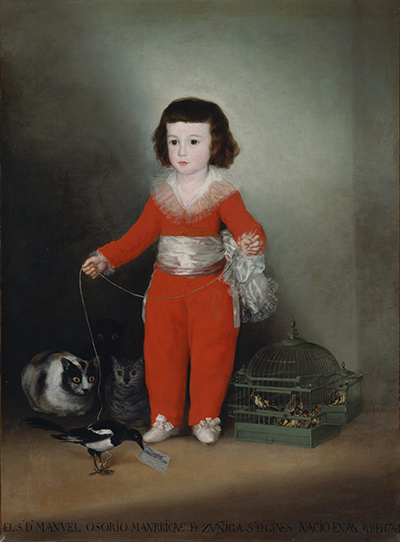
The boy in red holds a thread that descends almost to the floor. Follow it from his right hand, at the viewer’s left, and you find a magpie with a piece of paper in its beak. Behind the bird, three cats peer out of the darkness. Across the boy’s feet, a green cage holds a group of finches. In this portrait of Manuel Osorio Manrique de Zúñiga, Francisco de Goya gives the child the upright stance of a formal sitter and lets the animals supply the movement. The Metropolitan Museum of Art in New York dates the painting to 1787–88, when Manuel was about three or four. He was a son of the Count and Countess of Altamira, and his portrait is often called the Red Boy. [1] [2]
At a Glance
- ArtistFrancisco de Goya y Lucientes
- TitleManuel Osorio Manrique de Zúñiga, also known as the Red Boy
- Date1787–88, according to the Met’s English collection record. [1]
- Medium and dimensionsOil on canvas, 127 × 101.6 cm (height × width). [1]
- CollectionThe Metropolitan Museum of Art, New York, 49.7.41, The Jules Bache Collection, 1949. [1]
Works across Goya’s career
The Parasol
1777The Nude Maja
1795–1800Saturn Devouring His Son
c. 1820–23The Dog
c. 1820–23The red suit and the pale sash
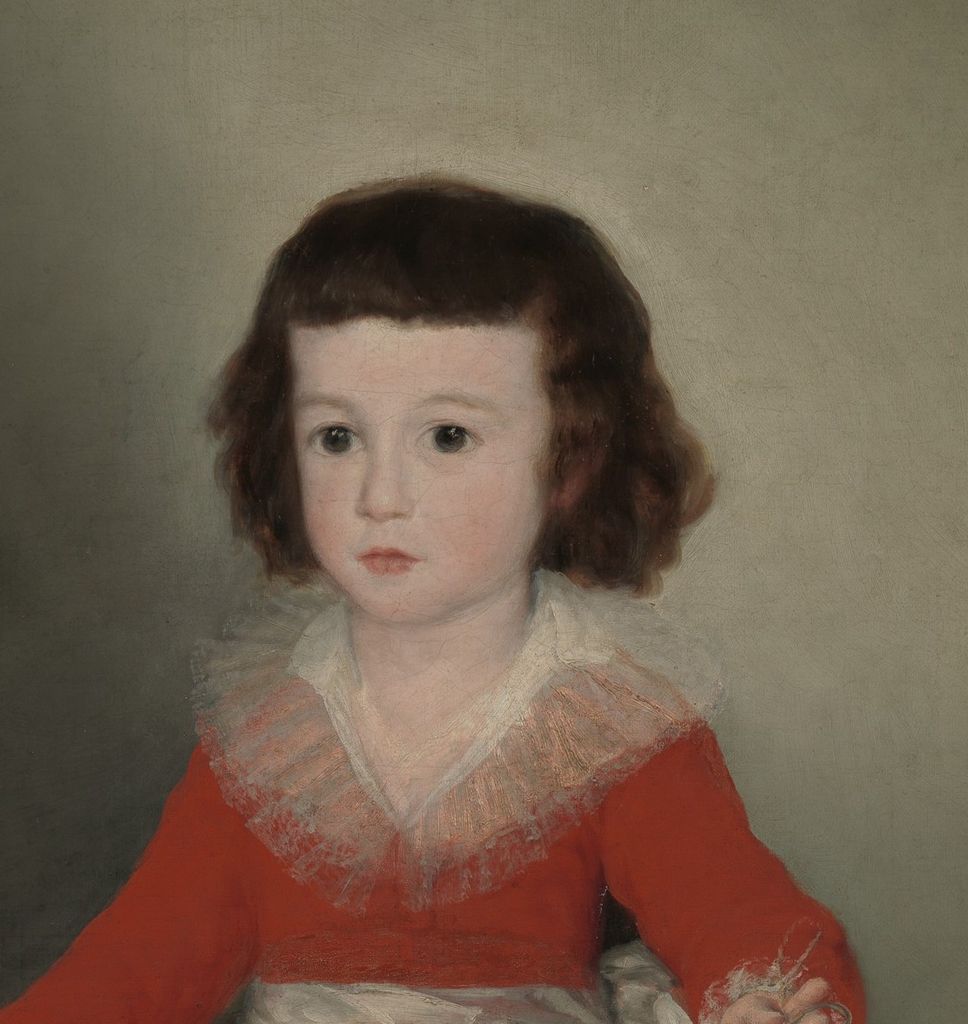
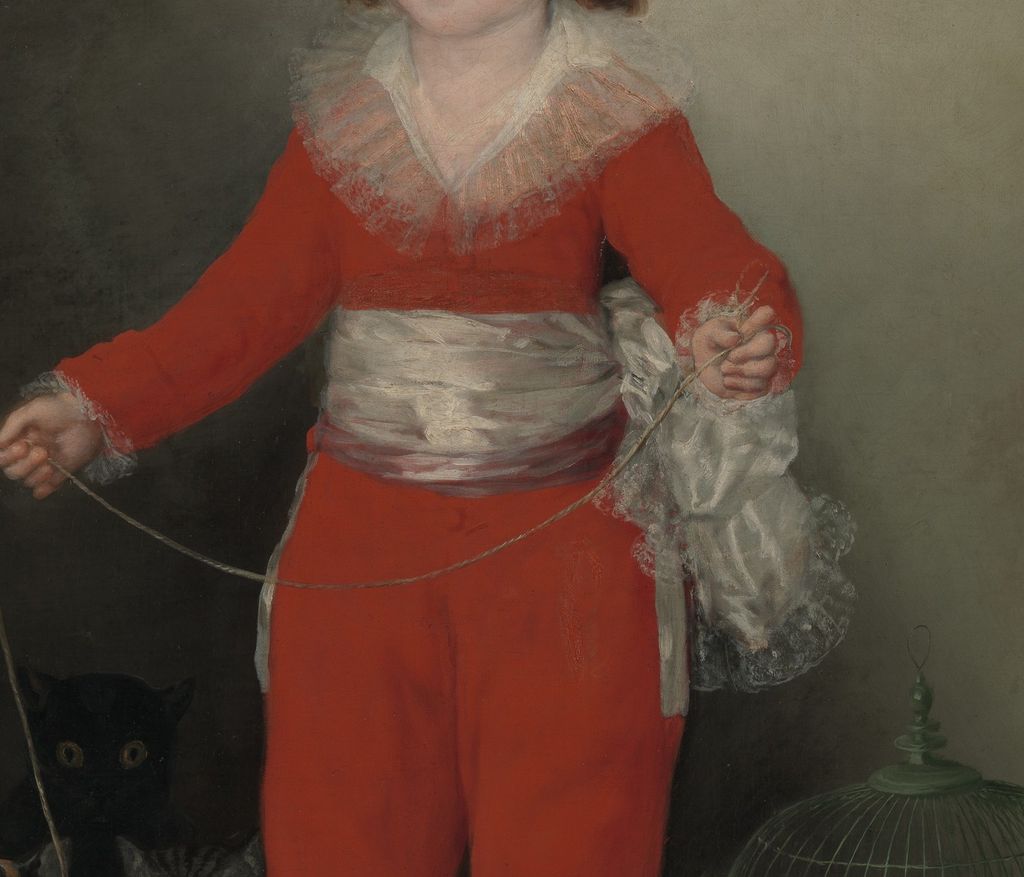
Goya places Manuel’s dark hair against one of the lightest areas of the wall. His face turns a little towards the viewer’s left. Below the chin, a broad lace collar follows the line of the shoulders and makes a deep V against the red. The sash crosses the waist in pale, shiny folds, then gathers into a mass of fabric beside his left hand. There are small white bows on his shoes. Seen from across a room, the clothes make a single long patch of red interrupted at the waist. Up close, the collar, sash and shoes give the red three different edges, from the delicate irregularities of lace at the neck to the blunt ends of the trouser legs just above the floor. [1]
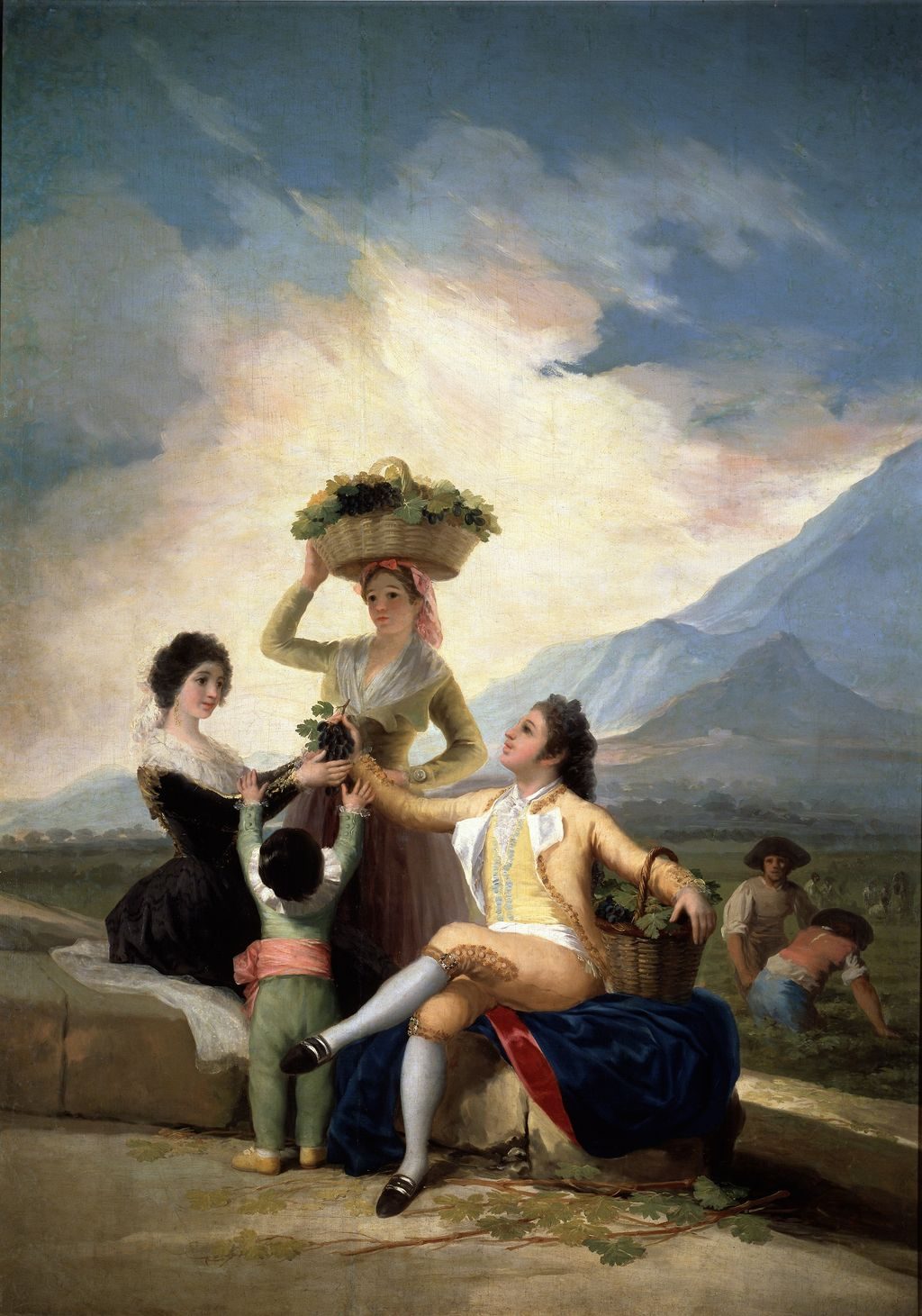
Xavier F. Salomon, writing for the Met’s 2014 exhibition on the Altamiras, identifies the suit and sash as a fashionable ensemble for children in late eighteenth-century Spain. Goya painted a child in a similar outfit in The Grape Harvest, or Autumn. In the tapestry design the child is seen from behind, stretching towards the grapes. The sash is low in the picture, and the reaching arms draw the eye up into the company of adults. In Manuel’s portrait both arms are held below shoulder height and the entire front of the suit is visible. The same fashion gives Goya room to describe two different poses, one of a child straining to reach something and one of a child asked to stand still. [2] [3]
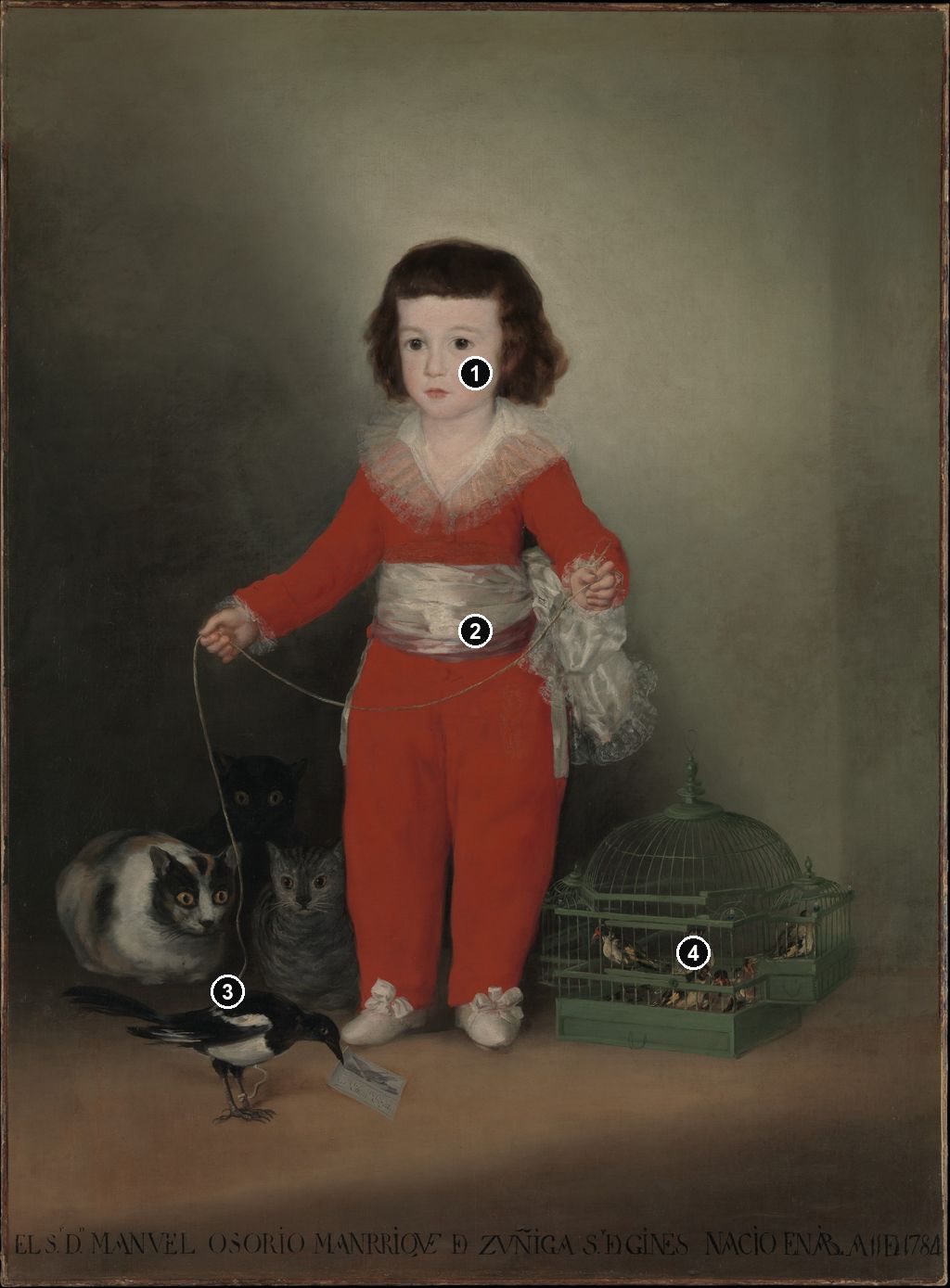
Annotated Details from Manuel Osorio Manrique de Zúñiga
Follow the arrangement of the figures and the details around them.
Details from MANUEL OSORIO MANRIQUE DE ZÚÑIGA
Details from the portrait in the Metropolitan Museum of Art (49.7.41).
The face and collar
The pale face and collar set off the red suit.
The child’s hands
The hands are held apart, with a fine line descending from the hand at left.
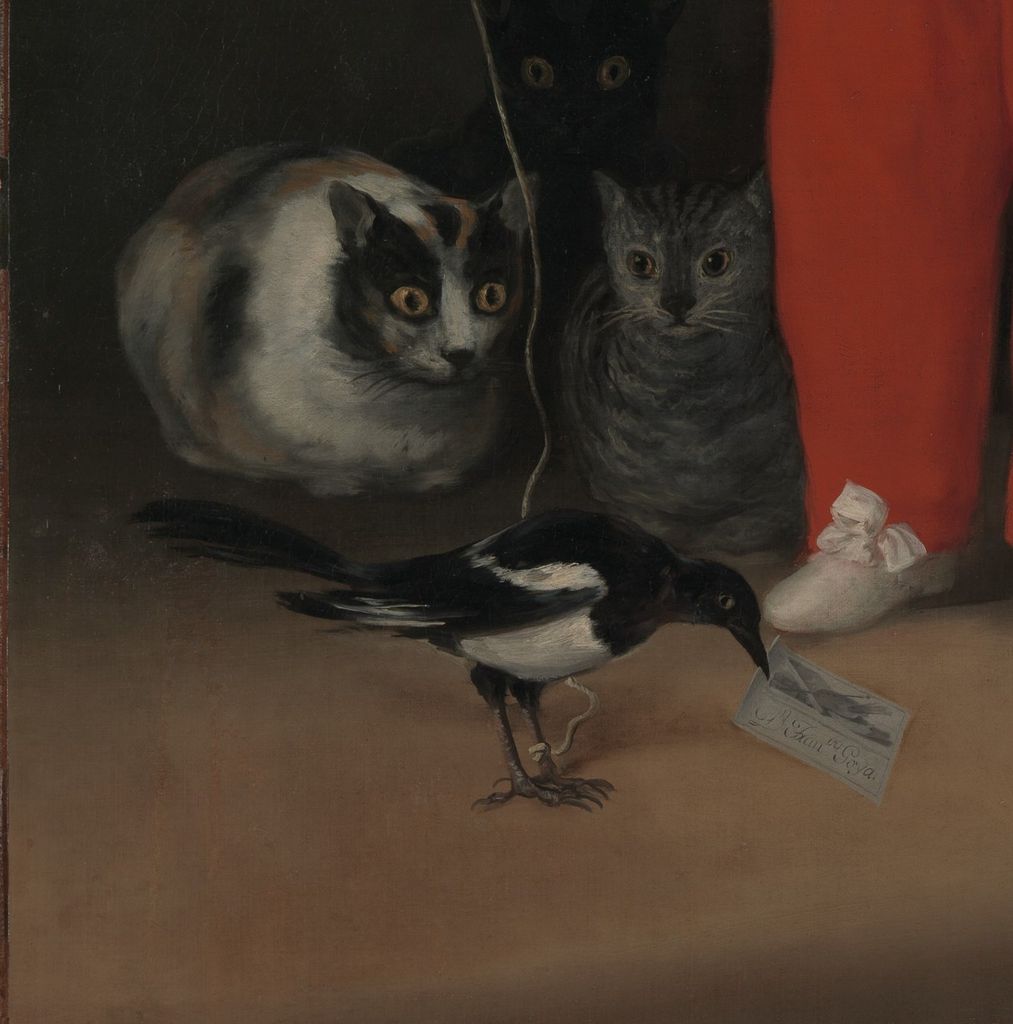
The magpie and the cats
The magpie stands in front of the cats, with a small piece of paper in its beak.
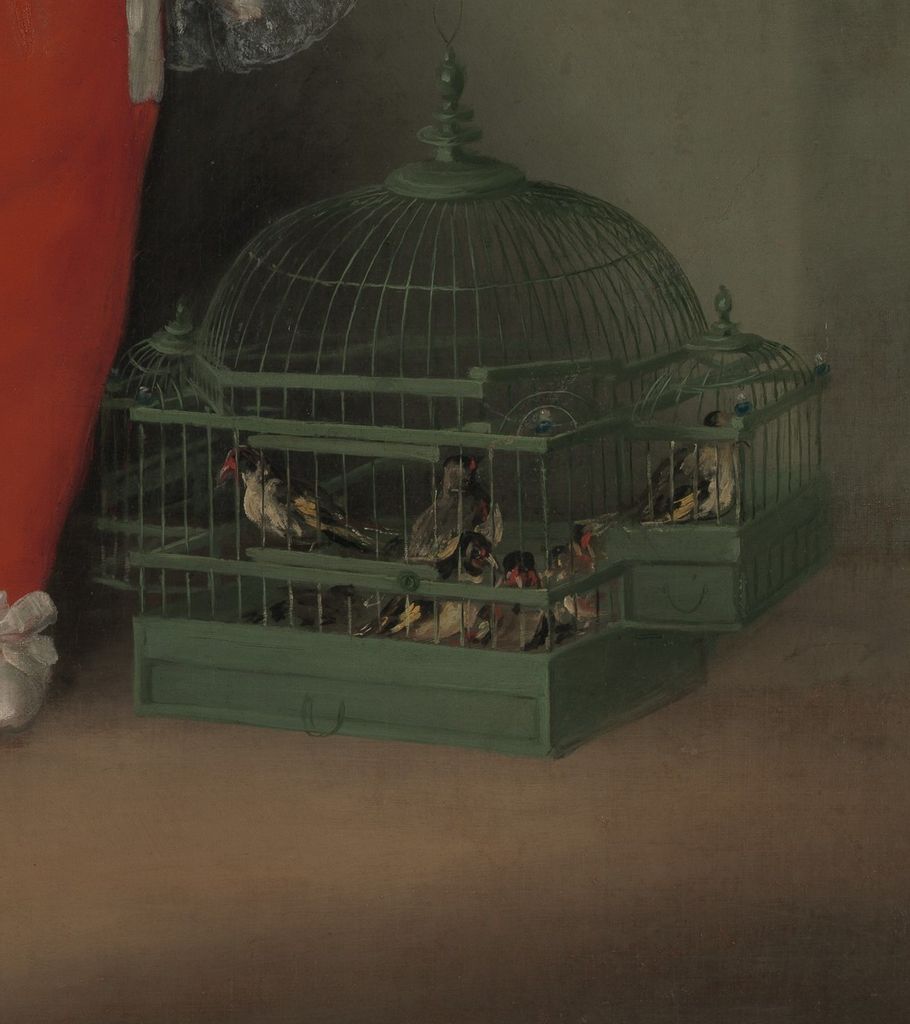
The cage
The bars and domed top set the cage apart from the dark around it.
A magpie with Goya’s signature
The lead nearly disappears where it crosses the dark background. The sag between the boy’s hands is easier to see where it cuts across the red, below the sash. Farther down, the black and white of the magpie’s feathers stand out against the floor, and the paper in its beak hangs at an angle. The Met describes it as Goya’s calling card. The Fundación Goya en Aragón transcribes the signature on it as Dn. Franco Goya, an abbreviated form of the artist’s name. A second, much longer inscription runs along the lower edge of the canvas. It names Manuel, gives his title of señor de Ginés and records his birth in April 1784. To read the painter’s name the viewer has to follow the course of the lead and look where the cats are looking. The sitter’s name is set below the scene, at the edge of the space the animals inhabit. [1] [2] [4]
The three cats and the caged finches
At the far left a mottled cat crouches with its head turned towards the bird. A striped cat sits close to Manuel’s red trouser leg. Behind them the third is almost swallowed by shadow, its eyes the easiest part to pick out. The two more clearly lit cats give the viewer something to recognise at once, and the one in the rear rewards a slower look. All three are packed into the space below Manuel’s extended arm. The magpie has room around its feet and tail, but its thread traces a line back into the space above their heads. [1] [2]
The finches on the other side register in small flashes through upright bars. The cage’s rounded roof and projecting base make it an object with appreciable weight on the floor. The cage encloses several birds at once, while a single line runs from Manuel’s hand to the exposed magpie. The arrangement gives the animals two very different kinds of proximity to the boy and to one another. Manuel stands between the cats and the cage, with one shoe close to the cage’s corner. The colour and scale of the suit hold him in the centre even as the animals draw the eye back and forth at his feet. [1] [2]
Goya on film
Five films explore Goya’s portraits, prints, Black Paintings and painting techniques.
The Duke of Wellington by Goya
The portrait, its military decorations and its later theft.
Watch on YouTubeWhat might the animals mean?
The Met’s collection entry suggests that the animals may evoke the vulnerability of childhood or the transience of youth. That reading starts from a visible feature of the painting. The cats are intent on the magpie, and a viewer can imagine what would happen if one sprang forward. Goya holds the three animals in place and leaves the encounter unresolved. His later print The Sleep of Reason Produces Monsters also uses the fixed attention of a feline. In the 1799 print, the Met identifies the watchful animal as a lynx, and the sleeping figure is surrounded by flying creatures. The two works offer different settings for the animal gaze, a domestic grouping at a child’s feet and the gathering of creatures in a nightmare. [1] [5]
Salomon gives weight to an interpretation by Manuela Mena that relates the pets to Enlightenment ideas about bringing children into contact with nature. On that reading, the animals belong to the boy’s education. The string and the cage show the practical means by which he can keep and handle them. Salomon also looks to older portraits of children with pets, such as Velázquez’s Felipe Próspero, Prince of Asturias, in which a little dog sits beside the prince on a chair. In Manuel’s picture, companionship and the work of keeping animals can be seen in the same group. The cats’ concentrated attention gives that group its particular tension. [2]
The Altamira family portraits
Manuel’s father, Vicente Joaquín Osorio de Moscoso y Guzmán, was the thirteenth Count of Altamira and a director of the Banco de San Carlos. Goya painted him around 1786 for the bank’s assembly hall. In that picture the seated count has writing materials at hand, and the Banco de España records that the bank paid Goya in January 1787 for the count’s portrait and two other commissions together. Salomon traces the family portraits to the commission that followed, for the Altamiras’ palace on the Calle de la Flor Alta in Madrid. [2] [6] [7]
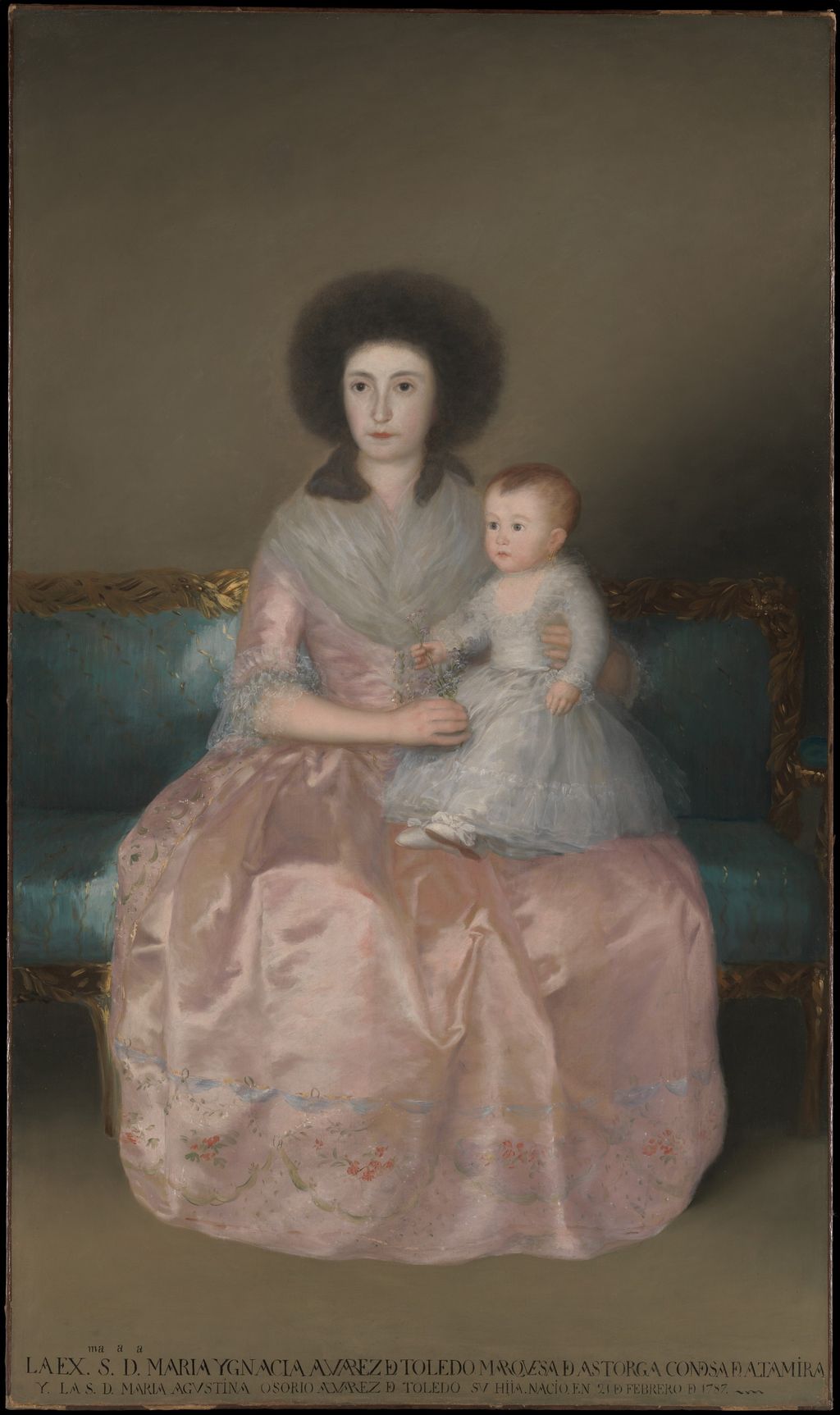
Manuel’s elder brother Vicente, the Count of Trastámara, also appears standing at full length, with an animal beside him. His small dog rises on its hind legs and draws attention back towards the sitter. Vicente wears a wig and the formal clothes of an heir. Manuel’s own hair is visible, and his loose trousers reach to his shoes. Their mother, María Ignacia Álvarez de Toledo, appears with their infant sister María Agustina in a third family portrait. The pink of the countess’s embroidered dress fills much of the canvas, while the child in a white gown rests against her. That quieter relationship between two figures is expressed through the support of the mother’s arm and their closeness on the seat. In Manuel’s portrait, the tether extends his reach well beyond his own body. Both paintings are at the Met, which brought together all four Goya portraits of the family in 2014 and showed them with another Altamira portrait by Agustín Esteve. [2] [7] [8] [9]
A similar red outfit appears a dozen years later in The Family of Charles IV. Salomon compares Manuel’s clothes with those of the young Infante Francisco de Paula, the boy whose hand the queen holds. The prince’s decorations put his red suit among the many signs of rank worn by the royal family. The sash and lace in Manuel’s portrait do more of the work of indicating his place in society. [2]
From Madrid to New York
The 1864 inventory of the Altamira palace still recorded the family portraits made for the house. The count’s bank portrait had its own institutional home, and the likenesses of his wife and children were dispersed in the second half of the nineteenth century. [2] [7]
By 1903 the painting was in the collection of the French playwright Henri Bernstein. In 1924 he used it as part of the set for his play La Galerie des glaces at the Théâtre du Gymnase in Paris, where it hung above a settee. Bernstein sold it to the dealer Joseph Duveen, and it reached the United States in 1926 after Jules Bache bought it. His daughter Kathryn Bache Miller displayed the portrait in her New York apartment. Even after it entered the Met with the Jules Bache Collection in 1949, she kept it at home for part of each year until her death in 1979. [1] [2] [9]
Artworks directory
| Name | Date | Medium |
|---|---|---|
| And There’s No Help for It, Plate 15 | Printed 1863 | |
| Asmodea | c. 1820–23 | Wall painting transferred to canvas |
| Boys Inflating a Bladder | 1777–78 | Tapestry cartoon |
| Boys Picking Fruit | 1778 | Tapestry cartoon |
| Bullfight in a Divided Ring | 1825 | Lithograph |
| Card Players | 1777–78 | Tapestry cartoon |
| Card Players (sketch) | 1777–78 | Painted sketch |
| Dance on the Banks of the Manzanares | 1777 | Tapestry cartoon |
| Duel with Cudgels | c. 1820–23 | Wall painting transferred to canvas |
| Heads in a Landscape | c. 1820–23 | Easel painting |
| Judith and Holofernes | c. 1820–23 | Wall painting transferred to canvas |
| Leocadia | c. 1820–23 | Wall painting transferred to canvas |
| Maja and Cloaked Men | 1777 | Tapestry cartoon |
| Maja and Cloaked Men (sketch) | 1777 | Painted sketch |
| Majo Clapping in Time to the Music | 1777 | Drawing |
| Men Reading | c. 1820–23 | Wall painting transferred to canvas |
| Out Hunting for Teeth, Plate 12 | 1799 | Etching, burnished aquatint and burin |
| Picnic in the Countryside (sketch) | 1776–78 | Painted sketch |
| Picnic on the Banks of the Manzanares | 1776 | Tapestry cartoon |
| Pilgrimage to San Isidro | c. 1820–23 | Wall painting transferred to canvas |
| Preparatory study for The Sleep of Reason Produces Monsters | c. 1796–97 | Drawing |
| Procession of the Holy Office | c. 1820–23 | Wall painting transferred to canvas |
| Quarrel at the Cockerel Inn (sketch) | 1777 | Painted sketch |
| Quarrel in the New Tavern | 1777 | Tapestry cartoon |
| Saturn Devouring His Son | c. 1820–23 | Wall painting transferred to canvas |
| Seated Majo Smoking | c. 1776 | Drawing |
| The Dog | c. 1820–23 | Wall painting transferred to canvas |
| The Drinker | 1777 | Tapestry cartoon |
| The Fates | c. 1820–23 | Wall painting transferred to canvas |
| The Great He-Goat | c. 1820–23 | Wall painting transferred to canvas |
| The Kite | 1777–78 | Tapestry cartoon |
| The Parasol | 1777 | Oil on canvas, tapestry cartoon |
| The Second of May 1808 | 1814 | Oil on canvas |
| The Sleep of Reason Produces Monsters, Plate 43 | 1799 | Etching and aquatint |
| The Third of May 1808 | 1814 | Oil on canvas |
| Thou Who Canst Not, Plate 42 | 1799 | Etching and burnished aquatint |
| Three Figures | 1776 | Drawing (lost) |
| Two Old Men | c. 1820–23 | Wall painting transferred to canvas |
| Two Old Men Eating Soup | c. 1820–23 | Wall painting transferred to canvas |
| Two Women and a Man | c. 1820–23 | Wall painting transferred to canvas |
| Universal Language: The Author Dreaming | 1797 | Drawing |
| The Family of Charles IV | 1800 | Oil on canvas |
| Witches’ Sabbath (Osuna painting) | 1797–98 | Oil on canvas |
| The Nude Maja | 1795–1800 | Oil on canvas |
| The Clothed Maja | 1800–07 | Oil on canvas |
| Self-Portrait (Drawing) | c. 1796 | Brush and carbon black ink on laid paper |
| The Swing, Madrid Album B.21 | 1795–97 | Brush and carbon black washes |
| Majas Fighting, a Majo Observing, Madrid Album B.15 | 1796–97 | Brush, grey and black washes on laid paper |
| Majos and Majas Conversing, Madrid Album B.16 | c. 1794–97 | Ink wash on paper |
| Weeping Woman and Three Men, Madrid Album B.17 | 1795–97 | Brush, carbon black washes and black chalk |
| Maja Seated on a Chair and Two Companions Behind, Madrid Album B.18 | 1795–97 | Brush and carbon black washes |
| Girl and Bull, Madrid Album B.23 | 1796–97 | Brush and carbon black washes |
| Lovers Sitting on a Rock, Madrid Album B.24 | 1796–97 | Brush and carbon black washes |
| Mariano Ceballos Riding a Bull | 1825 | Crayon lithograph and scraper |
| Landscape (lifetime impression) | c. 1807–10 | Etching and aquatint |
| Self-Portrait (1815), Prado canvas | 1815 | Oil on canvas |
| Self-Portrait (1815), Academy panel | 1815 | Oil on panel |
| Self-Portrait with Dr Arrieta | 1820 | Oil on canvas |
| Christ Crucified | 1780 | Oil on canvas |
| The Last Communion of Saint Joseph of Calasanz | 1819 | Oil on canvas |
| Christ on the Mount of Olives | 1819 | Oil on panel |
| The Flower Girls, or Spring | 1786–87 | Oil on canvas |
| The Grape Harvest, or Autumn | 1786–87 | Oil on canvas |
| The Snowstorm, or Winter | 1786–87 | Oil on canvas |
| The Threshing Ground, or Summer | 1786–87 | Oil on canvas |
| Picnic on the Banks of the Manzanares | 1776 | Oil on canvas |
| The Kite | 1777–78 | Oil on canvas |
| Dance on the Banks of the Manzanares | 1777 | Oil on canvas |
| A Fight at the Venta Nueva | 1777 | Oil on canvas |
| Blind Man’s Bluff | 1788 | Oil on canvas |
| Dogs on a Lead | 1775 | Oil on canvas |
| Hunting with a Decoy | 1775 | Oil on canvas |
| Hunter Loading His Rifle | 1775 | Oil on canvas |
| The Angler | 1775 | Oil on canvas |
| The Hermitage of San Isidro on His Feast Day | 1788 | Oil on canvas |
| The Meadow of San Isidro | 1788 | Oil on canvas |
| The Straw Manikin | 1791–92 | Oil on canvas |
| Witches’ Flight | c. 1797–98 | Oil on canvas |
| A Scene from ‘The Forcibly Bewitched’ | 1798 | Oil on canvas |
| The Duchess of Alba in Black | 1797 | Oil on canvas |
| The Duchess of Alba in White | 1795 | Oil on canvas |
| Charles III in Hunting Dress | c. 1786 | Oil on canvas |
| The Duke and Duchess of Osuna and Their Children | 1787–88 | Oil on canvas |
| Manuel Osorio Manrique de Zúñiga | 1787–88 | Oil on canvas |
| The Marquesa de Pontejos | c. 1786 | Oil on canvas |
| Equestrian Portrait of the 1st Duke of Wellington | 1812 | Oil on canvas |
| The Duke of Wellington | 1812–14 | Oil on wood |
| Portrait of Ferdinand VII of Spain | 1814 | Oil on canvas |
| Gaspar Melchor de Jovellanos | 1798 | Oil on canvas |
| María Tomasa Palafox y Portocarrero | 1804 | Oil on canvas |
| Señora Sabasa García | c. 1806–11 | Oil on canvas |
| Don Juan Bautista de Muguiro | 1827 | Oil on canvas |
| Doña Isabel de Porcel | Before 1805 | Oil on canvas |
| The Colossus | After 1808 | Oil on canvas |
| The Burial of the Sardine | 1808–12 | Oil on panel |
| The Madhouse | 1808–12 | Oil on panel |
| A Procession of Flagellants | 1808–12 | Oil on panel |
| Portrait of Jacques Galos | 1826 | Oil on canvas |
| Portrait of Mariano Goya, the Artist’s Grandson | 1827 | Oil on canvas |
| Milkmaid of Bordeaux | c. 1827 | Oil on canvas |
| Portrait of Don Juan Antonio Cuervo | 1819 | Oil on canvas |
| María Luisa of Parma (Naples version) | c. 1800 | Oil on canvas |
| The Countess of Baena | 1819 | Oil on canvas |
| The Family of the Infante Don Luis | 1783–84 | Oil on canvas |
| The Holy Family | c. 1787 | Oil on canvas |
| Saint Barbara | c. 1773 | Oil on canvas |
| Saints Justa and Rufina | 1817 | Oil on canvas |
| El Tío Paquete | c. 1819–20 | Oil on canvas |
| The Forge | c. 1815–20 | Oil on canvas |
| Majas on a Balcony (Metropolitan Museum version) | c. 1800–10 | Oil on canvas |
| Maja and Celestina on a Balcony | c. 1808–12 | Oil on canvas |
| The Water Bearer | 1808–12 | Oil on canvas |
| Time and the Old Women | c. 1810 | Oil on canvas |
Frequently Asked Questions
On the 1787–88 dating he was about three or four. He was born in April 1784 and died in June 1792 at the age of eight. Salomon uses his apparent age alongside the dating of the other Altamira portraits to support the earlier date. The Met’s Spanish page still gives a possible date after his death. [1] [2] [10]
Discussion
Look again at the images and ideas explored in Manuel Osorio Manrique de Zúñiga. These editorial prompts invite your observations.
Look at the place where the thin lead crosses the red suit, then follow it to the magpie. What makes the scene feel like play, and where does that impression begin to change?
Reader Insights
Where does Goya draw your attention first?
How does the companion work handle its figures?
Join the Conversation
Share a detail, comparison or question about Manuel Osorio Manrique de Zúñiga below.
References
- The Metropolitan Museum of Art, Manuel Osorio Manrique de Zuñiga (1784–1792), collection record for 49.7.41 and audio transcript. View source.
- Xavier F. Salomon, Goya and the Altamira Family, The Metropolitan Museum of Art Bulletin 71, no. 4 (2014), pp. 4–6, 33–40 and 45–47. View source.
- Fundación Goya en Aragón, La vendimia, catalogue entry for the Prado tapestry cartoon, P000795. View source.
- Fundación Goya en Aragón, Manuel Osorio Manrique de Zúñiga, catalogue entry and inscription transcriptions. View source.
- The Metropolitan Museum of Art, The Sleep of Reason Produces Monsters, collection record for plate 43 of Los Caprichos, 18.64(43). View source.
- Manuela Mena, Vicente Joaquín Osorio de Moscoso y Guzmán, XIII Count of Altamira, Banco de España collection record, P_132. View source.
- Xavier F. Salomon, ‘Another Brother for Goya’s “Red Boy”’, Metropolitan Museum Journal 49 (2014), pp. 201–205, especially figs. 2–4. View source.
- The Metropolitan Museum of Art, Condesa de Altamira and Her Daughter, María Agustina, collection record for 1975.1.148. View source.
- The Metropolitan Museum of Art, Goya and the Altamira Family, exhibition overview, 2014. View source.
- The Metropolitan Museum of Art, Manuel Osorio Manrique de Zúñiga (1784–1792), Spanish-language collection record for 49.7.41. View source.







