


 by Tom Gurney
Tom Gurney BSc (Hons) is an art history expert with over 20 years experience
Published on June 19, 2020 / Updated on November 20, 2026
Email: tomgurney1@gmail.com / Phone: +44 7429 011000
Introduction
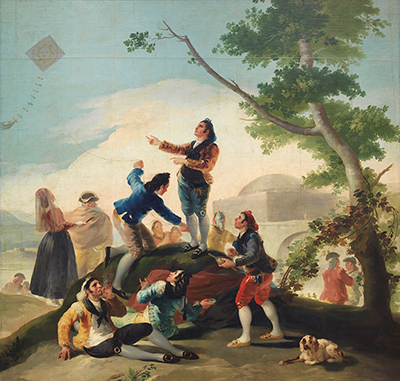
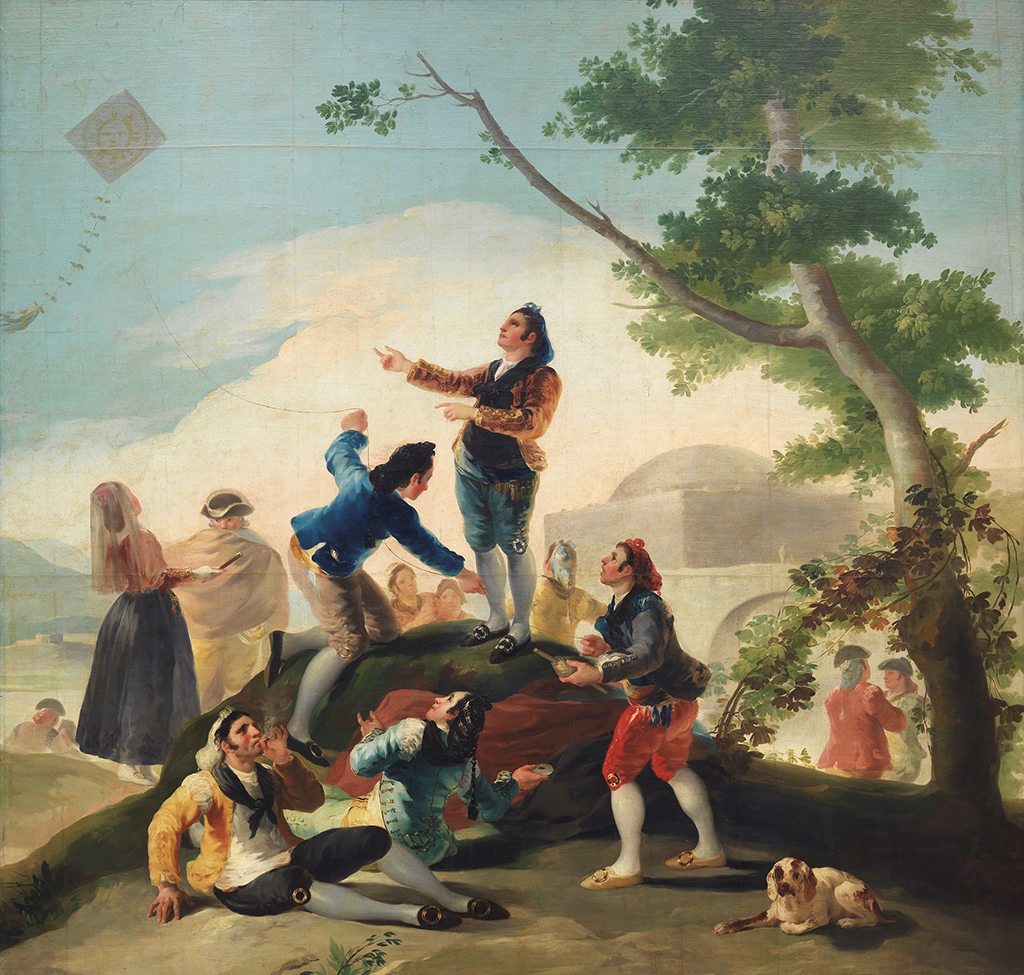
A young man stands on a grassy rise and points into the open sky. Below him, another man in a blue jacket lifts a fist, and a thin line curves away from it towards a kite in the upper left. The group includes a smoker, several onlookers and a dog resting in the shade. Francisco de Goya painted The Kite, or La cometa, in 1777–78 as a full-size design for a tapestry in the dining room of the Prince and Princess of Asturias at the Royal Palace of El Pardo. The oil painting is now in the Museo Nacional del Prado in Madrid. [1] [2]
At a Glance
- ArtistFrancisco José de Goya y Lucientes.
- Date1777–78. [1]
- MediumOil on canvas, painted as a tapestry cartoon. [1] [2]
- Size269 × 285 cm, height by width. [1] [2]
- SeriesTen tapestry designs for the dining room of the Prince and Princess of Asturias at El Pardo. [1] [2]
- CollectionMuseo Nacional del Prado, Madrid, P000774. [1] [2]
Works across Goya’s career
The Parasol
1777The Kite
1777–78The Nude Maja
1795–1800Saturn Devouring His Son
c. 1820–23The Dog
c. 1820–23Following the kite string
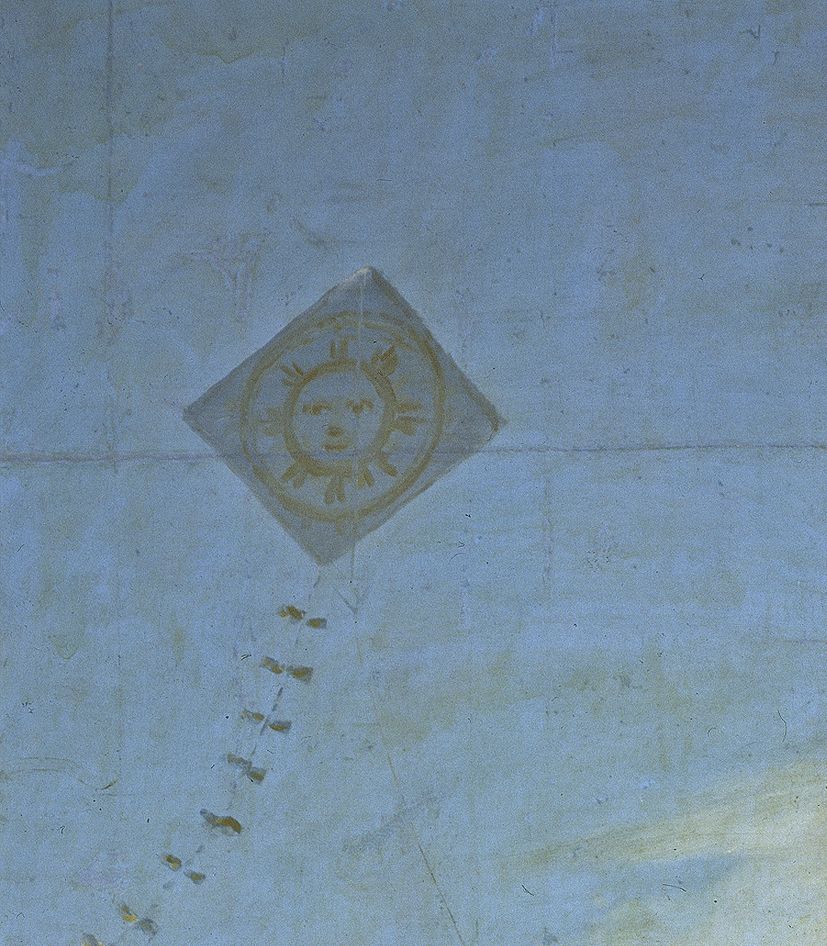
The kite is a pale diamond with a round, sunlike design in the middle. The bows on its tail mark a second line that swings towards the left edge. Look between the tail and the man in blue for the thread itself. It hangs in a shallow curve, clear against a bright cloud near the man's fist and harder to follow further up. The standing man beside him gives the eye a wider and more legible path across the same patch of sky. He lifts his chin and extends his index finger, with one foot set further forward on the mound. From across a room, his arm would be easier to see than the narrow line of the string. [1]
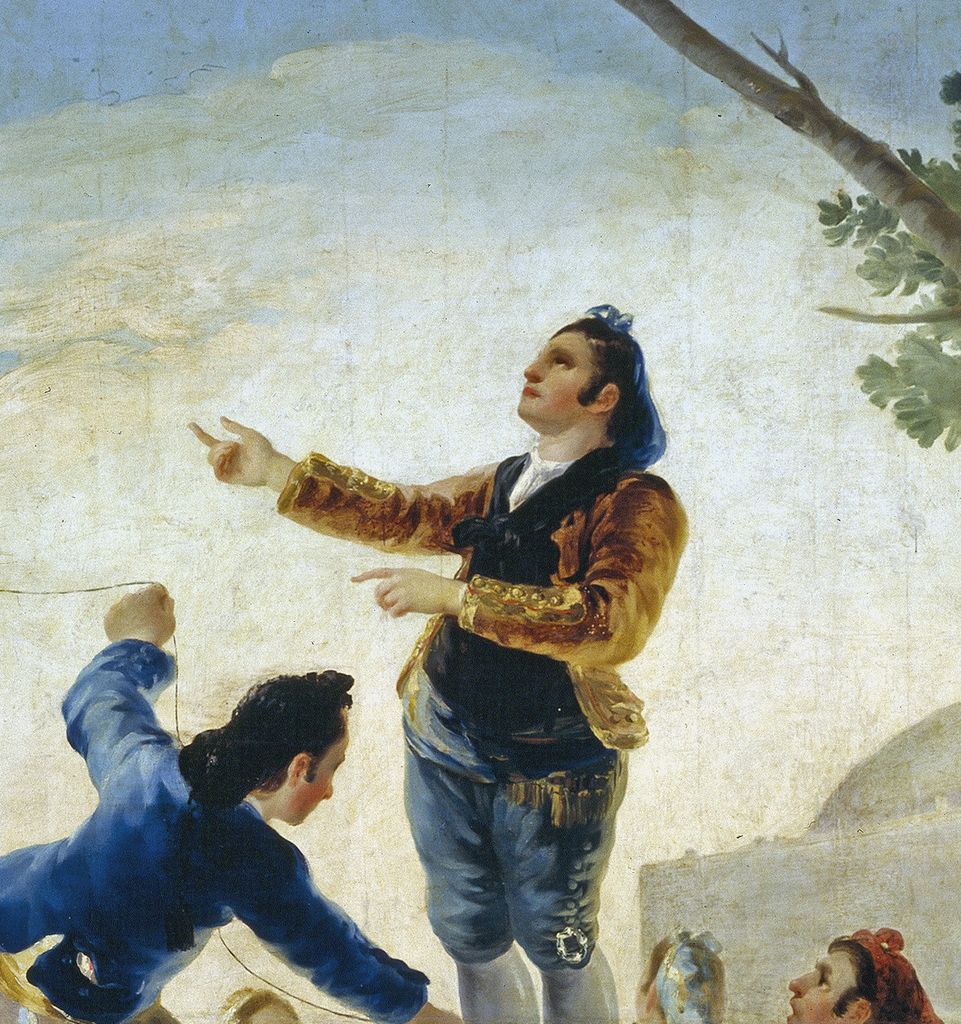
The man in blue has one knee against the slope and his other arm stretched out across it. His pose turns the pull on the line into something you can see in the arrangement of his shoulders. The man below him in red breeches looks up, with his knees bent and his hands poised over the rise. Between them, the upright figure reaches across his body with his lower hand as his other hand points into the sky. Their sleeves give three different directions to the game. One arm lifts, another reaches forward, and the pointing finger sends the eye out of the group altogether. [1]
The hill makes room for several people to take part at once. The Fundación Goya en Aragón relates the arrangement to the pyramidal composition recommended by Anton Raphael Mengs. The low foreground figures form a broad base and the standing man rises above them. A second set of figures shows between shoulders and legs just beyond the crest. Then the tree provides a much larger diagonal. Its trunk climbs out of the right-hand edge of the action, and a long branch bends left over the group. The gap between the branch and the kite leaves an area of open sky in which the little diamond can be seen. [1]
Annotated Details from The Kite
Trace the space from the pointing figure to the kite and compare the poses below.
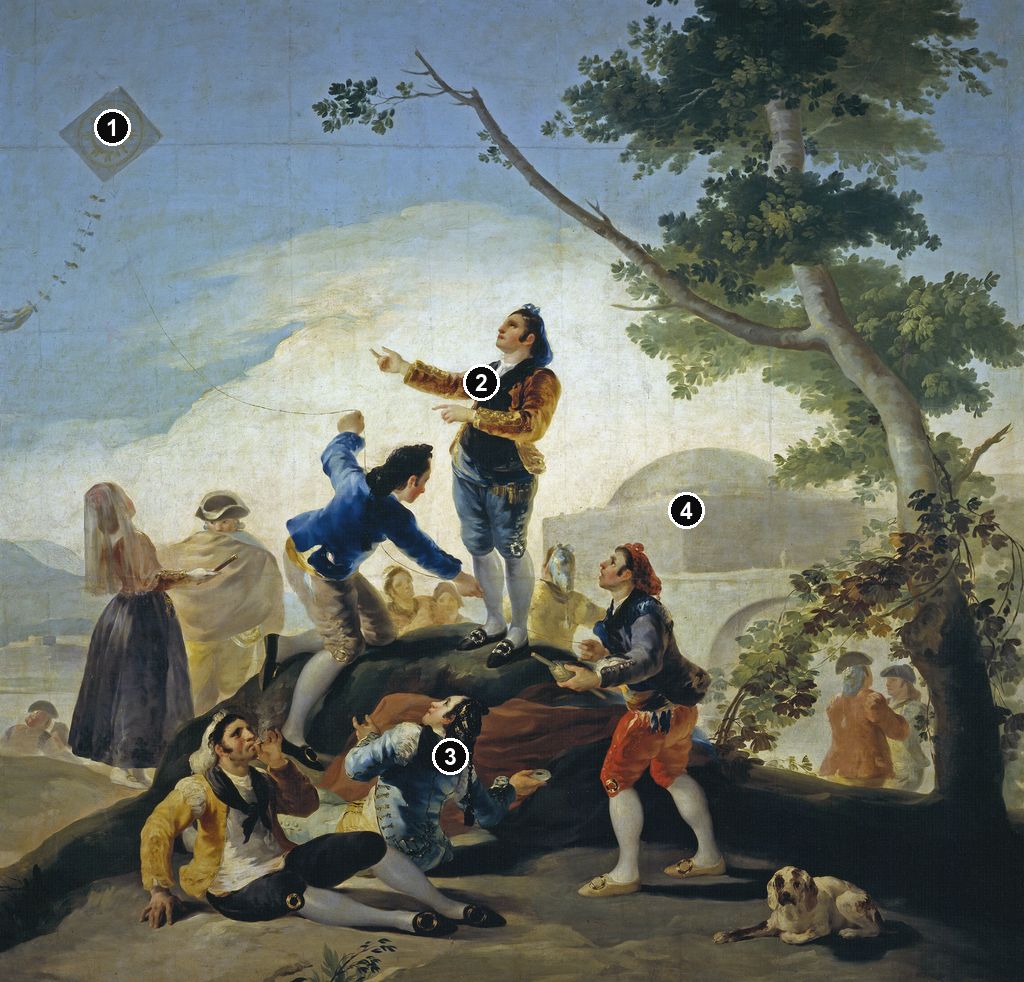
Details from THE KITE
Details from the tapestry cartoon in the Museo Nacional del Prado (P000774).
The kite and its tail
The kite appears high at the left, with its tail trailing down across the sky.
The pointing figure
A standing man raises one arm towards the left, and his face turns the same way.
The figures on the slope
Seated and reclining people fill the darker strip below the standing figures.
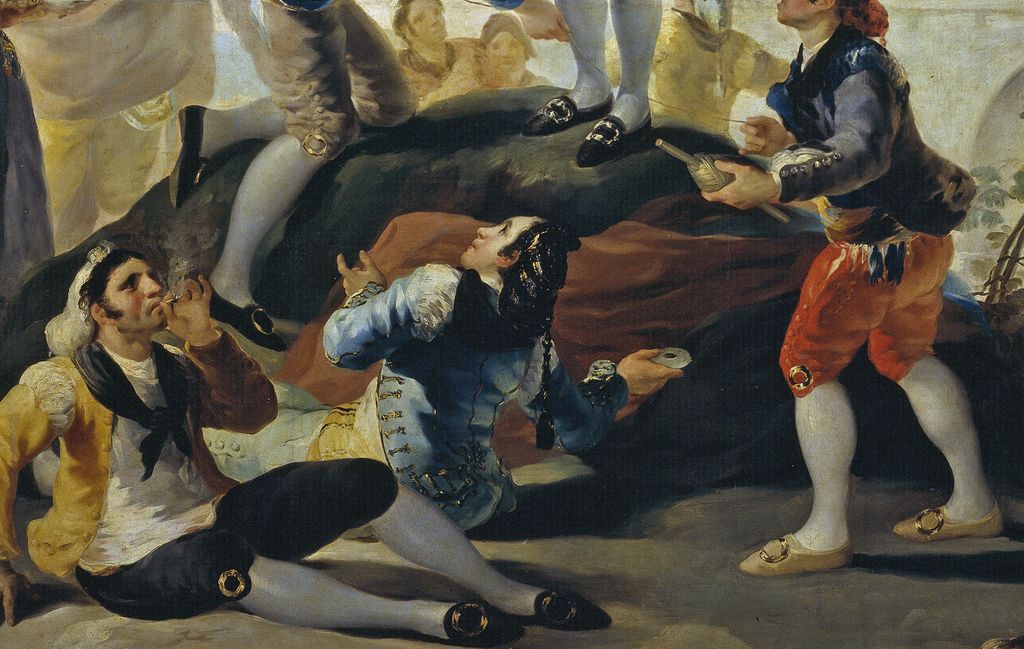
The rounded structure
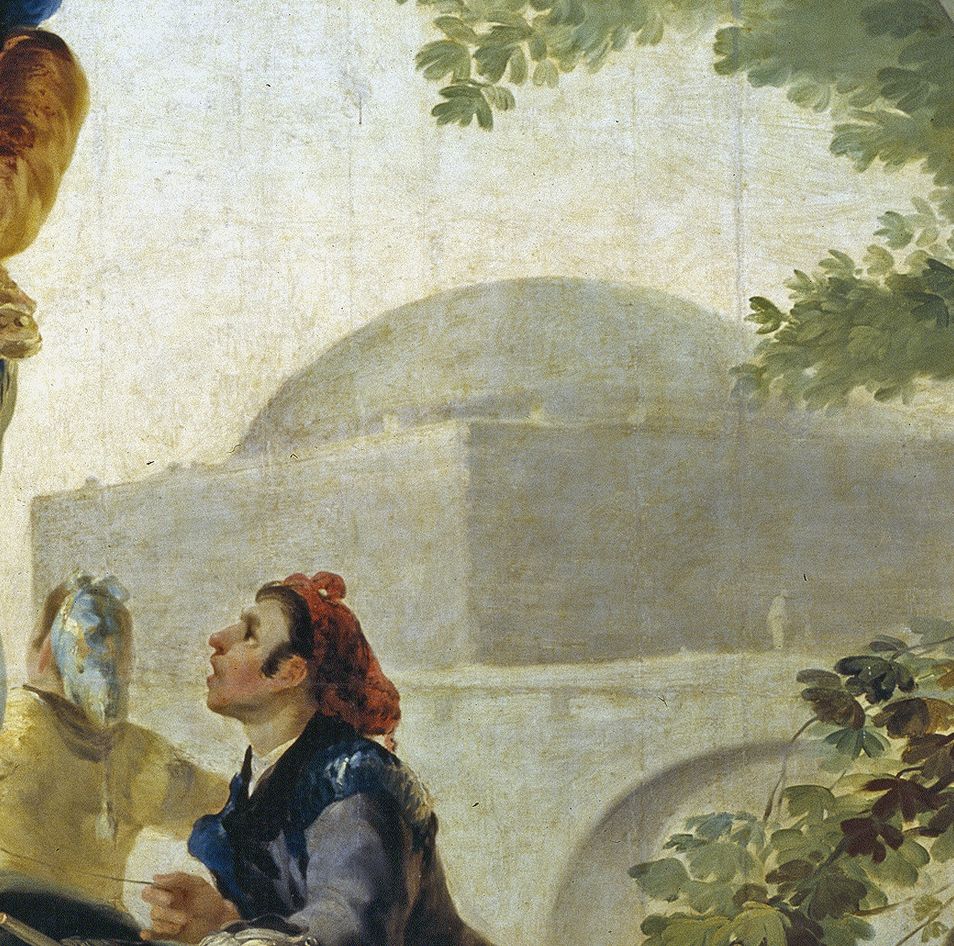
The rounded form behind the group is set against a pale opening in the landscape.
The watchers on the ground
The seated man at lower left plants a hand on the earth and brings a cigarette to his lips with the other. One leg crosses the other, with a buckle catching the light at his knee. The smoker's face tilts up, but his arm and long stretch of pale stocking follow the ground. Behind him, a man in a greenish blue jacket leans back to look up, his elbows bent and his dark braid falling towards the ground. The two relaxed figures put the exertion of the man handling the line in perspective. The outing leaves room to watch the game, join it, or simply sit close enough to follow it. [1] [3]
Beyond the rise, the gathering breaks into smaller encounters. On the left, a woman with a dark skirt and a veil holds a fan beside a man wrapped in a light cloak. On the right, two figures face one another below the tree. Several distant heads appear where the ground hides the bodies. These people give the outing a life beyond the kite. Bright red, blue and yellow catch the eye in the foreground, while the colours fade among the further figures. The dog lies at the base of the tree and turns its face outwards, in the viewer's direction. Its short, low silhouette answers the upright figure at the crest from the opposite end of the composition. [1] [3]
Goya on film
Five films explore Goya’s portraits, prints, Black Paintings and painting techniques.
The Duke of Wellington by Goya
The portrait, its military decorations and its later theft.
Watch on YouTubeThe dome in the distance
Beyond the standing men, a dome and a long pale wall emerge from the light. The older Prado catalogue identifies the building as San Francisco el Grande under construction. The Fundación Goya en Aragón notes a problem with that reading. In Dance on the Banks of the Manzanares, a cartoon delivered earlier in the series, Goya had already shown the church as complete. The Fundación also discusses the possibility that the dome evokes an astronomical observatory, a project debated at the court of Charles III. Work on Juan de Villanueva's building for the Madrid observatory began in 1790, more than a decade after Goya delivered this cartoon. If the building alludes to the project, Goya pictured an idea that had yet to become a finished landmark. [1] [2] [4]
The historian Janis A. Tomlinson reads the connection between an observatory and a kite, which could also be used in scientific experiments, in terms of vanitas, a tradition that calls attention to the limits of human endeavour. That reading gives the distant dome a role in the picture's meaning. In his account of the cartoon, Goya describes five young men out in the country with a kite, one of them watching with a cigarette in his mouth. He counts thirteen figures across the foreground and distance, including a young lady and a fashionably dressed man. He mentions the building among the elements of the landscape without identifying it. [1] [10]
A place on the north wall at El Pardo
Goya signed his account to the royal architect Francisco Sabatini on 26 January 1778. It lists The Kite first, followed by The Card Players, Children Blowing Up a Bladder and Boys Picking Fruit, and gives a value of 7,000 reales de vellón for The Kite. The Fundación Goya en Aragón dates the delivery of the four cartoons to the Royal Tapestry Factory of Santa Bárbara to the same day, as does Aureliano de Beruete y Moret. The Prado's older printed catalogue gives 25 January for the handover. The previous batch was delivered on 12 August 1777, giving the Fundación its starting point for the date of the painting. [1] [2] [5] [10]
Goya's account specifies the room where the Prince and Princess of Asturias dined at El Pardo. The couple were the future Charles IV and his wife, María Luisa of Parma. The Fundación locates the woven Kite at the centre of the north wall. The Prado's description places it between the windows. The two smaller scenes of children from the January delivery were designed for spaces above doors on that wall. A piece more than two and a half metres tall gave Goya space for a whole hillside of figures between the windows, while the overdoors called for scenes on a smaller scale. [1] [3] [6] [7] [10]
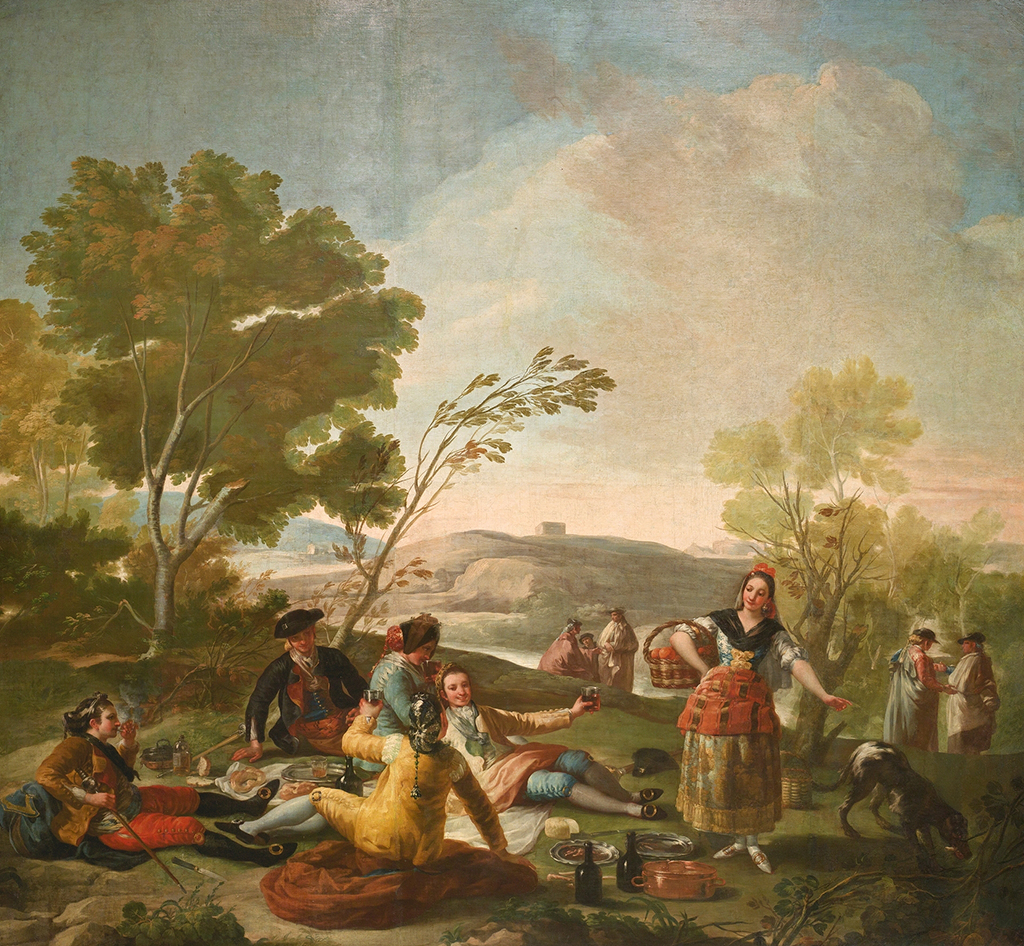
The Picnic on the Banks of the Manzanares was delivered in October 1776 for the same room. In that scene a group of young men sits around food, bottles and plates, and a woman selling oranges stands nearby. Both designs use uneven ground to place smaller groups behind the main action. In The Picnic, the people and still life draw the eye inward at ground level. In The Kite, a high hand and an elevated figure direct it up through the open sky. The two landscapes offer different ways to follow a gathering from a distance. [1] [8]
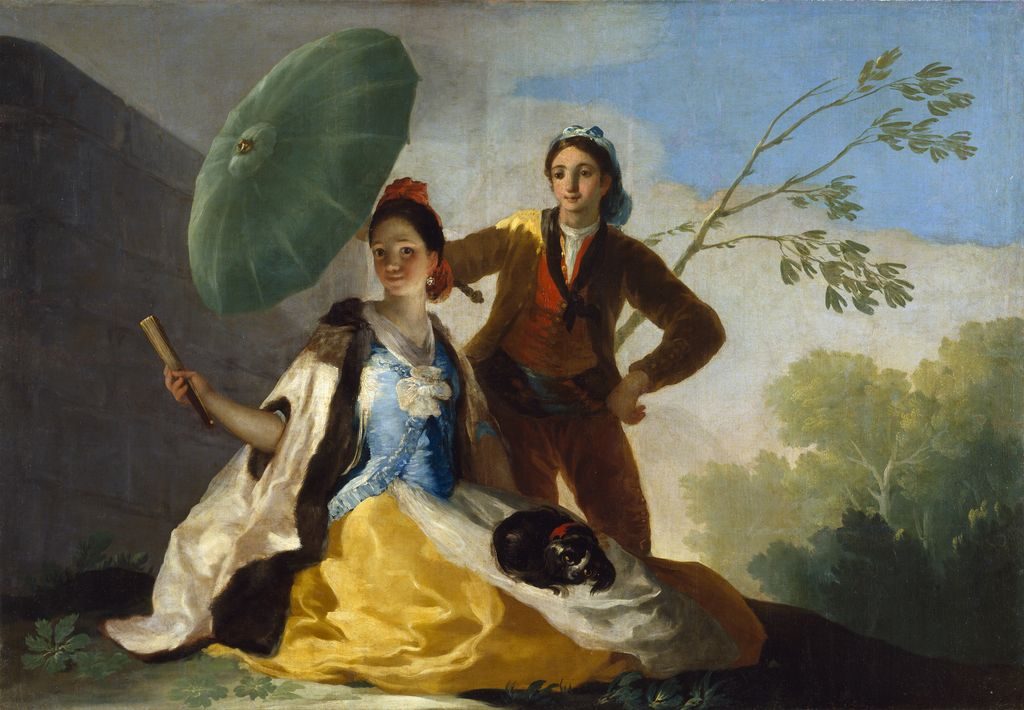
The painting and the woven hanging
The Prado canvas was the model for the weavers. Patrimonio Nacional records a silk-and-wool La cometa from the Madrid tapestry factory, inventory 10005774, dated 1778–1801 and measuring 284 × 278 cm. Beruete records three tapestries woven from the design. The Prado's historical catalogue also records a woven example at El Escorial. The oil cartoon followed a separate path. It passed from the factory to the Royal Palace in Madrid in about 1856 or 1857 and entered the Prado in 1870. [1] [2] [5] [9]
Artworks directory
| Name | Date | Medium |
|---|---|---|
| And There’s No Help for It, Plate 15 | Printed 1863 | |
| Asmodea | c. 1820–23 | Wall painting transferred to canvas |
| Boys Inflating a Bladder | 1777–78 | Tapestry cartoon |
| Boys Picking Fruit | 1778 | Tapestry cartoon |
| Bullfight in a Divided Ring | 1825 | Lithograph |
| Card Players | 1777–78 | Tapestry cartoon |
| Card Players (sketch) | 1777–78 | Painted sketch |
| Dance on the Banks of the Manzanares | 1777 | Tapestry cartoon |
| Duel with Cudgels | c. 1820–23 | Wall painting transferred to canvas |
| Heads in a Landscape | c. 1820–23 | Easel painting |
| Judith and Holofernes | c. 1820–23 | Wall painting transferred to canvas |
| Leocadia | c. 1820–23 | Wall painting transferred to canvas |
| Maja and Cloaked Men | 1777 | Tapestry cartoon |
| Maja and Cloaked Men (sketch) | 1777 | Painted sketch |
| Majo Clapping in Time to the Music | 1777 | Drawing |
| Men Reading | c. 1820–23 | Wall painting transferred to canvas |
| Out Hunting for Teeth, Plate 12 | 1799 | Etching, burnished aquatint and burin |
| Picnic in the Countryside (sketch) | 1776–78 | Painted sketch |
| Picnic on the Banks of the Manzanares | 1776 | Tapestry cartoon |
| Pilgrimage to San Isidro | c. 1820–23 | Wall painting transferred to canvas |
| Preparatory study for The Sleep of Reason Produces Monsters | c. 1796–97 | Drawing |
| Procession of the Holy Office | c. 1820–23 | Wall painting transferred to canvas |
| Quarrel at the Cockerel Inn (sketch) | 1777 | Painted sketch |
| Quarrel in the New Tavern | 1777 | Tapestry cartoon |
| Saturn Devouring His Son | c. 1820–23 | Wall painting transferred to canvas |
| Seated Majo Smoking | c. 1776 | Drawing |
| The Dog | c. 1820–23 | Wall painting transferred to canvas |
| The Drinker | 1777 | Tapestry cartoon |
| The Fates | c. 1820–23 | Wall painting transferred to canvas |
| The Great He-Goat | c. 1820–23 | Wall painting transferred to canvas |
| The Kite | 1777–78 | Tapestry cartoon |
| The Parasol | 1777 | Oil on canvas, tapestry cartoon |
| The Second of May 1808 | 1814 | Oil on canvas |
| The Sleep of Reason Produces Monsters, Plate 43 | 1799 | Etching and aquatint |
| The Third of May 1808 | 1814 | Oil on canvas |
| Thou Who Canst Not, Plate 42 | 1799 | Etching and burnished aquatint |
| Three Figures | 1776 | Drawing (lost) |
| Two Old Men | c. 1820–23 | Wall painting transferred to canvas |
| Two Old Men Eating Soup | c. 1820–23 | Wall painting transferred to canvas |
| Two Women and a Man | c. 1820–23 | Wall painting transferred to canvas |
| Universal Language: The Author Dreaming | 1797 | Drawing |
| The Family of Charles IV | 1800 | Oil on canvas |
| Witches’ Sabbath (Osuna painting) | 1797–98 | Oil on canvas |
| The Nude Maja | 1795–1800 | Oil on canvas |
| The Clothed Maja | 1800–07 | Oil on canvas |
| Self-Portrait (Drawing) | c. 1796 | Brush and carbon black ink on laid paper |
| The Swing, Madrid Album B.21 | 1795–97 | Brush and carbon black washes |
| Majas Fighting, a Majo Observing, Madrid Album B.15 | 1796–97 | Brush, grey and black washes on laid paper |
| Majos and Majas Conversing, Madrid Album B.16 | c. 1794–97 | Ink wash on paper |
| Weeping Woman and Three Men, Madrid Album B.17 | 1795–97 | Brush, carbon black washes and black chalk |
| Maja Seated on a Chair and Two Companions Behind, Madrid Album B.18 | 1795–97 | Brush and carbon black washes |
| Girl and Bull, Madrid Album B.23 | 1796–97 | Brush and carbon black washes |
| Lovers Sitting on a Rock, Madrid Album B.24 | 1796–97 | Brush and carbon black washes |
| Mariano Ceballos Riding a Bull | 1825 | Crayon lithograph and scraper |
| Landscape (lifetime impression) | c. 1807–10 | Etching and aquatint |
| Self-Portrait (1815), Prado canvas | 1815 | Oil on canvas |
| Self-Portrait (1815), Academy panel | 1815 | Oil on panel |
| Self-Portrait with Dr Arrieta | 1820 | Oil on canvas |
| Christ Crucified | 1780 | Oil on canvas |
| The Last Communion of Saint Joseph of Calasanz | 1819 | Oil on canvas |
| Christ on the Mount of Olives | 1819 | Oil on panel |
| The Flower Girls, or Spring | 1786–87 | Oil on canvas |
| The Grape Harvest, or Autumn | 1786–87 | Oil on canvas |
| The Snowstorm, or Winter | 1786–87 | Oil on canvas |
| The Threshing Ground, or Summer | 1786–87 | Oil on canvas |
| Picnic on the Banks of the Manzanares | 1776 | Oil on canvas |
| The Kite | 1777–78 | Oil on canvas |
| Dance on the Banks of the Manzanares | 1777 | Oil on canvas |
| A Fight at the Venta Nueva | 1777 | Oil on canvas |
| Blind Man’s Bluff | 1788 | Oil on canvas |
| Dogs on a Lead | 1775 | Oil on canvas |
| Hunting with a Decoy | 1775 | Oil on canvas |
| Hunter Loading His Rifle | 1775 | Oil on canvas |
| The Angler | 1775 | Oil on canvas |
| The Hermitage of San Isidro on His Feast Day | 1788 | Oil on canvas |
| The Meadow of San Isidro | 1788 | Oil on canvas |
| The Straw Manikin | 1791–92 | Oil on canvas |
| Witches’ Flight | c. 1797–98 | Oil on canvas |
| A Scene from ‘The Forcibly Bewitched’ | 1798 | Oil on canvas |
| The Duchess of Alba in Black | 1797 | Oil on canvas |
| The Duchess of Alba in White | 1795 | Oil on canvas |
| Charles III in Hunting Dress | c. 1786 | Oil on canvas |
| The Duke and Duchess of Osuna and Their Children | 1787–88 | Oil on canvas |
| Manuel Osorio Manrique de Zúñiga | 1787–88 | Oil on canvas |
| The Marquesa de Pontejos | c. 1786 | Oil on canvas |
| Equestrian Portrait of the 1st Duke of Wellington | 1812 | Oil on canvas |
| The Duke of Wellington | 1812–14 | Oil on wood |
| Portrait of Ferdinand VII of Spain | 1814 | Oil on canvas |
| Gaspar Melchor de Jovellanos | 1798 | Oil on canvas |
| María Tomasa Palafox y Portocarrero | 1804 | Oil on canvas |
| Señora Sabasa García | c. 1806–11 | Oil on canvas |
| Don Juan Bautista de Muguiro | 1827 | Oil on canvas |
| Doña Isabel de Porcel | Before 1805 | Oil on canvas |
| The Colossus | After 1808 | Oil on canvas |
| The Burial of the Sardine | 1808–12 | Oil on panel |
| The Madhouse | 1808–12 | Oil on panel |
| A Procession of Flagellants | 1808–12 | Oil on panel |
| Portrait of Jacques Galos | 1826 | Oil on canvas |
| Portrait of Mariano Goya, the Artist’s Grandson | 1827 | Oil on canvas |
| Milkmaid of Bordeaux | c. 1827 | Oil on canvas |
| Portrait of Don Juan Antonio Cuervo | 1819 | Oil on canvas |
| María Luisa of Parma (Naples version) | c. 1800 | Oil on canvas |
| The Countess of Baena | 1819 | Oil on canvas |
| The Family of the Infante Don Luis | 1783–84 | Oil on canvas |
| The Holy Family | c. 1787 | Oil on canvas |
| Saint Barbara | c. 1773 | Oil on canvas |
| Saints Justa and Rufina | 1817 | Oil on canvas |
| El Tío Paquete | c. 1819–20 | Oil on canvas |
| The Forge | c. 1815–20 | Oil on canvas |
| Majas on a Balcony (Metropolitan Museum version) | c. 1800–10 | Oil on canvas |
| Maja and Celestina on a Balcony | c. 1808–12 | Oil on canvas |
| The Water Bearer | 1808–12 | Oil on canvas |
| Time and the Old Women | c. 1810 | Oil on canvas |
Frequently Asked Questions
The Prado canvas is the full-size finished model for the weavers. Goya made smaller studies when developing some of his tapestry designs, including surviving figure drawings for The Picnic, but the Fundación's entry for The Kite identifies the finished cartoon and does not list a surviving sketch for it. [1] [8]
The thread curves towards the raised fist of the man in the blue jacket, who leans into the rise. The man standing just above him points towards the kite. [1]
Discussion
Look again at the images and ideas explored in The Kite. These editorial prompts invite your observations.
Which gesture first draws your eye to the kite? Follow the thread back down and see where the seated smoker, the figures beyond the hill and the dog each direct your gaze.
Reader Insights
How does the pointing hand help you locate the kite?
Which figures seem most interested in what is happening overhead?
Join the Conversation
Share a detail, comparison or question about The Kite below.
References
- Fundación Goya en Aragón, The Kite (La cometa), catalogue entry, illustration and summary of Tomlinson's interpretation. View source.
- Museo Nacional del Prado, La cometa, P000774 and printed collection catalogue, no. 774. View source 1. View source 2.
- Universidad de Castilla-La Mancha, Modernalia, La cometa, preserving the Prado's description of the wall position. View source.
- Instituto Geográfico Nacional, Real Observatorio de Madrid, history of the observatory and Villanueva's building. View source.
- Aureliano de Beruete y Moret, Goya. Composiciones y figuras, pp. 43–44, delivery and weaving records. View source.
- Fundación Goya en Aragón, Niños inflando una vejiga, north-wall overdoor. View source.
- Fundación Goya en Aragón, Muchachos cogiendo fruta, north-wall overdoor. View source.
- Fundación Goya en Aragón, La merienda, companion cartoon, P000768. View source.
- Patrimonio Nacional, Museo de las Colecciones Reales. Selección inaugural de piezas, Sala 11, no. 26, tapestry inventory 10005774. View source.
- Francisco de Goya, accounts to Francisco Sabatini of 12 August 1777 and 26 January 1778, in Francisco de Goya. Diplomatario, Institución Fernando el Católico, documents 16 and 18, pp. 211–12 and 214. View source.







