


 by Tom Gurney
Tom Gurney BSc (Hons) is an art history expert with over 20 years experience
Published on June 19, 2020 / Updated on November 20, 2026
Email: tomgurney1@gmail.com / Phone: +44 7429 011000
Introduction
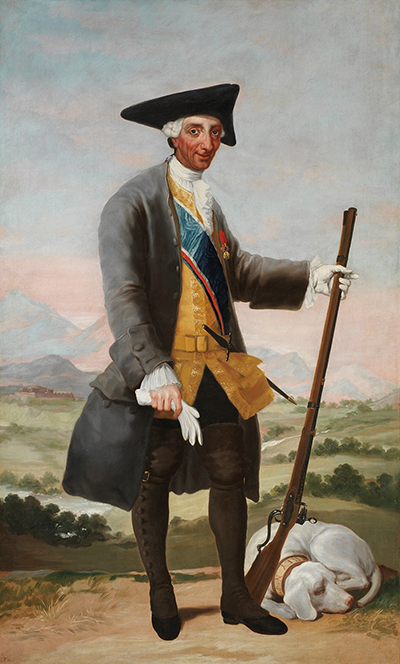
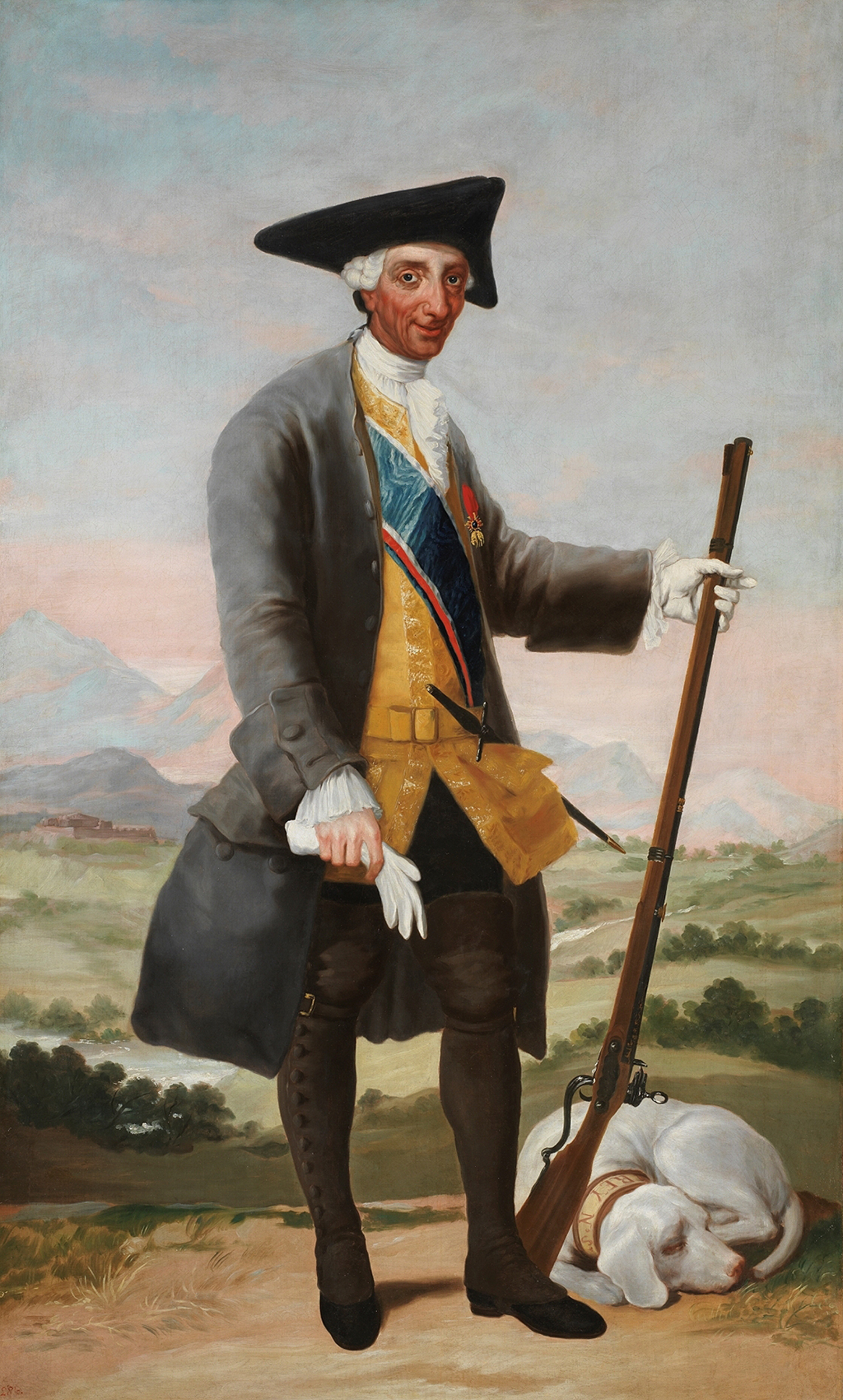
Charles III turns his face towards us from beneath a broad black hat. His coat hangs open over a gold-coloured waistcoat and a cluster of bright ribbons. One hand holds his gloves and the other rests on a hunting gun. At his feet a white dog sleeps with its muzzle tucked down. Goya gives the King of Spain the scale of a full-length state portrait and the ease of a man who has paused on a hillside. The small gold pendant on his chest identifies a royal honour. The letters on the dog's collar identify its owner. [1] [2]

At a Glance
- Artist and sitterFrancisco de Goya y Lucientes. Charles III ruled Spain from 1759 until his death in 1788. [1] [3]
- DateAbout 1786. The Fundación Goya en Aragón dates the Prado canvas to about 1787. [1] [4]
- Medium and dimensionsOil on canvas, 207 × 126 cm. [1] [4]
- CollectionMuseo Nacional del Prado, Madrid, P000737. The painting entered the museum from the Royal Collection in 1847. [3] [4]
Works across Goya’s career
The Parasol
1777Charles III in Hunting Dress
c. 1786The Nude Maja
1795–1800Saturn Devouring His Son
c. 1820–23The Dog
c. 1820–23The hat, the face and the coat
The tricorn seems wider still because Goya sets its dark brim against pale sky. It casts a shadow across the upper part of the face, while light catches the bridge of the nose and the skin beneath the eyes. Dabs of white describe the powdered hair. The king's complexion is warm by comparison, with deeper reds beside the nose and on the cheek. The corners of his mouth turn slightly upwards. The gaze can seem amused, especially if you follow the slight lift of the mouth after looking into the eyes. The shoulder and chest turn away, making the head's turn towards us all the more apparent. [1] [3]
The clothes distribute the light further down the figure. A grey coat parts to show the gold-coloured waistcoat, down to the long points that sit apart over the dark breeches. A line of buttons follows the shin on the viewer's left. At the cuff, the ridges of the linen pick up the light before the eye reaches the white gloves in the king's bare right hand. The left hand is gloved, with pale fingers visible against the dark gun. The Count of Fernán Núñez's account of the king's winter hunting clothes, cited by the Fundación Goya en Aragón in its entry on the signed version, describes a coat of Segovian cloth, dark suede clothes, lace, woollen stockings, boots and gloves. It offers a contemporary counterpart to the mixture of textures Goya paints. [4] [5]
Annotated Details from Charles III in Hunting Dress
Follow the face, court insignia and hunting equipment down to the dog.
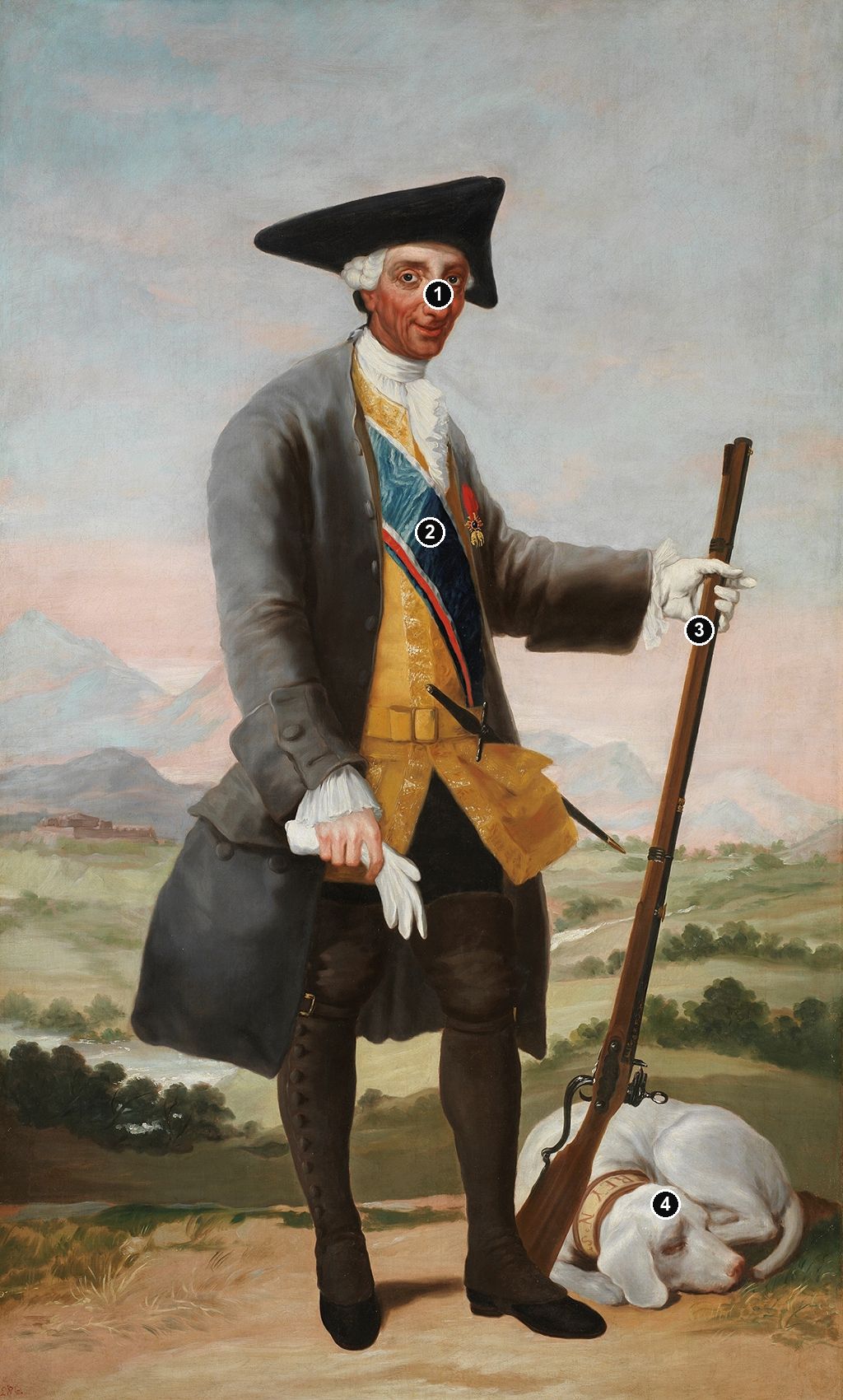
Details from CHARLES III IN HUNTING DRESS
Details from the Museo Nacional del Prado portrait (P000737).
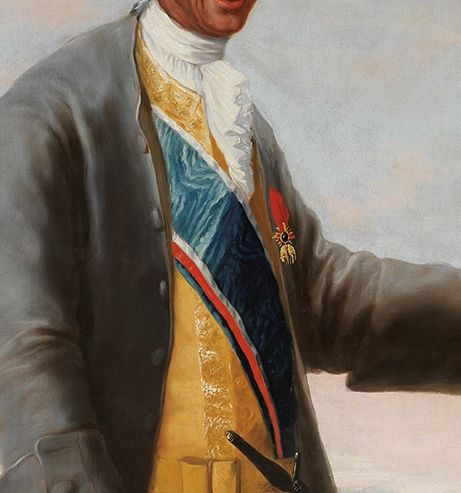
The face beneath the hat
The shaded hat brim sits above the warmly lit face.
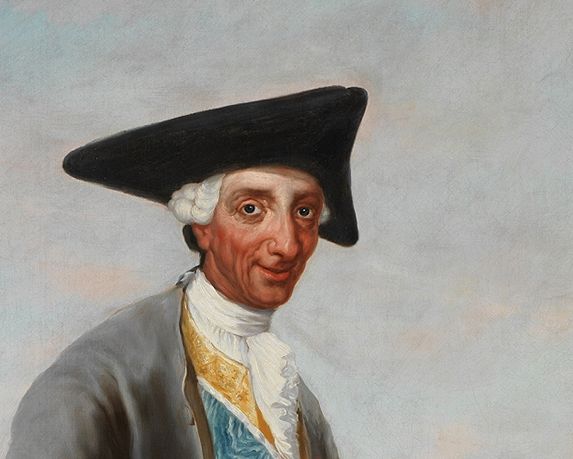
The royal insignia
Several coloured ribbons cross the coat and waistcoat.
The gloved hand and gun
The pale glove is visible against the vertical line of the gun.
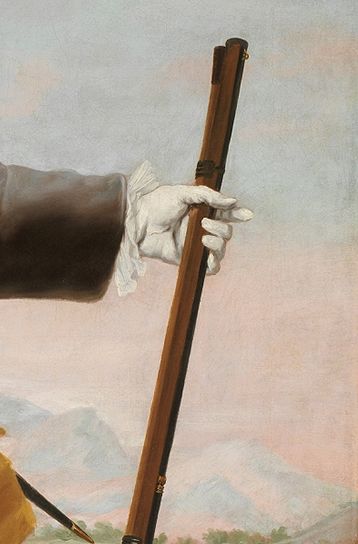
The sleeping dog
The pale dog curls up beside the king’s boots.
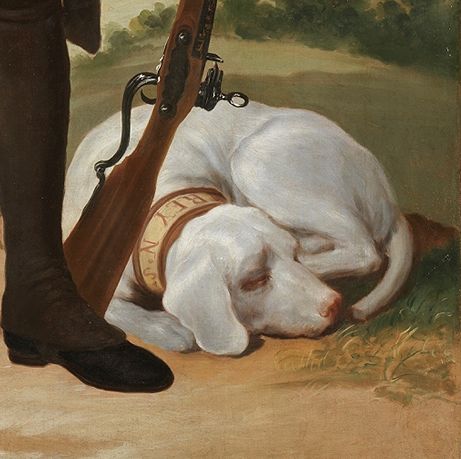
What the sashes and the collar say
The Galería de las Colecciones Reales identifies the sashes of the orders of Charles III, Saint Januarius and the Holy Spirit, along with the insignia of the Golden Fleece. The red ribbon and blue bands lie close together. At a distance they read as a single diagonal through the open coat, but up close narrow strips of colour and small gold marks emerge from the folds. The Golden Fleece is the pendant on the chest. The honours evoke more than one court. Saint Januarius was the Neapolitan order, and Charles had ruled in Naples and Sicily before taking the Spanish throne. He founded the order that bears his own name in 1771. [2] [3] [6]
The dog's collar is broad and gold-coloured, with a reddish border and the inscription the Fundación transcribes as REY No.Sr, short for Rey Nuestro Señor, or ‘Our Lord the King’. The curve of the collar turns the letters into the light above the animal's lowered head. Look at the dog's bent foreleg and the way its head drops towards the ground. A few grey shadows describe the weight of the white body. The folded body fits low in the corner, next to the king's feet and partly behind the gun. The royal titles on the collar and the ease of the sleeping animal coexist in a detail that could easily be missed below the bands of colour on the king's chest. [2] [4]
Looking into the hunting country
Pale blues and pinks in the sky and the far slopes leave the line of the king's shoulder easy to follow. At boot level the shrubs have heavier shadows and the dry grass is painted with short directional marks. To the left, blocks of earth colour suggest a small settlement, with fields across the low ground behind the figure. The standing figure and the long diagonal of the gun carry the eye up through those horizontal changes of tone. The reduction of detail in the farthest slopes creates much of the distance. The king is close enough for the fabric at his wrists to be visible, while the mountains have already softened into broad planes of colour. [1] [2]
The Galería de las Colecciones Reales associates the setting with royal hunting grounds, suggesting the environs of El Escorial or the country between El Pardo and the Madrid mountains. It interprets the royal hunt as an image of strategy and protection. The activity in Goya's portrait is subdued enough to sustain that reading without the spectacle of a chase. The alert face and sleeping dog also allow a simpler observation. A man with a familiar outdoor pursuit has stopped, and Goya has given him time to look back. [2]
Goya on film
Five films explore Goya’s portraits, prints, Black Paintings and painting techniques.
The Duke of Wellington by Goya
The portrait, its military decorations and its later theft.
Watch on YouTubeVelázquez's hunters and Goya's prints
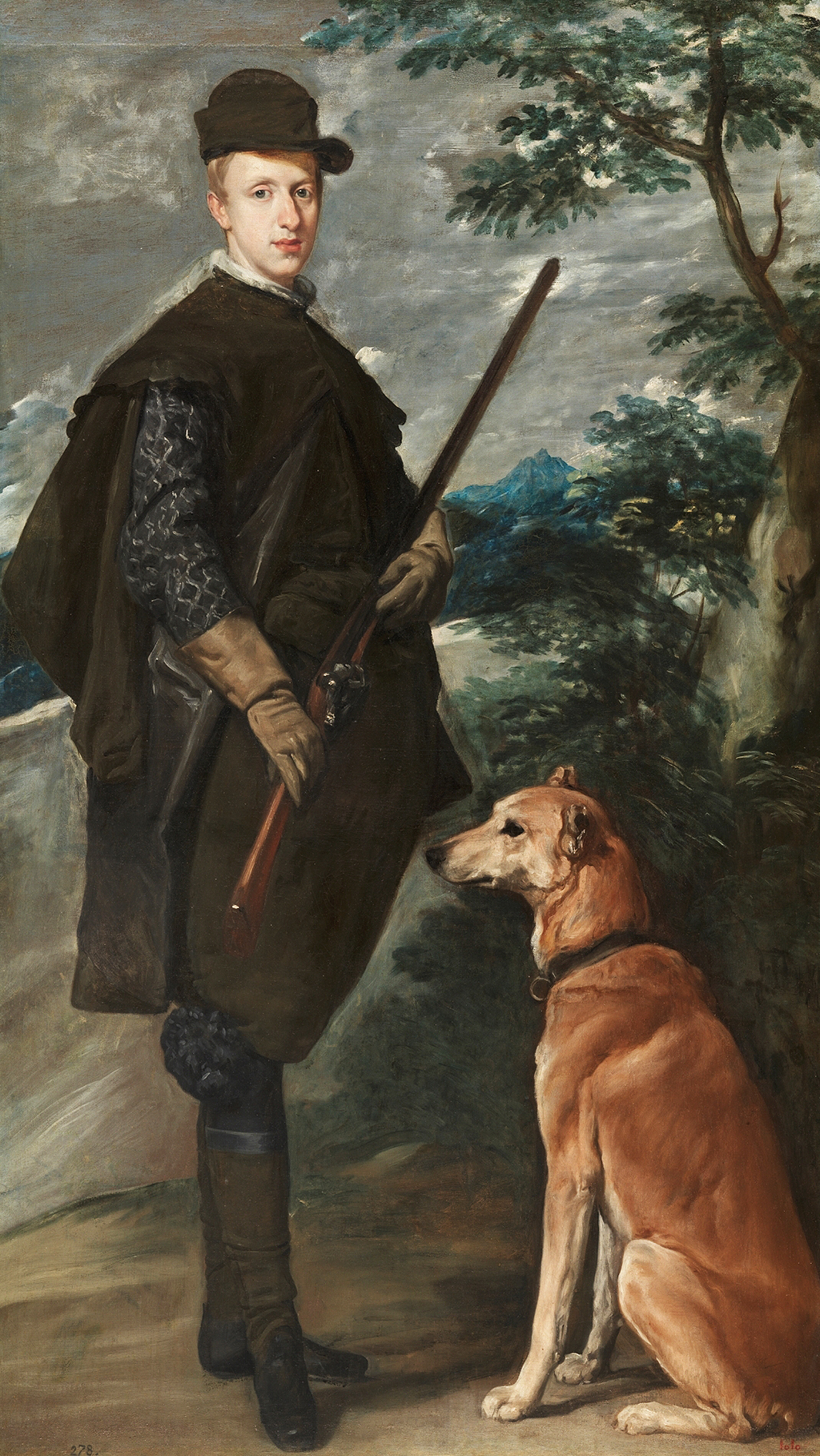
More than a century earlier, Velázquez had painted Philip IV, his brother the Cardinal-Infante Don Fernando and the young Prince Baltasar Carlos in Hunting Dress. The portraits are associated with the Torre de la Parada, a royal hunting lodge. They gave Goya a precedent for setting a full-length royal figure among trees and hills with a gun and a dog at ground level. The gun in the Philip IV portrait crosses the body, and the dog's upright posture adds a second alert figure near the ground. Goya gives Charles's torso more room by moving the long gun out to one side. The sleeping dog in Velázquez's portrait of Baltasar Carlos is a closer parallel to the animal beside Charles's boots. [2] [7]
Goya had already studied the hunting portraits in other media. His etched Infante Don Fernando, made around 1778–79 according to the Norton Simon Museum, makes the patches of light and shade around the sitter and the dog especially clear. The Fundación describes how successive acid bites brought out those heads against the surrounding tones. In his red-pencil copy of Prince Baltasar Carlos in Hunting Dress, now at the Hamburger Kunsthalle, the accumulation of strokes on the boy's outfit likewise makes the figure stand out from the landscape. Goya's 1778 prints after Velázquez also include equestrian portraits of Philip IV and Baltasar Carlos. The child's red-pencil hunting image and the engraving that shows him on horseback belong to different compositions. [8] [9] [10] [11]
The Prado canvas and the other versions
The Prado's painting came from the Royal Collection in 1847. The museum says it was long treated as a secondary version even after it began to catalogue the picture as Goya's work in 1900. It removed oxidised varnishes in 2016 and presented the canvas in an exhibition curated by Manuela Mena Marqués. The museum read the variety of the brushwork and the adjustments in the composition as evidence that Goya painted in front of the sitter. The curatorial team also took the royal provenance as evidence for an early place in the sequence. This reading challenged the older view that Goya had derived the likeness from Mengs's official portrait of about 1765. That portrait circulated widely through copies and prints, which helps explain why its possible influence was taken seriously. [3] [12]
The Fundación's catalogue retains a different account of the sequence, treating the Prado picture as a likely replica of the canvas associated with the Duchess of Fernán Núñez. The Fernán Núñez painting measures 210 × 127 cm and bears the words Goya lo hizo, ‘Goya made it’, at the lower right. Madrid's municipal museum identifies that canvas as the sole signed example among five surviving versions. Its own painting, IN. 95.203, is dated 1785 by the museum, which links it to the celebrations around two marriages between the Spanish and Portuguese royal families that year. BBVA holds a canvas of 209 × 125 cm, inventory 443, which it dates to about 1787–88. The Fundación also lists the version formerly associated with the British collector Lord Margadale. The similar compositions and diverging catalogue dates make the collection and its inventory number especially helpful when identifying a reproduction. [4] [5] [13] [14]
Charles also appears in a full-length court portrait by Goya for the Banco de San Carlos. Its financial records document payment in January 1787. The bank suggests that its canvas came first, in part because of adjustments to the figure visible in technical examination. The Prado's restoration account draws attention to revisions and the royal provenance of the hunting portrait in arguing for its early position. The documented payment helps date the separate commission. It sets the portraits close enough in time to compare their uses of the same pose. In the bank picture Charles holds a baton before a dark interior. In the hunting portrait his extended arm takes our eye out into open country. [3] [15]
Artworks directory
| Name | Date | Medium |
|---|---|---|
| And There’s No Help for It, Plate 15 | Printed 1863 | |
| Asmodea | c. 1820–23 | Wall painting transferred to canvas |
| Boys Inflating a Bladder | 1777–78 | Tapestry cartoon |
| Boys Picking Fruit | 1778 | Tapestry cartoon |
| Bullfight in a Divided Ring | 1825 | Lithograph |
| Card Players | 1777–78 | Tapestry cartoon |
| Card Players (sketch) | 1777–78 | Painted sketch |
| Dance on the Banks of the Manzanares | 1777 | Tapestry cartoon |
| Duel with Cudgels | c. 1820–23 | Wall painting transferred to canvas |
| Heads in a Landscape | c. 1820–23 | Easel painting |
| Judith and Holofernes | c. 1820–23 | Wall painting transferred to canvas |
| Leocadia | c. 1820–23 | Wall painting transferred to canvas |
| Maja and Cloaked Men | 1777 | Tapestry cartoon |
| Maja and Cloaked Men (sketch) | 1777 | Painted sketch |
| Majo Clapping in Time to the Music | 1777 | Drawing |
| Men Reading | c. 1820–23 | Wall painting transferred to canvas |
| Out Hunting for Teeth, Plate 12 | 1799 | Etching, burnished aquatint and burin |
| Picnic in the Countryside (sketch) | 1776–78 | Painted sketch |
| Picnic on the Banks of the Manzanares | 1776 | Tapestry cartoon |
| Pilgrimage to San Isidro | c. 1820–23 | Wall painting transferred to canvas |
| Preparatory study for The Sleep of Reason Produces Monsters | c. 1796–97 | Drawing |
| Procession of the Holy Office | c. 1820–23 | Wall painting transferred to canvas |
| Quarrel at the Cockerel Inn (sketch) | 1777 | Painted sketch |
| Quarrel in the New Tavern | 1777 | Tapestry cartoon |
| Saturn Devouring His Son | c. 1820–23 | Wall painting transferred to canvas |
| Seated Majo Smoking | c. 1776 | Drawing |
| The Dog | c. 1820–23 | Wall painting transferred to canvas |
| The Drinker | 1777 | Tapestry cartoon |
| The Fates | c. 1820–23 | Wall painting transferred to canvas |
| The Great He-Goat | c. 1820–23 | Wall painting transferred to canvas |
| The Kite | 1777–78 | Tapestry cartoon |
| The Parasol | 1777 | Oil on canvas, tapestry cartoon |
| The Second of May 1808 | 1814 | Oil on canvas |
| The Sleep of Reason Produces Monsters, Plate 43 | 1799 | Etching and aquatint |
| The Third of May 1808 | 1814 | Oil on canvas |
| Thou Who Canst Not, Plate 42 | 1799 | Etching and burnished aquatint |
| Three Figures | 1776 | Drawing (lost) |
| Two Old Men | c. 1820–23 | Wall painting transferred to canvas |
| Two Old Men Eating Soup | c. 1820–23 | Wall painting transferred to canvas |
| Two Women and a Man | c. 1820–23 | Wall painting transferred to canvas |
| Universal Language: The Author Dreaming | 1797 | Drawing |
| The Family of Charles IV | 1800 | Oil on canvas |
| Witches’ Sabbath (Osuna painting) | 1797–98 | Oil on canvas |
| The Nude Maja | 1795–1800 | Oil on canvas |
| The Clothed Maja | 1800–07 | Oil on canvas |
| Self-Portrait (Drawing) | c. 1796 | Brush and carbon black ink on laid paper |
| The Swing, Madrid Album B.21 | 1795–97 | Brush and carbon black washes |
| Majas Fighting, a Majo Observing, Madrid Album B.15 | 1796–97 | Brush, grey and black washes on laid paper |
| Majos and Majas Conversing, Madrid Album B.16 | c. 1794–97 | Ink wash on paper |
| Weeping Woman and Three Men, Madrid Album B.17 | 1795–97 | Brush, carbon black washes and black chalk |
| Maja Seated on a Chair and Two Companions Behind, Madrid Album B.18 | 1795–97 | Brush and carbon black washes |
| Girl and Bull, Madrid Album B.23 | 1796–97 | Brush and carbon black washes |
| Lovers Sitting on a Rock, Madrid Album B.24 | 1796–97 | Brush and carbon black washes |
| Mariano Ceballos Riding a Bull | 1825 | Crayon lithograph and scraper |
| Landscape (lifetime impression) | c. 1807–10 | Etching and aquatint |
| Self-Portrait (1815), Prado canvas | 1815 | Oil on canvas |
| Self-Portrait (1815), Academy panel | 1815 | Oil on panel |
| Self-Portrait with Dr Arrieta | 1820 | Oil on canvas |
| Christ Crucified | 1780 | Oil on canvas |
| The Last Communion of Saint Joseph of Calasanz | 1819 | Oil on canvas |
| Christ on the Mount of Olives | 1819 | Oil on panel |
| The Flower Girls, or Spring | 1786–87 | Oil on canvas |
| The Grape Harvest, or Autumn | 1786–87 | Oil on canvas |
| The Snowstorm, or Winter | 1786–87 | Oil on canvas |
| The Threshing Ground, or Summer | 1786–87 | Oil on canvas |
| Picnic on the Banks of the Manzanares | 1776 | Oil on canvas |
| The Kite | 1777–78 | Oil on canvas |
| Dance on the Banks of the Manzanares | 1777 | Oil on canvas |
| A Fight at the Venta Nueva | 1777 | Oil on canvas |
| Blind Man’s Bluff | 1788 | Oil on canvas |
| Dogs on a Lead | 1775 | Oil on canvas |
| Hunting with a Decoy | 1775 | Oil on canvas |
| Hunter Loading His Rifle | 1775 | Oil on canvas |
| The Angler | 1775 | Oil on canvas |
| The Hermitage of San Isidro on His Feast Day | 1788 | Oil on canvas |
| The Meadow of San Isidro | 1788 | Oil on canvas |
| The Straw Manikin | 1791–92 | Oil on canvas |
| Witches’ Flight | c. 1797–98 | Oil on canvas |
| A Scene from ‘The Forcibly Bewitched’ | 1798 | Oil on canvas |
| The Duchess of Alba in Black | 1797 | Oil on canvas |
| The Duchess of Alba in White | 1795 | Oil on canvas |
| Charles III in Hunting Dress | c. 1786 | Oil on canvas |
| The Duke and Duchess of Osuna and Their Children | 1787–88 | Oil on canvas |
| Manuel Osorio Manrique de Zúñiga | 1787–88 | Oil on canvas |
| The Marquesa de Pontejos | c. 1786 | Oil on canvas |
| Equestrian Portrait of the 1st Duke of Wellington | 1812 | Oil on canvas |
| The Duke of Wellington | 1812–14 | Oil on wood |
| Portrait of Ferdinand VII of Spain | 1814 | Oil on canvas |
| Gaspar Melchor de Jovellanos | 1798 | Oil on canvas |
| María Tomasa Palafox y Portocarrero | 1804 | Oil on canvas |
| Señora Sabasa García | c. 1806–11 | Oil on canvas |
| Don Juan Bautista de Muguiro | 1827 | Oil on canvas |
| Doña Isabel de Porcel | Before 1805 | Oil on canvas |
| The Colossus | After 1808 | Oil on canvas |
| The Burial of the Sardine | 1808–12 | Oil on panel |
| The Madhouse | 1808–12 | Oil on panel |
| A Procession of Flagellants | 1808–12 | Oil on panel |
| Portrait of Jacques Galos | 1826 | Oil on canvas |
| Portrait of Mariano Goya, the Artist’s Grandson | 1827 | Oil on canvas |
| Milkmaid of Bordeaux | c. 1827 | Oil on canvas |
| Portrait of Don Juan Antonio Cuervo | 1819 | Oil on canvas |
| María Luisa of Parma (Naples version) | c. 1800 | Oil on canvas |
| The Countess of Baena | 1819 | Oil on canvas |
| The Family of the Infante Don Luis | 1783–84 | Oil on canvas |
| The Holy Family | c. 1787 | Oil on canvas |
| Saint Barbara | c. 1773 | Oil on canvas |
| Saints Justa and Rufina | 1817 | Oil on canvas |
| El Tío Paquete | c. 1819–20 | Oil on canvas |
| The Forge | c. 1815–20 | Oil on canvas |
| Majas on a Balcony (Metropolitan Museum version) | c. 1800–10 | Oil on canvas |
| Maja and Celestina on a Balcony | c. 1808–12 | Oil on canvas |
| The Water Bearer | 1808–12 | Oil on canvas |
| Time and the Old Women | c. 1810 | Oil on canvas |
Frequently Asked Questions
The Prado interprets details revealed by the painting's 2016 restoration as evidence that Goya painted from life. In an exhibition that opened that December it put Goya's painting alongside Mengs's earlier portrait, the proposed source for the likeness. [3]
Discussion
Look again at the images and ideas explored in Charles III in Hunting Dress. These editorial prompts invite your observations.
Look first at the king's expression, then at the sashes and the dog's collar. Which detail changes your sense of how formal the encounter is?
Reader Insights
Which elements distinguish this sitter from the hunters in Goya’s tapestry designs?
How does Goya handle the dog differently from Velázquez?
Join the Conversation
Share a detail, comparison or question about Charles III in Hunting Dress below.
References
- Museo Nacional del Prado, Carlos III, cazador, P000737. See also the official exhibition object list for the date, medium and dimensions. View source 1. View source 2.
- Galería de las Colecciones Reales, Goyas of Museo del Prado, Royal Collections interpretation of the portrait. View source.
- Museo Nacional del Prado, Memoria de actividades 2016, pp. 178–179, ‘Carlos III, cazador de Francisco de Goya. Relaciones y divergencias’. View source.
- Fundación Goya en Aragón, Charles III Hunting, entry on the Prado painting, P000737. View source.
- Fundación Goya en Aragón, Charles III Hunting, entry on the signed Fernán Núñez canvas. See also the 1996 heritage designation of the Junta de Andalucía. View source 1. View source 2.
- Museo Nacional del Prado, Luis Paret y Alcázar, Charles III Dining Before the Court, P002422, for the royal orders. View source.
- The Metropolitan Museum of Art, Velázquez, exhibition catalogue (1989), entries 20–22 on the hunting portraits. See also the Prado's record for Philip IV in Hunting Dress, P001184. View source 1. View source 2.
- Norton Simon Museum, Goya, Copies after Velázquez: Un infante de España (Infante Don Fernando), M.1975.10.1.4.G. View source.
- Fundación Goya en Aragón, El infante Don Fernando, catalogue entry on the states of Goya's print. View source.
- Fundación Goya en Aragón, El príncipe Baltasar Carlos, cazador, catalogue entry on Goya's drawing. View source.
- The Metropolitan Museum of Art, Philip IV on Horseback, after Velázquez. See also Museo Goya, Fundación Ibercaja, D. Baltasar Carlos príncipe de España. Hijo del rey Felipe IV. View source 1. View source 2.
- Colección Banco de España, Charles III in Armour, P_131, for the circulation of Mengs's portrait type. View source.
- Museo de Historia de Madrid, Carlos III en traje de caza, IN. 95.203. View source.
- Fundación Goya en Aragón, Charles III Hunting, further version in private ownership. See also Colección BBVA, Carlos III cazador, inventory 443. View source 1. View source 2.
- Colección Banco de España, El rey Carlos III, P_135, for the bank commission and its documented payment. View source.







