


 by Tom Gurney
Tom Gurney BSc (Hons) is an art history expert with over 20 years experience
Published on June 19, 2020 / Updated on November 20, 2026
Email: tomgurney1@gmail.com / Phone: +44 7429 011000
Introduction
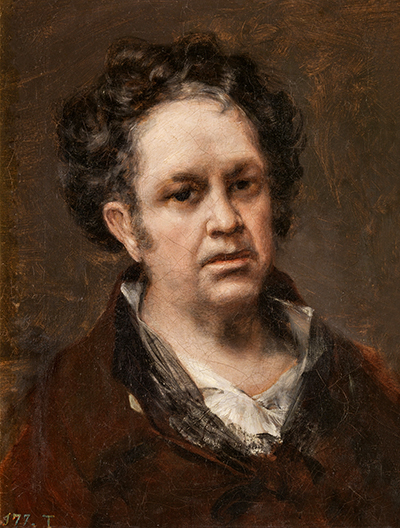
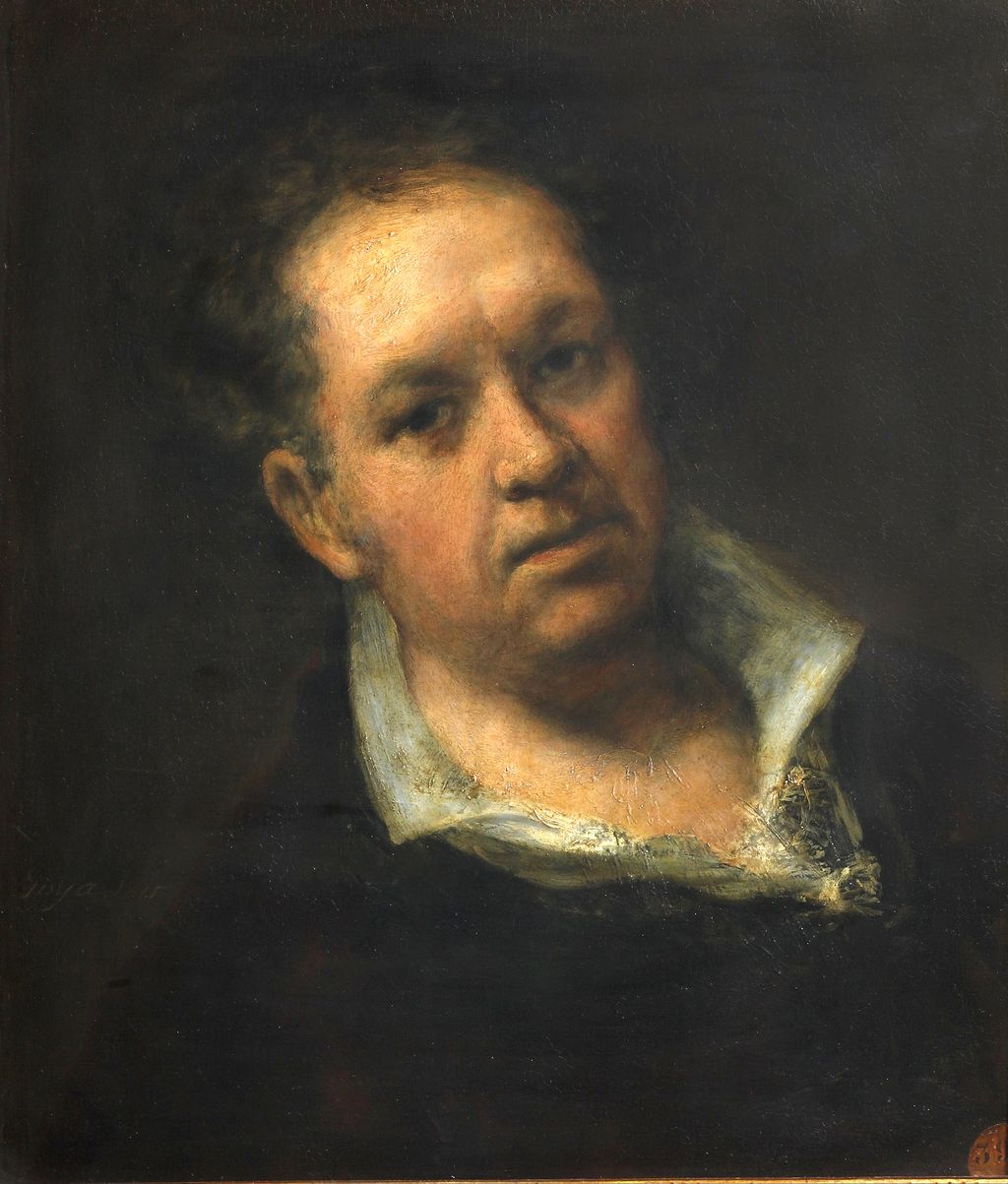
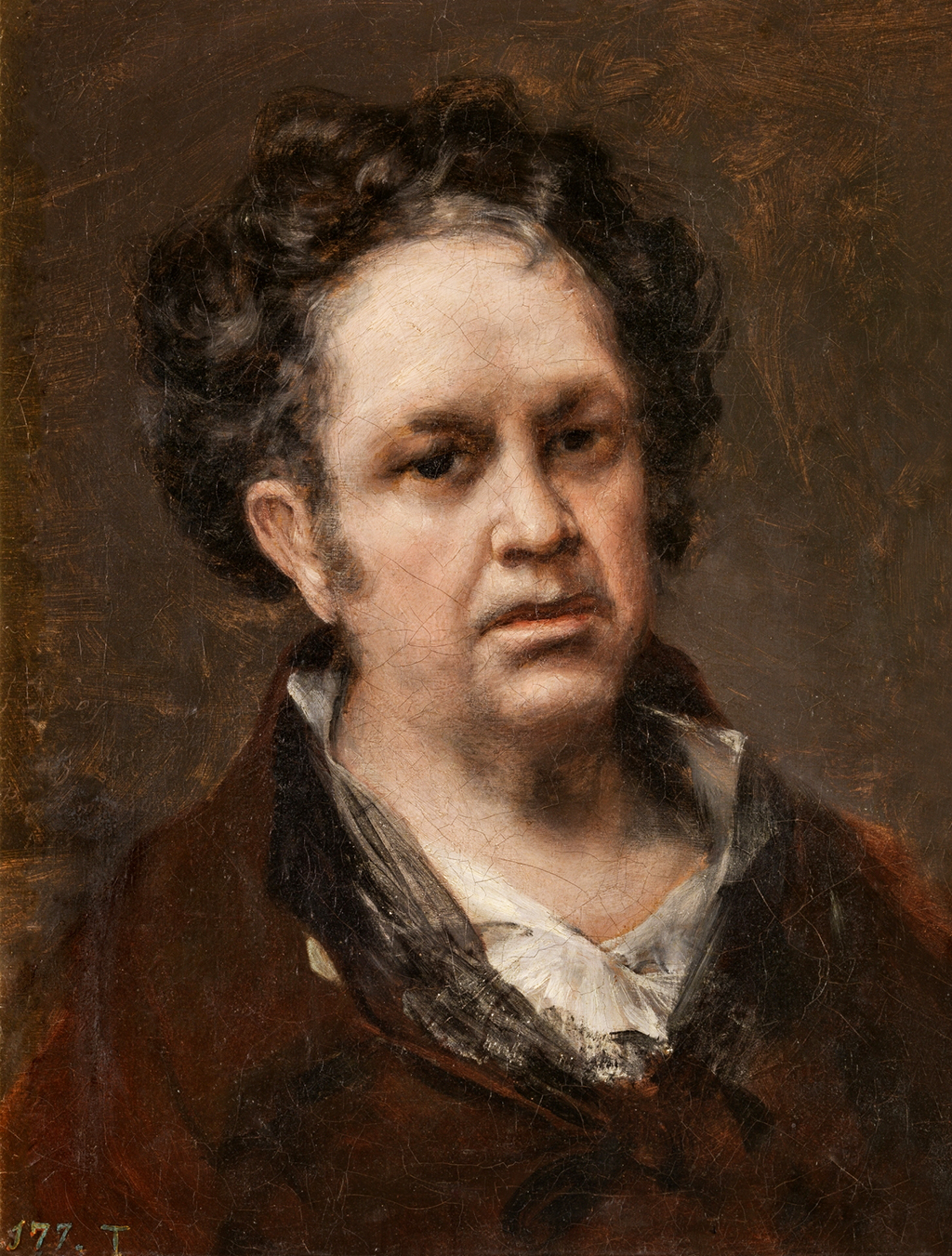
Francisco de Goya turns his head slightly and looks out from a dark brown ground. The light falls on his forehead, one cheek and the open neck of his white shirt. He was sixty-nine in 1815, the year he scratched into the paint beside his neck. There are two surviving oil self-portraits dated that year. This one is the narrower of the two, painted on canvas and now in the Museo Nacional del Prado. Its companion, in Madrid’s Real Academia de Bellas Artes de San Fernando, is painted on walnut and gives the same sitter a different tilt of the head. [1] [2] [3] [4]
At a Glance
- Artist and sitterFrancisco de Goya y Lucientes (1746–1828). [1] [3]
- Date1815, recorded in an inscription incised into the painted surface. [1] [2]
- Medium and dimensionsOil on canvas, 45.8 × 35.6 cm. [1]
- CollectionMuseo Nacional del Prado, Madrid, P000723. Acquired for the Museo de la Trinidad in 1866 and transferred to the Prado in 1872. [1] [2]
- Companion paintingOil on walnut panel, 51 × 46 cm, Real Academia de Bellas Artes de San Fernando, Madrid, 0669. [3] [4]
Works across Goya’s career
The Parasol
1777The Nude Maja
1795–1800Saturn Devouring His Son
c. 1820–23The Dog
c. 1820–23The face and the open collar
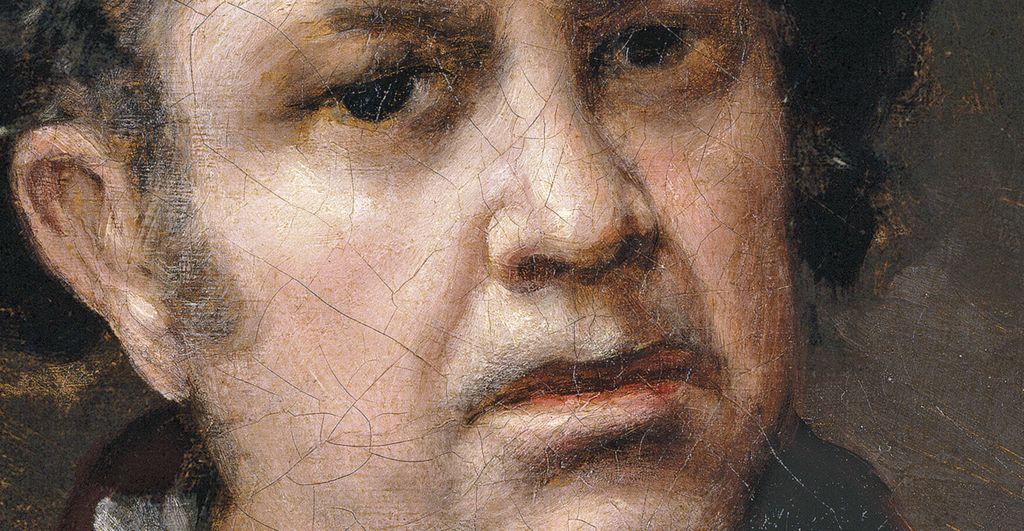
The conspicuous area of light is high on the forehead, where loose dark curls pull away from the skin. The head turns towards the viewer’s right, bringing the ear on the left of the picture into view. Follow the light down and it breaks into smaller touches around the eyes and nose. The pale ridge of the nose interrupts the shadow across the eye sockets. The line between the lips gathers into shadow at one corner, and a warmer touch on the lower lip keeps the mouth distinct from the grey-brown modelling around it. The expression can appear tired or wary. Its restraint owes much to these small choices in the paint, especially the relatively low light on the eyes beneath the brightness of the forehead. [2]
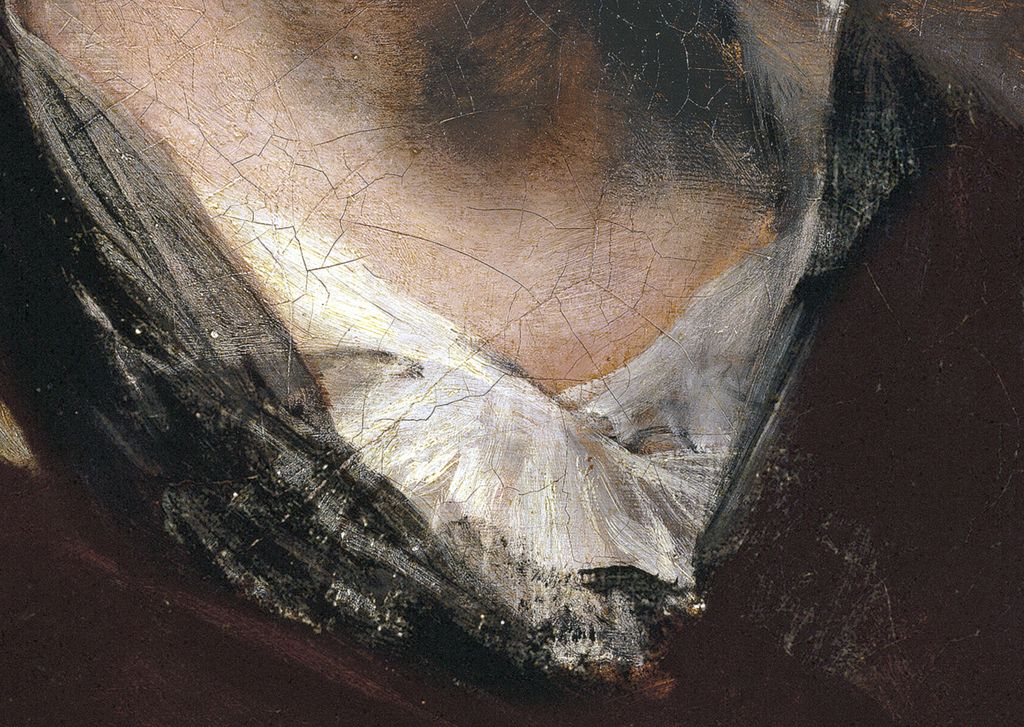
Below the chin, the shirt opens into a broad angle. The edging on the viewer’s left stands up against the neck, then the cloth descends in slanting grey strokes to join the white folds over the chest. The bright point at the bottom of the opening sits off to one side of the nose, giving the collar and head slightly different directions. Goya uses fewer, broader strokes on the dark outer garment. Broad reddish-brown passages mark the shoulders, and the left edge of the coat runs into the brushwork of the ground. Look above the hair and you can still see curved brush marks in the brown. The absence of a furnished setting makes differences in the thickness, direction and colour of those marks easier to see. [1] [2]
Goya gives himself an open shirt and a dark gown. Both are legible at a distance, but the folds and transitions are worth looking at up close. The deepest dark near the neck is adjacent to a gathering of whites and greys that gives the shirt its crumpled appearance. Higher up, the transitions from shadow to light are more gradual across the skin. The closeness feels natural partly because everything beyond this head and collar is held just below the level of detail needed to compete with them. The narrow canvas crops the body above the hands and leaves the viewer to make sense of a momentary turn without the aid of an easel, brushes or other signs of work. [1] [2]
Annotated Details from Self-Portrait (1815)
Look from the lit face to the loose marks in the hair, clothes and background.
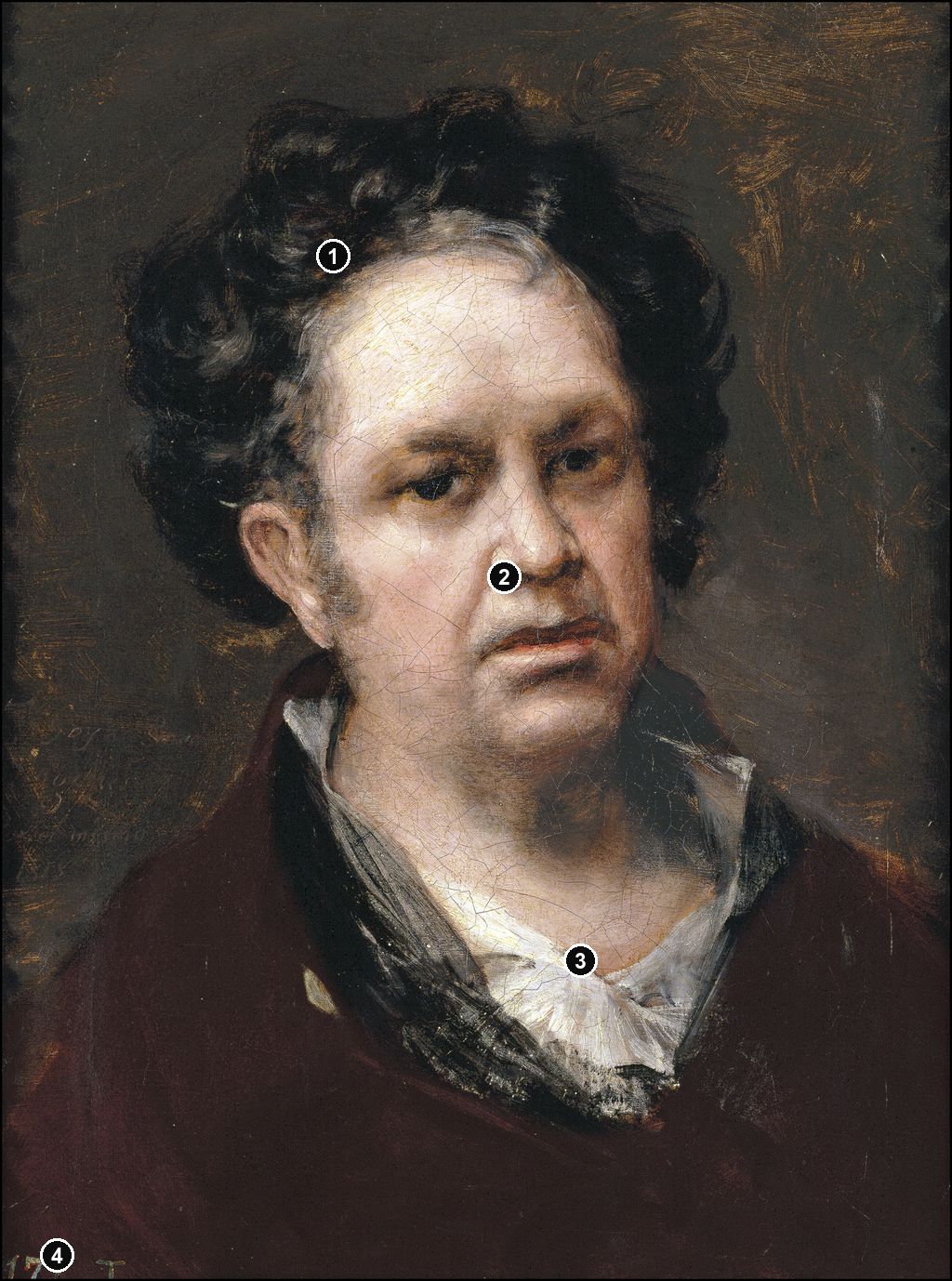
Details from SELF-PORTRAIT (1815)
Details from the oil on canvas in the Museo Nacional del Prado (P000723).
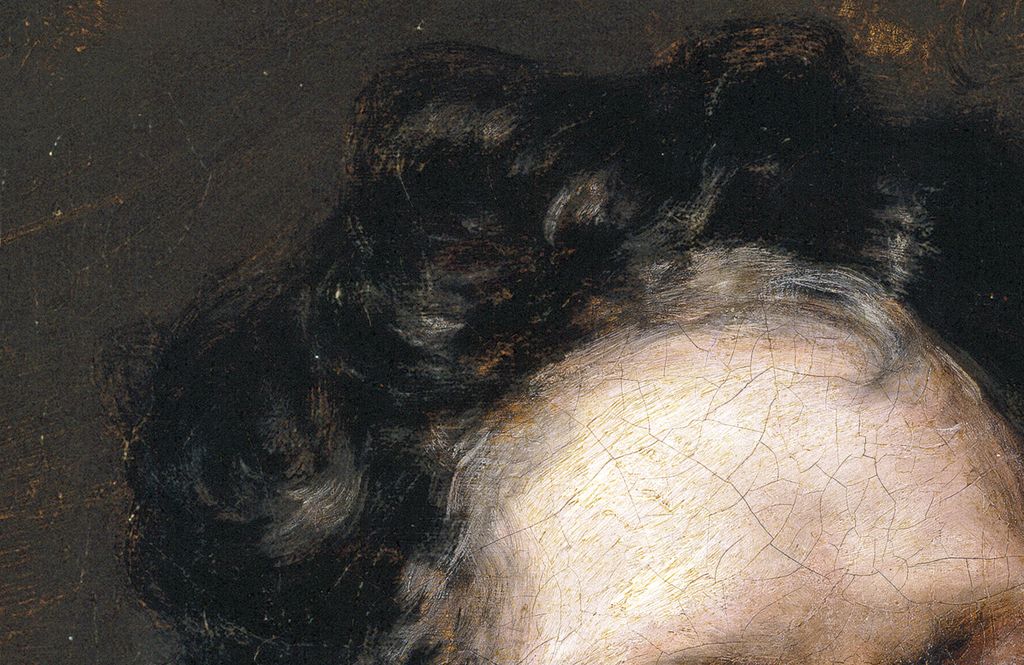
Curls against the ground
Small lighter strokes break up the dark mass of hair along its upper edge.
Eyes and brows
The gaze holds steady while the eyelids and brows are painted unevenly in light and shade.
The open shirt
Broken strokes of white and grey describe the folds at the open neck.
The lower-left number
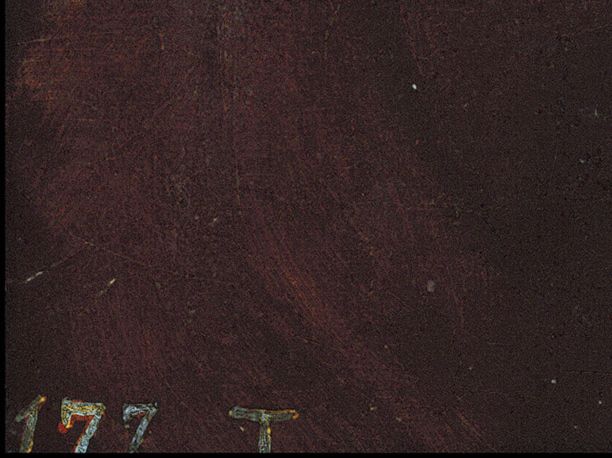
Part of an inventory mark is visible at the bottom edge.
Two paintings dated 1815
The Academy panel is a little taller and more than ten centimetres wider. Its extra width is apparent around the shoulders, which form a broader base. The head tips more strongly towards the viewer’s left, even as Goya keeps his eyes turned out of the picture. The white folds stand up more prominently on both sides of the throat, with a thick, broken edge that the Fundación Goya en Aragón likens to lace. This produces a brighter passage across the chest than the more compact opening in the Prado painting. As the slope of the panel’s shoulders meets the opposed tilt of the head, the figure can look as though he is leaning forward to see us. [2] [3] [5]
The support also makes the object at the Academy quite different. Conservator María Dolores Fúster Sabater identified the wood as European walnut through examination of samples. It is a single board with the grain running vertically. Its rough edges, grooves on the back and traces of old glue led her to suggest that the board may have come from a piece of furniture. A reddish oil ground can be seen in places along the edges where paint has been lost. These material details are better evidence for how this particular painting was made than the smoothness of a cheek or the appearance of a crack in a reproduction. [4]
Light cast across the surface of the panel brings out small raised areas where Goya revised the shape of the collar. The Academy proposes that he painted the canvas second because it lacks the particular corrections found on the panel. The Fundación also describes signs of repainting in the canvas collar. The Academy’s proposal depends on the particular shapes that Goya revised on the panel. Those raised areas are evidence of an earlier arrangement of the shirt in that painting. The shared date leaves open the order in which Goya started, resumed or signed the two likenesses. [2] [3] [4] [5]
Goya on film
Five films explore Goya’s portraits, prints, Black Paintings and painting techniques.
The Duke of Wellington by Goya
The portrait, its military decorations and its later theft.
Watch on YouTubeA signature and two routes into public collections
The Prado inscription gives Goya’s name, identifies him as Aragonese, says the likeness is by his own hand and dates it to 1815. It is cut into the paint at neck height on the left, where its legibility depends on the light falling across the surface. The Academy panel carries the shorter inscription “Goya 1815” at the lower left. The expanded wording on the canvas has prompted the suggestion that a fine arts academy might have been the intended recipient. A statement of regional origin fits that possibility, but the inscription gives no recipient. And the panel’s eventual destination tells us what Goya’s son Javier did with the portrait after his father’s death. [2] [3]
The Academy records Javier’s gift on 11 July 1829. The Fundación connects the transfer with the settlement of the Academy’s outstanding payment for Goya’s equestrian portrait of Ferdinand VII. The canvas followed a different course. Documents vary in the name they give its nineteenth-century owner or intermediary, whom the Fundación records as Román Garreta or Román de la Huerta. In 1866 a Royal Order authorised its purchase for the Museo de la Trinidad for four hundred escudos. The painting entered the Prado collections when the two museums merged in 1872. The Academy panel eventually circulated in another form. José María Galván drew and engraved it for the Academy’s series of prints issued to acquaint viewers with works in the collection. The print was published with a text by Valentín Carderera. By 1885, the date the Academy gives for its inclusion in the series, the face that Javier had given to the institution could be seen far beyond its walls. [2] [3] [5]
Goya’s other ways of picturing himself
The 1815 canvas comes from a period when Goya was supplying an official likeness of Ferdinand VII. The king returned in 1814 and Goya resumed his duties as First Court Painter. In the Prado’s Ferdinand VII in Court Dress of 1814–15, Goya describes the gold chain and brocade in dots and broken strokes. The regalia and the grip of the hands matter there because they show a monarch exercising the authority of his office. The same eye for what a few well-placed touches can convey is apparent in the open collar of the self-portrait. Here the white cloth gives emphasis to the exposed throat and the turn of the head. [2] [6]
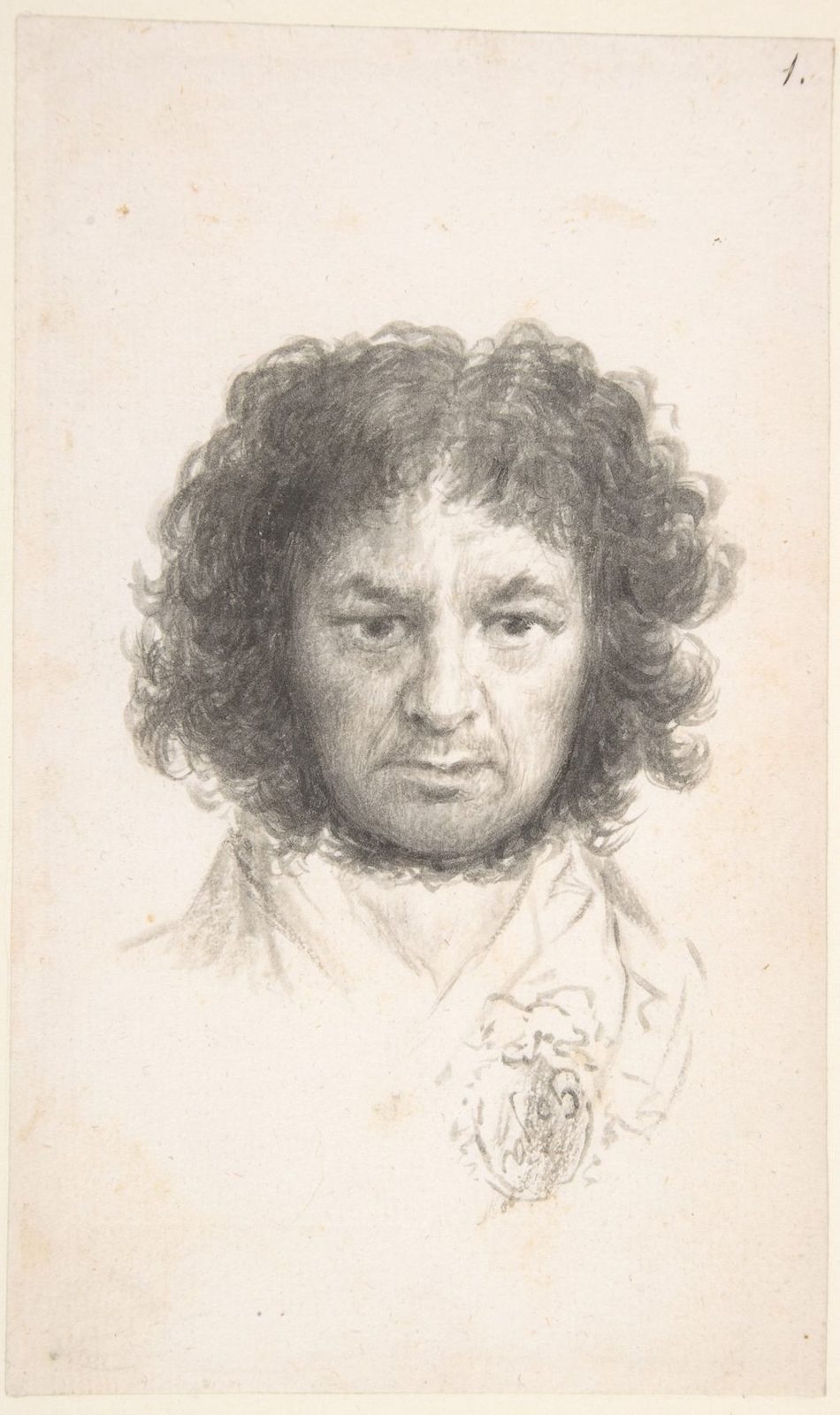
In the small ink self-portrait of about 1796 in the Metropolitan Museum of Art, Goya also draws attention to the eyes and leaves much of the clothing loosely indicated. The drawing is only fifteen centimetres high. White paper supplies the lights and shows through the thin ink washes. In the 1815 canvas pale paint brings the face forward from a darker field. The ink likeness gives Goya’s name on a small badge on his lapel. It later served as an opening image in an album of his drawings, a documented use distinct from the unknown circumstances in which he first took up the brush. On the canvas the letters sit outside the figure, incised in the painted field. In each case the image can hold a viewer’s gaze before its maker’s name comes into view. [2] [7]
Five years after the two Madrid portraits, Goya painted himself as a patient in Self-Portrait with Dr Arrieta. The 1820 canvas is more than twice the height of the Prado portrait, with room to show a doctor who supports his patient and holds a glass to his lips. Goya’s hands grasp the bedclothes. His eyes have much less power over the direction of ours because the glass and the hands make a second centre of attention. A strip of writing across the foot of the canvas thanks Arrieta for saving him during a serious illness in late 1819. That dedication names the friend the picture addresses and gives an account of a particular event. The earlier canvas leaves us with the sitter’s chosen pose and the words with which he identifies himself. [2] [8] [9]
Artworks directory
| Name | Date | Medium |
|---|---|---|
| And There’s No Help for It, Plate 15 | Printed 1863 | |
| Asmodea | c. 1820–23 | Wall painting transferred to canvas |
| Boys Inflating a Bladder | 1777–78 | Tapestry cartoon |
| Boys Picking Fruit | 1778 | Tapestry cartoon |
| Bullfight in a Divided Ring | 1825 | Lithograph |
| Card Players | 1777–78 | Tapestry cartoon |
| Card Players (sketch) | 1777–78 | Painted sketch |
| Dance on the Banks of the Manzanares | 1777 | Tapestry cartoon |
| Duel with Cudgels | c. 1820–23 | Wall painting transferred to canvas |
| Heads in a Landscape | c. 1820–23 | Easel painting |
| Judith and Holofernes | c. 1820–23 | Wall painting transferred to canvas |
| Leocadia | c. 1820–23 | Wall painting transferred to canvas |
| Maja and Cloaked Men | 1777 | Tapestry cartoon |
| Maja and Cloaked Men (sketch) | 1777 | Painted sketch |
| Majo Clapping in Time to the Music | 1777 | Drawing |
| Men Reading | c. 1820–23 | Wall painting transferred to canvas |
| Out Hunting for Teeth, Plate 12 | 1799 | Etching, burnished aquatint and burin |
| Picnic in the Countryside (sketch) | 1776–78 | Painted sketch |
| Picnic on the Banks of the Manzanares | 1776 | Tapestry cartoon |
| Pilgrimage to San Isidro | c. 1820–23 | Wall painting transferred to canvas |
| Preparatory study for The Sleep of Reason Produces Monsters | c. 1796–97 | Drawing |
| Procession of the Holy Office | c. 1820–23 | Wall painting transferred to canvas |
| Quarrel at the Cockerel Inn (sketch) | 1777 | Painted sketch |
| Quarrel in the New Tavern | 1777 | Tapestry cartoon |
| Saturn Devouring His Son | c. 1820–23 | Wall painting transferred to canvas |
| Seated Majo Smoking | c. 1776 | Drawing |
| The Dog | c. 1820–23 | Wall painting transferred to canvas |
| The Drinker | 1777 | Tapestry cartoon |
| The Fates | c. 1820–23 | Wall painting transferred to canvas |
| The Great He-Goat | c. 1820–23 | Wall painting transferred to canvas |
| The Kite | 1777–78 | Tapestry cartoon |
| The Parasol | 1777 | Oil on canvas, tapestry cartoon |
| The Second of May 1808 | 1814 | Oil on canvas |
| The Sleep of Reason Produces Monsters, Plate 43 | 1799 | Etching and aquatint |
| The Third of May 1808 | 1814 | Oil on canvas |
| Thou Who Canst Not, Plate 42 | 1799 | Etching and burnished aquatint |
| Three Figures | 1776 | Drawing (lost) |
| Two Old Men | c. 1820–23 | Wall painting transferred to canvas |
| Two Old Men Eating Soup | c. 1820–23 | Wall painting transferred to canvas |
| Two Women and a Man | c. 1820–23 | Wall painting transferred to canvas |
| Universal Language: The Author Dreaming | 1797 | Drawing |
| The Family of Charles IV | 1800 | Oil on canvas |
| Witches’ Sabbath (Osuna painting) | 1797–98 | Oil on canvas |
| The Nude Maja | 1795–1800 | Oil on canvas |
| The Clothed Maja | 1800–07 | Oil on canvas |
| Self-Portrait (Drawing) | c. 1796 | Brush and carbon black ink on laid paper |
| The Swing, Madrid Album B.21 | 1795–97 | Brush and carbon black washes |
| Majas Fighting, a Majo Observing, Madrid Album B.15 | 1796–97 | Brush, grey and black washes on laid paper |
| Majos and Majas Conversing, Madrid Album B.16 | c. 1794–97 | Ink wash on paper |
| Weeping Woman and Three Men, Madrid Album B.17 | 1795–97 | Brush, carbon black washes and black chalk |
| Maja Seated on a Chair and Two Companions Behind, Madrid Album B.18 | 1795–97 | Brush and carbon black washes |
| Girl and Bull, Madrid Album B.23 | 1796–97 | Brush and carbon black washes |
| Lovers Sitting on a Rock, Madrid Album B.24 | 1796–97 | Brush and carbon black washes |
| Mariano Ceballos Riding a Bull | 1825 | Crayon lithograph and scraper |
| Landscape (lifetime impression) | c. 1807–10 | Etching and aquatint |
| Self-Portrait (1815), Prado canvas | 1815 | Oil on canvas |
| Self-Portrait (1815), Academy panel | 1815 | Oil on panel |
| Self-Portrait with Dr Arrieta | 1820 | Oil on canvas |
| Christ Crucified | 1780 | Oil on canvas |
| The Last Communion of Saint Joseph of Calasanz | 1819 | Oil on canvas |
| Christ on the Mount of Olives | 1819 | Oil on panel |
| The Flower Girls, or Spring | 1786–87 | Oil on canvas |
| The Grape Harvest, or Autumn | 1786–87 | Oil on canvas |
| The Snowstorm, or Winter | 1786–87 | Oil on canvas |
| The Threshing Ground, or Summer | 1786–87 | Oil on canvas |
| Picnic on the Banks of the Manzanares | 1776 | Oil on canvas |
| The Kite | 1777–78 | Oil on canvas |
| Dance on the Banks of the Manzanares | 1777 | Oil on canvas |
| A Fight at the Venta Nueva | 1777 | Oil on canvas |
| Blind Man’s Bluff | 1788 | Oil on canvas |
| Dogs on a Lead | 1775 | Oil on canvas |
| Hunting with a Decoy | 1775 | Oil on canvas |
| Hunter Loading His Rifle | 1775 | Oil on canvas |
| The Angler | 1775 | Oil on canvas |
| The Hermitage of San Isidro on His Feast Day | 1788 | Oil on canvas |
| The Meadow of San Isidro | 1788 | Oil on canvas |
| The Straw Manikin | 1791–92 | Oil on canvas |
| Witches’ Flight | c. 1797–98 | Oil on canvas |
| A Scene from ‘The Forcibly Bewitched’ | 1798 | Oil on canvas |
| The Duchess of Alba in Black | 1797 | Oil on canvas |
| The Duchess of Alba in White | 1795 | Oil on canvas |
| Charles III in Hunting Dress | c. 1786 | Oil on canvas |
| The Duke and Duchess of Osuna and Their Children | 1787–88 | Oil on canvas |
| Manuel Osorio Manrique de Zúñiga | 1787–88 | Oil on canvas |
| The Marquesa de Pontejos | c. 1786 | Oil on canvas |
| Equestrian Portrait of the 1st Duke of Wellington | 1812 | Oil on canvas |
| The Duke of Wellington | 1812–14 | Oil on wood |
| Portrait of Ferdinand VII of Spain | 1814 | Oil on canvas |
| Gaspar Melchor de Jovellanos | 1798 | Oil on canvas |
| María Tomasa Palafox y Portocarrero | 1804 | Oil on canvas |
| Señora Sabasa García | c. 1806–11 | Oil on canvas |
| Don Juan Bautista de Muguiro | 1827 | Oil on canvas |
| Doña Isabel de Porcel | Before 1805 | Oil on canvas |
| The Colossus | After 1808 | Oil on canvas |
| The Burial of the Sardine | 1808–12 | Oil on panel |
| The Madhouse | 1808–12 | Oil on panel |
| A Procession of Flagellants | 1808–12 | Oil on panel |
| Portrait of Jacques Galos | 1826 | Oil on canvas |
| Portrait of Mariano Goya, the Artist’s Grandson | 1827 | Oil on canvas |
| Milkmaid of Bordeaux | c. 1827 | Oil on canvas |
| Portrait of Don Juan Antonio Cuervo | 1819 | Oil on canvas |
| María Luisa of Parma (Naples version) | c. 1800 | Oil on canvas |
| The Countess of Baena | 1819 | Oil on canvas |
| The Family of the Infante Don Luis | 1783–84 | Oil on canvas |
| The Holy Family | c. 1787 | Oil on canvas |
| Saint Barbara | c. 1773 | Oil on canvas |
| Saints Justa and Rufina | 1817 | Oil on canvas |
| El Tío Paquete | c. 1819–20 | Oil on canvas |
| The Forge | c. 1815–20 | Oil on canvas |
| Majas on a Balcony (Metropolitan Museum version) | c. 1800–10 | Oil on canvas |
| Maja and Celestina on a Balcony | c. 1808–12 | Oil on canvas |
| The Water Bearer | 1808–12 | Oil on canvas |
| Time and the Old Women | c. 1810 | Oil on canvas |
Frequently Asked Questions
The Prado has P000723, a 45.8 × 35.6 cm oil on canvas. The companion oil on walnut is larger and is held by the Real Academia de Bellas Artes de San Fernando as 0669. The shape of the collar and the tilt of the head help distinguish the paintings even in reproductions where they appear to be the same size. [1] [3] [4]
Discussion
Look again at the images and ideas explored in Self-Portrait (1815). These editorial prompts invite your observations.
Look at where the collar meets the throat in the Prado and Academy portraits. How does the angle of the head change the way the shirt hangs, and which alteration makes the stronger difference to how each sitter seems to meet your gaze?
Reader Insights
Where does the loose brushwork change the way you see Goya’s face and clothing?
Which detail best distinguishes the Prado canvas from the Academy panel?
Join the Conversation
Share a detail, comparison or question about Self-Portrait (1815) below.
References
- National Gallery of Victoria, Goya: Drawings from the Prado Museum, list of works, pp. 336–37, Prado canvas P000723. View source.
- Fundación Goya en Aragón, Self-Portrait, Museo Nacional del Prado, inscription, acquisition and curatorial description. View source.
- Real Academia de Bellas Artes de San Fernando, Autorretrato, 0669, collection record for the signed panel. View source.
- María Dolores Fúster Sabater, “Los soportes de madera en las obras de Goya. Materiales y técnicas”, Academia 118 (2016), pp. 141–46, technical examination of the Academy self-portrait. View source.
- Fundación Goya en Aragón, Autorretrato, Real Academia de Bellas Artes de San Fernando, provenance and curatorial description. View source.
- The National Gallery, London, “Goya: Exhibition in focus. Liberals and despots”, Ferdinand VII’s restoration and the brushwork of his portrait in court dress. View source.
- The Metropolitan Museum of Art, Self-Portrait, 35.103.1, medium and history of the ink drawing. View source.
- Minneapolis Institute of Art, “Goya’s Self-Portrait with Dr. Arrieta”, interpretation of the painting and its dedication. View source.
- Minneapolis Institute of Art, Family, Friends, and Communities, canvas measurements and object number 52.14. View source.







