


 by Tom Gurney
Tom Gurney BSc (Hons) is an art history expert with over 20 years experience
Published on June 19, 2020 / Updated on November 20, 2026
Email: tomgurney1@gmail.com / Phone: +44 7429 011000
Introduction
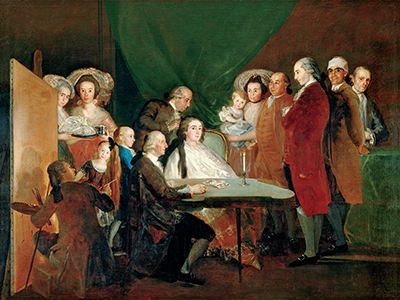
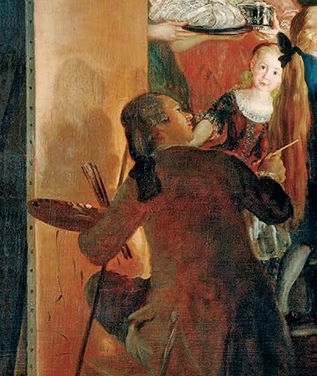
Don Luis sits at a green card table while a man dresses his wife’s hair. Their son stands just behind his father, looking in the same direction, and their elder daughter peers towards the painter. A candle burns almost unnoticed between the cards and the standing figures. At the far left, Goya turns towards the company with a brush in his hand. He has given himself the nearest place to the viewer and one of the darkest faces in the room. [1] [2]
This is Goya’s large group portrait of Don Luis de Borbón, the youngest brother of Charles III, and his household at Arenas de San Pedro. The original oil on canvas belongs to the Fondazione Magnani-Rocca near Parma. Goya made two visits to the family, in 1783 and 1784. His letters give a close account of what it was like to work for Don Luis, and they help explain how a set of individual commissions led to a picture that brings the family and its attendants into one room. [1] [2] [3] [4]
At a Glance
- ArtistFrancisco de Goya y Lucientes
- TitleThe Family of the Infante Don Luis (La familia del Infante don Luis)
- Date1783–84, with the group commission associated with the 1784 visit
- Medium and dimensionsOil on canvas, 248 × 328 cm (height × width)
- SettingThe household of Don Luis de Borbón at the palace of La Mosquera, Arenas de San Pedro, Ávila
- CollectionFondazione Magnani-Rocca, Mamiano di Traversetolo, near Parma, Italy. [1] [2] [5]
Works across Goya’s career
The Parasol
1777The Nude Maja
1795–1800Saturn Devouring His Son
c. 1820–23The Dog
c. 1820–23Two visits to Arenas de San Pedro
Don Luis married María Teresa de Vallabriga in 1776. She came from the Aragonese nobility. Under the terms of their morganatic marriage, their children were excluded from succession to the throne. The couple lived away from the royal court. At Arenas de San Pedro, the palace designed by Ventura Rodríguez gave Don Luis space for his collection and household. The staff included musicians, secretaries and people who looked after the children. Some of the jobs that sustained the household are visible in the painting itself. [1] [5]
Writing from Madrid on 20 September 1783, Goya told Martín Zapater that he had spent a month with the family and made likenesses of Don Luis, his wife and their two older children. He reported that the portraits had been well received. He had also gone hunting with Don Luis twice. The family gave him a thousand duros and a dress worked in silver and gold for his wife, Josefa Bayeu. Goya wrote that they asked him to return at least once a year. His account gives the artist a place in the life of the household beyond his hours at the easel. [3]
By 2 July 1784 Goya was writing from Arenas again, with an equestrian portrait of María Teresa de Vallabriga nearing completion. On 13 October, back in Madrid, he told Zapater that Don Luis had given him 30,000 reales for two paintings. The letter leaves the works unnamed. The Banco de España’s exhibition catalogue identifies them as the equestrian portrait and the group portrait. The Fondazione Magnani-Rocca dates the group to 1783–84 and proposes that Goya began it at La Mosquera and may have finished it in Madrid. The Fundación Goya en Aragón places its execution during the second visit. The two letters establish what Goya was doing at specific points in 1784 and leave the canvas’s finishing location open. [1] [2] [4] [6] [7]
Annotated Details from The Family of the Infante Don Luis
Follow the glances around the table, from Goya’s easel to the attendants.
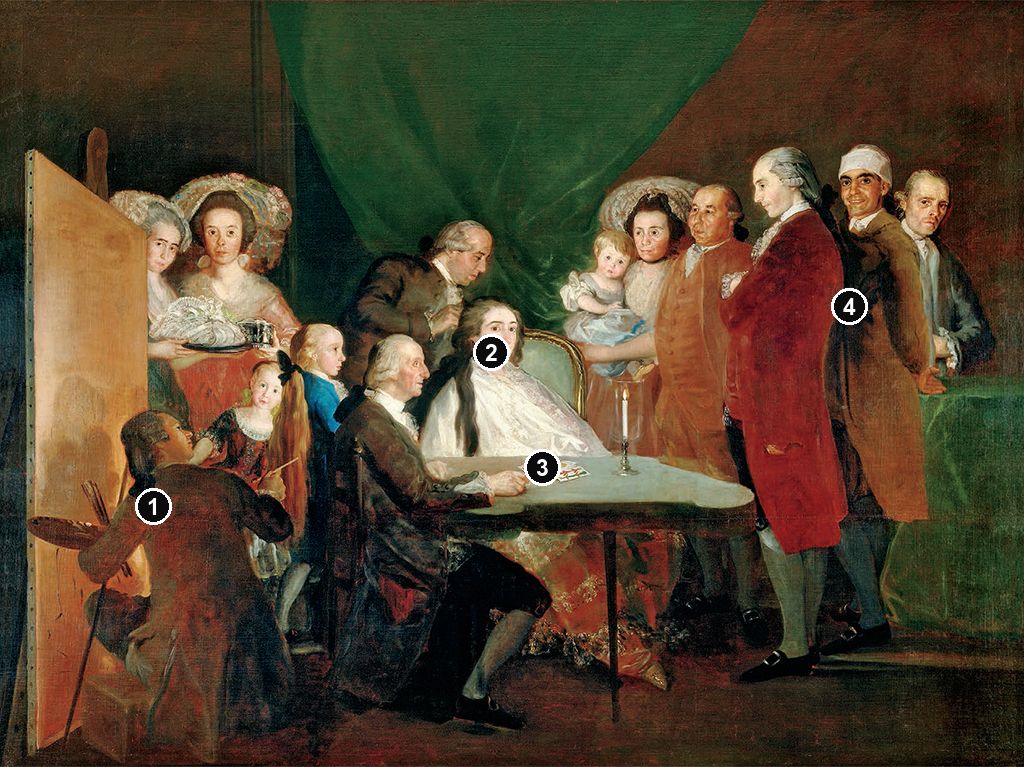
Details from THE FAMILY OF THE INFANTE DON LUIS
Details from the Fondazione Magnani-Rocca canvas.
Goya at the easel
The seated painter faces the back of the canvas.
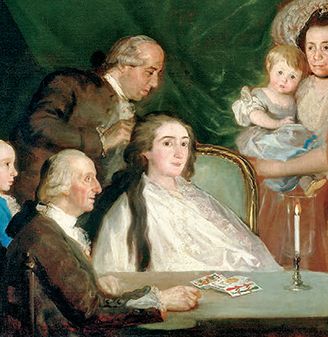
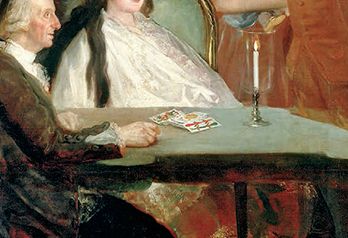
The hairdresser and white gown
María Teresa de Vallabriga sits while a man works behind her chair.
The table
Light picks out part of the tabletop between the seated figures.
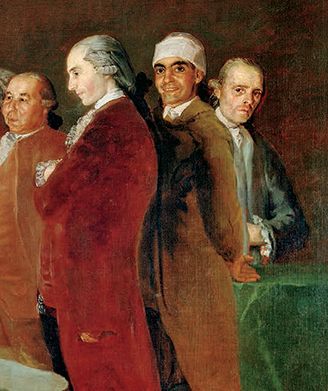
The figures to the right
The standing figures overlap in a shallow group behind the table.
The people around the table
María Teresa de Vallabriga occupies the centre in a white dressing gown. One long lock falls down the front, finding a dark outline against the cloth. At the back of her chair, the hairdresser bends in with his hands near her head. The Fundación Goya en Aragón identifies him as Santos Gracia. It identifies the two women to the left as attendants Antonia de Vanderbrocht and Petronila de Valdearenas. Look just beyond the painted canvas for the lace cap they have brought on a tray and the small container beside it. Those objects let the viewer follow the next steps in a routine already under way. [1] [2]
At the near end of the table, Don Luis leans forward, the light picking out his collar and the white hair at his temple. Luis María’s blue coat comes into view behind him. The little boy’s profile echoes his father’s across the short gap between their heads. His sister María Teresa, the future Countess of Chinchón, turns in the other direction. She tilts her head, and her eyes lead towards Goya at the easel. Across the room a woman usually identified as the governess Isidra Fuentes holds the youngest child, María Luisa. The baby’s bent arm and the pale blue fabric across her lap bring the eye back down from the row of standing faces. [1] [2]
The standing men are harder to name. The broad man in brown may be Manuel Moreno de las Heras, an official in Don Luis’s secretariat. The man beside him, in red and in profile, has often been identified as the composer and cellist Luigi Boccherini. The catalogues also list Gregorio Ruiz de Arce, a member of the chamber staff, and Estanislao de Lugo, tutor to Luis María, as possibilities. The smiling man in a white head covering may be Francisco del Campo, secretary to María Teresa. Alejandro de la Cruz and Gregorio Ferro, both painters, have been suggested for the figure at the far right. Palace payrolls give researchers names and jobs to work with. Assigning each name to a face requires further evidence, such as an independent likeness. [1] [2]
Goya on film
Five films explore Goya’s portraits, prints, Black Paintings and painting techniques.
The Duke of Wellington by Goya
The portrait, its military decorations and its later theft.
Watch on YouTubeThe candle, the curtain and the cards
Much of the upper half is given to a green curtain. Its falling edges converge behind María Teresa’s chair. Across the lower half, the table pushes forward at an angle, opening a patch of green between the dress and the red coat of the standing man. The folds of the curtain and the edges of the table draw the eye into the same area by different routes. On the left, the tall rectangle of Goya’s canvas partly hides the attendants. On the right, coats and overlapping shoulders compress four standing men into a narrow run of space. Seen across the whole width, the two ends frame a small area of activity between the hairdresser and Don Luis’s hand. [1] [2]
The candle is the only light source Goya shows. Tiny points of light mark the shaft and foot of the silver candlestick. Look higher and the light becomes harder to account for. It spreads across María Teresa’s gown and reaches faces at either end of the group, while Goya remains in shadow in the foreground. Stefano Roffi, writing for the Fondazione Magnani-Rocca, suggests that the lighting may reflect the use of separately painted likenesses. Goya varies the edges as much as the brightness. María Teresa’s white garment has a clear silhouette, with loose strokes within it, while the edges of the painter’s coat are almost lost against the dark floor. Roffi also describes a red-ochre preparation left visible in parts of the painting. At the far left, the warm expanse of the canvas beside Goya suggests the colour of a prepared surface and gives his dark figure an edge. [1] [8]
Don Luis’s cards are spread within reach of his right hand. Roffi identifies the ace of coins, the knight of clubs and the two of clubs from the Spanish-suited pack. The gesture could suggest a game of patience while the family waits. The candle has also prompted readings that connect it to the candlelit paintings Don Luis collected, or to the brevity of life. The objects give each reading a place to start. They also work at the scale of the room. The small white cards make the green cloth easier to see, and the upright candle separates the two seated adults from the men standing opposite. [1]
From single likenesses to a family portrait
Two portraits from the first visit help us see what changed when Goya brought the children together. In the Museo de Zaragoza’s portrait of Luis María, the boy has a whole canvas in which to turn. At the table Goya draws attention to the shape of his profile and its resemblance to his father’s. In the National Gallery of Art’s portrait of María Teresa, her small figure stands in a garden with a mountain landscape behind her. In the family canvas, a tilt of her head is enough to give her a role of her own amid all the faces. Goya painted her again as an adult in the Prado’s Countess of Chinchón. She eventually inherited the family portrait. [1] [2] [9] [10] [11]
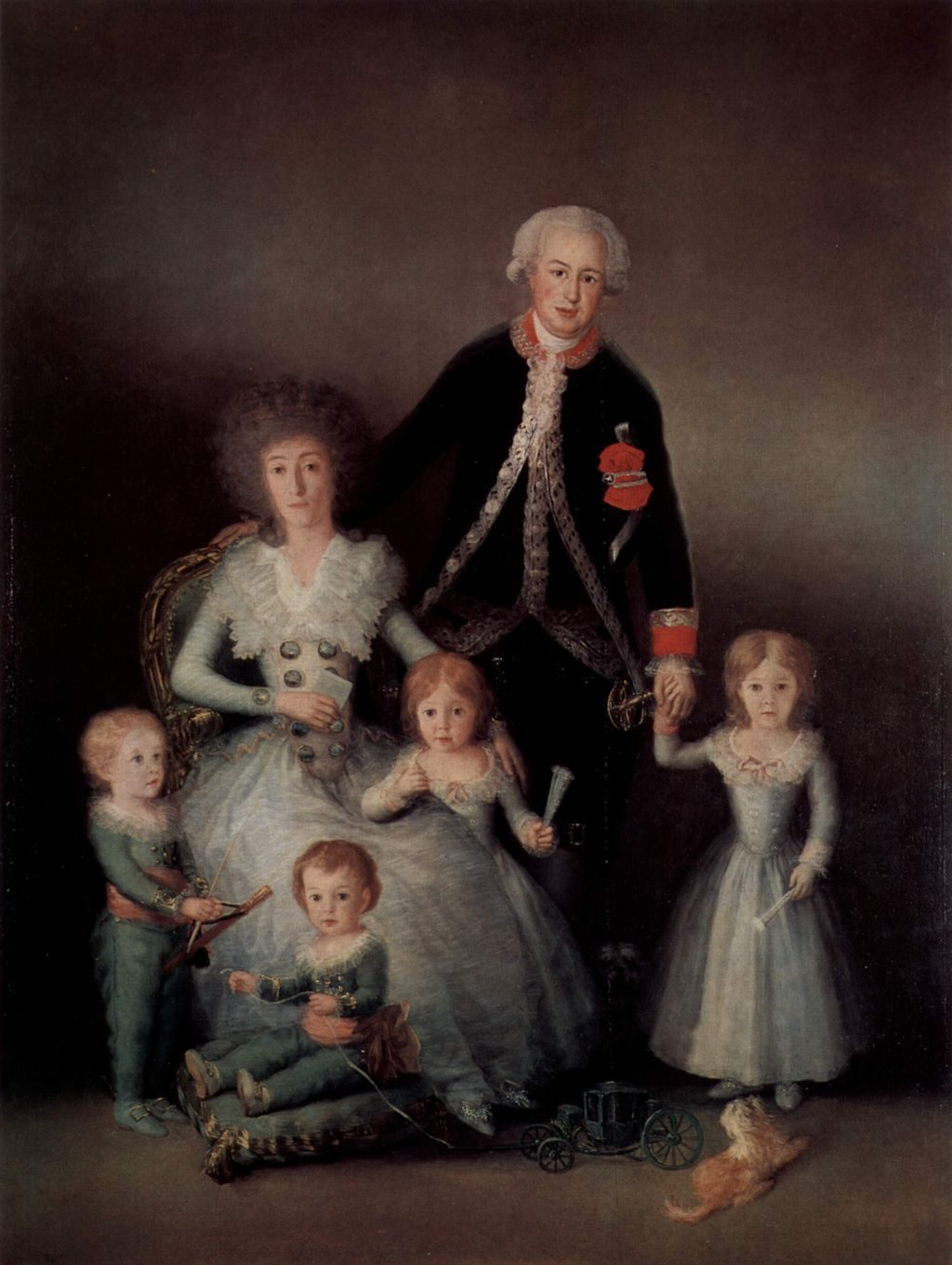
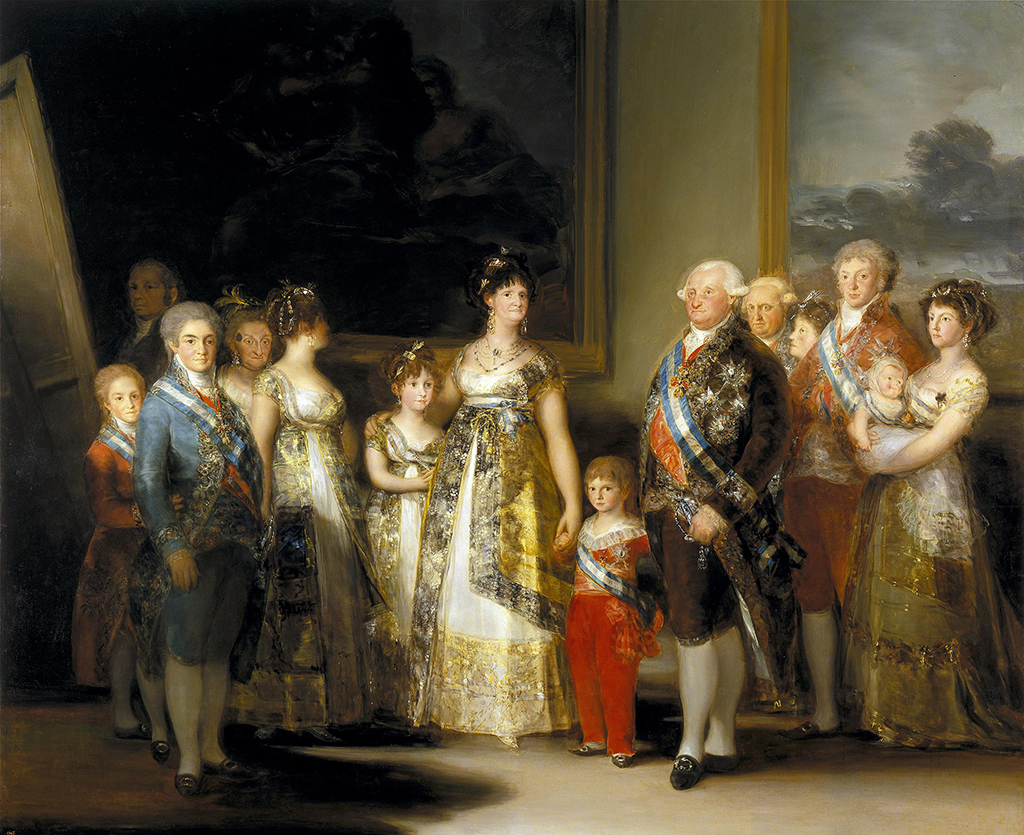
The choice to put himself beside a large canvas recalls Diego Velázquez’s Las Meninas. Goya studied the painting closely when making his prints after Velázquez. At Arenas the back of his painted canvas conceals the image he is making, while his brush and the little girl’s gaze make him part of the scene. By the time of The Family of Charles IV, he again put himself in shadow on the left, this time behind a largely standing royal group. Another family commission from the intervening years, The Duke and Duchess of Osuna and Their Children, lets the children gather around their parents against a pale background. In the Arenas group, the reach of the table and the presence of the attendants give the family a whole room to inhabit. [1] [12] [13] [14]
From Boadilla to Mamiano
The portrait passed to Don Luis’s elder daughter, the Countess of Chinchón, and was moved to the family palace at Boadilla del Monte around 1820. It appears in the palace’s inventory of 27 May 1832 and again in later family inventories. The countess’s daughter Carlota Luisa, who married Camillo Ruspoli, inherited it. In 1904 the Ruspoli heirs moved the canvas to their palace in Florence. Luigi Magnani acquired it in 1974. A period copy is recorded in the collection of the Duke and Duchess of Sueca, while Goya’s original is the canvas now held at Mamiano di Traversetolo. Italy’s national cultural heritage catalogue records it under code 0800682331. That record gives a width of 330 cm. The owning foundation and the Fundación Goya en Aragón both give 328 cm. [1] [2] [15]

Artworks directory
| Name | Date | Medium |
|---|---|---|
| And There’s No Help for It, Plate 15 | Printed 1863 | |
| Asmodea | c. 1820–23 | Wall painting transferred to canvas |
| Boys Inflating a Bladder | 1777–78 | Tapestry cartoon |
| Boys Picking Fruit | 1778 | Tapestry cartoon |
| Bullfight in a Divided Ring | 1825 | Lithograph |
| Card Players | 1777–78 | Tapestry cartoon |
| Card Players (sketch) | 1777–78 | Painted sketch |
| Dance on the Banks of the Manzanares | 1777 | Tapestry cartoon |
| Duel with Cudgels | c. 1820–23 | Wall painting transferred to canvas |
| Heads in a Landscape | c. 1820–23 | Easel painting |
| Judith and Holofernes | c. 1820–23 | Wall painting transferred to canvas |
| Leocadia | c. 1820–23 | Wall painting transferred to canvas |
| Maja and Cloaked Men | 1777 | Tapestry cartoon |
| Maja and Cloaked Men (sketch) | 1777 | Painted sketch |
| Majo Clapping in Time to the Music | 1777 | Drawing |
| Men Reading | c. 1820–23 | Wall painting transferred to canvas |
| Out Hunting for Teeth, Plate 12 | 1799 | Etching, burnished aquatint and burin |
| Picnic in the Countryside (sketch) | 1776–78 | Painted sketch |
| Picnic on the Banks of the Manzanares | 1776 | Tapestry cartoon |
| Pilgrimage to San Isidro | c. 1820–23 | Wall painting transferred to canvas |
| Preparatory study for The Sleep of Reason Produces Monsters | c. 1796–97 | Drawing |
| Procession of the Holy Office | c. 1820–23 | Wall painting transferred to canvas |
| Quarrel at the Cockerel Inn (sketch) | 1777 | Painted sketch |
| Quarrel in the New Tavern | 1777 | Tapestry cartoon |
| Saturn Devouring His Son | c. 1820–23 | Wall painting transferred to canvas |
| Seated Majo Smoking | c. 1776 | Drawing |
| The Dog | c. 1820–23 | Wall painting transferred to canvas |
| The Drinker | 1777 | Tapestry cartoon |
| The Fates | c. 1820–23 | Wall painting transferred to canvas |
| The Great He-Goat | c. 1820–23 | Wall painting transferred to canvas |
| The Kite | 1777–78 | Tapestry cartoon |
| The Parasol | 1777 | Oil on canvas, tapestry cartoon |
| The Second of May 1808 | 1814 | Oil on canvas |
| The Sleep of Reason Produces Monsters, Plate 43 | 1799 | Etching and aquatint |
| The Third of May 1808 | 1814 | Oil on canvas |
| Thou Who Canst Not, Plate 42 | 1799 | Etching and burnished aquatint |
| Three Figures | 1776 | Drawing (lost) |
| Two Old Men | c. 1820–23 | Wall painting transferred to canvas |
| Two Old Men Eating Soup | c. 1820–23 | Wall painting transferred to canvas |
| Two Women and a Man | c. 1820–23 | Wall painting transferred to canvas |
| Universal Language: The Author Dreaming | 1797 | Drawing |
| The Family of Charles IV | 1800 | Oil on canvas |
| Witches’ Sabbath (Osuna painting) | 1797–98 | Oil on canvas |
| The Nude Maja | 1795–1800 | Oil on canvas |
| The Clothed Maja | 1800–07 | Oil on canvas |
| Self-Portrait (Drawing) | c. 1796 | Brush and carbon black ink on laid paper |
| The Swing, Madrid Album B.21 | 1795–97 | Brush and carbon black washes |
| Majas Fighting, a Majo Observing, Madrid Album B.15 | 1796–97 | Brush, grey and black washes on laid paper |
| Majos and Majas Conversing, Madrid Album B.16 | c. 1794–97 | Ink wash on paper |
| Weeping Woman and Three Men, Madrid Album B.17 | 1795–97 | Brush, carbon black washes and black chalk |
| Maja Seated on a Chair and Two Companions Behind, Madrid Album B.18 | 1795–97 | Brush and carbon black washes |
| Girl and Bull, Madrid Album B.23 | 1796–97 | Brush and carbon black washes |
| Lovers Sitting on a Rock, Madrid Album B.24 | 1796–97 | Brush and carbon black washes |
| Mariano Ceballos Riding a Bull | 1825 | Crayon lithograph and scraper |
| Landscape (lifetime impression) | c. 1807–10 | Etching and aquatint |
| Self-Portrait (1815), Prado canvas | 1815 | Oil on canvas |
| Self-Portrait (1815), Academy panel | 1815 | Oil on panel |
| Self-Portrait with Dr Arrieta | 1820 | Oil on canvas |
| Christ Crucified | 1780 | Oil on canvas |
| The Last Communion of Saint Joseph of Calasanz | 1819 | Oil on canvas |
| Christ on the Mount of Olives | 1819 | Oil on panel |
| The Flower Girls, or Spring | 1786–87 | Oil on canvas |
| The Grape Harvest, or Autumn | 1786–87 | Oil on canvas |
| The Snowstorm, or Winter | 1786–87 | Oil on canvas |
| The Threshing Ground, or Summer | 1786–87 | Oil on canvas |
| Picnic on the Banks of the Manzanares | 1776 | Oil on canvas |
| The Kite | 1777–78 | Oil on canvas |
| Dance on the Banks of the Manzanares | 1777 | Oil on canvas |
| A Fight at the Venta Nueva | 1777 | Oil on canvas |
| Blind Man’s Bluff | 1788 | Oil on canvas |
| Dogs on a Lead | 1775 | Oil on canvas |
| Hunting with a Decoy | 1775 | Oil on canvas |
| Hunter Loading His Rifle | 1775 | Oil on canvas |
| The Angler | 1775 | Oil on canvas |
| The Hermitage of San Isidro on His Feast Day | 1788 | Oil on canvas |
| The Meadow of San Isidro | 1788 | Oil on canvas |
| The Straw Manikin | 1791–92 | Oil on canvas |
| Witches’ Flight | c. 1797–98 | Oil on canvas |
| A Scene from ‘The Forcibly Bewitched’ | 1798 | Oil on canvas |
| The Duchess of Alba in Black | 1797 | Oil on canvas |
| The Duchess of Alba in White | 1795 | Oil on canvas |
| Charles III in Hunting Dress | c. 1786 | Oil on canvas |
| The Duke and Duchess of Osuna and Their Children | 1787–88 | Oil on canvas |
| Manuel Osorio Manrique de Zúñiga | 1787–88 | Oil on canvas |
| The Marquesa de Pontejos | c. 1786 | Oil on canvas |
| Equestrian Portrait of the 1st Duke of Wellington | 1812 | Oil on canvas |
| The Duke of Wellington | 1812–14 | Oil on wood |
| Portrait of Ferdinand VII of Spain | 1814 | Oil on canvas |
| Gaspar Melchor de Jovellanos | 1798 | Oil on canvas |
| María Tomasa Palafox y Portocarrero | 1804 | Oil on canvas |
| Señora Sabasa García | c. 1806–11 | Oil on canvas |
| Don Juan Bautista de Muguiro | 1827 | Oil on canvas |
| Doña Isabel de Porcel | Before 1805 | Oil on canvas |
| The Colossus | After 1808 | Oil on canvas |
| The Burial of the Sardine | 1808–12 | Oil on panel |
| The Madhouse | 1808–12 | Oil on panel |
| A Procession of Flagellants | 1808–12 | Oil on panel |
| Portrait of Jacques Galos | 1826 | Oil on canvas |
| Portrait of Mariano Goya, the Artist’s Grandson | 1827 | Oil on canvas |
| Milkmaid of Bordeaux | c. 1827 | Oil on canvas |
| Portrait of Don Juan Antonio Cuervo | 1819 | Oil on canvas |
| María Luisa of Parma (Naples version) | c. 1800 | Oil on canvas |
| The Countess of Baena | 1819 | Oil on canvas |
| The Family of the Infante Don Luis | 1783–84 | Oil on canvas |
| The Holy Family | c. 1787 | Oil on canvas |
| Saint Barbara | c. 1773 | Oil on canvas |
| Saints Justa and Rufina | 1817 | Oil on canvas |
| El Tío Paquete | c. 1819–20 | Oil on canvas |
| The Forge | c. 1815–20 | Oil on canvas |
| Majas on a Balcony (Metropolitan Museum version) | c. 1800–10 | Oil on canvas |
| Maja and Celestina on a Balcony | c. 1808–12 | Oil on canvas |
| The Water Bearer | 1808–12 | Oil on canvas |
| Time and the Old Women | c. 1810 | Oil on canvas |
Frequently Asked Questions
The original is in the permanent collection of the Fondazione Magnani-Rocca at the Villa dei Capolavori, Mamiano di Traversetolo, near Parma in Italy. [1]
Discussion
Look again at the images and ideas explored in The Family of the Infante Don Luis. These editorial prompts invite your observations.
Start with the girl looking towards the painter, then follow the father and son’s profiles across the table. Which figure seems most aware of being watched, and what does the direction of their gaze make you think is happening beyond the frame?
Reader Insights
Follow the glances between the painter, the children and the table.
How does the candle help hold the group together?
Join the Conversation
Share a detail, comparison or question about The Family of the Infante Don Luis below.
References
- Stefano Roffi, Fondazione Magnani-Rocca, La Famiglia dell’infante don Luis di Goya, collection entry with provenance, composition and proposed sitter identifications. View source.
- Fundación Goya en Aragón, La familia del Infante don Luis, catalogue entry 337. View source.
- Francisco de Goya, letter to Martín Zapater, Madrid, 20 September 1783, in Ángel Canellas López’s Diplomatario, doc. 72, Universidad de Zaragoza. View source.
- Francisco de Goya, letter to Martín Zapater, Arenas de San Pedro, 2 July 1784, in Ángel Canellas López’s Diplomatario, doc. 81, Universidad de Zaragoza. View source.
- Patrimonio Nacional, Goya y el Infante Don Luis: el exilio y el reino, exhibition overview. View source.
- Francisco de Goya, letter to Martín Zapater, Madrid, 13 October 1784, in Ángel Canellas López’s Diplomatario, doc. 84, Universidad de Zaragoza. View source.
- Manuela B. Mena Marqués, “The Image of Banco de San Carlos through its Art and its Archive”, in 2328 reales de vellón. Goya y los orígenes de la Colección Banco de España, exhibition catalogue, p. 222. View source.
- National Gallery, London, Goya: Exhibition in focus, notes on the group portrait and the visit to Arenas. View source.
- Museo de Zaragoza, Luis María de Borbón y Vallabriga, collection record 54278. View source.
- National Gallery of Art, Washington, María Teresa de Borbón y Vallabriga, later Condesa de Chinchón, 1783, collection record 1970.17.123. View source.
- Fundación Goya en Aragón, The Countess of Chinchón, catalogue entry 356, Museo Nacional del Prado P007767. View source.
- Fundación Goya en Aragón, Goya after Velázquez, Las Meninas, catalogue entry 698. View source.
- Fundación Goya en Aragón, The Family of Charles IV, catalogue entry 355, Museo Nacional del Prado P000726. View source.
- Museo Nacional del Prado, Los duques de Osuna y sus hijos, collection record P000739. View source.
- Ministero della Cultura, La famiglia dell’Infante Don Luis di Borbone, Catalogo generale dei Beni Culturali, national catalogue code 0800682331. View source.







