


 by Tom Gurney
Tom Gurney BSc (Hons) is an art history expert with over 20 years experience
Published on June 19, 2020 / Updated on November 20, 2026
Email: tomgurney1@gmail.com / Phone: +44 7429 011000
Introduction
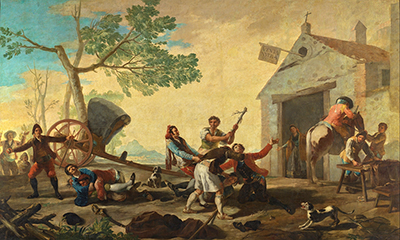
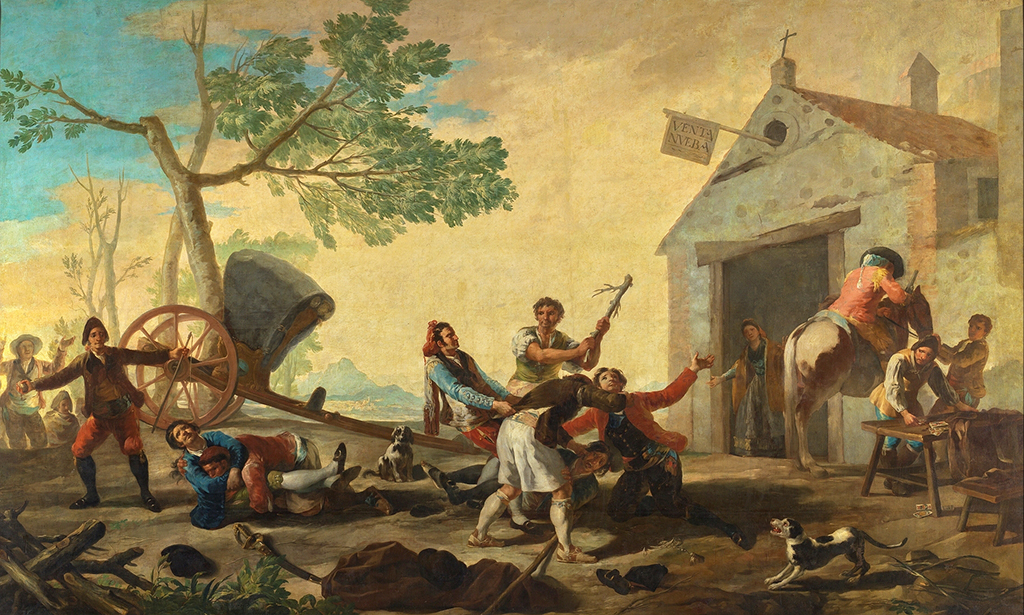
A man stoops over a table to gather the stakes while the card players fight in the dust outside a roadside inn. Beside him a rider leans over his horse, and a dog springs towards the melee. Francisco de Goya painted A Fight at the Venta Nueva (La riña en la Venta Nueva) in 1777 as a full-size design for a tapestry for the royal dining room at El Pardo. The painting, now in the Museo Nacional del Prado, spreads the quarrel across more than four metres of canvas. [1] [2] [3]
At a Glance
- ArtistFrancisco José de Goya y Lucientes.
- Date1777. Delivered to the Royal Tapestry Factory on 12 August. [2] [3]
- MediumOil on canvas, painted as a tapestry cartoon. [1]
- Size275 × 414 cm. [1]
- CommissionOne of ten designs for the dining room of the Prince and Princess of Asturias at the Royal Palace of El Pardo. [1] [2]
- CollectionMuseo Nacional del Prado, Madrid, P000770. [1]
Works across Goya’s career
The Parasol
1777The Nude Maja
1795–1800Saturn Devouring His Son
c. 1820–23The Dog
c. 1820–23The fight across the yard
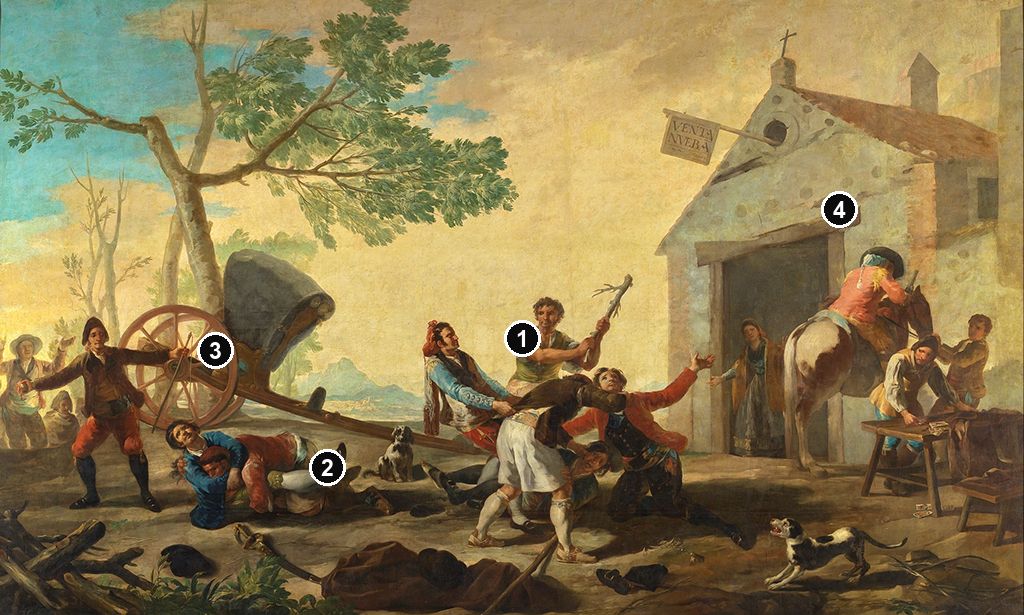
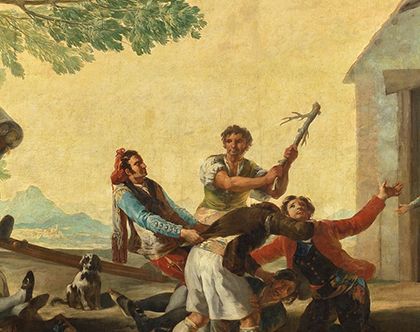
At the centre, a man stands with his back to us and both feet planted on the ground. His pale breeches and white stockings make his legs easy to follow even as his upper body disappears among arms and coat tails. At his left, a man in blue leans backwards and pulls at his coat. At his right, a figure in red flings an arm out towards the inn. Another man raises a forked branch above them. The eye travels from the man’s firm footing upwards through a knot of bodies to the bare twigs of the branch, which show clearly against the sky. [2] [3]
Goya’s invoice helps to disentangle those gestures. He identifies the man seen from behind as a Murcian and describes him getting the better of two men. A third man tries to pull him away and tears the skirt of his coat. The man with the branch is also trying to break up the fight, according to Goya. The raised branch looks threatening even before we recognise what its bearer means to do. Short breeches and footwear helped contemporaries read the central figure’s regional dress, a point picked up by the Fundación Goya en Aragón. For the court, the figures brought together recognisable clothing and occupations from several parts of Spain. [1] [2] [3]
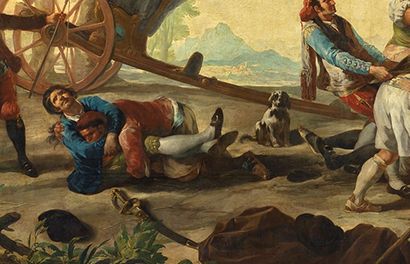
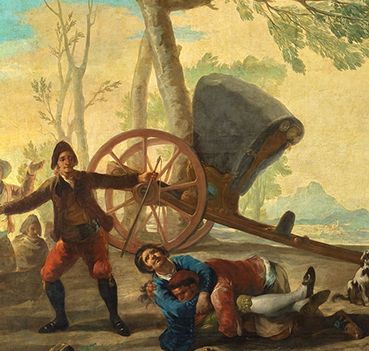
To the left of the standing men, another pair wrestle on the ground. Their stockings, shoes and bent knees are visible against the shadow under the carriage. A man beside the large wheel has spread his arms, one hand holding a stone. Goya describes him as poised to run away. Beyond his outstretched arm, smaller faces appear at the edge of the picture. The open yard makes room for both struggles and for someone to hesitate between getting involved and making his escape. A dog sitting between the two groups is dwarfed by the carriage shafts, which slope down towards the standing men. [2] [3]
Annotated Details from A Fight at the Venta Nueva
Follow the raised sticks and open arms between the road and the inn.
Details from A FIGHT AT THE VENTA NUEVA
Details from the tapestry cartoon in the Museo Nacional del Prado (P000770).
The raised sticks
Several long, thin lines cut across the open ground above the figures.
The figures on the ground
Low bodies and scattered objects flatten the movement at this end of the scene.
The cart at left
A large wheel stands out beside the tree and the small figures.
The inn
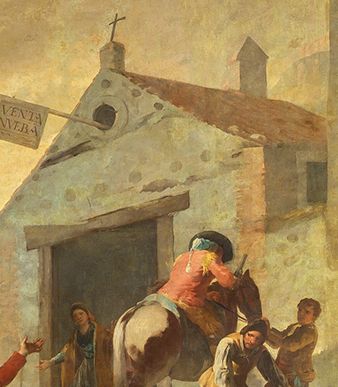
The sloping roof and pale wall lead down towards the mounted figure at the doorway.
At the inn door
The card game is easiest to find by looking to the far right. The innkeeper bends over the table and gathers the money, as Goya explains in the invoice. Cards appear among the small objects scattered near the table. Beside the innkeeper a rider turns in the saddle. Goya says he is about to dismount with a pistol. A woman in the doorway extends one hand into the yard. The horse, seen from behind, blocks part of the doorway and separates her from the table. Across the bottom of the canvas, branches and discarded clothing mark the nearest stretch of ground. A second dog, black and white, lunges across this space with its mouth open. [1] [2] [3]
Look up from the door and the dark opening gives way to cracked plaster, a circular window and a projecting sign. The tilted board spells out the name of the inn, with the painted spelling arranged over two lines. A small cross crowns the gable. Across the yard the tree forks into one nearly bare upright limb and a broad leafy branch. The inn and tree frame a strip of blue mountains between the carriage and the men. The way the figures enter from the edges and come into view at different heights has prompted comparisons with the sainete, a short Spanish comic play of everyday life associated with Ramón de la Cruz. The Prado also places the design in a tradition of Flemish and Dutch scenes of ordinary life familiar to tapestry makers. [1] [2]
A venta was a roadside inn where people stopped as they travelled. Goya’s account introduces carriage drivers and muleteers from several Spanish provinces who rest and then play cards. Valentín de Sambricio associated the setting with the inns of the Espíritu Santo on the outskirts of Madrid, in the area now called Las Ventas. The Prado presents that location as a possibility. Manuela Mena, writing about the preparatory oil and the cartoon, reads the worn building and tilted sign as an irony in a scene whose inn is called ‘new’. The damage to the plaster gives that reading a visible starting point. [1] [2] [3] [4]
Goya on film
Five films explore Goya’s portraits, prints, Black Paintings and painting techniques.
The Duke of Wellington by Goya
The portrait, its military decorations and its later theft.
Watch on YouTubeFrom the factory to the royal dining room
Goya addressed the bill of 12 August 1777 to Francisco Sabatini, the king’s first architect. He said he had invented the compositions himself and described them as models for the tapestries for the room where the Prince and Princess of Asturias ate. The couple were the future Charles IV and María Luisa of Parma. He valued the fight at 10,000 reales de vellón, over half the 18,000 he listed for the four canvases in that delivery. The later factory register records Cornelio Vandergoten’s receipt for all four on the same date and an award of 17,000 reales for the group by royal order on 3 October. The two figures record Goya’s valuation and the factory’s account of the amount paid. [1] [2] [3]
The fight was the widest of the ten designs. The Fundación calculates that its original width was about 469 cm from the dimensions in Goya’s bill and reports that the canvas was cut down. Its size suggests that it occupied a substantial part of a wall, although its precise position in the room is uncertain. A woven version at the Louvre, produced by the Royal Tapestry Factory in wool and silk around 1777–78, measures 285 × 479 cm. It reverses the scene, with the inn and table on the left and the carriage on the right. The cartoon remained with the factory until the mid-nineteenth century, passed to the Royal Palace in Madrid and entered the Prado in 1870. [1] [2] [5]
Other scenes in the same commission
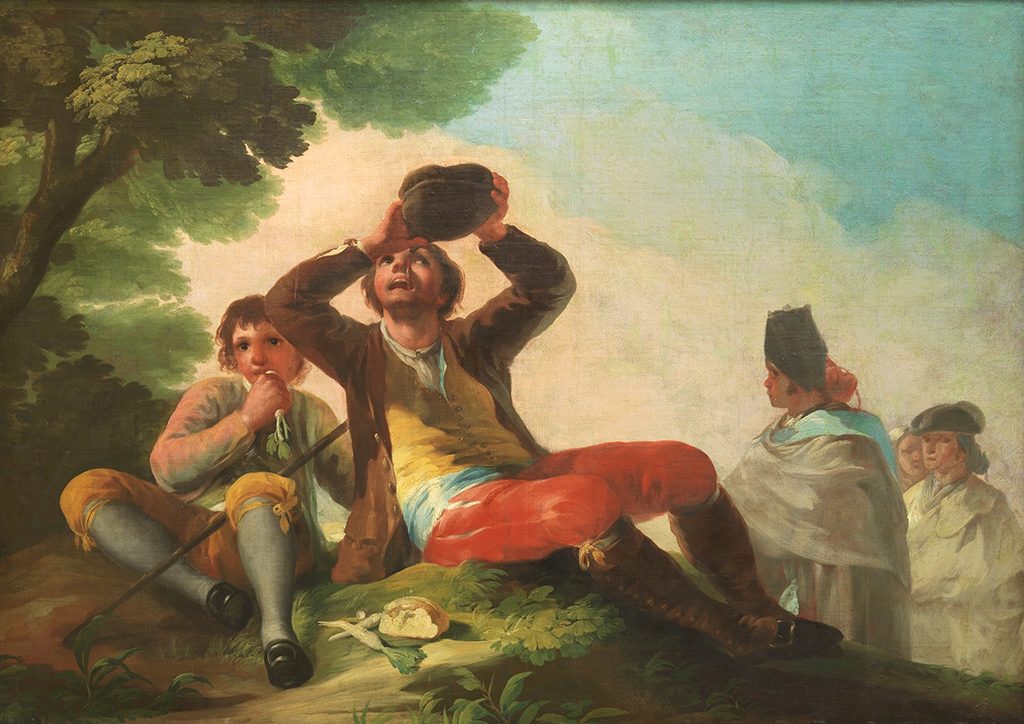
The August delivery also included The Parasol, The Drinker and The Maja and the Cloaked Men. In The Parasol, a young man and a seated woman fit under the curve of the parasol, and a small dog lies settled in her lap. In the fight, the dogs register the disturbance at ground level and the people are spread across a much wider space. The dimensions and subjects entered together in the factory register show the range of shapes and actions intended for the same dining room. [2] [3] [4]
The later Card Players (Los jugadores de naipes, Prado P000775) shows a game still in progress. In his bill of 26 January 1778, Goya identifies a spectator signalling the value of a player’s hand to an accomplice. The men remain grouped under the shade of a cloak hung from a tree. At the Venta Nueva, the participants have scattered into the yard and their abandoned game has to be reconstructed from the table, the cards and the money. Goya specifies a quarrel arising from play in the August bill. The January bill explicitly describes cheating in the separate Card Players design. [3] [6]
The smaller fight at the Cockerel Inn
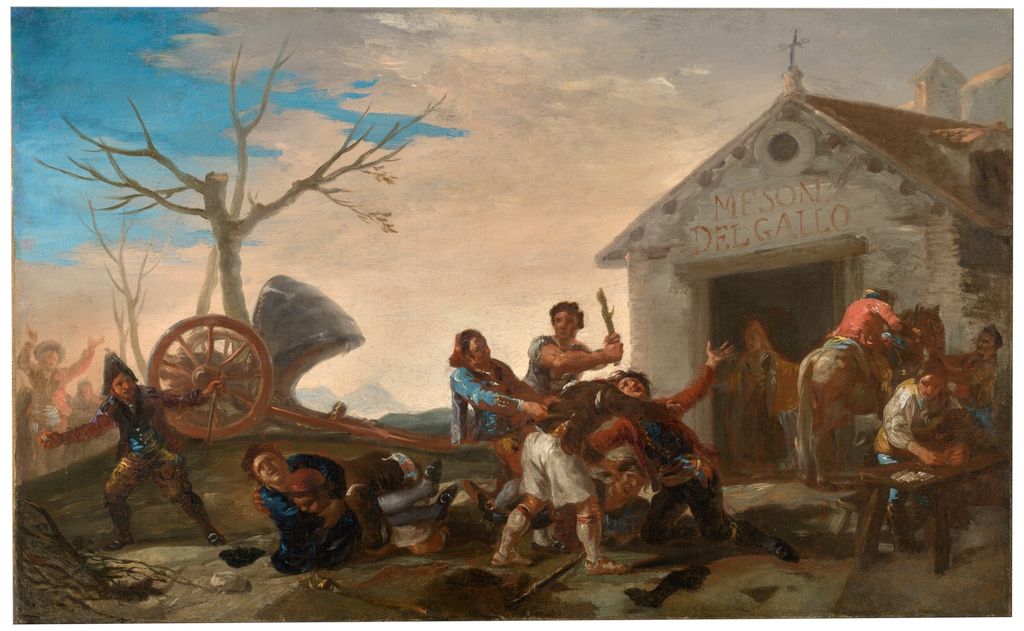
Goya’s preparatory oil, La riña en el Mesón del Gallo (A Fight at the Cockerel Inn), is also in the Prado, P007801. The 41.9 × 67.3 cm canvas gathers the fighters into a shallow, packed row. In the full-size version, more ground opens between the incidents, the building recedes and dogs occupy some of the intervals between people. The name changes from the Cockerel Inn in the study to the Venta Nueva in the cartoon. The different signs help distinguish the two stages of the same design. A small oil in Winterthur catalogued as an attributed study for Card Players belongs to the separate composition of the game under the tree. [1] [4] [7] [8]
Artworks directory
| Name | Date | Medium |
|---|---|---|
| And There’s No Help for It, Plate 15 | Printed 1863 | |
| Asmodea | c. 1820–23 | Wall painting transferred to canvas |
| Boys Inflating a Bladder | 1777–78 | Tapestry cartoon |
| Boys Picking Fruit | 1778 | Tapestry cartoon |
| Bullfight in a Divided Ring | 1825 | Lithograph |
| Card Players | 1777–78 | Tapestry cartoon |
| Card Players (sketch) | 1777–78 | Painted sketch |
| Dance on the Banks of the Manzanares | 1777 | Tapestry cartoon |
| Duel with Cudgels | c. 1820–23 | Wall painting transferred to canvas |
| Heads in a Landscape | c. 1820–23 | Easel painting |
| Judith and Holofernes | c. 1820–23 | Wall painting transferred to canvas |
| Leocadia | c. 1820–23 | Wall painting transferred to canvas |
| Maja and Cloaked Men | 1777 | Tapestry cartoon |
| Maja and Cloaked Men (sketch) | 1777 | Painted sketch |
| Majo Clapping in Time to the Music | 1777 | Drawing |
| Men Reading | c. 1820–23 | Wall painting transferred to canvas |
| Out Hunting for Teeth, Plate 12 | 1799 | Etching, burnished aquatint and burin |
| Picnic in the Countryside (sketch) | 1776–78 | Painted sketch |
| Picnic on the Banks of the Manzanares | 1776 | Tapestry cartoon |
| Pilgrimage to San Isidro | c. 1820–23 | Wall painting transferred to canvas |
| Preparatory study for The Sleep of Reason Produces Monsters | c. 1796–97 | Drawing |
| Procession of the Holy Office | c. 1820–23 | Wall painting transferred to canvas |
| Quarrel at the Cockerel Inn (sketch) | 1777 | Painted sketch |
| Quarrel in the New Tavern | 1777 | Tapestry cartoon |
| Saturn Devouring His Son | c. 1820–23 | Wall painting transferred to canvas |
| Seated Majo Smoking | c. 1776 | Drawing |
| The Dog | c. 1820–23 | Wall painting transferred to canvas |
| The Drinker | 1777 | Tapestry cartoon |
| The Fates | c. 1820–23 | Wall painting transferred to canvas |
| The Great He-Goat | c. 1820–23 | Wall painting transferred to canvas |
| The Kite | 1777–78 | Tapestry cartoon |
| The Parasol | 1777 | Oil on canvas, tapestry cartoon |
| The Second of May 1808 | 1814 | Oil on canvas |
| The Sleep of Reason Produces Monsters, Plate 43 | 1799 | Etching and aquatint |
| The Third of May 1808 | 1814 | Oil on canvas |
| Thou Who Canst Not, Plate 42 | 1799 | Etching and burnished aquatint |
| Three Figures | 1776 | Drawing (lost) |
| Two Old Men | c. 1820–23 | Wall painting transferred to canvas |
| Two Old Men Eating Soup | c. 1820–23 | Wall painting transferred to canvas |
| Two Women and a Man | c. 1820–23 | Wall painting transferred to canvas |
| Universal Language: The Author Dreaming | 1797 | Drawing |
| The Family of Charles IV | 1800 | Oil on canvas |
| Witches’ Sabbath (Osuna painting) | 1797–98 | Oil on canvas |
| The Nude Maja | 1795–1800 | Oil on canvas |
| The Clothed Maja | 1800–07 | Oil on canvas |
| Self-Portrait (Drawing) | c. 1796 | Brush and carbon black ink on laid paper |
| The Swing, Madrid Album B.21 | 1795–97 | Brush and carbon black washes |
| Majas Fighting, a Majo Observing, Madrid Album B.15 | 1796–97 | Brush, grey and black washes on laid paper |
| Majos and Majas Conversing, Madrid Album B.16 | c. 1794–97 | Ink wash on paper |
| Weeping Woman and Three Men, Madrid Album B.17 | 1795–97 | Brush, carbon black washes and black chalk |
| Maja Seated on a Chair and Two Companions Behind, Madrid Album B.18 | 1795–97 | Brush and carbon black washes |
| Girl and Bull, Madrid Album B.23 | 1796–97 | Brush and carbon black washes |
| Lovers Sitting on a Rock, Madrid Album B.24 | 1796–97 | Brush and carbon black washes |
| Mariano Ceballos Riding a Bull | 1825 | Crayon lithograph and scraper |
| Landscape (lifetime impression) | c. 1807–10 | Etching and aquatint |
| Self-Portrait (1815), Prado canvas | 1815 | Oil on canvas |
| Self-Portrait (1815), Academy panel | 1815 | Oil on panel |
| Self-Portrait with Dr Arrieta | 1820 | Oil on canvas |
| Christ Crucified | 1780 | Oil on canvas |
| The Last Communion of Saint Joseph of Calasanz | 1819 | Oil on canvas |
| Christ on the Mount of Olives | 1819 | Oil on panel |
| The Flower Girls, or Spring | 1786–87 | Oil on canvas |
| The Grape Harvest, or Autumn | 1786–87 | Oil on canvas |
| The Snowstorm, or Winter | 1786–87 | Oil on canvas |
| The Threshing Ground, or Summer | 1786–87 | Oil on canvas |
| Picnic on the Banks of the Manzanares | 1776 | Oil on canvas |
| The Kite | 1777–78 | Oil on canvas |
| Dance on the Banks of the Manzanares | 1777 | Oil on canvas |
| A Fight at the Venta Nueva | 1777 | Oil on canvas |
| Blind Man’s Bluff | 1788 | Oil on canvas |
| Dogs on a Lead | 1775 | Oil on canvas |
| Hunting with a Decoy | 1775 | Oil on canvas |
| Hunter Loading His Rifle | 1775 | Oil on canvas |
| The Angler | 1775 | Oil on canvas |
| The Hermitage of San Isidro on His Feast Day | 1788 | Oil on canvas |
| The Meadow of San Isidro | 1788 | Oil on canvas |
| The Straw Manikin | 1791–92 | Oil on canvas |
| Witches’ Flight | c. 1797–98 | Oil on canvas |
| A Scene from ‘The Forcibly Bewitched’ | 1798 | Oil on canvas |
| The Duchess of Alba in Black | 1797 | Oil on canvas |
| The Duchess of Alba in White | 1795 | Oil on canvas |
| Charles III in Hunting Dress | c. 1786 | Oil on canvas |
| The Duke and Duchess of Osuna and Their Children | 1787–88 | Oil on canvas |
| Manuel Osorio Manrique de Zúñiga | 1787–88 | Oil on canvas |
| The Marquesa de Pontejos | c. 1786 | Oil on canvas |
| Equestrian Portrait of the 1st Duke of Wellington | 1812 | Oil on canvas |
| The Duke of Wellington | 1812–14 | Oil on wood |
| Portrait of Ferdinand VII of Spain | 1814 | Oil on canvas |
| Gaspar Melchor de Jovellanos | 1798 | Oil on canvas |
| María Tomasa Palafox y Portocarrero | 1804 | Oil on canvas |
| Señora Sabasa García | c. 1806–11 | Oil on canvas |
| Don Juan Bautista de Muguiro | 1827 | Oil on canvas |
| Doña Isabel de Porcel | Before 1805 | Oil on canvas |
| The Colossus | After 1808 | Oil on canvas |
| The Burial of the Sardine | 1808–12 | Oil on panel |
| The Madhouse | 1808–12 | Oil on panel |
| A Procession of Flagellants | 1808–12 | Oil on panel |
| Portrait of Jacques Galos | 1826 | Oil on canvas |
| Portrait of Mariano Goya, the Artist’s Grandson | 1827 | Oil on canvas |
| Milkmaid of Bordeaux | c. 1827 | Oil on canvas |
| Portrait of Don Juan Antonio Cuervo | 1819 | Oil on canvas |
| María Luisa of Parma (Naples version) | c. 1800 | Oil on canvas |
| The Countess of Baena | 1819 | Oil on canvas |
| The Family of the Infante Don Luis | 1783–84 | Oil on canvas |
| The Holy Family | c. 1787 | Oil on canvas |
| Saint Barbara | c. 1773 | Oil on canvas |
| Saints Justa and Rufina | 1817 | Oil on canvas |
| El Tío Paquete | c. 1819–20 | Oil on canvas |
| The Forge | c. 1815–20 | Oil on canvas |
| Majas on a Balcony (Metropolitan Museum version) | c. 1800–10 | Oil on canvas |
| Maja and Celestina on a Balcony | c. 1808–12 | Oil on canvas |
| The Water Bearer | 1808–12 | Oil on canvas |
| Time and the Old Women | c. 1810 | Oil on canvas |
Frequently Asked Questions
Discussion
Look again at the images and ideas explored in A Fight at the Venta Nueva. These editorial prompts invite your observations.
Which figure first tells you how the fight started? How does following the action from the carriage towards the inn change your reading of the men in the centre?
Reader Insights
Which gestures lead your eye across the yard?
What did Goya change between the small oil and the finished cartoon?
Join the Conversation
Share a detail, comparison or question about A Fight at the Venta Nueva below.
References
- Museo Nacional del Prado, La riña en la Venta Nueva, P000770, education sheet. View source.
- Fundación Goya en Aragón, La riña en la Venta Nueva, catalogue and illustration. View source.
- Ángel Canellas López (ed.), Francisco de Goya. Diplomatario, Institución Fernando el Católico, pp. 211–212 and 214, Goya’s accounts of 12 August 1777 and 26 January 1778, and pp. 418–419 and 427, factory records. View source.
- Manuela Mena, Riña en el Mesón del Gallo, Museo Nacional del Prado, Memoria de actividades 2002, pp. 64–65. View source.
- Musée du Louvre, La Riña en la Venta Nueva (ou Bataille entre joueurs de cartes), tapestry OA 11930. View source.
- Fundación Goya en Aragón, Los jugadores de naipes, cartoon P000775. View source.
- Fundación Goya en Aragón, La riña en el Mesón del Gallo (boceto), preparatory oil P007801. View source.
- Fundación Goya en Aragón, Los jugadores de naipes (boceto), attributed oil, Museum Oskar Reinhart, inv. 1937.3. View source.







