


 by Tom Gurney
Tom Gurney BSc (Hons) is an art history expert with over 20 years experience
Published on June 19, 2020 / Updated on November 20, 2026
Email: tomgurney1@gmail.com / Phone: +44 7429 011000
Introduction
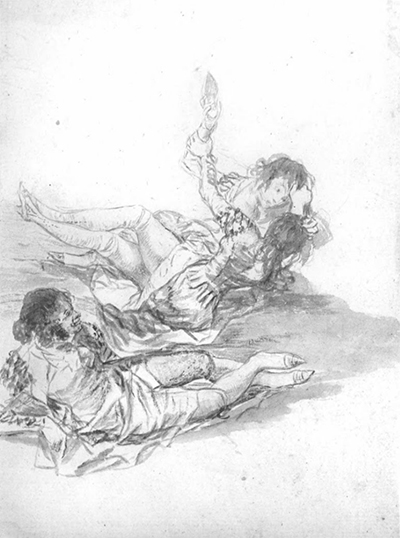
A shoe rises above the tangle of arms and hair. Two women are struggling on the ground, one holding the shoe over her opponent. In the foreground a man props himself up to watch. His open mouth and comfortable sprawl make the fight look like entertainment from where he lies. Francisco de Goya drew all three figures in brush and wash on a narrow leaf of his Madrid Album. Turn the paper over and the scuffle gives way to men and women sitting in conversation. [1] [2] [3]
At a Glance
- ArtistFrancisco de Goya y Lucientes (1746–1828). [1]
- Date1796–97, following the Hispanic Society. Fundación Goya en Aragón gives a broader range of about 1794–97. [1] [2]
- MediumBlack ink and grey wash applied with a brush on laid paper. [1]
- Dimensions22.8 × 14 cm. [1]
- Album and collectionMadrid Album B.15 (recto), Hispanic Society of America, New York, A3309. The reverse is B.16, A3310. The leaf entered the collection through the bequest of Archer M. Huntington in 1956. [1] [3]
Works across Goya’s career
The Parasol
1777The Nude Maja
1795–1800Saturn Devouring His Son
c. 1820–23The Dog
c. 1820–23The raised shoe and the reclining man
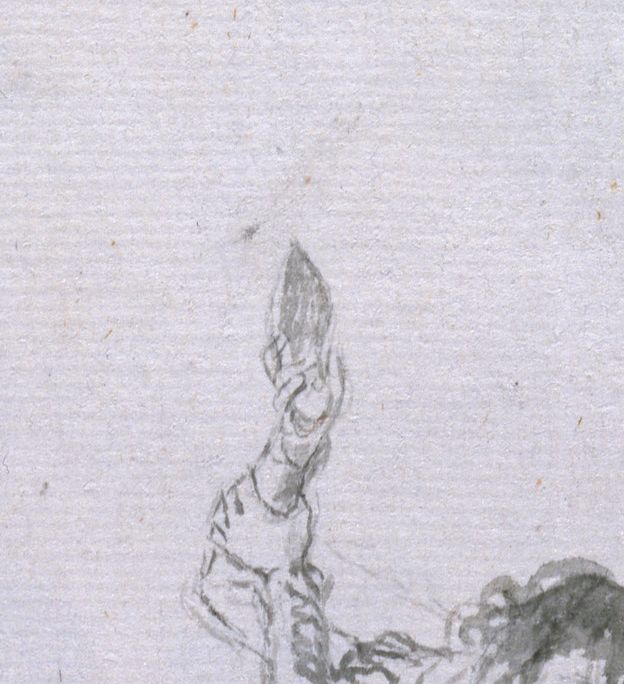
Follow the raised forearm upwards from the middle of the group. It climbs away from the mass of clothing and ends in a small, pointed shape against the bare paper. The Fundación and the Frick identify the object as a shoe. At the other end of the group, feet and stockinged legs point left, almost sideways to the lifted arm. A bare thigh appears where a skirt has ridden up. The shoe and the disarranged clothes make it possible to reconstruct a little of the movement that brought both fighters to the ground. [2] [4]
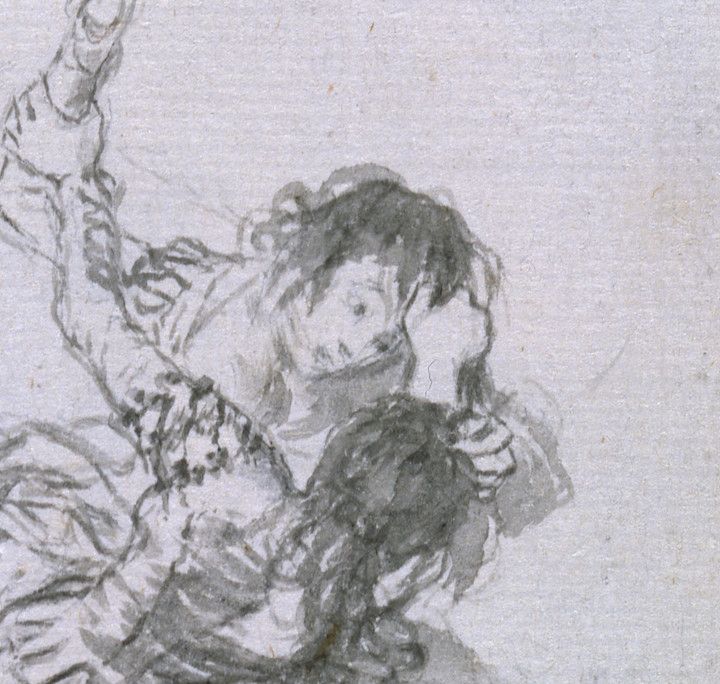
The fighter with the shoe looks towards us, her face partly framed by loose hair. Her opponent is turned away, with much of her head lost in a dark cluster of strokes. Near their faces, an arm comes back towards the woman who has lifted the shoe. The Frick reads this as the other fighter grabbing her hair. Lower down, the hands and sleeves merge into the folds of the skirts and bodices. Goya makes the raised hand easy to follow and leaves the struggle at ground level harder to untangle. [1] [2] [4]
The majo lies below them, head to the left and feet extending to the right. He turns towards the women, with a hand close to his face. His legs take a course roughly opposite to theirs, so that the figures fill a broad strip across a tall page. He is near enough for the folds of his clothes and the edges of their skirts to sit close together on the paper. His posture leaves him free to look on while the fighters’ hands are occupied. As he watches, Goya gives us time to take in his pose, from the lifted head to the feet at rest. [1] [2] [4]
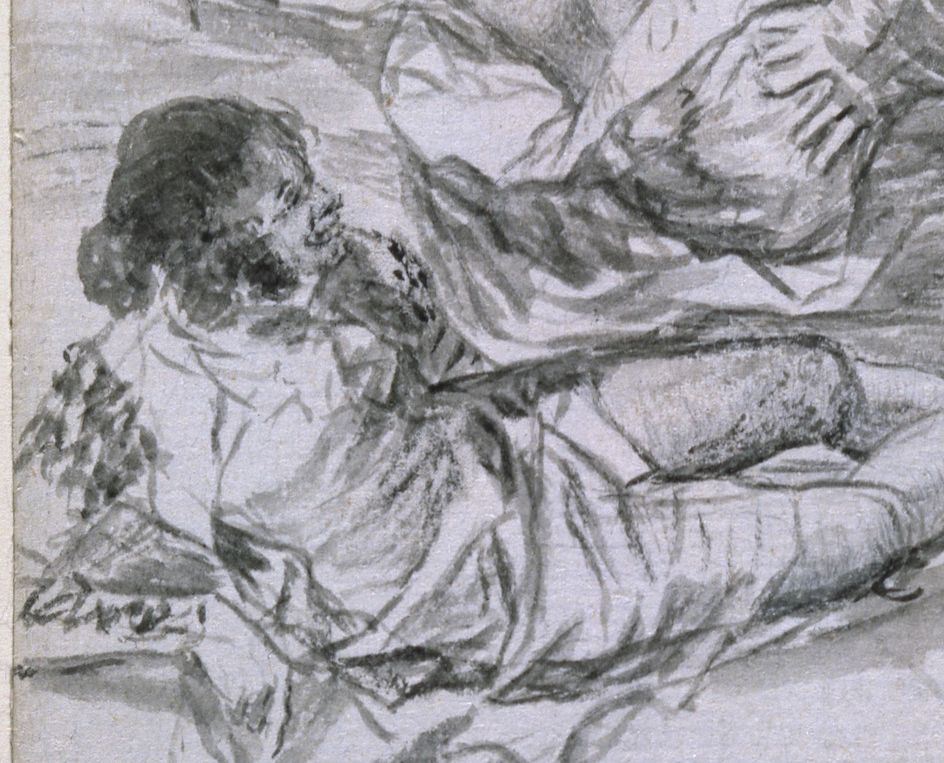
Annotated Details from Majas Fighting, a Majo Observing
Compare the raised arm and tangled figures with the man lying in the foreground.
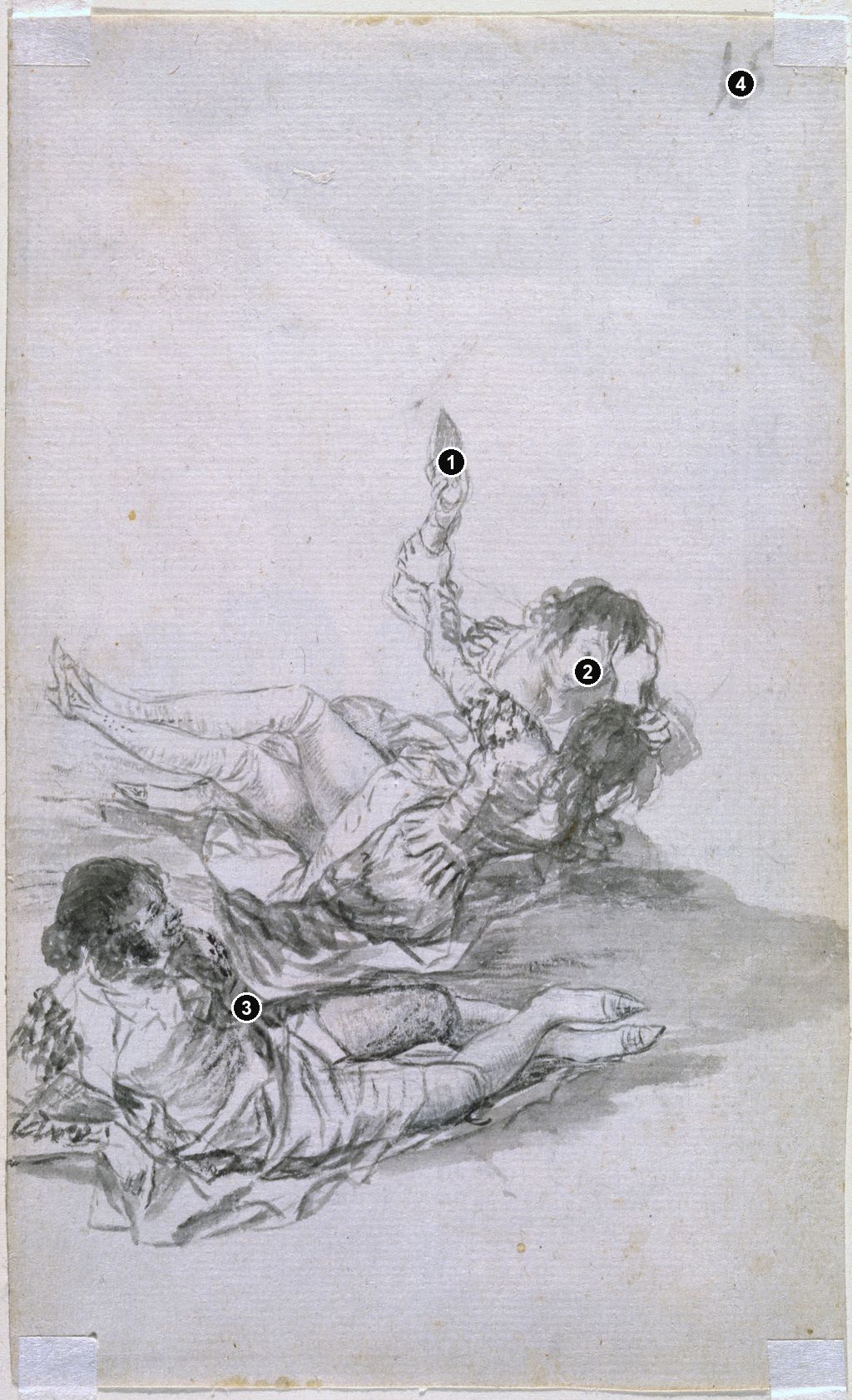
Details from MAJAS FIGHTING, A MAJO OBSERVING
Details from Madrid Album B.15 in the Hispanic Society of America (A 3309).
The raised shoe
An arm lifts a pointed shoe above the two women.
Hair and hands
The heads and hands almost merge where the women grapple.
The reclining man
The man lies low on one elbow, facing the struggle.
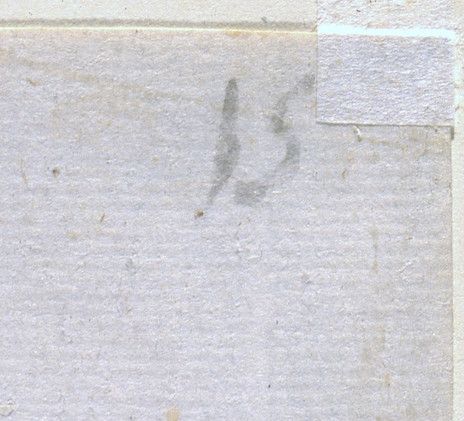
The page number
The small ink number 15 sits far above the figures.
Dress, wash and the empty page
The narrow outlines of the shoes and the small marks at the stockings can be easy to miss amid the bodies. The Fundación describes the women’s fitted bodices, full skirts, embroidered stockings and heeled shoes. These details distinguish the garments even where one figure’s clothes lie over the other’s. The shoe aloft has the same pointed profile as the footwear down at ground level. A feature of fashionable dress becomes the object on which the scene turns. [2] [4]
Goya uses patches of pale and dark wash to order the action. Look at the broad grey area under the fighters, which widens towards the right and thins at its edge. The spreading wash gives weight to the bodies lying above it and supplies almost all the information about where they are. Within the group, small dark touches pick out hair, fingers and seams. Pale paper on faces and fabric separates adjoining forms. Above them, the space around the shoe is largely unmarked. The small raised object can command as much attention as the densely worked stretch of paper below it. [1] [2] [4]
Pierre Gassier compared the onlooker’s lounging pose to figures in two earlier tapestry cartoons, The Picnic and The Kite. In those designs the reclining figures belong to larger scenes of leisure. On the album leaf, Goya gives the man a position close to the two people he is watching. His ease makes the force of their movements more conspicuous. Gassier also records vertical chain lines and a fragment of a coat-of-arms watermark in the paper. These are features of the sheet itself and help distinguish a description of the object from what one can see in a reproduction of its image. [5] [6]
Goya on film
Five films explore Goya’s portraits, prints, Black Paintings and painting techniques.
The Duke of Wellington by Goya
The portrait, its military decorations and its later theft.
Watch on YouTubeWhat started the fight?
The Hispanic Society calls the drawing Majas Fighting, a Majo Observing. It describes the spectator as amused and allows that Goya may have intended a sardonic comment. The Frick exhibited the drawing as A Fight and raised the possibility that the pair might be a man and a woman. The Fundación lists another title that describes the fighters as sex workers. Those readings go beyond the visible shoe, tangled limbs and elaborate clothing. The surviving inscription, a brushed 15 at the upper right that the Hispanic Society attributes to Goya, gives the drawing’s position in the album and leaves the cause of the fight open. [1] [2] [4]
The Hispanic Society compares the scene to the later drawing commonly called Who Will Win?, Album E.36. There two women come to grips and Goya’s pencilled question asks the viewer to consider the outcome. The Prado’s account allows for either a quarrel or a game in that later scene. On B.15 the reclining man supplies a reaction where a written question might otherwise go. His apparent amusement gives the scene a comic edge even though the pulled hair and raised shoe give the viewer grounds to read the encounter more harshly. [1] [4] [7] [8]
The conversation on the reverse
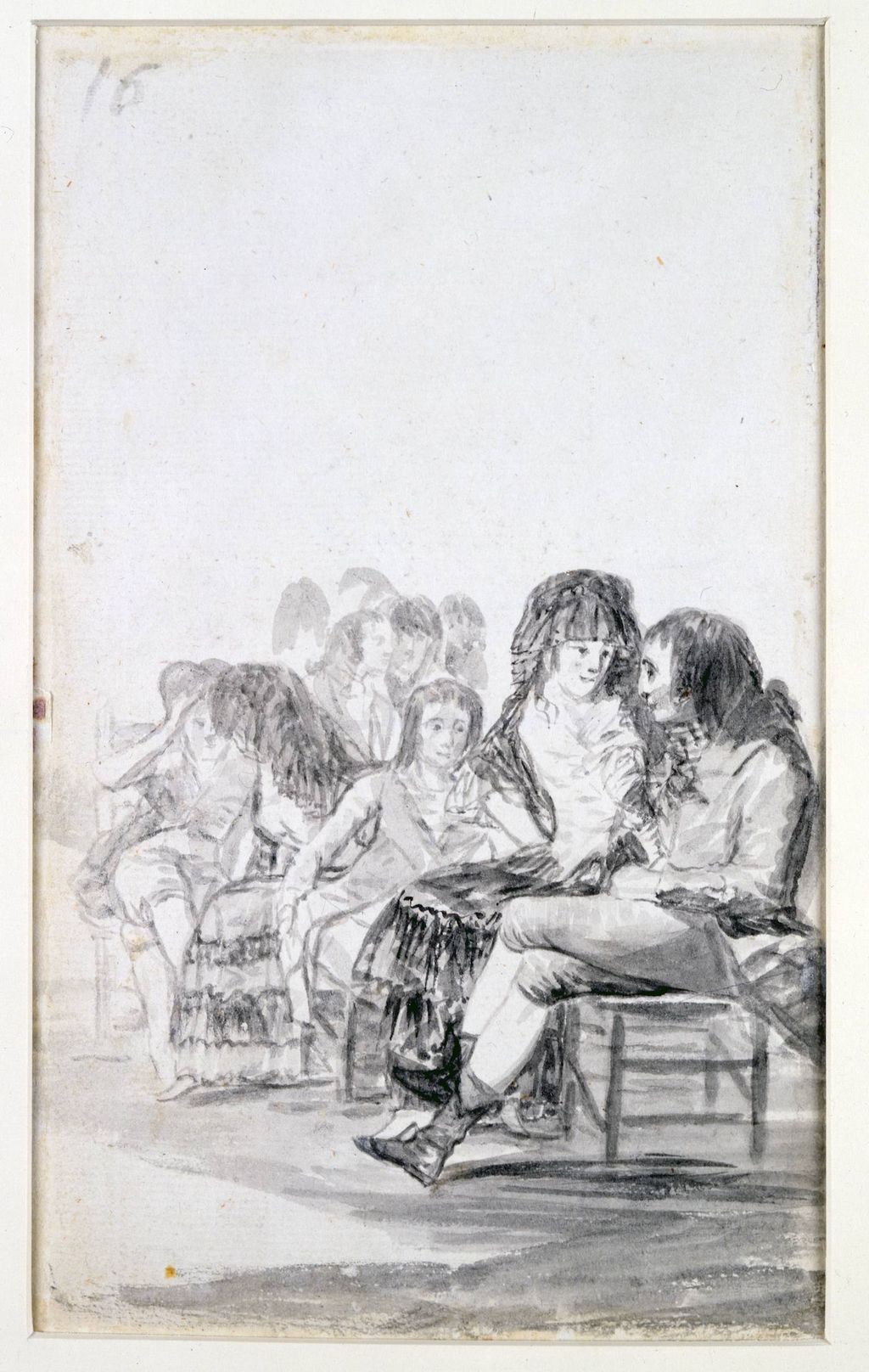
On the other side of the same paper, Majos and Majas Conversing carries the ink number 16 at upper left. The Fundación records the same sheet dimensions and describes groups of seated people, possibly outdoors. At the right, a man sits with his legs crossed and turns to the woman beside him. Her face is light inside the dark shape of her head covering. The chair and the wash below his shoes give the pair a firm place in the foreground. Farther to the left the figures overlap and grow paler, so the eye can follow several conversations back across the paper. [3] [5]
On B.15, Goya puts his strongest accents around one struggle. On B.16 the foreground couple holds the eye for a moment before the lighter figures draw it deeper into the group. In both scenes the pressure of a body against the ground or a seat comes largely from a few strokes of shadow. The same small sheet gives Goya room to bring two people almost on top of each other on one side and to suggest a gathering spread over a much greater distance on the other. The two sides have separate catalogue numbers, A3309 and A3310. They travelled together through Goya’s family and through the Madrazo collection before Huntington acquired the leaf in 1913. [1] [2] [3] [5]
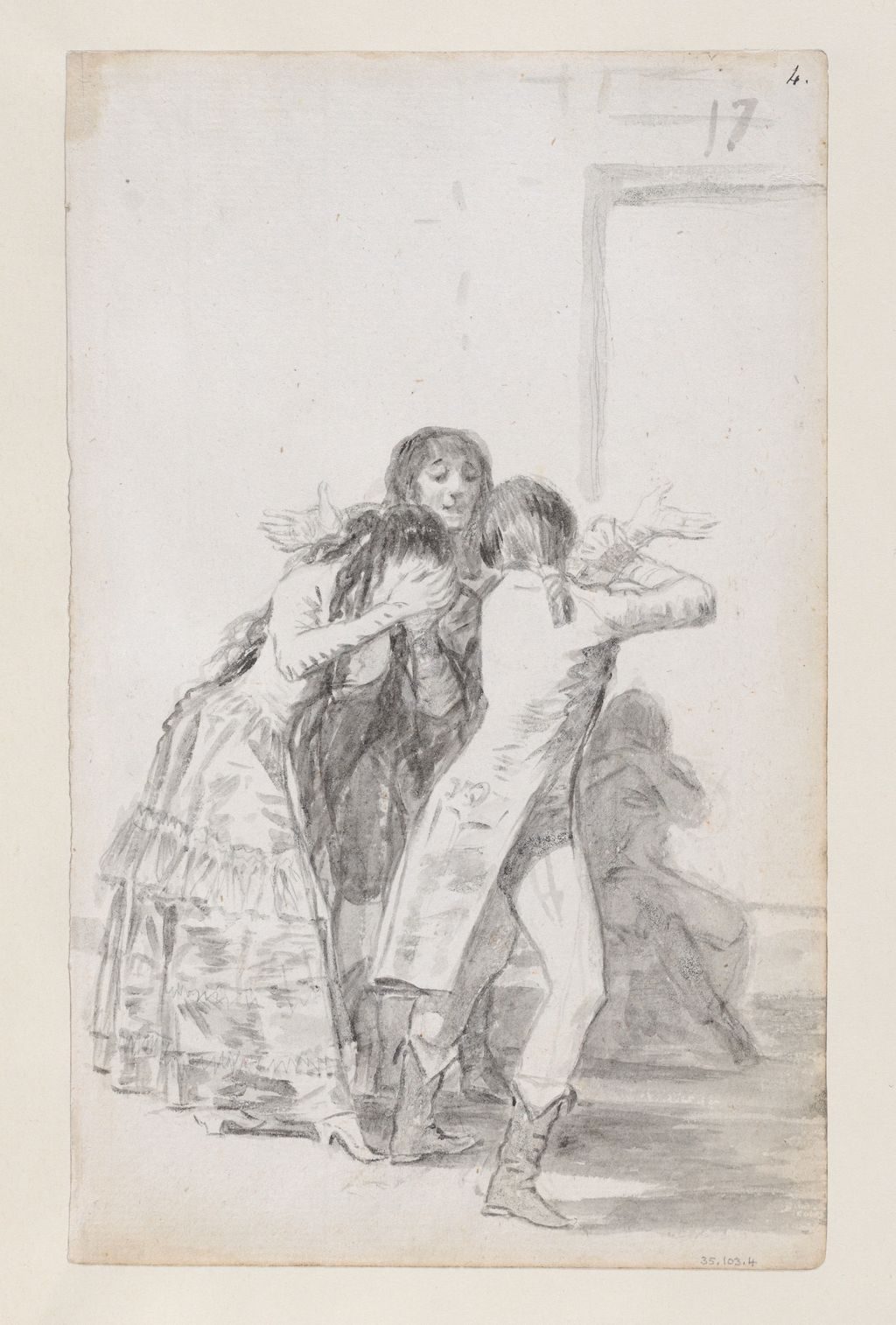
The next numbered page, Weeping Woman and Three Men, is the front of a different leaf, now at the Metropolitan Museum of Art. There the woman’s hands cover her face, two men stand close and another figure sits back near a doorway. The room and the upright men move the action higher on the page. In B.15 the strongest gesture carries an object into the open. In B.17 the action that most draws the eye hides the evidence of the woman’s expression. The change makes it possible to follow how Goya varies the amount a viewer can learn from a hand or a face from one page to the next. [4] [5] [9]
The two collections also preserve different histories of ownership. The Hispanic Society traces B.15 through Javier and Mariano Goya, Román Garreta y Huerta, Federico de Madrazo and Raimundo de Madrazo to Huntington. In 2006–07 the Prado included the drawing in its exhibition of Spanish drawings from the Hispanic Society, as catalogue number 64. B.17 went to the Met in 1935 as part of a group of drawings that had been gathered in a later album. The sequential numbers let us read these works again as neighbouring pages. The guide to Goya’s drawings follows the relationships between other dispersed leaves. [1] [2] [9] [11]
Artworks directory
| Name | Date | Medium |
|---|---|---|
| And There’s No Help for It, Plate 15 | Printed 1863 | |
| Asmodea | c. 1820–23 | Wall painting transferred to canvas |
| Boys Inflating a Bladder | 1777–78 | Tapestry cartoon |
| Boys Picking Fruit | 1778 | Tapestry cartoon |
| Bullfight in a Divided Ring | 1825 | Lithograph |
| Card Players | 1777–78 | Tapestry cartoon |
| Card Players (sketch) | 1777–78 | Painted sketch |
| Dance on the Banks of the Manzanares | 1777 | Tapestry cartoon |
| Duel with Cudgels | c. 1820–23 | Wall painting transferred to canvas |
| Heads in a Landscape | c. 1820–23 | Easel painting |
| Judith and Holofernes | c. 1820–23 | Wall painting transferred to canvas |
| Leocadia | c. 1820–23 | Wall painting transferred to canvas |
| Maja and Cloaked Men | 1777 | Tapestry cartoon |
| Maja and Cloaked Men (sketch) | 1777 | Painted sketch |
| Majo Clapping in Time to the Music | 1777 | Drawing |
| Men Reading | c. 1820–23 | Wall painting transferred to canvas |
| Out Hunting for Teeth, Plate 12 | 1799 | Etching, burnished aquatint and burin |
| Picnic in the Countryside (sketch) | 1776–78 | Painted sketch |
| Picnic on the Banks of the Manzanares | 1776 | Tapestry cartoon |
| Pilgrimage to San Isidro | c. 1820–23 | Wall painting transferred to canvas |
| Preparatory study for The Sleep of Reason Produces Monsters | c. 1796–97 | Drawing |
| Procession of the Holy Office | c. 1820–23 | Wall painting transferred to canvas |
| Quarrel at the Cockerel Inn (sketch) | 1777 | Painted sketch |
| Quarrel in the New Tavern | 1777 | Tapestry cartoon |
| Saturn Devouring His Son | c. 1820–23 | Wall painting transferred to canvas |
| Seated Majo Smoking | c. 1776 | Drawing |
| The Dog | c. 1820–23 | Wall painting transferred to canvas |
| The Drinker | 1777 | Tapestry cartoon |
| The Fates | c. 1820–23 | Wall painting transferred to canvas |
| The Great He-Goat | c. 1820–23 | Wall painting transferred to canvas |
| The Kite | 1777–78 | Tapestry cartoon |
| The Parasol | 1777 | Oil on canvas, tapestry cartoon |
| The Second of May 1808 | 1814 | Oil on canvas |
| The Sleep of Reason Produces Monsters, Plate 43 | 1799 | Etching and aquatint |
| The Third of May 1808 | 1814 | Oil on canvas |
| Thou Who Canst Not, Plate 42 | 1799 | Etching and burnished aquatint |
| Three Figures | 1776 | Drawing (lost) |
| Two Old Men | c. 1820–23 | Wall painting transferred to canvas |
| Two Old Men Eating Soup | c. 1820–23 | Wall painting transferred to canvas |
| Two Women and a Man | c. 1820–23 | Wall painting transferred to canvas |
| Universal Language: The Author Dreaming | 1797 | Drawing |
| The Family of Charles IV | 1800 | Oil on canvas |
| Witches’ Sabbath (Osuna painting) | 1797–98 | Oil on canvas |
| The Nude Maja | 1795–1800 | Oil on canvas |
| The Clothed Maja | 1800–07 | Oil on canvas |
| Self-Portrait (Drawing) | c. 1796 | Brush and carbon black ink on laid paper |
| The Swing, Madrid Album B.21 | 1795–97 | Brush and carbon black washes |
| Majas Fighting, a Majo Observing, Madrid Album B.15 | 1796–97 | Brush, grey and black washes on laid paper |
| Majos and Majas Conversing, Madrid Album B.16 | c. 1794–97 | Ink wash on paper |
| Weeping Woman and Three Men, Madrid Album B.17 | 1795–97 | Brush, carbon black washes and black chalk |
| Maja Seated on a Chair and Two Companions Behind, Madrid Album B.18 | 1795–97 | Brush and carbon black washes |
| Girl and Bull, Madrid Album B.23 | 1796–97 | Brush and carbon black washes |
| Lovers Sitting on a Rock, Madrid Album B.24 | 1796–97 | Brush and carbon black washes |
| Mariano Ceballos Riding a Bull | 1825 | Crayon lithograph and scraper |
| Landscape (lifetime impression) | c. 1807–10 | Etching and aquatint |
| Self-Portrait (1815), Prado canvas | 1815 | Oil on canvas |
| Self-Portrait (1815), Academy panel | 1815 | Oil on panel |
| Self-Portrait with Dr Arrieta | 1820 | Oil on canvas |
| Christ Crucified | 1780 | Oil on canvas |
| The Last Communion of Saint Joseph of Calasanz | 1819 | Oil on canvas |
| Christ on the Mount of Olives | 1819 | Oil on panel |
| The Flower Girls, or Spring | 1786–87 | Oil on canvas |
| The Grape Harvest, or Autumn | 1786–87 | Oil on canvas |
| The Snowstorm, or Winter | 1786–87 | Oil on canvas |
| The Threshing Ground, or Summer | 1786–87 | Oil on canvas |
| Picnic on the Banks of the Manzanares | 1776 | Oil on canvas |
| The Kite | 1777–78 | Oil on canvas |
| Dance on the Banks of the Manzanares | 1777 | Oil on canvas |
| A Fight at the Venta Nueva | 1777 | Oil on canvas |
| Blind Man’s Bluff | 1788 | Oil on canvas |
| Dogs on a Lead | 1775 | Oil on canvas |
| Hunting with a Decoy | 1775 | Oil on canvas |
| Hunter Loading His Rifle | 1775 | Oil on canvas |
| The Angler | 1775 | Oil on canvas |
| The Hermitage of San Isidro on His Feast Day | 1788 | Oil on canvas |
| The Meadow of San Isidro | 1788 | Oil on canvas |
| The Straw Manikin | 1791–92 | Oil on canvas |
| Witches’ Flight | c. 1797–98 | Oil on canvas |
| A Scene from ‘The Forcibly Bewitched’ | 1798 | Oil on canvas |
| The Duchess of Alba in Black | 1797 | Oil on canvas |
| The Duchess of Alba in White | 1795 | Oil on canvas |
| Charles III in Hunting Dress | c. 1786 | Oil on canvas |
| The Duke and Duchess of Osuna and Their Children | 1787–88 | Oil on canvas |
| Manuel Osorio Manrique de Zúñiga | 1787–88 | Oil on canvas |
| The Marquesa de Pontejos | c. 1786 | Oil on canvas |
| Equestrian Portrait of the 1st Duke of Wellington | 1812 | Oil on canvas |
| The Duke of Wellington | 1812–14 | Oil on wood |
| Portrait of Ferdinand VII of Spain | 1814 | Oil on canvas |
| Gaspar Melchor de Jovellanos | 1798 | Oil on canvas |
| María Tomasa Palafox y Portocarrero | 1804 | Oil on canvas |
| Señora Sabasa García | c. 1806–11 | Oil on canvas |
| Don Juan Bautista de Muguiro | 1827 | Oil on canvas |
| Doña Isabel de Porcel | Before 1805 | Oil on canvas |
| The Colossus | After 1808 | Oil on canvas |
| The Burial of the Sardine | 1808–12 | Oil on panel |
| The Madhouse | 1808–12 | Oil on panel |
| A Procession of Flagellants | 1808–12 | Oil on panel |
| Portrait of Jacques Galos | 1826 | Oil on canvas |
| Portrait of Mariano Goya, the Artist’s Grandson | 1827 | Oil on canvas |
| Milkmaid of Bordeaux | c. 1827 | Oil on canvas |
| Portrait of Don Juan Antonio Cuervo | 1819 | Oil on canvas |
| María Luisa of Parma (Naples version) | c. 1800 | Oil on canvas |
| The Countess of Baena | 1819 | Oil on canvas |
| The Family of the Infante Don Luis | 1783–84 | Oil on canvas |
| The Holy Family | c. 1787 | Oil on canvas |
| Saint Barbara | c. 1773 | Oil on canvas |
| Saints Justa and Rufina | 1817 | Oil on canvas |
| El Tío Paquete | c. 1819–20 | Oil on canvas |
| The Forge | c. 1815–20 | Oil on canvas |
| Majas on a Balcony (Metropolitan Museum version) | c. 1800–10 | Oil on canvas |
| Maja and Celestina on a Balcony | c. 1808–12 | Oil on canvas |
| The Water Bearer | 1808–12 | Oil on canvas |
| Time and the Old Women | c. 1810 | Oil on canvas |
Frequently Asked Questions
Discussion
Look again at the images and ideas explored in Majo Laughing at Two Girls Fighting. These editorial prompts invite your observations.
Where does your eye go after you notice the raised shoe? Follow the hands at the centre of the fight, then look at the reclining man’s posture and consider how it changes your reading of the scene.
Reader Insights
Which marks show the movement of the fight while the observer stays still?
What changes when you turn the leaf and see the groups in conversation?
Join the Conversation
Share a detail, comparison or question about Majo Laughing at Two Girls Fighting below.
References
- Hispanic Society of America, Majas Fighting, a Majo Observing (recto), Madrid Album B.15, A3309. Collection record. View source.
- Fundación Goya en Aragón, Majo riéndose de dos muchachas que se pegan, B.15, A 3309. View source.
- Fundación Goya en Aragón, Majos y majas conversando, B.16, A 3310. View source.
- The Frick Collection, The Spanish Manner: Drawings from Ribera to Goya, 2010–11 exhibition checklist, cat. 34, A Fight (Album B.15). View source.
- Pierre Gassier, Francisco Goya: Drawings. The Complete Albums, 1973, nos. 30–32, pp. 57–59 and catalogue entries for B.15–17. View catalogue transcription. View source.
- Museo Nacional del Prado, collection entry for Children blowing up a Bladder, with the related El Pardo tapestry designs The Picnic (P00768) and The Kite (P00774). View source.
- Fundación Goya en Aragón, ¿Quién vencerá?, Album E.36, Museo Nacional del Prado. View source.
- Museo Nacional del Prado, Memoria de actividades 2007, acquisition account for ¿Quién vencerá? View source.
- The Metropolitan Museum of Art, Young woman weeping and covering her face with her hands, accompanied by men, B.17, 35.103.4. View source.
- Hispanic Society of America and Albuquerque Museum, Visions of the Hispanic World exhibition guide, cat. 180, Majas Fighting, a Majo Observing. View source.
- Colta Ives and Susan Alyson Stein, Goya in The Metropolitan Museum of Art, 1995, Album B entries and account of the 1935 acquisition. View source.







