


 by Tom Gurney
Tom Gurney BSc (Hons) is an art history expert with over 20 years experience
Published on June 19, 2020 / Updated on November 20, 2026
Email: tomgurney1@gmail.com / Phone: +44 7429 011000
Introduction
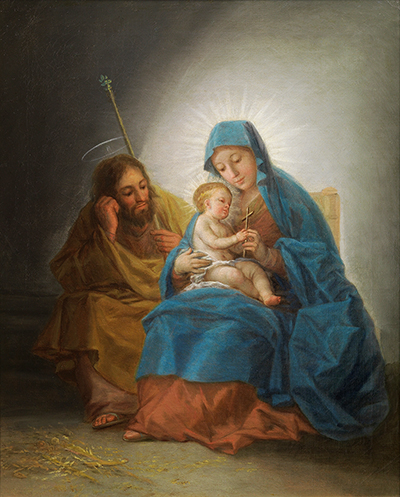
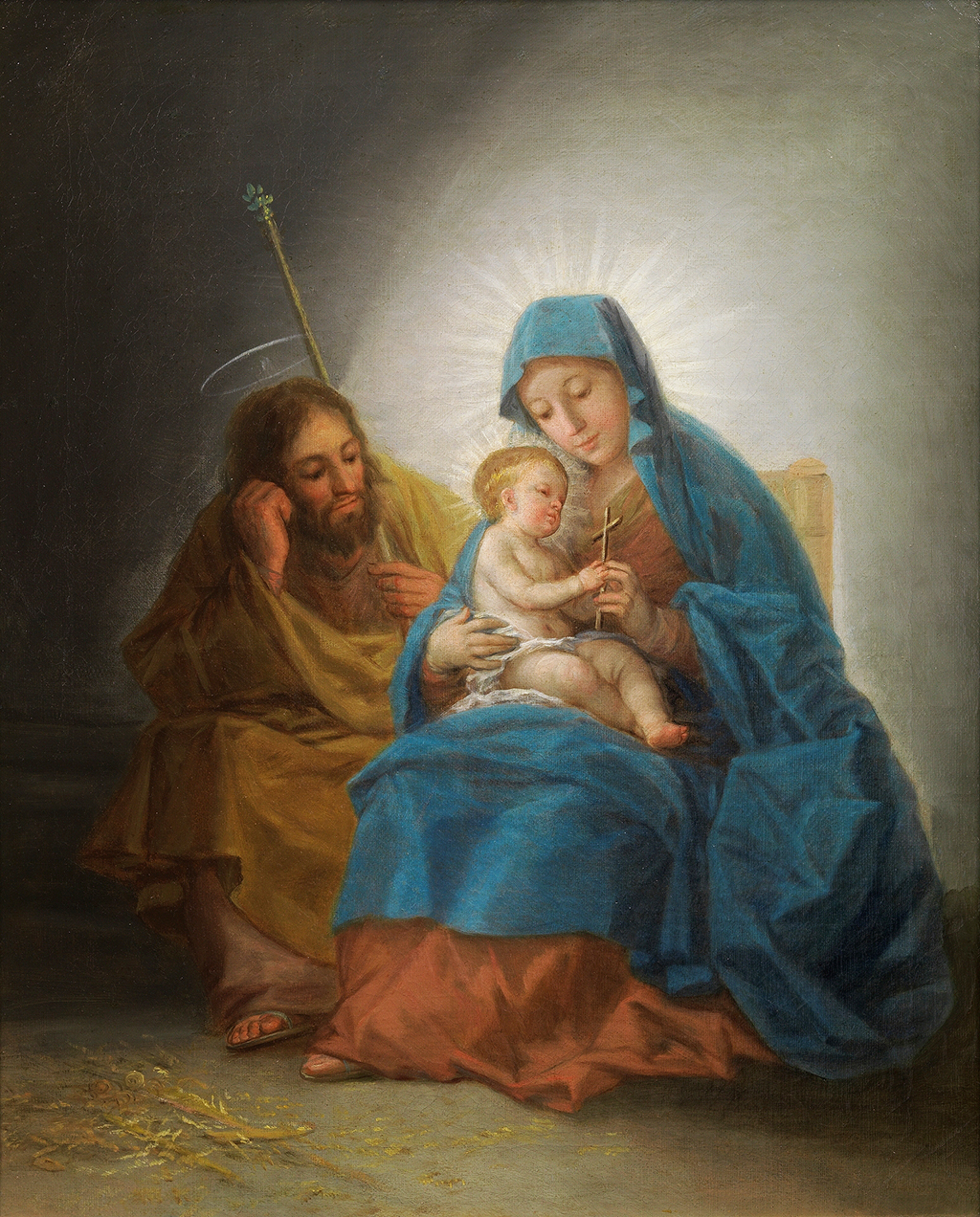
Mary sits on the right, holding Jesus across her lap. The child clasps a little cross against the red of her dress. At the left, Joseph leans his head on his hand, his staff rising behind him. Pale rays spread out above Mary’s blue mantle, carrying light into a room whose floor is scattered with wood shavings. The Museo Nacional del Prado identifies this small canvas as Goya’s Sagrada familia, P007857, painted around 1787. The combination of three figures, the shavings and the cross held close to Mary’s chest distinguishes it from Goya’s larger Holy Family with the young Saint John the Baptist, also in the Prado. [1] [2] [4]
At a Glance
- ArtistFrancisco José de Goya y Lucientes (1746–1828). [1]
- DateAbout 1787. The Prado’s 2003 acquisition report gives about 1787–88. [1] [2]
- Medium and sizeOil on canvas, 63.5 × 51.5 cm. [1] [2]
- SubjectMary, the Christ Child and Saint Joseph in a setting suggestive of Joseph’s carpentry workshop. [2]
- CollectionMuseo Nacional del Prado, Madrid, P007857. [1]
- Companion paintingTobias and the Angel, Museo Nacional del Prado, P007856. [1] [3]
Works across Goya’s career
The Parasol
1777The Holy Family
c. 1787The Nude Maja
1795–1800Saturn Devouring His Son
c. 1820–23The Dog
c. 1820–23The three figures in the workshop
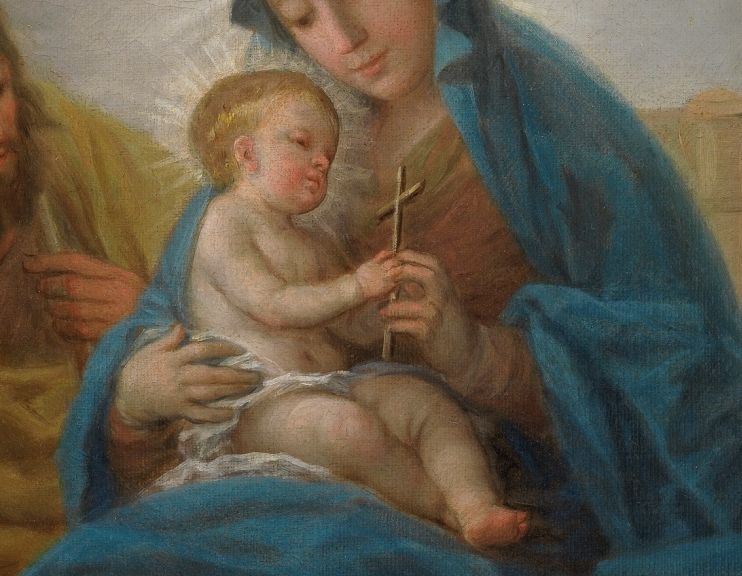
Start with the child’s bare feet. They point towards the right, across the blue folds that cover Mary’s knees. His head turns back towards her, and one shoulder catches the light. A strip of white cloth runs underneath him, just above the hand with which she supports his body. Her other hand rises beside the cross. Goya gives the mother and child a closely interlocking set of gestures. The hand beneath the child keeps him steady, leaving his own hands free to explore the object in front of him. Mary inclines her head so that her face is close to his. A little distance opens beneath their chins, just where the top of the cross appears. [1] [2]
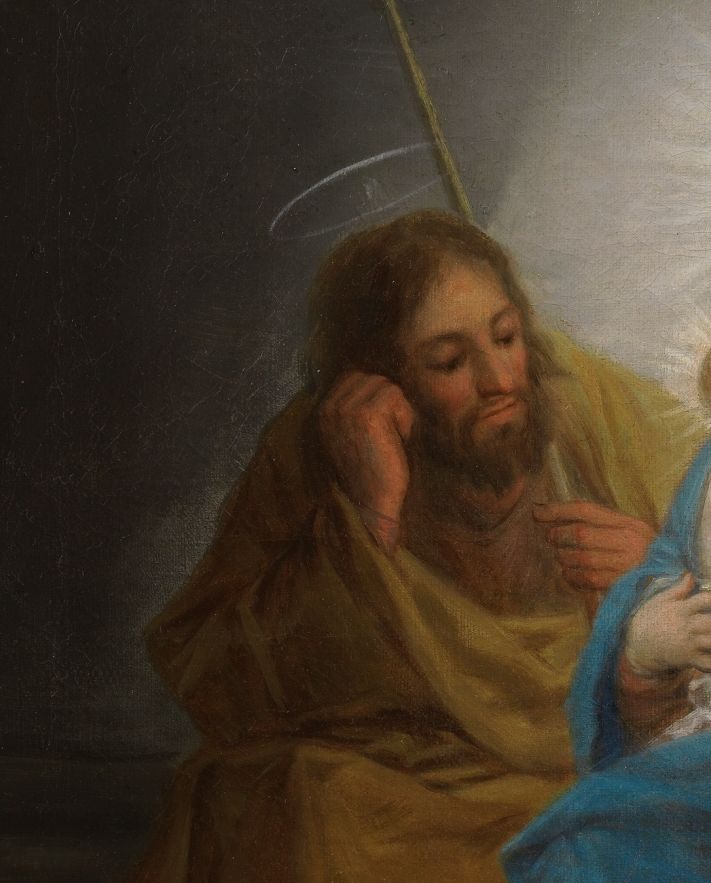
Joseph is close enough for the ochre at his shoulder to meet the blue at Mary’s elbow. His lowered brow and supported head give his pose a different rhythm from hers. One elbow folds inwards while his opposite hand rests close to his chest. Above him a steep diagonal leads up the staff to its small flowering tip, and a faint arc marks his halo. Below, a sandal emerges from his robes just short of Mary’s foot. Across that narrow interval, the painting moves from ochre through blue towards a broad reddish hem on the floor. The points where their robes overlap give the group its depth in an interior whose walls and corners are barely defined. [2]
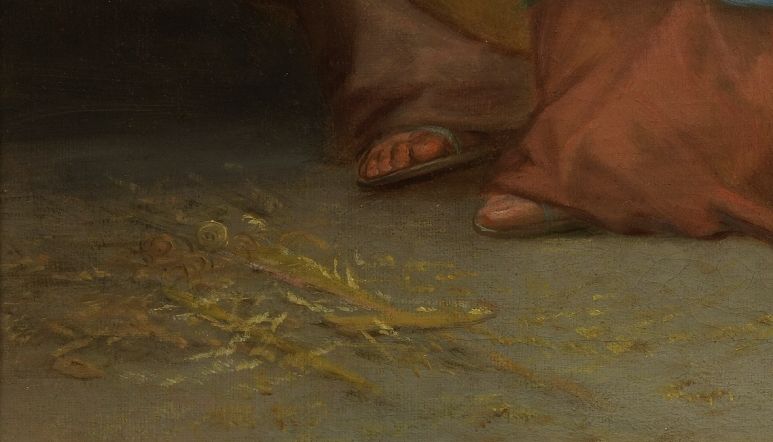
The wood shavings are easiest to find against the light on the floor at the lower left. The Fundación Goya en Aragón identifies them as the clue to Joseph’s trade and to the setting of the picture. Notice how little else Goya supplies to establish the workshop. The chair back comes into view over Mary’s shoulder, where a short upright interrupts the blue. The painting leaves plenty of room above the figures for the glow to spread and enough floor in front of them for the shavings to read as the scattered residue of work. Those few marks make it possible to picture a day in the room before the three figures came to rest. [2]
Annotated Details from The Holy Family
Start with Mary and the child, then follow the light down to the workshop floor.
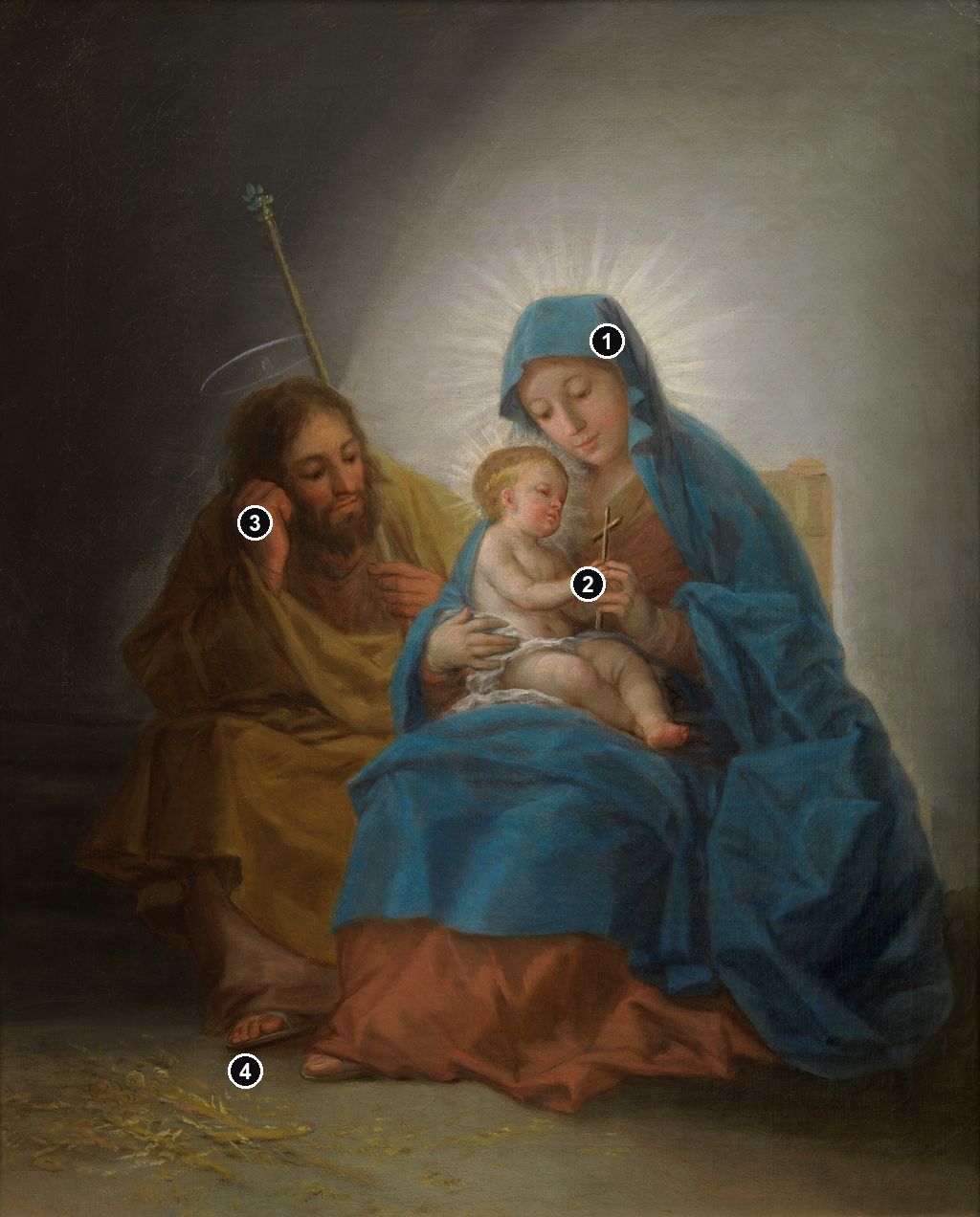
Details from THE HOLY FAMILY
Details from the Prado canvas (P007857).
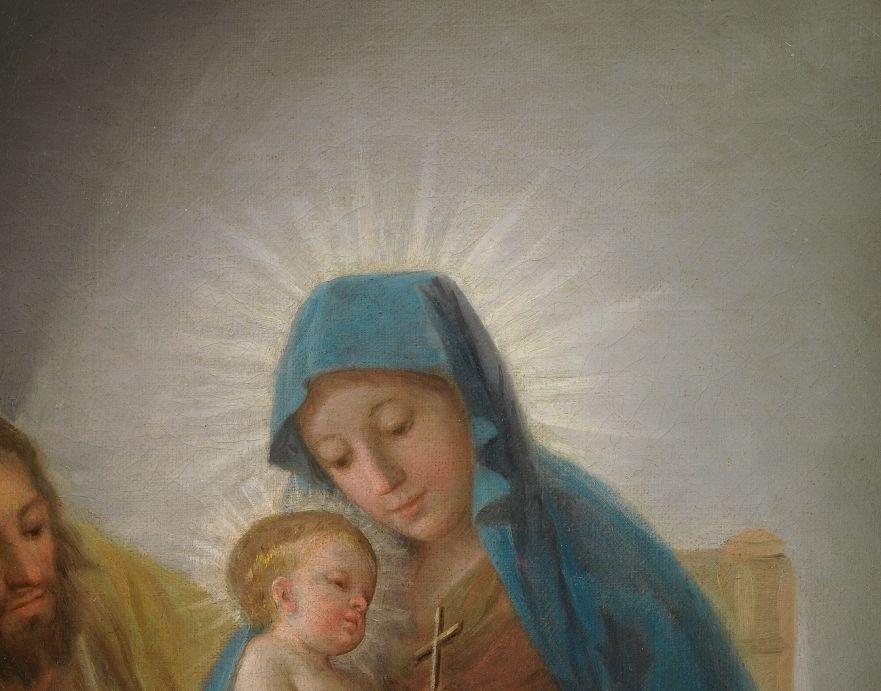
Light around Mary
Pale rays spread behind the dark edge of Mary’s covering.
The child and Mary’s hands
Mary’s hands support the child at the centre of the group.
Joseph and his staff
Joseph’s face catches a little light beside the long staff.
Shavings on the floor
Pale curled fragments lie on the floor beside Mary’s robe.
The cross and the light
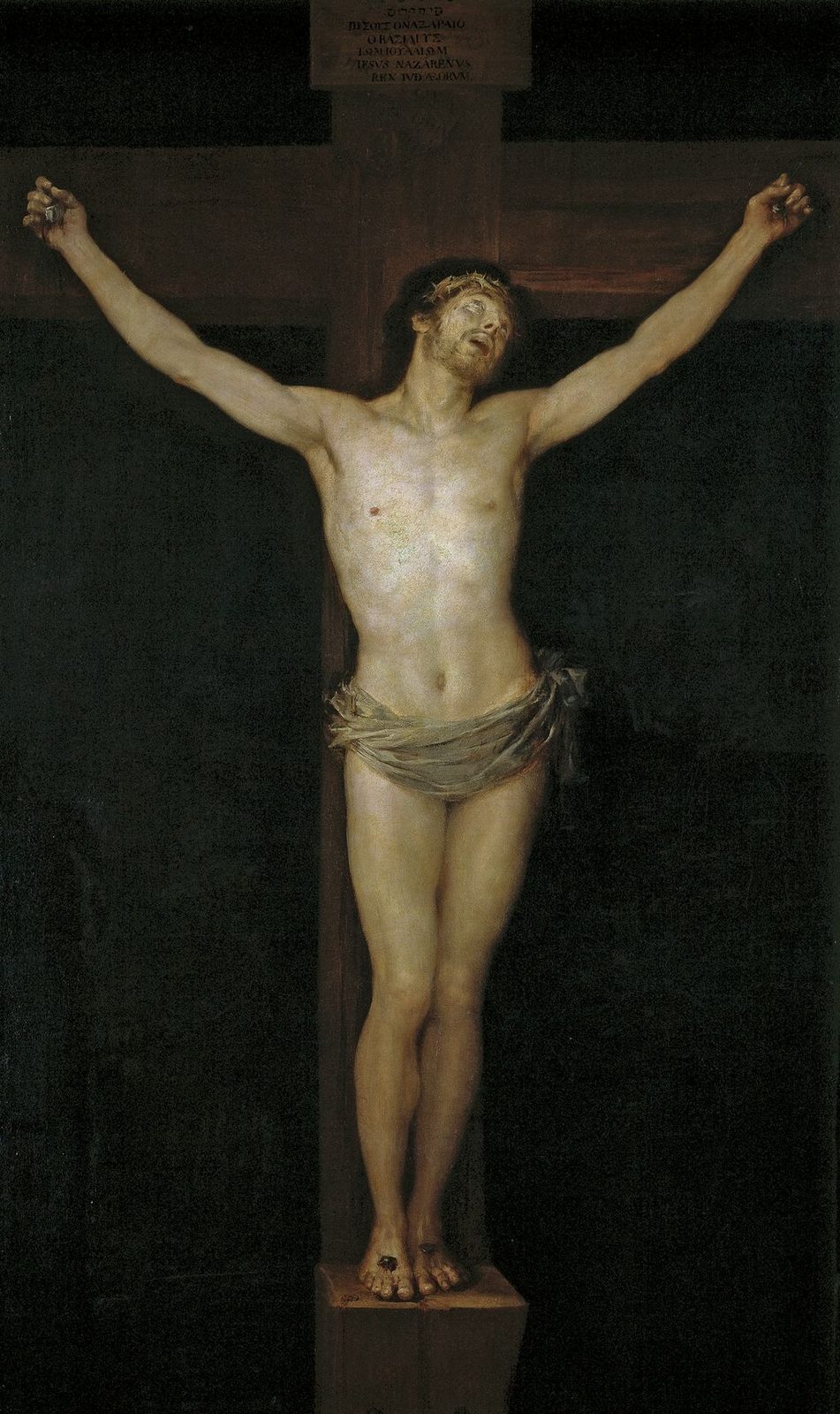
At a distance, the lightest passage includes the child’s head and the space around Mary’s hood. At close range, a second focus emerges at the slender cross. Part of it is outlined against Mary’s reddish dress, and the child’s fingers cover part of the upright. Its size allows the gesture to look like a child handling an object that has been placed within reach. The Prado interprets it as a premonition of Christ’s death. The picture depends on both scales of attention. The glow draws the viewer towards the familiar exchange between mother and child, and the small object gives that exchange a place in the much longer story of the Passion. Compare the scale and placement of the cross in Goya’s Christ Crucified, where the upright runs almost the full height of the canvas. [1] [2]
The rays behind Mary are most distinct near her head. Towards the edges they open into more diffuse light, which leaves Joseph’s far shoulder and the upper left of the room in shadow. The Prado relates the handling of light and drapery to Goya’s canvases for the convent church of Santa Ana in Valladolid. The soft passages in this canvas also let the viewer imagine the glow as light falling through a room, catching flesh, fabric and the scattered shavings. One of the warmest highlights touches Joseph’s sleeve very near the place where it meets Mary’s mantle. The warmth and the surrounding shade make his proximity to the illuminated figures apparent. [1] [2]
Manuela Mena suggested that the tenderness of the portrayal may owe something to Goya’s experience with his son Javier, born in 1784. This remains a suggestion about the artist’s experience. The face, widely spaced toes and compact shape of the child’s body are specific enough to reward looking on their own. The infant settles across the folds of the mantle with the weight of a child who needs a hand beneath him. [2]
Goya on film
Five films explore Goya’s portraits, prints, Black Paintings and painting techniques.
The Duke of Wellington by Goya
The portrait, its military decorations and its later theft.
Watch on YouTubeWhy the Prado treats it as one of a pair
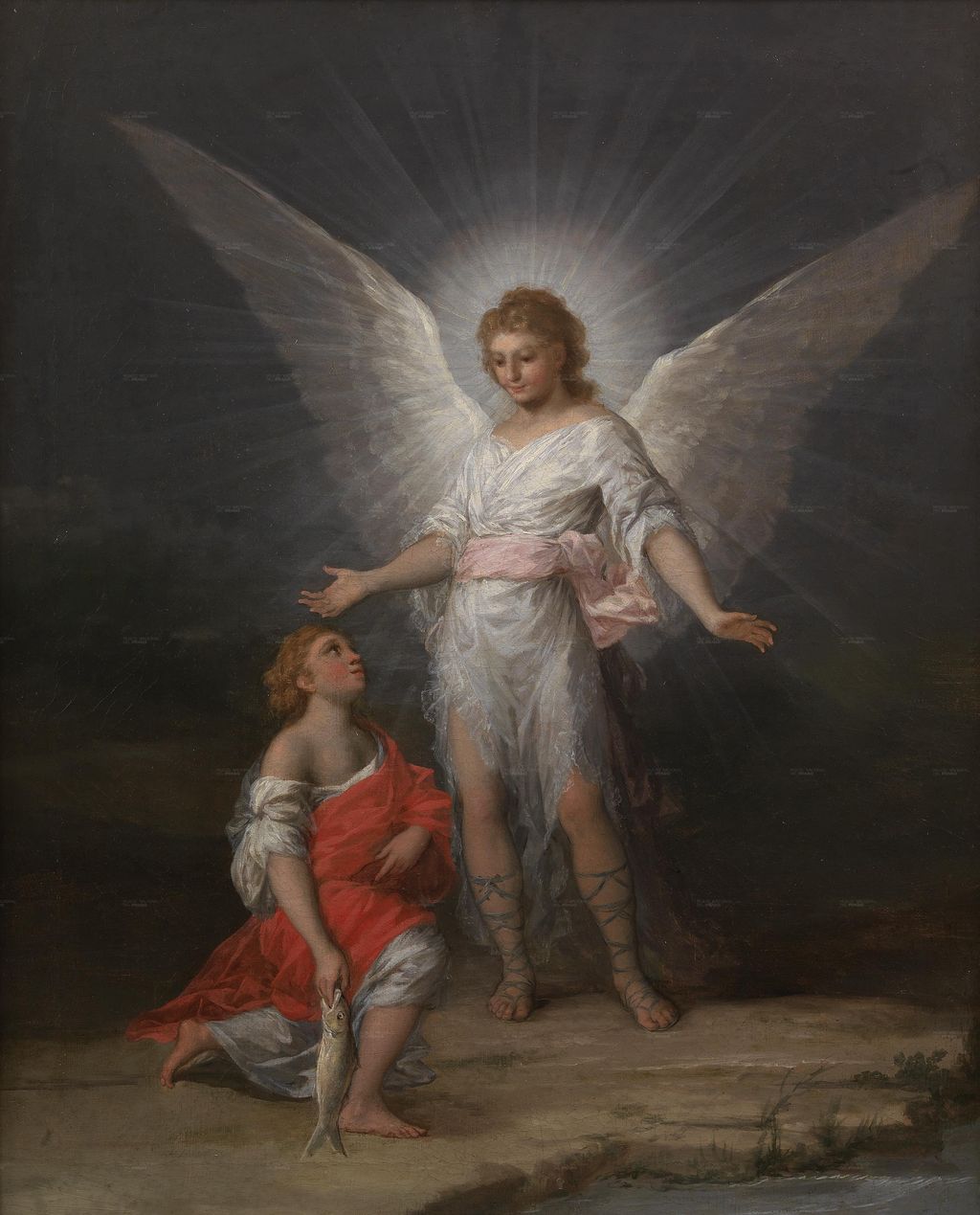
Goya’s Tobias and the Angel is an oil on canvas of the same dimensions, 63.5 × 51.5 cm. It shows Tobias crouching with the fish that will help restore his father’s sight. The archangel Raphael inclines his head towards him and sends rays into the darkening sky. Both works use light associated with a holy figure to illuminate people nearby, although the settings and the spread of the light differ. In the workshop, the warm haze eases into an interior and falls across the seated Joseph. In the other canvas, longer, more distinct rays extend across the open air. Tobias’s red garment helps bring his smaller, crouching figure into view below the angel. [1] [3]
The Prado’s account of the acquisition points to the shared type and size of the canvases, the handling of paint and the two pictures’ history in the same Madrid collection. The museum also associates them through their subjects. The story of Tobias and his father’s recovery had long been linked to the Virgin and Child because Tobias was understood as a precursor of Christ. The Prado gives Raphael’s Madonna of the Fish, P000297, as an example of that connection in a single image. With Goya’s two canvases, the cure effected through the fish and the cross held by Jesus give a viewer two ways of reflecting on salvation. [1] [3]
The small format led the Prado to propose that the pair was made for private devotion. The cross and the subtle work on Joseph’s face would have been easy to study at the distance from which a small painting can be viewed in a room. The initial owner and display setting remain unknown. The published provenance places the pictures together in a private collection in Madrid by the late nineteenth century. Richard de Willermin identified the pair as Goya’s, and they came up for auction at Alcalá Subastas on 8 May 2003. They entered the Prado that year through a state acquisition arranged via Caja Madrid’s payment of tax in kind. [1] [2] [3]
Other Holy Families by Goya
The first painting to check against this one is the Prado’s Holy Family with the Young Saint John the Baptist, P000746. That picture includes two children and stands just over two metres high. It gathers the figures into a pyramid in which Saint John approaches the Christ Child. The Fundación Goya en Aragón notes that the painting has been difficult to date. Its catalogue currently assigns a range of 1775–85. It entered the Prado in 1877, more than a century before the small workshop Holy Family and its companion. The figure of Saint John and the difference in dimensions make the two Prado canvases readily distinguishable even when an older source calls both simply The Holy Family. [1] [4]
The cross already appears in a pen drawing in Goya’s Italian Notebook, catalogued by the Fundación as Holy Family in an Oval and kept at the Prado as D6068/40. Here Mary is on the left and points down, the child shows her the cross, and Joseph reads a large book on the right. Palm leaves form a border around the scene. The shift in Joseph’s activity changes the balance of attention. In the drawing he has a separate act to perform, while in the painting his tilted head brings him into the shared pause. The notebook is one of the places to trace Goya’s development through his drawings. [2] [5]
An early canvas attributed to Goya by the Fundación broadens the subject across three generations. The Triple Generation, recorded in the collection of the Marqués de Las Palmas in Cádiz, includes the child’s grandparents Joachim and Anne as well as God the Father above. The Fundación catalogues it separately and pairs it with a painting of the coming of the Virgin of the Pillar. In that work the vertical arrangement carries the eye from an earthly group up towards the clouds. The workshop canvas concentrates the glow much closer to the faces. [2] [6]
Artworks directory
| Name | Date | Medium |
|---|---|---|
| And There’s No Help for It, Plate 15 | Printed 1863 | |
| Asmodea | c. 1820–23 | Wall painting transferred to canvas |
| Boys Inflating a Bladder | 1777–78 | Tapestry cartoon |
| Boys Picking Fruit | 1778 | Tapestry cartoon |
| Bullfight in a Divided Ring | 1825 | Lithograph |
| Card Players | 1777–78 | Tapestry cartoon |
| Card Players (sketch) | 1777–78 | Painted sketch |
| Dance on the Banks of the Manzanares | 1777 | Tapestry cartoon |
| Duel with Cudgels | c. 1820–23 | Wall painting transferred to canvas |
| Heads in a Landscape | c. 1820–23 | Easel painting |
| Judith and Holofernes | c. 1820–23 | Wall painting transferred to canvas |
| Leocadia | c. 1820–23 | Wall painting transferred to canvas |
| Maja and Cloaked Men | 1777 | Tapestry cartoon |
| Maja and Cloaked Men (sketch) | 1777 | Painted sketch |
| Majo Clapping in Time to the Music | 1777 | Drawing |
| Men Reading | c. 1820–23 | Wall painting transferred to canvas |
| Out Hunting for Teeth, Plate 12 | 1799 | Etching, burnished aquatint and burin |
| Picnic in the Countryside (sketch) | 1776–78 | Painted sketch |
| Picnic on the Banks of the Manzanares | 1776 | Tapestry cartoon |
| Pilgrimage to San Isidro | c. 1820–23 | Wall painting transferred to canvas |
| Preparatory study for The Sleep of Reason Produces Monsters | c. 1796–97 | Drawing |
| Procession of the Holy Office | c. 1820–23 | Wall painting transferred to canvas |
| Quarrel at the Cockerel Inn (sketch) | 1777 | Painted sketch |
| Quarrel in the New Tavern | 1777 | Tapestry cartoon |
| Saturn Devouring His Son | c. 1820–23 | Wall painting transferred to canvas |
| Seated Majo Smoking | c. 1776 | Drawing |
| The Dog | c. 1820–23 | Wall painting transferred to canvas |
| The Drinker | 1777 | Tapestry cartoon |
| The Fates | c. 1820–23 | Wall painting transferred to canvas |
| The Great He-Goat | c. 1820–23 | Wall painting transferred to canvas |
| The Kite | 1777–78 | Tapestry cartoon |
| The Parasol | 1777 | Oil on canvas, tapestry cartoon |
| The Second of May 1808 | 1814 | Oil on canvas |
| The Sleep of Reason Produces Monsters, Plate 43 | 1799 | Etching and aquatint |
| The Third of May 1808 | 1814 | Oil on canvas |
| Thou Who Canst Not, Plate 42 | 1799 | Etching and burnished aquatint |
| Three Figures | 1776 | Drawing (lost) |
| Two Old Men | c. 1820–23 | Wall painting transferred to canvas |
| Two Old Men Eating Soup | c. 1820–23 | Wall painting transferred to canvas |
| Two Women and a Man | c. 1820–23 | Wall painting transferred to canvas |
| Universal Language: The Author Dreaming | 1797 | Drawing |
| The Family of Charles IV | 1800 | Oil on canvas |
| Witches’ Sabbath (Osuna painting) | 1797–98 | Oil on canvas |
| The Nude Maja | 1795–1800 | Oil on canvas |
| The Clothed Maja | 1800–07 | Oil on canvas |
| Self-Portrait (Drawing) | c. 1796 | Brush and carbon black ink on laid paper |
| The Swing, Madrid Album B.21 | 1795–97 | Brush and carbon black washes |
| Majas Fighting, a Majo Observing, Madrid Album B.15 | 1796–97 | Brush, grey and black washes on laid paper |
| Majos and Majas Conversing, Madrid Album B.16 | c. 1794–97 | Ink wash on paper |
| Weeping Woman and Three Men, Madrid Album B.17 | 1795–97 | Brush, carbon black washes and black chalk |
| Maja Seated on a Chair and Two Companions Behind, Madrid Album B.18 | 1795–97 | Brush and carbon black washes |
| Girl and Bull, Madrid Album B.23 | 1796–97 | Brush and carbon black washes |
| Lovers Sitting on a Rock, Madrid Album B.24 | 1796–97 | Brush and carbon black washes |
| Mariano Ceballos Riding a Bull | 1825 | Crayon lithograph and scraper |
| Landscape (lifetime impression) | c. 1807–10 | Etching and aquatint |
| Self-Portrait (1815), Prado canvas | 1815 | Oil on canvas |
| Self-Portrait (1815), Academy panel | 1815 | Oil on panel |
| Self-Portrait with Dr Arrieta | 1820 | Oil on canvas |
| Christ Crucified | 1780 | Oil on canvas |
| The Last Communion of Saint Joseph of Calasanz | 1819 | Oil on canvas |
| Christ on the Mount of Olives | 1819 | Oil on panel |
| The Flower Girls, or Spring | 1786–87 | Oil on canvas |
| The Grape Harvest, or Autumn | 1786–87 | Oil on canvas |
| The Snowstorm, or Winter | 1786–87 | Oil on canvas |
| The Threshing Ground, or Summer | 1786–87 | Oil on canvas |
| Picnic on the Banks of the Manzanares | 1776 | Oil on canvas |
| The Kite | 1777–78 | Oil on canvas |
| Dance on the Banks of the Manzanares | 1777 | Oil on canvas |
| A Fight at the Venta Nueva | 1777 | Oil on canvas |
| Blind Man’s Bluff | 1788 | Oil on canvas |
| Dogs on a Lead | 1775 | Oil on canvas |
| Hunting with a Decoy | 1775 | Oil on canvas |
| Hunter Loading His Rifle | 1775 | Oil on canvas |
| The Angler | 1775 | Oil on canvas |
| The Hermitage of San Isidro on His Feast Day | 1788 | Oil on canvas |
| The Meadow of San Isidro | 1788 | Oil on canvas |
| The Straw Manikin | 1791–92 | Oil on canvas |
| Witches’ Flight | c. 1797–98 | Oil on canvas |
| A Scene from ‘The Forcibly Bewitched’ | 1798 | Oil on canvas |
| The Duchess of Alba in Black | 1797 | Oil on canvas |
| The Duchess of Alba in White | 1795 | Oil on canvas |
| Charles III in Hunting Dress | c. 1786 | Oil on canvas |
| The Duke and Duchess of Osuna and Their Children | 1787–88 | Oil on canvas |
| Manuel Osorio Manrique de Zúñiga | 1787–88 | Oil on canvas |
| The Marquesa de Pontejos | c. 1786 | Oil on canvas |
| Equestrian Portrait of the 1st Duke of Wellington | 1812 | Oil on canvas |
| The Duke of Wellington | 1812–14 | Oil on wood |
| Portrait of Ferdinand VII of Spain | 1814 | Oil on canvas |
| Gaspar Melchor de Jovellanos | 1798 | Oil on canvas |
| María Tomasa Palafox y Portocarrero | 1804 | Oil on canvas |
| Señora Sabasa García | c. 1806–11 | Oil on canvas |
| Don Juan Bautista de Muguiro | 1827 | Oil on canvas |
| Doña Isabel de Porcel | Before 1805 | Oil on canvas |
| The Colossus | After 1808 | Oil on canvas |
| The Burial of the Sardine | 1808–12 | Oil on panel |
| The Madhouse | 1808–12 | Oil on panel |
| A Procession of Flagellants | 1808–12 | Oil on panel |
| Portrait of Jacques Galos | 1826 | Oil on canvas |
| Portrait of Mariano Goya, the Artist’s Grandson | 1827 | Oil on canvas |
| Milkmaid of Bordeaux | c. 1827 | Oil on canvas |
| Portrait of Don Juan Antonio Cuervo | 1819 | Oil on canvas |
| María Luisa of Parma (Naples version) | c. 1800 | Oil on canvas |
| The Countess of Baena | 1819 | Oil on canvas |
| The Family of the Infante Don Luis | 1783–84 | Oil on canvas |
| The Holy Family | c. 1787 | Oil on canvas |
| Saint Barbara | c. 1773 | Oil on canvas |
| Saints Justa and Rufina | 1817 | Oil on canvas |
| El Tío Paquete | c. 1819–20 | Oil on canvas |
| The Forge | c. 1815–20 | Oil on canvas |
| Majas on a Balcony (Metropolitan Museum version) | c. 1800–10 | Oil on canvas |
| Maja and Celestina on a Balcony | c. 1808–12 | Oil on canvas |
| The Water Bearer | 1808–12 | Oil on canvas |
| Time and the Old Women | c. 1810 | Oil on canvas |
Frequently Asked Questions
The thin curls and flecks across the floor at lower left are wood shavings. The Fundación Goya en Aragón identifies them as the detail that suggests Joseph’s workshop. [2]
Discussion
Look again at the images and ideas explored in The Holy Family. These editorial prompts invite your observations.
When did you first notice the cross? Follow the light from Mary’s hood to the child’s face and then down towards the shavings. Does the cross change the way you look at Joseph, who sits close by in the shade?
Reader Insights
How does the light shape the relationship between the three figures?
Compare the source of illumination in the two Prado canvases.
Join the Conversation
Share a detail, comparison or question about The Holy Family below.
References
- Museo Nacional del Prado, Memoria de actividades 2003, pp. 38–41, illustrated acquisition report for P007857 and P007856. View source.
- Fundación Goya en Aragón, Sagrada familia and Holy Family, Spanish and English catalogue entries. View source 1. View source 2.
- Fundación Goya en Aragón, Tobías y el arcángel Rafael, catalogue entry for the companion painting. View source.
- Fundación Goya en Aragón, Sagrada familia con San Juan Bautista niño, catalogue entry for Prado P000746. View source.
- Fundación Goya en Aragón, Sagrada Familia en un óvalo, catalogue entry for the Prado drawing D6068/40. View source.
- Fundación Goya en Aragón, La triple generación, catalogue entry for the composition in the Marqués de Las Palmas collection. View source.







