


 by Tom Gurney
Tom Gurney BSc (Hons) is an art history expert with over 20 years experience
Published on June 19, 2020 / Updated on November 20, 2026
Email: tomgurney1@gmail.com / Phone: +44 7429 011000
Introduction
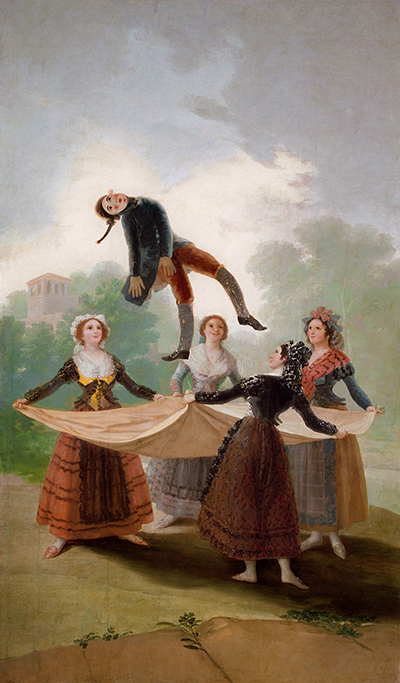
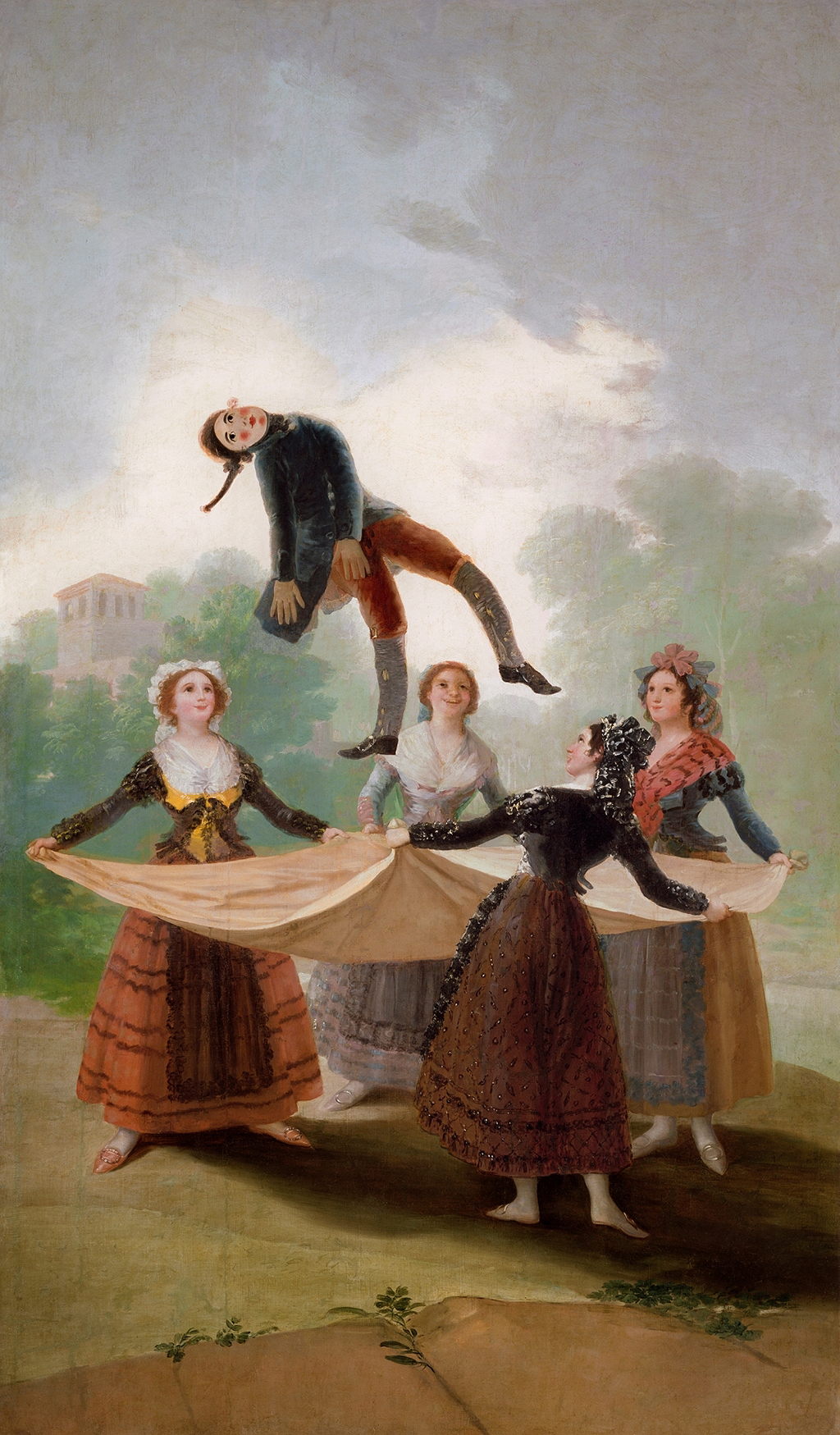
Four women hold a blanket across a clearing. Above their heads, a man-sized doll in a dark coat and red breeches hangs crookedly against a bank of white cloud. Francisco de Goya painted The Straw Manikin, or El pelele, in 1791–92 as a full-size model for a tapestry destined for Charles IV’s study at El Escorial. The oil painting is now in the Museo Nacional del Prado, Madrid. [1] [2]
At a Glance
- ArtistFrancisco José de Goya y Lucientes.
- Date1791–92. [2]
- MediumOil on canvas, painted as a tapestry cartoon. [1] [2]
- Size267 × 160 cm, height by width. [1] [2]
- CommissionThe final tapestry programme for Charles IV’s study at the Palace of San Lorenzo de El Escorial. [2] [3]
- CollectionMuseo Nacional del Prado, Madrid, P000802. [1] [2]
Works across Goya’s career
The Parasol
1777The Straw Manikin
1791–92The Nude Maja
1795–1800Saturn Devouring His Son
c. 1820–23The Dog
c. 1820–23Four women and a blanket
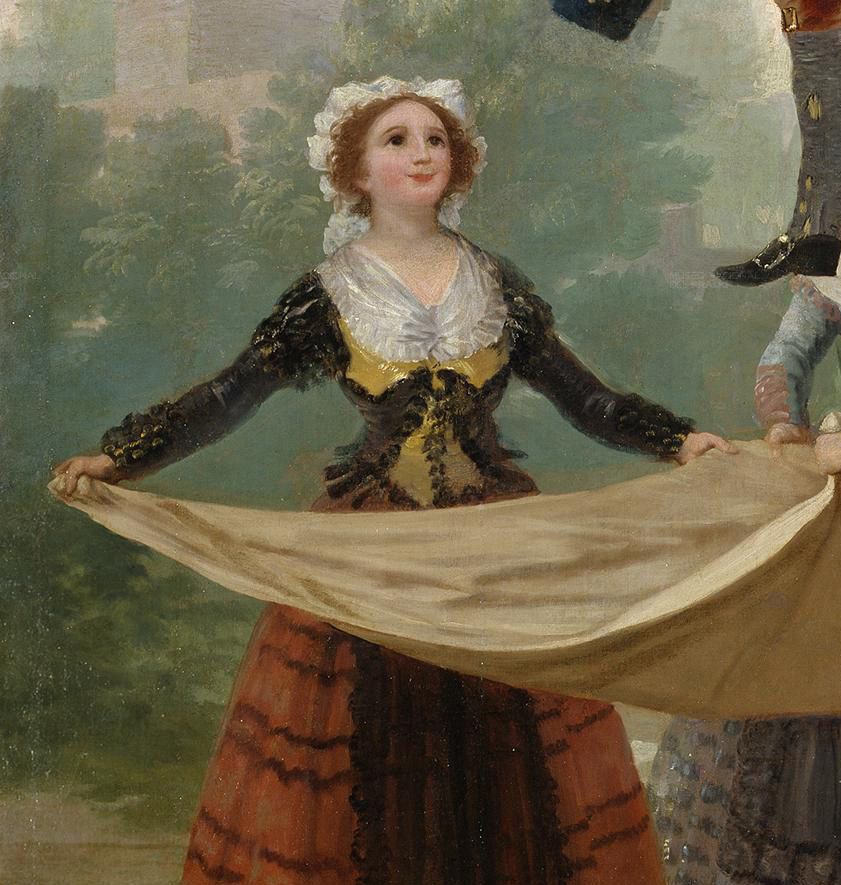
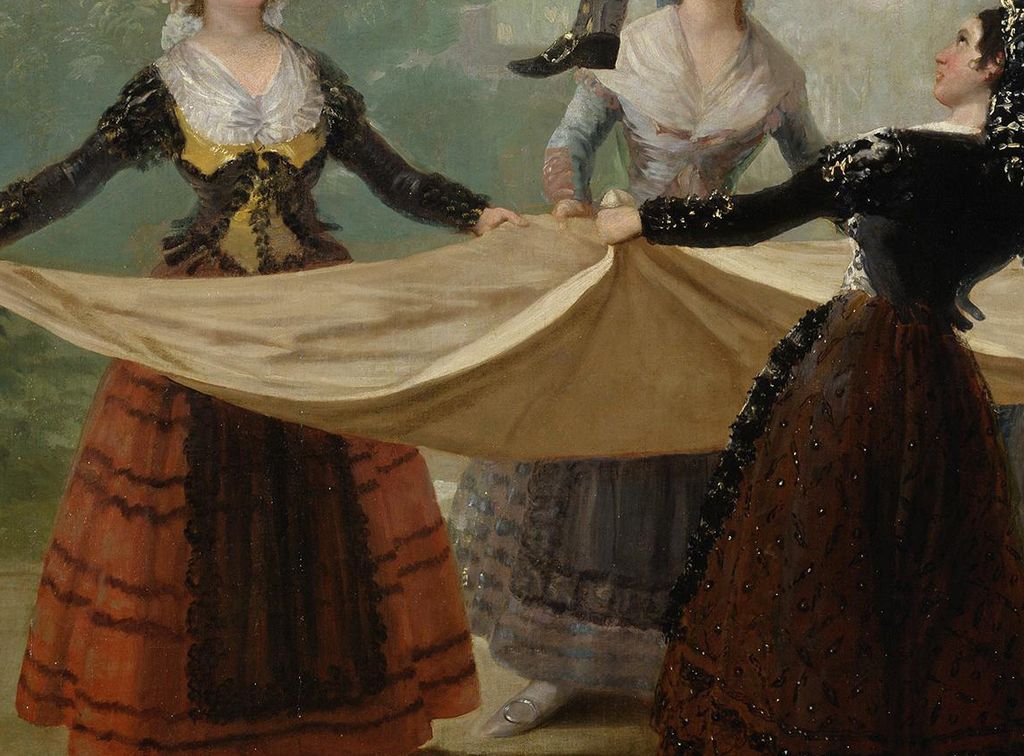
Start with the hand at the far left. It pinches the blanket at its outermost point and pulls the edge into a long curve. The woman holding it wears a white cap and a dark bodice with yellow panels. Her pink shoes are well apart beneath an orange skirt. At the opposite side, the woman with the red shawl and pink bow draws the corner out with her blue-sleeved arm. Between them, the woman in pale blue smiles over the far edge. In front of her, the player in black stands mostly with her back to us. Her arms spread to either side and her head turns, bringing her face into profile. The different angles show where the women stand around the blanket even though we see them crowded together within the narrow canvas. [1]
The near edge of the blanket dips low at the left, rises sharply into the foreground player’s fist and falls again behind her other sleeve. A broad plane of cloth hangs down from that central grip. Its shading gives the blanket depth and lets us distinguish folds with slack in them from the edges where the women pull. In the game of manteo, the players use that slack to catch the figure as it falls, then snap the cloth to launch it again. Goya shows the interval while the blanket is empty and the women have time to prepare for what comes down. The shadow collecting beneath their feet makes their footing especially clear. [1]
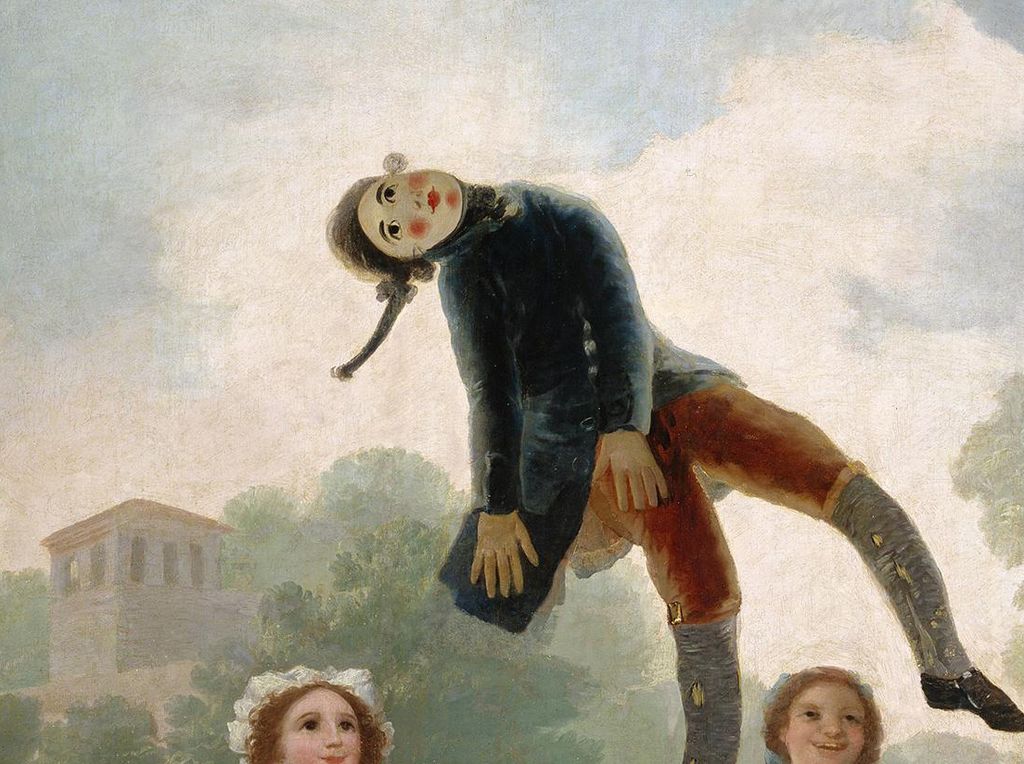
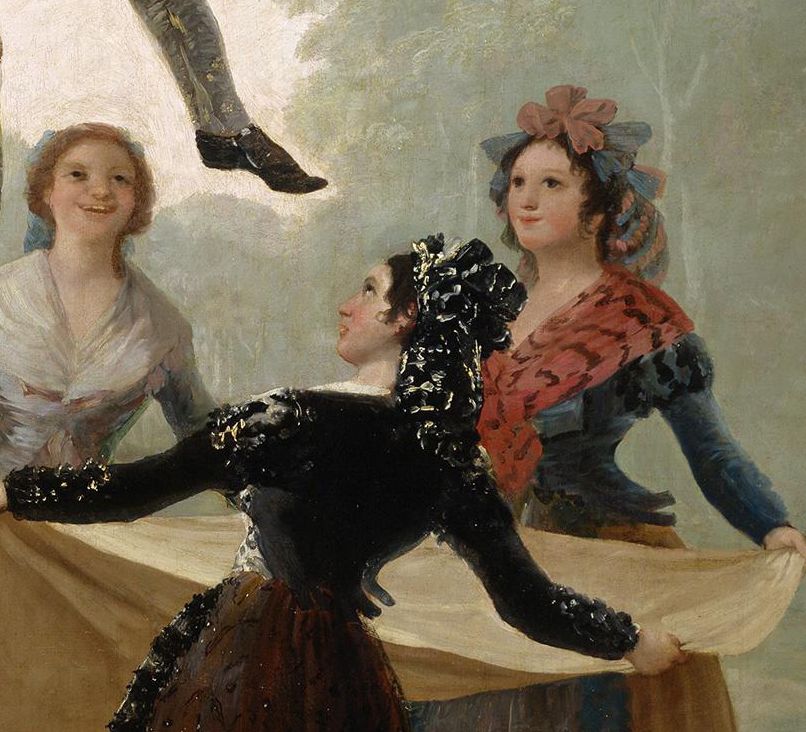
The dummy’s leftward tilt begins at the head and continues across the shoulders. One leg hangs almost vertically until the black shoe turns to the left. The other stretches towards the right, with a bend at the knee. Buttons catch the light on the dark coat and leggings, and a narrow tail of hair falls from the back of the head. Both hands droop loosely. The round eyes, spots of rouge and small red mouth stay visible because the face turns out of the picture even as the body tips sideways. Down below, the women look generally up or across the blanket. The turn of the foreground woman’s head makes her attention especially visible, while the smiling player behind the cloth faces close to the viewer’s direction. The dummy is the figure whose painted eyes most directly meet ours. [1]
A pale stone building rises above the trees on the left, below the dummy’s head. Goya lets the trees dissolve into a blue-green haze at the right and puts his strongest light in the cloud behind the coat. The manikin’s outline is easy to see from the far end of a room. There is also enough sky above it to suggest it could rise further. Near the bottom of the design, a few leaves along the edge of a rock give the eye a place to stop below the blanket and the skirts. The ground at our feet and the open air over the players make the height of the throw legible. [1]
Annotated Details from The Straw Manikin
Follow the blanket between the women and look at the dummy suspended above it.
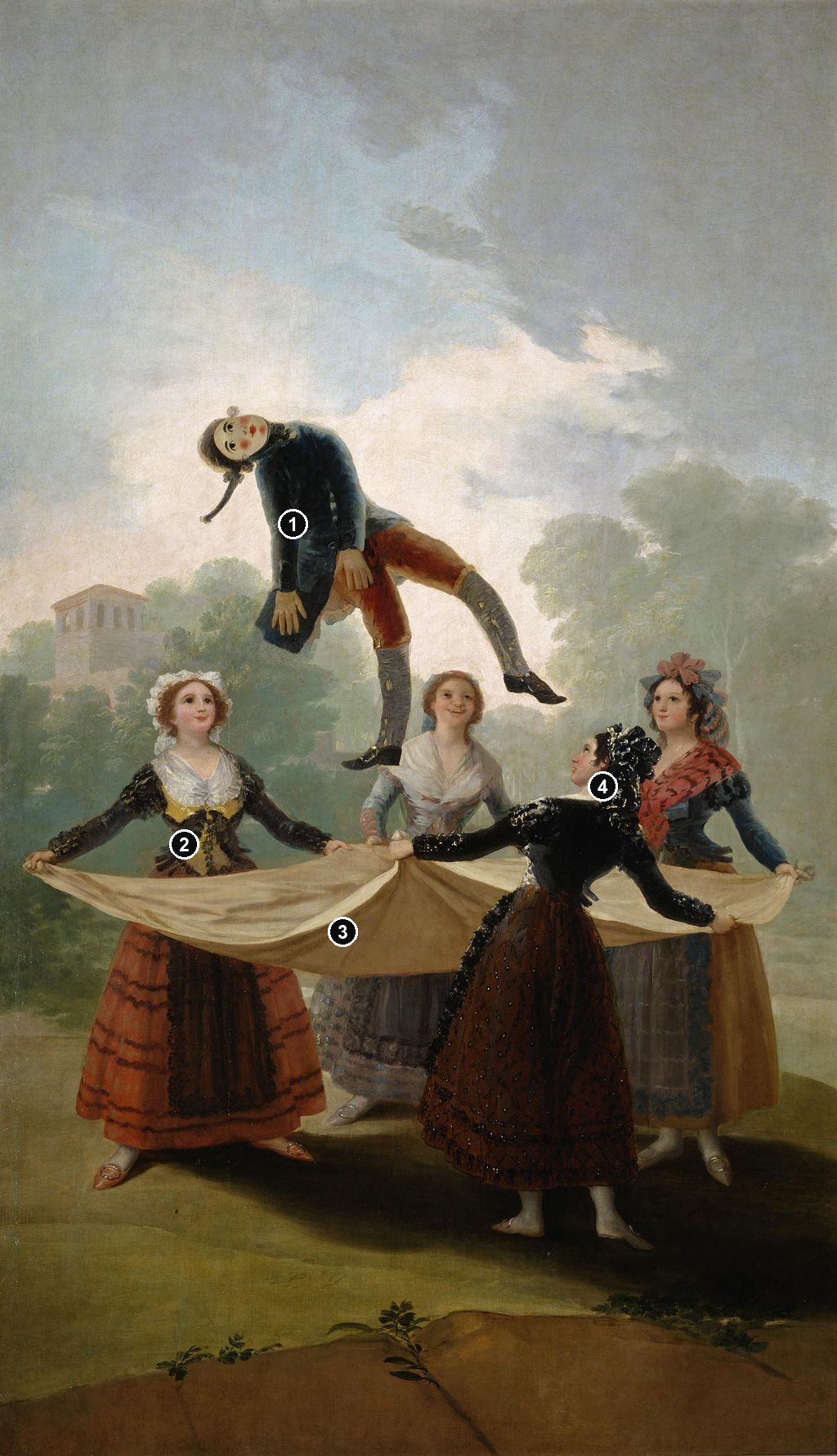
Details from THE STRAW MANIKIN
Details from the tapestry cartoon in the Museo Nacional del Prado (P000802).
The dummy in the air
The dummy’s head falls to one side while its legs trail away from the dark coat.
The hands at left
A woman holds the left edge of the blanket with her arms apart.
Folds in the blanket
Pale lines fan out across the cloth from the points where it is held.
Two faces at right
One woman looks across the group and the other tilts her face up towards the dummy.
The tapestry for Charles IV’s study
The commission came in 1790, and surviving correspondence shows that the Royal Tapestry Factory was still waiting for designs in April 1791. Its director, Livinio Stuick Vandergotten, complained to the king that Goya had declined the work after his appointment as court painter. Vandergotten cited the payments the artist received for providing designs and warned of the effect a shortage of models would have on the factory’s workers. By June, according to the Fundación Goya en Aragón, Goya had begun the small designs. A carpenter’s bill dated June 1792 records the stretchers for the larger canvases. The Fundación identifies two of the same dimensions as those for The Straw Manikin and Young Women with Pitchers. [2] [3] [4]
The Fundación identifies seven completed cartoons for the room. The tall format of The Straw Manikin makes more sense alongside its equally narrow companion, Young Women with Pitchers, and the much wider Wedding, in which a procession crosses beneath a stone arch. The three designs would have shared a wall. The tapestry after The Straw Manikin was woven, and the specialist Valentín de Sambricio traced it to El Escorial, correcting an earlier proposal that it had been made for the Infantas’ bedroom. The painted model entered the Prado in 1870. [1] [2] [3]
Goya on film
Five films explore Goya’s portraits, prints, Black Paintings and painting techniques.
The Duke of Wellington by Goya
The portrait, its military decorations and its later theft.
Watch on YouTubeThe two small paintings
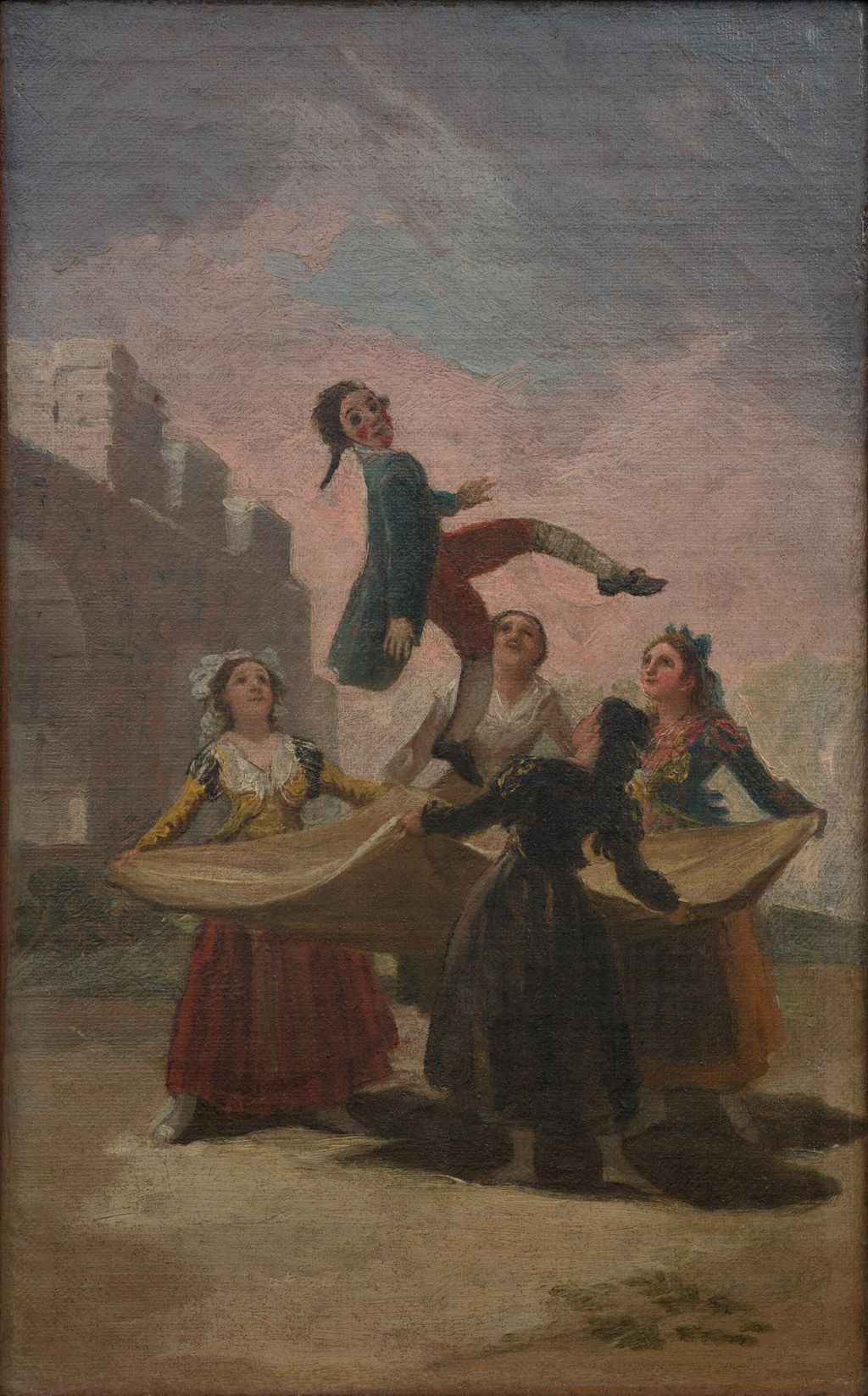
The Hammer Museum in Los Angeles catalogues a canvas of about 1791, just 35.6 × 23.2 cm, as Goya’s oil sketch for the design. The light brushwork gathers the women into a rough triangle with the doll at its peak. Its angular legs suggest a running stride. The Fundación points out the crenellated bridge at the left, a feature it connects with the small version of Young Women with Pitchers. The large Madrid picture keeps a building in the landscape, set back beyond the trees, and gives the cloth and the women’s dress more sharply drawn edges. In both works the face turns out to meet the viewer. [1] [5] [6]
A second small oil on canvas, 44.5 × 25.4 cm and recorded by the Fundación in a private collection, closely follows the composition of the Hammer painting. The trees in the background are more apparent in this version. The Fundación lists both small canvases as attributed to Goya and records longstanding uncertainty about which was the preparatory study. It reports that Juliet Wilson considered the privately held painting a possible copy or replica. The two small works show how closely versions of a design can resemble one another even when their place in the making of the cartoon is open to debate. [6]
What the game can mean
Blanket-tossing belonged to popular festivities and was also associated with rites around marriage. The Hammer Museum reads the game as a joke about choosing a husband. Four women control the figure that will fall into their hands. The Fundación relates the same idea of power between women and men to the other two designs intended for the wall. The art historian Janis A. Tomlinson, whose interpretation the Fundación summarises, suggests the painted face could belong to a petimetre, a fashionable fop treated like a doll. That reading gives the carefully buttoned clothes and rouged face a purpose beyond making a recognisable plaything. [2] [5] [7]
Victor Chan proposed a political reading. In his account, the four women suggest the seasons turning the wheel of fortune, and the figure rises and falls like a minister in an unstable court. The Fundación notes that Tomlinson also saw a concern with instability in this commission, pointing to the boys climbing a tree and the men walking on stilts. The picture leaves the manikin suspended between a rise and a fall. Its awkward pose can look like a joke about courtly fortune or the ordinary consequence of being tossed in a blanket. [2]
From the cartoon to Feminine Folly
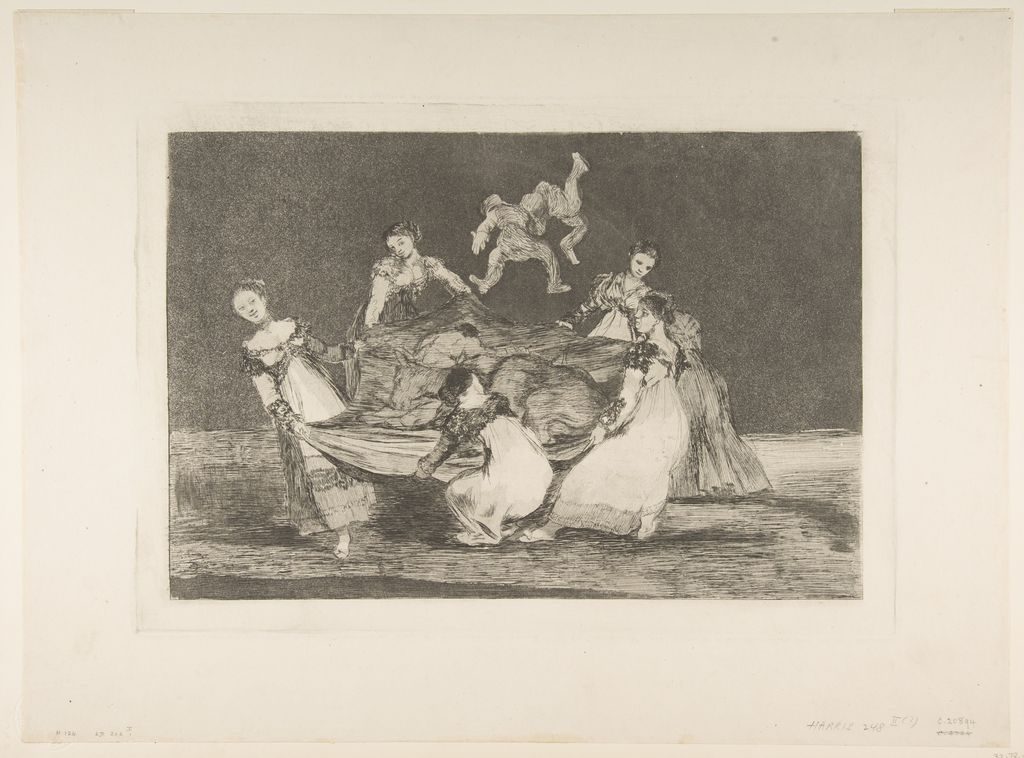
The blanket game reappears in Feminine Folly (Disparate femenino), a print the Metropolitan Museum of Art dates to about 1815–19. The women again pull at a sheet while loose-limbed figures hang overhead. Here there are two airborne figures and a donkey in the blanket. The bare horizon and dark aquatint sky give the game a different setting from the green clearing of the cartoon. Where the tall painting gives a single body room to rise, the wide print distributes several bodies along the length of the cloth. At the loom the design became wall decoration for a royal room. The print, made on a copperplate, circulated in impressions on paper and appeared in the first published edition in 1864. The article on Los Disparates follows this image from the preparatory drawing to two posthumous impressions. [1] [8] [9]
Artworks directory
| Name | Date | Medium |
|---|---|---|
| And There’s No Help for It, Plate 15 | Printed 1863 | |
| Asmodea | c. 1820–23 | Wall painting transferred to canvas |
| Boys Inflating a Bladder | 1777–78 | Tapestry cartoon |
| Boys Picking Fruit | 1778 | Tapestry cartoon |
| Bullfight in a Divided Ring | 1825 | Lithograph |
| Card Players | 1777–78 | Tapestry cartoon |
| Card Players (sketch) | 1777–78 | Painted sketch |
| Dance on the Banks of the Manzanares | 1777 | Tapestry cartoon |
| Duel with Cudgels | c. 1820–23 | Wall painting transferred to canvas |
| Heads in a Landscape | c. 1820–23 | Easel painting |
| Judith and Holofernes | c. 1820–23 | Wall painting transferred to canvas |
| Leocadia | c. 1820–23 | Wall painting transferred to canvas |
| Maja and Cloaked Men | 1777 | Tapestry cartoon |
| Maja and Cloaked Men (sketch) | 1777 | Painted sketch |
| Majo Clapping in Time to the Music | 1777 | Drawing |
| Men Reading | c. 1820–23 | Wall painting transferred to canvas |
| Out Hunting for Teeth, Plate 12 | 1799 | Etching, burnished aquatint and burin |
| Picnic in the Countryside (sketch) | 1776–78 | Painted sketch |
| Picnic on the Banks of the Manzanares | 1776 | Tapestry cartoon |
| Pilgrimage to San Isidro | c. 1820–23 | Wall painting transferred to canvas |
| Preparatory study for The Sleep of Reason Produces Monsters | c. 1796–97 | Drawing |
| Procession of the Holy Office | c. 1820–23 | Wall painting transferred to canvas |
| Quarrel at the Cockerel Inn (sketch) | 1777 | Painted sketch |
| Quarrel in the New Tavern | 1777 | Tapestry cartoon |
| Saturn Devouring His Son | c. 1820–23 | Wall painting transferred to canvas |
| Seated Majo Smoking | c. 1776 | Drawing |
| The Dog | c. 1820–23 | Wall painting transferred to canvas |
| The Drinker | 1777 | Tapestry cartoon |
| The Fates | c. 1820–23 | Wall painting transferred to canvas |
| The Great He-Goat | c. 1820–23 | Wall painting transferred to canvas |
| The Kite | 1777–78 | Tapestry cartoon |
| The Parasol | 1777 | Oil on canvas, tapestry cartoon |
| The Second of May 1808 | 1814 | Oil on canvas |
| The Sleep of Reason Produces Monsters, Plate 43 | 1799 | Etching and aquatint |
| The Third of May 1808 | 1814 | Oil on canvas |
| Thou Who Canst Not, Plate 42 | 1799 | Etching and burnished aquatint |
| Three Figures | 1776 | Drawing (lost) |
| Two Old Men | c. 1820–23 | Wall painting transferred to canvas |
| Two Old Men Eating Soup | c. 1820–23 | Wall painting transferred to canvas |
| Two Women and a Man | c. 1820–23 | Wall painting transferred to canvas |
| Universal Language: The Author Dreaming | 1797 | Drawing |
| The Family of Charles IV | 1800 | Oil on canvas |
| Witches’ Sabbath (Osuna painting) | 1797–98 | Oil on canvas |
| The Nude Maja | 1795–1800 | Oil on canvas |
| The Clothed Maja | 1800–07 | Oil on canvas |
| Self-Portrait (Drawing) | c. 1796 | Brush and carbon black ink on laid paper |
| The Swing, Madrid Album B.21 | 1795–97 | Brush and carbon black washes |
| Majas Fighting, a Majo Observing, Madrid Album B.15 | 1796–97 | Brush, grey and black washes on laid paper |
| Majos and Majas Conversing, Madrid Album B.16 | c. 1794–97 | Ink wash on paper |
| Weeping Woman and Three Men, Madrid Album B.17 | 1795–97 | Brush, carbon black washes and black chalk |
| Maja Seated on a Chair and Two Companions Behind, Madrid Album B.18 | 1795–97 | Brush and carbon black washes |
| Girl and Bull, Madrid Album B.23 | 1796–97 | Brush and carbon black washes |
| Lovers Sitting on a Rock, Madrid Album B.24 | 1796–97 | Brush and carbon black washes |
| Mariano Ceballos Riding a Bull | 1825 | Crayon lithograph and scraper |
| Landscape (lifetime impression) | c. 1807–10 | Etching and aquatint |
| Self-Portrait (1815), Prado canvas | 1815 | Oil on canvas |
| Self-Portrait (1815), Academy panel | 1815 | Oil on panel |
| Self-Portrait with Dr Arrieta | 1820 | Oil on canvas |
| Christ Crucified | 1780 | Oil on canvas |
| The Last Communion of Saint Joseph of Calasanz | 1819 | Oil on canvas |
| Christ on the Mount of Olives | 1819 | Oil on panel |
| The Flower Girls, or Spring | 1786–87 | Oil on canvas |
| The Grape Harvest, or Autumn | 1786–87 | Oil on canvas |
| The Snowstorm, or Winter | 1786–87 | Oil on canvas |
| The Threshing Ground, or Summer | 1786–87 | Oil on canvas |
| Picnic on the Banks of the Manzanares | 1776 | Oil on canvas |
| The Kite | 1777–78 | Oil on canvas |
| Dance on the Banks of the Manzanares | 1777 | Oil on canvas |
| A Fight at the Venta Nueva | 1777 | Oil on canvas |
| Blind Man’s Bluff | 1788 | Oil on canvas |
| Dogs on a Lead | 1775 | Oil on canvas |
| Hunting with a Decoy | 1775 | Oil on canvas |
| Hunter Loading His Rifle | 1775 | Oil on canvas |
| The Angler | 1775 | Oil on canvas |
| The Hermitage of San Isidro on His Feast Day | 1788 | Oil on canvas |
| The Meadow of San Isidro | 1788 | Oil on canvas |
| The Straw Manikin | 1791–92 | Oil on canvas |
| Witches’ Flight | c. 1797–98 | Oil on canvas |
| A Scene from ‘The Forcibly Bewitched’ | 1798 | Oil on canvas |
| The Duchess of Alba in Black | 1797 | Oil on canvas |
| The Duchess of Alba in White | 1795 | Oil on canvas |
| Charles III in Hunting Dress | c. 1786 | Oil on canvas |
| The Duke and Duchess of Osuna and Their Children | 1787–88 | Oil on canvas |
| Manuel Osorio Manrique de Zúñiga | 1787–88 | Oil on canvas |
| The Marquesa de Pontejos | c. 1786 | Oil on canvas |
| Equestrian Portrait of the 1st Duke of Wellington | 1812 | Oil on canvas |
| The Duke of Wellington | 1812–14 | Oil on wood |
| Portrait of Ferdinand VII of Spain | 1814 | Oil on canvas |
| Gaspar Melchor de Jovellanos | 1798 | Oil on canvas |
| María Tomasa Palafox y Portocarrero | 1804 | Oil on canvas |
| Señora Sabasa García | c. 1806–11 | Oil on canvas |
| Don Juan Bautista de Muguiro | 1827 | Oil on canvas |
| Doña Isabel de Porcel | Before 1805 | Oil on canvas |
| The Colossus | After 1808 | Oil on canvas |
| The Burial of the Sardine | 1808–12 | Oil on panel |
| The Madhouse | 1808–12 | Oil on panel |
| A Procession of Flagellants | 1808–12 | Oil on panel |
| Portrait of Jacques Galos | 1826 | Oil on canvas |
| Portrait of Mariano Goya, the Artist’s Grandson | 1827 | Oil on canvas |
| Milkmaid of Bordeaux | c. 1827 | Oil on canvas |
| Portrait of Don Juan Antonio Cuervo | 1819 | Oil on canvas |
| María Luisa of Parma (Naples version) | c. 1800 | Oil on canvas |
| The Countess of Baena | 1819 | Oil on canvas |
| The Family of the Infante Don Luis | 1783–84 | Oil on canvas |
| The Holy Family | c. 1787 | Oil on canvas |
| Saint Barbara | c. 1773 | Oil on canvas |
| Saints Justa and Rufina | 1817 | Oil on canvas |
| El Tío Paquete | c. 1819–20 | Oil on canvas |
| The Forge | c. 1815–20 | Oil on canvas |
| Majas on a Balcony (Metropolitan Museum version) | c. 1800–10 | Oil on canvas |
| Maja and Celestina on a Balcony | c. 1808–12 | Oil on canvas |
| The Water Bearer | 1808–12 | Oil on canvas |
| Time and the Old Women | c. 1810 | Oil on canvas |
Frequently Asked Questions
Discussion
Look again at the images and ideas explored in The Straw Manikin. These editorial prompts invite your observations.
Follow the near edge of the blanket from the woman in the orange skirt to the woman in black, then look up at the doll. Where does Goya make you feel the weight of the cloth and the weight of the figure? What changes when you look for the same effects in Feminine Folly?
Reader Insights
Where do the blanket and the women’s hands direct your eye?
How does the smaller painting arrange the same action?
Join the Conversation
Share a detail, comparison or question about The Straw Manikin below.
References
- Museo Nacional del Prado, El pelele, P000802, and printed collection catalogue, no. 802. View source 1. View source 2.
- Fundación Goya en Aragón, El pelele, catalogue entry with the commission history and summaries of interpretations by Janis A. Tomlinson and Victor Chan. View source.
- Fundación Goya en Aragón, La boda, on the royal commission and the Cittadini bill. View source.
- Livinio Stuick Vandergotten, letter to Charles IV of 13 April 1791, in the University of Zaragoza’s Diplomatario de Francisco de Goya. View source.
- Hammer Museum, El pelele (The strawman), AH.90.36. View source.
- Fundación Goya en Aragón, El pelele (boceto) and El pelele (boceto 2), catalogue entries on the small paintings. View source 1. View source 2.
- Cultura en Vena, El pelele, exhibition text on blanket-tossing in popular festivities. View source.
- Fondation Custodia, Disparate femenino, trial proof, 2011-P.31, on the print and the earlier tapestry design. View source.
- Metropolitan Museum of Art, Feminine Folly, first-edition impression, 24.30.2. View source.







