


 by Tom Gurney
Tom Gurney BSc (Hons) is an art history expert with over 20 years experience
Published on June 19, 2020 / Updated on November 20, 2026
Email: tomgurney1@gmail.com / Phone: +44 7429 011000
Introduction
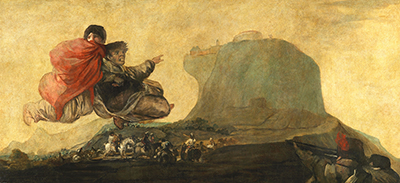
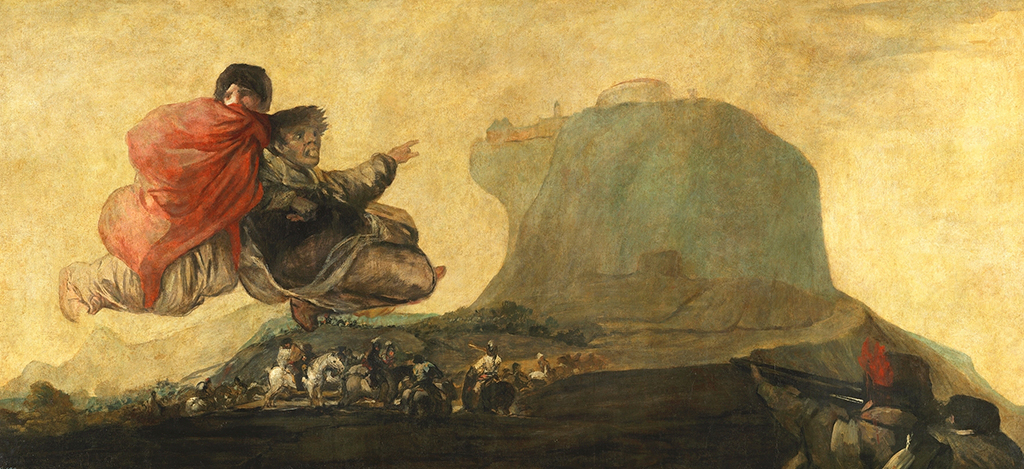
Two figures fly low across a landscape, pressed together as if a movement by either might unsettle them both. One points towards a steep rock crowned with buildings. The other pulls a red cloak across the lower face and looks back. Below, horses and people gather on the uneven ground, with riflemen at the lower right. Francisco de Goya painted this encounter around 1820–1823 on an upstairs wall of his house outside Madrid. The work survives on canvas at the Museo Nacional del Prado and is also known as Fantastic Vision (Visión fantástica). [1] [2]
At a Glance
- ArtistFrancisco de Goya
- DateAbout 1820–1823
- MediumOil-based wall painting on plaster, transferred to canvas
- Dimensions127 × 263 cm (height × width)
- CollectionMuseo Nacional del Prado, Madrid, P000756
- Original settingUpper floor of the Quinta del Sordo, on the same wall as Procession of the Holy Office. [1] [2]
Works across Goya’s career
The Parasol
1777The Nude Maja
1795–1800Asmodea
c. 1820–23Saturn Devouring His Son
c. 1820–23The Dog
c. 1820–23The flight and the ground below
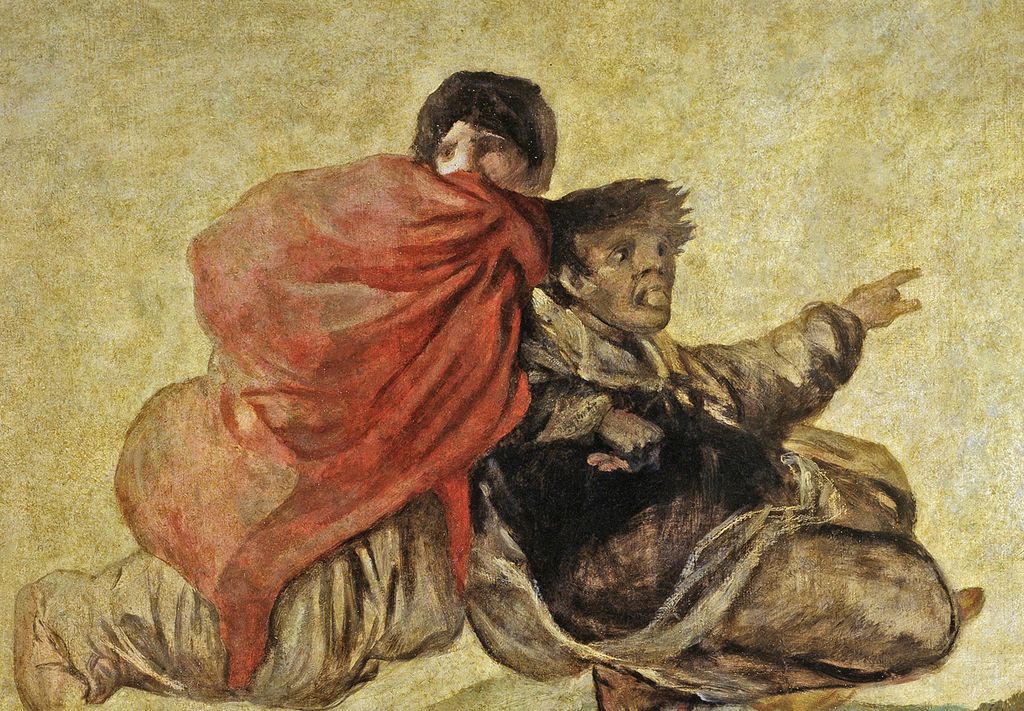
Goya makes the airborne pair unusually easy to find. Their bodies take up much of the left half of the picture, where a stretch of pale yellow sky keeps their outlines clear. The strongest colour sits high in that half of the canvas. The red cloth is drawn tight just under the eyes, then opens into broad folds down the back. Where it ends, cream fabric bunches around a bent leg, and a foot emerges near the left edge. The other figure's darker clothes and drawn-up knees gather into a rounded shape with the companion's drapery. Seen together, the two bodies seem to travel sideways even as their heads turn apart. [2]
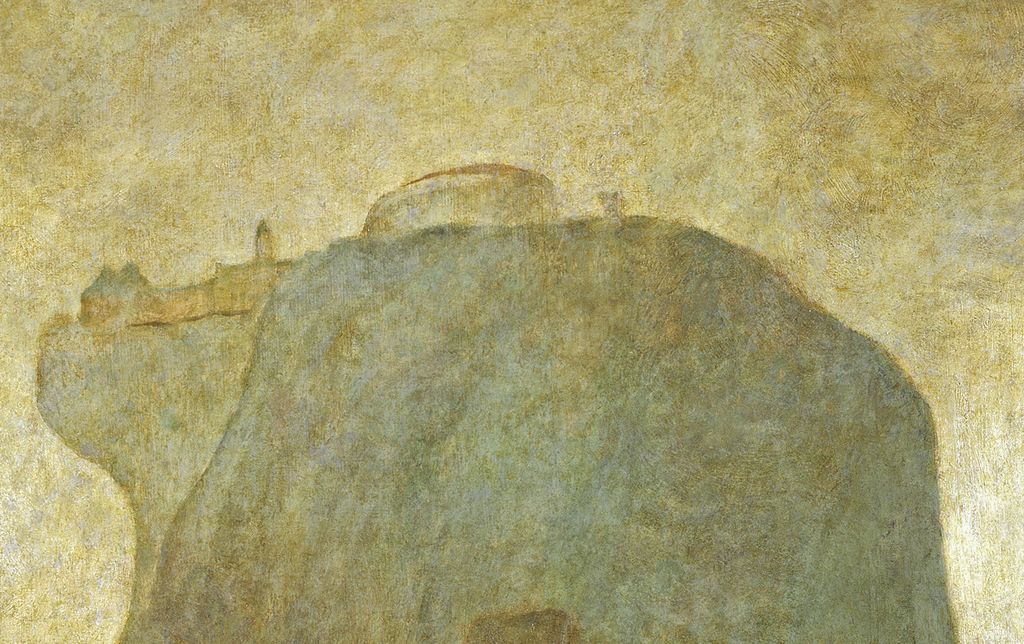
The extended hand makes the next move in the composition. Its small silhouette stands out against a clear patch of sky and points across a gap towards the rock. Look near the left lip of the summit for a narrow strip of buildings, then a little further right for a low, rounded structure against the skyline. Their small size gives the rock a scale the bare slope could scarcely convey on its own. The face of the rock is broad and shaded, its top almost level. It presents a formidable barrier to anyone on foot. From the air the destination seems close enough to point out, though the gap between fingertip and summit leaves the arrival unresolved. [2]
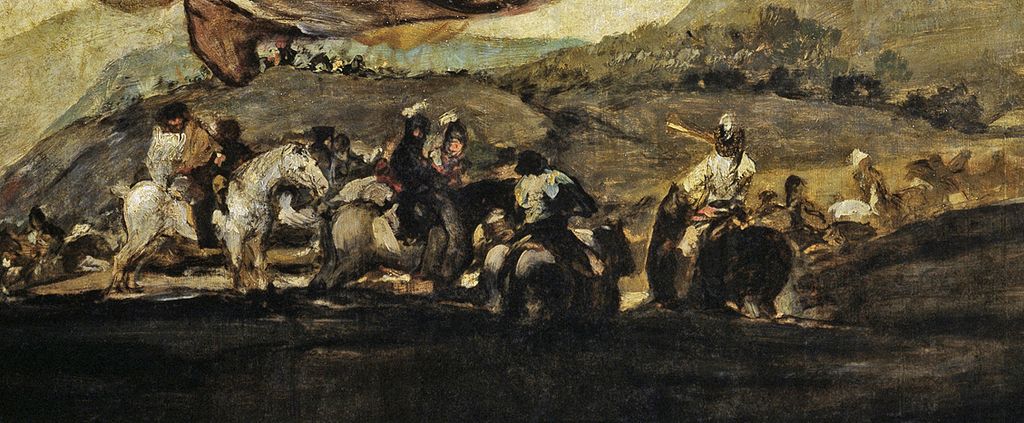
In the lower half, the same country looks much harder to cross. The near ground stretches darkly across the bottom of the canvas. Behind it small figures and horses move in a broken band at the foot of the hill. A pale horse at the left of the group catches the light and makes it easier to find the riders and animals around it. Further back, people are reduced to dabs along the rising ground. Their small size gives a sense of distance within the landscape, while the airborne bodies remain large enough for the viewer to see the set of a mouth or the direction of a glance. [2]
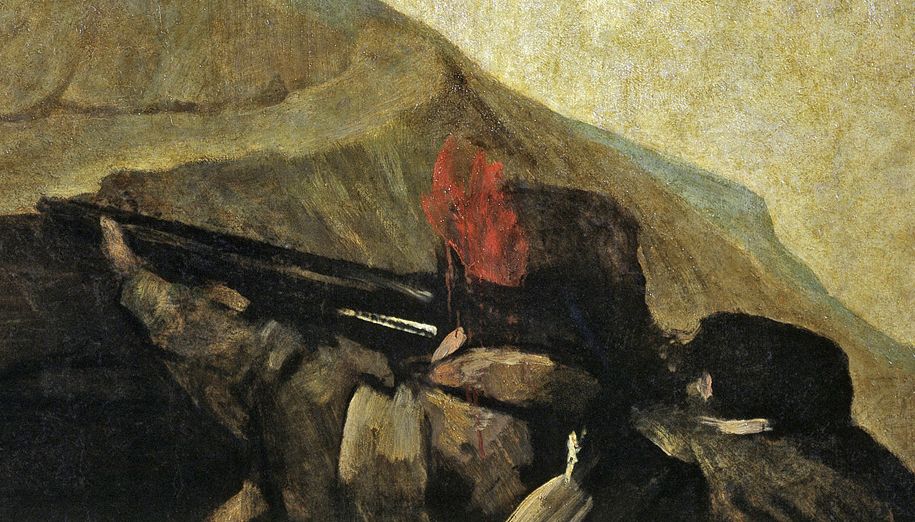
The far right is easy to pass over after following the hand to the summit. Look for the small red accent in the nearer rifleman's headgear, then trace the dark barrels extending to the left. The figures are seen from behind and cut off by the lower edge, so equipment and posture communicate their action while their expressions are hidden. The Fundación Goya en Aragón reads their aim as directed towards the group on the ground. The French writer Charles Yriarte, who described the mural before it was transferred, likewise thought the guns were levelled at the riders. Across the width of the picture the rifles also send the eye back in the direction of the airborne pair. That visual connection helps explain why the pair can seem to be fleeing the men below, even though the exact object of the riflemen's attention is open to interpretation. [2] [3]
Annotated Details from Asmodea
Follow the gesture of the airborne figure towards the summit, then look below.
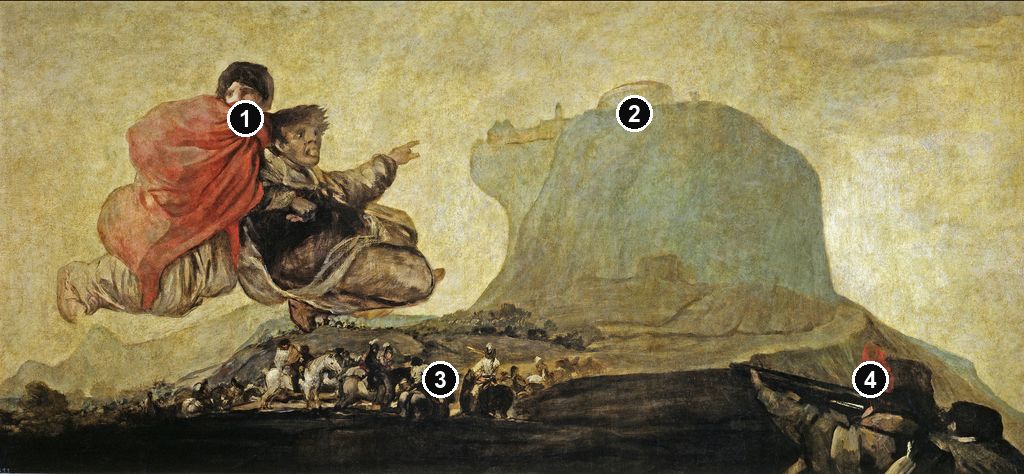
Details from ASMODEA
Details from the canvas in the Museo Nacional del Prado (P000756).
Two figures in the air
The red cloth sweeps diagonally across the pair. The companion’s outstretched hand continues the movement towards the rock.
Buildings at the summit
Small shapes at the edge of the summit suggest buildings. Their small scale makes the rock appear immense.
Riders below the figures
Small patches of pale paint pick out horses and riders. They sit in a narrow band between the hillside and the dark foreground.
Gun barrels in the foreground
Two long dark barrels point back towards the left across the lower edge of the picture.
What the title can tell us
The name Asmodea appears in an inventory of works belonging to Goya's son Javier, compiled by the painter Antonio Brugada at an uncertain date in the mid-nineteenth century. In 1867 Yriarte used the French form L'Asmodée in his catalogue. In the narrative of his visit he introduced the name as a possibility, saying that one could call the composition Asmodée. The Prado's first catalogue to include the Black Paintings, issued in 1900, listed this work as El aquelarre, meaning a witches' gathering. That early entry refers to P000756, distinct from Goya's other Quinta mural now called Witches' Sabbath or The Great He-Goat (P000761). The Prado used Asmodea in its 2021 agreement for the exhibition Goya, Sin límites. Fantastic Vision, used in English scholarship, describes the apparition while leaving its story open. [1] [3] [4] [5]
Brugada's title echoes Asmodeus, the demon who kills Sarah's seven husbands in the Book of Tobit. Tobias survives their marriage with the help of the angel Raphael, who binds the demon. That story offers a source for the name and for the idea of a threatening supernatural figure. The hilltop buildings and armed encounter belong to a different set of images from the wedding chamber and the rite by which Tobias drives away the demon. A closer literary parallel to the experience of flight appears in Luis Vélez de Guevara's El diablo cojuelo, in which a devil shows a companion the world below from above the rooftops. In Alain-René Lesage's French adaptation, the devil is explicitly called Asmodeus. Looking down on human society with a supernatural escort makes sense of the painting's two levels, although it still leaves the violence below to be explained. [2] [6] [7]
The Fundación Goya catalogue records another proposal, from art historian John F. Moffitt, that the flying figures are Minerva and Prometheus and that the rock is Mount Caucasus. The destination gives the pointing gesture particular weight in that reading. Carlos Foradada has proposed a political interpretation centred on the French intervention of 1823. He reads the red-cloaked figure as constitutional Spain and compares the red and cream clothing to Titian's personification of Spain in Spain Succouring Religion. Foradada also argues that the ground troops' attire provides clues to their allegiances. Both readings depend on connections made outside the picture. A cloak can support a comparison without settling the identity or gender of the wearer, and the distant architecture is conveyed in strokes too small to identify a particular settlement with confidence. [2] [7]
Goya on film
Five films explore Goya’s portraits, prints, Black Paintings and painting techniques.
The Duke of Wellington by Goya
The portrait, its military decorations and its later theft.
Watch on YouTubeAn upstairs wall at the Quinta del Sordo
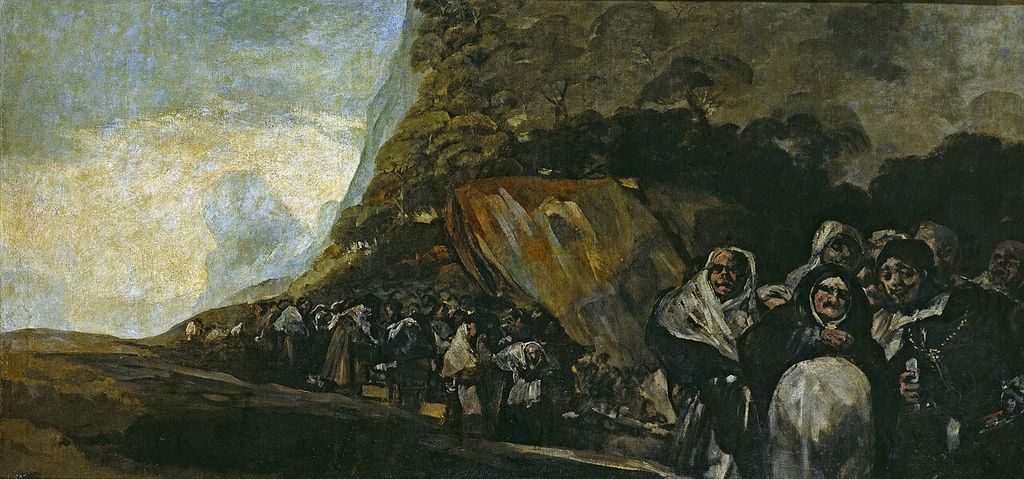
Goya acquired the Quinta del Sordo in 1819. The house lay outside Madrid near the Manzanares River, and the paintings now called the Black Paintings decorated rooms on two storeys. Asmodea belonged to the upper room. In the reconstruction by Foradada and colleagues it was on the wall to the right as visitors entered, with a window separating it from the Procession of the Holy Office. A viewer in that room could move from the ground party in Asmodea to the larger procession in the next panel. Across the room, The Fates and Fight with Cudgels shared the other long wall in the reconstruction. A turn from Asmodea towards The Fates brought a second group suspended above a landscape into view. The broad formats make the comparison especially close. In The Fates, figures gather round one another, drawing attention to what they hold. In Asmodea, an arm leads outward towards a place, giving the suspension a direction. [2] [3] [8]
The surface Goya worked on was dry plaster. He used paint containing oil, and the finished mural became part of the wall's layered surface. The Fundación Goya reports that radiographs show the two flying figures superimposed on a landscape that already included distant figures and the mountain. This gives the scene a material sequence as well as a pictorial one. The hillside and distant company can hold the eye as a landscape in their own right. The two much larger bodies inserted against the sky change how we understand that terrain, making it a place that can be surveyed or crossed by flight. The radiographs establish the overlap of the paint layers. The interval between those layers and the reason for adding the pair remain uncertain. [2] [4]
Laurent's photograph and the transfer to canvas
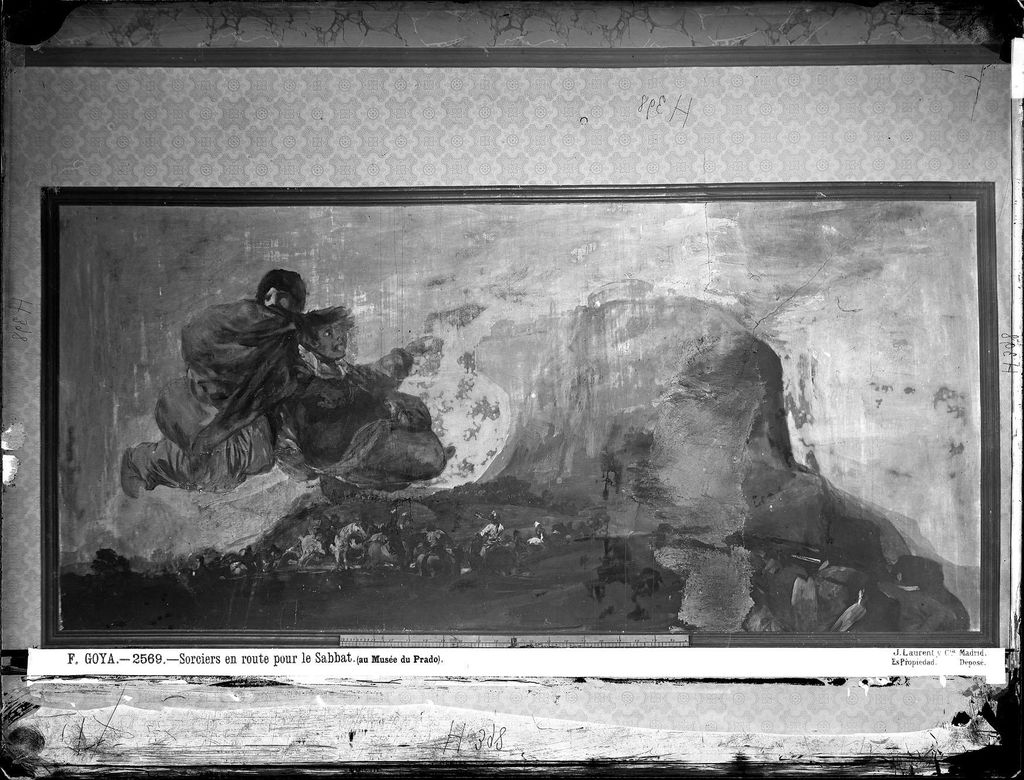
The photograph of this particular mural in the house is Jean Laurent's glass negative VN-08121, preserved in the Archivo Ruiz Vernacci at Spain's Instituto del Patrimonio Cultural. Teresa Díaz Fraile of the Instituto del Patrimonio Cultural de España dates the exposure to 1874, while the Prado's earlier catalogue account gives about 1873 for the photographs of the group. The paper surround and the visibly distressed plaster place the exposure before the transfer. The inscription on the negative calls the scene Sorciers en route pour le Sabbat (sorcerers on their way to the sabbath). Its reference to the Prado belongs to the photographs' later circulation. Laurent's successors marketed the images around 1890, when the paintings already belonged to the Prado. [4] [9] [10]
Start with the border in the photograph. Inside the patterned surround are the familiar large bodies at the left and the steep rock at the right of centre. Above the picture, the photograph takes in moulding near the ceiling. Inside the painted boundary, it shows cracks and extensive pale losses across the lower right. Foradada and colleagues used evidence from the photographs to estimate a mural height of about 122 cm, compared with 127 cm for the present canvas. The wall and canvas measurements refer to two stages of the object. [8] The broad arrangement, including the distance between the pointing hand and the rock, can be followed from photograph to canvas. At a smaller scale, Nigel Glendinning's comparison of early and restored photographs drew attention to the skyline buildings, the folds around the left figure's legs and the slope descending behind the riflemen. He found that the foothills had a flatter appearance after restoration. His discussion distinguishes a photograph published by Calleja in 1924, whose source negative he could not confirm, from a separate photograph of the work after restoration. The digitised VN-08121 plate provides identifiable evidence of the mural in the house. Its greys can be used to compare contours and tonal areas, while Yriarte's account of a pale yellow sky and carmine drapery supplies independent testimony about colour before transfer. [3] [5] [9] [10]
Baron Émile d'Erlanger, who acquired the house in 1873, commissioned Salvador Martínez Cubells to transfer the murals to canvas. That work began in the 1870s and allowed the paintings to travel to the Paris Universal Exhibition of 1878, where they were shown at the Trocadéro. D'Erlanger gave them to the Spanish state in 1881, and they entered the Prado. The transferred canvases preserved the paintings as individual objects and changed the scale on which the old interior could be read. At the Quinta, the surrounding paper, the neighbouring panels and the window divided a whole wall into successive fields of attention. Today the painted action fills a single framed rectangle. Factum Arte's recording of Asmodea at the Prado in 2014 combined colour photography with a scan of the current surface relief. It documents a different stage in the painting's history from Laurent's plate, down to the texture of individual painted passages. [2] [4] [8] [11]
Artworks directory
| Name | Date | Medium |
|---|---|---|
| And There’s No Help for It, Plate 15 | Printed 1863 | |
| Asmodea | c. 1820–23 | Wall painting transferred to canvas |
| Boys Inflating a Bladder | 1777–78 | Tapestry cartoon |
| Boys Picking Fruit | 1778 | Tapestry cartoon |
| Bullfight in a Divided Ring | 1825 | Lithograph |
| Card Players | 1777–78 | Tapestry cartoon |
| Card Players (sketch) | 1777–78 | Painted sketch |
| Dance on the Banks of the Manzanares | 1777 | Tapestry cartoon |
| Duel with Cudgels | c. 1820–23 | Wall painting transferred to canvas |
| Heads in a Landscape | c. 1820–23 | Easel painting |
| Judith and Holofernes | c. 1820–23 | Wall painting transferred to canvas |
| Leocadia | c. 1820–23 | Wall painting transferred to canvas |
| Maja and Cloaked Men | 1777 | Tapestry cartoon |
| Maja and Cloaked Men (sketch) | 1777 | Painted sketch |
| Majo Clapping in Time to the Music | 1777 | Drawing |
| Men Reading | c. 1820–23 | Wall painting transferred to canvas |
| Out Hunting for Teeth, Plate 12 | 1799 | Etching, burnished aquatint and burin |
| Picnic in the Countryside (sketch) | 1776–78 | Painted sketch |
| Picnic on the Banks of the Manzanares | 1776 | Tapestry cartoon |
| Pilgrimage to San Isidro | c. 1820–23 | Wall painting transferred to canvas |
| Preparatory study for The Sleep of Reason Produces Monsters | c. 1796–97 | Drawing |
| Procession of the Holy Office | c. 1820–23 | Wall painting transferred to canvas |
| Quarrel at the Cockerel Inn (sketch) | 1777 | Painted sketch |
| Quarrel in the New Tavern | 1777 | Tapestry cartoon |
| Saturn Devouring His Son | c. 1820–23 | Wall painting transferred to canvas |
| Seated Majo Smoking | c. 1776 | Drawing |
| The Dog | c. 1820–23 | Wall painting transferred to canvas |
| The Drinker | 1777 | Tapestry cartoon |
| The Fates | c. 1820–23 | Wall painting transferred to canvas |
| The Great He-Goat | c. 1820–23 | Wall painting transferred to canvas |
| The Kite | 1777–78 | Tapestry cartoon |
| The Parasol | 1777 | Oil on canvas, tapestry cartoon |
| The Second of May 1808 | 1814 | Oil on canvas |
| The Sleep of Reason Produces Monsters, Plate 43 | 1799 | Etching and aquatint |
| The Third of May 1808 | 1814 | Oil on canvas |
| Thou Who Canst Not, Plate 42 | 1799 | Etching and burnished aquatint |
| Three Figures | 1776 | Drawing (lost) |
| Two Old Men | c. 1820–23 | Wall painting transferred to canvas |
| Two Old Men Eating Soup | c. 1820–23 | Wall painting transferred to canvas |
| Two Women and a Man | c. 1820–23 | Wall painting transferred to canvas |
| Universal Language: The Author Dreaming | 1797 | Drawing |
| The Family of Charles IV | 1800 | Oil on canvas |
| Witches’ Sabbath (Osuna painting) | 1797–98 | Oil on canvas |
| The Nude Maja | 1795–1800 | Oil on canvas |
| The Clothed Maja | 1800–07 | Oil on canvas |
| Self-Portrait (Drawing) | c. 1796 | Brush and carbon black ink on laid paper |
| The Swing, Madrid Album B.21 | 1795–97 | Brush and carbon black washes |
| Majas Fighting, a Majo Observing, Madrid Album B.15 | 1796–97 | Brush, grey and black washes on laid paper |
| Majos and Majas Conversing, Madrid Album B.16 | c. 1794–97 | Ink wash on paper |
| Weeping Woman and Three Men, Madrid Album B.17 | 1795–97 | Brush, carbon black washes and black chalk |
| Maja Seated on a Chair and Two Companions Behind, Madrid Album B.18 | 1795–97 | Brush and carbon black washes |
| Girl and Bull, Madrid Album B.23 | 1796–97 | Brush and carbon black washes |
| Lovers Sitting on a Rock, Madrid Album B.24 | 1796–97 | Brush and carbon black washes |
| Mariano Ceballos Riding a Bull | 1825 | Crayon lithograph and scraper |
| Landscape (lifetime impression) | c. 1807–10 | Etching and aquatint |
| Self-Portrait (1815), Prado canvas | 1815 | Oil on canvas |
| Self-Portrait (1815), Academy panel | 1815 | Oil on panel |
| Self-Portrait with Dr Arrieta | 1820 | Oil on canvas |
| Christ Crucified | 1780 | Oil on canvas |
| The Last Communion of Saint Joseph of Calasanz | 1819 | Oil on canvas |
| Christ on the Mount of Olives | 1819 | Oil on panel |
| The Flower Girls, or Spring | 1786–87 | Oil on canvas |
| The Grape Harvest, or Autumn | 1786–87 | Oil on canvas |
| The Snowstorm, or Winter | 1786–87 | Oil on canvas |
| The Threshing Ground, or Summer | 1786–87 | Oil on canvas |
| Picnic on the Banks of the Manzanares | 1776 | Oil on canvas |
| The Kite | 1777–78 | Oil on canvas |
| Dance on the Banks of the Manzanares | 1777 | Oil on canvas |
| A Fight at the Venta Nueva | 1777 | Oil on canvas |
| Blind Man’s Bluff | 1788 | Oil on canvas |
| Dogs on a Lead | 1775 | Oil on canvas |
| Hunting with a Decoy | 1775 | Oil on canvas |
| Hunter Loading His Rifle | 1775 | Oil on canvas |
| The Angler | 1775 | Oil on canvas |
| The Hermitage of San Isidro on His Feast Day | 1788 | Oil on canvas |
| The Meadow of San Isidro | 1788 | Oil on canvas |
| The Straw Manikin | 1791–92 | Oil on canvas |
| Witches’ Flight | c. 1797–98 | Oil on canvas |
| A Scene from ‘The Forcibly Bewitched’ | 1798 | Oil on canvas |
| The Duchess of Alba in Black | 1797 | Oil on canvas |
| The Duchess of Alba in White | 1795 | Oil on canvas |
| Charles III in Hunting Dress | c. 1786 | Oil on canvas |
| The Duke and Duchess of Osuna and Their Children | 1787–88 | Oil on canvas |
| Manuel Osorio Manrique de Zúñiga | 1787–88 | Oil on canvas |
| The Marquesa de Pontejos | c. 1786 | Oil on canvas |
| Equestrian Portrait of the 1st Duke of Wellington | 1812 | Oil on canvas |
| The Duke of Wellington | 1812–14 | Oil on wood |
| Portrait of Ferdinand VII of Spain | 1814 | Oil on canvas |
| Gaspar Melchor de Jovellanos | 1798 | Oil on canvas |
| María Tomasa Palafox y Portocarrero | 1804 | Oil on canvas |
| Señora Sabasa García | c. 1806–11 | Oil on canvas |
| Don Juan Bautista de Muguiro | 1827 | Oil on canvas |
| Doña Isabel de Porcel | Before 1805 | Oil on canvas |
| The Colossus | After 1808 | Oil on canvas |
| The Burial of the Sardine | 1808–12 | Oil on panel |
| The Madhouse | 1808–12 | Oil on panel |
| A Procession of Flagellants | 1808–12 | Oil on panel |
| Portrait of Jacques Galos | 1826 | Oil on canvas |
| Portrait of Mariano Goya, the Artist’s Grandson | 1827 | Oil on canvas |
| Milkmaid of Bordeaux | c. 1827 | Oil on canvas |
| Portrait of Don Juan Antonio Cuervo | 1819 | Oil on canvas |
| María Luisa of Parma (Naples version) | c. 1800 | Oil on canvas |
| The Countess of Baena | 1819 | Oil on canvas |
| The Family of the Infante Don Luis | 1783–84 | Oil on canvas |
| The Holy Family | c. 1787 | Oil on canvas |
| Saint Barbara | c. 1773 | Oil on canvas |
| Saints Justa and Rufina | 1817 | Oil on canvas |
| El Tío Paquete | c. 1819–20 | Oil on canvas |
| The Forge | c. 1815–20 | Oil on canvas |
| Majas on a Balcony (Metropolitan Museum version) | c. 1800–10 | Oil on canvas |
| Maja and Celestina on a Balcony | c. 1808–12 | Oil on canvas |
| The Water Bearer | 1808–12 | Oil on canvas |
| Time and the Old Women | c. 1810 | Oil on canvas |
Frequently Asked Questions
Their identities remain uncertain. The title suggests an association with Asmodeus. Other proposals include Minerva carrying Prometheus and Foradada's interpretation of the cloaked figure as constitutional Spain. The pair's clothes, gesture and positions are visible evidence on which these differing readings depend. [2] [7]
Discussion
Look again at the images and ideas explored in Asmodea. These editorial prompts invite your observations.
Start with the pointing hand and follow it to the summit. Then start with the riflemen and trace their line across the lower part of the scene. Where do the two routes bring your eye, and how does each change what you think the people on the ground are doing?
Reader Insights
How does the pointing hand change the way you see the scene below?
What detail in Laurent’s photograph changes your reading of the canvas?
Join the Conversation
Share a detail, comparison or question about Asmodea below.
References
- Museo Nacional del Prado, Asmodea, P000756. See also the Prado agreement published in the Boletín Oficial del Estado, 3 August 2021, annex entry P756. View source 1. View source 2.
- Fundación Goya en Aragón, Asmodea, catalogue entry and colour reproduction, revised 2023. View source.
- Charles Yriarte, Goya. Sa vie, son œuvre, Paris, Henri Plon, 1867, ‘La maison de Goya’ and the catalogue of murals, pp. 95 and 140–141. View source.
- Museo Nacional del Prado, historical catalogue entry for P00756, mirrored museum catalogue sheet, pp. 1–3. See also RTVE's Mirar un cuadro entry, Visión fantástica. View source 1. View source 2.
- Nigel Glendinning, ‘The Strange Translation of Goya's “Black Paintings”’, The Burlington Magazine 117, 1975, pp. 465–479, especially figs. 67–68 and p. 477. View source.
- Book of Tobit, 3:7–17 and 8:1–3, New American Bible, Revised Edition. View source 1. View source 2.
- Carlos Foradada, ‘El Goya político en las “Pinturas negras”’, interview in El Cuaderno, 2019. View source.
- Carlos Foradada, Carlos Narbaiza, José Javier Luis and Alfonso Burgos, ‘Las medidas de la casa de Goya y sus Pinturas negras en su entorno original’, ASRI, no. 20, 2021, pp. 53–82, especially figs. 28–29. View source.
- Jean Laurent, Asmodea in the Quinta del Sordo, 1874, digital positive from wet-collodion glass negative VN-08121, Archivo Ruiz Vernacci, Instituto del Patrimonio Cultural de España. View source.
- Teresa Díaz Fraile, ‘La Fototeca del Instituto del Patrimonio Cultural de España’, in María Teresa Fernández Talaya (ed.), Archivos fotográficos en Madrid, Instituto de Estudios Madrileños, 2023, pp. 148–149, with a reproduction of VN-08121. View source.
- Factum Arte, 3D and colour recording of Francisco de Goya's Black Paintings, Museo Nacional del Prado project, 2014–2015, including the colour and surface detail of Asmodea. View source.








