


 by Tom Gurney
Tom Gurney BSc (Hons) is an art history expert with over 20 years experience
Published on June 19, 2020 / Updated on November 20, 2026
Email: tomgurney1@gmail.com / Phone: +44 7429 011000
Introduction
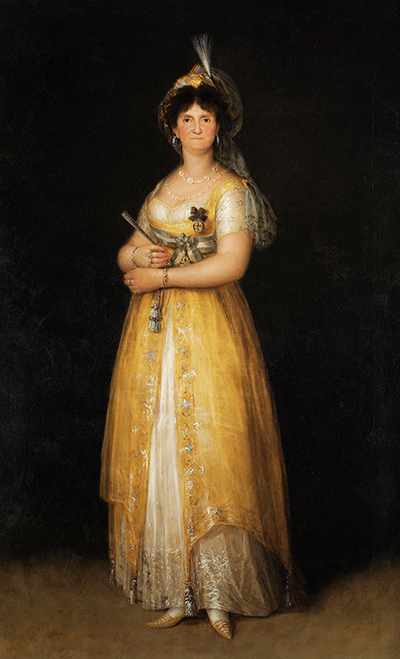
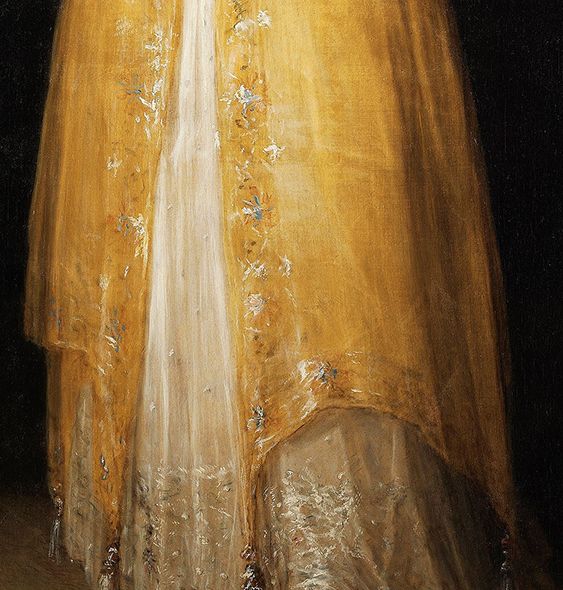
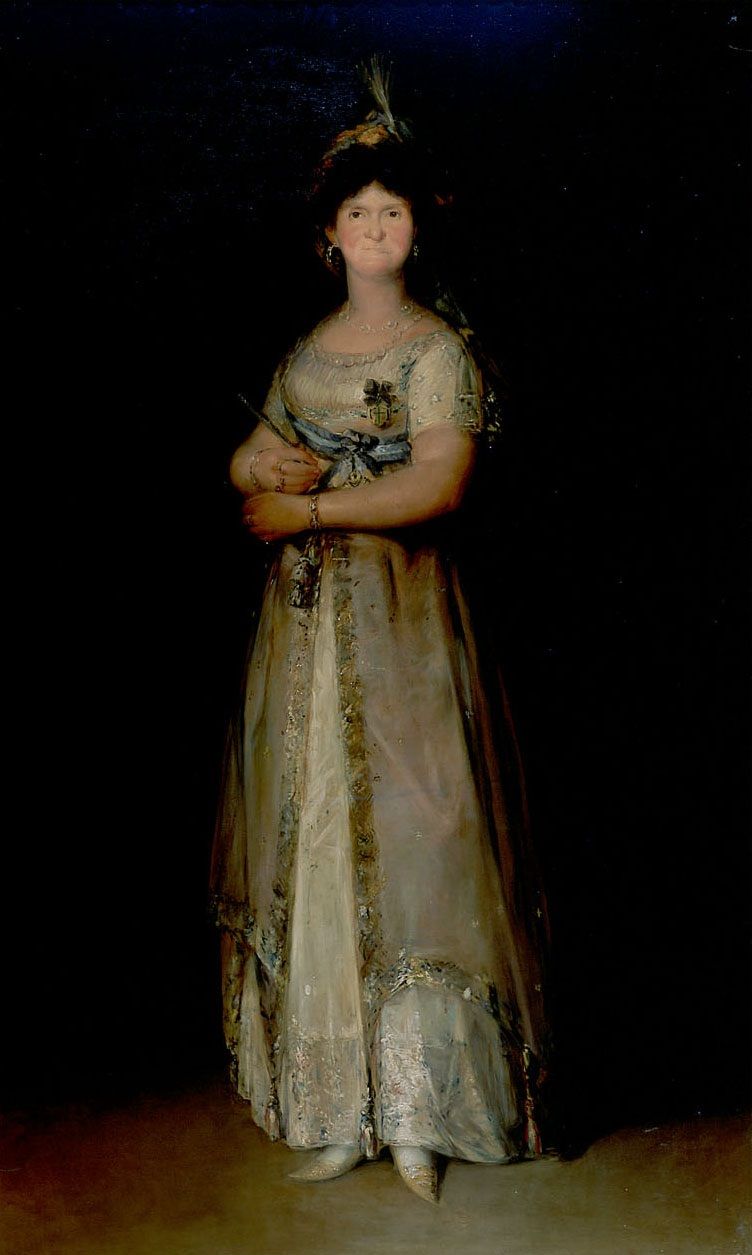
María Luisa of Parma holds a closed fan across her waist. One wrist crosses the other in front of an ochre overdress, open down the centre to show the pale skirt beneath. A feather-shaped ornament rises above her dark curls. At her feet, the tips of two gold-toned slippers emerge at different angles, and a little space opens up between the hem and the brown floor. The plain background leaves each of these details in view. A dark ribbon and an oval decoration sit high on the bodice, where they are easily distinguished from the glints of embroidery. [1] [2]
This is the full-length court-dress portrait in Naples, inventory OA 119. The corresponding portrait by Francisco de Goya in the Spanish Royal Collections has the same pose, the same closed fan and a dark blue overdress. The shift from blue to ochre changes the way the figure meets the background. In the Naples painting, warm colour carries the eye from the shoulder to the hem, with flashes of white between the open edges. The two canvases preserve different versions of the queen’s court clothing within a single design. [1] [2] [3]
At a Glance
- TitlePortrait of María Luisa of Parma in Court Dress, Naples version
- SitterMaría Luisa of Parma (1751–1819), queen consort of Charles IV of Spain
- ArtistAgustín Esteve after Francisco de Goya, according to Capodimonte’s exhibition catalogue. [1]
- DateAbout 1800, following Capodimonte. Goya’s Madrid version is dated 1799. [1] [3]
- Medium and dimensionsOil on canvas, 202 × 124 cm (height × width). [2] [4]
- CollectionMuseo e Real Bosco di Capodimonte, Naples, OA 119. [2] [4]
Works across Goya’s career
The Parasol
1777The Nude Maja
1795–1800Saturn Devouring His Son
c. 1820–23The Dog
c. 1820–23The fan, the sash and two royal orders
The queen’s hands sit where the fabric changes direction. The high waist gathers the pale underdress just below the bust. Beneath it, the front edges of the ochre garment fall in a pair of long curves. The fan makes a short diagonal across that arrangement, its darker sticks taking the eye up towards the shoulder. Her fingers curl around it. Rings and a bracelet catch the light beside it, and a second bracelet crosses the wrist below. The hands occupy only a small part of the picture, but the angles of the fan and the arms give the upper half of the composition much of its shape. [2]
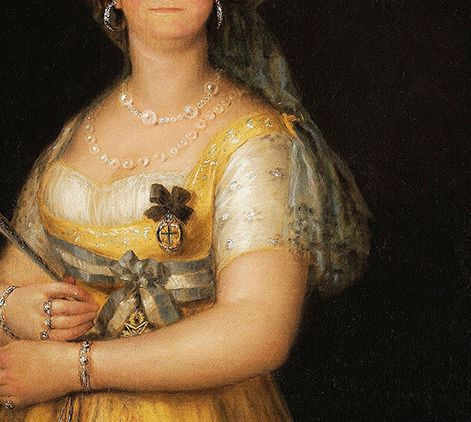
At the breast, the black bow suspends the badge of the Austrian Order of the Starry Cross. A separate distinction belongs to the Spanish court. The sash drawn across her torso bears the insignia of the Royal Order of Noble Ladies of Queen María Luisa. It gathers under the bust, so that it also reads as part of the dress. Look for the dark bow above it, then follow the folds of the sash across the ochre fabric. In the blue-dress portrait the same details appear against cooler colours. The two insignia mark distinct honours even when their ribbons look like elements of the court ensemble. [2] [3]
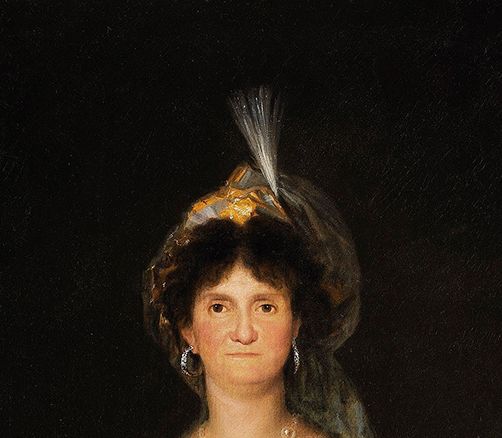
The two rows of pearls follow the curves of the neckline without meeting its embroidered edge. Above them, the head is lit almost straight on. One earring shines against the shadow at the side of her face and the raised ornament is visible well above the mass of the headdress. The concentrated light around the eyes and nose gives the face a firmness distinct from the softer passage where the wrap falls towards the shoulder. Even on a canvas dominated by the gold of the skirt, the pennant-like shape at the top and the reflections around the neck draw the eye back upwards. [2]
Annotated Details from Portrait of María Luisa of Parma
Follow the headdress, the badges of the orders and the fan down to the ochre skirt.
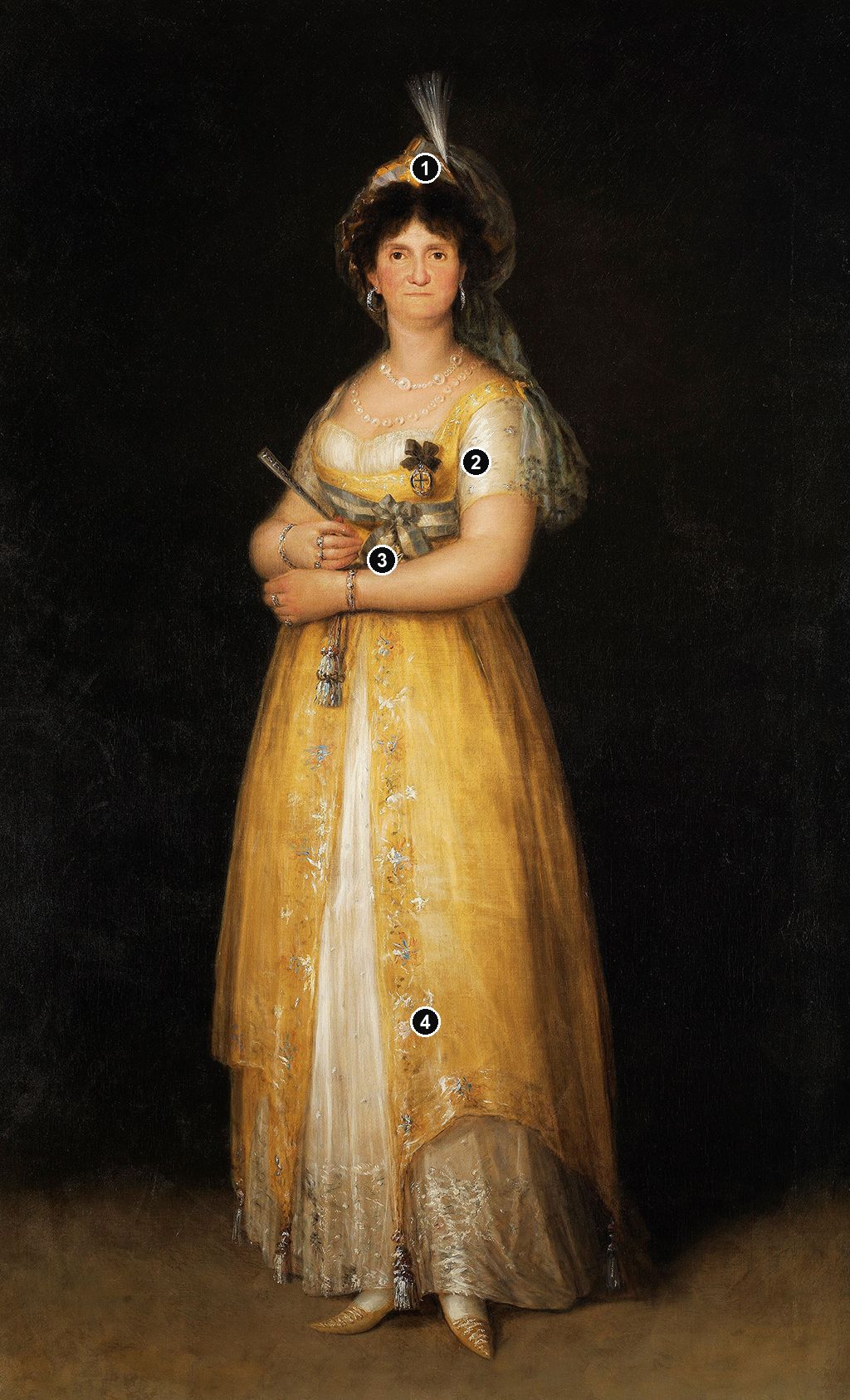
Details from PORTRAIT OF MARÍA LUISA OF PARMA
Details from the Naples portrait (OA 119).
The tall headdress ornament
The pale feather-shaped ornament rises above the sitter’s head.
The badges and sash
A dark bow and badge lie above a pale diagonal sash.
The closed fan
The folded fan crosses the front of the dress above the wrists.
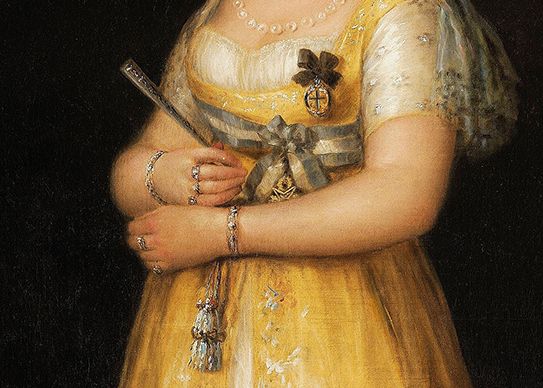
The ochre fabric and pale inset
The skirt opens around a long strip of paler embroidered fabric.
What the wardrobe accounts tell us
The gold outer garment falls over a pale, high-waisted dress with short sleeves. Contemporary French usage called such an open outer layer a tunique de bal. The household records Gimeno Martínez discusses also use the term sultana. In the Naples portrait, the darker sides have broad, almost unbroken colour, while the narrow edges carry light marks like stitching or sequins. At the opening, tassels interrupt the otherwise continuous line of the skirt. The underlying fabric has its own decoration near the floor, visible through and below the ochre layer. [2]
An account paid in March 1799 through the Countess of Trullás records work on an ochre garment and a blue one. Among the materials for the ochre garment were tassels, cord, sequins and lining. Further records specify French satin for both colours, delivered to the embroiderer Josef Nieto. Gimeno Martínez connects the documents to the painted dresses through the combination of colours and trimmings. The account names dressmaker María Manuela Acosta and Nieto. Both taught in schools for girls administered by the Junta de Damas, a board of women attached to the Royal Economic Society of Madrid. The evidence identifies the people who worked on the dresses and shows how French fabric and Spanish dressmaking could meet in a single commission. [2]
María Luisa had followed and ordered French fashions for years. The royal textile curator Pilar Benito García traces handwritten instructions in which the queen, as Princess of Asturias, specified garments for different occasions and asked for current Parisian styles. The palace also employed Spanish tailors and embroiderers. Gimeno Martínez sees the 1799 court portrait as bringing two interests together. In his reading, French fashion signalled an affinity with France, while the dressmakers’ connection to the Junta de Damas signalled support for Spanish manufacture and women’s training. The wardrobe accounts establish who made the clothes. The political meaning he proposes for their appearance in the portrait remains an interpretation. [2] [6]
Goya on film
Five films explore Goya’s portraits, prints, Black Paintings and painting techniques.
The Duke of Wellington by Goya
The portrait, its military decorations and its later theft.
Watch on YouTubeThree portraits in the queen’s letters
In October 1799 the queen wrote to Manuel Godoy about the progress of her likenesses. She said that she had finished sitting for her portrait on horseback after three sessions and that people found it an even closer likeness than the mantilla portrait. She added that the formal portrait would begin the following day. Gimeno Martínez identifies that reference with the Madrid court-dress picture. A later letter expresses her hope that the copies would turn out well. The Galería de las Colecciones Reales considers it likely that Godoy played a part in commissioning the series. This correspondence provides a chronology for the Madrid original and places the production of replicas among the queen’s recorded concerns. [2] [3] [5]
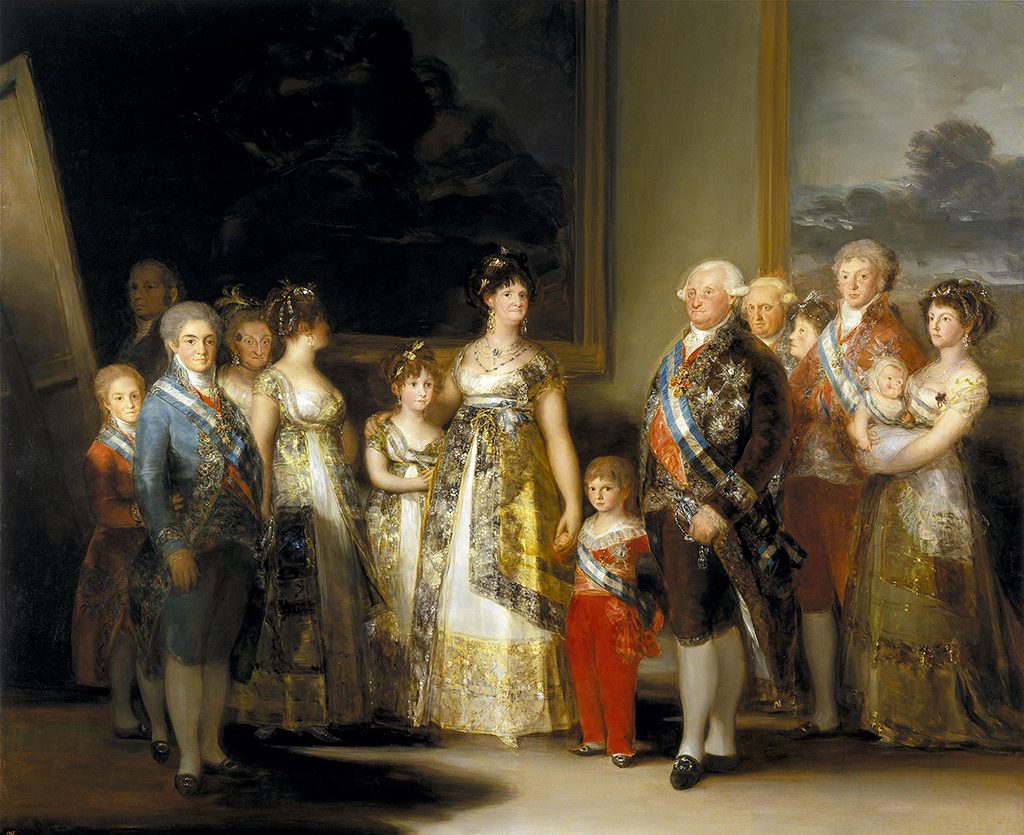
For the mantilla portrait in Patrimonio Nacional, Goya set a black lace veil over the head and shoulders and brought the fan higher, in front of the chest. The Spanish dress has a parallel in the black lace and mantilla of Doña Isabel de Porcel. In the Prado’s equestrian portrait, the queen rides Marcial in the dark uniform of a colonel of the Royal Bodyguard. Her hands take the reins and the hill country opens behind her. In The Family of Charles IV, painted soon afterwards, her two arms connect her to two of her children. Comparing these gestures with the clasped hands and closed fan in the Naples portrait shows how Goya’s designs gave the same sitter a different public role in each setting. [2] [7] [8] [9]
How the portrait reached Naples
Isadora Rose-de Viejo reconstructs two sets of replicas in Godoy’s collection using inventories and correspondence. In her account, the court-dress queen was originally paired with Charles IV in the uniform of a colonel of the Royal Bodyguard. The two were a royal gift to Godoy in 1800. An inventory drawn up after the seizure of his collection identifies the queen by her fan and the king by his uniform. Rose-de Viejo associates that king with the portrait now in the Prado, P000727. She identifies the portrait paired with the queen in the Naples collection as a different likeness of Charles IV, in hunting dress, OA 121. Its original counterpart was the queen in a mantilla. [4] [5] [10]
Ferdinand VII reclaimed the four paintings from Godoy’s confiscated collection in 1815. Rose-de Viejo dates the transfer of the court-dress queen and the king in hunting dress to Naples probably to 1816, around the restoration of the Kingdom of the Two Sicilies. The two canvases that had been their partners stayed in Spain and subsequently went to the Prado. Thus visitors to Naples encounter portraits of the two monarchs together, although the household and seizure records suggest a different arrangement in Godoy’s residence. [1] [4] [5]
Esteve’s own July 1800 bill records that he had made six full-length paintings after Goya’s originals on royal orders. The bill documents the practice of making court replicas at the time. The Naples painting also shows how much latitude a version could have within a repeated design. With the gesture, setting and outline held remarkably close, its ochre fabric records a distinct piece of the queen’s wardrobe. For the recipients of the replicas, the familiar pose could carry a detail that the original in Madrid did not. [2] [5]
Artworks directory
| Name | Date | Medium |
|---|---|---|
| And There’s No Help for It, Plate 15 | Printed 1863 | |
| Asmodea | c. 1820–23 | Wall painting transferred to canvas |
| Boys Inflating a Bladder | 1777–78 | Tapestry cartoon |
| Boys Picking Fruit | 1778 | Tapestry cartoon |
| Bullfight in a Divided Ring | 1825 | Lithograph |
| Card Players | 1777–78 | Tapestry cartoon |
| Card Players (sketch) | 1777–78 | Painted sketch |
| Dance on the Banks of the Manzanares | 1777 | Tapestry cartoon |
| Duel with Cudgels | c. 1820–23 | Wall painting transferred to canvas |
| Heads in a Landscape | c. 1820–23 | Easel painting |
| Judith and Holofernes | c. 1820–23 | Wall painting transferred to canvas |
| Leocadia | c. 1820–23 | Wall painting transferred to canvas |
| Maja and Cloaked Men | 1777 | Tapestry cartoon |
| Maja and Cloaked Men (sketch) | 1777 | Painted sketch |
| Majo Clapping in Time to the Music | 1777 | Drawing |
| Men Reading | c. 1820–23 | Wall painting transferred to canvas |
| Out Hunting for Teeth, Plate 12 | 1799 | Etching, burnished aquatint and burin |
| Picnic in the Countryside (sketch) | 1776–78 | Painted sketch |
| Picnic on the Banks of the Manzanares | 1776 | Tapestry cartoon |
| Pilgrimage to San Isidro | c. 1820–23 | Wall painting transferred to canvas |
| Preparatory study for The Sleep of Reason Produces Monsters | c. 1796–97 | Drawing |
| Procession of the Holy Office | c. 1820–23 | Wall painting transferred to canvas |
| Quarrel at the Cockerel Inn (sketch) | 1777 | Painted sketch |
| Quarrel in the New Tavern | 1777 | Tapestry cartoon |
| Saturn Devouring His Son | c. 1820–23 | Wall painting transferred to canvas |
| Seated Majo Smoking | c. 1776 | Drawing |
| The Dog | c. 1820–23 | Wall painting transferred to canvas |
| The Drinker | 1777 | Tapestry cartoon |
| The Fates | c. 1820–23 | Wall painting transferred to canvas |
| The Great He-Goat | c. 1820–23 | Wall painting transferred to canvas |
| The Kite | 1777–78 | Tapestry cartoon |
| The Parasol | 1777 | Oil on canvas, tapestry cartoon |
| The Second of May 1808 | 1814 | Oil on canvas |
| The Sleep of Reason Produces Monsters, Plate 43 | 1799 | Etching and aquatint |
| The Third of May 1808 | 1814 | Oil on canvas |
| Thou Who Canst Not, Plate 42 | 1799 | Etching and burnished aquatint |
| Three Figures | 1776 | Drawing (lost) |
| Two Old Men | c. 1820–23 | Wall painting transferred to canvas |
| Two Old Men Eating Soup | c. 1820–23 | Wall painting transferred to canvas |
| Two Women and a Man | c. 1820–23 | Wall painting transferred to canvas |
| Universal Language: The Author Dreaming | 1797 | Drawing |
| The Family of Charles IV | 1800 | Oil on canvas |
| Witches’ Sabbath (Osuna painting) | 1797–98 | Oil on canvas |
| The Nude Maja | 1795–1800 | Oil on canvas |
| The Clothed Maja | 1800–07 | Oil on canvas |
| Self-Portrait (Drawing) | c. 1796 | Brush and carbon black ink on laid paper |
| The Swing, Madrid Album B.21 | 1795–97 | Brush and carbon black washes |
| Majas Fighting, a Majo Observing, Madrid Album B.15 | 1796–97 | Brush, grey and black washes on laid paper |
| Majos and Majas Conversing, Madrid Album B.16 | c. 1794–97 | Ink wash on paper |
| Weeping Woman and Three Men, Madrid Album B.17 | 1795–97 | Brush, carbon black washes and black chalk |
| Maja Seated on a Chair and Two Companions Behind, Madrid Album B.18 | 1795–97 | Brush and carbon black washes |
| Girl and Bull, Madrid Album B.23 | 1796–97 | Brush and carbon black washes |
| Lovers Sitting on a Rock, Madrid Album B.24 | 1796–97 | Brush and carbon black washes |
| Mariano Ceballos Riding a Bull | 1825 | Crayon lithograph and scraper |
| Landscape (lifetime impression) | c. 1807–10 | Etching and aquatint |
| Self-Portrait (1815), Prado canvas | 1815 | Oil on canvas |
| Self-Portrait (1815), Academy panel | 1815 | Oil on panel |
| Self-Portrait with Dr Arrieta | 1820 | Oil on canvas |
| Christ Crucified | 1780 | Oil on canvas |
| The Last Communion of Saint Joseph of Calasanz | 1819 | Oil on canvas |
| Christ on the Mount of Olives | 1819 | Oil on panel |
| The Flower Girls, or Spring | 1786–87 | Oil on canvas |
| The Grape Harvest, or Autumn | 1786–87 | Oil on canvas |
| The Snowstorm, or Winter | 1786–87 | Oil on canvas |
| The Threshing Ground, or Summer | 1786–87 | Oil on canvas |
| Picnic on the Banks of the Manzanares | 1776 | Oil on canvas |
| The Kite | 1777–78 | Oil on canvas |
| Dance on the Banks of the Manzanares | 1777 | Oil on canvas |
| A Fight at the Venta Nueva | 1777 | Oil on canvas |
| Blind Man’s Bluff | 1788 | Oil on canvas |
| Dogs on a Lead | 1775 | Oil on canvas |
| Hunting with a Decoy | 1775 | Oil on canvas |
| Hunter Loading His Rifle | 1775 | Oil on canvas |
| The Angler | 1775 | Oil on canvas |
| The Hermitage of San Isidro on His Feast Day | 1788 | Oil on canvas |
| The Meadow of San Isidro | 1788 | Oil on canvas |
| The Straw Manikin | 1791–92 | Oil on canvas |
| Witches’ Flight | c. 1797–98 | Oil on canvas |
| A Scene from ‘The Forcibly Bewitched’ | 1798 | Oil on canvas |
| The Duchess of Alba in Black | 1797 | Oil on canvas |
| The Duchess of Alba in White | 1795 | Oil on canvas |
| Charles III in Hunting Dress | c. 1786 | Oil on canvas |
| The Duke and Duchess of Osuna and Their Children | 1787–88 | Oil on canvas |
| Manuel Osorio Manrique de Zúñiga | 1787–88 | Oil on canvas |
| The Marquesa de Pontejos | c. 1786 | Oil on canvas |
| Equestrian Portrait of the 1st Duke of Wellington | 1812 | Oil on canvas |
| The Duke of Wellington | 1812–14 | Oil on wood |
| Portrait of Ferdinand VII of Spain | 1814 | Oil on canvas |
| Gaspar Melchor de Jovellanos | 1798 | Oil on canvas |
| María Tomasa Palafox y Portocarrero | 1804 | Oil on canvas |
| Señora Sabasa García | c. 1806–11 | Oil on canvas |
| Don Juan Bautista de Muguiro | 1827 | Oil on canvas |
| Doña Isabel de Porcel | Before 1805 | Oil on canvas |
| The Colossus | After 1808 | Oil on canvas |
| The Burial of the Sardine | 1808–12 | Oil on panel |
| The Madhouse | 1808–12 | Oil on panel |
| A Procession of Flagellants | 1808–12 | Oil on panel |
| Portrait of Jacques Galos | 1826 | Oil on canvas |
| Portrait of Mariano Goya, the Artist’s Grandson | 1827 | Oil on canvas |
| Milkmaid of Bordeaux | c. 1827 | Oil on canvas |
| Portrait of Don Juan Antonio Cuervo | 1819 | Oil on canvas |
| María Luisa of Parma (Naples version) | c. 1800 | Oil on canvas |
| The Countess of Baena | 1819 | Oil on canvas |
| The Family of the Infante Don Luis | 1783–84 | Oil on canvas |
| The Holy Family | c. 1787 | Oil on canvas |
| Saint Barbara | c. 1773 | Oil on canvas |
| Saints Justa and Rufina | 1817 | Oil on canvas |
| El Tío Paquete | c. 1819–20 | Oil on canvas |
| The Forge | c. 1815–20 | Oil on canvas |
| Majas on a Balcony (Metropolitan Museum version) | c. 1800–10 | Oil on canvas |
| Maja and Celestina on a Balcony | c. 1808–12 | Oil on canvas |
| The Water Bearer | 1808–12 | Oil on canvas |
| Time and the Old Women | c. 1810 | Oil on canvas |
Frequently Asked Questions
Rose-de Viejo’s catalogue pairs the Naples queen originally with the uniformed king now at the Prado. She dates the pairing with the hunting portrait to the transfer of the two paintings to Naples, probably in 1816. [5]
Discussion
Look again at the images and ideas explored in Portrait of María Luisa of Parma. These editorial prompts invite your observations.
Compare the two court-dress portraits from the feather-shaped ornament down to the shoes. Where does the change from blue to ochre draw your attention first? Which details of the queen’s pose or insignia carry across most clearly?
Reader Insights
Look at how the court orders cross the dress.
How does the change in colour affect the two versions?
Join the Conversation
Share a detail, comparison or question about Portrait of María Luisa of Parma below.
References
- Museo e Real Bosco di Capodimonte, Napoli Napoli. Di lava, porcellana e musica, 2019–20 exhibition press packet, checklist for the room “Miseria e nobiltà”. View source.
- Javier Gimeno Martínez, ‘La moda política. Un análisis del Retrato de María Luisa de Parma en traje de corte (1799) de Francisco de Goya’, Archivo Español de Arte 98, no. 391, article 1501, especially figs. 1–2 and pp. 8–10. View source.
- Galería de las Colecciones Reales, Patrimonio Nacional, Retrato de María Luisa de Parma en traje de corte, collection record 10002936. View source.
- Museo Bodoniano, Spagna e l’ambiente spagnolo a Roma, exhibition catalogue, entries 168–169, Capodimonte OA 121 and OA 119. View source.
- Isadora Rose-de Viejo, Catálogo actualizado de la colección de Manuel Godoy, 2021, entries CA 236–239, with transcriptions from the Archivo General de Palacio and early inventories. View source.
- Pilar Benito García, ‘Marie-Louise de Parme, reine d’Espagne habillée à la française (1751–1819)’, in Isabelle Paresys and Natacha Coquery (eds.), Se vêtir à la cour en Europe 1400–1815, 2011, pp. 213–228. View source.
- Fundación Goya en Aragón, María Luisa de Parma with Mantilla, catalogue entry 446, Patrimonio Nacional 10002935. View source.
- Fundación Goya en Aragón, Queen María Luisa on Horseback, catalogue entry 384, Museo Nacional del Prado P000720. View source.
- Museo Nacional del Prado and National Gallery of Art, Goya: Images of Women, 2002 exhibition catalogue, especially entries for Queen María Luisa and The Family of Charles IV. View source.
- Museo Nacional del Prado, Agustín Esteve after Goya, Charles IV in the Uniform of a Colonel of the Royal Guard, collection record P000727. View source.







