


 by Tom Gurney
Tom Gurney BSc (Hons) is an art history expert with over 20 years experience
Published on June 19, 2020 / Updated on November 20, 2026
Email: tomgurney1@gmail.com / Phone: +44 7429 011000
Introduction
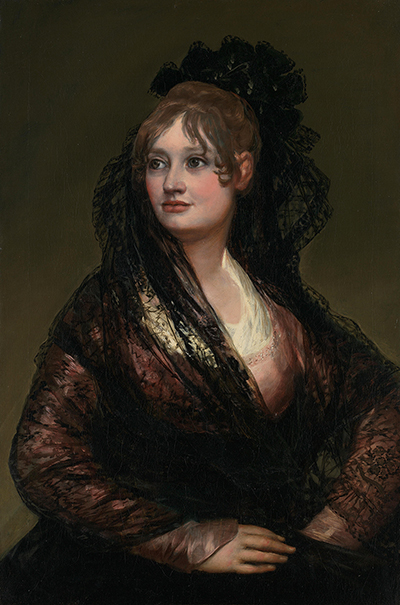
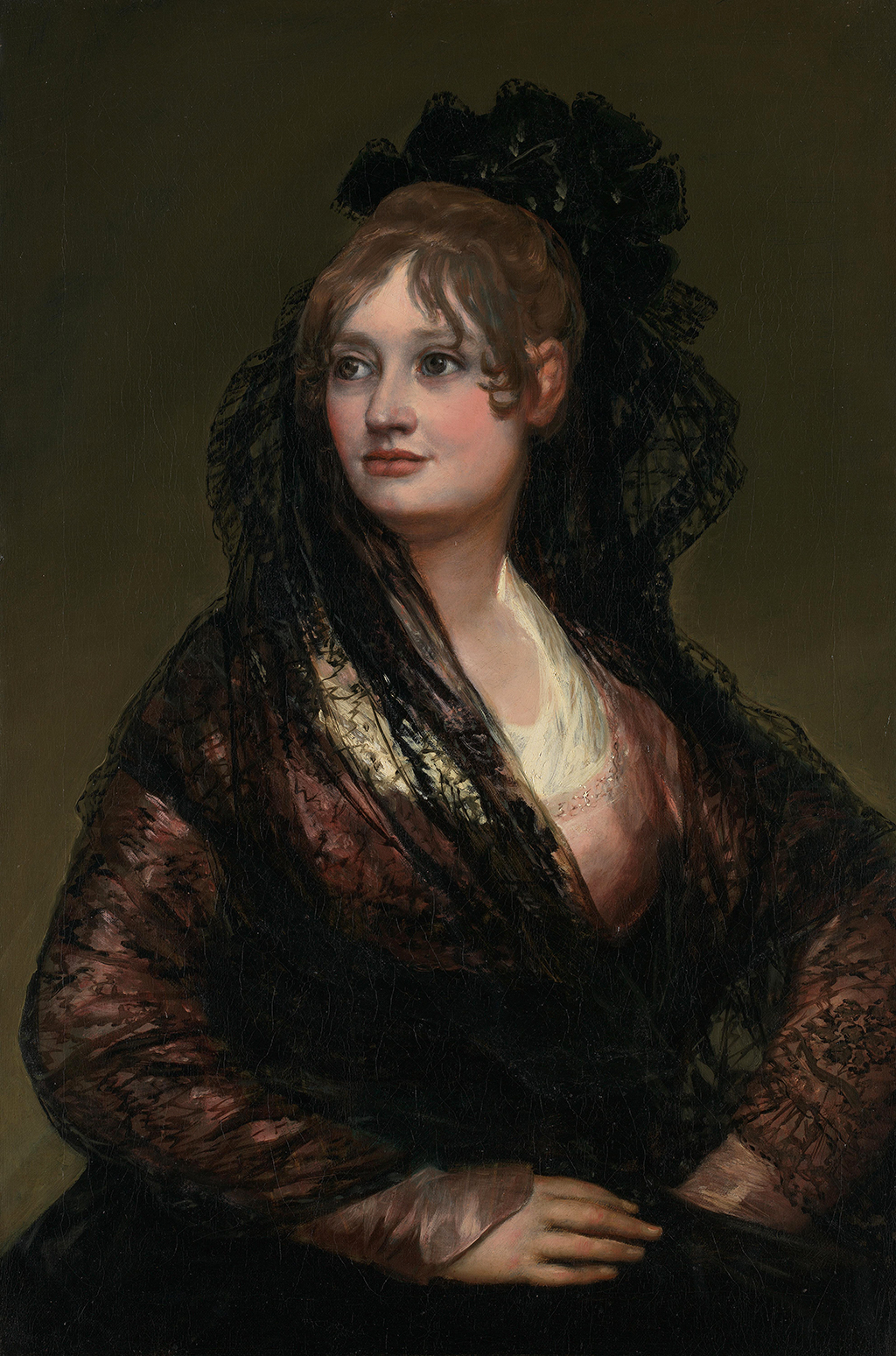
Doña Isabel de Porcel has turned her head towards something beyond the left edge of the canvas. Her hand lies low across the gathered black lace, almost as still as the dark background, while the light catches her cheek and the pale cloth at her throat. Look closely at her chin and there is a second, faint curve. The National Gallery identifies it as part of an eyebrow from the portrait underneath. The woman in the mantilla is the image the painter meant us to see, but the canvas has carried two faces since the second was painted over the first. [1] [2]
At a Glance
- ArtistThe National Gallery lists ‘Francisco de Goya’. Its collection text records doubts about the attribution, discussed in a dedicated display in 2015–16. [1] [3]
- Title and sitterThe Gallery’s full title is Doña Isabel de Porcel. Its collection text reads, ‘The sitter is Doña Isabel de Porcel, according to an inscription on the back of the original canvas.’ The Gallery’s September 2015 account uses the full name Doña Isabel Lobo de Porcel. [1] [4]
- DateBefore 1805, according to the National Gallery. [1]
- Medium and dimensionsOil on canvas, 82 × 54.6 cm (height × width). [1]
- CollectionNational Gallery, London, NG1473. Bought in 1896. [1]
Works across Goya’s career
The Parasol
1777The Nude Maja
1795–1800Doña Isabel de Porcel
Before 1805Saturn Devouring His Son
c. 1820–23The Dog
c. 1820–23A turn of the head
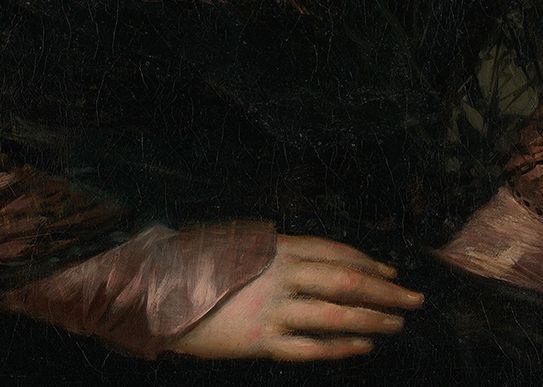
The sitter fills almost the entire width of the canvas at the level of her elbows. Above them the figure narrows quickly, leaving a strip of olive-grey space between the lace and the left edge. Her eyes travel across that space. The body, face and eyes each turn by a different amount, so the movement continues even though the hand has come to rest. The face is high in the frame and the fingers are close to the lower edge. Between them the edge of the mantilla crosses the brighter neckline at a steep diagonal. That line gives the eye a way back down through a portrait whose gaze points out of it. [1]
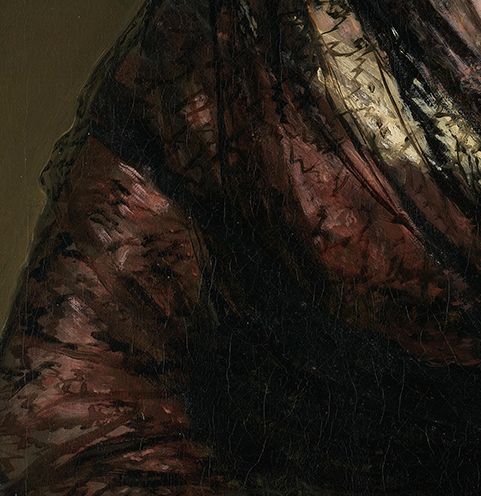
The lace falls from a comb decorated with a rosette of ribbons, called a caramba. High above the forehead the dark ribbon loops overlap in a compact mass. Beside the sitter’s ear, the lace spreads thinly enough to let the background show through. The same fabric has a different effect over the pale cloth at the neckline, where the black pattern breaks into short, jagged strokes. Follow the pattern still lower and it opens across the pink sleeve. At the waist it becomes much harder to pick out the design as the folds gather. Much of the sense of transparency comes from the changing brightness of the areas beneath the lace. [1]
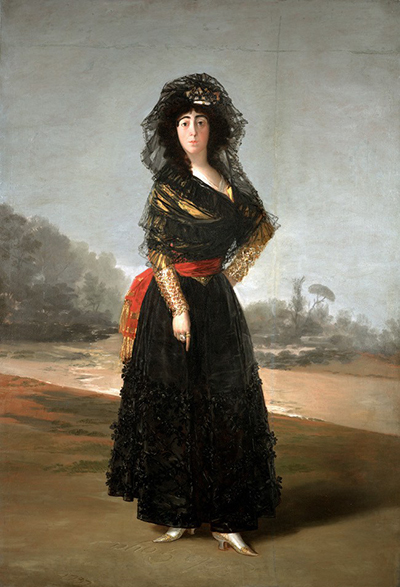
The mantilla belonged to a style of dress associated with majas, women of lower social rank whose clothes became fashionable among the Spanish aristocracy and royalty. It is worth looking at how the costume works in Goya’s 1797 portrait of the Duchess of Alba, now in the Hispanic Society’s collection in New York. The duchess stands outdoors and directs our attention downwards with a pointed finger. Her black lace belongs to a full-length silhouette that can be read from the head all the way to the ground. Here the black lace frames a much nearer face, then spreads across the sleeves and partly hides one hand. The smaller canvas has room for the folds and textures to register at close range. [1] [5] [6]
Annotated Details from Doña Isabel de Porcel
Follow the sitter’s glance, the lace and the hands at the waist.
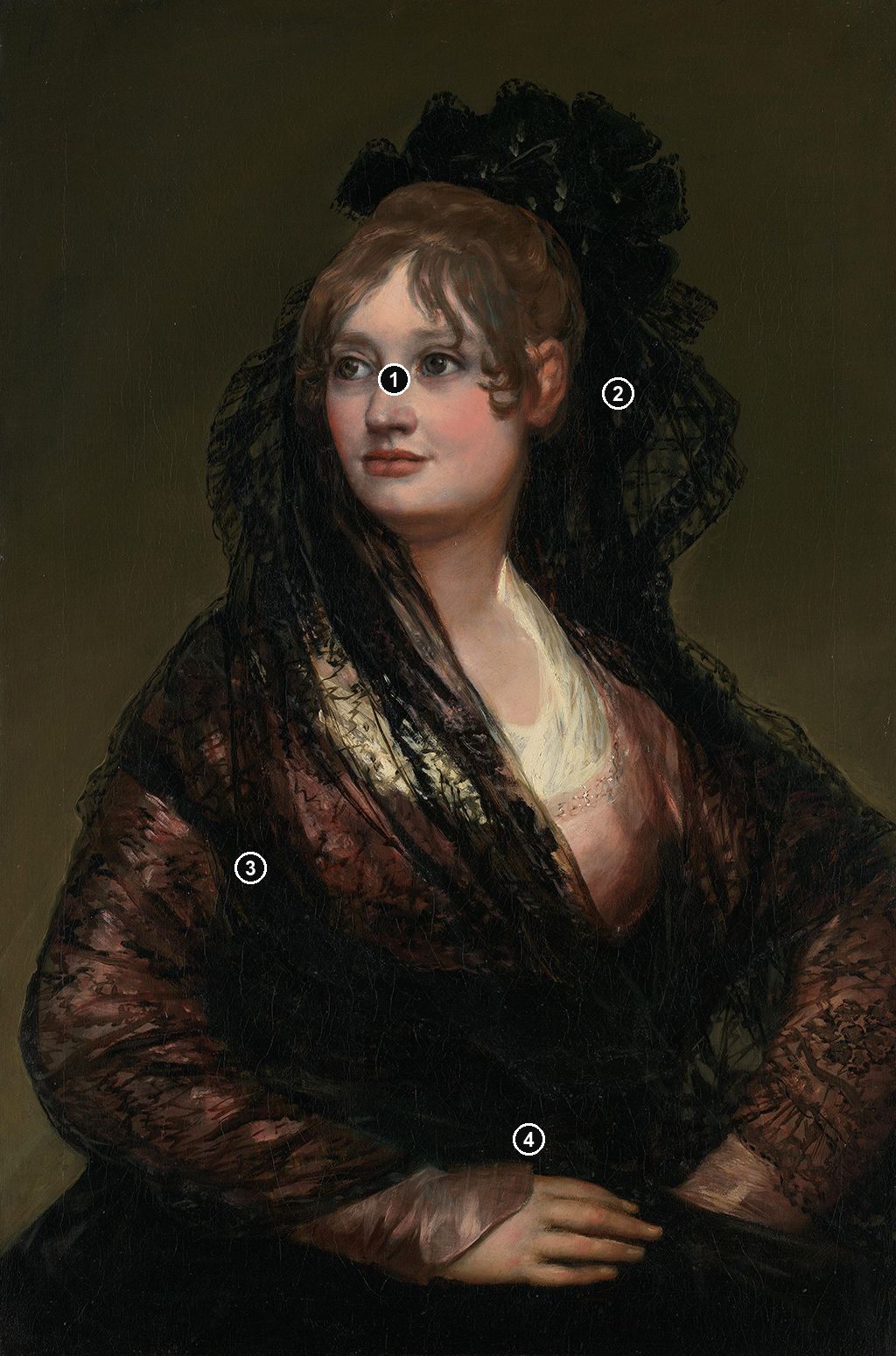
Details from DOÑA ISABEL DE PORCEL
Details from the National Gallery painting (NG1473).
The eyes and the turn
The sitter’s gaze moves towards the left of the picture.
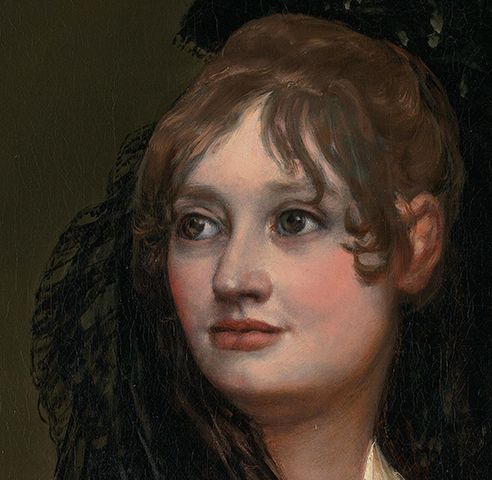
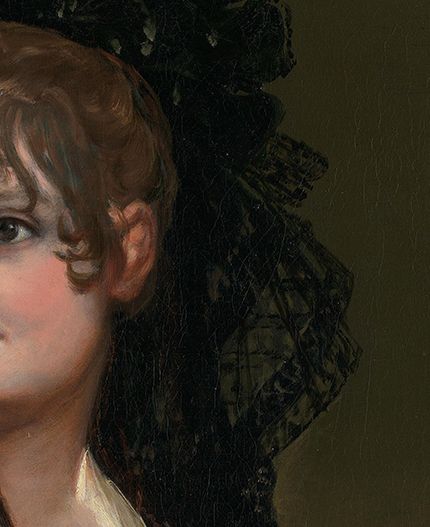
Lace beside the face
The dark mantilla changes in density around the cheek and ear.
Lace over the sleeve
Loose dark marks cross the pink fabric at the arm.
Hands at the waist
An illuminated hand lies across the dark clothes below the lace.
The name on the back
The sitter’s name survives on the reverse of the original canvas. In the conservation treatment reported by Martin Wyld in 1981, the removal of a secondary canvas exposed a handwritten inscription naming Isabel Lobo de Porcel and crediting Goya. The secondary canvas also bore an inscription, where Wyld reads the surname as ‘Cobos’. The two inscriptions explain how another spelling entered accounts of the picture. Wyld reproduces the back of the original canvas after the glue was removed, so the location of the surviving inscription can be checked against the photograph. The Gallery’s current short title uses the form Doña Isabel de Porcel. [1] [2] [4]
Isabel married Antonio Porcel in 1802. Antonio was a government official with responsibilities for Spain’s American colonies and a political associate of Gaspar Melchor de Jovellanos, whose portrait Goya painted in 1798. The record of the Royal Academy of Fine Arts of San Fernando establishes that Goya exhibited a portrait of Isabel in Madrid in 1805. The National Gallery’s provenance entry says its canvas was presumably the one exhibited. The inscription and the history of ownership explain that identification, but there is room for uncertainty about whether the record and surviving picture refer to the same object. The date ‘Before 1805’ is the Gallery’s catalogue dating. [1] [4] [7]
Goya painted Antonio in 1806. The two portraits appear to have stayed in the Porcel family until around 1887, but their shared family history offers stronger grounds for linking them than their physical formats. Antonio’s portrait was painted on a panel of different dimensions and was destroyed in a fire at the Jockey Club in Buenos Aires in 1953. Isabel’s portrait passed through the Urzáiz family before the National Gallery bought it in June 1896. It was the first portrait the Gallery acquired under Goya’s name. [1] [4]
Goya on film
Five films explore Goya’s portraits, prints, Black Paintings and painting techniques.
The Duke of Wellington by Goya
The portrait, its military decorations and its later theft.
Watch on YouTubeThe man in the striped coat
The reason for taking the picture off its stretcher in 1980 was visible on the surface. The varnish had yellowed enough to change the appearance of the skin and black lace. Paint along the cracks was also lifting, and the cracks ran through both portraits into the red ochre ground. The Gallery cleaned and relined the canvas. Wyld’s colour plate shows the picture after treatment. [2]
The conservators took the first X-radiographs during that treatment. They revealed a well-advanced portrait of a man wearing a waistcoat and striped jacket. The print in the 1981 Technical Bulletin shows how much of the figure had already been laid in. Its brow falls at the level of Isabel’s chin in the finished portrait. The jacket stripes lie beneath her right sleeve, on the viewer’s left. Once you know where to look, the printed radiograph and infrared detail let you see why a stray dark curve or a vertical line in the upper picture can belong to something quite different underneath. [1] [2]
A sample in cross-section allows conservators to inspect the layers of paint edge on. Wyld found the upper portrait applied directly over the lower one, with neither a new priming layer nor intervening dirt or varnish. The Gallery takes the absence of dirt as evidence that the canvas was painted over fairly soon, and the absence of varnish as a reason to think the earlier picture probably stayed in the studio. The physical sequence gives a firmer answer about the order of the two portraits than about the circumstances that led someone to cover the first one. [1] [2] [3]
In 2015 the Gallery used a scanning X-ray fluorescence instrument made available through collaboration with Delft University of Technology. This time the researchers could map particular chemical elements across the picture. When they combined maps of lead, iron and antimony and interpreted them in relation to the pigments present, they could make out the man’s blue coat with yellow stripes and his yellow waistcoat. The fashion led the Gallery’s researchers to place his clothes in the last decade of the eighteenth century. The composite map helps reconstruct the costume, while the man’s identity remains unknown. The colours in the published composite indicate the distribution of selected paint materials. The original coat colours are an interpretation of those maps. [2] [8]
How the attribution came into question
From 7 October 2015 to 10 January 2016 the National Gallery put the picture at the centre of A Question of Attribution in Room 1. The display ran alongside Goya: The Portraits in the Sainsbury Wing. The larger exhibition gave visitors a range of Goya portraits to compare with the work in Room 1. Some scholars questioned whether the bold handling of the lace and the treatment of textures had the subtlety they found in his accepted paintings. The Gallery’s introduction to the picture also admires the way the lace is made to look transparent. Those judgements can coexist. The sleeve can look convincing at a distance, while at close quarters the little black marks have a bluntness an individual viewer might find striking. [1] [3] [4] [9]
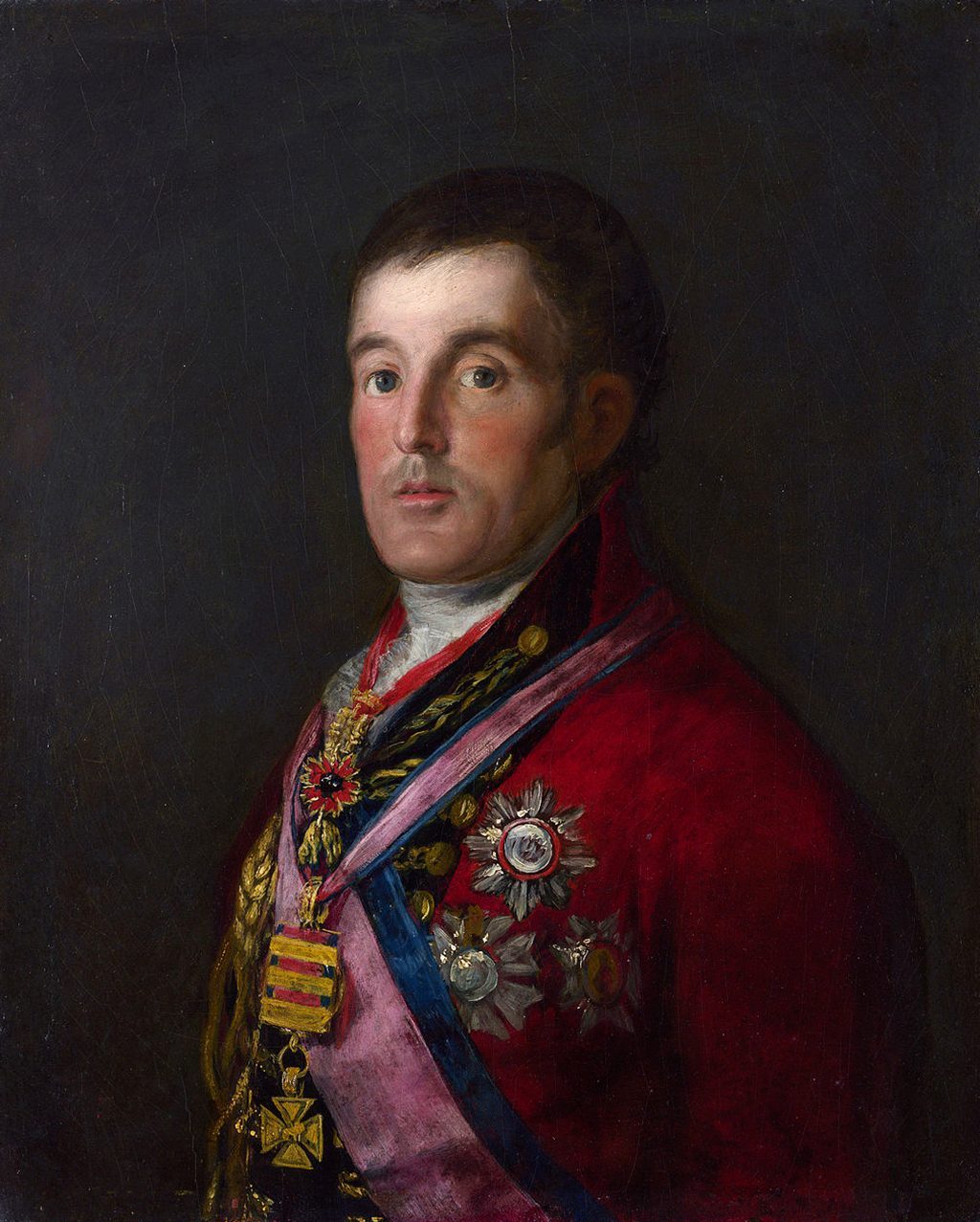
A comparison from the same collection is The Duke of Wellington. Both paintings bring the figure near the picture plane, but Wellington looks towards us and his uniform identifies his public role. Technical examination found repeated changes to his pose and decorations, alongside alterations associated with honours he received after his first sitting. In Isabel’s portrait the evidence is of a different kind. Her figure covers another sitter altogether. The reuse of the support is compatible with Goya’s practice and was also available to other painters. The Gallery’s review of the display and its technical work describes the evidence for authorship as inconclusive. Its current catalogue retains Goya’s name and records the doubts alongside it. [1] [3] [8] [10]
Artworks directory
| Name | Date | Medium |
|---|---|---|
| And There’s No Help for It, Plate 15 | Printed 1863 | |
| Asmodea | c. 1820–23 | Wall painting transferred to canvas |
| Boys Inflating a Bladder | 1777–78 | Tapestry cartoon |
| Boys Picking Fruit | 1778 | Tapestry cartoon |
| Bullfight in a Divided Ring | 1825 | Lithograph |
| Card Players | 1777–78 | Tapestry cartoon |
| Card Players (sketch) | 1777–78 | Painted sketch |
| Dance on the Banks of the Manzanares | 1777 | Tapestry cartoon |
| Duel with Cudgels | c. 1820–23 | Wall painting transferred to canvas |
| Heads in a Landscape | c. 1820–23 | Easel painting |
| Judith and Holofernes | c. 1820–23 | Wall painting transferred to canvas |
| Leocadia | c. 1820–23 | Wall painting transferred to canvas |
| Maja and Cloaked Men | 1777 | Tapestry cartoon |
| Maja and Cloaked Men (sketch) | 1777 | Painted sketch |
| Majo Clapping in Time to the Music | 1777 | Drawing |
| Men Reading | c. 1820–23 | Wall painting transferred to canvas |
| Out Hunting for Teeth, Plate 12 | 1799 | Etching, burnished aquatint and burin |
| Picnic in the Countryside (sketch) | 1776–78 | Painted sketch |
| Picnic on the Banks of the Manzanares | 1776 | Tapestry cartoon |
| Pilgrimage to San Isidro | c. 1820–23 | Wall painting transferred to canvas |
| Preparatory study for The Sleep of Reason Produces Monsters | c. 1796–97 | Drawing |
| Procession of the Holy Office | c. 1820–23 | Wall painting transferred to canvas |
| Quarrel at the Cockerel Inn (sketch) | 1777 | Painted sketch |
| Quarrel in the New Tavern | 1777 | Tapestry cartoon |
| Saturn Devouring His Son | c. 1820–23 | Wall painting transferred to canvas |
| Seated Majo Smoking | c. 1776 | Drawing |
| The Dog | c. 1820–23 | Wall painting transferred to canvas |
| The Drinker | 1777 | Tapestry cartoon |
| The Fates | c. 1820–23 | Wall painting transferred to canvas |
| The Great He-Goat | c. 1820–23 | Wall painting transferred to canvas |
| The Kite | 1777–78 | Tapestry cartoon |
| The Parasol | 1777 | Oil on canvas, tapestry cartoon |
| The Second of May 1808 | 1814 | Oil on canvas |
| The Sleep of Reason Produces Monsters, Plate 43 | 1799 | Etching and aquatint |
| The Third of May 1808 | 1814 | Oil on canvas |
| Thou Who Canst Not, Plate 42 | 1799 | Etching and burnished aquatint |
| Three Figures | 1776 | Drawing (lost) |
| Two Old Men | c. 1820–23 | Wall painting transferred to canvas |
| Two Old Men Eating Soup | c. 1820–23 | Wall painting transferred to canvas |
| Two Women and a Man | c. 1820–23 | Wall painting transferred to canvas |
| Universal Language: The Author Dreaming | 1797 | Drawing |
| The Family of Charles IV | 1800 | Oil on canvas |
| Witches’ Sabbath (Osuna painting) | 1797–98 | Oil on canvas |
| The Nude Maja | 1795–1800 | Oil on canvas |
| The Clothed Maja | 1800–07 | Oil on canvas |
| Self-Portrait (Drawing) | c. 1796 | Brush and carbon black ink on laid paper |
| The Swing, Madrid Album B.21 | 1795–97 | Brush and carbon black washes |
| Majas Fighting, a Majo Observing, Madrid Album B.15 | 1796–97 | Brush, grey and black washes on laid paper |
| Majos and Majas Conversing, Madrid Album B.16 | c. 1794–97 | Ink wash on paper |
| Weeping Woman and Three Men, Madrid Album B.17 | 1795–97 | Brush, carbon black washes and black chalk |
| Maja Seated on a Chair and Two Companions Behind, Madrid Album B.18 | 1795–97 | Brush and carbon black washes |
| Girl and Bull, Madrid Album B.23 | 1796–97 | Brush and carbon black washes |
| Lovers Sitting on a Rock, Madrid Album B.24 | 1796–97 | Brush and carbon black washes |
| Mariano Ceballos Riding a Bull | 1825 | Crayon lithograph and scraper |
| Landscape (lifetime impression) | c. 1807–10 | Etching and aquatint |
| Self-Portrait (1815), Prado canvas | 1815 | Oil on canvas |
| Self-Portrait (1815), Academy panel | 1815 | Oil on panel |
| Self-Portrait with Dr Arrieta | 1820 | Oil on canvas |
| Christ Crucified | 1780 | Oil on canvas |
| The Last Communion of Saint Joseph of Calasanz | 1819 | Oil on canvas |
| Christ on the Mount of Olives | 1819 | Oil on panel |
| The Flower Girls, or Spring | 1786–87 | Oil on canvas |
| The Grape Harvest, or Autumn | 1786–87 | Oil on canvas |
| The Snowstorm, or Winter | 1786–87 | Oil on canvas |
| The Threshing Ground, or Summer | 1786–87 | Oil on canvas |
| Picnic on the Banks of the Manzanares | 1776 | Oil on canvas |
| The Kite | 1777–78 | Oil on canvas |
| Dance on the Banks of the Manzanares | 1777 | Oil on canvas |
| A Fight at the Venta Nueva | 1777 | Oil on canvas |
| Blind Man’s Bluff | 1788 | Oil on canvas |
| Dogs on a Lead | 1775 | Oil on canvas |
| Hunting with a Decoy | 1775 | Oil on canvas |
| Hunter Loading His Rifle | 1775 | Oil on canvas |
| The Angler | 1775 | Oil on canvas |
| The Hermitage of San Isidro on His Feast Day | 1788 | Oil on canvas |
| The Meadow of San Isidro | 1788 | Oil on canvas |
| The Straw Manikin | 1791–92 | Oil on canvas |
| Witches’ Flight | c. 1797–98 | Oil on canvas |
| A Scene from ‘The Forcibly Bewitched’ | 1798 | Oil on canvas |
| The Duchess of Alba in Black | 1797 | Oil on canvas |
| The Duchess of Alba in White | 1795 | Oil on canvas |
| Charles III in Hunting Dress | c. 1786 | Oil on canvas |
| The Duke and Duchess of Osuna and Their Children | 1787–88 | Oil on canvas |
| Manuel Osorio Manrique de Zúñiga | 1787–88 | Oil on canvas |
| The Marquesa de Pontejos | c. 1786 | Oil on canvas |
| Equestrian Portrait of the 1st Duke of Wellington | 1812 | Oil on canvas |
| The Duke of Wellington | 1812–14 | Oil on wood |
| Portrait of Ferdinand VII of Spain | 1814 | Oil on canvas |
| Gaspar Melchor de Jovellanos | 1798 | Oil on canvas |
| María Tomasa Palafox y Portocarrero | 1804 | Oil on canvas |
| Señora Sabasa García | c. 1806–11 | Oil on canvas |
| Don Juan Bautista de Muguiro | 1827 | Oil on canvas |
| Doña Isabel de Porcel | Before 1805 | Oil on canvas |
| The Colossus | After 1808 | Oil on canvas |
| The Burial of the Sardine | 1808–12 | Oil on panel |
| The Madhouse | 1808–12 | Oil on panel |
| A Procession of Flagellants | 1808–12 | Oil on panel |
| Portrait of Jacques Galos | 1826 | Oil on canvas |
| Portrait of Mariano Goya, the Artist’s Grandson | 1827 | Oil on canvas |
| Milkmaid of Bordeaux | c. 1827 | Oil on canvas |
| Portrait of Don Juan Antonio Cuervo | 1819 | Oil on canvas |
| María Luisa of Parma (Naples version) | c. 1800 | Oil on canvas |
| The Countess of Baena | 1819 | Oil on canvas |
| The Family of the Infante Don Luis | 1783–84 | Oil on canvas |
| The Holy Family | c. 1787 | Oil on canvas |
| Saint Barbara | c. 1773 | Oil on canvas |
| Saints Justa and Rufina | 1817 | Oil on canvas |
| El Tío Paquete | c. 1819–20 | Oil on canvas |
| The Forge | c. 1815–20 | Oil on canvas |
| Majas on a Balcony (Metropolitan Museum version) | c. 1800–10 | Oil on canvas |
| Maja and Celestina on a Balcony | c. 1808–12 | Oil on canvas |
| The Water Bearer | 1808–12 | Oil on canvas |
| Time and the Old Women | c. 1810 | Oil on canvas |
Frequently Asked Questions
It belongs to the National Gallery in London, inventory number NG1473. The Gallery dates the oil painting to before 1805 and lists its dimensions as 82 × 54.6 cm. [1]
Discussion
Look again at the images and ideas explored in Portrait of Doña Isabel de Porcel. These editorial prompts invite your observations.
Follow the edge of the mantilla from the ribbon above the sitter’s head to the hand at her waist. Where does the lace look most transparent? Compare Isabel’s right sleeve, on the left of the picture, with the X-radiograph in Wyld’s study. Which lines still read as folds in the finished portrait once you know where the earlier coat crosses them? [2]
Reader Insights
Where does the lace change from fine lines to broad patches?
How does the turned head affect your reading of the portrait?
Join the Conversation
Share a detail, comparison or question about Portrait of Doña Isabel de Porcel below.
References
- National Gallery, London, Doña Isabel de Porcel, collection record NG1473, consulted 15 November 2026. View source.
- Martin Wyld, ‘Goya’s Re-use of a Canvas for “Doña Isabel”’, National Gallery Technical Bulletin 5 (1981), pp. 38–43. Figs. 2–3 reproduce the X-radiograph and infrared detail. Figs. 4–5 show the inscriptions. View source.
- National Gallery, London, Goya’s Portrait of Doña Isabel de Porcel: A Question of Attribution, archive entry for the Room 1 display, 7 October 2015 to 10 January 2016. View source.
- National Gallery, London, ‘Francisco de Goya’s “Portrait of Doña Isabel de Porcel”: A Question of Attribution’, September 2015 press release. View source.
- Hispanic Society Museum & Library, ‘Hispanic Society Museum & Library to present Treasures Exhibition at The Prado’, identifies the Society’s Duchess of Alba as a work of 1797. View source.
- National Gallery, London, ‘The National Gallery announces exceptional loans to Goya exhibition’, September 2015 press release on the mantillas in the portraits of María Luisa and the Duchess of Alba. View source.
- Fundación Goya en Aragón, Gaspar Melchor de Jovellanos, catalogue entry 352. View source.
- National Gallery, London, Review of the Year 2015–2016, p. 34 on the attribution display and pp. 44–46 on scientific imaging, including the composite XRF map. View source.
- National Gallery, London, Goya: The Portraits, archive entry for the Sainsbury Wing exhibition, 7 October 2015 to 10 January 2016. View source.
- National Gallery, London, The Duke of Wellington, collection record NG6322. View source.







