


 by Tom Gurney
Tom Gurney BSc (Hons) is an art history expert with over 20 years experience
Published on June 19, 2020 / Updated on November 20, 2026
Email: tomgurney1@gmail.com / Phone: +44 7429 011000
Introduction
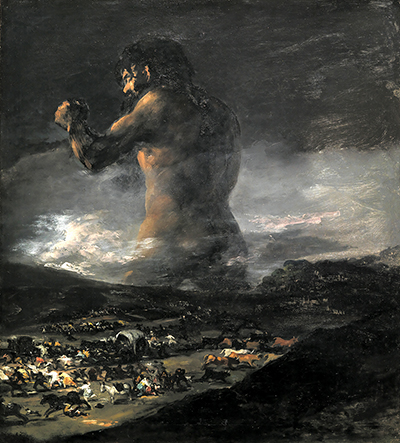
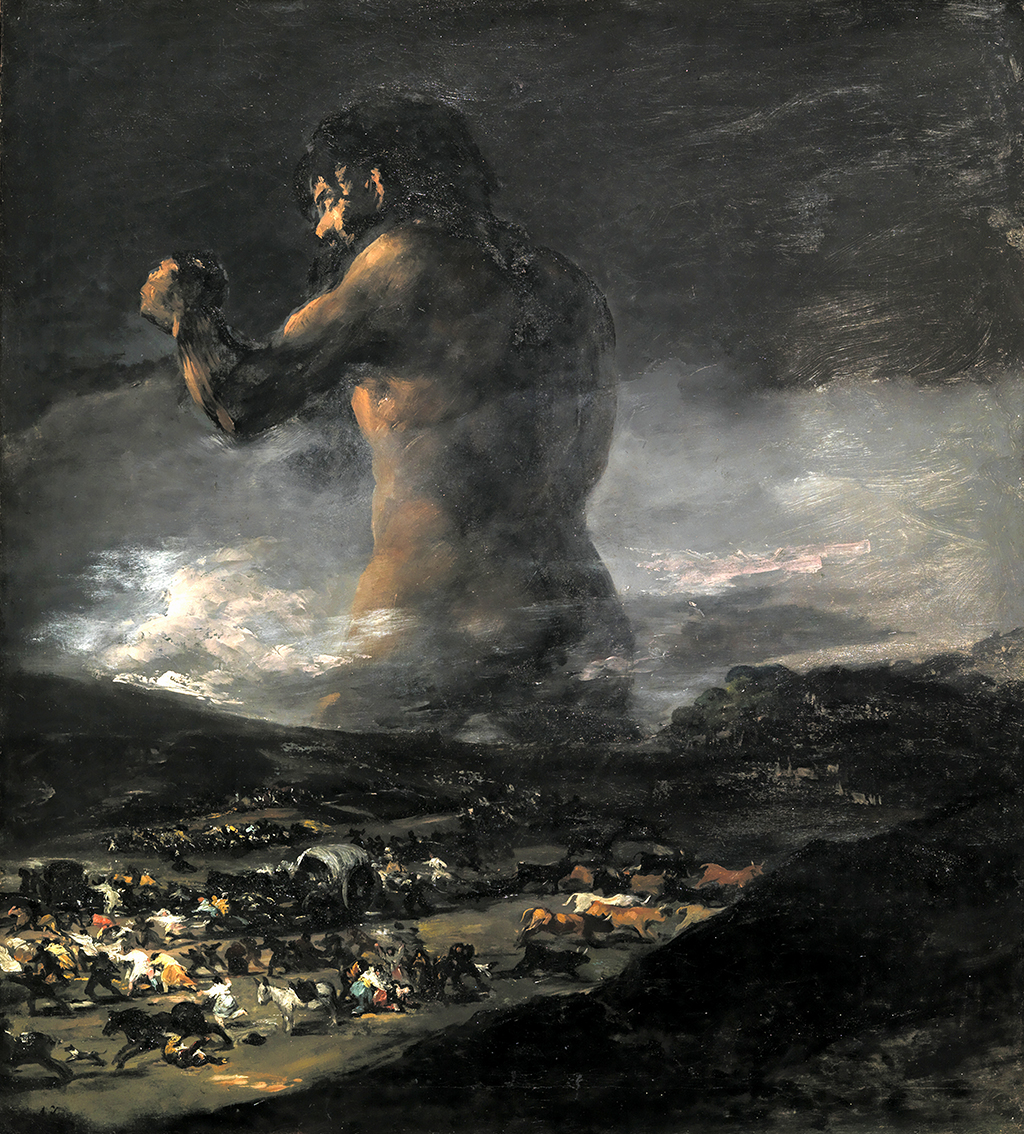
A giant raises his fist above the mountains while people and animals scatter through the valley below. A donkey stands still amid the flight. The giant turns towards the left side of the canvas, and the people closest to us are so small that it takes a moment to see who is running and who has fallen. The Museo Nacional del Prado catalogues the oil painting as attributed to Francisco de Goya and dates it to after 1808. The figure has often been read as a response to the Peninsular War. Its purpose in the scene, and the identity of the painter who put it there, are both matters of debate. [1] [2] [3]
At a Glance
- ArtistAttributed to Francisco de Goya y Lucientes in the Prado’s catalogue. [1]
- TitleThe Colossus (El coloso).
- DateAfter 1808 in the Prado’s catalogue. The Fundación Goya en Aragón gives about 1808–12. [1] [2]
- Medium and dimensionsOil on canvas, 116 × 105 cm (height × width), approximately 46 × 41 inches. [1] [2]
- CollectionMuseo Nacional del Prado, Madrid, P002785. Bequest of Pedro Fernández Durán y Bernaldo de Quirós, 1931. [1]
Works across Goya’s career
The Parasol
1777The Nude Maja
1795–1800The Colossus
After 1808Saturn Devouring His Son
c. 1820–23The Dog
c. 1820–23What is happening in the valley?
Start at the top of the picture, with the fist and the bulky shoulder just below it. The giant’s head turns to the left and the visible eye appears closed. The light picks out parts of his arm and back against the dark grey sky. Low clouds interrupt the outline of his body, and the hilltops conceal his legs. We see enough of him to imagine the next movement of his upper body, but we have to supply the ground beneath his feet. On a canvas just over a metre high, this interruption makes him seem to occupy a stretch of country much larger than the valley we can see. [1] [2]
Then follow the pale patches of the valley floor. Figures bunch together and break away. Glendinning and Vega traced much of the human flight towards the left, with cattle scattering towards the right. The opposing directions give the impression that the crowd has come apart in front of us. The dark shape of the still donkey takes a little longer to register. Once you see it, the animals and people around it become easier to follow. The donkey also offers a measure of how much the giant’s body dominates the picture. Something familiar in size, close to the lower edge, barely occupies a fraction of the space taken up by a single shoulder in the distance. [1] [3]
The difference in scale changes how we look for the cause of the panic. The valley lets us trace the consequences in many small incidents, from a figure falling to a group being swept along. The sky gives us a single raised fist, with the figure’s attention directed across the landscape. Its intended target lies outside our view. Look back down from the fist and it becomes hard to tell whether everyone below is reacting to the giant himself or to a danger in the direction he faces. That gap between what we see and what the people might see is central to the two very different roles the giant has been given. [1] [2] [3]
The Fundación Goya en Aragón compares the layout with Goya’s The Hot Air Balloon, now in the Musée des Beaux-Arts d’Agen. There too the sky occupies much of the picture. A balloon hangs above small figures on foot and on horseback, and their agitation sets the open sky against the activity on the ground. In The Colossus, the cloud cuts across the giant’s torso, so the feature that dominates the sky also appears to belong to the land. The comparison helps explain why even a small reproduction retains the force of the giant’s scale. [2] [11]
Annotated Details from The Colossus
Look from the figure’s raised fists to the movement in the valley below.
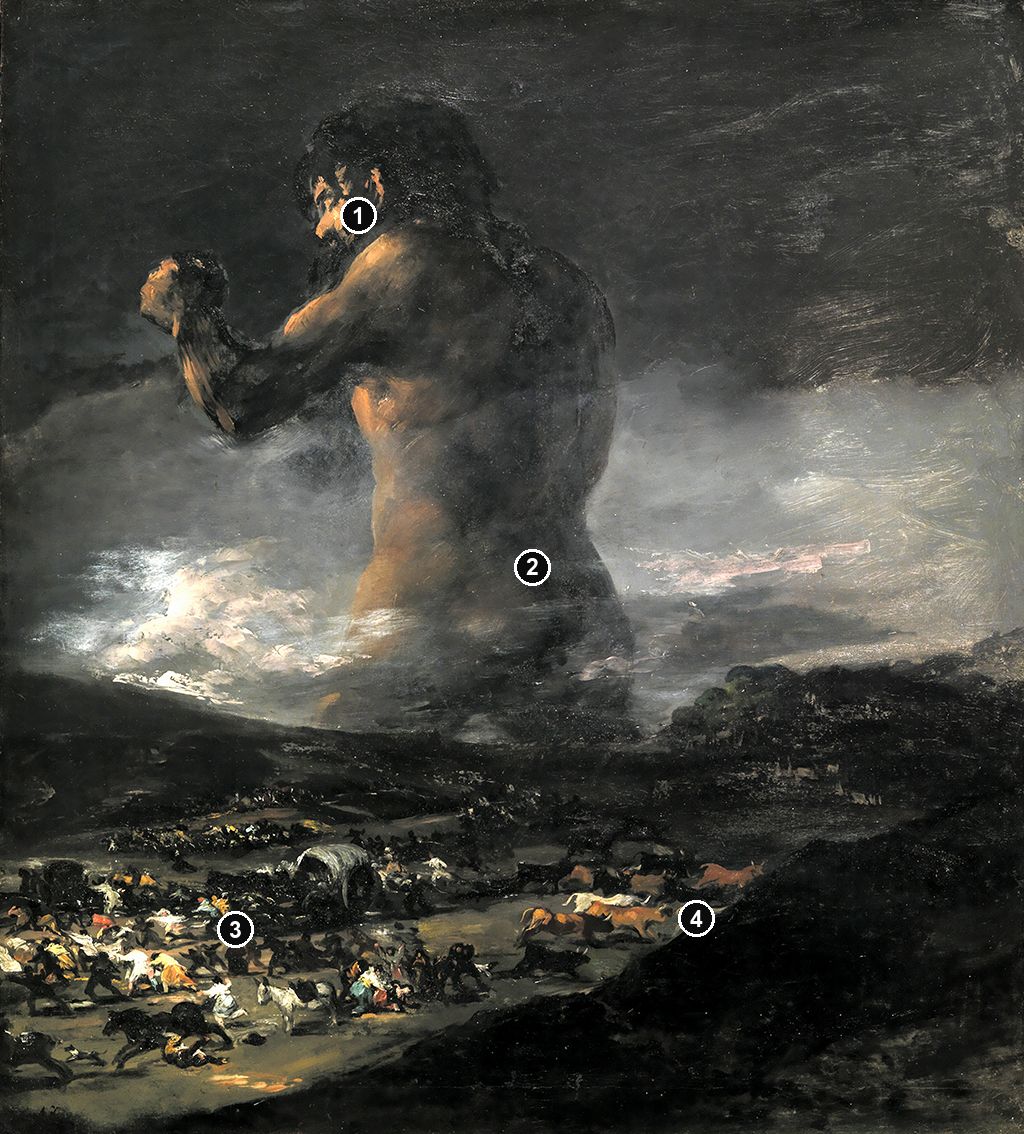
Details from THE COLOSSUS
Details from the Prado canvas (P002785).
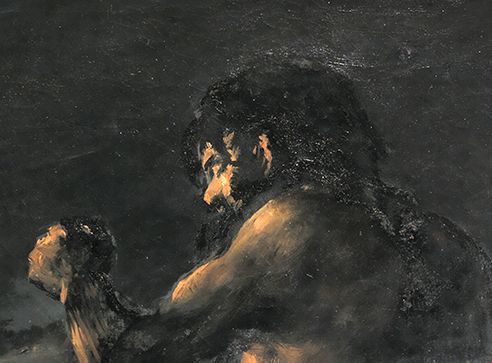
The head and the fists
The giant stands in profile with both arms bent.
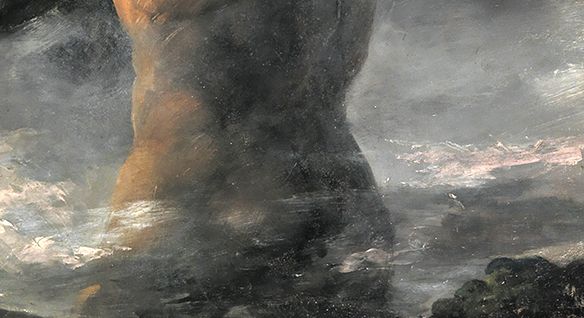
The figure against the clouds
Pale clouds break across the giant’s lower body.
Movement in the valley
People and animals crowd the left side of the valley.
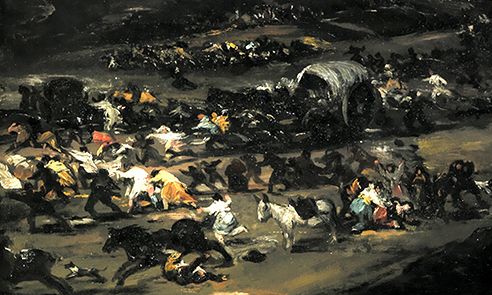
Horses on the slope
A row of smaller figures and horses follows the slope into the distance.
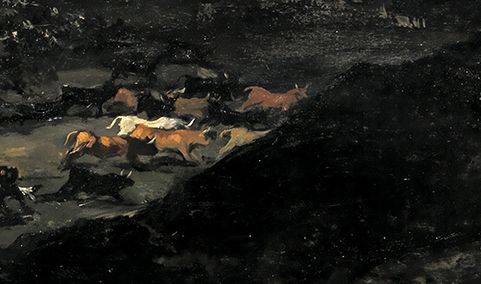
What might the giant represent?
The Peninsular War began in 1808. French occupation and Spanish resistance gave poets and artists an occasion to picture changes in power on a scale far beyond one person’s experience. The Prado treats an association with the war as a longstanding interpretation. The scattering civilians and animals give it some purchase. If the giant embodies the violence of invasion, the valley shows what that violence does to the people caught underneath it. The picture’s great disparity of scale makes it easy to see how helpless the people are, without supplying an identifiable battle or a named place. [1] [2] [4]
In 1963 Nigel Glendinning proposed a different reading through Juan Bautista Arriaza’s patriotic poem Profecía del Pirineo (Prophecy of the Pyrenees). Its colossal figure personifies a force that could defend Spain. Clouds gather about its waist, a detail with an evident parallel in the canvas. Read in that light, the fist might be directed against an invader beyond the edge of the picture, and the people in the valley might be fleeing the wider conflict. Spain’s Congress of Deputies, in its account of patriotic verse from the war, places Arriaza alongside other poets who used figures of enormous stature. The parallel makes the defender reading plausible and locates the idea within a wider literary culture. The link to Arriaza remains Glendinning’s interpretation. [2] [3] [4]
Compare the giant’s averted face with the illuminated man who lifts his arms in Goya’s Third of May 1808, painted in 1814. In that picture we can follow the direction of the men’s rifles across a strip of ground to the condemned prisoners. The positions of the living and the dead tell us what has happened and what will happen next. In The Colossus the raised arm occupies a similar place in the sequence of looking, drawing the eye first before we turn to the people at risk. The composition leaves the source and course of that risk open. [1] [5]
Two of Goya’s later Black Paintings put that uncertainty into relief. In Fight with Cudgels, two men raise their weapons within reach of one another. We can see who each man is striking at even though the reason for their fight remains unclear. In Saturn Devouring His Son, the pale body gripped in the god’s hands gives the horror a single focus. Both works began as paintings on the walls of the Quinta del Sordo and were transferred to canvas. The Colossus was painted on canvas, and its violence is harder to locate. Our attention has to travel between a gesture in the sky and lives in danger far below. [1] [9] [10]
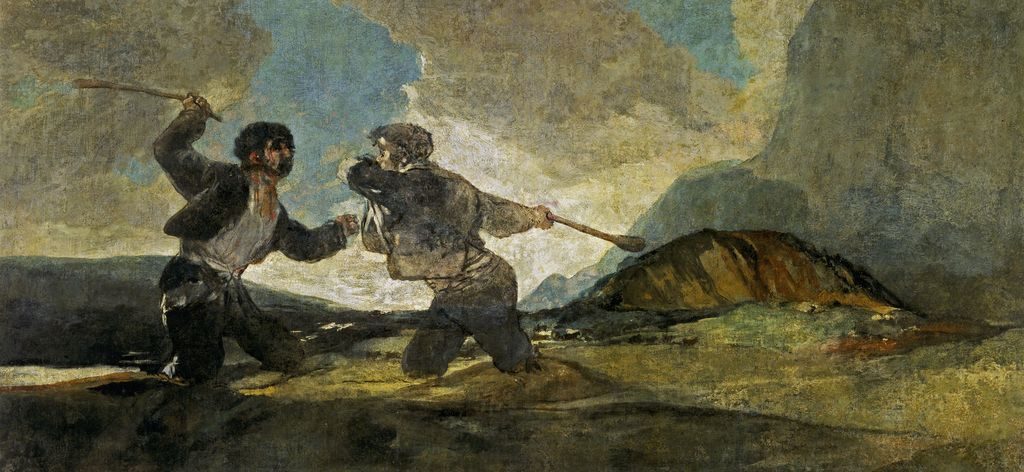
What do the inventories establish?
After Josefa Bayeu, Goya’s wife, died in 1812, the family’s property was inventoried for division between Goya and their son Javier. The list includes a painting described simply as a giant. In the original numbering the entry was 16. In a corrected version dated 1814 it became 18, valued at 90 reales. The descriptions in these lists are brief and give no dimensions for the painting. Some surviving works associated with the inventory do carry an X and a number, commonly linked with Javier, whose name was also written Xavier. A match to that system would tie the Prado canvas to a piece of documentary evidence from Goya’s household and would give it an upper limit for the date, which the Prado’s current wording leaves open. The inventory recorded possessions and their value. Authorship is a separate question. [1] [3] [6]
A later record gives a fuller description. In 1874 Vicente Poleró listed a work in the Perales collection as a prophetic allegory of the calamities of the War of Independence and credited it to Goya. He recorded the painting as undergoing restoration. That entry gives the attribution a nineteenth-century history, and the description is much more specific than the earlier inventory’s reference to a giant. The basis for Poleró’s attribution is unknown. The Fundación Goya en Aragón links the Prado canvas to both Goya’s family and the Perales collection. The Prado’s current text describes the family inventory as containing a work on a similar subject and its provenance field records the 1931 bequest. [1] [2] [3] [6]
In 1946 Francisco Javier Sánchez Cantón published the corrected inventory and connected the Prado painting to the giant it describes. That connection reached the Prado’s catalogue in 1952. It gave the association with the Peninsular War a documentary basis, provided the two paintings were the same. Mena also considered a later date, in the 1820s, on the basis of the dress of some small figures and the circumstances in which Juliá might have worked for the Perales family. The two datings depend on different identifications, one with a household record and the other with a possible painter and patron. [1] [6]
Goya on film
Five films explore Goya’s portraits, prints, Black Paintings and painting techniques.
The Duke of Wellington by Goya
The portrait, its military decorations and its later theft.
Watch on YouTubeThe disputed mark in the lower left
One of the most contested details lies at the lower-left edge of the painting. Manuela Mena Marqués, then responsible for eighteenth-century painting and Goya at the Prado, examined the canvas as part of the museum’s 2008 investigation. Her report, published in the Prado bulletin dated 2008 and made public online in January 2009, explored whether the traces read as the letters A and J. That would make them possible initials of Asensio Juliá, a Valencian artist who worked with Goya at San Antonio de la Florida in Madrid in 1798. Mena also looked at the links between Juliá and the Perales family and considered how those links might account for the work entering its collection. The initials and the proposed route into the collection depend on identifying the traces correctly. [2] [3] [6]
Glendinning and Jesusa Vega challenged that reading in their 2009 response. They studied early photographs, including material from around the time the work entered the Prado. The signal-processing specialist Maria Petrou, whom they consulted, considered a reading of 18 possible and was unable to recover an A J from one digitised plate supplied by the museum. Parts of what they took for an 8 were obscured by the frame or the edge of the photograph. For them the number might connect the painting to the inventory. For Mena, the expected white inventory marking was absent from the surface and from the early photographs she considered. The case illustrates how the framing of a photograph, and the loss or alteration of surface paint over time, can affect what a trace looks like when enlarged. [3] [6]
What the X-ray and paint samples tell us
An X-radiograph reveals a roughly frontal nude beneath the surface figure, with one arm at the hip. Mena interpreted it as an early version of the giant and read differences between it and the final composition as evidence of repeated changes in pose. She thought the extent and character of the reworking differed from Goya’s practice. Glendinning and Vega questioned whether the frontal nude was part of this composition from the start. They raised the possibility that the painter used a canvas with an abandoned study on it. Goya reused painted canvases elsewhere, including for works associated with the inventory. The X-ray makes the underlying figure visible. The connection between the two figures has to be inferred from their positions and from other evidence about how the painting was made. [2] [3] [6]
Mena also examined how the paint behaves. She described some blacks as relatively opaque compared with the varied, more transparent darks in secure works such as Goya’s Last Communion of Saint Joseph Calasanz. Some dark areas of the canvas proved sensitive during solvent testing. She associated that sensitivity in part with the low proportion of lead white in some dark samples and the presence of walnut oil, which dries more slowly. Her appraisal combined the material findings with observations about how the painter laid down colour, modelled the giant and organised the smaller figures. Glendinning and Vega argued that Goya’s handling varies considerably between works and that the documented nineteenth-century restoration has to be weighed when judging the present surface. They also pointed to works by Goya that use comparable effects of light behind figures and give crowds a similar outward movement. [3] [6]
The rivalry between these explanations puts different kinds of evidence under pressure. A material consistent with Goya’s practice could also have been available to another painter. The documentary trail could establish that a work belonged to Goya’s household without identifying its maker. This helps explain why the Prado’s current account gives weight to several connections together, including the inventory and the striking invention of the subject, when it places the canvas in his immediate circle. [1]
Goya’s seated giant in print
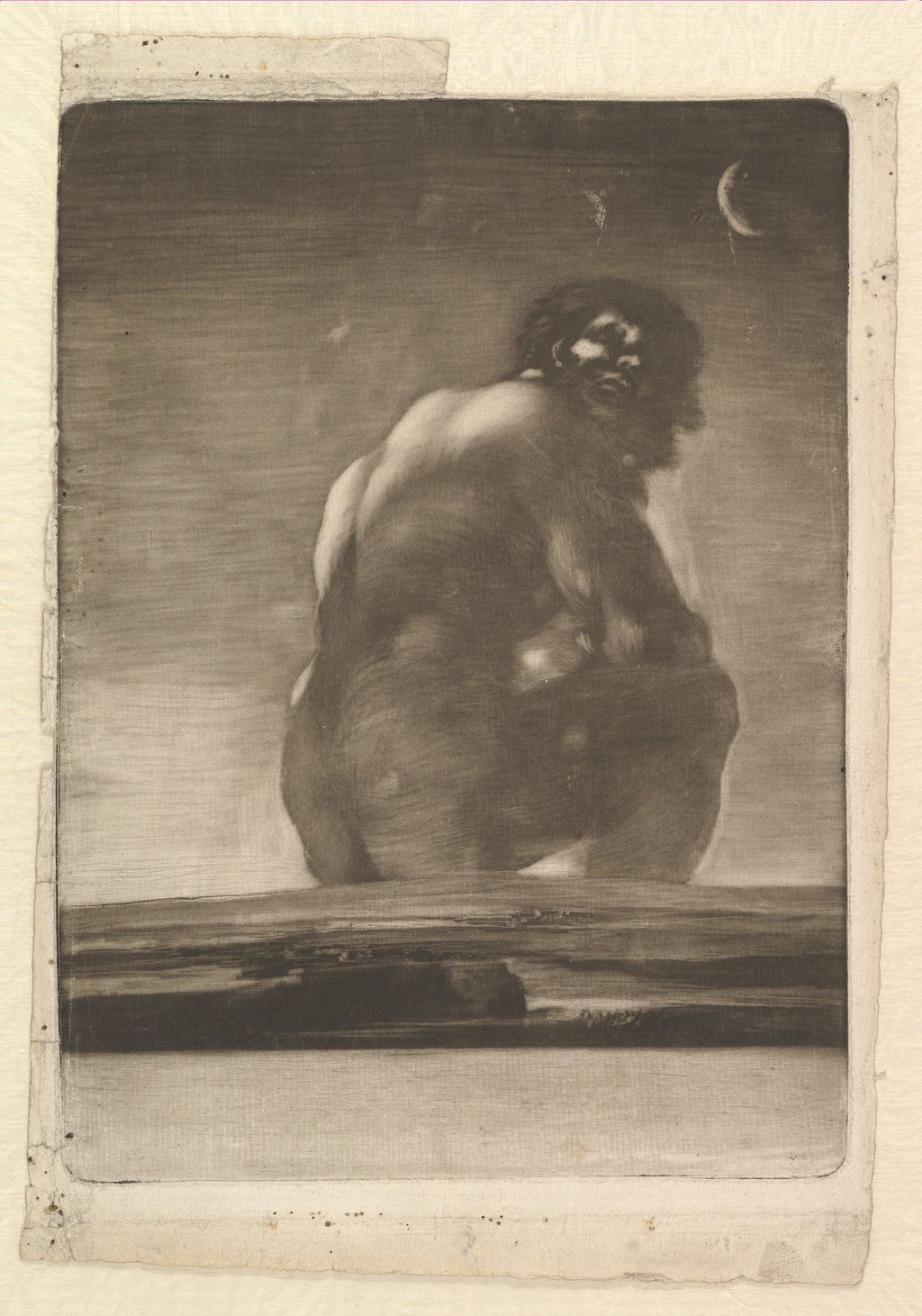
Goya’s Seated Giant is sometimes also called The Colossus. In the Metropolitan Museum of Art’s impression, 35.42, the figure sits with his back towards us. He bends one leg, rests an arm on it and turns his head to the side. A crescent moon and a low horizon leave a wide expanse of grey around him. The print’s dark tones come from aquatint, which gives the impression a fine grain and allows gradual changes of tone around the figure. The Met dates the work to by 1818, possibly 1814–18. It lists the plate as 28.4 × 20.8 cm, a small upright format in which the giant again feels immense. [7]
The seated pose changes the meaning of the giant’s scale. In the print the body fills the space where a viewer might ordinarily look for distant scenery, and there is no fleeing crowd to give his size a human measure. In the painting the elbow comes up as the fist tightens, and below it the little figures make the landscape busy. Glendinning and Vega reversed the printed figure to help compare it with the canvas, recalling that an impression reverses the image on the copper plate. Their comparison drew attention to the resemblance between the heads. A resemblance can support a connection between the two inventions while leaving open their order and whether the same person made both. Those questions depend partly on whether the picture can securely be dated before the print. [3] [6] [7]
What a comparison can establish about the giant
Scale makes the connection between the canvas and the print visible. In the painting a crowded foreground supplies a measure for the much larger figure visible above it. A person or animal at ground level helps the eye assign depth to the landscape, but the figure rises on a scale that defeats ordinary distance. In the print, the broad seated body is silhouetted across the upper terrain. The small buildings and lower contours sharpen the discrepancy. Each work asks the viewer to use the land to grasp how large the figure is. [1] [7]
The mood and mechanics of the two works diverge. The leaning, turning giant in the print can be followed around its shoulder and back. The hilly ground invites the viewer to imagine where it has put its weight. In the oil painting the rise of the body behind the bank and clouds makes that connection much harder to follow. The crowded foreground continues to move even if the giant itself seems suspended above it. The print makes a comparison of scale and posture possible, while the painting’s best evidence about its own making remains in its materials and documented history. [1] [7]
The museum records make that distinction explicit through the different status of the two attributions. The sheet gives a well-documented example of Goya working on a giant as a subject in print. The comparison can illuminate how such a motif can be organised in Spanish art of the period. To use it as evidence for an individual hand would require more, such as a shared preparatory design or technical features independently tied to the painter. The resemblance has real interpretive value even with that open question. [1] [7]
The print’s medium adds one further limit to the comparison. Differences in the darkness of an impression can change the prominence of distant marks while retaining the design of the figure. Paintings with a different history of surface treatment offer different reasons for tonal variation. A shared arrangement of dark masses makes a useful formal analogy. To assess the attribution one still needs records tied to the material of the canvas, its provenance and technical examination. The print offers a particularly clear control because it can be kept available for comparison even if an institutional attribution of the oil painting is later refined. [1] [7]
Artworks directory
| Name | Date | Medium |
|---|---|---|
| And There’s No Help for It, Plate 15 | Printed 1863 | |
| Asmodea | c. 1820–23 | Wall painting transferred to canvas |
| Boys Inflating a Bladder | 1777–78 | Tapestry cartoon |
| Boys Picking Fruit | 1778 | Tapestry cartoon |
| Bullfight in a Divided Ring | 1825 | Lithograph |
| Card Players | 1777–78 | Tapestry cartoon |
| Card Players (sketch) | 1777–78 | Painted sketch |
| Dance on the Banks of the Manzanares | 1777 | Tapestry cartoon |
| Duel with Cudgels | c. 1820–23 | Wall painting transferred to canvas |
| Heads in a Landscape | c. 1820–23 | Easel painting |
| Judith and Holofernes | c. 1820–23 | Wall painting transferred to canvas |
| Leocadia | c. 1820–23 | Wall painting transferred to canvas |
| Maja and Cloaked Men | 1777 | Tapestry cartoon |
| Maja and Cloaked Men (sketch) | 1777 | Painted sketch |
| Majo Clapping in Time to the Music | 1777 | Drawing |
| Men Reading | c. 1820–23 | Wall painting transferred to canvas |
| Out Hunting for Teeth, Plate 12 | 1799 | Etching, burnished aquatint and burin |
| Picnic in the Countryside (sketch) | 1776–78 | Painted sketch |
| Picnic on the Banks of the Manzanares | 1776 | Tapestry cartoon |
| Pilgrimage to San Isidro | c. 1820–23 | Wall painting transferred to canvas |
| Preparatory study for The Sleep of Reason Produces Monsters | c. 1796–97 | Drawing |
| Procession of the Holy Office | c. 1820–23 | Wall painting transferred to canvas |
| Quarrel at the Cockerel Inn (sketch) | 1777 | Painted sketch |
| Quarrel in the New Tavern | 1777 | Tapestry cartoon |
| Saturn Devouring His Son | c. 1820–23 | Wall painting transferred to canvas |
| Seated Majo Smoking | c. 1776 | Drawing |
| The Dog | c. 1820–23 | Wall painting transferred to canvas |
| The Drinker | 1777 | Tapestry cartoon |
| The Fates | c. 1820–23 | Wall painting transferred to canvas |
| The Great He-Goat | c. 1820–23 | Wall painting transferred to canvas |
| The Kite | 1777–78 | Tapestry cartoon |
| The Parasol | 1777 | Oil on canvas, tapestry cartoon |
| The Second of May 1808 | 1814 | Oil on canvas |
| The Sleep of Reason Produces Monsters, Plate 43 | 1799 | Etching and aquatint |
| The Third of May 1808 | 1814 | Oil on canvas |
| Thou Who Canst Not, Plate 42 | 1799 | Etching and burnished aquatint |
| Three Figures | 1776 | Drawing (lost) |
| Two Old Men | c. 1820–23 | Wall painting transferred to canvas |
| Two Old Men Eating Soup | c. 1820–23 | Wall painting transferred to canvas |
| Two Women and a Man | c. 1820–23 | Wall painting transferred to canvas |
| Universal Language: The Author Dreaming | 1797 | Drawing |
| The Family of Charles IV | 1800 | Oil on canvas |
| Witches’ Sabbath (Osuna painting) | 1797–98 | Oil on canvas |
| The Nude Maja | 1795–1800 | Oil on canvas |
| The Clothed Maja | 1800–07 | Oil on canvas |
| Self-Portrait (Drawing) | c. 1796 | Brush and carbon black ink on laid paper |
| The Swing, Madrid Album B.21 | 1795–97 | Brush and carbon black washes |
| Majas Fighting, a Majo Observing, Madrid Album B.15 | 1796–97 | Brush, grey and black washes on laid paper |
| Majos and Majas Conversing, Madrid Album B.16 | c. 1794–97 | Ink wash on paper |
| Weeping Woman and Three Men, Madrid Album B.17 | 1795–97 | Brush, carbon black washes and black chalk |
| Maja Seated on a Chair and Two Companions Behind, Madrid Album B.18 | 1795–97 | Brush and carbon black washes |
| Girl and Bull, Madrid Album B.23 | 1796–97 | Brush and carbon black washes |
| Lovers Sitting on a Rock, Madrid Album B.24 | 1796–97 | Brush and carbon black washes |
| Mariano Ceballos Riding a Bull | 1825 | Crayon lithograph and scraper |
| Landscape (lifetime impression) | c. 1807–10 | Etching and aquatint |
| Self-Portrait (1815), Prado canvas | 1815 | Oil on canvas |
| Self-Portrait (1815), Academy panel | 1815 | Oil on panel |
| Self-Portrait with Dr Arrieta | 1820 | Oil on canvas |
| Christ Crucified | 1780 | Oil on canvas |
| The Last Communion of Saint Joseph of Calasanz | 1819 | Oil on canvas |
| Christ on the Mount of Olives | 1819 | Oil on panel |
| The Flower Girls, or Spring | 1786–87 | Oil on canvas |
| The Grape Harvest, or Autumn | 1786–87 | Oil on canvas |
| The Snowstorm, or Winter | 1786–87 | Oil on canvas |
| The Threshing Ground, or Summer | 1786–87 | Oil on canvas |
| Picnic on the Banks of the Manzanares | 1776 | Oil on canvas |
| The Kite | 1777–78 | Oil on canvas |
| Dance on the Banks of the Manzanares | 1777 | Oil on canvas |
| A Fight at the Venta Nueva | 1777 | Oil on canvas |
| Blind Man’s Bluff | 1788 | Oil on canvas |
| Dogs on a Lead | 1775 | Oil on canvas |
| Hunting with a Decoy | 1775 | Oil on canvas |
| Hunter Loading His Rifle | 1775 | Oil on canvas |
| The Angler | 1775 | Oil on canvas |
| The Hermitage of San Isidro on His Feast Day | 1788 | Oil on canvas |
| The Meadow of San Isidro | 1788 | Oil on canvas |
| The Straw Manikin | 1791–92 | Oil on canvas |
| Witches’ Flight | c. 1797–98 | Oil on canvas |
| A Scene from ‘The Forcibly Bewitched’ | 1798 | Oil on canvas |
| The Duchess of Alba in Black | 1797 | Oil on canvas |
| The Duchess of Alba in White | 1795 | Oil on canvas |
| Charles III in Hunting Dress | c. 1786 | Oil on canvas |
| The Duke and Duchess of Osuna and Their Children | 1787–88 | Oil on canvas |
| Manuel Osorio Manrique de Zúñiga | 1787–88 | Oil on canvas |
| The Marquesa de Pontejos | c. 1786 | Oil on canvas |
| Equestrian Portrait of the 1st Duke of Wellington | 1812 | Oil on canvas |
| The Duke of Wellington | 1812–14 | Oil on wood |
| Portrait of Ferdinand VII of Spain | 1814 | Oil on canvas |
| Gaspar Melchor de Jovellanos | 1798 | Oil on canvas |
| María Tomasa Palafox y Portocarrero | 1804 | Oil on canvas |
| Señora Sabasa García | c. 1806–11 | Oil on canvas |
| Don Juan Bautista de Muguiro | 1827 | Oil on canvas |
| Doña Isabel de Porcel | Before 1805 | Oil on canvas |
| The Colossus | After 1808 | Oil on canvas |
| The Burial of the Sardine | 1808–12 | Oil on panel |
| The Madhouse | 1808–12 | Oil on panel |
| A Procession of Flagellants | 1808–12 | Oil on panel |
| Portrait of Jacques Galos | 1826 | Oil on canvas |
| Portrait of Mariano Goya, the Artist’s Grandson | 1827 | Oil on canvas |
| Milkmaid of Bordeaux | c. 1827 | Oil on canvas |
| Portrait of Don Juan Antonio Cuervo | 1819 | Oil on canvas |
| María Luisa of Parma (Naples version) | c. 1800 | Oil on canvas |
| The Countess of Baena | 1819 | Oil on canvas |
| The Family of the Infante Don Luis | 1783–84 | Oil on canvas |
| The Holy Family | c. 1787 | Oil on canvas |
| Saint Barbara | c. 1773 | Oil on canvas |
| Saints Justa and Rufina | 1817 | Oil on canvas |
| El Tío Paquete | c. 1819–20 | Oil on canvas |
| The Forge | c. 1815–20 | Oil on canvas |
| Majas on a Balcony (Metropolitan Museum version) | c. 1800–10 | Oil on canvas |
| Maja and Celestina on a Balcony | c. 1808–12 | Oil on canvas |
| The Water Bearer | 1808–12 | Oil on canvas |
| Time and the Old Women | c. 1810 | Oil on canvas |
Frequently Asked Questions
It belongs to the Museo Nacional del Prado in Madrid. The oil on canvas is 116 cm high by 105 cm wide and its Prado inventory number is P002785. It entered the collection in 1931. [1]
Discussion
Look again at the images and ideas explored in The Colossus. These editorial prompts invite your observations.
Follow the movement of the people and cattle, then look at the giant’s face and fist. Where would you place the danger from which the people are fleeing? How does your reading change if the giant is defending the valley?
Reader Insights
Follow the movement of the people and animals in the valley.
How does the seated figure in the print change the sense of scale?
Join the Conversation
Share a detail, comparison or question about The Colossus below.
References
- Museo Nacional del Prado, The Colossus, collection record P002785. View source.
- Fundación Goya en Aragón, The Colossus (El Coloso), catalogue entry 589. View source.
- Nigel Glendinning, in collaboration with Jesusa Vega, ‘¿Un fracasado intento de descatalogar El Coloso por el Museo del Prado?’, Goya 326 (2009), pp. 61–68. Reproduced in the Universitat de València’s teaching collection. View source.
- Congreso de los Diputados, ‘Mayo 1811’, on patriotic verse including Arriaza’s Profecía del Pirineo. View source.
- Fundación Goya en Aragón, Third of May 1808, catalogue entry 181. View source.
- Manuela Mena Marqués, ‘El Coloso y su atribución a Goya’, Boletín del Museo del Prado 26, no. 44 (2008), pp. 34–61. Reproduced in the Universitat de València’s teaching collection. View source.
- The Metropolitan Museum of Art, Seated Giant, collection record 35.42. View source.
- Ángeles García, ‘El Prado le da la vuelta al siglo XIX y de paso cambia la cartela de “El coloso”’, El País, 6 July 2021, reporting the revised gallery label during the museum’s rehang. View source.
- Fundación Goya en Aragón, Duel with Cudgels, catalogue entry 664. View source.
- Fundación Goya en Aragón, Saturn Devouring One of His Children, catalogue entry 660. View source.
- Fundación Goya en Aragón, El Globo, catalogue entry 593. View source.







