


 by Tom Gurney
Tom Gurney BSc (Hons) is an art history expert with over 20 years experience
Published on June 19, 2020 / Updated on November 20, 2026
Email: tomgurney1@gmail.com / Phone: +44 7429 011000
Introduction
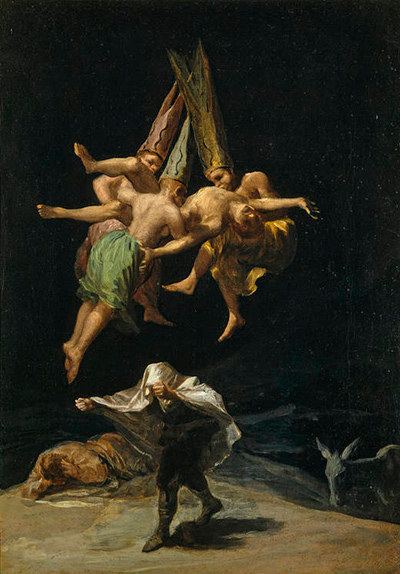
Three figures in tall pointed hats carry a naked man through the dark. Below them, one man presses his hands to his ears and another steps forward with a white cloth drawn over his head. A donkey stands back from the action. Francisco de Goya painted Witches’ Flight around 1797–1798, as part of a set of six small canvases acquired by the Duke and Duchess of Osuna for their country house. The painting is now in the Museo Nacional del Prado. Its sharpest contrasts appear in the places where its figures have the most reason to look away. [1] [2] [3]
At a Glance
- ArtistFrancisco de Goya
- Spanish titleVuelo de brujas
- DateAbout 1797–1798
- MediumOil on canvas
- Dimensions43.5 × 30.5 cm, height before width
- CollectionMuseo Nacional del Prado, Madrid, P007748
- Original settingEl Capricho, the Osunas’ country estate at La Alameda
- SeriesSix paintings of witchcraft and supernatural subjects acquired in 1798
Works across Goya’s career
The Parasol
1777Witches’ Flight
c. 1797–98The Nude Maja
1795–1800Saturn Devouring His Son
c. 1820–23The Dog
c. 1820–23The figures in the air and on the ground
The airborne group comes into focus through patches of light on bare skin. The back of the nearest carrier, at left, is broad and warm against the dark. A fold of green fabric hangs from the waist and the feet trail below. On the right, yellow-brown folds gather beneath bent legs. Above these bodies the narrow hats rise in a cluster. Across the middle, the naked man’s head falls back and his arms stretch out to either side. At the right, one hand reaches beyond the close knot of shoulders and torsos. The sweep of his arms and the steep line of the hats carry the eye in almost perpendicular directions. [1] [2]
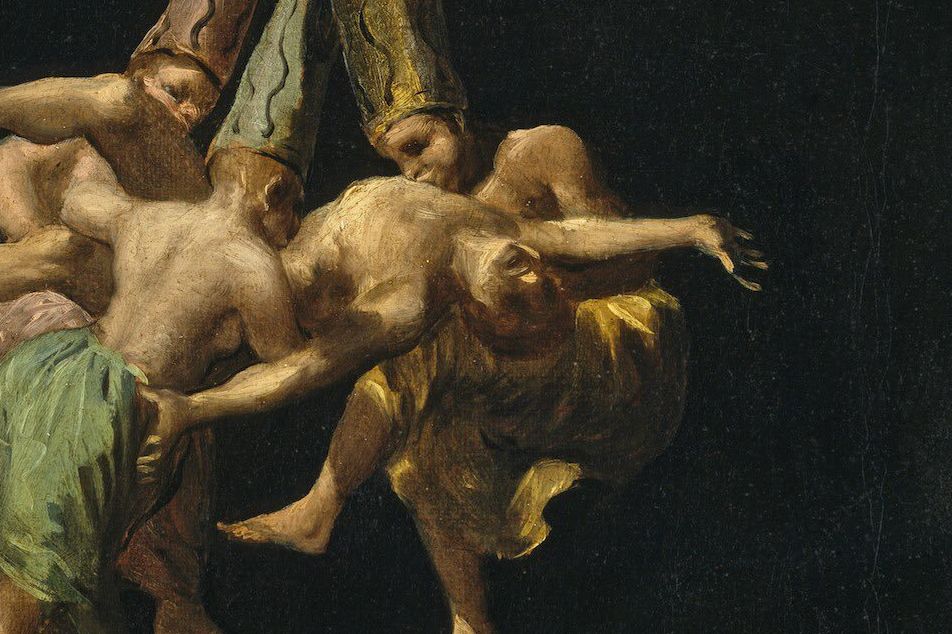
The positions of the carriers’ limbs suggest the effort of holding the man. Where the nearest arm curves around his hips, the paint gives us enough detail to follow the grasp. At their heads Goya lets contours run together, so the relation of each mouth to the naked man is harder to make out. One supporting arm runs back beneath him, and the nearest pair of feet hang down while others are bent as if in mid-stride. Goya leaves clear dark space beneath their lowest feet. The visible ground begins much further down, so there is no perch or surrounding structure against which to judge the height of the flight. Even in this small canvas the gap feels substantial. The figures seem to have been caught during a movement whose direction we can barely determine. [2] [3]
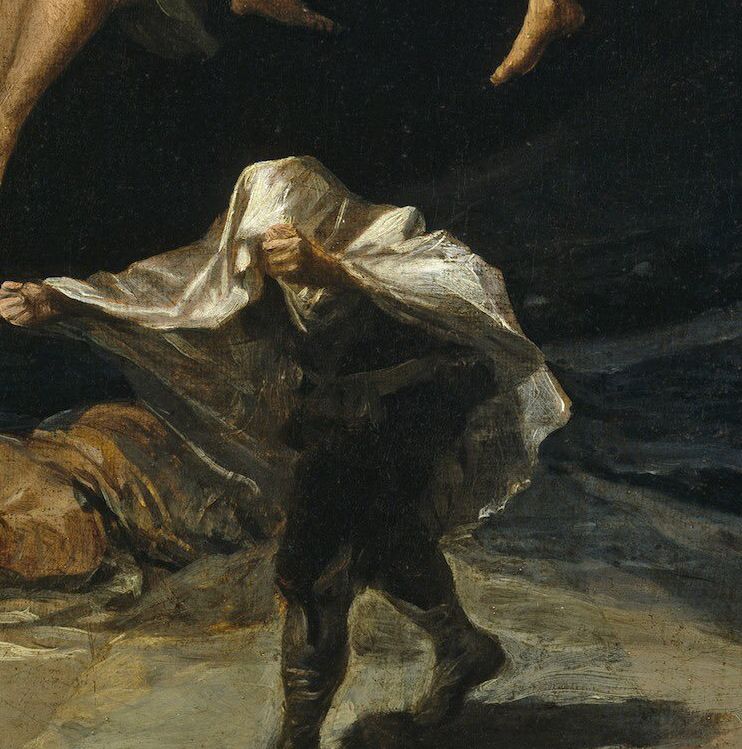
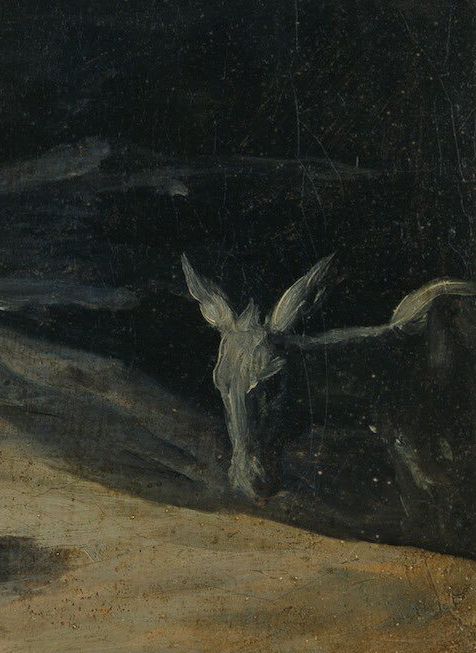
On the ground, the figure in brown has dropped face down. The dark-clothed figure closer to us still has one foot in front of the other. His hands emerge at either side of a white covering that spreads across his shoulders and conceals much of his face. The fabric forms a bright ridge directly below the illuminated bodies, and his shadow runs diagonally to the right. Farther back on that side, the donkey’s ears and part of its pale head pick up enough light to become visible. Its posture is almost still. It can take a moment to find the animal, after following the conspicuous gestures of the two men. [1] [2] [3]
The movement in the lower half depends on a few angled strokes. The illuminated foreground slopes towards a darker path behind the covered man. Beyond it there is little to fix the eye at a distance. No moon or stars explain the light, which strikes the lifted man and touches the path near our feet. Manuela B. Mena Marqués, writing for the Prado’s 2008 exhibition, locates its source beyond the edge of the composition. She also reports that an X-ray showed an earlier version of the covered man with his back turned, fleeing downwards. In the finished painting he steps into the lit foreground while shielding his eyes. That change brings his reluctance to look into the most visible part of the picture. [2] [5]
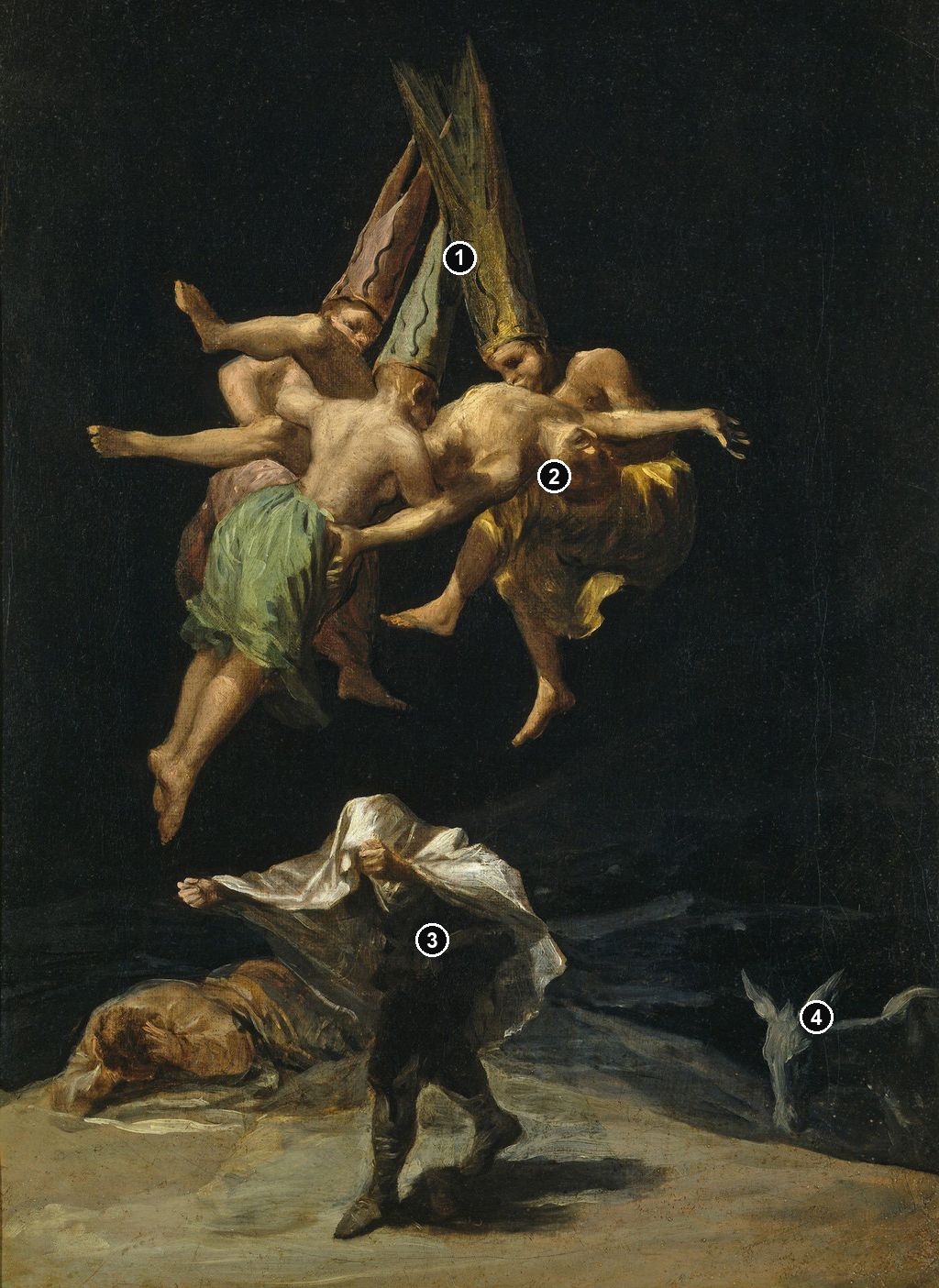
Annotated Details from Witches’ Flight
Compare the suspended group with the people and donkey on the ground.
Details from WITCHES’ FLIGHT
Details from the Osuna painting in the Museo Nacional del Prado (P007748).
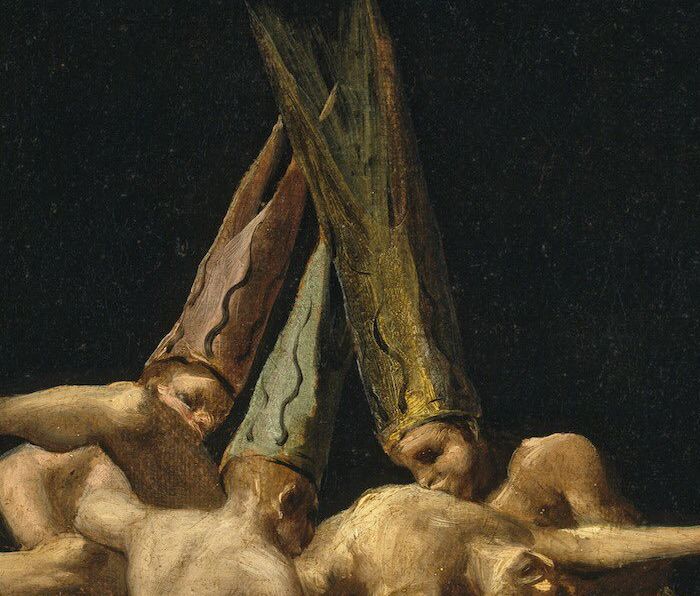
The pointed headdresses
Three sharp forms rise above the suspended bodies and catch strokes of light.
The body held aloft
Limbs extend out across the suspended group in several directions.
The covered figure
A pale cloth distinguishes the figure who steps across the ground.
The donkey in shadow
The ears and face appear faintly against the darkness at right.
Hats, gestures and competing readings
The Fundación Goya en Aragón identifies the pointed headgear as corozas, associated with the Holy Office of the Spanish Inquisition. The Fondation Beyeler describes their shape in terms of the heretic’s mitre. The hats in Goya’s print These Specks of Dust, plate 23 of Los Caprichos, give the comparison a historical setting. There, a seated defendant wearing a cone-shaped hat is presented to a tribunal. In the canvas the cone-like hats belong to the figures who hold the exposed man. Their outlines overlap, and details on their surfaces are hard to resolve at first glance. Mena reads their elongated shapes as almost priestly and describes snake motifs on them. The resemblance to religious headgear helps explain why the picture has prompted interpretations involving institutional authority as well as folk beliefs. [2] [3] [5] [6]
The covered man’s hands are as important as the cloth. The Fundación identifies his gesture as the higa, a sign made by pushing the thumb between the index and middle fingers and traditionally used to ward off the evil eye. The other man’s response is easier to recognise. He presses his hands against his head as if to shut out sound. The Fundación and Mena both read the donkey as an emblem of ignorance. The animal’s presence makes a contrast available even before we give it any symbolic weight. The men respond urgently to a threat while their companion stands quietly just beyond them. [2] [3] [5] [13]
The Fundación reads the open mouths near the lifted man as part of a bloodsucking scene, and interprets the flight as what the men on the ground imagine. Mena draws attention to the carriers’ inflated cheeks and sees them blowing into the man. She proposes that the ascent towards light and the serpents on the hats could allude to a Masonic initiation, with breath conveying knowledge and the men below closing themselves to it. The two readings turn on something the image depicts without sound or clear movement. A face close to skin can imply an intake of breath or an exhalation. Under the first reading the gestures below belong to a story about fear. Under the second they also suggest a refusal to know. [2] [5]
Goya on film
Five films explore Goya’s portraits, prints, Black Paintings and painting techniques.
The Duke of Wellington by Goya
The portrait, its military decorations and its later theft.
Watch on YouTubeSix pictures for El Capricho
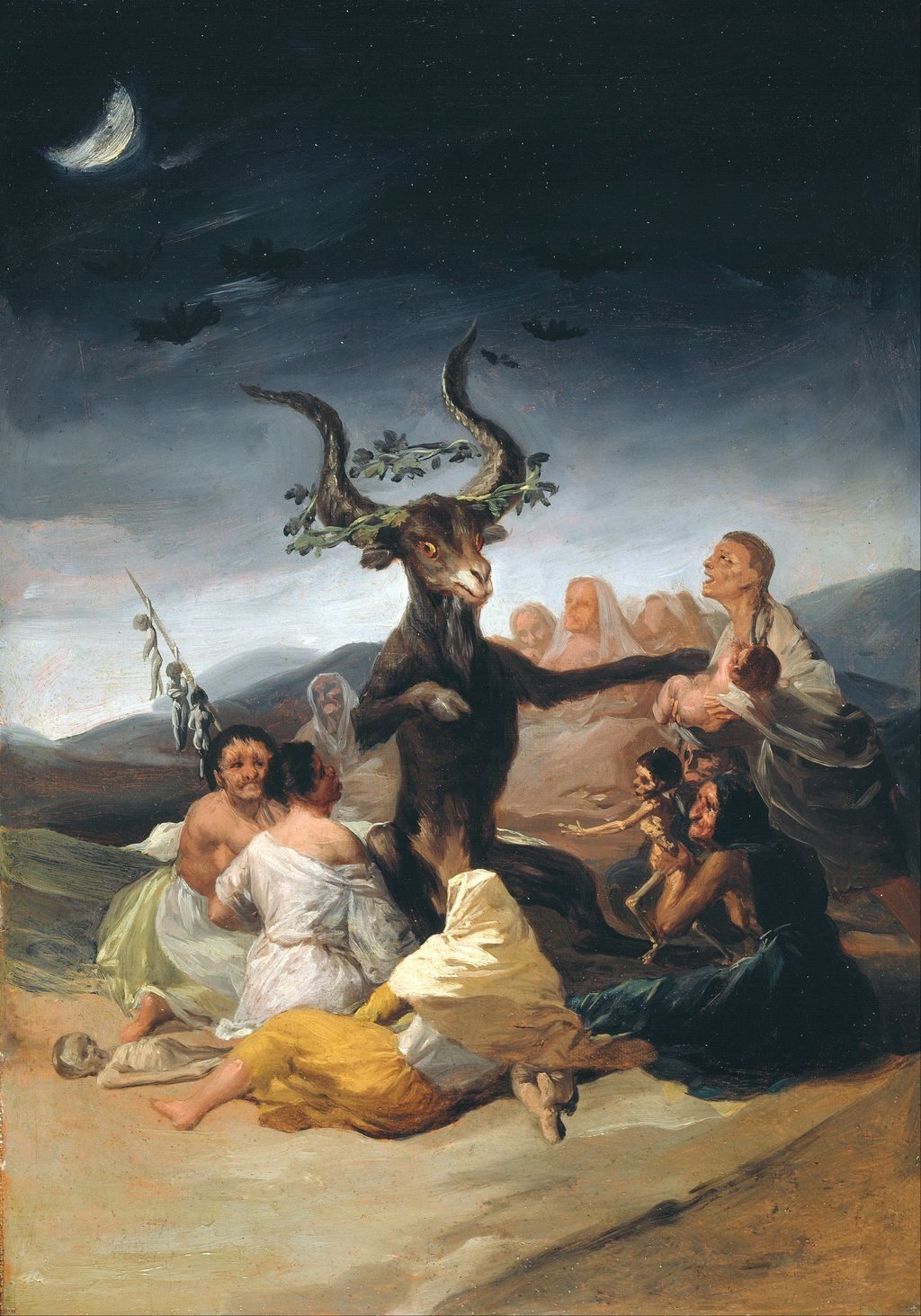
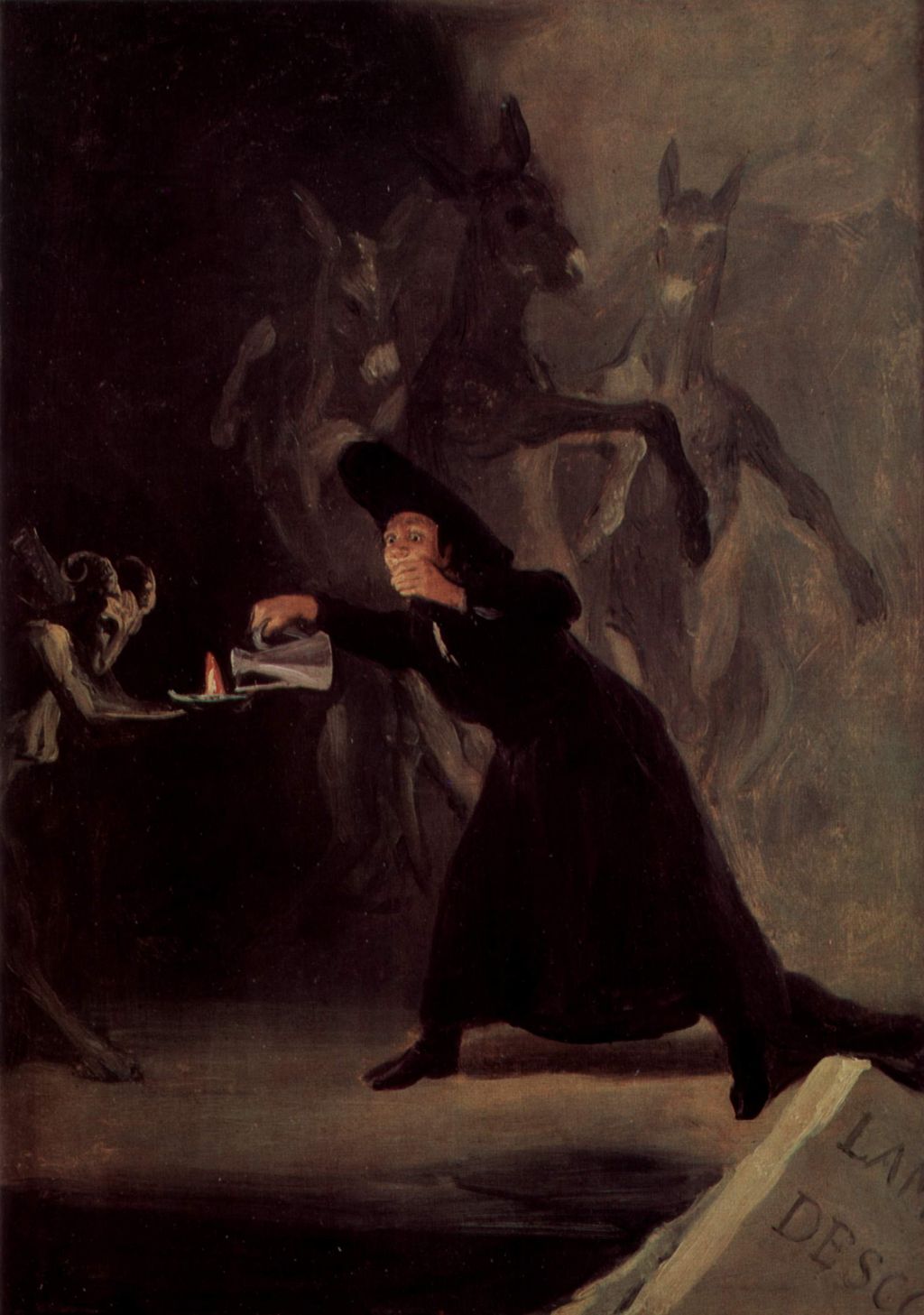
Goya’s account of 27 June 1798 records 6,000 reales de vellón for six pictures on witch subjects that were already at La Alameda. The patrons, the ninth Duke and Duchess of Osuna, acquired the set for their country residence, El Capricho. The Fundación’s series catalogue identifies the five companions as Witches’ Sabbath, The Incantation, The Witches’ Kitchen, The Bewitched Man and Don Juan and the Commendatore. The Museo Lázaro Galdiano records matching neoclassical frames on its own Witches’ Sabbath and The Incantation and on the Prado canvas, a surviving link across the dispersed group. [2] [7] [8]
Goya handles darkness differently in the two canvases. In the Osuna Witches’ Sabbath, the crescent and the low hills give the gathering a setting. Women, children and a wreath-crowned goat make a dense circle through which the eye can travel from face to face. In Witches’ Flight, the darkness opens up between the two levels of the action. There is no shared centre to connect what the men on the ground experience with what we see above them. Goya’s much later Witches’ Sabbath or The Great He-Goat belongs to the Black Paintings he made on the walls of his own house, the Quinta del Sordo, around 1820–1823. It is now also at the Prado. Its long band of faces descends from a wall-scale composition with a different setting and history. [1] [8] [9]
The National Gallery identifies The Bewitched Man as a scene from Antonio de Zamora’s comedy El hechizado por fuerza. A frightened man pours oil into a lamp because he has been tricked into believing his life depends on keeping it alight. In Witches’ Flight, the gestures of self-protection are just as legible, but the source of the fear is harder to pin down. The scholar Frank Irving Heckes, as reported by the Fundación, proposed a theatrical source for the picture in the second act of José de Cañizares’s El dómine Lucas. The Fundación also discusses that play in connection with Los Chinchillas, plate 50 of Los Caprichos, where two men in stiff heraldic costumes have their ears blocked by padlocks. Looking at the print beside the canvas makes the choice of gestures especially clear. In one scene closed senses are built into the costume. In the other, the figures use their own hands and clothing. [2] [10] [11]
From La Alameda to the Prado
The canvas appeared as lot 83 in the Osuna sale in Madrid in 1896. The Prado’s 2008 catalogue traces it through Ramón Ibarra in Madrid, the Ibarra collection in Bilbao and Luis Arana’s collection, also in Bilbao. Jaime Ortiz Patiño acquired it at the Sotheby’s–Peel sale in Madrid on 19 December 1985, where it was lot 11. Funds from the Villaescusa legacy helped bring the painting into the Prado. Mena dates the acquisition to 1999 in the Prado’s 2008 exhibition catalogue and in her later study of the purchase. A Spanish government exhibition order dated December 1999 already lists the painting under the Prado. The Fundación’s catalogue gives 2000. [2] [4] [5] [12]
Artworks directory
| Name | Date | Medium |
|---|---|---|
| And There’s No Help for It, Plate 15 | Printed 1863 | |
| Asmodea | c. 1820–23 | Wall painting transferred to canvas |
| Boys Inflating a Bladder | 1777–78 | Tapestry cartoon |
| Boys Picking Fruit | 1778 | Tapestry cartoon |
| Bullfight in a Divided Ring | 1825 | Lithograph |
| Card Players | 1777–78 | Tapestry cartoon |
| Card Players (sketch) | 1777–78 | Painted sketch |
| Dance on the Banks of the Manzanares | 1777 | Tapestry cartoon |
| Duel with Cudgels | c. 1820–23 | Wall painting transferred to canvas |
| Heads in a Landscape | c. 1820–23 | Easel painting |
| Judith and Holofernes | c. 1820–23 | Wall painting transferred to canvas |
| Leocadia | c. 1820–23 | Wall painting transferred to canvas |
| Maja and Cloaked Men | 1777 | Tapestry cartoon |
| Maja and Cloaked Men (sketch) | 1777 | Painted sketch |
| Majo Clapping in Time to the Music | 1777 | Drawing |
| Men Reading | c. 1820–23 | Wall painting transferred to canvas |
| Out Hunting for Teeth, Plate 12 | 1799 | Etching, burnished aquatint and burin |
| Picnic in the Countryside (sketch) | 1776–78 | Painted sketch |
| Picnic on the Banks of the Manzanares | 1776 | Tapestry cartoon |
| Pilgrimage to San Isidro | c. 1820–23 | Wall painting transferred to canvas |
| Preparatory study for The Sleep of Reason Produces Monsters | c. 1796–97 | Drawing |
| Procession of the Holy Office | c. 1820–23 | Wall painting transferred to canvas |
| Quarrel at the Cockerel Inn (sketch) | 1777 | Painted sketch |
| Quarrel in the New Tavern | 1777 | Tapestry cartoon |
| Saturn Devouring His Son | c. 1820–23 | Wall painting transferred to canvas |
| Seated Majo Smoking | c. 1776 | Drawing |
| The Dog | c. 1820–23 | Wall painting transferred to canvas |
| The Drinker | 1777 | Tapestry cartoon |
| The Fates | c. 1820–23 | Wall painting transferred to canvas |
| The Great He-Goat | c. 1820–23 | Wall painting transferred to canvas |
| The Kite | 1777–78 | Tapestry cartoon |
| The Parasol | 1777 | Oil on canvas, tapestry cartoon |
| The Second of May 1808 | 1814 | Oil on canvas |
| The Sleep of Reason Produces Monsters, Plate 43 | 1799 | Etching and aquatint |
| The Third of May 1808 | 1814 | Oil on canvas |
| Thou Who Canst Not, Plate 42 | 1799 | Etching and burnished aquatint |
| Three Figures | 1776 | Drawing (lost) |
| Two Old Men | c. 1820–23 | Wall painting transferred to canvas |
| Two Old Men Eating Soup | c. 1820–23 | Wall painting transferred to canvas |
| Two Women and a Man | c. 1820–23 | Wall painting transferred to canvas |
| Universal Language: The Author Dreaming | 1797 | Drawing |
| The Family of Charles IV | 1800 | Oil on canvas |
| Witches’ Sabbath (Osuna painting) | 1797–98 | Oil on canvas |
| The Nude Maja | 1795–1800 | Oil on canvas |
| The Clothed Maja | 1800–07 | Oil on canvas |
| Self-Portrait (Drawing) | c. 1796 | Brush and carbon black ink on laid paper |
| The Swing, Madrid Album B.21 | 1795–97 | Brush and carbon black washes |
| Majas Fighting, a Majo Observing, Madrid Album B.15 | 1796–97 | Brush, grey and black washes on laid paper |
| Majos and Majas Conversing, Madrid Album B.16 | c. 1794–97 | Ink wash on paper |
| Weeping Woman and Three Men, Madrid Album B.17 | 1795–97 | Brush, carbon black washes and black chalk |
| Maja Seated on a Chair and Two Companions Behind, Madrid Album B.18 | 1795–97 | Brush and carbon black washes |
| Girl and Bull, Madrid Album B.23 | 1796–97 | Brush and carbon black washes |
| Lovers Sitting on a Rock, Madrid Album B.24 | 1796–97 | Brush and carbon black washes |
| Mariano Ceballos Riding a Bull | 1825 | Crayon lithograph and scraper |
| Landscape (lifetime impression) | c. 1807–10 | Etching and aquatint |
| Self-Portrait (1815), Prado canvas | 1815 | Oil on canvas |
| Self-Portrait (1815), Academy panel | 1815 | Oil on panel |
| Self-Portrait with Dr Arrieta | 1820 | Oil on canvas |
| Christ Crucified | 1780 | Oil on canvas |
| The Last Communion of Saint Joseph of Calasanz | 1819 | Oil on canvas |
| Christ on the Mount of Olives | 1819 | Oil on panel |
| The Flower Girls, or Spring | 1786–87 | Oil on canvas |
| The Grape Harvest, or Autumn | 1786–87 | Oil on canvas |
| The Snowstorm, or Winter | 1786–87 | Oil on canvas |
| The Threshing Ground, or Summer | 1786–87 | Oil on canvas |
| Picnic on the Banks of the Manzanares | 1776 | Oil on canvas |
| The Kite | 1777–78 | Oil on canvas |
| Dance on the Banks of the Manzanares | 1777 | Oil on canvas |
| A Fight at the Venta Nueva | 1777 | Oil on canvas |
| Blind Man’s Bluff | 1788 | Oil on canvas |
| Dogs on a Lead | 1775 | Oil on canvas |
| Hunting with a Decoy | 1775 | Oil on canvas |
| Hunter Loading His Rifle | 1775 | Oil on canvas |
| The Angler | 1775 | Oil on canvas |
| The Hermitage of San Isidro on His Feast Day | 1788 | Oil on canvas |
| The Meadow of San Isidro | 1788 | Oil on canvas |
| The Straw Manikin | 1791–92 | Oil on canvas |
| Witches’ Flight | c. 1797–98 | Oil on canvas |
| A Scene from ‘The Forcibly Bewitched’ | 1798 | Oil on canvas |
| The Duchess of Alba in Black | 1797 | Oil on canvas |
| The Duchess of Alba in White | 1795 | Oil on canvas |
| Charles III in Hunting Dress | c. 1786 | Oil on canvas |
| The Duke and Duchess of Osuna and Their Children | 1787–88 | Oil on canvas |
| Manuel Osorio Manrique de Zúñiga | 1787–88 | Oil on canvas |
| The Marquesa de Pontejos | c. 1786 | Oil on canvas |
| Equestrian Portrait of the 1st Duke of Wellington | 1812 | Oil on canvas |
| The Duke of Wellington | 1812–14 | Oil on wood |
| Portrait of Ferdinand VII of Spain | 1814 | Oil on canvas |
| Gaspar Melchor de Jovellanos | 1798 | Oil on canvas |
| María Tomasa Palafox y Portocarrero | 1804 | Oil on canvas |
| Señora Sabasa García | c. 1806–11 | Oil on canvas |
| Don Juan Bautista de Muguiro | 1827 | Oil on canvas |
| Doña Isabel de Porcel | Before 1805 | Oil on canvas |
| The Colossus | After 1808 | Oil on canvas |
| The Burial of the Sardine | 1808–12 | Oil on panel |
| The Madhouse | 1808–12 | Oil on panel |
| A Procession of Flagellants | 1808–12 | Oil on panel |
| Portrait of Jacques Galos | 1826 | Oil on canvas |
| Portrait of Mariano Goya, the Artist’s Grandson | 1827 | Oil on canvas |
| Milkmaid of Bordeaux | c. 1827 | Oil on canvas |
| Portrait of Don Juan Antonio Cuervo | 1819 | Oil on canvas |
| María Luisa of Parma (Naples version) | c. 1800 | Oil on canvas |
| The Countess of Baena | 1819 | Oil on canvas |
| The Family of the Infante Don Luis | 1783–84 | Oil on canvas |
| The Holy Family | c. 1787 | Oil on canvas |
| Saint Barbara | c. 1773 | Oil on canvas |
| Saints Justa and Rufina | 1817 | Oil on canvas |
| El Tío Paquete | c. 1819–20 | Oil on canvas |
| The Forge | c. 1815–20 | Oil on canvas |
| Majas on a Balcony (Metropolitan Museum version) | c. 1800–10 | Oil on canvas |
| Maja and Celestina on a Balcony | c. 1808–12 | Oil on canvas |
| The Water Bearer | 1808–12 | Oil on canvas |
| Time and the Old Women | c. 1810 | Oil on canvas |
Frequently Asked Questions
Discussion
Look again at the images and ideas explored in Witches’ Flight. These editorial prompts invite your observations.
Look first at the man’s hands emerging from the white cloth. Then follow the bright fabric up to the outstretched arms above. What changes if you begin with the two men on the ground and take the flight to be something they picture? Where does your eye go first if you take the scene as an abduction they are trying to avoid? [1] [2] [3]
Reader Insights
Which details hold the airborne group together against the dark?
How do the figures on the ground change the way you read the scene?
Join the Conversation
Share a detail, comparison or question about Witches’ Flight below.
References
- Museo Nacional del Prado, Memoria de actividades 2023, exhibition loans for Vuelo de brujas, P007748. View source.
- Fundación Goya en Aragón, The Witches’ Flight (Vuelo de brujas), catalogue entry 525, with a reproduction and transcription of Goya’s account. View source.
- Fondation Beyeler, Goya exhibition guide, 2021–2022, Room 2, no. 5. View source.
- Boletín Oficial del Estado, Order of 9 December 1999, published 13 January 2000, p. 1547, technical data for Vuelo de brujas. View source.
- Manuela B. Mena Marqués, ‘Vuelo de brujas’, Goya en tiempos de guerra, Museo Nacional del Prado, 2008, cat. 17, pp. 160–163.
- Metropolitan Museum of Art, These Specks of Dust (Aquellos polbos), Los Caprichos, plate 23, 18.64(23). View source.
- Fundación Goya en Aragón, Asuntos de brujas para la Alameda de Osuna, catalogue of the six paintings. View source.
- Museo Lázaro Galdiano, El Aquelarre, inventory 02006, with Carmen Espinosa’s entry on the painting and Carlos Sánchez Díez’s entry on the frame. View source.
- Fundación Goya en Aragón, Witches’ Sabbath (El aquelarre), catalogue entry 659 for the Quinta del Sordo mural. View source.
- National Gallery, London, A Scene from ‘The Forcibly Bewitched’, NG1472. View source.
- Fundación Goya en Aragón, The Chinchillas (Los Chinchillas), catalogue entry for plate 50 of Los Caprichos. View source.
- Manuela B. Mena Marqués, ‘Dos adquisiciones de Goya en el Museo del Prado’, Los tesoros ocultos del Museo del Prado, Fundación Amigos del Museo del Prado, 2017, pp. 277–305. View source.
- Real Academia Española and Asociación de Academias de la Lengua Española, ‘Higa’, Diccionario de la lengua española. View source.







