


 by Tom Gurney
Tom Gurney BSc (Hons) is an art history expert with over 20 years experience
Published on June 19, 2020 / Updated on November 20, 2026
Email: tomgurney1@gmail.com / Phone: +44 7429 011000
Introduction
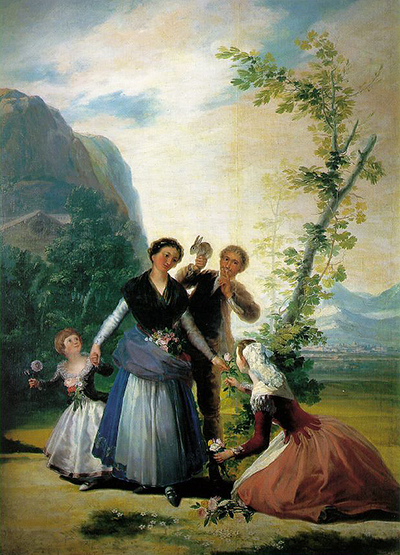
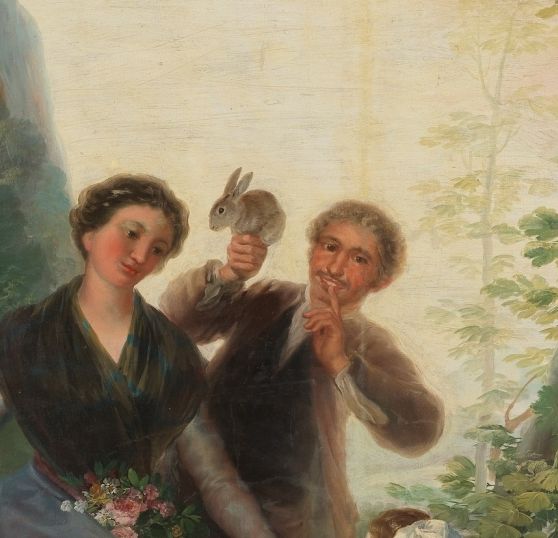
A woman reaches towards a flower while the man just behind her raises a hare and puts a finger to his lips. The girl at the woman’s side looks up. The flower seller, low on the right, seems intent on her offering. Francisco de Goya leaves the joke at the moment when it could still go undiscovered. He painted The Flower Girls, or Spring (Las floreras o La primavera) in 1786–87 as a full-size design for a royal tapestry. The oil on canvas in the Museo Nacional del Prado is nearly 2.8 metres high, yet the two actions that hold the scene together depend on a flower stem and a single finger. [1]
At a Glance
- Artist and titleFrancisco de Goya, The Flower Girls, or Spring (Las floreras o La primavera). [1]
- Date and medium1786–87, oil on canvas. [1]
- Size and collection277 × 192 cm. Museo Nacional del Prado, Madrid, inventory P000793. [1]
- Original purposeFull-size design for a tapestry intended for Charles III’s conversation room at El Pardo. [1] [2]
- CompanionThe Grape Harvest, or Autumn, designed for the other side of the south-wall balcony opening. [2] [4]
Works across Goya’s career
The Parasol
1777The Flower Girls, or Spring
1786–87The Nude Maja
1795–1800Saturn Devouring His Son
c. 1820–23The Dog
c. 1820–23A flower passes between two hands
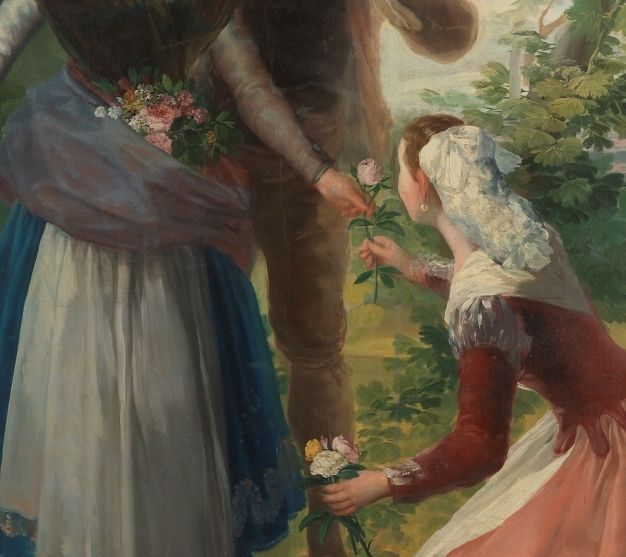
The standing woman turns her face towards the flower seller and lowers the hand nearest her. The seller is turned largely away from us. Her pale head covering picks up the light against the leaves, and the dark red sleeve beneath it leads down towards a small group of flowers near her lap. Her other hand raises a single pink bloom. The approaching fingers give the flower a brief interval of space. Goya puts that interval near the centre of the painting, where the diagonal down the standing woman’s arm meets the incline of the seller’s head and shoulder. A small spray of flowers at the woman’s waist and loose blooms by the hem of the seller’s skirt give the eye other places to find the colours of the offering. [1]
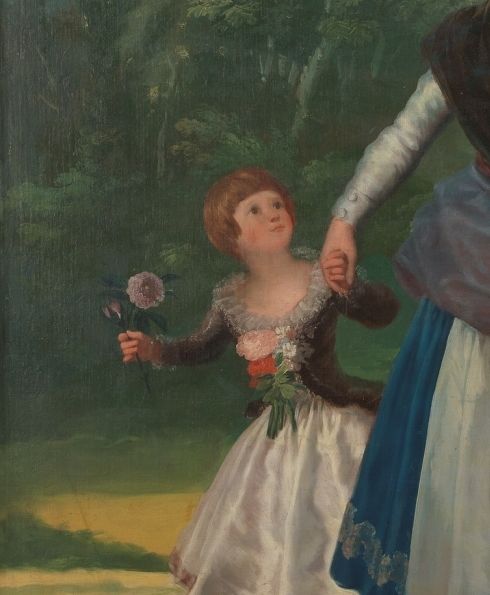
At the left the child holds up a flower in her free hand. Her other hand is in the standing woman’s grasp. The two adults are occupied by the exchange, but the girl’s upturned face sends the eye towards the higher figures. Look from the girl’s hand to the flower being offered and then up towards the man’s mouth. The gestures take place at different heights and are picked out against contrasting ground. The last is especially legible because one side of the man’s face and the raised animal stand out against the sky. The man looks outward from the group, which can make the signal feel directed at us as well as at anyone on the path who might give him away. [1]
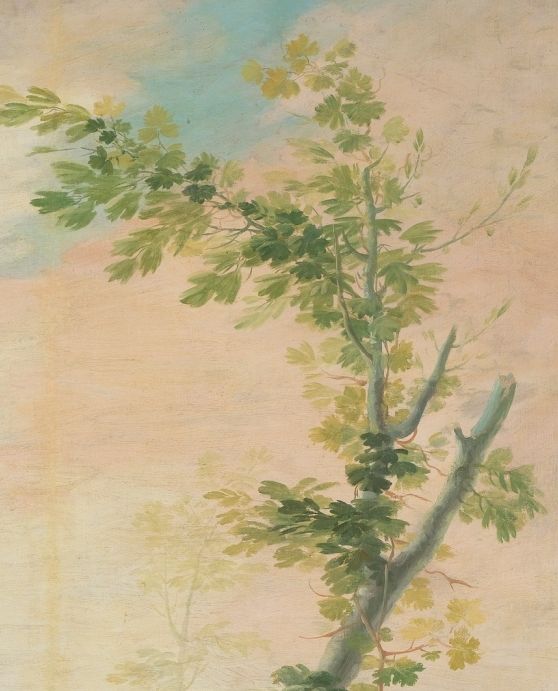
The background amplifies these changes of direction. The steep, shadowed slope on the left makes a dark backdrop for the girl’s face and dress. On the right, a slender tree rises on a slant and bends over towards the figures. Through a gap beyond it are pale hills and faint buildings on the plain. Between the mass of the slope and the finer lines of the tree, the sky gives the two standing heads room. Below, the young girl and the spreading reddish skirt give the group breadth at ground level. The Fundación Goya en Aragón describes the group as pyramidal. Its shape comes from the difference between standing and kneeling figures, and from the way the two exchanges occupy the same narrow stretch of path. [1]
Annotated Details from The Flower Girls, or Spring
Follow the flowers and the figures’ gestures between the tree and the mountain.
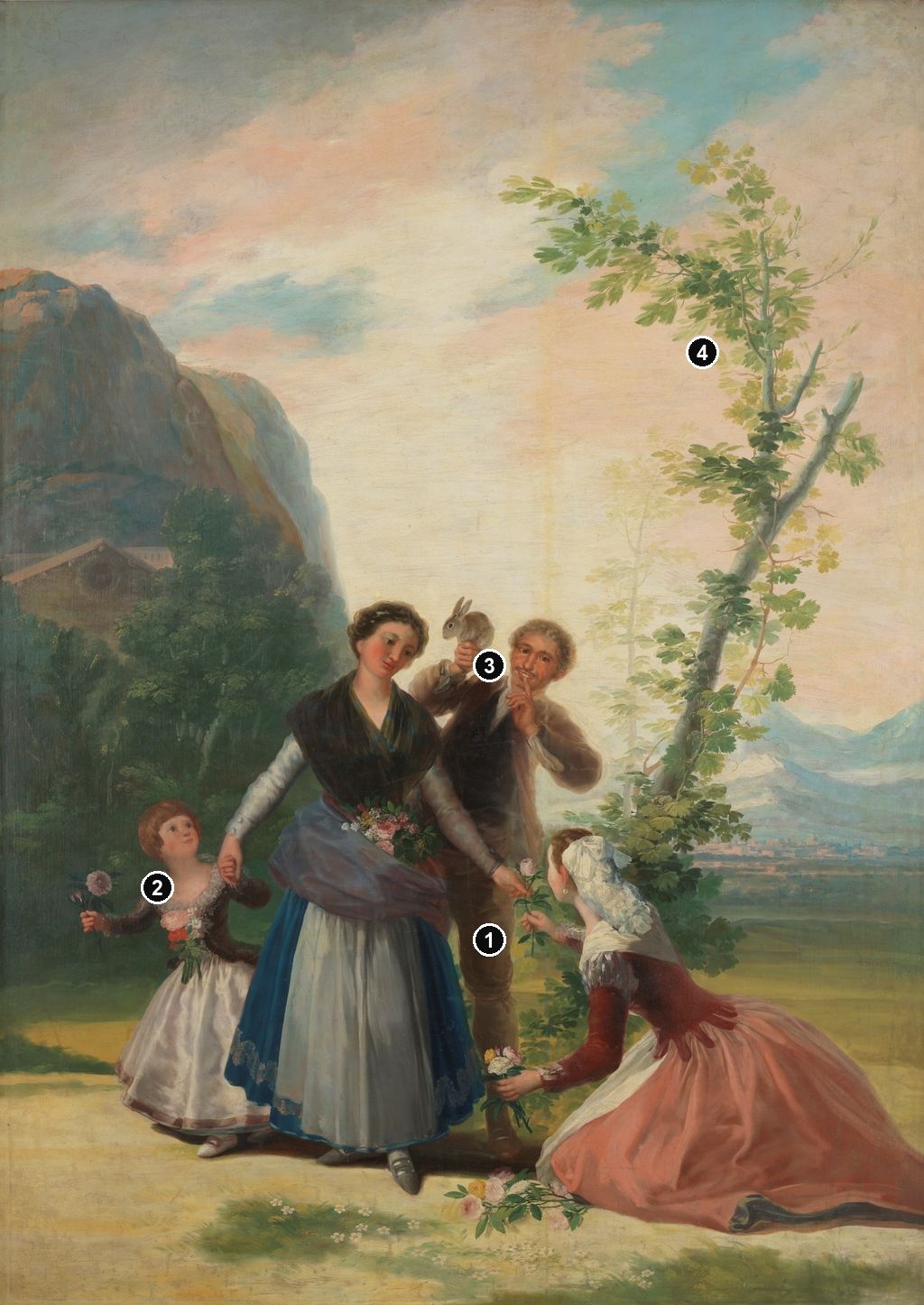
Details from THE FLOWER GIRLS, OR SPRING
Details from the tapestry cartoon in the Museo Nacional del Prado (P000793).
The flower offered
The kneeling figure reaches towards the standing woman with a flower.
The child at left
The child looks up, with one hand near the woman’s and the other stretched out.
The figure behind
A figure behind the woman gestures near his face while his other hand lifts a hare.
Leaves against sky
Thin branches and scattered clusters of leaves rise above the figures.
How an ordinary encounter becomes Spring
The first title draws attention to the women and the flowers they carry. The second invites us to read the same encounter as part of a cycle. The most direct seasonal signs are already doing something in the scene. The flower gives one woman a reason to stop and turn. The leaves mark the setting as a place of fresh growth. The hare provides a surprise, and a child who can look up while an adult looks down gives the scene two kinds of attention. Together, these details give Goya a way to show the season through people’s actions. [1]
The Fundación Goya en Aragón records Folke Nordström’s reading of the animal as a sign of fertility and Janis A. Tomlinson’s association of the child with youth and the renewal of spring. It also reports Tomlinson’s connection between the central flower and Venus. The flower is a natural starting point for these readings because Goya gives it so much compositional emphasis. The shushing gesture gives the scene a shorter timescale. The seasons return year after year, but this particular encounter is caught in the few seconds before the woman turns her head. [1]
Goya on film
Five films explore Goya’s portraits, prints, Black Paintings and painting techniques.
The Duke of Wellington by Goya
The portrait, its military decorations and its later theft.
Watch on YouTubeWhere Spring and Autumn were meant to hang
Goya made the seasonal series when he returned to supplying designs for the Royal Tapestry Factory of Santa Bárbara after a gap of about six years. The Fundación Goya en Aragón records that the carpenter’s bill in November 1786 included stretchers for the four seasons as well as The Injured Mason and The Poor at the Fountain. The stretchers were the frames on which the canvases would be held taut while the painter worked. The record places the seasons among a group of designs, with each canvas made to the dimensions of a particular part of the room. [1] [2]
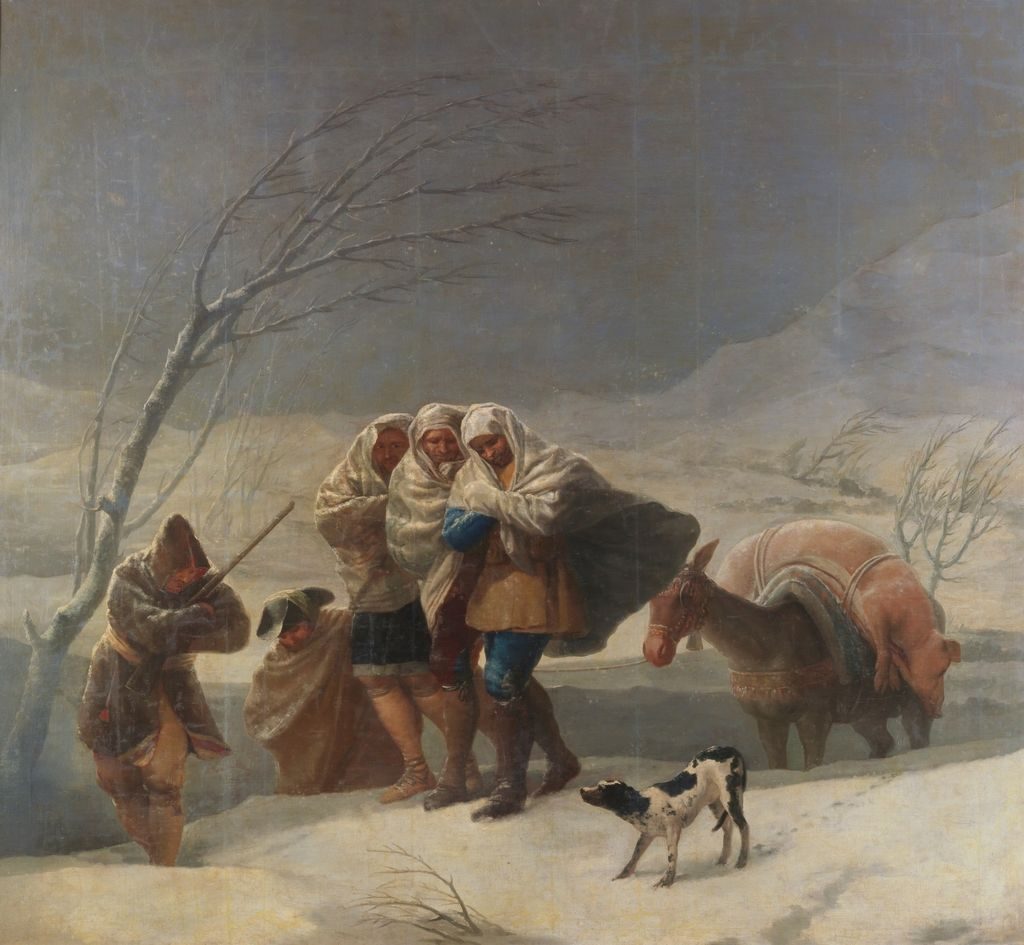
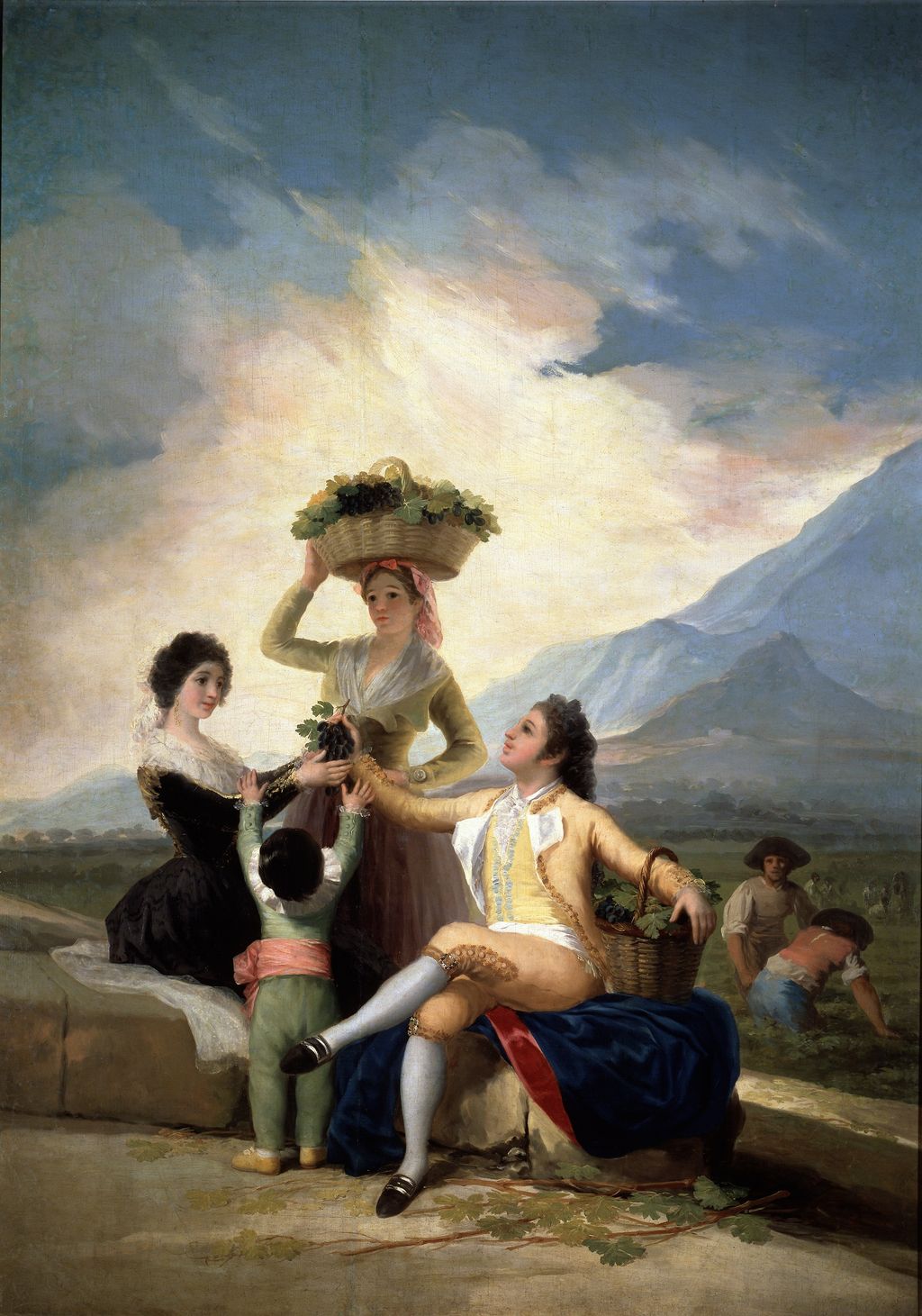
Patrimonio Nacional’s José Luis Sancho identifies the intended setting as Charles III’s conversation room at the Royal Palace of El Pardo, which the king used for supper. This was the first series Goya designed for the king’s own apartments. His earlier work at El Pardo included separate commissions for the apartments of the Prince and Princess of Asturias, among them the hanging designed from The Parasol. Sancho reconstructs Spring on the south wall to the right as one goes out onto the balcony, with The Grape Harvest, or Autumn to the left. Summer’s broad threshing scene belonged on the west wall and The Snowstorm, or Winter on the north. That distribution would have made the seasons visible in different directions around the room. The hangings never took up those places as a complete scheme. [2] [3]
The two tall designs for the south wall rhyme in subject and gesture. In Spring the woman looks down towards a single bloom. In Autumn a seated man offers a cluster of grapes, and a child reaches up from below. Spring scatters blossoms around the group and leaves the plain behind it quiet. In Autumn a basket is balanced on a woman’s head, and people working among the vines show how the grapes were gathered. Both designs put the gift at the centre of an encounter. Taken together, the figures offer two different ways of seeing what a season brings, from flowers gathered along a path to fruit brought in by a group of harvesters. [1] [4]
The sketch, the painted cartoon and the woven hanging
Goya first worked out the scene in a small oil sketch, around 34 × 24 centimetres, now in a private collection. The Fundación Goya en Aragón records that he made it to show the king and that he sought reimbursement for a carriage to San Lorenzo de El Escorial for that purpose. The same catalogue traces the sketch through the collections of the dukes of Osuna and Montellano. The little painting already has four figures, the tree on the right and the dark rising slope on the left. The animal in the man’s raised hand reads as a small dangling form in the sketch. In the larger canvas its lifted head and clearly silhouetted ears are much easier to distinguish. The shift makes the intended surprise legible from farther away, whatever the reason for the change. [1] [5]
The large painted model is the cartoon from which the Royal Tapestry Factory worked. The paint describes the blue folds of the standing woman’s dress, the peach-coloured sky and the shifts of light over the flowers. In the woven hanging, corresponding effects had to be made with coloured threads. Concha Herrero Carretero describes the woven Spring in Patrimonio Nacional’s collection using deep reds for the foreground and gradations of pink, white and golden silk farther back. Her comparison of the woven seasons finds that the weavers used different ranges of colour to evoke different kinds of light. In Spring she likens the pale transitions in the distance to dawn. Her study reproduces a detail of the surviving textile and dates it to 1786–89. [6]
The canvas had its own path after the factory used it. The Fundación Goya en Aragón records the cartoon in the 1834 inventory made in connection with the estate of Ferdinand VII. It was transferred from the factory to Madrid’s Royal Palace in 1856 or 1857 and entered the Prado in 1870. In front of the painting, the eye can move from the strong masses of colour that make the group intelligible at a distance to the individual fingers that carry the action. The woven and painted works belong to the same project, and each medium gives those small changes of colour and gesture a different texture. [1] [6]
Artworks directory
| Name | Date | Medium |
|---|---|---|
| And There’s No Help for It, Plate 15 | Printed 1863 | |
| Asmodea | c. 1820–23 | Wall painting transferred to canvas |
| Boys Inflating a Bladder | 1777–78 | Tapestry cartoon |
| Boys Picking Fruit | 1778 | Tapestry cartoon |
| Bullfight in a Divided Ring | 1825 | Lithograph |
| Card Players | 1777–78 | Tapestry cartoon |
| Card Players (sketch) | 1777–78 | Painted sketch |
| Dance on the Banks of the Manzanares | 1777 | Tapestry cartoon |
| Duel with Cudgels | c. 1820–23 | Wall painting transferred to canvas |
| Heads in a Landscape | c. 1820–23 | Easel painting |
| Judith and Holofernes | c. 1820–23 | Wall painting transferred to canvas |
| Leocadia | c. 1820–23 | Wall painting transferred to canvas |
| Maja and Cloaked Men | 1777 | Tapestry cartoon |
| Maja and Cloaked Men (sketch) | 1777 | Painted sketch |
| Majo Clapping in Time to the Music | 1777 | Drawing |
| Men Reading | c. 1820–23 | Wall painting transferred to canvas |
| Out Hunting for Teeth, Plate 12 | 1799 | Etching, burnished aquatint and burin |
| Picnic in the Countryside (sketch) | 1776–78 | Painted sketch |
| Picnic on the Banks of the Manzanares | 1776 | Tapestry cartoon |
| Pilgrimage to San Isidro | c. 1820–23 | Wall painting transferred to canvas |
| Preparatory study for The Sleep of Reason Produces Monsters | c. 1796–97 | Drawing |
| Procession of the Holy Office | c. 1820–23 | Wall painting transferred to canvas |
| Quarrel at the Cockerel Inn (sketch) | 1777 | Painted sketch |
| Quarrel in the New Tavern | 1777 | Tapestry cartoon |
| Saturn Devouring His Son | c. 1820–23 | Wall painting transferred to canvas |
| Seated Majo Smoking | c. 1776 | Drawing |
| The Dog | c. 1820–23 | Wall painting transferred to canvas |
| The Drinker | 1777 | Tapestry cartoon |
| The Fates | c. 1820–23 | Wall painting transferred to canvas |
| The Great He-Goat | c. 1820–23 | Wall painting transferred to canvas |
| The Kite | 1777–78 | Tapestry cartoon |
| The Parasol | 1777 | Oil on canvas, tapestry cartoon |
| The Second of May 1808 | 1814 | Oil on canvas |
| The Sleep of Reason Produces Monsters, Plate 43 | 1799 | Etching and aquatint |
| The Third of May 1808 | 1814 | Oil on canvas |
| Thou Who Canst Not, Plate 42 | 1799 | Etching and burnished aquatint |
| Three Figures | 1776 | Drawing (lost) |
| Two Old Men | c. 1820–23 | Wall painting transferred to canvas |
| Two Old Men Eating Soup | c. 1820–23 | Wall painting transferred to canvas |
| Two Women and a Man | c. 1820–23 | Wall painting transferred to canvas |
| Universal Language: The Author Dreaming | 1797 | Drawing |
| The Family of Charles IV | 1800 | Oil on canvas |
| Witches’ Sabbath (Osuna painting) | 1797–98 | Oil on canvas |
| The Nude Maja | 1795–1800 | Oil on canvas |
| The Clothed Maja | 1800–07 | Oil on canvas |
| Self-Portrait (Drawing) | c. 1796 | Brush and carbon black ink on laid paper |
| The Swing, Madrid Album B.21 | 1795–97 | Brush and carbon black washes |
| Majas Fighting, a Majo Observing, Madrid Album B.15 | 1796–97 | Brush, grey and black washes on laid paper |
| Majos and Majas Conversing, Madrid Album B.16 | c. 1794–97 | Ink wash on paper |
| Weeping Woman and Three Men, Madrid Album B.17 | 1795–97 | Brush, carbon black washes and black chalk |
| Maja Seated on a Chair and Two Companions Behind, Madrid Album B.18 | 1795–97 | Brush and carbon black washes |
| Girl and Bull, Madrid Album B.23 | 1796–97 | Brush and carbon black washes |
| Lovers Sitting on a Rock, Madrid Album B.24 | 1796–97 | Brush and carbon black washes |
| Mariano Ceballos Riding a Bull | 1825 | Crayon lithograph and scraper |
| Landscape (lifetime impression) | c. 1807–10 | Etching and aquatint |
| Self-Portrait (1815), Prado canvas | 1815 | Oil on canvas |
| Self-Portrait (1815), Academy panel | 1815 | Oil on panel |
| Self-Portrait with Dr Arrieta | 1820 | Oil on canvas |
| Christ Crucified | 1780 | Oil on canvas |
| The Last Communion of Saint Joseph of Calasanz | 1819 | Oil on canvas |
| Christ on the Mount of Olives | 1819 | Oil on panel |
| The Flower Girls, or Spring | 1786–87 | Oil on canvas |
| The Grape Harvest, or Autumn | 1786–87 | Oil on canvas |
| The Snowstorm, or Winter | 1786–87 | Oil on canvas |
| The Threshing Ground, or Summer | 1786–87 | Oil on canvas |
| Picnic on the Banks of the Manzanares | 1776 | Oil on canvas |
| The Kite | 1777–78 | Oil on canvas |
| Dance on the Banks of the Manzanares | 1777 | Oil on canvas |
| A Fight at the Venta Nueva | 1777 | Oil on canvas |
| Blind Man’s Bluff | 1788 | Oil on canvas |
| Dogs on a Lead | 1775 | Oil on canvas |
| Hunting with a Decoy | 1775 | Oil on canvas |
| Hunter Loading His Rifle | 1775 | Oil on canvas |
| The Angler | 1775 | Oil on canvas |
| The Hermitage of San Isidro on His Feast Day | 1788 | Oil on canvas |
| The Meadow of San Isidro | 1788 | Oil on canvas |
| The Straw Manikin | 1791–92 | Oil on canvas |
| Witches’ Flight | c. 1797–98 | Oil on canvas |
| A Scene from ‘The Forcibly Bewitched’ | 1798 | Oil on canvas |
| The Duchess of Alba in Black | 1797 | Oil on canvas |
| The Duchess of Alba in White | 1795 | Oil on canvas |
| Charles III in Hunting Dress | c. 1786 | Oil on canvas |
| The Duke and Duchess of Osuna and Their Children | 1787–88 | Oil on canvas |
| Manuel Osorio Manrique de Zúñiga | 1787–88 | Oil on canvas |
| The Marquesa de Pontejos | c. 1786 | Oil on canvas |
| Equestrian Portrait of the 1st Duke of Wellington | 1812 | Oil on canvas |
| The Duke of Wellington | 1812–14 | Oil on wood |
| Portrait of Ferdinand VII of Spain | 1814 | Oil on canvas |
| Gaspar Melchor de Jovellanos | 1798 | Oil on canvas |
| María Tomasa Palafox y Portocarrero | 1804 | Oil on canvas |
| Señora Sabasa García | c. 1806–11 | Oil on canvas |
| Don Juan Bautista de Muguiro | 1827 | Oil on canvas |
| Doña Isabel de Porcel | Before 1805 | Oil on canvas |
| The Colossus | After 1808 | Oil on canvas |
| The Burial of the Sardine | 1808–12 | Oil on panel |
| The Madhouse | 1808–12 | Oil on panel |
| A Procession of Flagellants | 1808–12 | Oil on panel |
| Portrait of Jacques Galos | 1826 | Oil on canvas |
| Portrait of Mariano Goya, the Artist’s Grandson | 1827 | Oil on canvas |
| Milkmaid of Bordeaux | c. 1827 | Oil on canvas |
| Portrait of Don Juan Antonio Cuervo | 1819 | Oil on canvas |
| María Luisa of Parma (Naples version) | c. 1800 | Oil on canvas |
| The Countess of Baena | 1819 | Oil on canvas |
| The Family of the Infante Don Luis | 1783–84 | Oil on canvas |
| The Holy Family | c. 1787 | Oil on canvas |
| Saint Barbara | c. 1773 | Oil on canvas |
| Saints Justa and Rufina | 1817 | Oil on canvas |
| El Tío Paquete | c. 1819–20 | Oil on canvas |
| The Forge | c. 1815–20 | Oil on canvas |
| Majas on a Balcony (Metropolitan Museum version) | c. 1800–10 | Oil on canvas |
| Maja and Celestina on a Balcony | c. 1808–12 | Oil on canvas |
| The Water Bearer | 1808–12 | Oil on canvas |
| Time and the Old Women | c. 1810 | Oil on canvas |
Frequently Asked Questions
The Fundación Goya en Aragón describes it as a hare. Its upright ears are visible above his raised hand. The finger at his lips suggests he means to surprise the standing woman, whose attention is on the flower offered from below. [1]
Discussion
Look again at the images and ideas explored in The Flower Girls, or Spring. These editorial prompts invite your observations.
Follow the child’s raised face, the standing woman’s lowered hand and the man’s finger in turn. When does the scene start to feel like a joke to you? Compare the place of the child in The Grape Harvest. What does the reaching figure there make you notice first?
Reader Insights
Which gestures connect the child, the two women and the man behind them?
How does the offered flower change when you compare it with the grapes in Autumn?
Join the Conversation
Share a detail, comparison or question about The Flower Girls, or Spring below.
References
- Fundación Goya en Aragón, Las floreras, catalogue entry and illustration of the Prado cartoon, P000793. View source.
- José Luis Sancho, La nevada o El invierno, in Patrimonio Nacional, Carlos III. Majestad y Ornato en los escenarios del Rey Ilustrado, tapestry entry and reconstruction of the room. View source.
- Fundación Goya en Aragón, El quitasol, catalogue entry for the earlier El Pardo commission. View source.
- Fundación Goya en Aragón, La vendimia, catalogue entry for the companion cartoon, P000795. View source.
- Fundación Goya en Aragón, La primavera (boceto), catalogue entry and illustration of the preparatory oil sketch. View source.
- Concha Herrero Carretero, ‘Goya, cartonista de tapices. Prestigio y caracterización de la manufactura madrileña’, in Eva March and Carme Narváez (eds.), Los mundos del arte: estudios en homenaje a Joan Sureda, Edicions de la Universitat de Barcelona, 2019, pp. 219–234, especially fig. 1 and pp. 229–231. View source.







