


 by Tom Gurney
Tom Gurney BSc (Hons) is an art history expert with over 20 years experience
Published on June 19, 2020 / Updated on November 20, 2026
Email: tomgurney1@gmail.com / Phone: +44 7429 011000
Introduction
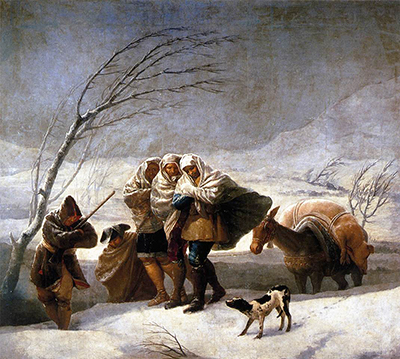
The bare tree bends to the right. So does a traveller’s cloak, just above a dog that has tucked its tail between its legs. Three men cross the snow with their heads drawn down into their wraps. Behind them a mule carries a slaughtered pig. Francisco de Goya painted The Snowstorm, also called Winter or La nevada, as a full-size design for a tapestry intended for Charles III’s rooms at the Royal Palace of El Pardo. The canvas is now in the Museo Nacional del Prado in Madrid. [1] [2] [3]
At a Glance
Works across Goya’s career
The Parasol
1777The Snowstorm, or Winter
1786–87The Nude Maja
1795–1800Saturn Devouring His Son
c. 1820–23The Dog
c. 1820–23Where the wind comes from
Start at the base of the tree on the left. Its trunk rises diagonally over the track, and at the top the bare twigs curve towards the right across the grey sky. The smaller growth behind the mule tilts the same way. In the middle of the canvas, the dark outer fabric of a traveller’s cloak swells out towards the right, giving the wind a broad surface to catch. The figures lean into its force, with their arms drawn in and their shoulders raised. The branches describe the direction of the gust while the clothes and bodies show what it takes to keep moving through it. [1] [2]
Follow the men down from their heads to their boots. Their hoods touch or overlap, and their faces sit in small hollows edged by pale folds. Lower down, the distinct steps reappear. A brown boot extends to the left while another leg, with blue clothing above the dark boot, is set back. One man has brought a hand up close to his chest. At this scale, those details are large enough to register separately, even though the three upper bodies make a single silhouette at a distance. Goya gives the group a common action through the shoulders and an uneven walking rhythm through the feet. [1]
The road passes behind a low ridge of snow. In the foreground it is possible to see the slope where the dog stands and a few stems that break through the white. The darker strip beneath the mule runs across the picture, helping to locate a route across the landscape. Further away, the contours of the hills become faint and their colours approach those of the sky. There is little to judge distance by on the upper slopes. The tree and the people provide the clearest sense of scale, while the track carries the eye towards the edge of the canvas without showing where the travellers are going. [1] [2]
Annotated Details from The Snowstorm, or Winter
Trace the wind through the tree, the people’s clothing and the low foreground.
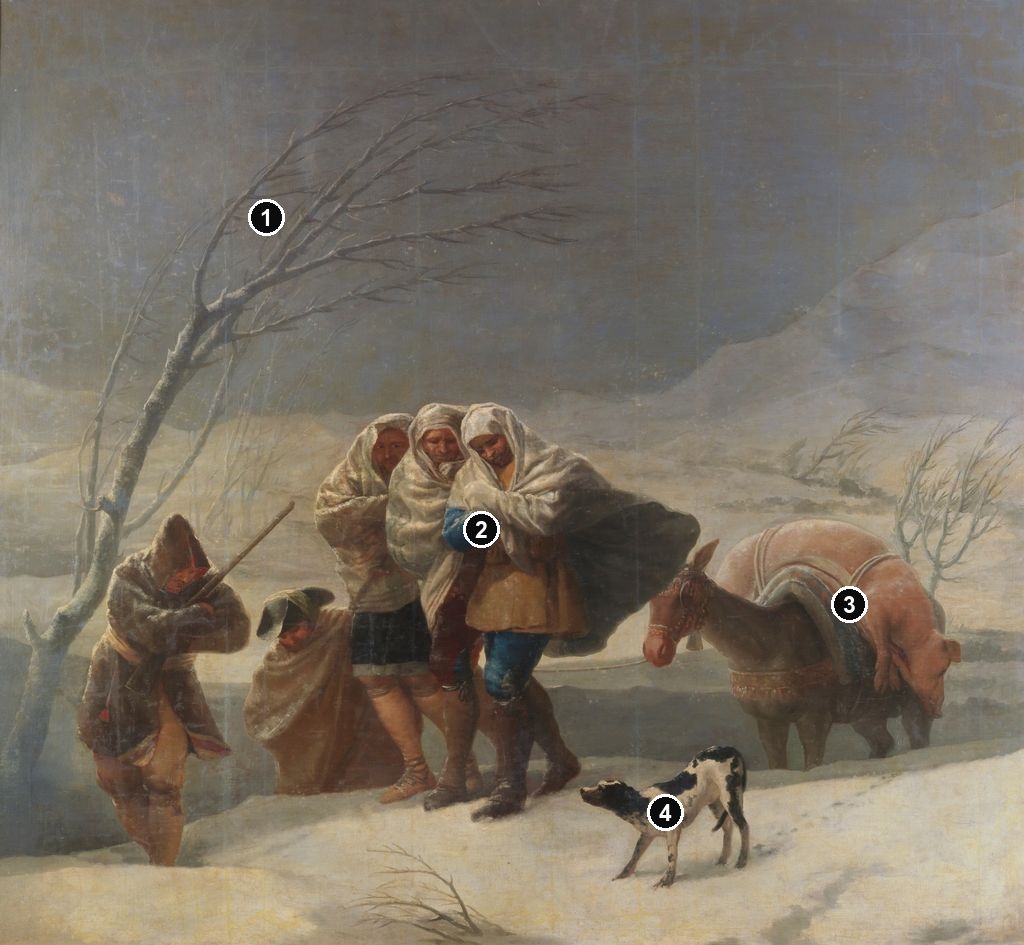
Details from THE SNOWSTORM, OR WINTER
Details from the tapestry cartoon in the Museo Nacional del Prado (P000798).
The leaning tree
The bare branches sweep across the otherwise nearly empty sky.
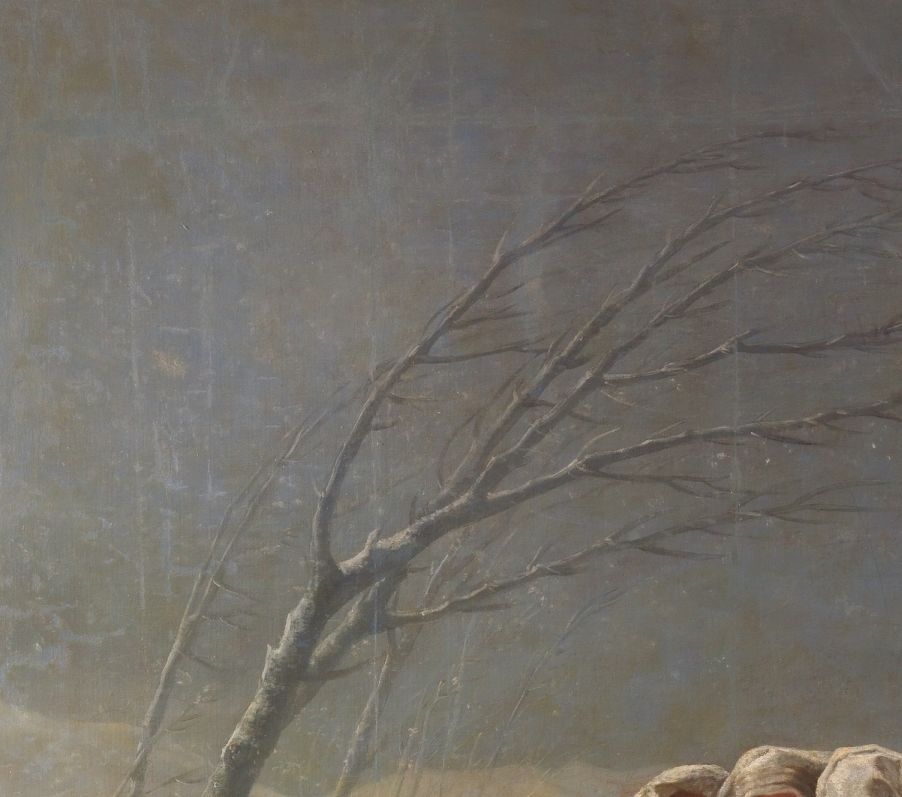
The huddled walkers
The figures draw close under their cloaks and coverings.
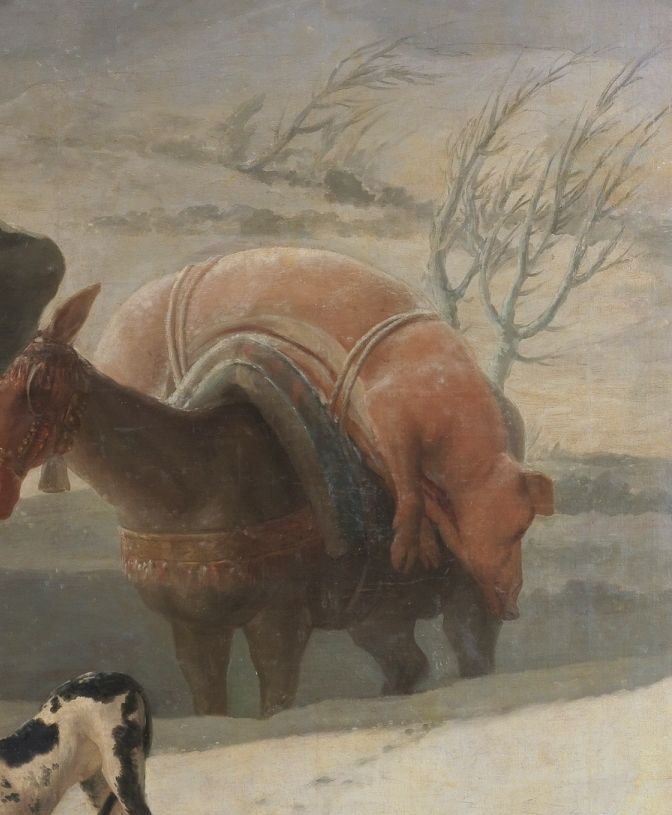
The animal and load
A pale curved load crosses the back of the pack animal.
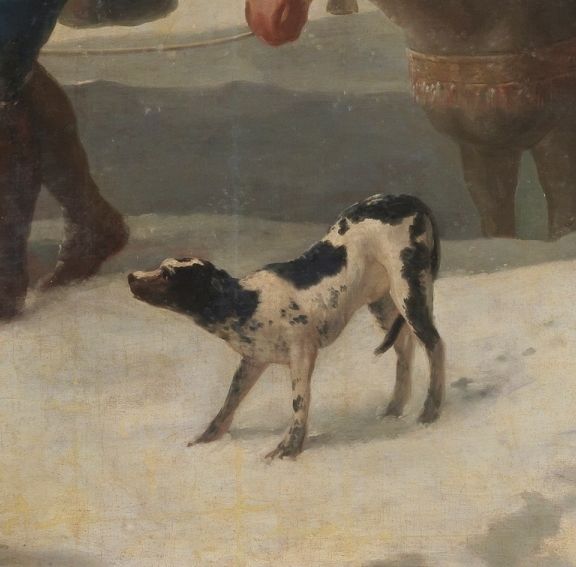
The dog
The dog stands against the light snow just ahead of the pack animal.
The mule, the pig and the dog
The mule lowers its head at the right. A blanket separates its dark body from the pale mass laid across the saddle. At the far end, the hoof and sagging weight help identify the load as a carcass. The Fundación Goya en Aragón connects the slaughtered pig with the matanza, the seasonal slaughter that marked the onset of winter. The size of the load gives this association an immediate physical presence. From the mule’s side of the painting, the pig is the most substantial pale object after the snow itself. [1] [2]
There are five men in all. The Prado curator Gudrun Maurer reads the three who huddle together as peasants coming away from an unsuccessful attempt to buy a pig. She interprets the two better-dressed men, one carrying a long gun and the other handling the mule, as possible servants of a prosperous household. The painting leaves their errand open, but makes the difference in their provisions easy to see. One set of travellers has a whole animal to carry, while the other draws its hands and arms under its clothing. The dog stands apart in the foreground with its muzzle turned left and its tail pressed down. Maurer sees it as the first to sense the meeting of the two groups. The tucked tail and lowered head already convey apprehension before the viewer has worked out the possible story. [1] [4]
Goya on film
Five films explore Goya’s portraits, prints, Black Paintings and painting techniques.
The Duke of Wellington by Goya
The portrait, its military decorations and its later theft.
Watch on YouTubeA north wall at El Pardo
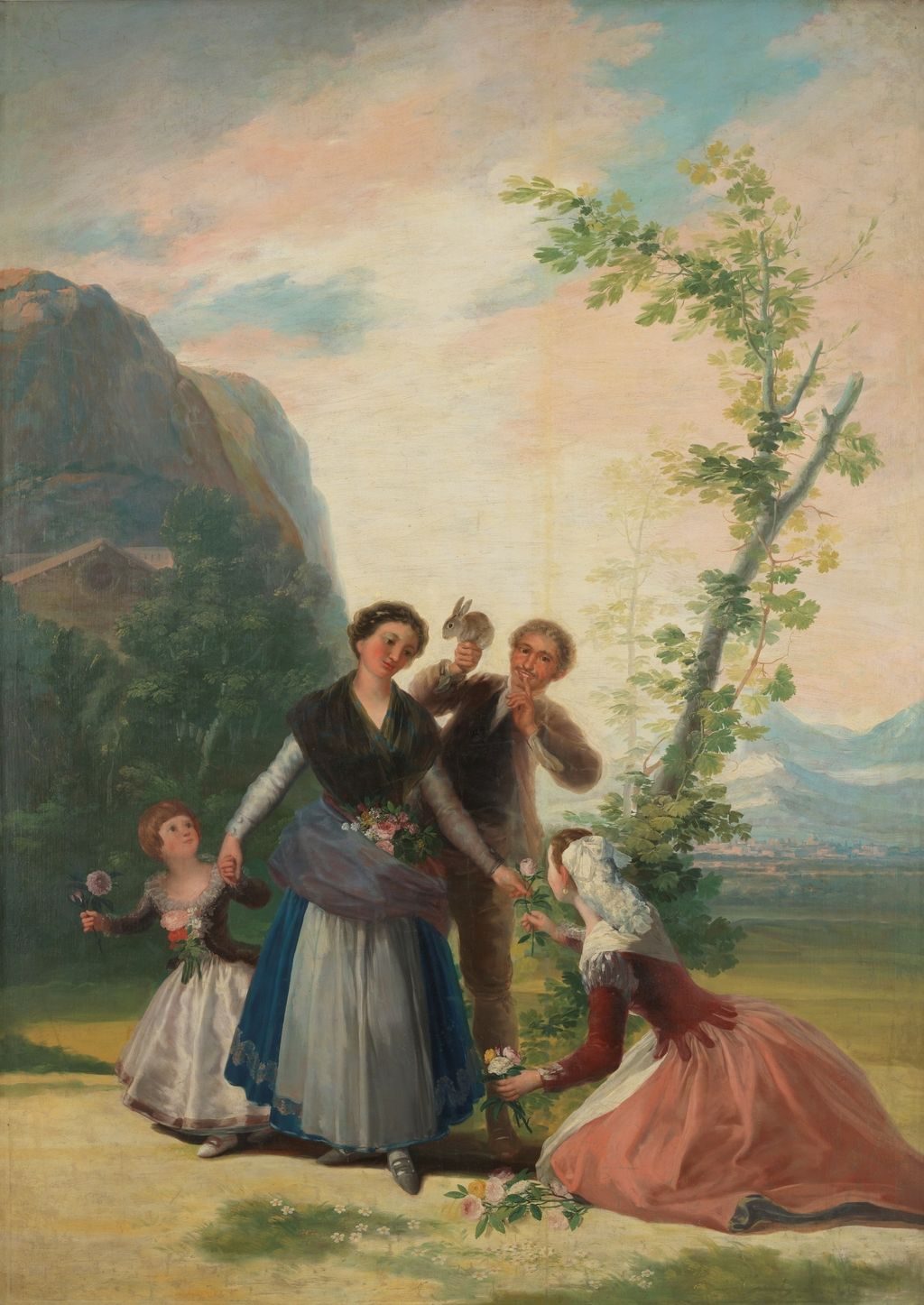
In 1786 Goya became a painter to the king and received his first tapestry commission for Charles III’s own apartments. Earlier designs such as The Parasol belonged to schemes for the Prince of Asturias. The royal commission took in four large seasonal subjects along with other designs made to fit particular spaces. In José Luis Sancho’s reconstruction for Patrimonio Nacional, Winter was intended for the north wall of the room in which the king dined, with the sweep of The Threshing Floor on the west wall. The Grape Harvest and The Flower Girls would face the winter scene from the south wall. The series never occupied the room in the arrangement for which it was designed. [3] [5]
Sancho places two smaller subjects above the doors in the north wall, on either side of the winter tapestry. Hunter beside a Spring and Shepherd Playing a Dulzaina both show a reclining man holding an object associated with his occupation. The hunter has his gun and the shepherd a wind instrument. Their low poses suit the broad spaces above the doorways. Seen as neighbours to the larger scene, they give the eye two moments of relative stillness around the struggle on the track. The designs belong to the same furnishing scheme, although the men in the overdoors have their own settings and occupations. [3] [6] [7]
The seasons put very different kinds of outdoor life before the king. In The Threshing Floor, reapers rest after the summer harvest. Goya spreads the company across more than six metres of canvas, giving individual faces and gestures room to emerge. In The Grape Harvest, an elegantly dressed man offers a bunch of grapes and a child reaches up for it, while agricultural labour goes on behind them. In Winter, food also carries the meaning of the season. It is slung across a working animal, and the people who must get it through the snow remain exposed to the same wind as those who walk empty-handed. [1] [2] [8] [9]
From a small oil sketch to a woven hanging
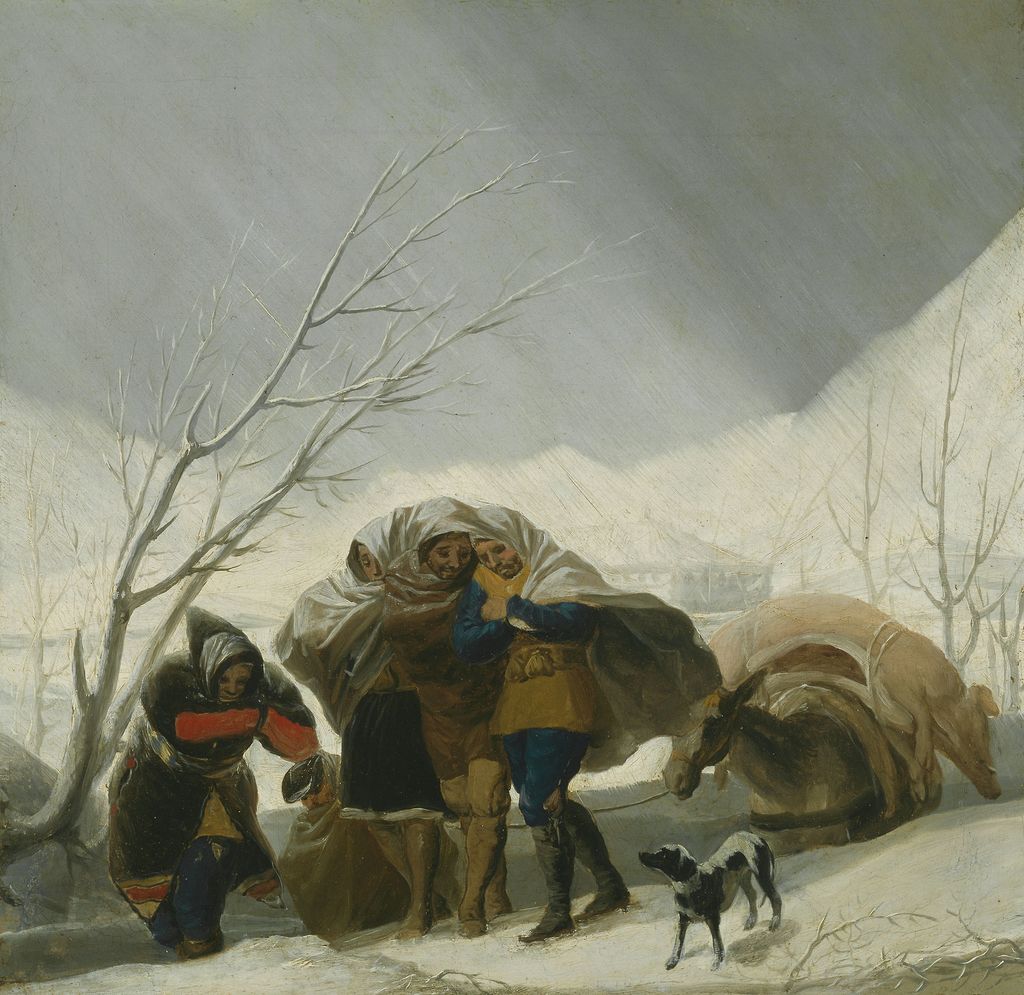
Goya made a small oil sketch in autumn 1786 as part of preparing the designs for Charles III. The sketch survives at the Art Institute of Chicago as Winter Scene, accession 1990.558. The Fundación Goya en Aragón cites a payment request for the carriage that took Goya to El Escorial to show the preliminary work to the king. It also traces the sketch to the ninth Duke of Osuna, who acquired it in 1799. [10]
In the sketch, the three walkers squeeze closer under their covering and the man with the gun is nearer to them. The Fundación identifies the outline of a building in the distance and describes Goya’s use of thin layers of paint to suggest the storm. In the large canvas the building disappears and gaps open up between the figures. Compare the dog and the feet of the walkers. In the sketch they are close to the edge of the painted scene. In the cartoon they stand amid a broader sweep of foreground snow. At full scale, the wind has more room to register in the open ground as well as in the turn of a head or the sweep of a cloak. [1] [10]
A woven La nevada o El invierno belongs to Patrimonio Nacional. Its catalogue records a high-warp tapestry in silk and wool measuring 281 × 288 cm, dated about 1786–88. The painted canvas served as the full-size model for the Royal Tapestry Factory. On a high-warp loom the lengthwise threads run vertically. The weavers build the image by passing coloured threads across them. At nearly three metres wide, the tapestry preserves the scale of the main forms that organise the painting. The sketch can be taken in at arm’s length. The tapestry was meant to be seen from across the room, where the dark cloak and bent tree would still carry the direction of the storm. [1] [3] [10]
Artworks directory
| Name | Date | Medium |
|---|---|---|
| And There’s No Help for It, Plate 15 | Printed 1863 | |
| Asmodea | c. 1820–23 | Wall painting transferred to canvas |
| Boys Inflating a Bladder | 1777–78 | Tapestry cartoon |
| Boys Picking Fruit | 1778 | Tapestry cartoon |
| Bullfight in a Divided Ring | 1825 | Lithograph |
| Card Players | 1777–78 | Tapestry cartoon |
| Card Players (sketch) | 1777–78 | Painted sketch |
| Dance on the Banks of the Manzanares | 1777 | Tapestry cartoon |
| Duel with Cudgels | c. 1820–23 | Wall painting transferred to canvas |
| Heads in a Landscape | c. 1820–23 | Easel painting |
| Judith and Holofernes | c. 1820–23 | Wall painting transferred to canvas |
| Leocadia | c. 1820–23 | Wall painting transferred to canvas |
| Maja and Cloaked Men | 1777 | Tapestry cartoon |
| Maja and Cloaked Men (sketch) | 1777 | Painted sketch |
| Majo Clapping in Time to the Music | 1777 | Drawing |
| Men Reading | c. 1820–23 | Wall painting transferred to canvas |
| Out Hunting for Teeth, Plate 12 | 1799 | Etching, burnished aquatint and burin |
| Picnic in the Countryside (sketch) | 1776–78 | Painted sketch |
| Picnic on the Banks of the Manzanares | 1776 | Tapestry cartoon |
| Pilgrimage to San Isidro | c. 1820–23 | Wall painting transferred to canvas |
| Preparatory study for The Sleep of Reason Produces Monsters | c. 1796–97 | Drawing |
| Procession of the Holy Office | c. 1820–23 | Wall painting transferred to canvas |
| Quarrel at the Cockerel Inn (sketch) | 1777 | Painted sketch |
| Quarrel in the New Tavern | 1777 | Tapestry cartoon |
| Saturn Devouring His Son | c. 1820–23 | Wall painting transferred to canvas |
| Seated Majo Smoking | c. 1776 | Drawing |
| The Dog | c. 1820–23 | Wall painting transferred to canvas |
| The Drinker | 1777 | Tapestry cartoon |
| The Fates | c. 1820–23 | Wall painting transferred to canvas |
| The Great He-Goat | c. 1820–23 | Wall painting transferred to canvas |
| The Kite | 1777–78 | Tapestry cartoon |
| The Parasol | 1777 | Oil on canvas, tapestry cartoon |
| The Second of May 1808 | 1814 | Oil on canvas |
| The Sleep of Reason Produces Monsters, Plate 43 | 1799 | Etching and aquatint |
| The Third of May 1808 | 1814 | Oil on canvas |
| Thou Who Canst Not, Plate 42 | 1799 | Etching and burnished aquatint |
| Three Figures | 1776 | Drawing (lost) |
| Two Old Men | c. 1820–23 | Wall painting transferred to canvas |
| Two Old Men Eating Soup | c. 1820–23 | Wall painting transferred to canvas |
| Two Women and a Man | c. 1820–23 | Wall painting transferred to canvas |
| Universal Language: The Author Dreaming | 1797 | Drawing |
| The Family of Charles IV | 1800 | Oil on canvas |
| Witches’ Sabbath (Osuna painting) | 1797–98 | Oil on canvas |
| The Nude Maja | 1795–1800 | Oil on canvas |
| The Clothed Maja | 1800–07 | Oil on canvas |
| Self-Portrait (Drawing) | c. 1796 | Brush and carbon black ink on laid paper |
| The Swing, Madrid Album B.21 | 1795–97 | Brush and carbon black washes |
| Majas Fighting, a Majo Observing, Madrid Album B.15 | 1796–97 | Brush, grey and black washes on laid paper |
| Majos and Majas Conversing, Madrid Album B.16 | c. 1794–97 | Ink wash on paper |
| Weeping Woman and Three Men, Madrid Album B.17 | 1795–97 | Brush, carbon black washes and black chalk |
| Maja Seated on a Chair and Two Companions Behind, Madrid Album B.18 | 1795–97 | Brush and carbon black washes |
| Girl and Bull, Madrid Album B.23 | 1796–97 | Brush and carbon black washes |
| Lovers Sitting on a Rock, Madrid Album B.24 | 1796–97 | Brush and carbon black washes |
| Mariano Ceballos Riding a Bull | 1825 | Crayon lithograph and scraper |
| Landscape (lifetime impression) | c. 1807–10 | Etching and aquatint |
| Self-Portrait (1815), Prado canvas | 1815 | Oil on canvas |
| Self-Portrait (1815), Academy panel | 1815 | Oil on panel |
| Self-Portrait with Dr Arrieta | 1820 | Oil on canvas |
| Christ Crucified | 1780 | Oil on canvas |
| The Last Communion of Saint Joseph of Calasanz | 1819 | Oil on canvas |
| Christ on the Mount of Olives | 1819 | Oil on panel |
| The Flower Girls, or Spring | 1786–87 | Oil on canvas |
| The Grape Harvest, or Autumn | 1786–87 | Oil on canvas |
| The Snowstorm, or Winter | 1786–87 | Oil on canvas |
| The Threshing Ground, or Summer | 1786–87 | Oil on canvas |
| Picnic on the Banks of the Manzanares | 1776 | Oil on canvas |
| The Kite | 1777–78 | Oil on canvas |
| Dance on the Banks of the Manzanares | 1777 | Oil on canvas |
| A Fight at the Venta Nueva | 1777 | Oil on canvas |
| Blind Man’s Bluff | 1788 | Oil on canvas |
| Dogs on a Lead | 1775 | Oil on canvas |
| Hunting with a Decoy | 1775 | Oil on canvas |
| Hunter Loading His Rifle | 1775 | Oil on canvas |
| The Angler | 1775 | Oil on canvas |
| The Hermitage of San Isidro on His Feast Day | 1788 | Oil on canvas |
| The Meadow of San Isidro | 1788 | Oil on canvas |
| The Straw Manikin | 1791–92 | Oil on canvas |
| Witches’ Flight | c. 1797–98 | Oil on canvas |
| A Scene from ‘The Forcibly Bewitched’ | 1798 | Oil on canvas |
| The Duchess of Alba in Black | 1797 | Oil on canvas |
| The Duchess of Alba in White | 1795 | Oil on canvas |
| Charles III in Hunting Dress | c. 1786 | Oil on canvas |
| The Duke and Duchess of Osuna and Their Children | 1787–88 | Oil on canvas |
| Manuel Osorio Manrique de Zúñiga | 1787–88 | Oil on canvas |
| The Marquesa de Pontejos | c. 1786 | Oil on canvas |
| Equestrian Portrait of the 1st Duke of Wellington | 1812 | Oil on canvas |
| The Duke of Wellington | 1812–14 | Oil on wood |
| Portrait of Ferdinand VII of Spain | 1814 | Oil on canvas |
| Gaspar Melchor de Jovellanos | 1798 | Oil on canvas |
| María Tomasa Palafox y Portocarrero | 1804 | Oil on canvas |
| Señora Sabasa García | c. 1806–11 | Oil on canvas |
| Don Juan Bautista de Muguiro | 1827 | Oil on canvas |
| Doña Isabel de Porcel | Before 1805 | Oil on canvas |
| The Colossus | After 1808 | Oil on canvas |
| The Burial of the Sardine | 1808–12 | Oil on panel |
| The Madhouse | 1808–12 | Oil on panel |
| A Procession of Flagellants | 1808–12 | Oil on panel |
| Portrait of Jacques Galos | 1826 | Oil on canvas |
| Portrait of Mariano Goya, the Artist’s Grandson | 1827 | Oil on canvas |
| Milkmaid of Bordeaux | c. 1827 | Oil on canvas |
| Portrait of Don Juan Antonio Cuervo | 1819 | Oil on canvas |
| María Luisa of Parma (Naples version) | c. 1800 | Oil on canvas |
| The Countess of Baena | 1819 | Oil on canvas |
| The Family of the Infante Don Luis | 1783–84 | Oil on canvas |
| The Holy Family | c. 1787 | Oil on canvas |
| Saint Barbara | c. 1773 | Oil on canvas |
| Saints Justa and Rufina | 1817 | Oil on canvas |
| El Tío Paquete | c. 1819–20 | Oil on canvas |
| The Forge | c. 1815–20 | Oil on canvas |
| Majas on a Balcony (Metropolitan Museum version) | c. 1800–10 | Oil on canvas |
| Maja and Celestina on a Balcony | c. 1808–12 | Oil on canvas |
| The Water Bearer | 1808–12 | Oil on canvas |
| Time and the Old Women | c. 1810 | Oil on canvas |
Frequently Asked Questions
Discussion
Look again at the images and ideas explored in The Snowstorm, or Winter. These editorial prompts invite your observations.
Where did you first notice the strength of the wind, in the branches, the clothes or the way the men walk? How does the dog’s position affect the way you read the encounter?
Reader Insights
Which forms make the wind visible?
How does the small Chicago sketch handle the group differently?
Join the Conversation
Share a detail, comparison or question about The Snowstorm, or Winter below.
References
- Museo Nacional del Prado, La nevada o El Invierno, P000798 and printed collection catalogue, no. 798. View source 1. View source 2.
- Fundación Goya en Aragón, La nevada, cartoon catalogue entry and illustration. View source.
- José Luis Sancho, La nevada o El invierno, in Carlos III. Majestad y Ornato, Patrimonio Nacional, tapestry entry and reconstruction of the El Pardo room. View source.
- Gudrun Maurer, The Snowstorm or Winter, Museo Nacional del Prado commentary, 2020. View source.
- Fundación Goya en Aragón, El quitasol, catalogue entry and El Pardo commission. View source.
- Fundación Goya en Aragón, Cazador al lado de una fuente, hunter cartoon. View source.
- Fundación Goya en Aragón, Pastor tocando la dulzaina, shepherd cartoon. View source.
- Fundación Goya en Aragón, La era, summer cartoon. View source.
- Fundación Goya en Aragón, La vendimia, autumn cartoon. View source.
- Fundación Goya en Aragón, El invierno (boceto), preparatory oil sketch in the Art Institute of Chicago, 1990.558. View source.







