


 by Tom Gurney
Tom Gurney BSc (Hons) is an art history expert with over 20 years experience
Published on June 19, 2020 / Updated on November 20, 2026
Email: tomgurney1@gmail.com / Phone: +44 7429 011000
Introduction
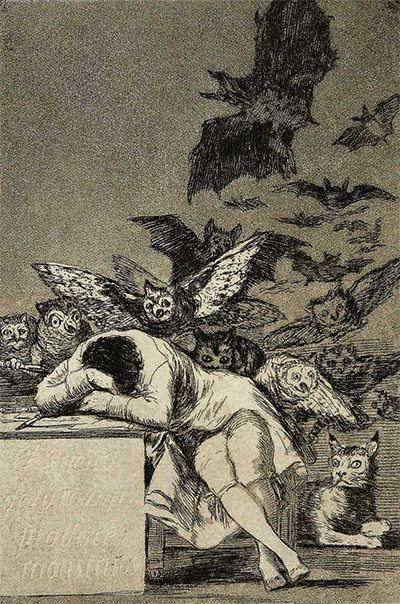
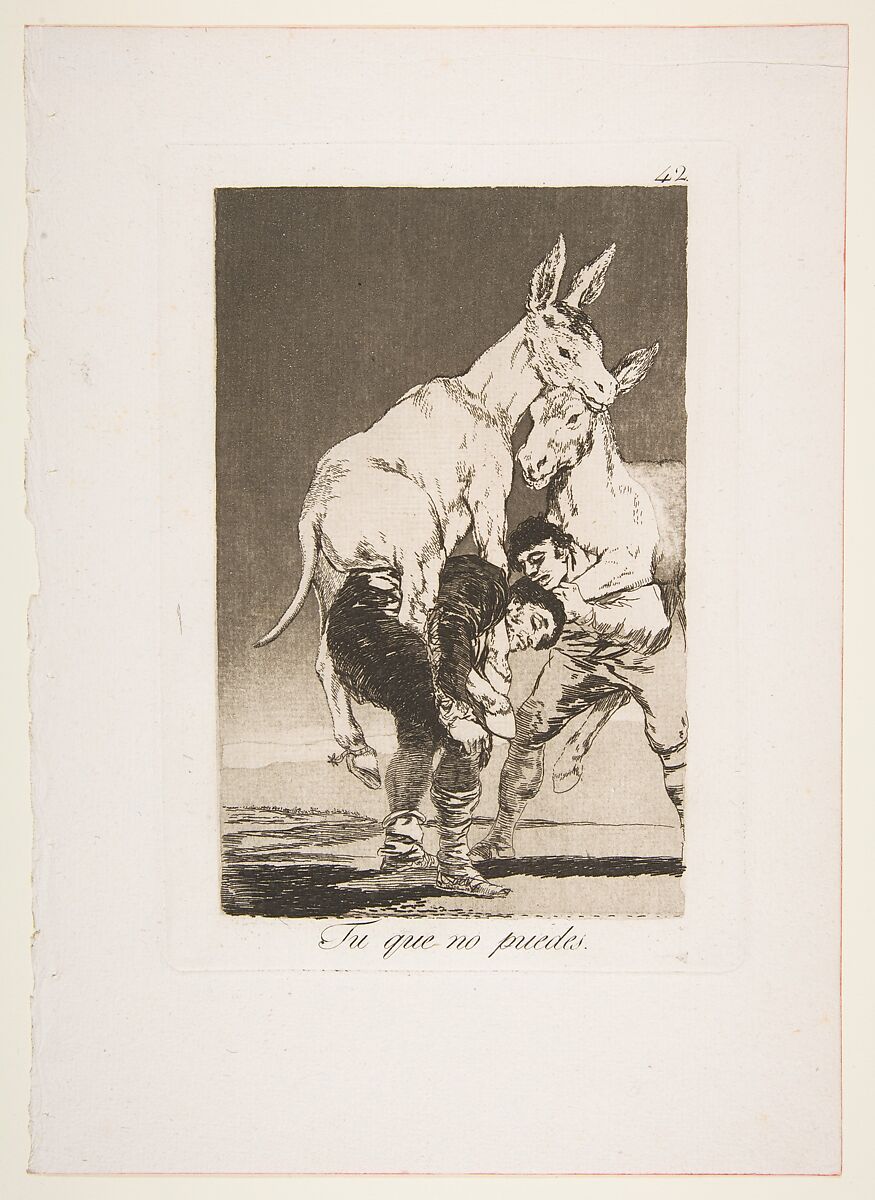
Two men bend almost double beneath the weight of two donkeys. One of the animals rides with its mouth open while its bearer pitches his face towards the ground. Underneath, Francisco de Goya has written Tu que no puedes, ‘Thou who canst not’. The words address someone already struggling. There is a joke in the sight of donkeys getting a ride, but the men’s shoulders and knees keep bringing the eye back to what the joke costs. This is Plate 42 of Los Caprichos. Turn the page and a man falls asleep at his desk as a flock of owls and bats gathers behind him. Goya puts the two pictures close enough together for a reader to carry the first image into the second. [1] [2]
Los Caprichos is the full series of eighty prints that Goya published in Madrid in 1799. The Metropolitan Museum of Art in New York holds examples of both of these prints from that edition. The National Gallery of Victoria in Melbourne acquired a first-edition set in 1976 through the Felton Bequest. Its catalogue records designs printed in sepia ink, and its print of Plate 42 combines etching and burnished aquatint. The same number, image and caption may appear on sheets printed decades apart because the copperplates survived and were used again. The edition matters when looking at the way a particular sheet renders a shadow, a face or a patch of open ground. [1] [2] [3] [4]
Some scenes involve courtship, money or public punishment, while others give animals human occupations and imagine what witches do out of sight. Connections often emerge from the way Goya poses a body or asks us to listen to a voice. A doctor leans over a patient. An older woman counsels a younger one. A crowd watches a shamed person pass. In each case, some people have the authority to direct or judge what others do. The picture and its caption can suggest very different things about whether that authority is deserved. [3] [4]
At a Glance
From the albums to a numbered series
Some of Goya’s material came from the drawings known as Album A, or the Sanlúcar Album, and Album B, or the Madrid Album. The Museo Lázaro Galdiano also traces the published series to the Sueños, or Dreams, a group of drawings that brought scenes and inscriptions together in preparation for printmaking. The albums gave Goya figures and situations to return to, while the Dreams show him thinking about what could happen when an imagined episode was read alongside a line of writing. The published numbers give the prints a new order. A reader can see the change even in the cases where the sequence of surviving works on paper is clear. [5] [6]
The Calcografía Nacional’s inventory gives a sense of how several stages could feed a single print. It lists a sheet from Album A among the sources for Plate 15, along with a separate preparatory drawing now in the Prado. For Plate 13, the inventory follows the scene back through two preparatory drawings, one numbered among the Sueños, to a brush drawing in Album B. The different paths to those two images help account for the variety of the published series. Sometimes Goya developed an idea through several sheets, and sometimes an album already supplied a figure or pairing that he could reuse. [25]
The Prado’s Dream 27: Witches Disguised as Ordinary Doctors (D04198), made in 1797, is a good place to start. Goya worked in pen and iron-gall ink over traces of black chalk. There are two donkey doctors at the patient’s bedside in this drawing. One takes his pulse; the other, above the bed, peers at a paper. A woman stands close to the physician in the foreground. The inscribed title invites the reader to consider what else the physicians might be. Frank I. Heckes, writing for the NGV, draws attention to the way the design brings two kinds of suspect cures together, those offered by doctors and those attributed to witches. [3] [4]
Set the drawing beside the NGV’s first-edition impression of Plate 40 (P1.40-1976), De que mal morira?, or Of What Ill Will He Die? A single donkey physician dominates the bed, its hoof extended to the sick man’s wrist. The shape of the room matters much less than the encounter. The animal’s large, dark figure faces a pale patient who can barely raise his head. The new caption asks about the cause of death as though death were a foregone conclusion. As the second doctor disappears and the reference to witches drops out of the wording, the apparent medical consultation becomes easier to recognise and harder to trust. The drawing anticipates the print and helps us see how deliberately Goya pared back the incident. Its 27 is the number of the Dream. Plate 40 puts the doctor among other donkeys with human roles. [4]
The change of opening image affected the whole book. The Prado’s drawing Ydioma universal. El Autor soñando (D03923) shows a sleeper slumped over a desk. An inscription identifies him as the dreaming author and declares his intention to dispel harmful popular misconceptions. The sheet bears the imprint of a copperplate from the pressure of the press when the design was transferred. An image developed to present the project to its reader became the basis of Plate 43. In the published print the words across the desk prompt the reader to think about reason and what happens in its sleep. [2] [7]
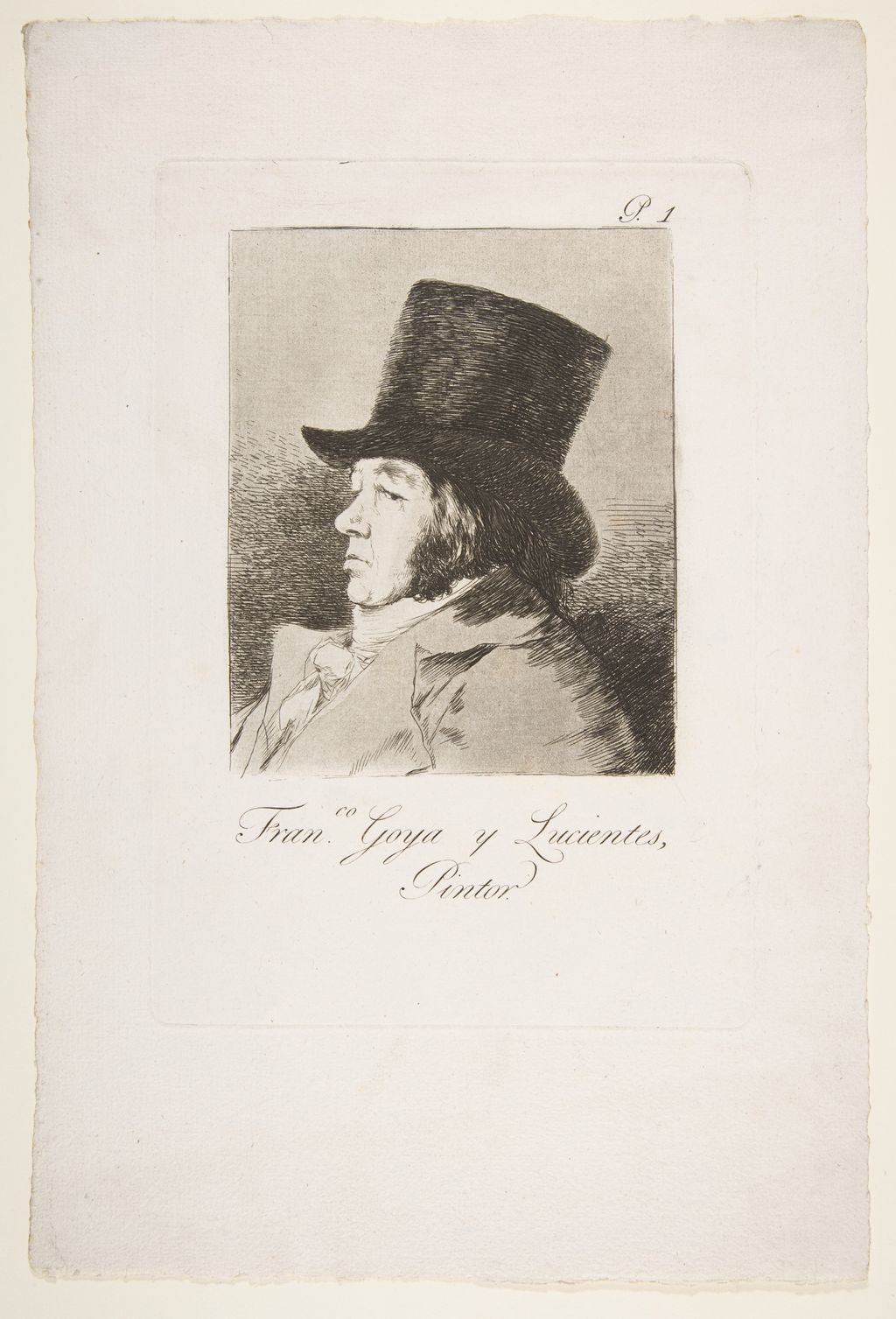
Instead, the book opens with the self-portrait Francisco Goya y Lucientes, Painter. The sitter wears a high hat and turns his eye sideways from a profile pose. His full name and profession appear below. The 1799 buyer thus encountered a named artist before meeting the people and creatures he invented. By the time that reader reached the sleeper near the middle, Goya had already asked them to entertain numerous small reversals of judgement. The picture can be read as a pause after those encounters and a prelude to the darker scenes ahead. The Prado’s marked drawing and the early printed sheets show that the position of a picture could change as much as its composition or words. [2] [7] [8]
Copper, tone and paper
At the size of an actual print, it takes only a slight shift in the density of the ink to bring a hand forward or let a figure recede. The engraved area of the Met’s Plate 42 is about 21.5 by 15 centimetres. The very fine contours of the beasts and their bearers coexist with large expanses of tone. Goya could make a drawn line by passing a needle through an acid-resistant coating on the copper. Acid bit into the exposed metal. When the plate was inked and wiped, the recessed lines held ink that transferred to paper under pressure. The pressure also often left the outline of the plate around the printed image. That outline can help a viewer distinguish the dimensions of the copper from those of the sheet they are holding. [1] [9]
Aquatint let Goya use the same principle to work in broad patches. Heated resin particles protected specks of copper while acid bit the metal between them. The tiny pits retained ink and printed as a grainy tone. Different depths of biting could give different shades. Goya could protect areas he wanted to keep pale with varnish, or smooth an already worked area with a burnisher so that it printed more lightly. The NGV’s conservators point to Plate 38, Brabísimo!, where he burnished through areas of both etched marks and aquatint to lift the light along the donkey’s hind leg. It is a local adjustment that gives the animal more shape. The white that meets the viewer is the result of working back into the copper, and a close view can make the difference between delicate shading and a harder edge apparent. [9] [10]
Other tools put marks directly into the metal. A burin cuts a groove, while a drypoint needle scratches the plate and can raise a burr that carries ink beside the incision. The Met lists etching, burnished aquatint, drypoint and burin in its impression of Plate 23. That list describes several kinds of work brought together in a small space. It leaves room to attend to the close-set contours that define the figure and the more elusive tonal shapes in which the crowd gathers. [9] [11]
The plate could change after Goya had seen it printed. A working proof of Plate 15, Bellos consejos, in the Met (30.54.44) has touches of pen and ink around the younger woman’s eyes. The museum describes this as hand retouching before Goya reworked the copper. On its published impression (18.64(15)), the museum lists etching, burnished aquatint and burin. The distinction helps explain what a proof could do in the workshop. Pulling an impression allowed Goya to judge the actual printed effect. He could try a change on that sheet before deciding how to make it in metal, where all impressions from the revised plate would carry it. [12] [13]
The way a plate was printed still mattered once its design was ready. The NGV’s conservators describe its first-edition set as printed in sepia ink on laid paper, with the plates wiped clean so that the paper could show through strongly in the highlights. They judge that the edition was probably made under Goya’s supervision and leave the printer’s identity open. The design cut and bitten into copper is only part of the evidence on a surviving sheet. The paper, the colour of the ink and the way the plate was wiped also tell us about that particular printing. These are features to keep in mind across Goya’s etchings, especially when collections hold multiple impressions from the same plate. [14]
Goya on film
Five films explore Goya’s portraits, prints, Black Paintings and painting techniques.
The Duke of Wellington by Goya
The portrait, its military decorations and its later theft.
Watch on YouTubeHow to read the satire
An ordinary action taken to an extreme
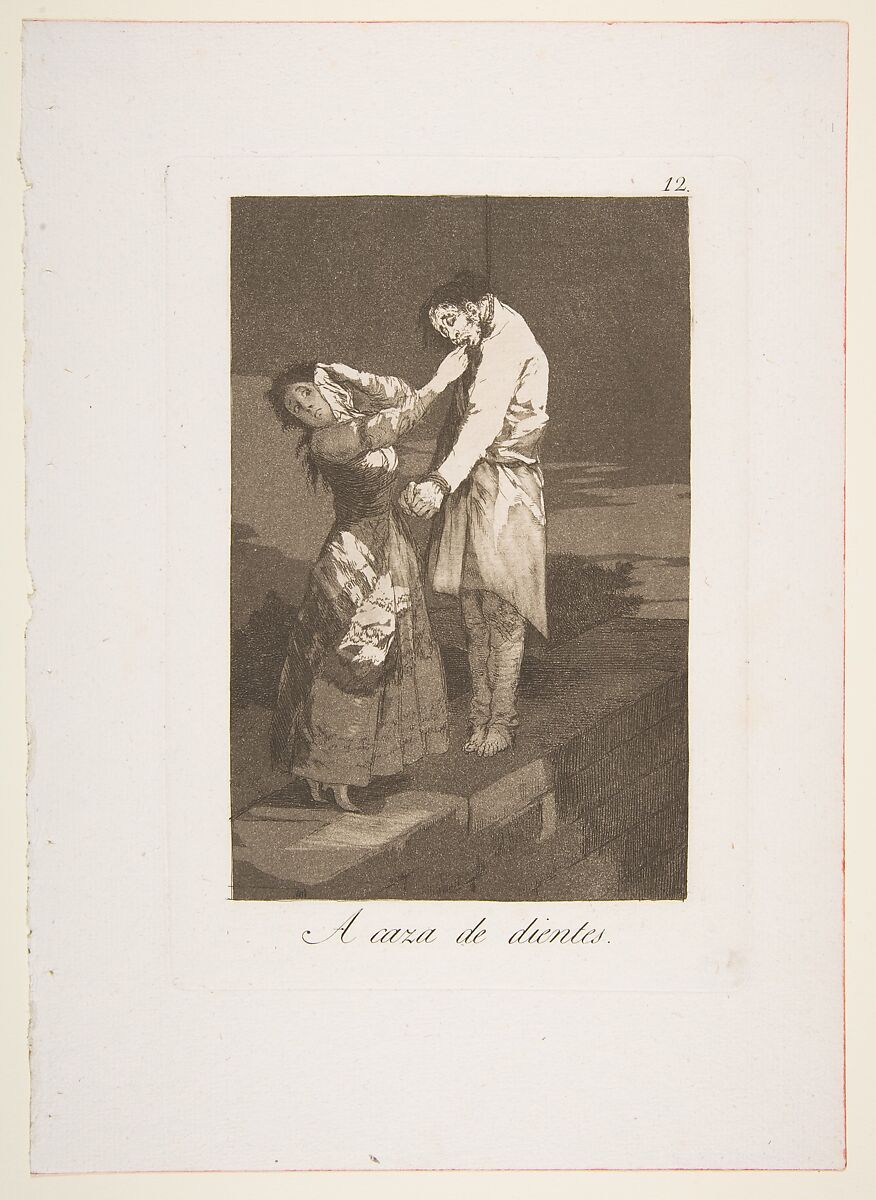
In Plate 12, A caza de dientes (Out Hunting for Teeth), a woman reaches up to the mouth of a hanged man. She rises onto her toes and holds a cloth to her face. Her body moves towards him as her head turns away. The Met’s 1799 impression (18.64(12)), made with etching, burnished aquatint and burin, makes the gesture easy to pick out. The pale dress claims space against the shadow even as the upper bodies draw awkwardly close. The caption names the activity with the briskness of a trip out to look for something. The image supplies the fear, effort and indignity that such a phrase leaves out. [15]
The Met cites an early manuscript commentary that explains the value of a hanged man’s teeth in sorcery and derides the belief. The gloss establishes a context for the action. The woman’s pose keeps another question alive. Why does someone visibly recoiling from the dead continue what she came to do? The print pictures the physical force that a belief can exert over someone. The Caprichos will revisit beliefs about witches in other forms, but here Goya makes the horror depend on a woman’s very human hesitation. [15]
A compliment with a sharp edge
The older, veiled woman in Plate 15 bends towards an elegantly dressed young woman, whose open fan takes the light while her eyes drop. The younger figure is a maja, a recognisable type associated here with fashionable street dress. The Met reads the older woman as a probable procuress coaching her companion in the art of attracting a man. The adjective in Bellos consejos, ‘pretty advice’, turns the title into a question of tone. It sounds like approval, but the closeness of the whisper and the younger woman’s lowered gaze invite us to weigh the motive for the advice. The economic bargain suggested by the encounter remains outside the visible moment. [12] [13]
The art of the fan, veil and downcast look can be read alongside the partly hidden face in Plate 12. One woman seems to avert her eyes from something repellent and the other listens with her eyes lowered. Each scene gives a small act of concealment great weight. The difference is in the degree of cooperation that the picture lets us see. The woman under the gallows will have to reach for what she came to take. The young woman in Plate 15 is still listening. [12] [15]
Judgement as a public sight
In Plate 23, Aquellos polbos (These Specks of Dust), the accused sits with head bowed under a tall penitential cap. An official reads from a raised platform at the side of the scene. Faces emerge from the gloom beyond. This is an inquisitorial spectacle, organised to make the accused visible to a crowd. The proverb evoked by the caption describes the dust that leads to mud. Written beneath such a scene, the fragment raises the question of how a supposed offence came to warrant public humiliation. Which small act set this in motion, and who decided what it should cost? [11] [16]
In the Met’s Plate 24 (18.64(24)), made with etching and burnished aquatint, the woman in the penitential cap sits astride a donkey while spectators line her route. The pose and angle have changed. In the preceding print the person under judgement bows their head; here the condemned woman’s face is exposed to view. The caption Nohubo remedio (‘There was no remedy’) sounds as if the outcome could only have gone one way. The commentary known from the López de Ayala manuscript gives that fatalism a social bite by asking how there could be a remedy for a woman who was poor and ugly. That gloss is testimony to a reading passed down with the prints. The printed words themselves leave open whose fatalism we are hearing. [17] [18]
The Prado commentary, generally attributed to Goya, the anonymous manuscript in the Biblioteca Nacional and the commentary known from the López de Ayala manuscript offer different kinds of explanations. As Heckes shows in his account of Plate 27, the Prado gloss gives a general reading about mutual deception in courtship, while the other two attach names to the pair. Such identifications tell us what people connected with the images, and the variety of readings makes it hard to treat any of the commentaries as a master key. [3] [4]
A burden turned into a proverb
Plate 42 again makes an unequal arrangement visible through posture. Its caption gives the first half of a familiar saying, which asks someone who is already struggling to carry the speaker on their back. One donkey wears a spur, a detail that makes the unequal arrangement look enforceable. The anonymous Biblioteca Nacional gloss takes the men to stand for people whose work and contributions support the state. Look back to the woman in Plate 24 and the shared device comes into view. Goya uses the position of an exposed body to make a social relation immediately legible, even as questions about the agents and causes of that arrangement remain open. [1] [17] [19]
The figures in Plate 42 and the animals of The Sleep of Reason Produces Monsters also look different for being neighbours. The donkeys ride in full view, calm enough to seem accustomed to such treatment. In the next print the creatures gather as the person who might see them hides his face in his sleeves. The sequence takes us from an absurdity that can be seen and described to the question of what comes into view when the observer’s eyes close. [1] [2]
Recognition and disguise in the opening plates
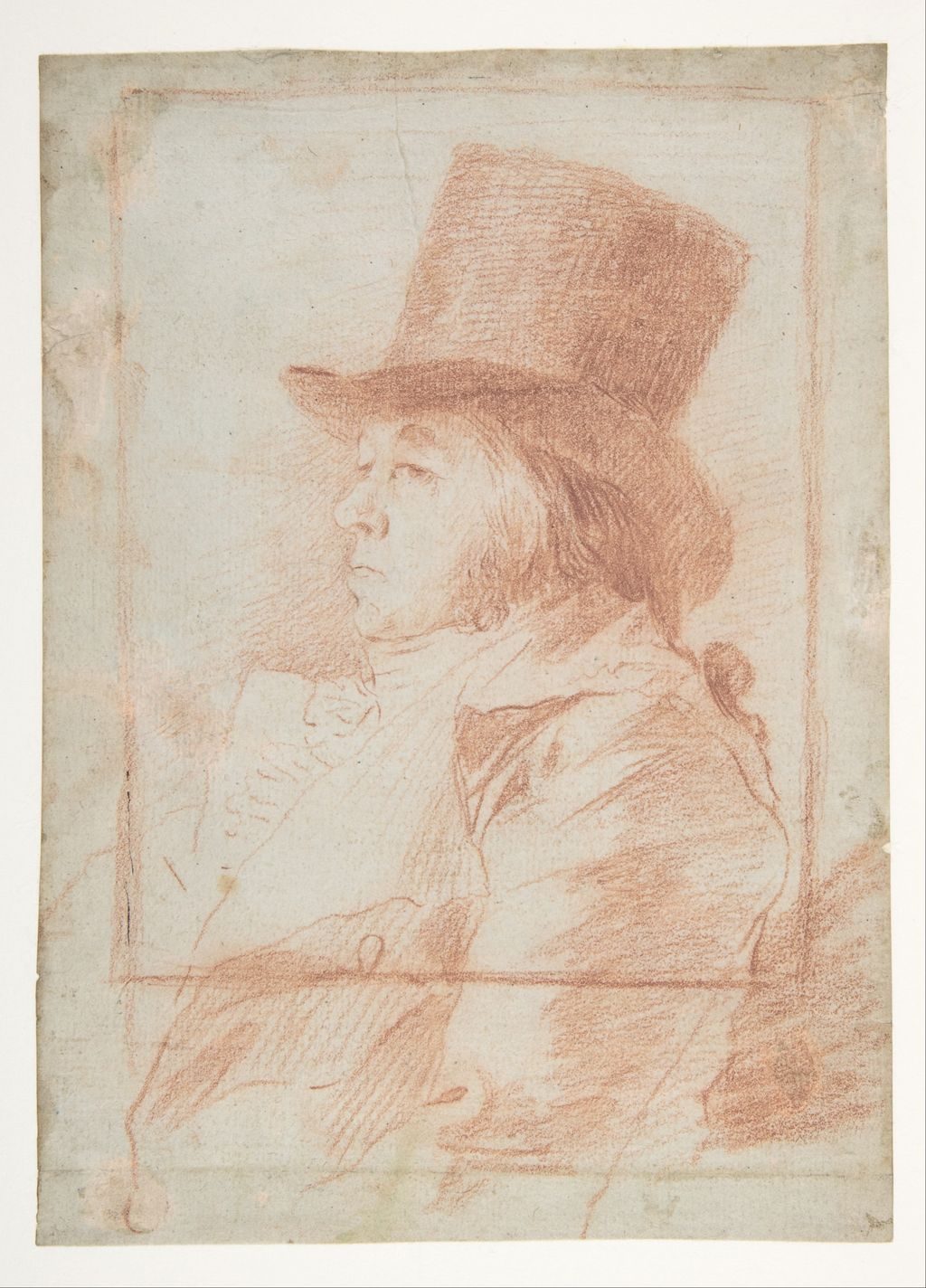
The first plate makes a pointed claim about who is looking. The preparatory drawing at the Met studies features and dress in red chalk on the front, with further studies of the face on the reverse. In the published self-portrait the name beneath the image gives the reader an identifiable author before the series begins to offer less secure identifications. The tall hat and stylish dress belong to the public person that author presents. The narrowed gaze, already something Goya had tested in drawing, encourages a reader to notice how people watch one another across the prints. [27] [28] [15]
Plate 12 takes recognition in a different direction. The act of reaching for the hanged man’s teeth can be understood through the period belief that such teeth could serve magical ends. The scene does not supply a portrait likeness or make the reader identify a particular victim. Goya gives physical prominence to the reaching figure’s response to the body overhead. If one reads the inscription before looking again, the awkward closeness between the two bodies acquires a motive. The words narrow the kind of action one sees and leave the individual actors anonymous. [27] [28] [15]
Placed beside one another, the prints show why the series does not need a single method for pointing to its targets. The opening likeness encourages readers to credit an artist with the choice of subject. A plate such as Out Hunting for Teeth gives them an action to recognise and judge. A manuscript gloss can add another historical reading, but visible details like dress, gaze and hand position remain available to people who never saw a commentary. The distance between the drawing for the self-portrait and the printed encounter with the hanged man also shows how readily Goya moves from a face studied at close range to an incident that the viewer has to reconstruct. [27] [28] [15]
The first plate also makes an instructive comparison between the catalogue terms for drawing and print. The study combines red chalk with work in pen and ink on the reverse. The plate gives the portrait a medium in which a repeatable tonal field can bring the head forward on many sheets. It is easy to concentrate exclusively on the identity of the sitter and miss that change of function. A specific pose first studied on one piece of paper becomes the first encounter in a book sold to strangers. The measured shape of the printed portrait makes an invitation out of a close and less public study. [27] [28] [15]
Sale, inquiry and later editions
How the prints reached buyers
On 6 February 1799, the Diario de Madrid announced that the collection could be bought at the perfume and liquor shop at no. 1 Calle del Desengaño. The charge for eighty prints was 320 reales de vellón. The shop was downstairs in the building where Goya lived. The price was for a complete set. Each design carried its own number and caption, so readers could follow and discuss the same order in different copies. The Biblioteca Nacional de España’s exhibition catalogue records private sales before the public notice, including four sets bought by the Duchess of Osuna. The advertisement marks the opening of public sale, by which time some prints had already reached buyers. [20] [21] [22]
The notice devoted much of its space to the grounds on which an artist might satirise faults and prejudices. It claimed for painting a freedom of invention similar to poetry’s. Traits dispersed among several people could be gathered into an invented figure. Think of the donkey doctor with his hoof on the patient’s wrist. The gesture is sufficiently particular to suggest a practitioner anyone might recognise, while the animal figure makes the latitude claimed in the notice plain. Putting the series on sale and explaining its aim were part of the same undertaking. Buyers got both a set of pictures to consider privately and an invitation to reflect on widely shared habits. [4] [20] [22]
Goya later reported selling twenty-seven sets in two days of public sale. The figure belongs to his account of the sale, alongside the evidence for private purchases and further circulation. In 1803 he offered the eighty copperplates to Charles IV, together with 240 printed sets, for the royal print office, the Real Calcografía. In return the Crown granted a pension to his son Javier. The transaction brought the means of making new impressions and a stock of finished prints under the same institution. As José María Lanzarote Guiral’s study of the documents shows, the Real Calcografía could sell the series from 1803, and prints continued to circulate. [3] [21] [22]
What the Inquisition record establishes
In a letter to Joaquín María Ferrer on 20 December 1825, Goya recalled giving the plates to the king and being reported to the Inquisition despite that transfer. A document published by Lanzarote Guiral gives the episode an archival date. On 7 September 1804 the tribunal in Toledo forwarded a copy of the prints and the papers of its inquiry to the central council of the Inquisition. The covering letter records a denunciation against the collection. It describes twenty-eight folios of case papers, including the tribunal’s recommendation. The surviving letter establishes that the inquiry took place a year after the transfer to the Crown. [22]
The accompanying file has yet to come to light, so the case against the pictures and the central council’s final response are unknown. Lanzarote Guiral considers possible intervention by figures in government, the royal family or the Church and reads the known record as suggesting that Goya escaped serious consequences. What prompted the early end of public sales in 1799 is a separate historical question. Goya’s account tells us how short that initial sale was. The surviving tribunal letter gives us firm evidence for an inquiry in 1804. An official ban and personal intervention remain unproven. [22]
An image can travel in more than one edition
The transfer also helps explain why Los Caprichos can be encountered in many forms today. Princeton University Art Museum holds a bound volume of eighty impressions (2004-377.1–.80), which it catalogues as a fifth edition printed in 1881–86 by the Calcografía Nacional for the Real Academia. Its plates bear the numbers and titles familiar to the original readers. Princeton’s two dates give the date of the original publication and that of the later edition of the physical volume. Comparing the set with the NGV’s first edition means comparing different sheets carrying the same designs. The condition of a plate, the paper and the printing can all contribute to the appearance of any one sheet. A photograph alone gives a limited basis for dating an impression. [14] [23]
A single later impression is the Museo de Zaragoza’s Until Death, Plate 55 (NIG 09319), catalogued as a 1937 impression from the twelfth edition. The museum records etching, drypoint and burnished aquatint, techniques that describe the making of the image on the plate. The edition date describes the making of this print more than a century after Goya’s death. On a collection label, both kinds of information can sit next to the artist’s name. [26]
The copperplates have histories of their own. The Real Academia’s conservation report records work on the eighty Caprichos matrices beginning in 2023. The Academy’s inventory had already recorded the coating of plates 41 to 60 in the first months of 1873. The conservators prepared the surfaces by removing old residues, then removed later electrolytic metal coatings that had been applied to the copper. They treated and protected the exposed surfaces for preservation. The cleaned plates and the 1799 impressions therefore preserve different kinds of evidence. The surviving copper shows the worked matrix, with its own history of treatment. An early sheet preserves the transfer of ink at a particular moment, under printing conditions that the plate alone cannot preserve. [14] [24] [25]
Artworks directory
| Name | Date | Medium |
|---|---|---|
| And There’s No Help for It, Plate 15 | Printed 1863 | |
| Asmodea | c. 1820–23 | Wall painting transferred to canvas |
| Boys Inflating a Bladder | 1777–78 | Tapestry cartoon |
| Boys Picking Fruit | 1778 | Tapestry cartoon |
| Bullfight in a Divided Ring | 1825 | Lithograph |
| Card Players | 1777–78 | Tapestry cartoon |
| Card Players (sketch) | 1777–78 | Painted sketch |
| Dance on the Banks of the Manzanares | 1777 | Tapestry cartoon |
| Duel with Cudgels | c. 1820–23 | Wall painting transferred to canvas |
| Heads in a Landscape | c. 1820–23 | Easel painting |
| Judith and Holofernes | c. 1820–23 | Wall painting transferred to canvas |
| Leocadia | c. 1820–23 | Wall painting transferred to canvas |
| Maja and Cloaked Men | 1777 | Tapestry cartoon |
| Maja and Cloaked Men (sketch) | 1777 | Painted sketch |
| Majo Clapping in Time to the Music | 1777 | Drawing |
| Men Reading | c. 1820–23 | Wall painting transferred to canvas |
| Out Hunting for Teeth, Plate 12 | 1799 | Etching, burnished aquatint and burin |
| Picnic in the Countryside (sketch) | 1776–78 | Painted sketch |
| Picnic on the Banks of the Manzanares | 1776 | Tapestry cartoon |
| Pilgrimage to San Isidro | c. 1820–23 | Wall painting transferred to canvas |
| Preparatory study for The Sleep of Reason Produces Monsters | c. 1796–97 | Drawing |
| Procession of the Holy Office | c. 1820–23 | Wall painting transferred to canvas |
| Quarrel at the Cockerel Inn (sketch) | 1777 | Painted sketch |
| Quarrel in the New Tavern | 1777 | Tapestry cartoon |
| Saturn Devouring His Son | c. 1820–23 | Wall painting transferred to canvas |
| Seated Majo Smoking | c. 1776 | Drawing |
| The Dog | c. 1820–23 | Wall painting transferred to canvas |
| The Drinker | 1777 | Tapestry cartoon |
| The Fates | c. 1820–23 | Wall painting transferred to canvas |
| The Great He-Goat | c. 1820–23 | Wall painting transferred to canvas |
| The Kite | 1777–78 | Tapestry cartoon |
| The Parasol | 1777 | Oil on canvas, tapestry cartoon |
| The Second of May 1808 | 1814 | Oil on canvas |
| The Sleep of Reason Produces Monsters, Plate 43 | 1799 | Etching and aquatint |
| The Third of May 1808 | 1814 | Oil on canvas |
| Thou Who Canst Not, Plate 42 | 1799 | Etching and burnished aquatint |
| Three Figures | 1776 | Drawing (lost) |
| Two Old Men | c. 1820–23 | Wall painting transferred to canvas |
| Two Old Men Eating Soup | c. 1820–23 | Wall painting transferred to canvas |
| Two Women and a Man | c. 1820–23 | Wall painting transferred to canvas |
| Universal Language: The Author Dreaming | 1797 | Drawing |
| The Family of Charles IV | 1800 | Oil on canvas |
| Witches’ Sabbath (Osuna painting) | 1797–98 | Oil on canvas |
| The Nude Maja | 1795–1800 | Oil on canvas |
| The Clothed Maja | 1800–07 | Oil on canvas |
| Self-Portrait (Drawing) | c. 1796 | Brush and carbon black ink on laid paper |
| The Swing, Madrid Album B.21 | 1795–97 | Brush and carbon black washes |
| Majas Fighting, a Majo Observing, Madrid Album B.15 | 1796–97 | Brush, grey and black washes on laid paper |
| Majos and Majas Conversing, Madrid Album B.16 | c. 1794–97 | Ink wash on paper |
| Weeping Woman and Three Men, Madrid Album B.17 | 1795–97 | Brush, carbon black washes and black chalk |
| Maja Seated on a Chair and Two Companions Behind, Madrid Album B.18 | 1795–97 | Brush and carbon black washes |
| Girl and Bull, Madrid Album B.23 | 1796–97 | Brush and carbon black washes |
| Lovers Sitting on a Rock, Madrid Album B.24 | 1796–97 | Brush and carbon black washes |
| Mariano Ceballos Riding a Bull | 1825 | Crayon lithograph and scraper |
| Landscape (lifetime impression) | c. 1807–10 | Etching and aquatint |
| Self-Portrait (1815), Prado canvas | 1815 | Oil on canvas |
| Self-Portrait (1815), Academy panel | 1815 | Oil on panel |
| Self-Portrait with Dr Arrieta | 1820 | Oil on canvas |
| Christ Crucified | 1780 | Oil on canvas |
| The Last Communion of Saint Joseph of Calasanz | 1819 | Oil on canvas |
| Christ on the Mount of Olives | 1819 | Oil on panel |
| The Flower Girls, or Spring | 1786–87 | Oil on canvas |
| The Grape Harvest, or Autumn | 1786–87 | Oil on canvas |
| The Snowstorm, or Winter | 1786–87 | Oil on canvas |
| The Threshing Ground, or Summer | 1786–87 | Oil on canvas |
| Picnic on the Banks of the Manzanares | 1776 | Oil on canvas |
| The Kite | 1777–78 | Oil on canvas |
| Dance on the Banks of the Manzanares | 1777 | Oil on canvas |
| A Fight at the Venta Nueva | 1777 | Oil on canvas |
| Blind Man’s Bluff | 1788 | Oil on canvas |
| Dogs on a Lead | 1775 | Oil on canvas |
| Hunting with a Decoy | 1775 | Oil on canvas |
| Hunter Loading His Rifle | 1775 | Oil on canvas |
| The Angler | 1775 | Oil on canvas |
| The Hermitage of San Isidro on His Feast Day | 1788 | Oil on canvas |
| The Meadow of San Isidro | 1788 | Oil on canvas |
| The Straw Manikin | 1791–92 | Oil on canvas |
| Witches’ Flight | c. 1797–98 | Oil on canvas |
| A Scene from ‘The Forcibly Bewitched’ | 1798 | Oil on canvas |
| The Duchess of Alba in Black | 1797 | Oil on canvas |
| The Duchess of Alba in White | 1795 | Oil on canvas |
| Charles III in Hunting Dress | c. 1786 | Oil on canvas |
| The Duke and Duchess of Osuna and Their Children | 1787–88 | Oil on canvas |
| Manuel Osorio Manrique de Zúñiga | 1787–88 | Oil on canvas |
| The Marquesa de Pontejos | c. 1786 | Oil on canvas |
| Equestrian Portrait of the 1st Duke of Wellington | 1812 | Oil on canvas |
| The Duke of Wellington | 1812–14 | Oil on wood |
| Portrait of Ferdinand VII of Spain | 1814 | Oil on canvas |
| Gaspar Melchor de Jovellanos | 1798 | Oil on canvas |
| María Tomasa Palafox y Portocarrero | 1804 | Oil on canvas |
| Señora Sabasa García | c. 1806–11 | Oil on canvas |
| Don Juan Bautista de Muguiro | 1827 | Oil on canvas |
| Doña Isabel de Porcel | Before 1805 | Oil on canvas |
| The Colossus | After 1808 | Oil on canvas |
| The Burial of the Sardine | 1808–12 | Oil on panel |
| The Madhouse | 1808–12 | Oil on panel |
| A Procession of Flagellants | 1808–12 | Oil on panel |
| Portrait of Jacques Galos | 1826 | Oil on canvas |
| Portrait of Mariano Goya, the Artist’s Grandson | 1827 | Oil on canvas |
| Milkmaid of Bordeaux | c. 1827 | Oil on canvas |
| Portrait of Don Juan Antonio Cuervo | 1819 | Oil on canvas |
| María Luisa of Parma (Naples version) | c. 1800 | Oil on canvas |
| The Countess of Baena | 1819 | Oil on canvas |
| The Family of the Infante Don Luis | 1783–84 | Oil on canvas |
| The Holy Family | c. 1787 | Oil on canvas |
| Saint Barbara | c. 1773 | Oil on canvas |
| Saints Justa and Rufina | 1817 | Oil on canvas |
| El Tío Paquete | c. 1819–20 | Oil on canvas |
| The Forge | c. 1815–20 | Oil on canvas |
| Majas on a Balcony (Metropolitan Museum version) | c. 1800–10 | Oil on canvas |
| Maja and Celestina on a Balcony | c. 1808–12 | Oil on canvas |
| The Water Bearer | 1808–12 | Oil on canvas |
| Time and the Old Women | c. 1810 | Oil on canvas |
Frequently Asked Questions
The NGV’s exhibition Goya: Drawings from the Prado Museum matched loans from Madrid with early impressions. Its catalogue places the Prado’s Dream 27 alongside the finished print of the donkey doctor. The change of caption and the disappearance of a second doctor are easy to follow across the pair. This is one way to see what Goya’s drawings contribute to his prints. [4]
Goya advertised Los Caprichos himself in 1799. The Disasters of War was first published in 1863, after his death, by the Real Academia de San Fernando. That difference matters when looking at a first edition and asking how much it can tell us about the decisions the artist made at the press. [4] [14] [20]
Discussion
Look again at the images and ideas explored in Los Caprichos. These editorial prompts invite your observations.
To see how the sequence works, look at Plates 23 and 24 together. Follow the lines of sight in each picture before reading the captions. Who gets to look freely and who has to endure being looked at? Then turn to Plate 42 and see how much you can learn about the distribution of power from the position of a head, a shoulder or a hoof. [1] [11] [17]
Reader Insights
Look at the figures in Plates 23 and 24. Where is each spectator looking?
How does Plate 42 use the positions of the people and donkeys to carry its joke?
Join the Conversation
Share a detail, comparison or question about Los Caprichos below.
References
- Metropolitan Museum of Art. Thou Who Canst Not (Tu que no puedes), Plate 42, 18.64(42). View source.
- Metropolitan Museum of Art. The Sleep of Reason Produces Monsters (El sueño de la razon produce monstruos), Plate 43, 18.64(43). View source.
- Frank I. Heckes. ‘Goya’s Caprichos’, National Gallery of Victoria. View source.
- National Gallery of Victoria. Goya: Drawings from the Prado Museum, exhibition labels. View source.
- Museo Lázaro Galdiano, CER.es. Caprichos, first edition, IB.11915-001. View source.
- Fundación Goya en Aragón. Idioma universal (sueño 1º). View source.
- Museo Nacional del Prado. Ydioma universal. El Autor soñando, D03923. View source.
- National Gallery of Victoria. Francisco Goya y Lucientes, Painter, Plate 1. View source.
- National Gallery of Victoria. Goya: Drawings from the Prado Museum, exhibition catalogue and glossary of technical terms. View source.
- National Gallery of Victoria. ‘Highlighting Techniques: Burnishing’, Impossible Monsters. View source.
- Metropolitan Museum of Art. These Specks of Dust (Aquellos polbos), Plate 23, 18.64(23). View source.
- Metropolitan Museum of Art. Pretty Advice (Bellos Consejos), working proof of Plate 15, 30.54.44. View source.
- Metropolitan Museum of Art. A Pretty Piece of Advice (Bellos consejos), Plate 15, 18.64(15). View source.
- National Gallery of Victoria. ‘Editions’, Impossible Monsters. View source.
- Metropolitan Museum of Art. Out Hunting for Teeth (A caza de dientes), Plate 12, 18.64(12). View source.
- Hilary Macartney. ‘A University Set on a Hill Overlooking One of the Richest Cities’: Stirling Maxwell, Spanish Culture and the University of Glasgow. View source.
- Metropolitan Museum of Art. Nothing Could Be Done About It (Nohubo remedio), Plate 24, 18.64(24). View source.
- Museu de Montserrat. ‘Los Caprichos by Goya’, with manuscript commentary on Plate 24. View source.
- Fundación Goya en Aragón. Tú que no puedes, Plate 42, with manuscript commentary. View source.
- Diario de Madrid, 6 February 1799, pp. 149–150. Facsimile, EducaMadrid. View source.
- Biblioteca Nacional de España and Acción Cultural Española. Biblioteca Nacional de España. 300 años haciendo historia, p. 147. View source.
- José María Lanzarote Guiral. ‘Goya investigado por la Inquisición: la censura de los Caprichos en 1804’, Príncipe de Viana 279 (2021), pp. 105–119. View source.
- Princeton University Art Museum. Los Caprichos, fifth edition, 2004-377.1–.80. View source.
- Real Academia de Bellas Artes de San Fernando. ‘Conservación de las láminas de Goya’. View source.
- Real Academia de Bellas Artes de San Fernando, Calcografía Nacional. Technical inventory of Goya’s copperplates. View source.
- Museo de Zaragoza. Women at the Museo de Zaragoza: A Look at Equality, entry 47, Until Death, NIG 09319. View source.
- Metropolitan Museum of Art, Self-Portrait, preparatory study for Plate 1. View source.
- Metropolitan Museum of Art, Self-Portrait, Plate 1 of Los Caprichos. View source.







