


 by Tom Gurney
Tom Gurney BSc (Hons) is an art history expert with over 20 years experience
Published on June 19, 2020 / Updated on November 20, 2026
Email: tomgurney1@gmail.com / Phone: +44 7429 011000
Introduction
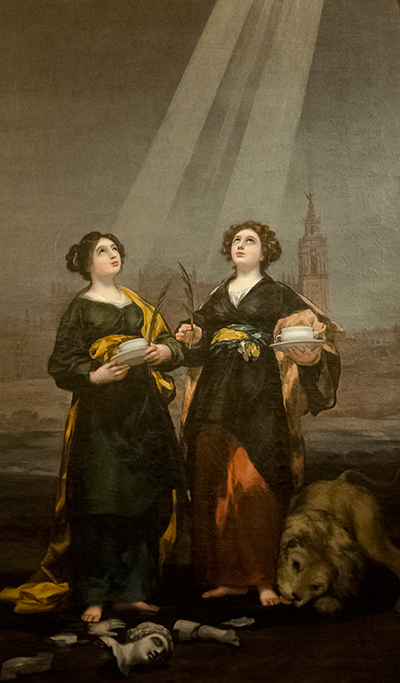
Two barefoot women look up as bands of light descend into a dark sky. They carry pale ceramic vessels and slender palms. A lion lowers its head beside the woman on the right, and the shattered head of a statue lies on the ground. Behind the women rises the Giralda, Seville Cathedral’s bell tower. Goya painted this altarpiece for the cathedral’s Sacristy of the Chalices, where it hangs above the altar. The fragments across the foreground identify the painting shown here as the finished Seville canvas. The small preparatory panel in Madrid leaves out the broken idol. [1] [2] [3]
At a Glance
- ArtistFrancisco José de Goya y Lucientes (1746–1828). [1]
- DateSigned and dated 1817 in Madrid. Delivered on 14 January 1818. [1] [2]
- Medium and sizeOil on canvas, 309 × 177 cm. [1]
- LocationSacristía de los Cálices, Seville Cathedral, Spain. [2]
- Documented studyOil on panel, 45 × 29 cm, Museo Nacional del Prado, P002650. [3]
Works across Goya’s career
The Parasol
1777The Nude Maja
1795–1800Saturn Devouring His Son
c. 1820–23The Dog
c. 1820–23An altarpiece for Seville Cathedral
In 1817 the cathedral chapter commissioned the painting through Juan Agustín Ceán Bermúdez, an art historian and friend of Goya. A letter from Ceán to the collector Tomás de Verí, dated 27 September 1817, describes the choices he made with the setting in mind. The chapter had considered a scene from the sisters’ martyrdom or another episode from their lives. Ceán felt a many-figured scene would be cramped in a canvas of these proportions and might distract the priest and congregation. He proposed two life-size figures whose attitudes would invite prayer. He also wrote that he had given Goya instructions and asked him to make three or four sketches. By the time of the letter, work on the large composition was already under way. [4] [5]
The more than three-metre height leaves a broad stretch of sky above the two saints. Their bodies occupy most of the lower part of the canvas, so the space overhead is particularly evident when their faces turn towards it. The beams enter high at the right and spread as they descend, the left band travelling further across the picture to reach the woman in green. At altar height the gesture directs a viewer’s attention upward. Art historian Hilary Macartney notes that the beams also suggest light entering the sacristy from high above. The painting allows a congregation to follow the direction of a familiar kind of light towards the object of the saints’ devotion. [1] [6]
In the lower left corner, a painted piece of paper names Goya, identifies him as a native of Zaragoza and First Court Painter to the King, and gives Madrid and the year 1817. The signature is easy to miss when the picture is reproduced at small scale. In the sanctuary it sits close to the level of the scattered fragments and the saints’ bare feet. Ceán wrote again to Verí on the day of delivery, reporting his satisfaction with the work and the payment of 28,000 reales. The size of the canvas, the painted signature and the documented delivery distinguish the cathedral commission from the reduced studies. [1] [2] [4]
Annotated Details from Saints Justa and Rufina
Follow the light to the faces, then look for the pottery, tower, lion and broken idol.
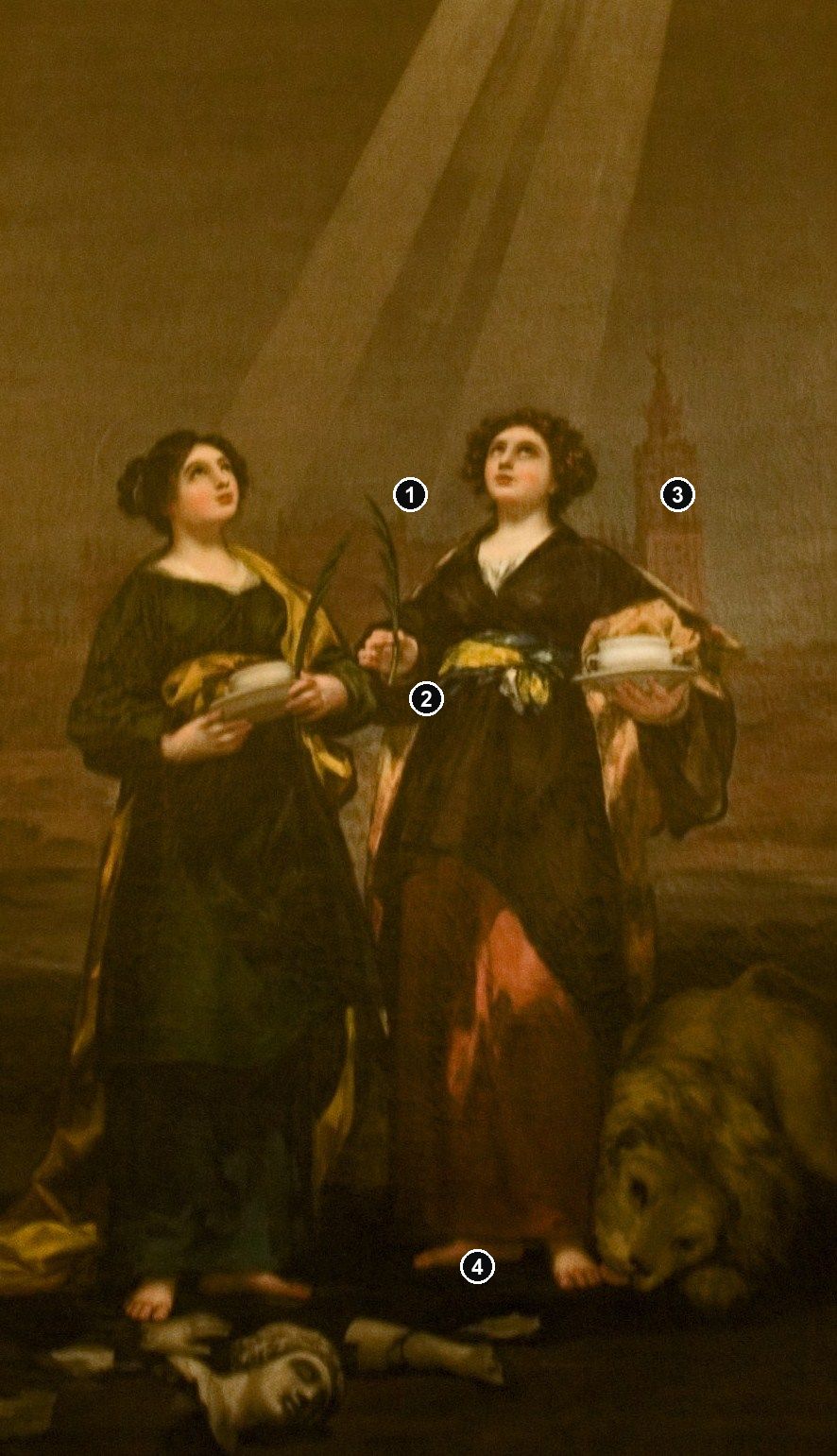
Details from SAINTS JUSTA AND RUFINA
Details from the completed altarpiece in Seville Cathedral.
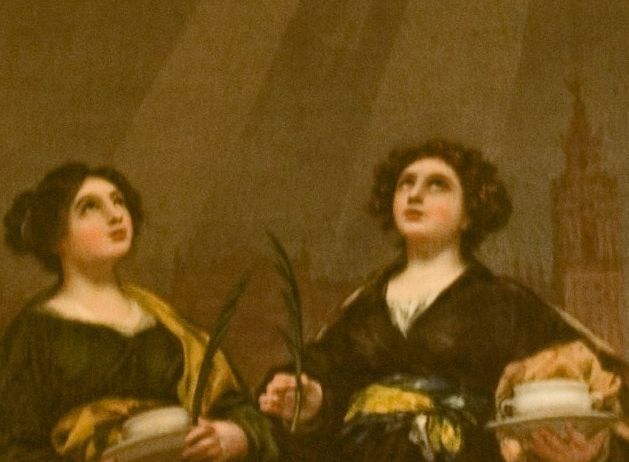
The upturned faces
Both figures turn their faces into the bands of light.
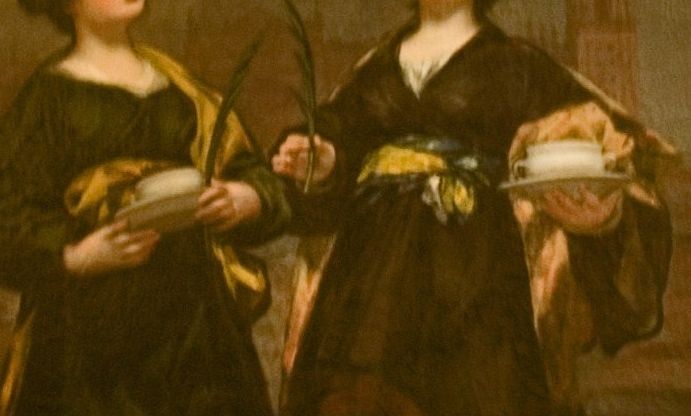
The vessels
Light touches the ceramic vessels that the women carry.
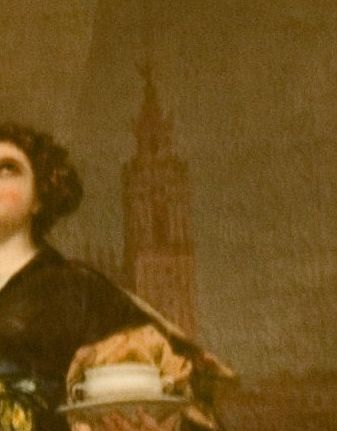
The Giralda
The tower is visible beyond the shoulder of the figure at the right.
The lion and broken idol
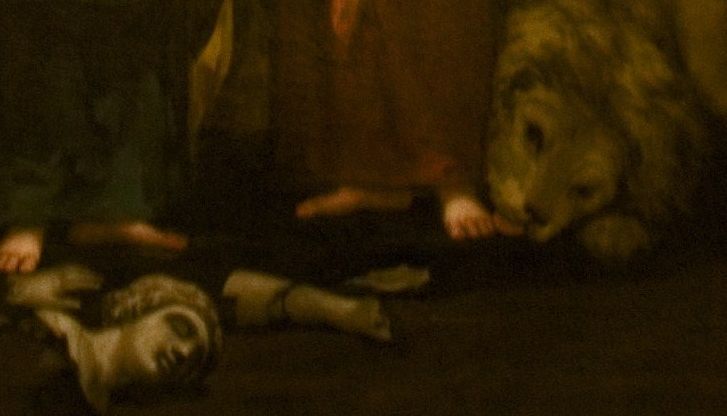
The lion crouches beside the feet and a fragment of the idol lies on the ground.
The potters, the broken idol and the lion
Seville Cathedral’s account places the sisters in Roman Seville and describes them as sellers of pottery. According to the tradition, a procession requested an offering for the pagan goddess Salambona, also called Salambó. The women refused. Their pottery was broken and they in turn smashed the idol. They were arrested and suffered martyrdom. Goya gives the exchange of blows a visible aftermath in the foreground. The severed head lies on its side, facing out from a band of shadow, with pieces scattered beside it. The intact vessels held at waist height recall the sisters’ trade, while the broken figure underfoot marks the confrontation that brought them before the Roman authorities. [1] [6] [7]
Goya sets the whites of the vessels against the sisters’ dark clothing. On the left, the woman curls both hands around the pale object before her. The woman on the right balances her dish and vessel across one forearm while holding a palm branch with her other hand. Look for the fine leaves rising between their faces. The palms identify the women as martyrs and carry attention from the objects in their hands to their upturned heads. In Goya’s Saint Barbara, a palm likewise identifies a martyr, and a different tower helps identify the individual saint. [1] [7]
The lion is tucked low against the rust-coloured skirt at the right. Its back makes an arc in the shadow and its head turns down towards the bare foot. In the account associated with Rufina, the animal dispatched against her in the amphitheatre licked her feet. The catalogue of the Fundación Goya en Aragón identifies the figure beside it as Rufina. Goya uses the lowered head to bring the lion and saint within a few inches of one another. Her gaze continues upwards as the animal settles down at her feet. The lion, the pots and the fragments refer to different parts of the story. A viewer can read them in succession around the standing pair, without needing to follow the movement of a crowd or the gestures of soldiers. [1] [6]
Goya on film
Five films explore Goya’s portraits, prints, Black Paintings and painting techniques.
The Duke of Wellington by Goya
The portrait, its military decorations and its later theft.
Watch on YouTubeWhy the Giralda is in the distance
The Giralda rises just to the right of the brighter face. It began as the minaret of Seville’s main mosque and later became the cathedral’s bell tower. In a much later legend, the saints protected it from collapse during an earthquake in 1504. Seville Cathedral preserves Miguel de Esquivel’s painting of about 1620, in which the saints stand either side of a large representation of the tower. Macartney points to its record of architectural additions and exterior decoration, including details that are now lost. In Bartolomé Esteban Murillo’s painting for the Capuchins, now in the Museo de Bellas Artes de Sevilla, the women steady a model of the Giralda between them. The model makes the story of their protection visible in the arrangement of their hands. [6] [7] [8]
Goya leaves the women’s hands free for their ceramics and palms. The tower emerges beyond them in grey-brown air, with the roofline and finial discernible against the sky. Compared with the edges of the pottery or the folds touching the women’s wrists, its edges seem soft. The difference creates distance between the figures and the city. From the sacristy the viewer could recognise the building of which the room itself was part. The landmark links the early Christian story to the later city where the sisters were venerated. [1] [6] [7]
The Prado study and another proposed sketch
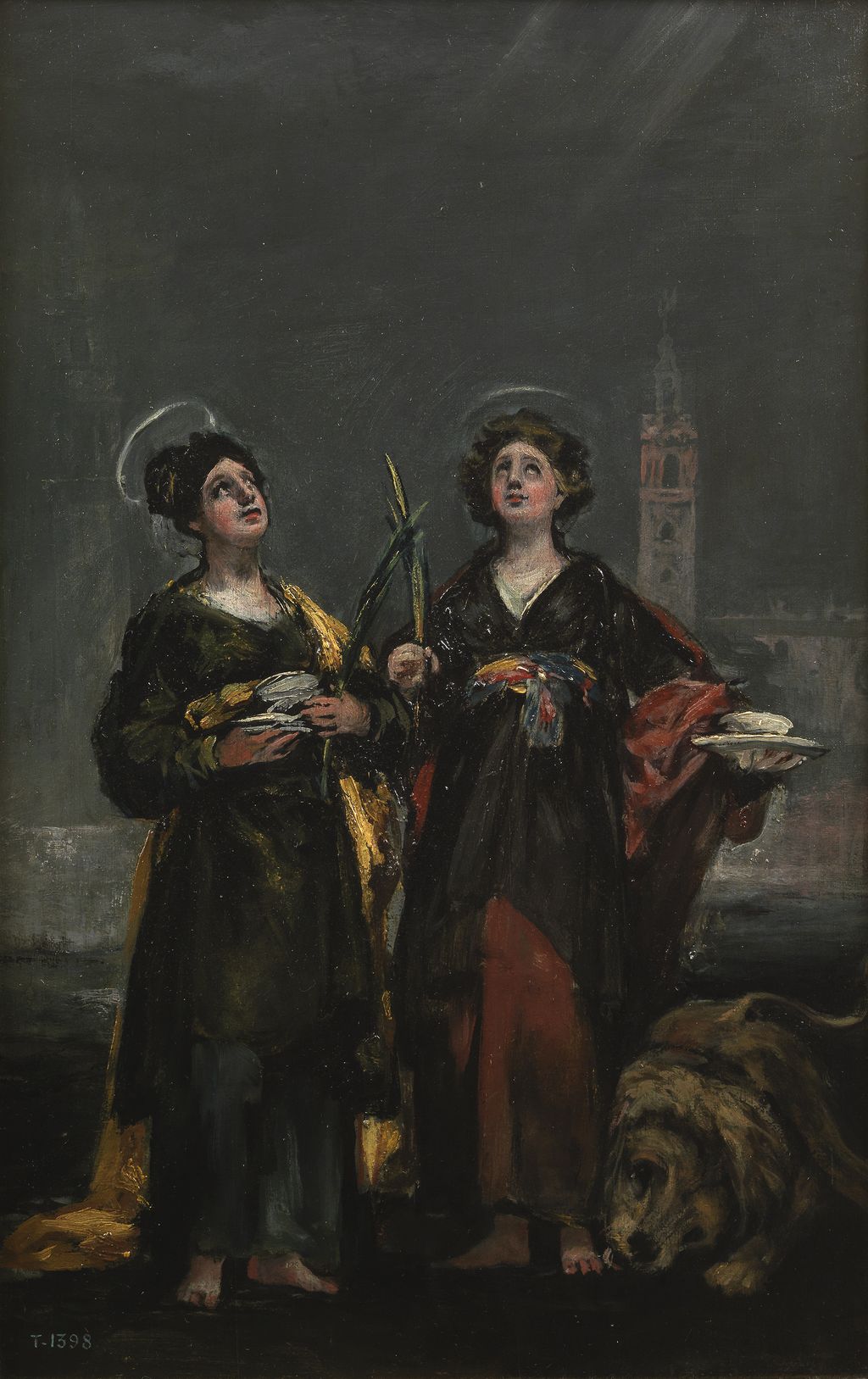
The documented Prado study is a small oil on wood, catalogued as P002650. It came from the collection of Pablo Bosch y Barrau and entered the Prado in 1916. The two women in the panel stand in much the same attitudes as in the finished painting, with light descending towards their faces. Look down to the ground to see the most reliable difference. The study has no broken pagan statue, while on the finished canvas the head and pieces spread across the foreground and give that part of the painting a clear narrative purpose. The study also brings the two figures together in a format which can be taken in at close range. In the sacristy the figures, the floor of the scene and the upper reaches of the sky occupy distinct areas of the viewer’s field of vision. [1] [3] [4]
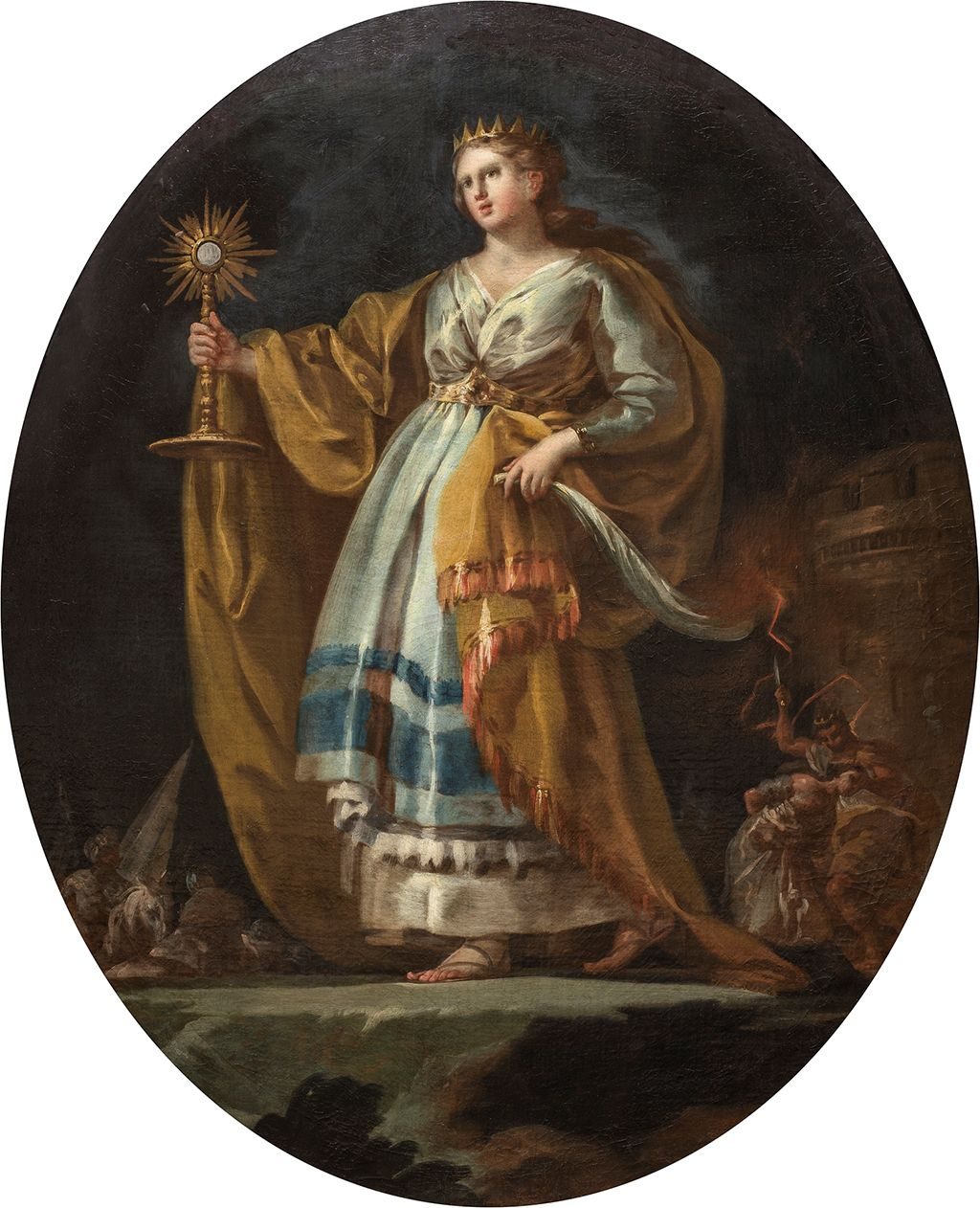
A further proposed study was exhibited on the auction market as an oil on canvas around 60 centimetres high. In the illustrated sale catalogue, one figure is seated or crouching and looks up towards a standing woman. That arrangement differs from the upright pairing shared by the Prado panel and the altarpiece. The Madrid regional heritage inventory registers the smaller canvas as attributed to Goya. Ceán’s letter confirms that he asked for several studies, while the exhibition catalogue on Ceán treats this other composition as a possible sketch. The Prado panel provides the clearest documented comparison for seeing how much of the finished composition was resolved before Goya added the broken idol. [3] [5] [9] [10]
How the altarpiece was received
Ceán’s letters show how much he wanted the painting to earn Goya a place among the religious painters represented in the cathedral. He went on to praise the work in an anonymous publication in 1817. He singled out the care given to the expressions, which he read as two responses to the divine. The faces repay that degree of attention. The left-hand saint turns more sharply to the side, so the light follows the curve of a cheek. The woman on the right throws her head further back, exposing her throat and giving the light a wider surface to reach. In Goya’s earlier Holy Family, the light gathers around the nearby faces of Mary and the Christ Child. Above the altar in Seville, the gazes and widening bands of light carry the eye away from the figures into the sky. [1] [5] [6]
The picture drew more divided judgements than Ceán’s enthusiastic letter suggests. The Fundación Goya en Aragón records opposition among Seville artists and the circulation of satirical verses. In the nineteenth century, the British writer Richard Ford attacked the painting’s apparently French Neoclassical manner. William Stirling initially judged it more favourably in his travel notes, then moved closer to Ford’s view in his published history. Their responses, traced by Macartney, put a different value on qualities Ceán had welcomed, including the carefully regulated poses and the measured space between the figures. The painting’s scale and placement still make those choices visible together. From a distance, the heads and palms register first. The lion and the broken face emerge as the eye settles into the foreground. [1] [4] [6]
Artworks directory
| Name | Date | Medium |
|---|---|---|
| And There’s No Help for It, Plate 15 | Printed 1863 | |
| Asmodea | c. 1820–23 | Wall painting transferred to canvas |
| Boys Inflating a Bladder | 1777–78 | Tapestry cartoon |
| Boys Picking Fruit | 1778 | Tapestry cartoon |
| Bullfight in a Divided Ring | 1825 | Lithograph |
| Card Players | 1777–78 | Tapestry cartoon |
| Card Players (sketch) | 1777–78 | Painted sketch |
| Dance on the Banks of the Manzanares | 1777 | Tapestry cartoon |
| Duel with Cudgels | c. 1820–23 | Wall painting transferred to canvas |
| Heads in a Landscape | c. 1820–23 | Easel painting |
| Judith and Holofernes | c. 1820–23 | Wall painting transferred to canvas |
| Leocadia | c. 1820–23 | Wall painting transferred to canvas |
| Maja and Cloaked Men | 1777 | Tapestry cartoon |
| Maja and Cloaked Men (sketch) | 1777 | Painted sketch |
| Majo Clapping in Time to the Music | 1777 | Drawing |
| Men Reading | c. 1820–23 | Wall painting transferred to canvas |
| Out Hunting for Teeth, Plate 12 | 1799 | Etching, burnished aquatint and burin |
| Picnic in the Countryside (sketch) | 1776–78 | Painted sketch |
| Picnic on the Banks of the Manzanares | 1776 | Tapestry cartoon |
| Pilgrimage to San Isidro | c. 1820–23 | Wall painting transferred to canvas |
| Preparatory study for The Sleep of Reason Produces Monsters | c. 1796–97 | Drawing |
| Procession of the Holy Office | c. 1820–23 | Wall painting transferred to canvas |
| Quarrel at the Cockerel Inn (sketch) | 1777 | Painted sketch |
| Quarrel in the New Tavern | 1777 | Tapestry cartoon |
| Saturn Devouring His Son | c. 1820–23 | Wall painting transferred to canvas |
| Seated Majo Smoking | c. 1776 | Drawing |
| The Dog | c. 1820–23 | Wall painting transferred to canvas |
| The Drinker | 1777 | Tapestry cartoon |
| The Fates | c. 1820–23 | Wall painting transferred to canvas |
| The Great He-Goat | c. 1820–23 | Wall painting transferred to canvas |
| The Kite | 1777–78 | Tapestry cartoon |
| The Parasol | 1777 | Oil on canvas, tapestry cartoon |
| The Second of May 1808 | 1814 | Oil on canvas |
| The Sleep of Reason Produces Monsters, Plate 43 | 1799 | Etching and aquatint |
| The Third of May 1808 | 1814 | Oil on canvas |
| Thou Who Canst Not, Plate 42 | 1799 | Etching and burnished aquatint |
| Three Figures | 1776 | Drawing (lost) |
| Two Old Men | c. 1820–23 | Wall painting transferred to canvas |
| Two Old Men Eating Soup | c. 1820–23 | Wall painting transferred to canvas |
| Two Women and a Man | c. 1820–23 | Wall painting transferred to canvas |
| Universal Language: The Author Dreaming | 1797 | Drawing |
| The Family of Charles IV | 1800 | Oil on canvas |
| Witches’ Sabbath (Osuna painting) | 1797–98 | Oil on canvas |
| The Nude Maja | 1795–1800 | Oil on canvas |
| The Clothed Maja | 1800–07 | Oil on canvas |
| Self-Portrait (Drawing) | c. 1796 | Brush and carbon black ink on laid paper |
| The Swing, Madrid Album B.21 | 1795–97 | Brush and carbon black washes |
| Majas Fighting, a Majo Observing, Madrid Album B.15 | 1796–97 | Brush, grey and black washes on laid paper |
| Majos and Majas Conversing, Madrid Album B.16 | c. 1794–97 | Ink wash on paper |
| Weeping Woman and Three Men, Madrid Album B.17 | 1795–97 | Brush, carbon black washes and black chalk |
| Maja Seated on a Chair and Two Companions Behind, Madrid Album B.18 | 1795–97 | Brush and carbon black washes |
| Girl and Bull, Madrid Album B.23 | 1796–97 | Brush and carbon black washes |
| Lovers Sitting on a Rock, Madrid Album B.24 | 1796–97 | Brush and carbon black washes |
| Mariano Ceballos Riding a Bull | 1825 | Crayon lithograph and scraper |
| Landscape (lifetime impression) | c. 1807–10 | Etching and aquatint |
| Self-Portrait (1815), Prado canvas | 1815 | Oil on canvas |
| Self-Portrait (1815), Academy panel | 1815 | Oil on panel |
| Self-Portrait with Dr Arrieta | 1820 | Oil on canvas |
| Christ Crucified | 1780 | Oil on canvas |
| The Last Communion of Saint Joseph of Calasanz | 1819 | Oil on canvas |
| Christ on the Mount of Olives | 1819 | Oil on panel |
| The Flower Girls, or Spring | 1786–87 | Oil on canvas |
| The Grape Harvest, or Autumn | 1786–87 | Oil on canvas |
| The Snowstorm, or Winter | 1786–87 | Oil on canvas |
| The Threshing Ground, or Summer | 1786–87 | Oil on canvas |
| Picnic on the Banks of the Manzanares | 1776 | Oil on canvas |
| The Kite | 1777–78 | Oil on canvas |
| Dance on the Banks of the Manzanares | 1777 | Oil on canvas |
| A Fight at the Venta Nueva | 1777 | Oil on canvas |
| Blind Man’s Bluff | 1788 | Oil on canvas |
| Dogs on a Lead | 1775 | Oil on canvas |
| Hunting with a Decoy | 1775 | Oil on canvas |
| Hunter Loading His Rifle | 1775 | Oil on canvas |
| The Angler | 1775 | Oil on canvas |
| The Hermitage of San Isidro on His Feast Day | 1788 | Oil on canvas |
| The Meadow of San Isidro | 1788 | Oil on canvas |
| The Straw Manikin | 1791–92 | Oil on canvas |
| Witches’ Flight | c. 1797–98 | Oil on canvas |
| A Scene from ‘The Forcibly Bewitched’ | 1798 | Oil on canvas |
| The Duchess of Alba in Black | 1797 | Oil on canvas |
| The Duchess of Alba in White | 1795 | Oil on canvas |
| Charles III in Hunting Dress | c. 1786 | Oil on canvas |
| The Duke and Duchess of Osuna and Their Children | 1787–88 | Oil on canvas |
| Manuel Osorio Manrique de Zúñiga | 1787–88 | Oil on canvas |
| The Marquesa de Pontejos | c. 1786 | Oil on canvas |
| Equestrian Portrait of the 1st Duke of Wellington | 1812 | Oil on canvas |
| The Duke of Wellington | 1812–14 | Oil on wood |
| Portrait of Ferdinand VII of Spain | 1814 | Oil on canvas |
| Gaspar Melchor de Jovellanos | 1798 | Oil on canvas |
| María Tomasa Palafox y Portocarrero | 1804 | Oil on canvas |
| Señora Sabasa García | c. 1806–11 | Oil on canvas |
| Don Juan Bautista de Muguiro | 1827 | Oil on canvas |
| Doña Isabel de Porcel | Before 1805 | Oil on canvas |
| The Colossus | After 1808 | Oil on canvas |
| The Burial of the Sardine | 1808–12 | Oil on panel |
| The Madhouse | 1808–12 | Oil on panel |
| A Procession of Flagellants | 1808–12 | Oil on panel |
| Portrait of Jacques Galos | 1826 | Oil on canvas |
| Portrait of Mariano Goya, the Artist’s Grandson | 1827 | Oil on canvas |
| Milkmaid of Bordeaux | c. 1827 | Oil on canvas |
| Portrait of Don Juan Antonio Cuervo | 1819 | Oil on canvas |
| María Luisa of Parma (Naples version) | c. 1800 | Oil on canvas |
| The Countess of Baena | 1819 | Oil on canvas |
| The Family of the Infante Don Luis | 1783–84 | Oil on canvas |
| The Holy Family | c. 1787 | Oil on canvas |
| Saint Barbara | c. 1773 | Oil on canvas |
| Saints Justa and Rufina | 1817 | Oil on canvas |
| El Tío Paquete | c. 1819–20 | Oil on canvas |
| The Forge | c. 1815–20 | Oil on canvas |
| Majas on a Balcony (Metropolitan Museum version) | c. 1800–10 | Oil on canvas |
| Maja and Celestina on a Balcony | c. 1808–12 | Oil on canvas |
| The Water Bearer | 1808–12 | Oil on canvas |
| Time and the Old Women | c. 1810 | Oil on canvas |
Frequently Asked Questions
Discussion
Look again at the images and ideas explored in Saints Justa and Rufina. These editorial prompts invite your observations.
Start at the hands and follow the thin palms towards the faces. When do you notice the tower? What happens to the balance of the composition when you shift your attention from the saints’ gaze to the lion and the idol below?
Reader Insights
Where does the light send your eye after it reaches the faces?
Compare what Goya put on the ground in the study and the altarpiece.
Join the Conversation
Share a detail, comparison or question about Saints Justa and Rufina below.
References
- Fundación Goya en Aragón, Santas Justa y Rufina and Saints Justa and Rufina, Spanish and English catalogue entries for the finished painting. View source 1. View source 2.
- Seville Cathedral, La Sacristía de Cálices de la Catedral de Sevilla alberga una excepcional colección pictórica, on the setting, signature and delivery. View source.
- Fundación Goya en Aragón, Santas Justa y Rufina (boceto), and Museo Nacional del Prado, Santa Justa y Santa Rufina, P002650. View source 1. View source 2.
- Wifredo Rincón García, Iconografía de Santas Justa y Rufina en Aragón, pp. 62–66, reproducing extracts of Ceán Bermúdez’s letters to Tomás de Verí of 27 September 1817 and 14 January 1818. See also Francisco de Goya. Diplomatario, no. CXLIV, pp. 495–496 for the September letter. View source 1. View source 2.
- Centro de Estudios Europa Hispánica, Ceán Bermúdez, historiador del arte y coleccionista ilustrado, p. 178, on the correspondence, Ceán’s aims and the sketches. View source.
- Hilary Macartney, Stirling, Ford and Nineteenth-Century Reception of Goya, Hispanic Research Journal, 8 (5), 2007, pp. 425–444, on the composition, iconography and reception, with extracts from Ceán’s 1817 analysis. View source.
- Seville Cathedral, Festividad de Santa Justa y Rufina, on local tradition and the cathedral’s representations of the saints. View source.
- Junta de Andalucía, Murillo y los Capuchinos de Sevilla, Museo de Bellas Artes de Sevilla exhibition dossier. View source.
- Comunidad de Madrid, Order 1594/2010, heritage inventory entry for a canvas attributed to Goya. View source.
- Gazette Drouot, sale catalogue, lot 215, illustrated record of the proposed canvas study. View source.
- Seville Cathedral Chapter, statement on the painting and its restoration, announcing the 2008 loan to the Prado. View source.







