


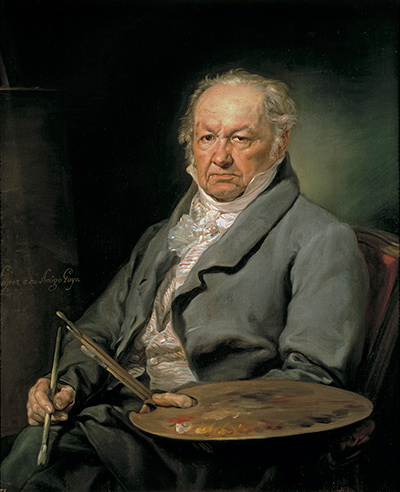
 by Tom Gurney
Tom Gurney BSc (Hons) is an art history expert with over 20 years experience
Published on June 19, 2020 / Updated on November 20, 2026
Email: tomgurney1@gmail.com / Phone: +44 7429 011000
Introduction
In The Parasol, a young man lifts a green canopy and a seated woman looks out. The green deepens across her face, an effect you can follow beneath the parasol even at a distance. In The Sleep of Reason Produces Monsters, another figure bends over a surface and hides his face in folded arms. Owls and bats fill the space that opens above him. Both works tell us where to look by arranging a large shape above a human head. The oil painting directs us back to an answering gaze. The print makes us inspect the space the sleeper cannot see. [1] [2]
The destinations of the two images were as different as their effects. Goya delivered the painting in 1777 as a design for a tapestry intended to hang over a door in the dining room of the Prince and Princess of Asturias at El Pardo. The painted oil and canvas were a stage in the making of a textile for a particular room. The smaller image was made with a plate and printed on paper as number 43 in Los Caprichos, which Goya published in 1799. An impression could be held close enough to make out the separate claws and eyes in the darkness, then turned aside to see the next print. The distance between eye and image affects how the two works unfold. [1] [2] [3]
Francisco de Goya y Lucientes (1746–1828) was born in Fuendetodos, near Zaragoza, and died in Bordeaux. In between he trained in Aragón, competed in Italy and worked his way from royal decorative commissions to the position of First Court Painter in Spain. At the height of that career he could give an intricate account of dynastic rank in a portrait and put his own name on an edition satirising social habits. The survival of letters, albums, prints and painting studies lets us see him move between those audiences. Some lines reached a single friend. Others were devised to survive the work of weavers, the press of an edition or the viewing distance of a palace wall. [3] [4] [5]
The works below are starting points for those different encounters. The biography follows the documents that establish where and for whom he worked. The paintings guide helps distinguish sketches, finished canvases and versions of the same subject. If you know Goya through a single picture, try another work that asks you to look from a different position. The young woman under the parasol has an unobstructed view of whoever enters her room. The little dog in his own house, painted decades later, looks up at a stretch of wall whose meaning is much harder to recover. [1] [6]
At a Glance
- ArtistFrancisco de Goya y Lucientes, 1746–1828. Born in Fuendetodos, professionally established in Madrid, and resident in Bordeaux in his final years. [4] [5]
- Palace and courtStart with The Parasol, then look for the painter himself on the left of The Family of Charles IV. [1] [7]
- PrintsThe published Caprichos satirise social behaviour. The Disasters of War turns to violence, displacement, famine and their aftermath. [3] [8]
- War paintingsThe Second and Third of May depict successive episodes in Madrid in 1808. Goya painted both in 1814. [9] [10]
- Later workThe Black Paintings began as murals in his house. In Bordeaux, Goya produced a set of four published bullfighting lithographs with the printer Cyprien Gaulon. [6] [11] [12] [13]
Goya’s artistic connections
The court, earlier Spanish painting and later artists offer four documented connections.
- Francisco Bayeu: Goya’s brother-in-law helped connect him to the royal tapestry workshop. [5]
- Anton Raphael Mengs: Mengs supported Goya’s work for the royal tapestry manufactory. [5]
- Diego Velázquez: Goya studied paintings in the royal collection and adapted several of Velázquez’s works for prints. [30]
- Édouard Manet: The National Gallery relates Manet’s earliest painted Execution of Maximilian to the Goya he saw in Madrid. [49]
Goya in context
Neoclassicism
c. 1750–1850 [44]Romanticism
c. 1800–1850 [45]Francisco de Goya
1746–1828 [46]Saint Barbara
c. 1773Dogs on a Lead
1775The Angler
1775The Drinker
1777The Parasol
1777The Kite
1777–78Christ Crucified
1780The Flower Girls, or Spring
1786–87The Grape Harvest, or Autumn
1786–87Charles III in Hunting Dress
c. 1786The Marquesa de Pontejos
c. 1786The Snowstorm, or Winter
1786–87The Holy Family
c. 1787The Straw Manikin
1791–92Self-Portrait (Drawing)
c. 1796The Swing, Madrid Album B.21
1795–97Witches’ Flight
c. 1797–98The Nude Maja
1795–1800The Clothed Maja
1800–07Doña Isabel de Porcel
Before 1805Señora Sabasa García
c. 1806–11The Colossus
After 1808Maja and Celestina on a Balcony
c. 1808–12The Water Bearer
1808–12Time and the Old Women
c. 1810The Duke of Wellington
1812–14The Burial of the Sardine
1808–12The Madhouse
1808–12A Procession of Flagellants
1808–12The Forge
c. 1815–20Asmodea
c. 1820–23Duel with Cudgels
c. 1820–23Heads in a Landscape
c. 1820–23Judith and Holofernes
c. 1820–23Leocadia
c. 1820–23Men Reading
c. 1820–23Pilgrimage to San Isidro
c. 1820–23Procession of the Holy Office
c. 1820–23Saturn Devouring His Son
c. 1820–23The Dog
c. 1820–23The Fates
c. 1820–23The Great He-Goat
c. 1820–23Two Old Men
c. 1820–23Two Old Men Eating Soup
c. 1820–23Two Women and a Man
c. 1820–23El Tío Paquete
c. 1819–20Bullfight in a Divided Ring
1825Milkmaid of Bordeaux
c. 1827Four stages of Goya’s career
Zaragoza, Rome and Parma
The Italian Notebook preserves preparatory work for the Hannibal competition picture as well as notes written after Goya returned to Spain. [5]
The workshop and the court
The royal tapestry workshop gave Goya a setting for paintings designed to be woven. His appointment as first painter of the chamber came in 1799. [5]

Changing patrons and audiences
Goya painted the royal family and later made canvases and prints responding to the occupation of Spain and the war. [5]

Essential works
The Parasol
1777 · A painted design for a tapestry intended to hang above a door.

The Family of Charles IV
1800 · A dynastic portrait organised through light, costume and the arrangement of the sitters.
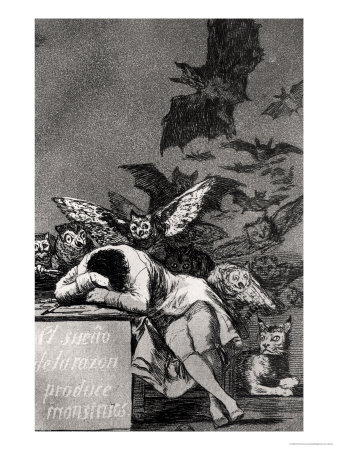
The Sleep of Reason Produces Monsters
1799 · A sleeping figure and a flight of animals on Plate 43 of Los Caprichos.
The Third of May 1808
1814 · A lantern lights the group facing a firing squad.

The Dog
c. 1820–23 · A small head appears above the sloping field of a Black Painting.

Saturn Devouring His Son
c. 1820–23 · Hands and eyes emerge from the dark in a mural later transferred to canvas.
From a working notebook to a palace dining room
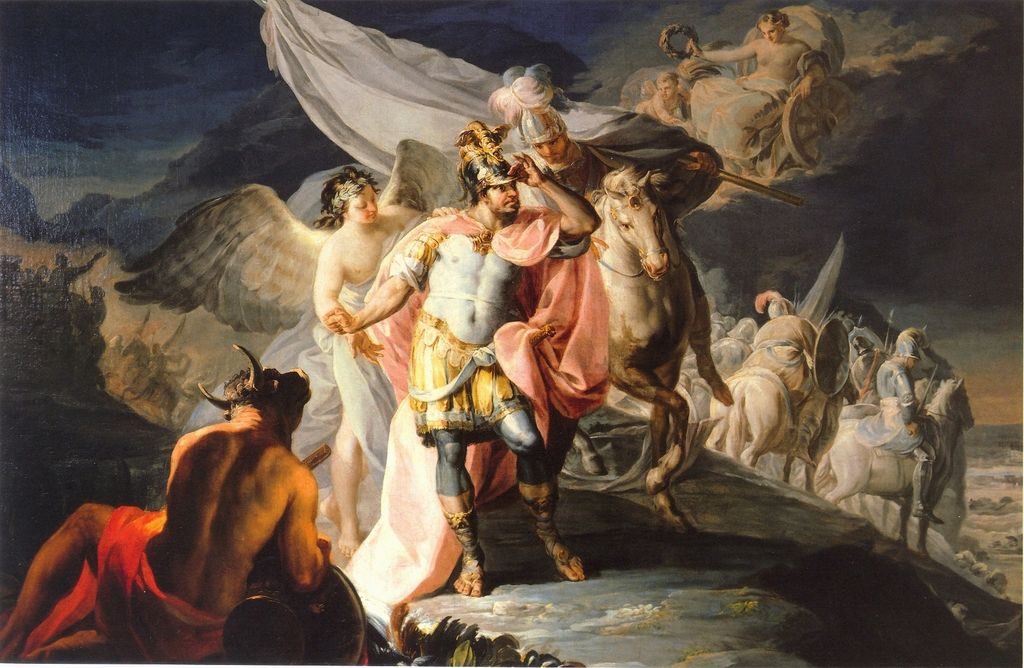
On page 37 of Goya’s Italian Notebook, red chalk gives just enough information to pick out Hannibal above a descending landscape. Behind him the hint of a winged figure and the height of a standard bring other figures into his orbit. To the lower left is a human-bodied figure with a bull’s head, identified by the Fundación Goya en Aragón as the personification of the river Po. Even on a page filled with abbreviated strokes, Hannibal’s centrality has been worked out. You can read the principal action across the page before you know what each figure represents. Other pages let Goya try out parts of the composition individually, including Hannibal, the winged figure and the river. [14] [15]
Goya submitted The Victorious Hannibal Seeing Italy from the Alps for the First Time to the Parma Academy’s competition in 1771. The brief required a horizontal painting, and Goya converted the upright arrangement of page 37 into a scene with room to either side of the general. Hannibal, the winged figure and a mounted soldier remain legible together on the rise. The army winding away behind them gives substance to the distance the general is trying to see. The Prado, which now holds the finished canvas, identifies two preparatory oil sketches as well as the notebook studies. Each step offered a different way of working out how to put the viewer alongside the general at the moment of discovery. The entry earned an honourable mention. Paolo Borroni won the gold medal. [14] [16] [17]
The Italian Notebook also carries entries from years after the trip for which it is named. In the facsimile prepared by Manuela B. Mena and Jesús Urrea, family notes and practical details of Goya’s circumstances share the book with early drawings. For a modern reader those entries can help establish dates and relationships. For the artist it was a book he could continue to use as circumstances changed. Seen in that company, the quick red lines of page 37 preserve a decision in progress. The decision eventually became visible at a much larger scale to judges who would have had a straightforward way to assess it. They knew the episode and the required format before they saw a single entry. [14] [15] [16]
The large shape over the woman in The Parasol places a different demand on the painter. The future tapestry was meant to occupy one of the spaces above the dining-room doors, alongside a companion design called The Drinker. The two would be seen from below. In The Parasol, the young man’s legs disappear behind an earthy rise, and the woman and the dog occupy the nearer plane. The unobstructed stretch of green under the canopy makes the angle instantly intelligible. Each of the main colours has a distinct area, including the yellow skirt set against the blue bodice. A person walking under the tapestry could register the figures and their relation to one another with a glance. [1]
The parasol shades the woman’s face while her companion remains standing behind her. Compare that distribution of attention with the platform in the Parma painting. Goya puts the solitary triumph high and in the middle of a turbulent view. He gives the young woman a composed place below the canopy, within a scene whose interest lies partly in the quiet work another person does for her. The Fundación catalogue identifies the cartoon’s triangular arrangement with the classicism Goya encountered through Anton Raphael Mengs. A familiar structure could serve a subject from contemporary life and accommodate the needs of a specific room. Goya’s work for the royal tapestry factory repeatedly asked him to consider how scenes in oil would read as textiles at the scale of a room. [1] [5] [16]
Portraits for a boardroom and a dynasty
A dark background and the pale turn of a face set up a different kind of encounter in Goya’s 1785 portrait of José de Toro-Zambrano y Ureta. The sitter, one of the first directors of the Banco de San Carlos, fills a narrow canvas. His face emerges from dark surroundings, picked out with his white neckwear and the pale cuff of his sleeve. The Bank records that it ordered portraits to decorate the rooms where its directors met and to commemorate their service. The painting would therefore be seen by people engaged in the institution’s continuing business. Its size and close framing give a board member a face to remember across a room, among several images of people with responsibilities in common. [18] [19]
A twentieth- or early twenty-first-century reproduction can show a distinction on the sitter’s coat that Goya never painted. Examination by the Banco de España and Prado established that the decoration had been added by another hand. Conservators removed it. The discovery changes the answers to two questions about the painting. Goya’s sitter projects standing through dress, bearing and likeness. Whoever later added the decoration wanted the canvas to register a specific honour as well. That difference in emphasis is especially legible in an institutional portrait, since the object remained available to record how the sitter’s standing was remembered. [18] [20]
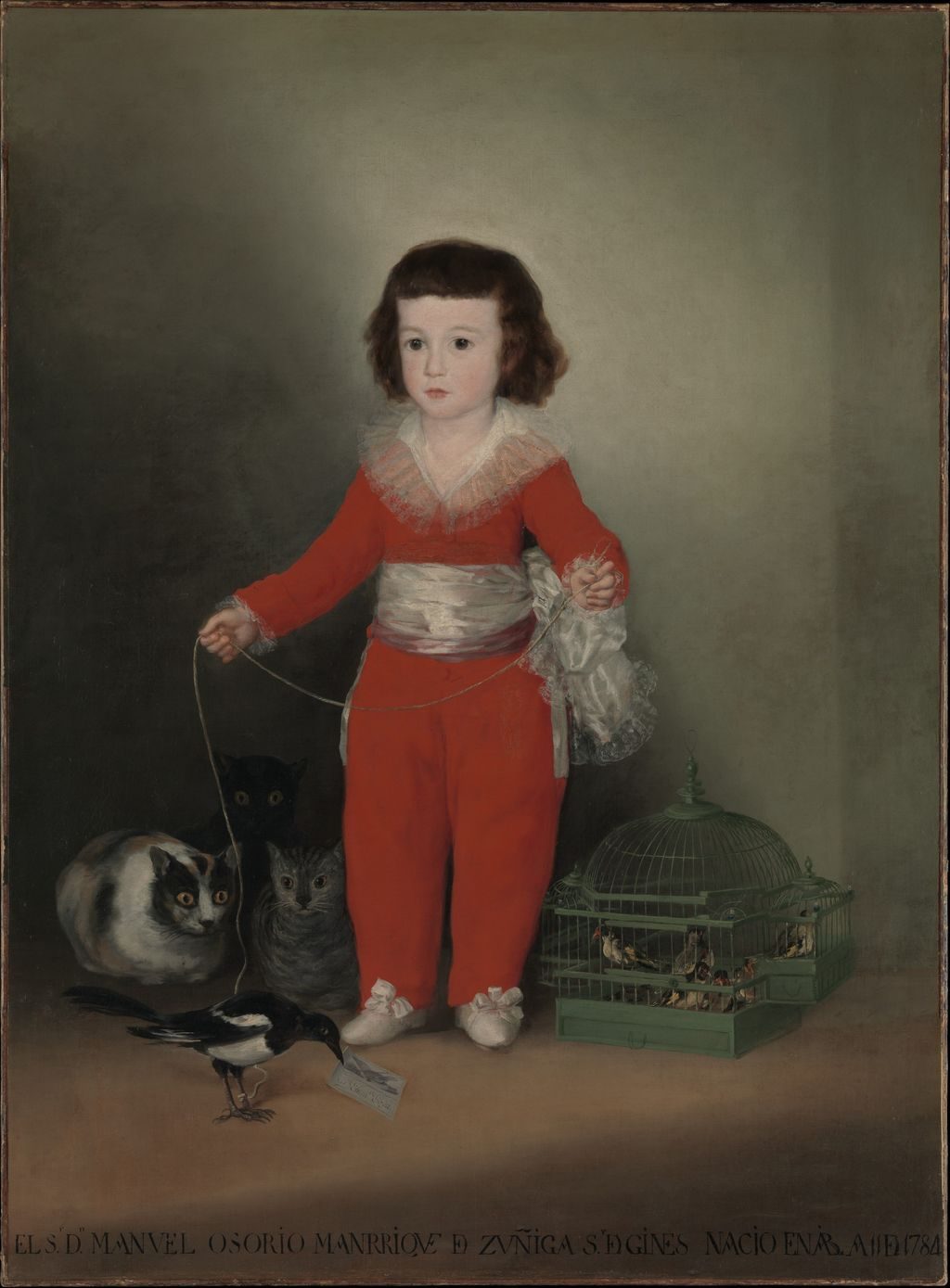
The Banco de San Carlos commission preceded Goya’s appointment as painter to Charles III in 1786. In 1789, under Charles IV, he became court painter and in 1799 First Court Painter. An appointment brought a position in royal service. An individual portrait had an occasion, sitters and terms of its own. The Bank ordered portraits from Goya between 1785 and 1788. Its sitters included the Count of Altamira, whose family also sat for Goya. In the portrait of Manuel Osorio Manrique de Zuñiga, the count’s son holds a tethered magpie that carries the painter’s calling card in its beak. Three cats watch the bird. That cluster of looking animals gives the eye a second circuit of the picture below the boy’s formal, brilliantly red costume. The portrait holds that small tension in reserve for a viewer who stays with it. [5] [19] [21] [22]
In The Family of Charles IV of 1800, actual relatives take on some of the pictorial work done by those accompanying details. The youngest figures appear close to parents or siblings. The queen holds the hand of her small son Francisco de Paula. Further along, her daughter María Luisa holds her own child. The repeated placing of children beside adults makes the succession of generations visible in the picture itself. Then the orders and sashes identify ranks and affiliations across those relationships. The plain background against which Toro-Zambrano sat made him immediately recognisable in his own frame. Here the viewer has to move across the width of the canvas and work out who stands with whom. [7] [18]
Goya also depicts himself in the shadow at the left, by the back of a canvas. The Fundación catalogue connects this part of the composition with Velázquez’s Las Meninas. A court artist visible at work gives a viewer a cue to think about how a royal likeness is made. In Goya’s case the painter’s shadowed position puts the brilliant royal faces and fabrics in front of him. The strong individual faces have invited readings of the portrait as satire. They can also be read beside the scrupulous placement of insignia and the documented studies for individual sitters. That evidence makes it possible to describe the choices that produced the effect while leaving the intention and the family’s private response open. [7] [23]
The court and bank portraits largely picture people whose names we know. The figure in The Nude Maja and The Clothed Maja is harder to identify. Both paintings were recorded in Manuel Godoy’s collection by 1808. A woman looks directly out from a reclining pose in each, with her hands behind her head. These works offer a further question about audience. Goya could paint that look twice on canvases of nearly the same size for works that would pass through the same collection. Looking from one to the other, the spectator is made aware of the act of looking and the difference made by the addition of clothes. The record of ownership is firmer than any proposed name for the model. [24] [25]
Where the Altamira portraits met their viewers
Goya’s work for the Altamiras gives a particularly clear example of a public commission opening the way to a private one. He painted the count as one of the directors of the Banco de San Carlos and went on to portray members of his family. The Met brought dispersed pictures from the group together in 2014. The reunion allowed viewers to compare how different kinds of family identity had been distributed among separate canvases. The mother appears with her daughter, while young Manuel stands alone with his animals. Both pictures present children as part of a dynasty, yet they give the children different physical relationships with the adults who commissioned the paintings. [50] [51]
In the double portrait the baby is held close and her light clothing joins the larger mass of the countess’s dress. The view of infancy depends on touch and proximity. In Manuel’s portrait, the child’s shoes and the animals’ feet establish a common ground. The red suit and the open area around him give him an independent presence. The magpie’s association with the painter’s card adds another small point of contact between the household and the professional who made the picture. Comparing the two portraits makes it possible to see how Goya could suggest independence, kinship or dependence by changing the arrangement of very few people and objects. [50] [51]
The group also shows what museum display can restore. A family portrait removed from the others may come to stand for Goya’s view of childhood in general. Seen together, the pictures recover some of the range of decisions made for one patronage network at an early stage in his career. That network joined finance, aristocratic households and court culture. Moving from the Altamira portrait to the royal family group broadens the comparison from family resemblance to the display of succession. [50] [51]
The Met’s 2014 display included four family portraits by Goya and one by Agustín Esteve. The fifth work matters because an artistic network is wider than one artist’s catalogue. The family could commission the work of more than one painter, with each canvas maintaining recognisable conventions of portraiture. Esteve’s contribution helps restore a choice the patrons actually had. In following Goya’s career from aristocratic portraiture into royal work, it is worth remembering that the institutions and households commissioning him also employed other artists. Similarities of format can reflect a shared system of portrait display as readily as an artistic exchange. [50] [51]
Goya on film
Five films explore Goya’s portraits, prints, Black Paintings and painting techniques.
The Duke of Wellington by Goya
The portrait, its military decorations and its later theft.
Watch on YouTubeWhen a drawing becomes a print
A letter to Martín Zapater dated 10 November 1790 begins and ends with a drawing. At the beginning Goya gives his friend a heart with vessels, an anatomically detailed version of an ordinary sign of affection. At the other end of the letter, the Prado’s Fundación de Amigos tentatively identifies a figure carrying someone on their back. The two drawings share the paper and iron gall ink of the written message. Goya could count on Zapater to receive the pictures with his words and whatever the two already knew about one another. For Zapater the heart was also the first thing to see before reading what his friend had to say. [26]
In the drawing known as Young Man Looking through a Magnifying Glass at a Maja, from the Madrid Album (Prado D04339r), Goya works in carbon ink wash. The young man brings his lens up towards the woman. It is a tool for bringing a small detail closer, and the proximity required to use it gives his action a comic insistence. The Prado and the National Gallery of Victoria identify the sheet as an early drawing for Plate 7 of Los Caprichos. The drawing’s descriptive title supplies the action and the types of people involved. The printed caption offers an outcome. Ni asi la distingue, translated by the NGV as Even thus he cannot make her out, puts the emphasis on the man’s failure. The viewer who has the print learns the outcome as soon as their eyes reach the words. [3] [27] [28]
The print takes the scene through etching, aquatint and drypoint. Look at where the darkest areas gather around the pair and compare them with the wash in the drawing. Wash can spread to form a single field behind a figure. The bitten tone in the print can place the faces and clothing within an equivalent field and repeat the contrast across an edition. In the print, the contrast between his pale clothes and her dark dress makes the two figures easy to follow down the sheet. Adrian Martin draws attention to the position of a spectator’s head, visible between the man’s arm and the woman’s dress. Once you see that face, this close-range inspection becomes a source of interest to the people around the pair. The edition makes the same joke available to separate readers, each of whom can assess how well they themselves understand what they see. The NGV’s Petra Kayser proposes that the fashionable admirer misconstrues a calculated invitation. The caption leaves the viewer with a more general joke about the ease with which a person can improve their view of an object and still misunderstand another person. [27] [28] [29]
That question of reading other people runs across the suite. In his advertisement of 6 February 1799, Goya presented the works as inventions about recurrent habits and errors in society. Some scenes give the reader the street, dress and customs of recognisable social dealings. Others put animals or invented figures into human situations. In Plate 43, the hollow behind the sleeper and the densely occupied air above him pull our attention towards what an unguarded mind might encounter or produce. The picture is a good point of entry to the series. Its tone changes when you meet it among the many instances of people misjudging one another, adopting poses or giving authority to dubious beliefs. Plate 7 places the limit on seeing in a physical lens. Plate 43 invites the reader to consider what happens when even an ordinary subject for scrutiny is gone. [2] [3] [28] [29]
A catalogue can distinguish the copperplate from a sheet printed from it. The Calcografía Nacional preserves plates by Goya, including the matrices of Los Caprichos. The NGV records the number on the upper right and the caption beneath the image on its first-edition Plate 7. Each institution is describing a different object involved in transmitting the same composition. That distinction matters because the words and tones you see on a sheet belong to the state of the plate and the circumstances of the impression. The paper is also the object someone could buy and leaf through. It is closer to that person’s experience of Los Caprichos than a studio drawing or the plate ever would have been. The drawings, etchings and prints guides let you follow those objects separately. [3] [28] [30]
Pictures of war and pictures for the Quinta
Goya’s Second of May 1808 gives a street fight the proportions of a large public history painting. Perspective has little time to settle. The pale flank of a horse interrupts the view at the centre and different bodies meet around it. In The Third of May 1808, the lantern on the ground sets out the space in which the approaching execution will happen. Follow the rifles towards the bright shirt and raised arms of the condemned man, then move back to those still waiting behind him. The lit figure gives this crowd a point to which the guns, and the viewer’s attention, are drawn. Across the pair, the civilian fighters of the first painting give way to civilians exposed to an organised reprisal. [9] [10]
In February 1814 Goya asked the Regency to let him preserve, “por medio del pincel” (“by means of the brush”), the outstanding acts of the uprising against Napoleon. [9] The works themselves arrange the events of 1808, which had happened six years earlier. Bills for the frames name the king’s apartments as the destination. The Fundación catalogue takes that destination as evidence of installation at the Royal Palace, and the Prado research team found the circumstances of the first display unresolved. The action of each work makes it possible to imagine a position from which a person might have seen something similar. The archival trail establishes when Goya decided to present the scenes in this form. It leaves the details of his own vantage point on those days unresolved. [9] [10] [31]
In Y no hai remedio (And There Is No Remedy), Plate 15 of The Disasters of War, rifles enter the picture from the edge and point towards a blindfolded man tied to a post. The cropping reduces the immediate firing party to the ends of its guns. You see a fallen body in the foreground and others being executed further away. The different positions expose several stages of the same process within one sheet. In the May canvas, lantern and white shirt register at the scale of a large room. In the print, the caption beneath the figure asks us to read that repetition as inescapable. The later publication history adds another difference. The Royal Academy of San Fernando first issued The Disasters of War in 1863, decades after the artist’s death. A private sequence of proofs and the published edition therefore represent different moments in the series’ life. [8] [10] [32] [33]
The series follows wartime damage beyond the place where fighting happens. In Carretadas al cementerio (Cartloads to the Cemetery), Plate 64, the Met relates the removal of bodies to the famine of 1811–12. The work of moving the dead into a pile and then away from the streets fills a scene without the paraphernalia of battle. It matters here that the image is one sheet among many. Goya can show an execution, then leave it and make a different aspect of the conflict occupy the reader’s whole view. The sequence changes the scale on which we pay attention to war. Beside the large painted pair, the prints make time for events that an account built around a famous date might pass over. [8] [34]
At the Quinta del Sordo, Goya painted The Dog on a wall. Most of the present composition consists of two broad areas of colour. The eye, ear and muzzle give the little head its direction, towards an upper area that contains very little to occupy the viewer’s attention. From across a room, the proportions of the two colour fields might register before the dog’s head comes into view. At the Quinta, the painted field had a decorated surround visible in Jean Laurent’s photograph taken before transfer. A museum visitor now sees the canvas on its own. The photograph lets us recover something of the enclosure that once held the open space around the dog. [6] [11] [35]
The Quinta’s murals address viewers differently even within the house. Saturn gives its central figure an object to grip, in an action cramped into a narrow upright space. In the Great He-Goat a cluster of faces turns instead towards the dark profile of an animal on the left of a broad horizontal composition. Readers who know the smaller Witches’ Sabbath can compare that appearance of the goat with one Goya painted on a canvas painted for the Osuna household at the end of the 1790s. The location and size of the object identify which painting you are seeing. For the Quinta works, titles, records of the rooms and old photographs help explain the encounter now that the surfaces have been transferred. The specifics of why Goya chose each subject for his home remain open. [11] [35] [36] [37]
The Disparates offer a comparison on paper. In A Way of Flying, the figures have wings strapped to their limbs and bird-shaped helmets on their heads. The Met connects their equipment with contemporary experiments in flight and with spectacles familiar in early nineteenth-century Madrid. The dark sky leaves the inventions themselves to hold our interest. Like the dog looking into an expanse of painted wall, the airborne figures occupy a place with few other clues to anchor the eye. But their clothes and equipment bring a human purpose into the scene. The Academy issued the first edition of the Disparates in 1864 under the title Los Proverbios. That later title is part of the history of how the prints were presented to readers. [6] [27] [42]
Bordeaux and the work of the lithographic stone
Goya settled in Bordeaux after leaving Spain in 1824. The Bulls of Bordeaux that he made there went into circulation through Cyprien Gaulon’s workshop. The Bibliothèque nationale de France records that Gaulon made the legal deposit in the Gironde of an edition of 100 impressions of each of four lithographs, on three dates in November and December 1825. It also records two December letters in which Goya proposed selling the prints in Paris through his friend Ferrer. The record puts a named printer and a proposed route to buyers next to the objects. Even after leaving Madrid, Goya was thinking about how to make a new group of works available to an audience beyond the place where he made it. [5] [12] [13]
In Bullfight in a Divided Ring, the barrier runs diagonally through the arena and lets a single crowd watch two fights at once. At the right a bullfighter uses his hat as a decoy. At the left another is poised with his banderillas. The spectator can go back and forth between the two actions, while the mass of people in the stands carries the eye across the division. The Met cites the biographer Laurent Matheron’s account of Goya working on stone with crayon and scraping back areas to obtain highlights. In the print the varied grain of the dark marks allows several depths in the crowd to emerge, including patches where individual spectators almost dissolve into a general commotion. [13] [38]
The bull and the collapsed fighter in The Unlucky Death of Pepe Illo in the Ring at Madrid, Plate 33 of La Tauromaquia, give the earlier suite a different end. The 1816 edition closed with this encounter. The dull field about the bull leaves the victim at the centre of the reader’s attention and gives weight to the consequence named in the title. Goya had modelled that field on the metal plate through aquatint and etched lines. With the public and two contests all in the frame in Bullfight in a Divided Ring, the areas of dark crayon and scattered light let the crowd participate in the effect. The subject carries over between the suites. The means of rendering the darks and the kind of attention they invite change substantially. [13] [38] [39]
The old man in the late drawing Aún aprendo (I Am Still Learning) seems to cover scarcely any ground. He bends over two sticks and looks out from a mass of hair and beard. Only the caption and a few marks around the body fill the space he fails to occupy. The Fundación Goya identifies both black pencil and lithographic crayon in the drawing. Within the dark shape of the old man’s body, small changes in value make it possible to pick out the face and the arms as they take some of his weight. His inscription lends a voice to this figure in one of the Bordeaux albums. It can also be read alongside a new group of prints whose artist at almost eighty had found another way to make a mark printable. Next to the close-packed assembly in the lithograph, the drawing lets you watch all that concentration fall on a single person taking a step. [13] [40]
Artworks directory
| Name | Date | Medium |
|---|---|---|
| And There’s No Help for It, Plate 15 | Printed 1863 | |
| Asmodea | c. 1820–23 | Wall painting transferred to canvas |
| Boys Inflating a Bladder | 1777–78 | Tapestry cartoon |
| Boys Picking Fruit | 1778 | Tapestry cartoon |
| Bullfight in a Divided Ring | 1825 | Lithograph |
| Card Players | 1777–78 | Tapestry cartoon |
| Card Players (sketch) | 1777–78 | Painted sketch |
| Dance on the Banks of the Manzanares | 1777 | Tapestry cartoon |
| Duel with Cudgels | c. 1820–23 | Wall painting transferred to canvas |
| Heads in a Landscape | c. 1820–23 | Easel painting |
| Judith and Holofernes | c. 1820–23 | Wall painting transferred to canvas |
| Leocadia | c. 1820–23 | Wall painting transferred to canvas |
| Maja and Cloaked Men | 1777 | Tapestry cartoon |
| Maja and Cloaked Men (sketch) | 1777 | Painted sketch |
| Majo Clapping in Time to the Music | 1777 | Drawing |
| Men Reading | c. 1820–23 | Wall painting transferred to canvas |
| Out Hunting for Teeth, Plate 12 | 1799 | Etching, burnished aquatint and burin |
| Picnic in the Countryside (sketch) | 1776–78 | Painted sketch |
| Picnic on the Banks of the Manzanares | 1776 | Tapestry cartoon |
| Pilgrimage to San Isidro | c. 1820–23 | Wall painting transferred to canvas |
| Preparatory study for The Sleep of Reason Produces Monsters | c. 1796–97 | Drawing |
| Procession of the Holy Office | c. 1820–23 | Wall painting transferred to canvas |
| Quarrel at the Cockerel Inn (sketch) | 1777 | Painted sketch |
| Quarrel in the New Tavern | 1777 | Tapestry cartoon |
| Saturn Devouring His Son | c. 1820–23 | Wall painting transferred to canvas |
| Seated Majo Smoking | c. 1776 | Drawing |
| The Dog | c. 1820–23 | Wall painting transferred to canvas |
| The Drinker | 1777 | Tapestry cartoon |
| The Fates | c. 1820–23 | Wall painting transferred to canvas |
| The Great He-Goat | c. 1820–23 | Wall painting transferred to canvas |
| The Kite | 1777–78 | Tapestry cartoon |
| The Parasol | 1777 | Oil on canvas, tapestry cartoon |
| The Second of May 1808 | 1814 | Oil on canvas |
| The Sleep of Reason Produces Monsters, Plate 43 | 1799 | Etching and aquatint |
| The Third of May 1808 | 1814 | Oil on canvas |
| Thou Who Canst Not, Plate 42 | 1799 | Etching and burnished aquatint |
| Three Figures | 1776 | Drawing (lost) |
| Two Old Men | c. 1820–23 | Wall painting transferred to canvas |
| Two Old Men Eating Soup | c. 1820–23 | Wall painting transferred to canvas |
| Two Women and a Man | c. 1820–23 | Wall painting transferred to canvas |
| Universal Language: The Author Dreaming | 1797 | Drawing |
| The Family of Charles IV | 1800 | Oil on canvas |
| Witches’ Sabbath (Osuna painting) | 1797–98 | Oil on canvas |
| The Nude Maja | 1795–1800 | Oil on canvas |
| The Clothed Maja | 1800–07 | Oil on canvas |
| Self-Portrait (Drawing) | c. 1796 | Brush and carbon black ink on laid paper |
| The Swing, Madrid Album B.21 | 1795–97 | Brush and carbon black washes |
| Majas Fighting, a Majo Observing, Madrid Album B.15 | 1796–97 | Brush, grey and black washes on laid paper |
| Majos and Majas Conversing, Madrid Album B.16 | c. 1794–97 | Ink wash on paper |
| Weeping Woman and Three Men, Madrid Album B.17 | 1795–97 | Brush, carbon black washes and black chalk |
| Maja Seated on a Chair and Two Companions Behind, Madrid Album B.18 | 1795–97 | Brush and carbon black washes |
| Girl and Bull, Madrid Album B.23 | 1796–97 | Brush and carbon black washes |
| Lovers Sitting on a Rock, Madrid Album B.24 | 1796–97 | Brush and carbon black washes |
| Mariano Ceballos Riding a Bull | 1825 | Crayon lithograph and scraper |
| Landscape (lifetime impression) | c. 1807–10 | Etching and aquatint |
| Self-Portrait (1815), Prado canvas | 1815 | Oil on canvas |
| Self-Portrait (1815), Academy panel | 1815 | Oil on panel |
| Self-Portrait with Dr Arrieta | 1820 | Oil on canvas |
| Christ Crucified | 1780 | Oil on canvas |
| The Last Communion of Saint Joseph of Calasanz | 1819 | Oil on canvas |
| Christ on the Mount of Olives | 1819 | Oil on panel |
| The Flower Girls, or Spring | 1786–87 | Oil on canvas |
| The Grape Harvest, or Autumn | 1786–87 | Oil on canvas |
| The Snowstorm, or Winter | 1786–87 | Oil on canvas |
| The Threshing Ground, or Summer | 1786–87 | Oil on canvas |
| Picnic on the Banks of the Manzanares | 1776 | Oil on canvas |
| The Kite | 1777–78 | Oil on canvas |
| Dance on the Banks of the Manzanares | 1777 | Oil on canvas |
| A Fight at the Venta Nueva | 1777 | Oil on canvas |
| Blind Man’s Bluff | 1788 | Oil on canvas |
| Dogs on a Lead | 1775 | Oil on canvas |
| Hunting with a Decoy | 1775 | Oil on canvas |
| Hunter Loading His Rifle | 1775 | Oil on canvas |
| The Angler | 1775 | Oil on canvas |
| The Hermitage of San Isidro on His Feast Day | 1788 | Oil on canvas |
| The Meadow of San Isidro | 1788 | Oil on canvas |
| The Straw Manikin | 1791–92 | Oil on canvas |
| Witches’ Flight | c. 1797–98 | Oil on canvas |
| A Scene from ‘The Forcibly Bewitched’ | 1798 | Oil on canvas |
| The Duchess of Alba in Black | 1797 | Oil on canvas |
| The Duchess of Alba in White | 1795 | Oil on canvas |
| Charles III in Hunting Dress | c. 1786 | Oil on canvas |
| The Duke and Duchess of Osuna and Their Children | 1787–88 | Oil on canvas |
| Manuel Osorio Manrique de Zúñiga | 1787–88 | Oil on canvas |
| The Marquesa de Pontejos | c. 1786 | Oil on canvas |
| Equestrian Portrait of the 1st Duke of Wellington | 1812 | Oil on canvas |
| The Duke of Wellington | 1812–14 | Oil on wood |
| Portrait of Ferdinand VII of Spain | 1814 | Oil on canvas |
| Gaspar Melchor de Jovellanos | 1798 | Oil on canvas |
| María Tomasa Palafox y Portocarrero | 1804 | Oil on canvas |
| Señora Sabasa García | c. 1806–11 | Oil on canvas |
| Don Juan Bautista de Muguiro | 1827 | Oil on canvas |
| Doña Isabel de Porcel | Before 1805 | Oil on canvas |
| The Colossus | After 1808 | Oil on canvas |
| The Burial of the Sardine | 1808–12 | Oil on panel |
| The Madhouse | 1808–12 | Oil on panel |
| A Procession of Flagellants | 1808–12 | Oil on panel |
| Portrait of Jacques Galos | 1826 | Oil on canvas |
| Portrait of Mariano Goya, the Artist’s Grandson | 1827 | Oil on canvas |
| Milkmaid of Bordeaux | c. 1827 | Oil on canvas |
| Portrait of Don Juan Antonio Cuervo | 1819 | Oil on canvas |
| María Luisa of Parma (Naples version) | c. 1800 | Oil on canvas |
| The Countess of Baena | 1819 | Oil on canvas |
| The Family of the Infante Don Luis | 1783–84 | Oil on canvas |
| The Holy Family | c. 1787 | Oil on canvas |
| Saint Barbara | c. 1773 | Oil on canvas |
| Saints Justa and Rufina | 1817 | Oil on canvas |
| El Tío Paquete | c. 1819–20 | Oil on canvas |
| The Forge | c. 1815–20 | Oil on canvas |
| Majas on a Balcony (Metropolitan Museum version) | c. 1800–10 | Oil on canvas |
| Maja and Celestina on a Balcony | c. 1808–12 | Oil on canvas |
| The Water Bearer | 1808–12 | Oil on canvas |
| Time and the Old Women | c. 1810 | Oil on canvas |
Frequently Asked Questions
His best-known works include the two paintings of the May uprising and reprisals, the satirical Los Caprichos and the murals now called the Black Paintings. They represent three ways of encountering his work. Start with the May pair for history painting, Plate 43 for works on paper, or The Dog for the paintings from his house. [2] [6] [7] [9] [10] [11]
The Museo Nacional del Prado in Madrid brings together tapestry cartoons, royal portraits, the May paintings and the Black Paintings, and holds drawings and prints. For the early Bank portraits consult the Banco de España collection. To compare impressions of the prints, use the object records at the National Gallery of Victoria and the Bibliothèque nationale de France alongside the Calcografía Nacional’s plate catalogue. [12] [19] [28] [30] [41]
Discussion
Look again at the images and ideas explored in Francisco de Goya. These editorial prompts invite your observations.
Put The Parasol beside The Dog. Both pictures once occupied a specific place in a room. Start where the figures look and follow their attention outwards. How does the amount of space above each head change the way you respond? Then try the same exercise with the two people in Plate 7 of Los Caprichos. Read the caption only after looking. Which part of the picture changes most when you learn that the man still cannot make the woman out?
Reader Insights
Which two works make the strongest comparison across Goya’s career?
Where do you see Goya changing his approach for a different audience or medium?
Join the Conversation
Share a detail, comparison or question about Francisco de Goya below.
References
- Fundación Goya en Aragón, El quitasol, Prado P00773, catalogue record and original tapestry setting. View source.
- National Gallery of Victoria, The Sleep of Reason Produces Monsters, Plate 43, first edition, P1.43-1976. View source.
- National Gallery of Victoria and Museo Nacional del Prado, Goya: Drawings from the Prado Museum, exhibition and object labels. View source.
- Portal de Archivos Españoles, Goya, Francisco de (1746–1828), authority record 47218. See also the linked Spanish State Archives library authority record. View source 1. View source 2.
- Fundación Goya en Aragón, Biografía, artist chronology and appointments. View source.
- Fundación Goya en Aragón, Half-Submerged Dog, Prado P000767. View source.
- Fundación Goya en Aragón, La familia de Carlos IV, Prado P000726, catalogue record. View source.
- Real Academia de Bellas Artes de San Fernando, Calcografía Nacional, Francisco de Goya, collection and series history. View source.
- Fundación Goya en Aragón, El dos de mayo de 1808, object record with Goya’s proposal to the Regency. View source.
- Fundación Goya en Aragón, Third of May 1808, object record. View source.
- Fundación Goya en Aragón, Pinturas negras, group catalogue, including Witches’ Sabbath and Saturno devorando a un hijo. View source 1. View source 2. View source 3.
- Bibliothèque nationale de France, Los toros de Burdeos, FRBNF42514440, with legal deposit and correspondence details. View source.
- The Metropolitan Museum of Art, Bullfight in a Divided Ring, 20.60.4, including Gaulon’s full name and Laurent Matheron’s account of the lithographic process. View source.
- Fundación Goya en Aragón, Aníbal vencedor, que por primera vez mira Italia desde los Alpes (estudio preparatorio), catalogue record for page 37 of the notebook. View source.
- Manuela B. Mena and Jesús Urrea, El Cuaderno Italiano de Goya, Fundación Amigos del Museo del Prado, 2008, facsimile publication record. View source.
- Museo Nacional del Prado, The Victorious Hannibal Seeing Italy from the Alps for the First Time, exhibition notice with the competition history and analysis of the painting. View source.
- Fundación Amigos del Museo del Prado, Aníbal vencedor que por primera vez mira Italia desde los Alpes, donation record. View source.
- Banco de España, José de Toro-Zambrano y Ureta, with Manuela Mena’s catalogue essay and a quotation from the resolutions commissioning the portraits. View source.
- Banco de España, Face to Face with History, collection itinerary. See also the Bank’s account of the six portraits. View source 1. View source 2.
- Banco de España, ‘Goya painting restored under collaboration agreement between Banco de España and Museo del Prado’, conservation account. View source.
- The Metropolitan Museum of Art, Manuel Osorio Manrique de Zuñiga, 49.7.41. View source.
- Xavier F. Salomon, Goya and the Altamira Family, The Metropolitan Museum of Art Bulletin, vol. 71, no. 4, spring 2014. View source.
- Museo Nacional del Prado, Infante Carlos María Isidro, preparatory study for the royal group. View source.
- Fundación Goya en Aragón, The Nude Maja, Prado P000742. View source.
- Fundación Goya en Aragón, The Clothed Maja, Prado P000741. View source.
- Fundación Amigos del Museo del Prado, Carta de Goya a Martín Zapater, letter of 10 November 1790, with transcription. View source.
- National Gallery of Victoria and Museo Nacional del Prado, Goya: Drawings from the Prado Museum, exhibition catalogue, especially the Prado drawing D04339r, p. 15, the NGV impression, p. 113, and Adrian Martin’s formal analysis, pp. 124–126. View source.
- National Gallery of Victoria, Even Thus He Cannot Make Her Out, Plate 7, first edition, P1.7-1976. View source.
- Petra Kayser, ‘Goya’s Visions: The universality of Goya’s art’, National Gallery of Victoria, with the citation to Goya’s advertisement in Diario de Madrid, 6 February 1799. View source.
- Real Academia de Bellas Artes de San Fernando, Calcografía Nacional, Catálogo de láminas de Goya, plate catalogue. View source.
- Manuela B. Mena Marqués, Gudrun Maurer, Carmen Garrido Pérez and colleagues, ‘Goya: el Dos y el Tres de mayo de 1808 en Madrid. Estudio y restauración’, Boletín del Museo del Prado, vol. 27, no. 45, 2009, pp. 129–149. View source.
- Fundación Goya en Aragón, Y no hai remedio, Plate 15, including proof and caption history. View source.
- Princeton University Art Museum, Y no hai remedio, first-edition impression. View source.
- The Metropolitan Museum of Art, Carretadas al cementerio, Plate 64, with the Madrid famine context. View source.
- Celia Isabel Díez Esteban, ‘La fotografía histórica como fuente de información de la obra de arte: J. Laurent y el perro semihundido de Goya’, pp. 153–162, including Laurent’s record of the work before transfer. View source.
- Fundación Goya en Aragón, The Witches’ Sabbath, the Museo Lázaro Galdiano canvas. View source.
- Museo Nacional del Prado, La lectura, P000766, with the mural group’s early records and transfer history. View source.
- Fundación Goya en Aragón, Bullfight in a Divided Ring, catalogue entry for the 1825 lithograph. View source.
- National Gallery of Victoria, The Unlucky Death of Pepe Illo in the Ring at Madrid, Plate 33 of La Tauromaquia. View source.
- Fundación Goya en Aragón, Aún aprendo (G.54), Prado D004151, including the inscription, medium and composition. View source.
- Museo Nacional del Prado, The Prado in Jerez, institutional overview of Goya’s representation in the collection and selected objects. View source.
- The Metropolitan Museum of Art, A Way of Flying, 24.30.14, with the flight experiments and edition history. View source.
- Victoria and Albert Museum, Rococo collection and period overview, View source.
- Department for Education, History of Art subject content, historical movements, View source.
- The Metropolitan Museum of Art, Romanticism, View source.
- National Gallery, London, Francisco de Goya, View source.
- Museo Nacional del Prado, El retrato español en el Museo del Prado, p. 27, View source.
- Bibliothèque nationale de France, Los toros de Burdeos, legal deposit and impressions, View source.
- National Gallery, London, Édouard Manet, The Execution of Maximilian, View source.
- Metropolitan Museum of Art, Goya and the Altamira Family. View source.
- Metropolitan Museum of Art, Condesa de Altamira and Her Daughter, María Agustina. View source.


