


 by Tom Gurney
Tom Gurney BSc (Hons) is an art history expert with over 20 years experience
Published on June 19, 2020 / Updated on November 20, 2026
Email: tomgurney1@gmail.com / Phone: +44 7429 011000
Introduction
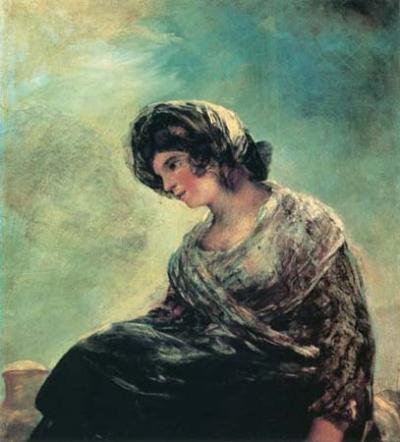
A young woman lowers her eyes towards the left edge of the picture. Her shawl sweeps across her chest and catches the same pale light that catches her hair. At the lower left, the rim of a vessel is just visible beside the dark mass of her skirt. The jug gives The Milkmaid of Bordeaux its subject, but the woman’s face holds the eye long before the jug comes into view. The Museo Nacional del Prado lists the painting under Francisco de Goya, whose last years in Bordeaux brought him into close contact with the people who first owned it. Some specialists have questioned whether Goya painted the canvas himself. [1] [2] [3]
At a Glance
- ArtistFrancisco de Goya y Lucientes in the Prado’s published records. [1] [2]
- TitleThe Milkmaid of Bordeaux (La lechera de Burdeos).
- DateAbout 1827. The Fundación Goya en Aragón gives 1825–27. [2] [3]
- Medium and dimensionsOil on canvas, 74 × 68 cm (height × width), approximately 29 × 27 inches. [2] [3]
- CollectionMuseo Nacional del Prado, Madrid, P002899. The painting entered the museum in 1945 from the Muguiro family. [1] [2] [3]
Works across Goya’s career
The Parasol
1777The Nude Maja
1795–1800Saturn Devouring His Son
c. 1820–23The Dog
c. 1820–23Milkmaid of Bordeaux
c. 1827Looking at the milkmaid
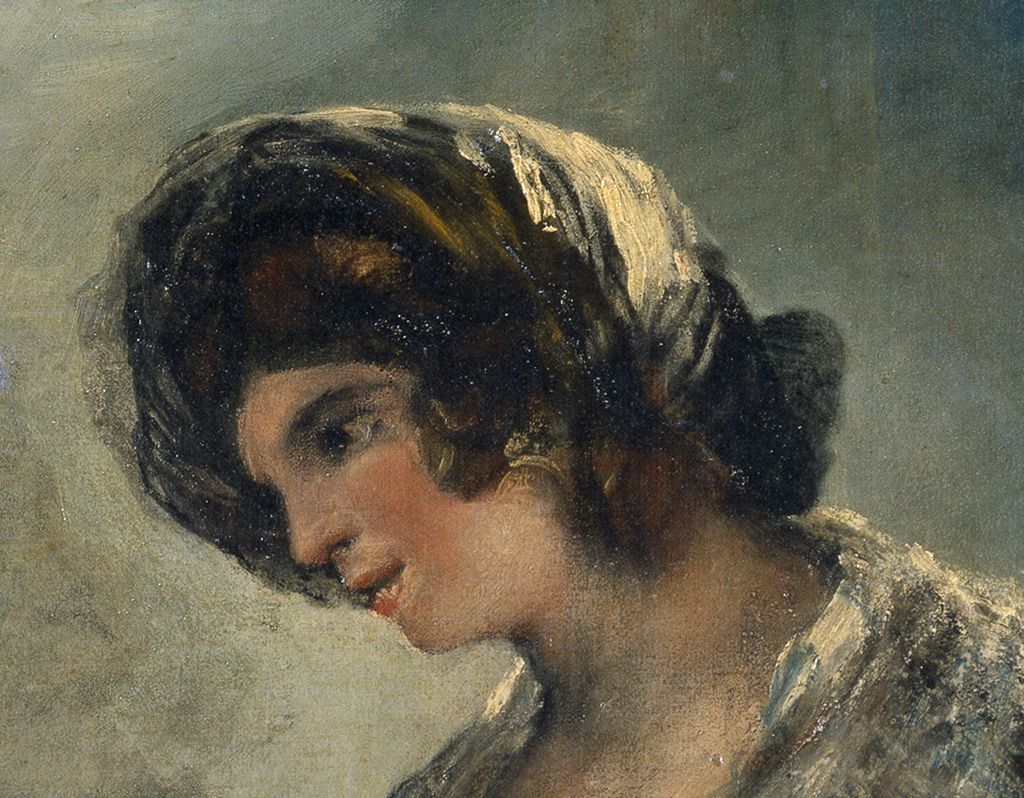
Start with the small patch of warm colour between the darkness of the hair and the slope of the shawl. The woman’s head tilts forward and her eyes follow the angle of her nose. The pale edge of the head covering continues the arc over her forehead, then drops into shadow at the back. A dark curl touches her cheek. The face is readable at once, even though much of its edge disappears into the hair or the shadow beneath her chin. The bowed head gives the pose a direction and leaves whatever she is looking at just beyond our view. [3]
The shawl takes that movement down into the body. Broken strokes run across the shoulder and meet the sloping fold that crosses the chest. Cream, grey, brown and blue-green appear across the fabric, sometimes overlapping, sometimes leaving darker paint between them. Where the shawl passes over the skirt, the brush marks widen. The dark skirt is interrupted by a few brighter streaks that carry the sweep of the folded body towards the left. Below the sleeve at the right edge, the small visible area of skin brings back some of the warmth in the cheek. [3]
Look next at the space around her. A light patch opens to her left, just where the bowed head directs the eye. The colour deepens above and behind her shoulder. The greenish blue of the sky recurs in parts of the clothes, and the mottled brushwork makes the distinction between their surfaces depend more on the way the strokes run than on colour alone. The face, the highest folds of the shawl and the lip of the jug each catch the light in a different way. Across the nearly square canvas, the small jug balances a much larger mass of dark clothing by sitting close to the corner where the figure’s downward tilt leads us. [3]
The traditional account makes the woman a milk seller riding a mule with a pitcher. The low crop leaves the animal difficult to make out, and the painted scene gives us little information about the place or the work at hand. There is no sale or delivery to follow. Leocadia’s early use of the name La Lechera establishes that the occupational title was already in circulation by 1829. The title identifies a role, while the concentrated treatment of the face gives the picture much of the immediacy of a portrait. The sitter’s identity remains unknown. [2] [3] [6] [7]
The Frick’s Portrait of a Lady (María Martínez de Puga?), dated 1824, offers a comparison from the start of Goya’s last years. Its sitter turns her face towards us, and a red necklace, a light cuff and white gloves pick out areas of the dark dress. The milkmaid turns into the painting, and the points of light follow the diagonal of her body. The Frick’s tentative identification of its sitter depends on a proposed connection to a witness to one of Goya’s legal documents. In the milkmaid we have an early title and a history of ownership, but nothing equivalent linking the face to a name. [3] [6] [8]
Annotated Details from Milkmaid of Bordeaux
Look from the bowed head to the loose strokes across the shawl and the vessel.
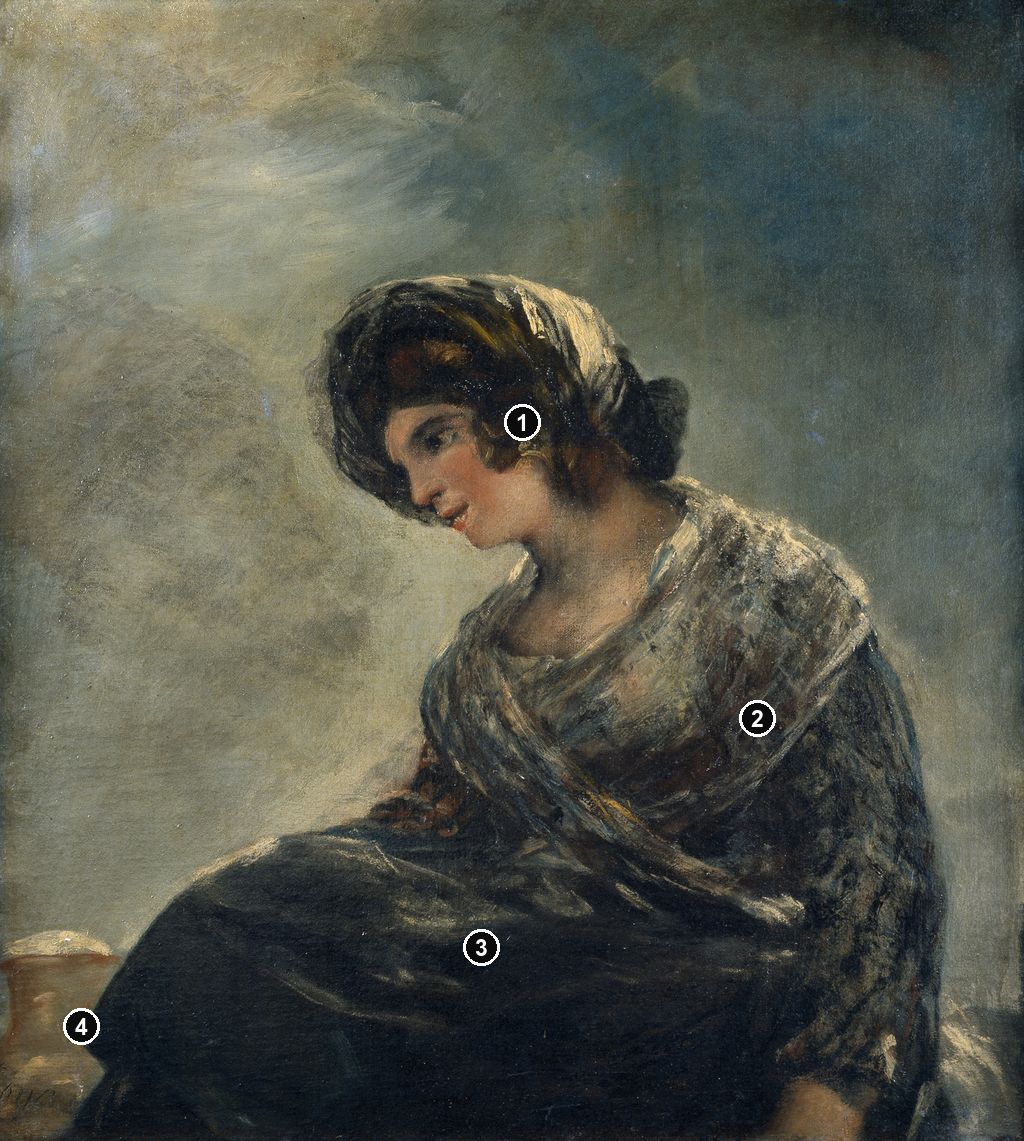
Details from MILKMAID OF BORDEAUX
Details from the Prado painting (P002899).
The bowed head
The head tilts down, with a pale edge to the dark hair and head covering.
The shawl
Light lines and broad grey strokes cross the figure’s shoulder and chest.
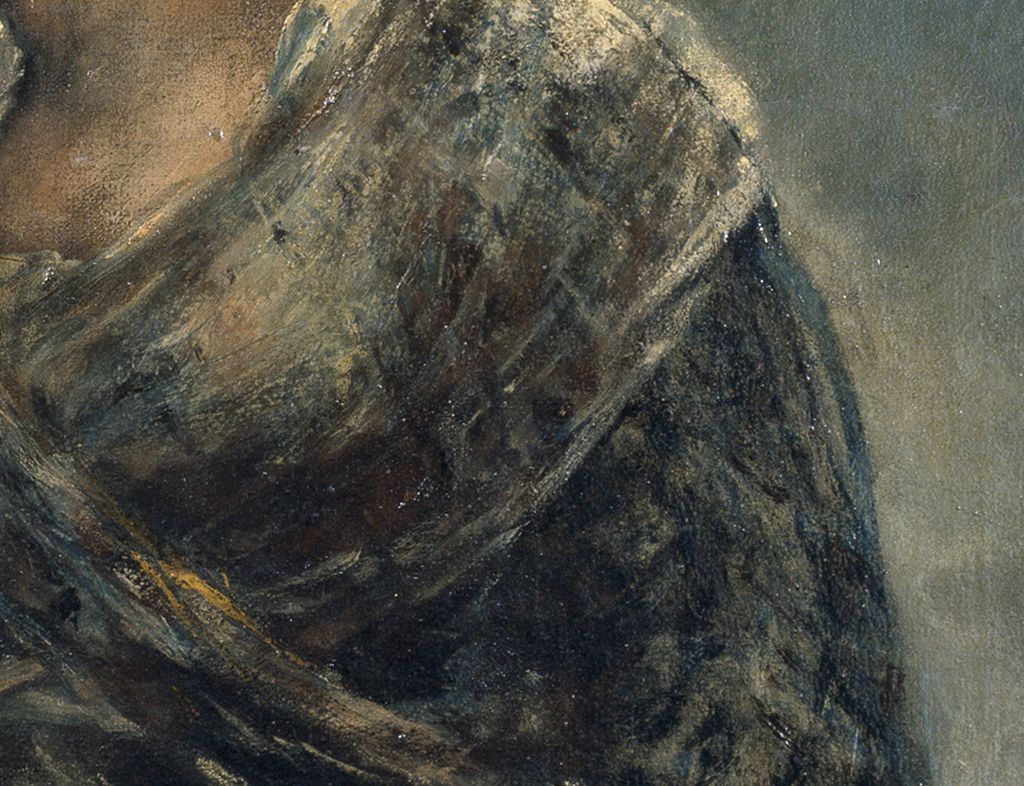
The blue fold
Broad blue and grey touches break across the lap.
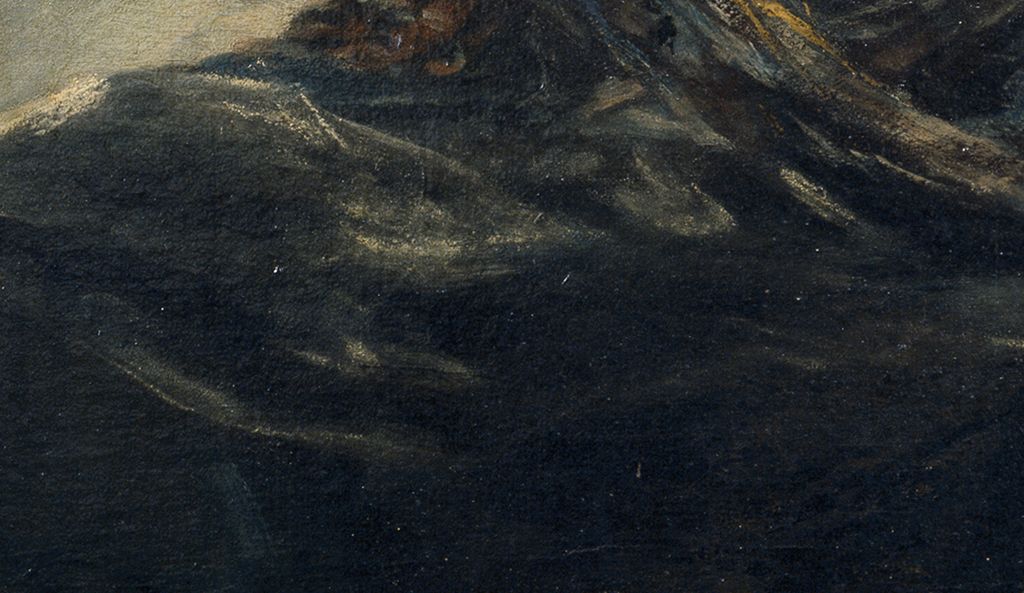
The vessel at the edge
Part of a pale vessel enters at the lower left.
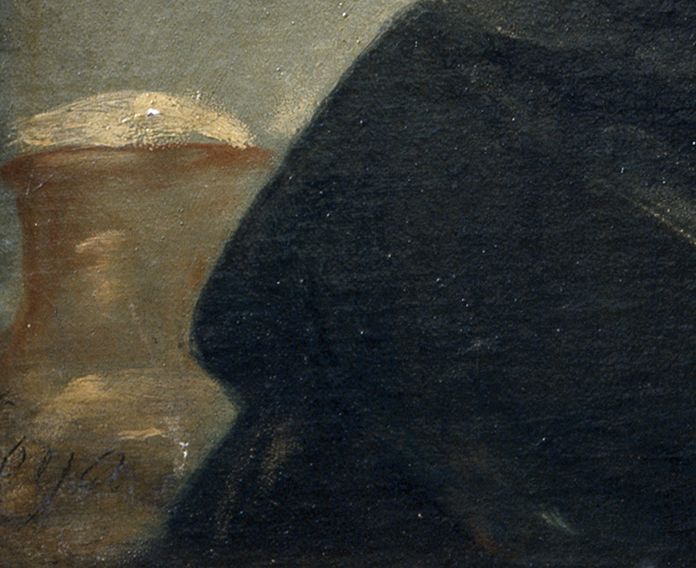
The letter from Leocadia Zorrilla
Goya moved to Bordeaux in 1824, after Ferdinand VII’s restoration of absolute rule and the repression of Spanish liberals. Among the Spanish people living there were friends and acquaintances from Madrid. Leocadia Zorrilla and her children joined him. The drawings, oil portraits, lithographs and paintings on ivory from Goya’s final years show how much he continued to work in that setting. After his death in April 1828, his son Javier was his heir. The Prado’s earlier account says it is unclear how The Milkmaid came into Leocadia’s possession. Her subsequent letter establishes that she had the picture and was prepared to sell it. [2] [6] [9]
On 9 December 1829 Leocadia wrote from Bordeaux to Juan Bautista de Muguiro. He had already pressed her to let him have the picture and to say what she wanted for it. She had replied that she intended to keep it unless need obliged her to sell, and she had promised him first refusal. She now wrote that the need had come, much to Rosario’s regret. She said the late Goya had told her to accept no less than an ounce. The Fundación Goya en Aragón specifies an ounce of gold. She offered to send the work to Ignacio García in Bayonne if Muguiro was still interested. The document records her terms and the proposed way of delivering the picture. The eventual price remains unknown. [3] [6]
The rest of the letter concerns Rosario’s future. Leocadia says Fermín Remón took an interest in helping her daughter make a career and had introduced her to the Duchess of San Fernando. The duchess held Rosario’s teacher in high regard and promised to do what she could for his pupil. Leocadia asked Muguiro for advice. In a single letter she put a value on a painting associated with the household and sought help advancing the training of a young artist. Her account of Goya’s advice is good evidence that he knew the picture and had discussed its fate with her. The letter says who had the picture, who wanted it and how Leocadia proposed to part with it. The identity of its painter is unstated. [6]
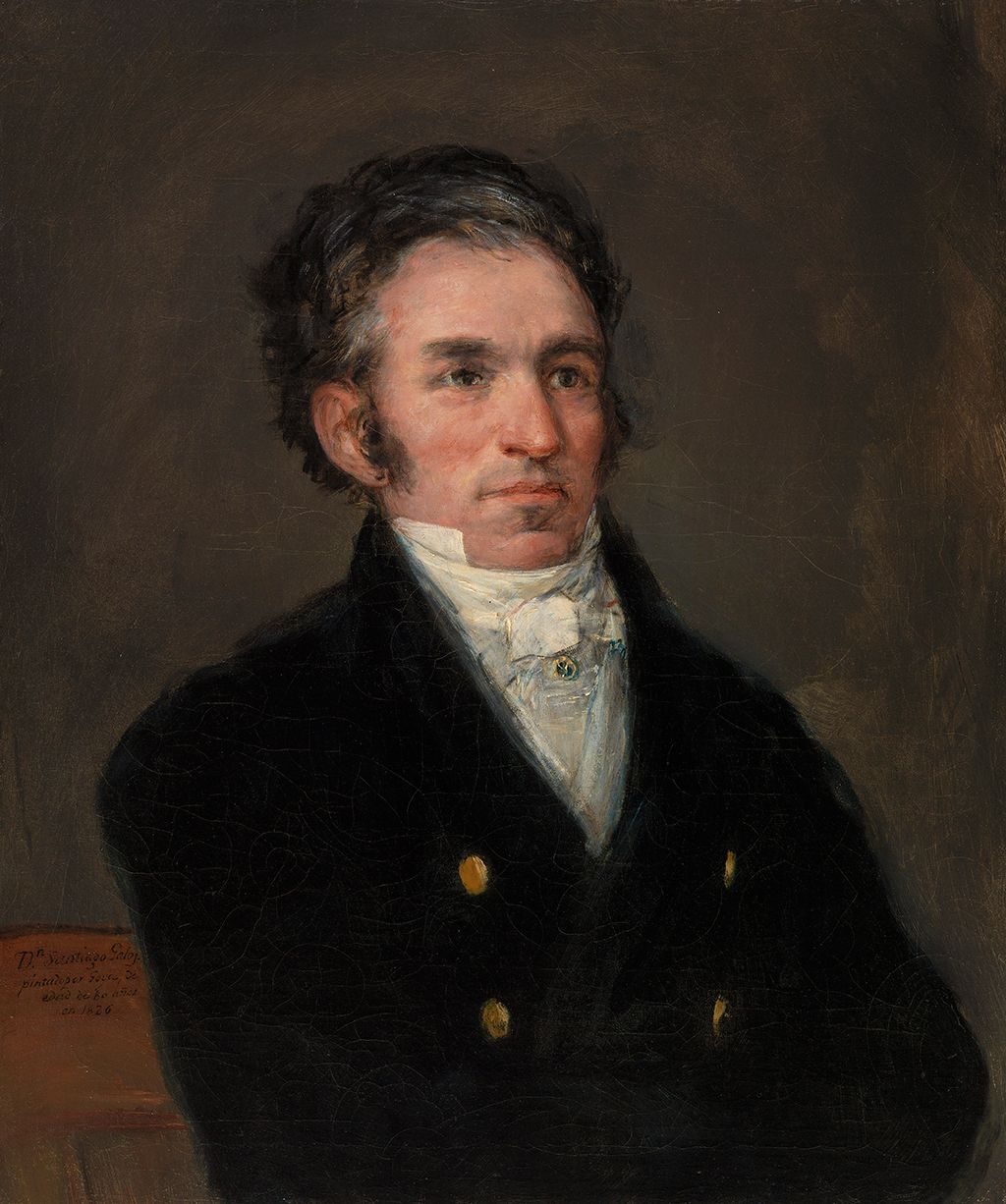
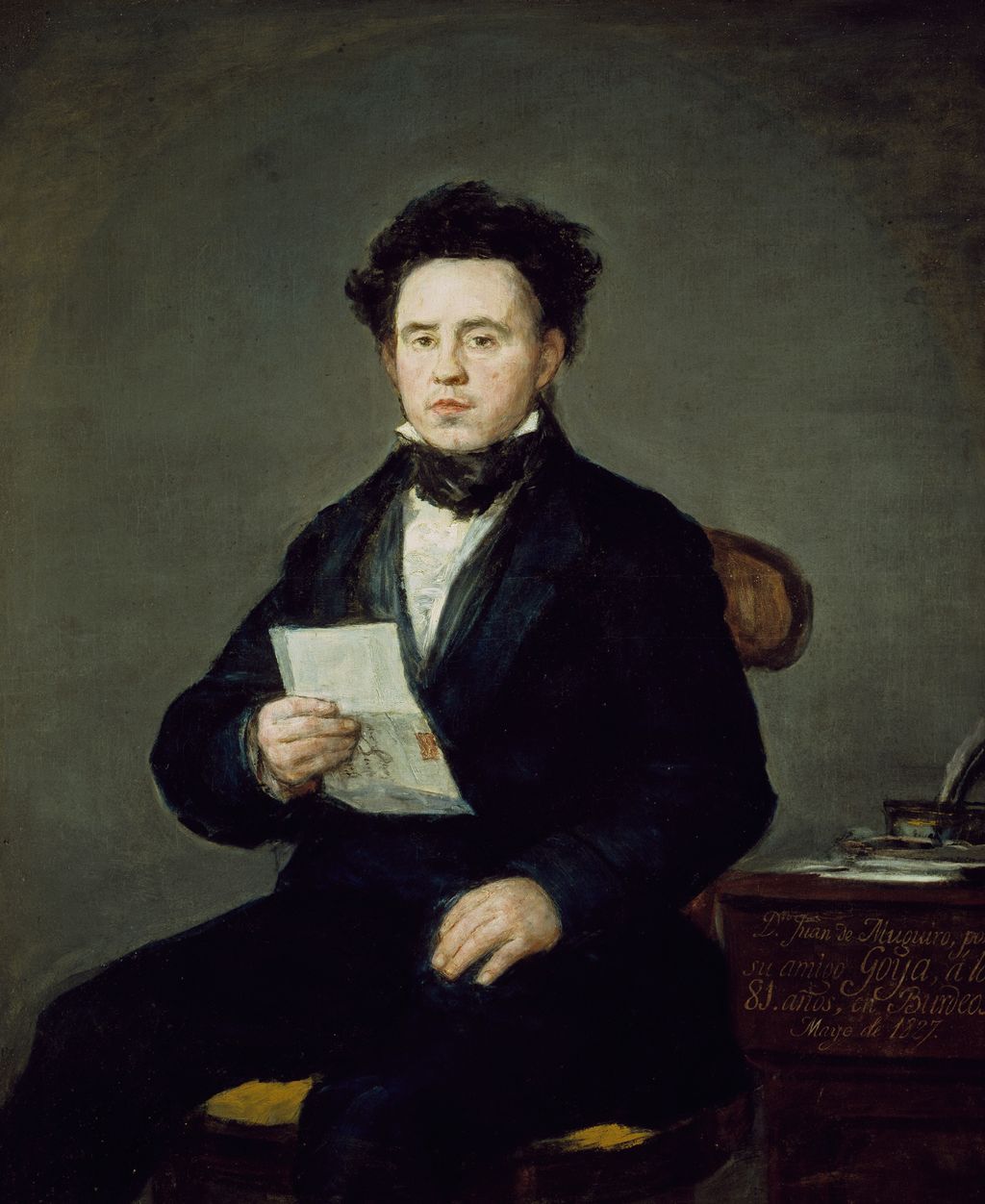
Muguiro acquired the canvas in 1830 according to the provenance given in the Prado’s earlier entry and the Instituto Cervantes’ account. It remained with his family and entered the Prado in December 1945. The museum also holds Goya’s Don Juan Bautista de Muguiro, inventory P002898, painted in Bordeaux in May 1827. Goya wrote Muguiro’s name, the date and his own name and age on the desk in that work. The portrait and the milkmaid passed through the same family, and looking at the two paintings together shows how different the information on the painted surfaces can be. In one case, the picture names a friend and gives the circumstances of its making. In the other, the small marks on the jug are themselves part of the attribution debate. [2] [3] [7] [10]
Goya on film
Five films explore Goya’s portraits, prints, Black Paintings and painting techniques.
The Duke of Wellington by Goya
The portrait, its military decorations and its later theft.
Watch on YouTubeWhy have specialists questioned the attribution?
The Fundación Goya en Aragón records an incised inscription reading ‘Goya’ on the curved side of the jug. It takes the inscription into account in cataloguing the painting as a documented Goya. Wilson-Bareau questioned whether the marks constituted an authentic signature. At her 2001 lecture for the Fundación Amigos del Museo del Prado, later published as an essay, she challenged the attribution. The contemporary account of her interview in El Periódico del Arte records her doubts about the strength of the brushwork and the way the figure sits within the format. For her, the framing and handling were evidence to weigh alongside the inscription. [3] [4] [5]
Radiographs were also part of the discussion. Contemporary reports of Wilson-Bareau’s presentation describe forms under the visible figure that she read as unrelated sketches. A French account reports that she compared these underlying forms with drawings by Rosario in Madrid and New York. The comparison concerns what lies beneath the paint as well as the handling of the finished picture. An X-ray can register paint that an artist subsequently covered. Its pattern may show a change in a composition or a support used for a different design. Identifying a hand from those forms still requires comparison with securely documented works, and identifying the hand responsible for a lower layer would leave open who finished the picture. [4] [11] [12]
Mena supported Wilson-Bareau’s challenge in 2001, while Prado director Fernando Checa publicly maintained the museum’s attribution. Sarah Symmons defended it on stylistic grounds in a 2004 interview. She argued that departures from Goya’s usual composition and handling could belong to a painter whose style kept changing in old age, and pointed to an unconventional print of a blind guitarist as a parallel. Goya’s work in Bordeaux certainly embraced a range of effects, from the shifting darks of lithography to the tiny, worked surfaces of paintings on ivory. That range helps explain why unusual handling alone has carried different weight with different specialists. Jonathan Brown’s entry for the Frick’s Goya’s Last Works exhibition in 2006 retained the painting among the late works. [5] [9] [13] [14]
The surviving ivory miniatures give some idea of what Symmons meant by change. In his December 1825 letter to Joaquín María de Ferrer, Goya described making almost forty of them in the previous winter. He compared the effect of the many small marks to Velázquez’s brushwork. The letter shows Goya himself thinking about how marks of different sizes read as an image. In the milkmaid, some of the shorter strokes define the edge of the shawl and others seem to dissolve into it. A comparison can show how an effect is achieved, even when attribution turns on whether the same painter achieved it. [3] [13] [15]
Rosario Weiss and the late work of Goya
Rosario was born in 1814. The Biblioteca Nacional de España’s exhibition of her drawings traces her early training from sketches Goya supplied for her to copy or complete to the public drawing school run by Pierre Lacour in Bordeaux, which she entered around 1825. This gives the authorship proposal a historical basis. She had access to Goya’s drawings and received formal teaching while the canvas is thought to have been painted. There are drawings on which the two artists’ work has been connected. For a painting of this scale and finish, the Fundación Goya en Aragón treats her age, around thirteen in 1827, as one reason for caution and retains the attribution to Goya. Her later drawings can be studied under her own name.
One sheet in the Biblioteca Nacional shows how closely related the pupil’s exercises and Goya’s sketches can be. The Fundación Goya en Aragón records a double attribution for the drawing of a French soldier on one side, following the specialist Carlos Sánchez Díez. The other side bears a small sketch of a woman’s head in profile. Manuel Gómez-Moreno assigned that sketch to Goya, while José López-Rey assigned it to Weiss. The sheet gives a concrete example of what comparison can and cannot establish for works made within the same circle. There is ample reason to compare the artists’ marks, and even on a sheet where scholars have considered the contribution of both, individual passages can be read differently. [16] [3] [17]
In 2008 Guadalupe Echevarría made Rosario and the question of copying central to her French-language study of the painting. An introduction by Charlotte Chastel-Rousseau, Guillaume Kientz and Bruno Mottin to the 2026 issue of Technè on Goya puts the milkmaid among works that have divided specialists. Their discussion concerns gaps in historical and technical evidence across Goya’s wider circle. Here those gaps affect very specific questions about a signature in a jug, the relationship between two layers of paint and the status of a canvas that passed through the hands of people Goya knew. Neither a possible apprenticeship connection nor an identification with a member of Goya’s household can supply the sitter’s name. [3] [12] [17] [18]
There is a longer history to the subject. In a 1985 essay for the J. Paul Getty Museum, Selma Holo compared the milkmaid with Goya’s drawing El trabajo siempre premia (Work Is Always Rewarding), which shows a young woman knitting beside a basket. Holo saw the drawing as an earlier example of the quiet attention Goya could give to a working woman. In the drawing, her hands explain what she does. In the milkmaid, the small jug has to do virtually all the work of identifying the occupation. That change in emphasis is worth looking for when you return to the canvas. The brushwork makes the face and clothing richly present while leaving the circumstances of her work to the corner of the picture. [3] [19]
Artworks directory
| Name | Date | Medium |
|---|---|---|
| And There’s No Help for It, Plate 15 | Printed 1863 | |
| Asmodea | c. 1820–23 | Wall painting transferred to canvas |
| Boys Inflating a Bladder | 1777–78 | Tapestry cartoon |
| Boys Picking Fruit | 1778 | Tapestry cartoon |
| Bullfight in a Divided Ring | 1825 | Lithograph |
| Card Players | 1777–78 | Tapestry cartoon |
| Card Players (sketch) | 1777–78 | Painted sketch |
| Dance on the Banks of the Manzanares | 1777 | Tapestry cartoon |
| Duel with Cudgels | c. 1820–23 | Wall painting transferred to canvas |
| Heads in a Landscape | c. 1820–23 | Easel painting |
| Judith and Holofernes | c. 1820–23 | Wall painting transferred to canvas |
| Leocadia | c. 1820–23 | Wall painting transferred to canvas |
| Maja and Cloaked Men | 1777 | Tapestry cartoon |
| Maja and Cloaked Men (sketch) | 1777 | Painted sketch |
| Majo Clapping in Time to the Music | 1777 | Drawing |
| Men Reading | c. 1820–23 | Wall painting transferred to canvas |
| Out Hunting for Teeth, Plate 12 | 1799 | Etching, burnished aquatint and burin |
| Picnic in the Countryside (sketch) | 1776–78 | Painted sketch |
| Picnic on the Banks of the Manzanares | 1776 | Tapestry cartoon |
| Pilgrimage to San Isidro | c. 1820–23 | Wall painting transferred to canvas |
| Preparatory study for The Sleep of Reason Produces Monsters | c. 1796–97 | Drawing |
| Procession of the Holy Office | c. 1820–23 | Wall painting transferred to canvas |
| Quarrel at the Cockerel Inn (sketch) | 1777 | Painted sketch |
| Quarrel in the New Tavern | 1777 | Tapestry cartoon |
| Saturn Devouring His Son | c. 1820–23 | Wall painting transferred to canvas |
| Seated Majo Smoking | c. 1776 | Drawing |
| The Dog | c. 1820–23 | Wall painting transferred to canvas |
| The Drinker | 1777 | Tapestry cartoon |
| The Fates | c. 1820–23 | Wall painting transferred to canvas |
| The Great He-Goat | c. 1820–23 | Wall painting transferred to canvas |
| The Kite | 1777–78 | Tapestry cartoon |
| The Parasol | 1777 | Oil on canvas, tapestry cartoon |
| The Second of May 1808 | 1814 | Oil on canvas |
| The Sleep of Reason Produces Monsters, Plate 43 | 1799 | Etching and aquatint |
| The Third of May 1808 | 1814 | Oil on canvas |
| Thou Who Canst Not, Plate 42 | 1799 | Etching and burnished aquatint |
| Three Figures | 1776 | Drawing (lost) |
| Two Old Men | c. 1820–23 | Wall painting transferred to canvas |
| Two Old Men Eating Soup | c. 1820–23 | Wall painting transferred to canvas |
| Two Women and a Man | c. 1820–23 | Wall painting transferred to canvas |
| Universal Language: The Author Dreaming | 1797 | Drawing |
| The Family of Charles IV | 1800 | Oil on canvas |
| Witches’ Sabbath (Osuna painting) | 1797–98 | Oil on canvas |
| The Nude Maja | 1795–1800 | Oil on canvas |
| The Clothed Maja | 1800–07 | Oil on canvas |
| Self-Portrait (Drawing) | c. 1796 | Brush and carbon black ink on laid paper |
| The Swing, Madrid Album B.21 | 1795–97 | Brush and carbon black washes |
| Majas Fighting, a Majo Observing, Madrid Album B.15 | 1796–97 | Brush, grey and black washes on laid paper |
| Majos and Majas Conversing, Madrid Album B.16 | c. 1794–97 | Ink wash on paper |
| Weeping Woman and Three Men, Madrid Album B.17 | 1795–97 | Brush, carbon black washes and black chalk |
| Maja Seated on a Chair and Two Companions Behind, Madrid Album B.18 | 1795–97 | Brush and carbon black washes |
| Girl and Bull, Madrid Album B.23 | 1796–97 | Brush and carbon black washes |
| Lovers Sitting on a Rock, Madrid Album B.24 | 1796–97 | Brush and carbon black washes |
| Mariano Ceballos Riding a Bull | 1825 | Crayon lithograph and scraper |
| Landscape (lifetime impression) | c. 1807–10 | Etching and aquatint |
| Self-Portrait (1815), Prado canvas | 1815 | Oil on canvas |
| Self-Portrait (1815), Academy panel | 1815 | Oil on panel |
| Self-Portrait with Dr Arrieta | 1820 | Oil on canvas |
| Christ Crucified | 1780 | Oil on canvas |
| The Last Communion of Saint Joseph of Calasanz | 1819 | Oil on canvas |
| Christ on the Mount of Olives | 1819 | Oil on panel |
| The Flower Girls, or Spring | 1786–87 | Oil on canvas |
| The Grape Harvest, or Autumn | 1786–87 | Oil on canvas |
| The Snowstorm, or Winter | 1786–87 | Oil on canvas |
| The Threshing Ground, or Summer | 1786–87 | Oil on canvas |
| Picnic on the Banks of the Manzanares | 1776 | Oil on canvas |
| The Kite | 1777–78 | Oil on canvas |
| Dance on the Banks of the Manzanares | 1777 | Oil on canvas |
| A Fight at the Venta Nueva | 1777 | Oil on canvas |
| Blind Man’s Bluff | 1788 | Oil on canvas |
| Dogs on a Lead | 1775 | Oil on canvas |
| Hunting with a Decoy | 1775 | Oil on canvas |
| Hunter Loading His Rifle | 1775 | Oil on canvas |
| The Angler | 1775 | Oil on canvas |
| The Hermitage of San Isidro on His Feast Day | 1788 | Oil on canvas |
| The Meadow of San Isidro | 1788 | Oil on canvas |
| The Straw Manikin | 1791–92 | Oil on canvas |
| Witches’ Flight | c. 1797–98 | Oil on canvas |
| A Scene from ‘The Forcibly Bewitched’ | 1798 | Oil on canvas |
| The Duchess of Alba in Black | 1797 | Oil on canvas |
| The Duchess of Alba in White | 1795 | Oil on canvas |
| Charles III in Hunting Dress | c. 1786 | Oil on canvas |
| The Duke and Duchess of Osuna and Their Children | 1787–88 | Oil on canvas |
| Manuel Osorio Manrique de Zúñiga | 1787–88 | Oil on canvas |
| The Marquesa de Pontejos | c. 1786 | Oil on canvas |
| Equestrian Portrait of the 1st Duke of Wellington | 1812 | Oil on canvas |
| The Duke of Wellington | 1812–14 | Oil on wood |
| Portrait of Ferdinand VII of Spain | 1814 | Oil on canvas |
| Gaspar Melchor de Jovellanos | 1798 | Oil on canvas |
| María Tomasa Palafox y Portocarrero | 1804 | Oil on canvas |
| Señora Sabasa García | c. 1806–11 | Oil on canvas |
| Don Juan Bautista de Muguiro | 1827 | Oil on canvas |
| Doña Isabel de Porcel | Before 1805 | Oil on canvas |
| The Colossus | After 1808 | Oil on canvas |
| The Burial of the Sardine | 1808–12 | Oil on panel |
| The Madhouse | 1808–12 | Oil on panel |
| A Procession of Flagellants | 1808–12 | Oil on panel |
| Portrait of Jacques Galos | 1826 | Oil on canvas |
| Portrait of Mariano Goya, the Artist’s Grandson | 1827 | Oil on canvas |
| Milkmaid of Bordeaux | c. 1827 | Oil on canvas |
| Portrait of Don Juan Antonio Cuervo | 1819 | Oil on canvas |
| María Luisa of Parma (Naples version) | c. 1800 | Oil on canvas |
| The Countess of Baena | 1819 | Oil on canvas |
| The Family of the Infante Don Luis | 1783–84 | Oil on canvas |
| The Holy Family | c. 1787 | Oil on canvas |
| Saint Barbara | c. 1773 | Oil on canvas |
| Saints Justa and Rufina | 1817 | Oil on canvas |
| El Tío Paquete | c. 1819–20 | Oil on canvas |
| The Forge | c. 1815–20 | Oil on canvas |
| Majas on a Balcony (Metropolitan Museum version) | c. 1800–10 | Oil on canvas |
| Maja and Celestina on a Balcony | c. 1808–12 | Oil on canvas |
| The Water Bearer | 1808–12 | Oil on canvas |
| Time and the Old Women | c. 1810 | Oil on canvas |
Frequently Asked Questions
Discussion
Look again at the images and ideas explored in Milkmaid of Bordeaux. These editorial prompts invite your observations.
Cover the corner with the jug and look at the woman’s head and shoulders. How does seeing the jug again change your understanding of her pose? Where do you look first once you know the painter’s name may be written on it?
Reader Insights
Where do the strokes make the shawl seem to move?
What details guide you between the face and the vessel?
Join the Conversation
Share a detail, comparison or question about Milkmaid of Bordeaux below.
References
- Museo Nacional del Prado, The Milkmaid of Bordeaux, P002899. See also Memoria de actividades 2021, where the museum credits the painting to Goya. View source 1. View source 2.
- Museo del Prado, Catálogo de las pinturas (1996), p. 154, entries 2898 and 2899, and earlier Prado catalogue record, P02899, reproduced by Studylib. View source 1. View source 2.
- Fundación Goya en Aragón, La lechera de Burdeos, catalogue entry 488, revised June 2023. View source.
- Juliet Wilson-Bareau, ‘La lechera de Burdeos’, Fundación Amigos del Museo del Prado, 2001 lecture. Published in Goya (2001), pp. 349–68. View source 1. View source 2.
- ‘El Museo del Prado mantiene la autoría de dos cuadros de Goya’, El País, 5 April 2001, contemporary statements from Wilson-Bareau, Mena and Checa. View source.
- Leocadia Zorrilla, letter to Juan de Muguiro Iribarren, Bordeaux, 9 December 1829, in Ángel Canellas López (ed.), Francisco de Goya. Diplomatario (Institución Fernando el Católico, 1981), document CLXXXIV, p. 515. View source.
- Instituto Cervantes, Bordeaux, La lechera de Burdeos, 2024 lecture listing and account of the subject and provenance. View source.
- The Frick Collection, Portrait of a Lady (María Martínez de Puga?), 1824, painting and exhibition entry. View source.
- The Frick Collection, Goya’s Last Works, exhibition overview and essay on the Bordeaux years. View source 1. View source 2.
- Fundación Goya en Aragón, Juan Bautista Muguiro, catalogue entry 189 and transcription of the dedication. View source.
- ‘Goya à l’épreuve’, Le Journal des Arts, 2001, contemporary account of Wilson-Bareau’s arguments and the responses to them. View source.
- Charlotte Chastel-Rousseau, Guillaume Kientz and Bruno Mottin, ‘Introduction’, Technè, on the limits of the technical and historical evidence for contested paintings associated with Goya. View source.
- Sarah Symmons, interview with Eric Weems, 2004. View source.
- Jonathan Brown, ‘Milkmaid of Bordeaux’, in Jonathan Brown and Susan Grace Galassi, Goya’s Last Works (The Frick Collection and Yale University Press, 2006), catalogue no. 12, pp. 118–23. View source.
- The Frick Collection, ‘Miniatures on Ivory’, essay for Goya’s Last Works, including the extract from Goya’s letter to Joaquín María de Ferrer. View source.
- Fundación Goya en Aragón, Soldado francés, Biblioteca Nacional de España, DIB/18/1/9181, including the attribution history of the drawing on the reverse. View source.
- Biblioteca Nacional de España, Dibujos de Rosario Weiss (1814–1843), exhibition account of Weiss’s training and drawings. View source.
- Guadalupe Echevarría, La jeune bâtarde et la modernité. Goya et la Laitière de Bordeaux (Bordeaux, Le Festin, 2008), as described in the Instituto Cervantes book presentation. View source.
- Selma Holo, ‘An Unsuspected Poseur in a Goya Drawing’, The J. Paul Getty Museum Journal, vol. 13 (1985), especially p. 107 and fig. 4. View source.







