


 by Tom Gurney
Tom Gurney BSc (Hons) is an art history expert with over 20 years experience
Published on June 19, 2020 / Updated on November 20, 2026
Email: tomgurney1@gmail.com / Phone: +44 7429 011000
Introduction
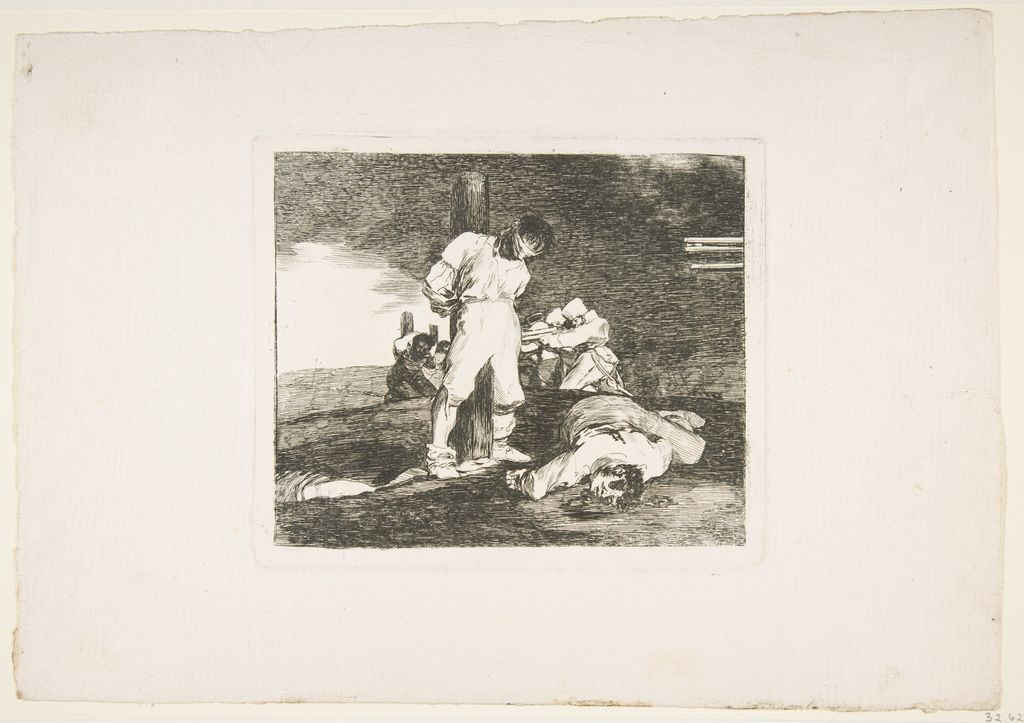
In one impression of Francisco de Goya’s I Saw It at the Metropolitan Museum of Art, the people run across the page and the space beneath them is empty. In another, the Spanish words Yo lo vi sit under the same scene. The first sheet is a proof taken before the lettering was added. The second belongs to the edition published in 1863, after Goya’s death. The two sheets came from the same copperplate at different stages in its history. Compare them and you can see how a brief caption turns a scene of people fleeing into a claim of personal witness. [1] [2]
The parts of Goya’s printmaking career reached the public at very different times. His copies after Velázquez were advertised in 1778, his social satires in 1799 and his bullfighting etchings in 1816. The war series and the strange scenes now called Los Disparates had to wait for posthumous editions. At the end of his career, in Bordeaux, Goya worked with a lithographic printer to bring out a new group of bullfighting scenes. The history of each body of work involves both the making of images and the circumstances in which people could see them. [4] [6] [7] [9] [11]
At a Glance
- Early etchings after VelázquezPrints after paintings in the Spanish royal collection were advertised in Madrid in 1778. [3] [6]
- Los CaprichosEighty prints, principally in etching and aquatint, offered for sale in Madrid in 1799. [7]
- The Disasters of WarMade during and after the Peninsular War. Eighty prints appeared in the first edition of 1863. Two further designs survive in the lifetime album of proofs associated with Ceán Bermúdez. [4] [8]
- La TauromaquiaFirst published in 1816 with 33 designs. An edition printed in 1876 added seven designs etched on the backs of plates. [9]
- Los DisparatesBegun in the later part of Goya’s Spanish career. The National Gallery of Victoria dates the making of the series to about 1815–19. Eighteen prints first appeared together as Los Proverbios in 1864. Four additional designs appeared in the Paris journal L’Art in 1877. [4] [10] [23]
- LithographsEarly trials in Madrid from 1819, followed by the Bulls of Bordeaux printed by Cyprien Gaulon in 1825. [5] [11]
Velázquez and the royal collection
While training with José Luzán in Zaragoza, Goya learnt to draw by copying prints. Access to the Spanish royal collection gave him the opportunity to work in the other direction, translating the paintings of Diego Velázquez into prints of his own. The Met connects the project to Anton Raphael Mengs’s advice to study those paintings. A notice in the Gazeta de Madrid of 28 July 1778 announced the first group, which included the equestrian portrait of Gaspar de Guzmán, Count-Duke of Olivares. A portrait familiar to people with access to the palace could now circulate on a sheet of paper. [3] [6] [12]
In the print, the horse rears across the foreground as its rider raises a baton. The smallest marks in the distance suggest a battle. Goya builds the mass of the horse with lines that follow its flank. Closely spaced strokes darken the armour, with openings between them where the eye can supply the effect of reflected light. These decisions matter when a composition passes from a large canvas to a sheet held in the hand. The suggestion of distance and the sheen of the armour have to work in a single ink. The National Gallery of Art’s impression, 1951.10.39, is on heavy laid paper and is catalogued as a first-edition sheet of the third state. This means the plate had already been revised by the time this early edition was printed. [6] [13]
Goya had other reasons to work in print alongside his paintings. His Blind Guitarist began as a design for a tapestry at El Pardo. The weavers sent the complicated tapestry cartoon back. Goya made an etching that preserves the more elaborate design, down to the many people and incidents surrounding the musician. Compare that chain of decisions with the portrait after Velázquez. In one case Goya spread knowledge of another painter’s work, and in the other he preserved a version of his own. [3] [12]
The Met traces Goya’s dramatic contrasts of light and dark in his later war prints in part to Rembrandt and Tiepolo. The prints after Velázquez offer another way to watch Goya practise with the relation between line and shadow. In the Olivares print, the grouping of strokes tells us which parts of the design have weight and which can be left to the light of the paper. [3] [6]
Los Caprichos and the public for satire
Look at Plate 42 of Los Caprichos, Tú que no puedes. The donkeys sit astride their human carriers. The men strain towards the ground, while the animals above retain their upright composure. With little else to occupy the picture, the viewer can hold the reversal of the ordinary order in mind while reading the caption. Turn the page to The Sleep of Reason Produces Monsters and another group of animals gathers around a human figure. The owls and bats emerge from a dimmer field, with the man’s sleeves and the side of his desk left pale. Goya’s combination of etched line and aquatint could make the burlesque arrangement of one plate clear at a glance and slow the eye down as it adjusted to the darkness of the next. [7] [14] [15]
A reader in 1799 could buy the eighty prints as a set. A notice in the Diario de Madrid gave buyers an address on the Calle del Desengaño, where the set was sold through a shop selling perfumes and liqueurs. The series opened with a self-portrait identifying Goya by name and profession. A preparatory drawing for the sleeper, dated 1797, shows that Goya had considered using a version of that image as the opening. With the sleeper moved into the sequence as Plate 43, the satirical turn from the donkeys to the creatures of the night occurs halfway through the book. [7] [15] [16]
The Disasters of War and delayed publication
Goya worked on the prints now called The Disasters of War during and after the war that began in Spain in 1808. He also addressed the events of that year in The Second of May 1808 and The Third of May 1808, painted in 1814. Those canvases give two episodes in Madrid the scale and setting of historical painting. In I Saw It, the man who turns his head as he flees looks towards something beyond the edge of a small sheet. The sparseness leaves room to notice what each person manages to carry and how difficult it is for the group to move together. The letters below the published image give it the authority of testimony and still leave the precise place and incident open. [1] [2] [12] [17]
Some wartime images were seen as proofs in Goya’s lifetime. An album associated with his friend, the art historian Juan Agustín Ceán Bermúdez, has a handwritten title that begins by describing the fatal consequences of the bloody war in Spain with Bonaparte. The title also mentions other, emphatic caprices. Across the album the scenes move from wartime violence to famine and then to allegories about the aftermath. The two additional designs in that album explain why today’s count of 82 differs from the 80 published by the Academy in 1863. Three small etchings of prisoners bound into the album are related works. The Academy’s shorter title, Los desastres de la guerra, is the one by which the series became publicly known. [4] [8]
La Tauromaquia and the bullring
In La Tauromaquia, Goya gave readers an account of bullfighting through its supposed origins, named performers and particular feats. The 1816 advertisement offered individual sheets as well as a complete set. A buyer could therefore choose a familiar incident or a celebrated fighter, while the full sequence drew attention to the moments in which skill or courage failed to control what was happening in the ring. The series ends with the death of José Delgado, known as Pepe Illo. The bull’s head and shoulders fill the space around the fallen man. Figures at the sides narrow the space in which anything can happen, and the bleak expanse of the ring gives the eye few places to escape the encounter. [18] [19]
The Fitzwilliam Museum’s impression of Plate 33 is a trimmed sheet from the 1816 first edition. Princeton University Art Museum holds an impression of the same design printed in Paris in 1876 by the publisher Eugène Loizelet. Its broad margins give the composition more room on the page than the trimmed Fitzwilliam copy. Princeton catalogues the combination of etching, burnished aquatint, drypoint and burin on laid Arches paper. Goya had etched additional images on the reverse of seven of the 33 copperplates. Those designs entered the published series with Loizelet’s third edition. One of them, lettered E in the enlarged set, returns to Pepe Illo’s death in a different composition. Plate 33 printed again in 1876 and the different design now called Plate E are two distinct consequences of going back to the same stock of copper. [9] [19] [20] [21]
Goya on film
Five films explore Goya’s portraits, prints, Black Paintings and painting techniques.
The Duke of Wellington by Goya
The portrait, its military decorations and its later theft.
Watch on YouTubeLos Disparates and the puzzle of the title
In Disparate femenino (Feminine Folly), a group of women gathers around a blanket and flings figures into the air. Goya had used a recognisable version of the game in a tapestry cartoon for the royal household. In the print, the darkness presses around the women, the flung figures have limbs that look disjointed, and a donkey appears in the folds of the blanket. The Fondation Custodia holds a rare trial proof printed in dense black ink. A working proof with a handwritten title supplies evidence for the name of the individual design, while a first-edition sheet at the National Gallery of Victoria shows how the design appeared when it finally reached a wider public. [22] [23]
The Academy brought out eighteen prints in 1864 under the title Los Proverbios (The Proverbs). Its lithographed title page survives in a bound copy at the National Gallery of Art. The name Los Disparates (The Follies) reflects the wording Goya wrote on a number of individual proofs. A reader who encounters the word ‘proverbs’ first might set out to match each image to a saying. The variety and uncertainty of such proposed matches is one reason to give the detail of the pictures and the wording of the surviving proofs their own weight. The four designs published separately in L’Art bring the usual count to 22. Neither publisher’s grouping settles what order Goya would have chosen for a complete Los Disparates. [4] [10] [22]
From Madrid to Bordeaux on stone
In Vieja hilandera (Old Woman Spinning), one extended arm and a strand of thread organise a small picture of an older woman at work. The date beneath the image places the print in Madrid in February 1819. The Fundación Goya en Aragón identifies it as Goya’s first lithographic trial and connects it to José María Cardano, whose studio officially opened the following month under the naval hydrographic service. Goya used a brush and pen for this early experiment. The unmarked ground makes it easy to see the line that runs from the woman’s hand towards her spindle. The Biblioteca Nacional de España lists this sheet among several small groups of trials from Goya’s Madrid years. [5] [24]
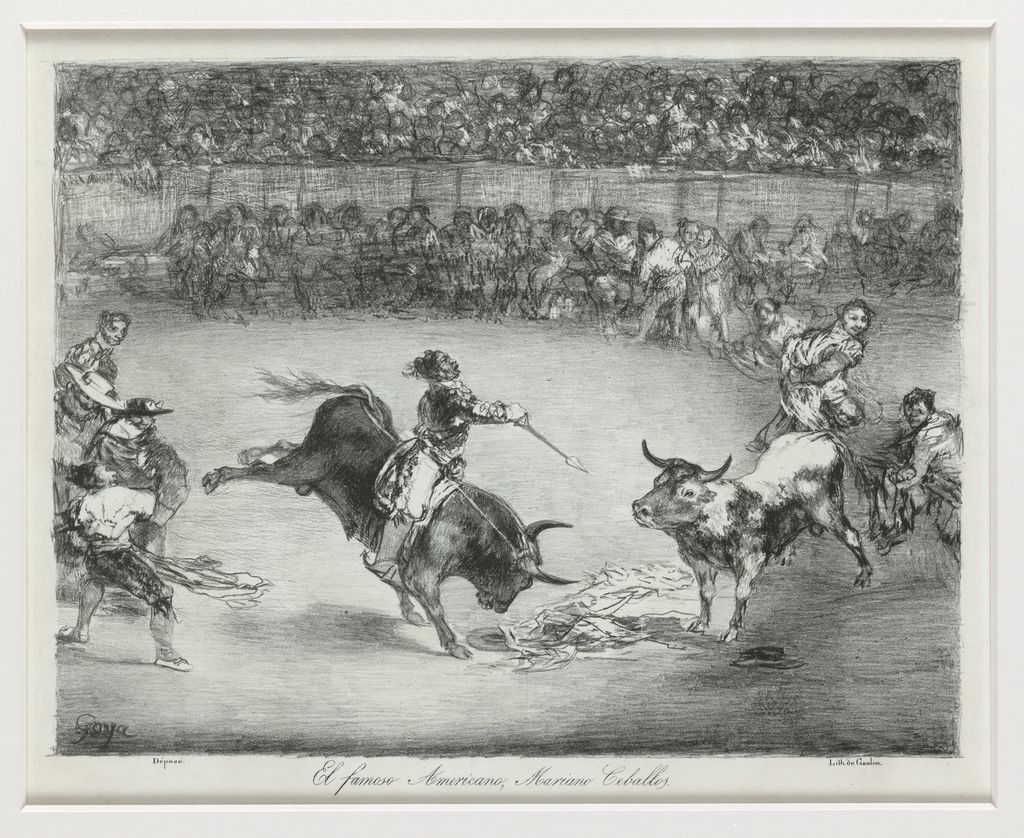
Lithography prints from a flat surface. In a traditional stone lithograph, greasy drawing material establishes the areas that accept printing ink. Dampened blank areas repel that ink. In the copperplate prints, pressure draws ink out of lines and textures below the surface. The difference is visible in Mariano Ceballos Riding a Bull, printed in Bordeaux in 1825. The grain of the crayon suggests a packed crowd with remarkably few distinct faces. Bright strokes open up the dark mass, and the Met catalogues the use of a scraper alongside the crayon. That combination produces a grain and range of light to compare with the etched lines and aquatint in the earlier Tauromaquia. Ceballos appears in that series too, so it is possible to compare Goya’s handling of the same performer across two printing processes. [28] [11] [25] [26]
Cyprien Gaulon’s name appears in the margin of Mariano Ceballos as its lithographic printer. Goya’s correspondence with Joaquín Ferrer documents his plans to sell the Bordeaux bullfight prints among Spanish émigrés as well as in Spain. The Fundación identifies four subjects issued in editions of a hundred and catalogues a related bullfight study, Corrida, known from a single proof. A count of four for the published Bulls of Bordeaux is therefore compatible with a catalogue entry for a fifth related image. [11] [25]
Reading a print label
Start with the subject or series title and the institution’s accession number. A plate can mean the physical printing surface or, in a label such as ‘Plate 43’, the numbered composition in a series. An impression is the particular sheet produced in one pass through the press. A state identifies a stage in the design on the matrix, as with the two stages of I Saw It before and after the addition of the caption. An edition is a group of impressions produced for a particular issue. Two impressions of the same state may differ in ink, paper, wiping or trimming. A proof can help establish when the design or lettering changed, and the history of an edition explains when readers encountered those changes. [1] [2] [19] [26]
Accession numbers let readers check which sheet they are seeing. For I Saw It, Met 32.62.2 takes you to the proof before lettering and Met 22.60.25(44) to the sheet published in 1863. For Feminine Folly, the Fondation Custodia’s trial proof, 2011-P.31, and the National Gallery of Victoria’s first-edition impression, P23.1-1981, show two moments in the history of the design. The first takes us back to Goya testing the plate and the second to the Academy putting the print into circulation. [1] [2] [22] [23]
How a plate becomes a particular sheet
A print title often identifies the image more readily than the particular object in front of you. A museum’s record can distinguish the publisher, the production of the plate and the paper impression. In an aquatint, small areas of the plate retain ink to give the picture tonal fields. Different exposures to acid while preparing the plate can set up broad steps of value. When that plate is printed, the wiping and condition of the metal help determine how much of those steps remains apparent. A label’s single word for medium points to a whole sequence of operations. [29] [30]
The marks close to the edge explain why dimensions need their own labels. A single catalogue entry may record the size of the paper and the size of the plate. The edge of the plate leaves an impression in the paper when the metal goes through the press. How much paper remains outside that impression depends partly on the original preparation of the sheet and partly on its history in an album or mount. A digital crop can remove this evidence from view. Looking for the dimensions before comparing two photographs helps a reader avoid treating a larger reproduction as a larger work. [29] [30]
The Met’s bound copy of the Disparates is also evidence of the form in which the prints reached an audience. Its engraved list supplies a title and sequence beyond the evidence of an isolated impression. An individual proof, in turn, may record adjustments made before publication. The two kinds of objects answer different questions about Goya’s prints. One helps establish how people could read across a book. The other may let a viewer follow what changed in the image before a printer or publisher settled on its public form. [29] [30]
The Met record for the bound volume lists a subset of the numbered plates alongside its engraved list. That makes it particularly clear why a book held today and an ideal first edition need different descriptions. The list has information about how the publication named and organised the series. The physical group of plates in this copy shows exactly what this copy preserves. When a missing image would matter to an interpretation, consult the list and another impression before assuming that an interruption belongs to the sequence as published. [29] [30]
Related paintings





Artworks directory
| Name | Date | Medium |
|---|---|---|
| And There’s No Help for It, Plate 15 | Printed 1863 | |
| Asmodea | c. 1820–23 | Wall painting transferred to canvas |
| Boys Inflating a Bladder | 1777–78 | Tapestry cartoon |
| Boys Picking Fruit | 1778 | Tapestry cartoon |
| Bullfight in a Divided Ring | 1825 | Lithograph |
| Card Players | 1777–78 | Tapestry cartoon |
| Card Players (sketch) | 1777–78 | Painted sketch |
| Dance on the Banks of the Manzanares | 1777 | Tapestry cartoon |
| Duel with Cudgels | c. 1820–23 | Wall painting transferred to canvas |
| Heads in a Landscape | c. 1820–23 | Easel painting |
| Judith and Holofernes | c. 1820–23 | Wall painting transferred to canvas |
| Leocadia | c. 1820–23 | Wall painting transferred to canvas |
| Maja and Cloaked Men | 1777 | Tapestry cartoon |
| Maja and Cloaked Men (sketch) | 1777 | Painted sketch |
| Majo Clapping in Time to the Music | 1777 | Drawing |
| Men Reading | c. 1820–23 | Wall painting transferred to canvas |
| Out Hunting for Teeth, Plate 12 | 1799 | Etching, burnished aquatint and burin |
| Picnic in the Countryside (sketch) | 1776–78 | Painted sketch |
| Picnic on the Banks of the Manzanares | 1776 | Tapestry cartoon |
| Pilgrimage to San Isidro | c. 1820–23 | Wall painting transferred to canvas |
| Preparatory study for The Sleep of Reason Produces Monsters | c. 1796–97 | Drawing |
| Procession of the Holy Office | c. 1820–23 | Wall painting transferred to canvas |
| Quarrel at the Cockerel Inn (sketch) | 1777 | Painted sketch |
| Quarrel in the New Tavern | 1777 | Tapestry cartoon |
| Saturn Devouring His Son | c. 1820–23 | Wall painting transferred to canvas |
| Seated Majo Smoking | c. 1776 | Drawing |
| The Dog | c. 1820–23 | Wall painting transferred to canvas |
| The Drinker | 1777 | Tapestry cartoon |
| The Fates | c. 1820–23 | Wall painting transferred to canvas |
| The Great He-Goat | c. 1820–23 | Wall painting transferred to canvas |
| The Kite | 1777–78 | Tapestry cartoon |
| The Parasol | 1777 | Oil on canvas, tapestry cartoon |
| The Second of May 1808 | 1814 | Oil on canvas |
| The Sleep of Reason Produces Monsters, Plate 43 | 1799 | Etching and aquatint |
| The Third of May 1808 | 1814 | Oil on canvas |
| Thou Who Canst Not, Plate 42 | 1799 | Etching and burnished aquatint |
| Three Figures | 1776 | Drawing (lost) |
| Two Old Men | c. 1820–23 | Wall painting transferred to canvas |
| Two Old Men Eating Soup | c. 1820–23 | Wall painting transferred to canvas |
| Two Women and a Man | c. 1820–23 | Wall painting transferred to canvas |
| Universal Language: The Author Dreaming | 1797 | Drawing |
| The Family of Charles IV | 1800 | Oil on canvas |
| Witches’ Sabbath (Osuna painting) | 1797–98 | Oil on canvas |
| The Nude Maja | 1795–1800 | Oil on canvas |
| The Clothed Maja | 1800–07 | Oil on canvas |
| Self-Portrait (Drawing) | c. 1796 | Brush and carbon black ink on laid paper |
| The Swing, Madrid Album B.21 | 1795–97 | Brush and carbon black washes |
| Majas Fighting, a Majo Observing, Madrid Album B.15 | 1796–97 | Brush, grey and black washes on laid paper |
| Majos and Majas Conversing, Madrid Album B.16 | c. 1794–97 | Ink wash on paper |
| Weeping Woman and Three Men, Madrid Album B.17 | 1795–97 | Brush, carbon black washes and black chalk |
| Maja Seated on a Chair and Two Companions Behind, Madrid Album B.18 | 1795–97 | Brush and carbon black washes |
| Girl and Bull, Madrid Album B.23 | 1796–97 | Brush and carbon black washes |
| Lovers Sitting on a Rock, Madrid Album B.24 | 1796–97 | Brush and carbon black washes |
| Mariano Ceballos Riding a Bull | 1825 | Crayon lithograph and scraper |
| Landscape (lifetime impression) | c. 1807–10 | Etching and aquatint |
| Self-Portrait (1815), Prado canvas | 1815 | Oil on canvas |
| Self-Portrait (1815), Academy panel | 1815 | Oil on panel |
| Self-Portrait with Dr Arrieta | 1820 | Oil on canvas |
| Christ Crucified | 1780 | Oil on canvas |
| The Last Communion of Saint Joseph of Calasanz | 1819 | Oil on canvas |
| Christ on the Mount of Olives | 1819 | Oil on panel |
| The Flower Girls, or Spring | 1786–87 | Oil on canvas |
| The Grape Harvest, or Autumn | 1786–87 | Oil on canvas |
| The Snowstorm, or Winter | 1786–87 | Oil on canvas |
| The Threshing Ground, or Summer | 1786–87 | Oil on canvas |
| Picnic on the Banks of the Manzanares | 1776 | Oil on canvas |
| The Kite | 1777–78 | Oil on canvas |
| Dance on the Banks of the Manzanares | 1777 | Oil on canvas |
| A Fight at the Venta Nueva | 1777 | Oil on canvas |
| Blind Man’s Bluff | 1788 | Oil on canvas |
| Dogs on a Lead | 1775 | Oil on canvas |
| Hunting with a Decoy | 1775 | Oil on canvas |
| Hunter Loading His Rifle | 1775 | Oil on canvas |
| The Angler | 1775 | Oil on canvas |
| The Hermitage of San Isidro on His Feast Day | 1788 | Oil on canvas |
| The Meadow of San Isidro | 1788 | Oil on canvas |
| The Straw Manikin | 1791–92 | Oil on canvas |
| Witches’ Flight | c. 1797–98 | Oil on canvas |
| A Scene from ‘The Forcibly Bewitched’ | 1798 | Oil on canvas |
| The Duchess of Alba in Black | 1797 | Oil on canvas |
| The Duchess of Alba in White | 1795 | Oil on canvas |
| Charles III in Hunting Dress | c. 1786 | Oil on canvas |
| The Duke and Duchess of Osuna and Their Children | 1787–88 | Oil on canvas |
| Manuel Osorio Manrique de Zúñiga | 1787–88 | Oil on canvas |
| The Marquesa de Pontejos | c. 1786 | Oil on canvas |
| Equestrian Portrait of the 1st Duke of Wellington | 1812 | Oil on canvas |
| The Duke of Wellington | 1812–14 | Oil on wood |
| Portrait of Ferdinand VII of Spain | 1814 | Oil on canvas |
| Gaspar Melchor de Jovellanos | 1798 | Oil on canvas |
| María Tomasa Palafox y Portocarrero | 1804 | Oil on canvas |
| Señora Sabasa García | c. 1806–11 | Oil on canvas |
| Don Juan Bautista de Muguiro | 1827 | Oil on canvas |
| Doña Isabel de Porcel | Before 1805 | Oil on canvas |
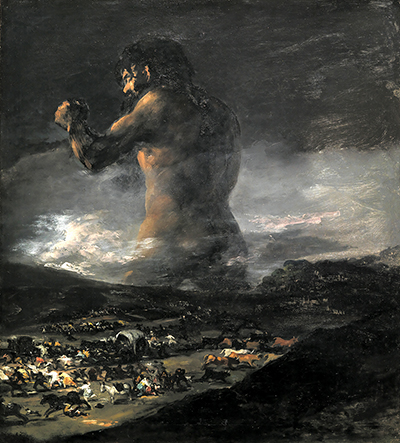
| The Colossus | After 1808 | Oil on canvas |
| The Burial of the Sardine | 1808–12 | Oil on panel |
| The Madhouse | 1808–12 | Oil on panel |
| A Procession of Flagellants | 1808–12 | Oil on panel |
| Portrait of Jacques Galos | 1826 | Oil on canvas |
| Portrait of Mariano Goya, the Artist’s Grandson | 1827 | Oil on canvas |
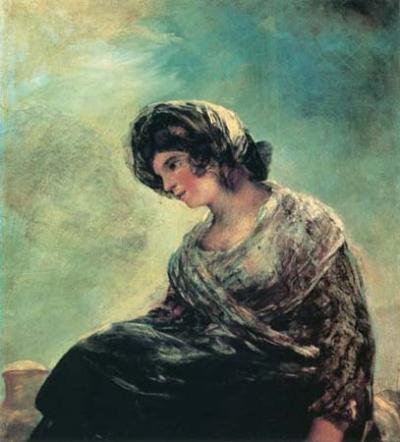
| Milkmaid of Bordeaux | c. 1827 | Oil on canvas |
| Portrait of Don Juan Antonio Cuervo | 1819 | Oil on canvas |
| María Luisa of Parma (Naples version) | c. 1800 | Oil on canvas |
| The Countess of Baena | 1819 | Oil on canvas |
| The Family of the Infante Don Luis | 1783–84 | Oil on canvas |
| The Holy Family | c. 1787 | Oil on canvas |
| Saint Barbara | c. 1773 | Oil on canvas |
| Saints Justa and Rufina | 1817 | Oil on canvas |
| El Tío Paquete | c. 1819–20 | Oil on canvas |
| The Forge | c. 1815–20 | Oil on canvas |
| Majas on a Balcony (Metropolitan Museum version) | c. 1800–10 | Oil on canvas |
| Maja and Celestina on a Balcony | c. 1808–12 | Oil on canvas |
| The Water Bearer | 1808–12 | Oil on canvas |
| Time and the Old Women | c. 1810 | Oil on canvas |
Frequently Asked Questions
A modern reproduction of one of Goya’s oils is a print in everyday usage. In a collection of Goya’s graphic work, the term refers to an image he developed for printing, including sheets issued from his matrices after his death. A poster of The Third of May 1808 reproduces a painting. The Met’s 1863 impression of I Saw It was taken from a copperplate Goya worked on. [2] [4] [17]
Madrid has substantial holdings of Goya’s works on paper. The Calcografía Nacional catalogues his surviving copperplates, and the Biblioteca Nacional de España holds impressions, including rare proofs and early lithographs. For a comparison with editions held elsewhere, the Metropolitan Museum of Art and the National Gallery of Victoria provide detailed object records tied to individual sheets. [27] [14] [23] [24]
Goya used some drawings to develop an image for print, as the dated study for Plate 43 shows. His drawing albums also contain independent images. See Goya’s drawings for the albums and studies, and Goya’s etchings for the work that went into making and revising a copperplate. [12] [16]
Discussion
Look again at the images and ideas explored in Goya’s prints. These editorial prompts invite your observations.
Compare the proof and the published impression of I Saw It. Before you read the caption, where does the image suggest you are standing in relation to the people fleeing? What changes once someone on the page says ‘I saw it’?
Reader Insights
How do the marks in the Bordeaux lithograph differ from the marks in the intaglio prints?
How does an edition’s publication date affect the way you read the subject?
Join the Conversation
Share a detail, comparison or question about Goya’s prints below.
References
- The Metropolitan Museum of Art. I Saw It, proof before lettering, 32.62.2. View source.
- The Metropolitan Museum of Art. I Saw It, 1863 impression, 22.60.25(44). View source.
- The Metropolitan Museum of Art. ‘Francisco de Goya (1746–1828) and the Spanish Enlightenment’. View source.
- Calcografía Nacional, Real Academia de Bellas Artes de San Fernando. Francisco de Goya en Calcografía Nacional, collection history and series catalogues. View source.
- Fundación Goya en Aragón. Vieja hilandera, catalogue record 961. View source.
- Fundación Goya en Aragón. Don Gaspar de Guzmán, Count-Duke of Olivares, catalogue record 683. View source.
- Diario de Madrid, 6 February 1799, pp. 149–150. Facsimile held by EducaMadrid. View source.
- National Gallery of Victoria and Museo Nacional del Prado. Goya: Drawings from the Prado Museum, exhibition catalogue. View source.
- Real Academia de Bellas Artes de San Fernando. Goya / Picasso. Tauromaquias, exhibition and copperplate history. View source.
- National Gallery of Art. Los Proverbios, bound first edition, 1943.3.4717. View source.
- The Metropolitan Museum of Art. Mariano Ceballos Riding a Bull, 1825, crayon lithograph and scraper, 46.103. View source.
- Colta Ives and Susan Alyson Stein. Goya in The Metropolitan Museum of Art, catalogue and essay. View source.
- National Gallery of Art. Gaspar de Guzmán, Count-Duke of Olivares, first edition, 1951.10.39. View source.
- The Metropolitan Museum of Art. Thou Who Canst Not, Plate 42, 18.64(42). View source.
- The Metropolitan Museum of Art. The Sleep of Reason Produces Monsters, Plate 43, 18.64(43). View source.
- Museo Nacional del Prado. Ydioma universal. El Autor soñando, dated preparatory drawing, D03923. View source.
- Fundación Goya en Aragón. The Second of May 1808 and The Third of May 1808, painting records. View source 1. View source 2.
- Banco de España. Tauromaquia, series record including the 1816 advertisement. View source.
- The Fitzwilliam Museum. The Unlucky Death of Pepe Illo in the Ring at Madrid, 1816 first edition, P.77-1937. View source.
- Princeton University Art Museum. Death of Pepe Illo, 1876 impression, x1946-250. View source.
- Fundación Goya en Aragón. La muerte de Pepe Illo, Plate E, catalogue record 1923. View source.
- Fondation Custodia. Disparate femenino, trial proof, 2011-P.31. View source.
- National Gallery of Victoria. Feminine Folly, 1864 first edition, P23.1-1981. View source.
- Biblioteca Nacional de España. Pilar Vinatea Serrano, ‘Goya en la BNE’. View source.
- Fundación Goya en Aragón. El famoso Americano, Mariano Ceballos, inscriptions, related prints and Gaulon’s edition. View source.
- National Gallery of Victoria and Museo Nacional del Prado. Goya: Drawings from the Prado Museum, artwork labels and printmaking notes. View source.
- Calcografía Nacional, Real Academia de Bellas Artes de San Fernando. Catalogue of Goya’s plates. View source.
- The Metropolitan Museum of Art. ‘Lithograph’, Materials and Techniques. View source.
- Metropolitan Museum of Art, The Printed Image in the West: Aquatint. View source.
- Metropolitan Museum of Art, The Follies, bound set. View source.


