


 by Tom Gurney
Tom Gurney BSc (Hons) is an art history expert with over 20 years experience
Published on June 19, 2020 / Updated on November 20, 2026
Email: tomgurney1@gmail.com / Phone: +44 7429 011000
Introduction
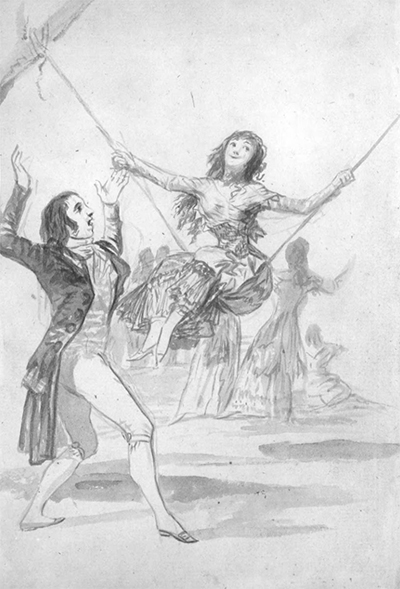
A woman swings across the middle of a narrow sheet. Her arms stretch out along the ropes and her feet lift beneath a skirt full of broken grey strokes. At the left a man throws up both hands, his mouth open as he looks towards her. Francisco de Goya gives the pair the darkest accents on the page. Further back, other people gather in a wash so pale that their faces all but disappear. The Swing is page 21 of Goya’s Madrid Album, a drawing the Metropolitan Museum of Art dates to 1795–97. On the back of the same piece of paper, a woman and a man stand so close that his arm crosses her veil. [1] [2] [3]
At a Glance
- ArtistFrancisco de Goya y Lucientes (1746–1828).
- WorkThe Swing (El columpio), Madrid Album B, page 21, recto.
- Date and medium1795–97. Brush and point of brush, carbon black washes, on a sheet measuring 23.5 × 14.5 cm.
- CollectionThe Metropolitan Museum of Art, New York, 35.103.2, Harris Brisbane Dick Fund, 1935.
- ReverseMaja and an Officer, Album B, page 22, Met 35.103.3. [1] [2]
Works across Goya’s career
The Parasol
1777The Swing, Madrid Album B.21
1795–97The Nude Maja
1795–1800Saturn Devouring His Son
c. 1820–23The Dog
c. 1820–23The rope and the reach
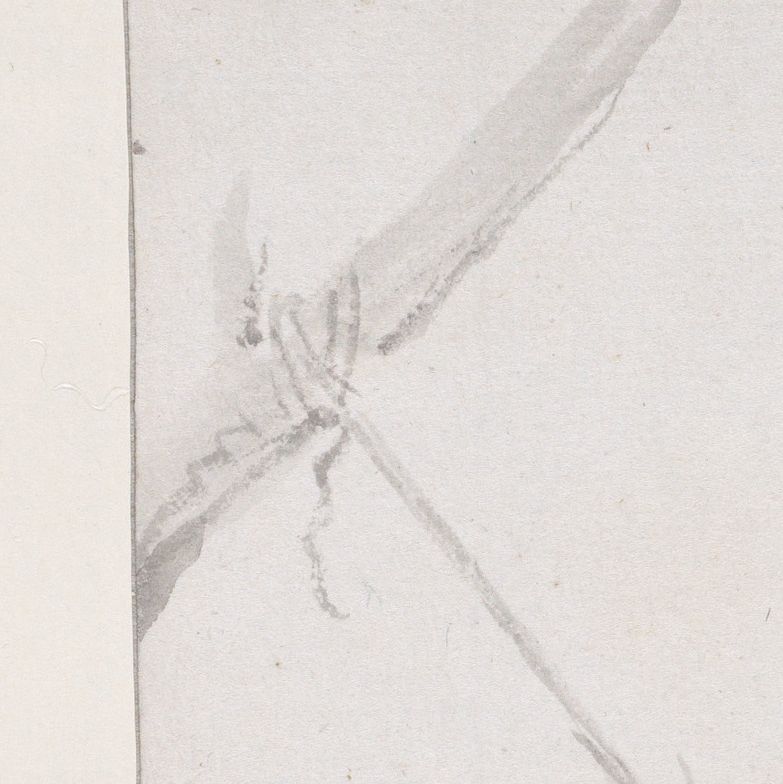
Follow the rope up from the woman’s hand nearest the man. It leads left to several turns around a branch and then to a short, loose end. The other rope runs up to the right edge, where it passes out of sight. The Fundación Goya en Aragón describes an improvised swing. Goya supplies enough of the branch to show how one end is fixed and lets the viewer imagine what supports the other. The ropes open a broad V into the lightest and emptiest part of the sheet. Concentrating on that opening makes the figures below seem to fill the page very suddenly. [1] [3]
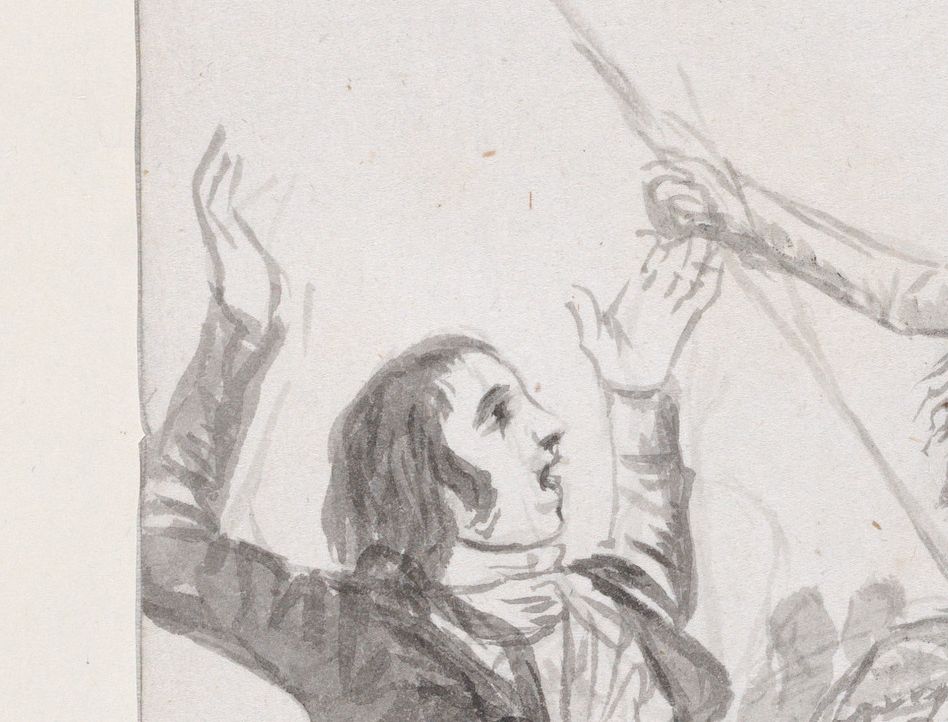
The woman grips the ropes with her arms spread wide. Her torso inclines slightly from the hips, her head tips back and her skirt catches across her knees. Just below her leftmost hand the man spreads his fingers. His other hand almost meets the left edge of the sheet. With feet far apart, one knee flexed and his coat pulled open by his stance, he gives the movement an answering shape. The closest of his hands comes near her grip with a little distance still visible between them. That gap holds the instant. It is easy to imagine an earlier push or a cry of encouragement, and either action would explain the energy of the pose. [1] [3]
The Met reads the open mouth as a cry, probably one of encouragement, and finds a suggestion of flirtation in the woman’s expression. The Fundación describes the man as a petimetre, a fashion-conscious dandy, and reads him as pushing the swing enthusiastically. Look at the dark coat, fitted breeches and conspicuous neckcloth for the first part of that reading. His raised hands tell us where his attention goes. The woman looks up, her face turned at an angle to his, and the gesture leaves their relationship open. The two readings bring out different aspects of a meeting that Goya makes lively with very little space between the man’s hand and the rope. [1] [3]
Annotated Details from The Swing
Trace the ropes from the woman’s hands and look at how Goya varies the strength of the wash.
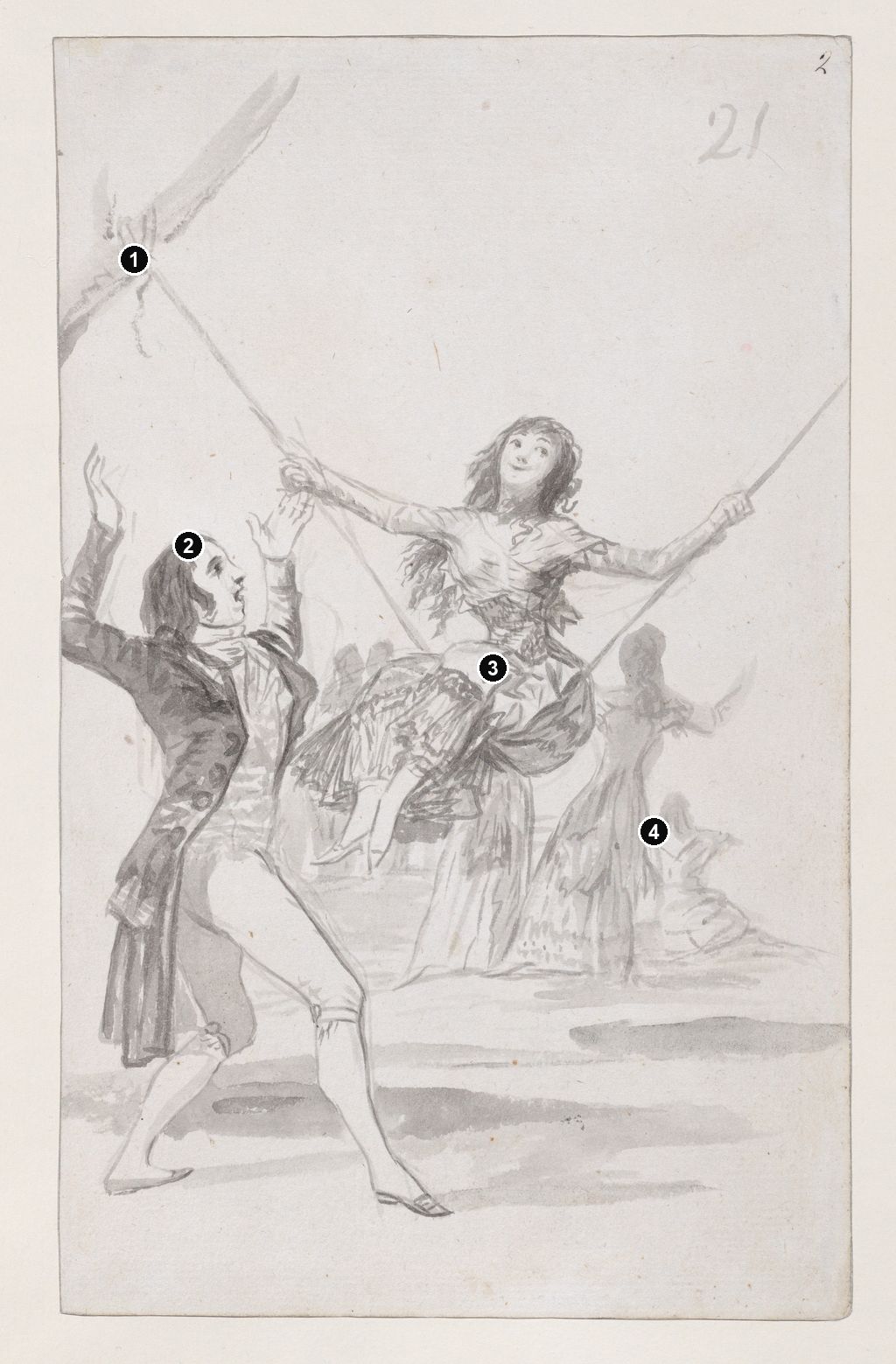
Details from THE SWING
Details from Madrid Album B.21 in the Metropolitan Museum of Art (35.103.2).
The knot
A loop around the diagonal branch secures one rope.
The man’s raised hands
Both hands are raised, one close to the strand on the left.
The swinging woman
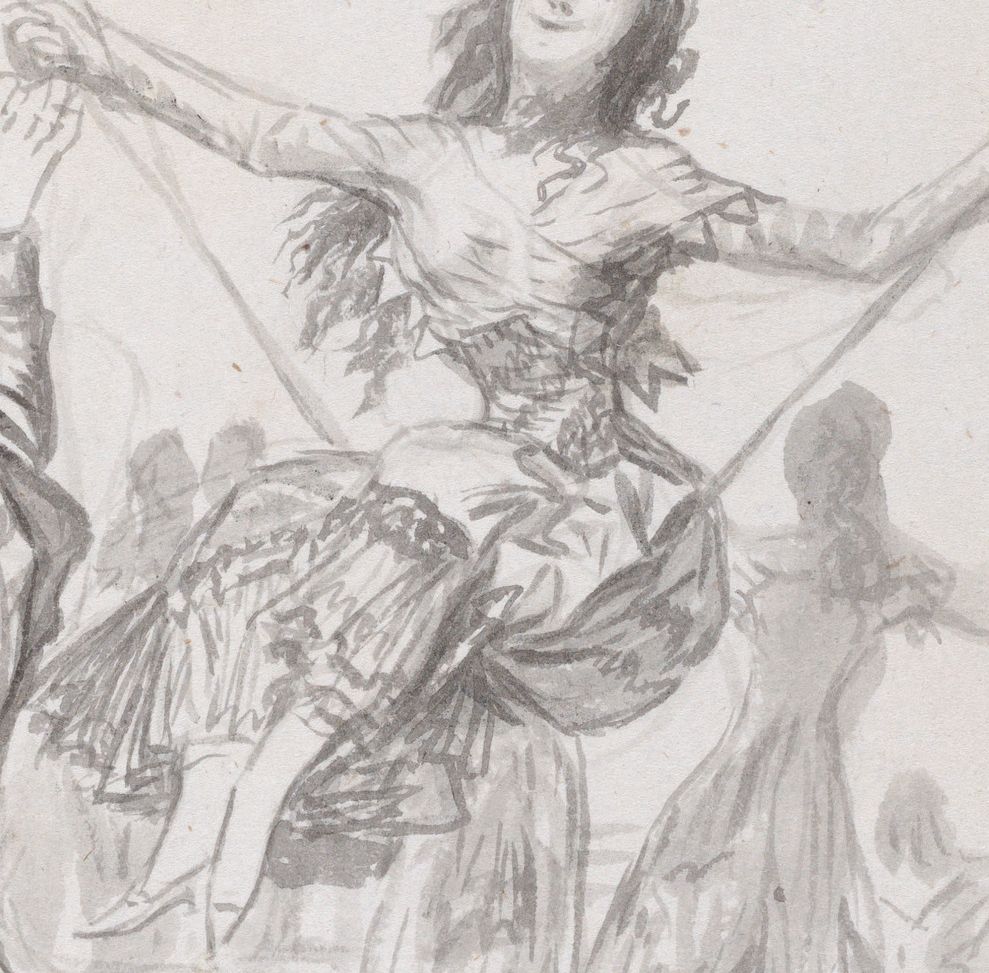
The strong folds around her legs and bodice give weight to the body suspended from the ropes.
The paler group
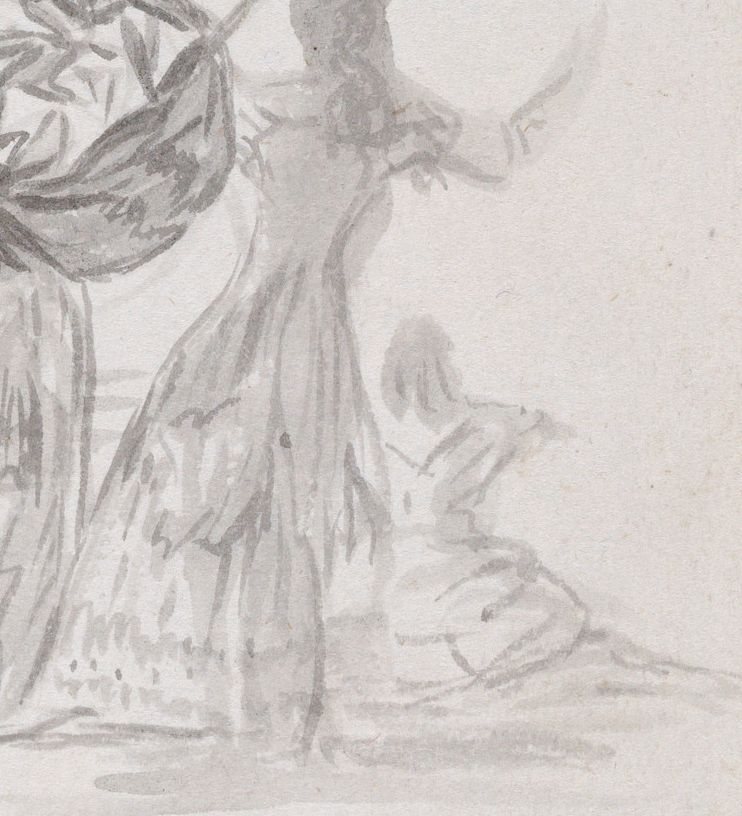
Lighter strokes mark the figures beyond the swing.
How the wash sets the distance
The dark marks are distributed sparingly. Goya draws the man’s coat with broad patches and places smaller marks along its opening, while much of the breeches is a light surface defined at the edges. On the woman the brush tip picks out loose hair, folds around her waist and the pattern of the skirt. The pale area of her face makes her expression legible against the brushwork at the temples. At the right, a standing figure and a lower figure are much softer. Their heads and garments register, even though the wash supplies little facial detail. The contrast between these figures and the pair in front establishes depth without a carefully mapped landscape. [1] [3]
Below them, several washes cross the ground. Their low, broad shapes give the man’s shoes somewhere to stand and make room beneath the lifted feet. They also work against the direction of the ropes. Try tracing the ground first, then the diagonal from the branch to the swing. The eye moves from the man’s firm stance into the woman’s suspended posture. The faint figures help measure the interval between those two actions and the outdoor company beyond them. [1]
Two drawings on one leaf
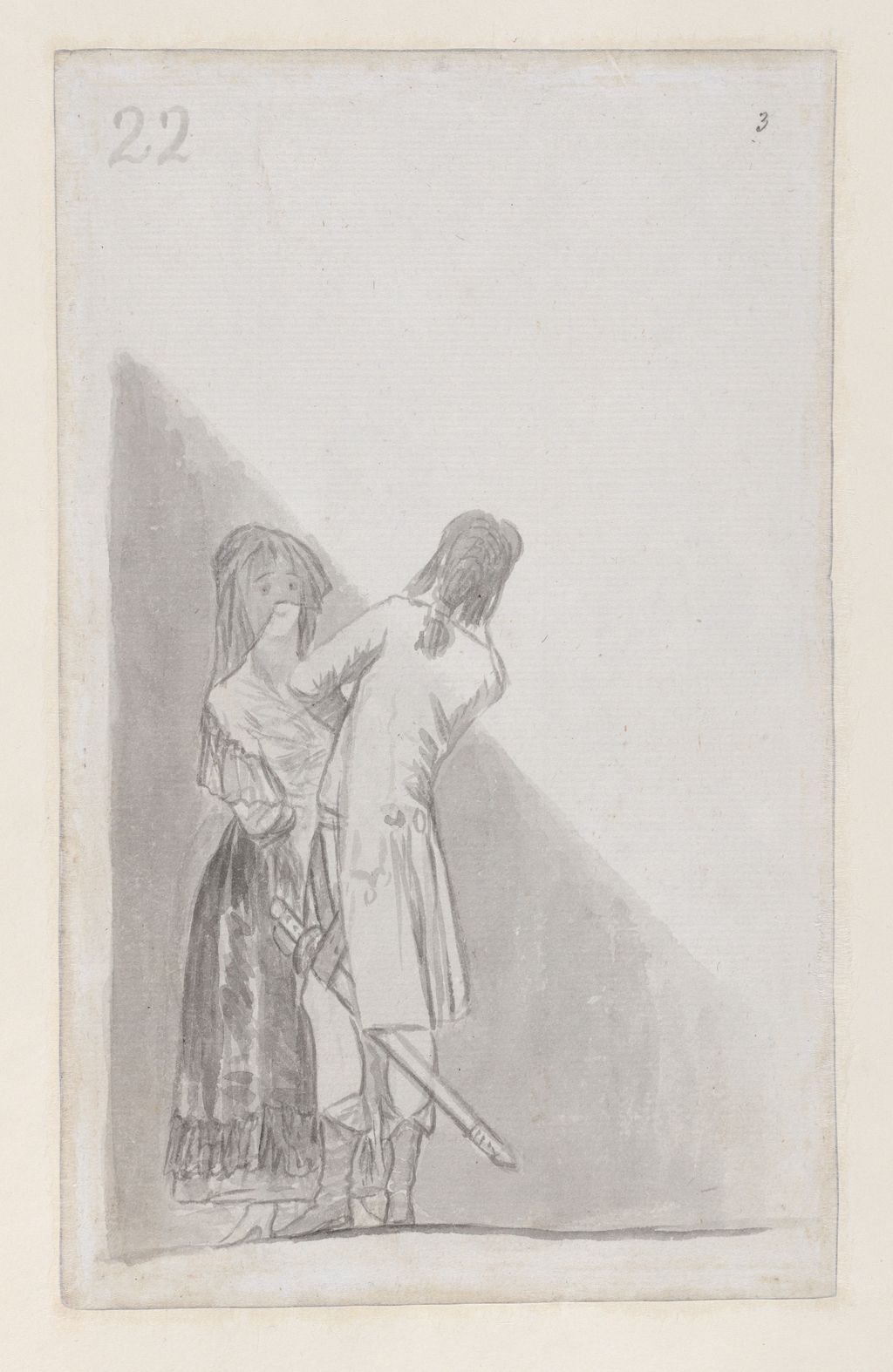
Turn the leaf over and the open air of the swing gives way to a broad diagonal wash. Maja and an Officer brings the figures together near the bottom left. The officer has his back to us. He turns his head in towards the woman, and the sword at his waist angles out into the lighter wash below. The woman’s eyes show above the fabric across her face. The Met reads a smile and an encounter charged with sexual tension. The Fundación calls attention to the way the composition keeps to one side of the diagonal division between light and shadow, a device Goya also used in Album A’s drawing of a young woman sweeping. [1] [2] [4]
The same medium serves a different kind of exchange. In The Swing, a diagonal line takes the eye out towards the branch and the edge of the paper. In Maja and an Officer, the diagonal takes shape at the boundary of a single broad wash, against which the pair hold their position. Their bodies overlap where the first pair nearly touch. The officer’s back limits what we can read in his face, while the woman’s veil gives her eyes particular weight. Turning the paper lets a reader compare two scenes about proximity. The titles describe each encounter and leave the figures’ identities to the imagination. [1] [2] [4]
The two large grey numbers, 21 on the front and 22 on the back, show why it helps to think in pages as well as sheets. The catalogue records refer to the two sides as recto and verso and assign each a separate accession number. The Met’s 1995 catalogue lists The Swing with Maja and an Officer as its verso, and the Fundación explicitly connects each record to the drawing on the other face. The surviving page numbers make it possible to place the leaf next to related sheets even though the original binding is gone. [1] [2] [3] [4] [5] [6]
Goya on film
Five films explore Goya’s portraits, prints, Black Paintings and painting techniques.
The Duke of Wellington by Goya
The portrait, its military decorations and its later theft.
Watch on YouTubeWhat survives of the Madrid Album
The Madrid Album is also called Album B in the scholarly system for Goya’s drawings. The Fundación records 38 known leaves carrying 74 drawings. The highest surviving page number is 94. Goya’s early pages often let one or two prominent figures occupy the foreground and suggest companions in lighter tones. Some later pages bring figures into close, dark backgrounds and add captions. Those pages help explain the album’s place in the development of Los Caprichos. A specific example is B.68, a scene of a charlatan extracting a tooth that the Met links to Plate 33. B.21 belongs to the album’s earlier pages, where Goya gives the figures room to act without explaining the scene in words. [5] [6]
After Goya’s death the album passed to his son Javier and later to his grandson Mariano. The pages were dispersed. The Met acquired eight of the album’s leaves in 1935 as part of a purchase of fifty drawings. The museum’s 1995 catalogue describes the acquired group as a scrapbook of drawings from four of Goya’s albums, pasted onto rose-coloured pages, and attributes its assembly tentatively to Javier. The group came to the Met from Mariano Fortuny y Madrazo. A number beginning 35.103 therefore locates a drawing within the museum’s acquisition. The earlier page number places it among the other drawings that once made up Album B. [3] [5] [6]
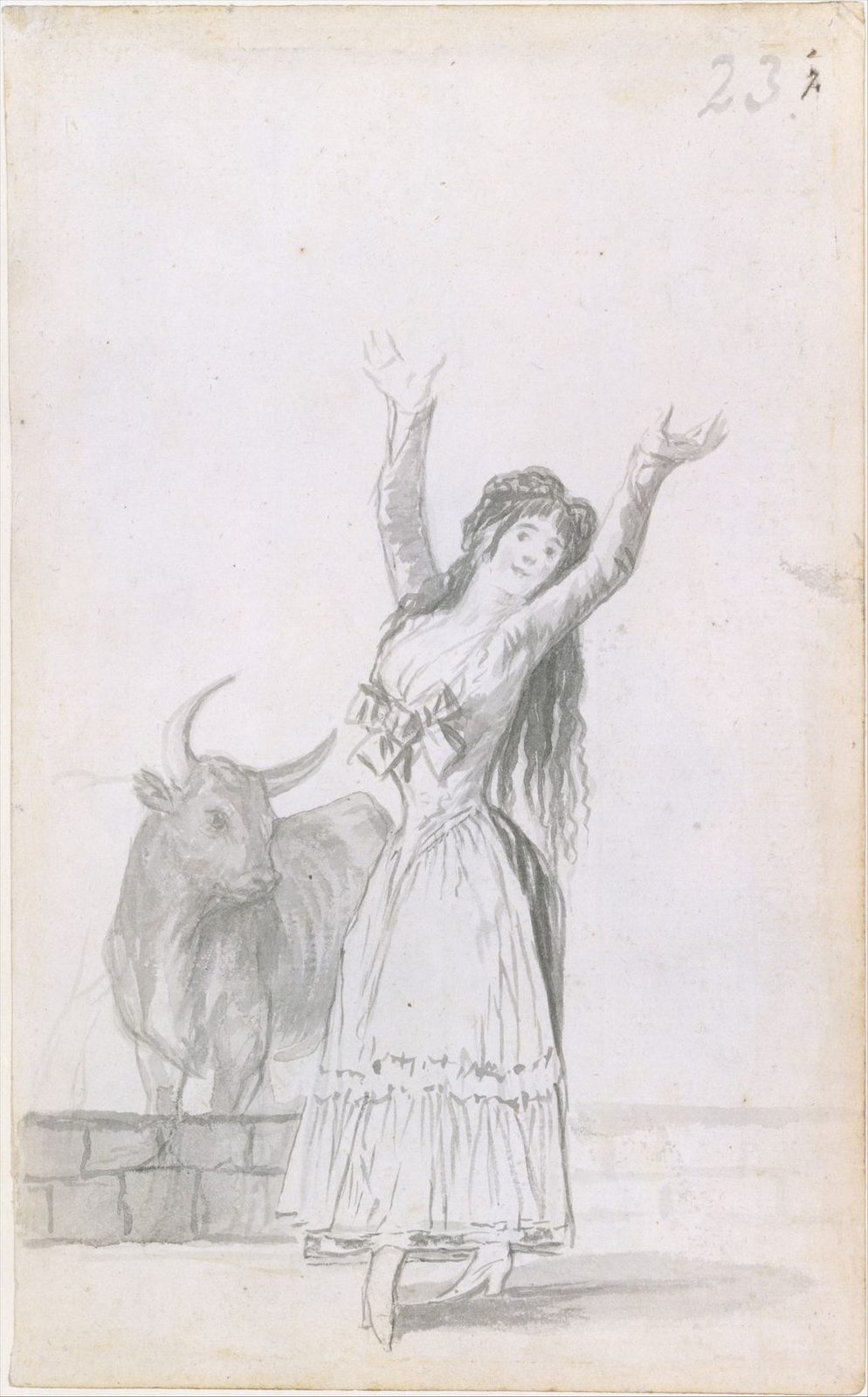
The nearby Weeping Woman and Three Men is B.17. There the central figure puts her hands to her face, and her companions’ positions make that gesture feel hemmed in. On B.23, Girl and Bull, a young woman again lifts both arms, with the bull placed well behind her. Read alongside B.21, the pages show how much Goya could alter the feeling of a lifted arm by varying who is near it and how clearly the viewer can see the space around it. [1] [7] [8]
Goya’s other swings and Fragonard’s painting
Goya had already painted a swing for a royal tapestry. The Prado’s 1779 oil cartoon, P00785, was delivered to the Royal Tapestry Factory for a hanging intended for the princes of Asturias at El Pardo. A child pushes the woman on the swing in a scene that Goya described as a countryside outing. The Fundación connects the Madrid Album drawing more closely to a separate El columpio painted in 1786–87 for the Duke and Duchess of Osuna. In that canvas, trees fill much of the picture and support the ropes of a makeshift swing, with the company gathered below. In the album sheet the man’s upturned face and raised hands are given unusual prominence by the blankness and pale wash around them. In both comparisons, the oils precede the Met’s dates for the drawing. [1] [3] [9] [10]
Jean-Honoré Fragonard’s The Swing, Les hasards heureux de l’escarpolette, is an oil painting of about 1767–68 in the Wallace Collection, P430. In the French painting the rider’s pink dress, flying slipper and the position of her admirer make looking part of the subject. In Goya’s drawing, the foreground man is plainly visible with open hands, while the light wash grants less prominence to the people beyond him. The two works use the swing to arrange who can look at whom. The Wallace Collection also documents the motif’s wider eighteenth-century popularity in gardens and decorative art. The comparison helps explain the appeal of the subject, while a direct borrowing by Goya remains unestablished. [1] [11] [12]
Artworks directory
| Name | Date | Medium |
|---|---|---|
| And There’s No Help for It, Plate 15 | Printed 1863 | |
| Asmodea | c. 1820–23 | Wall painting transferred to canvas |
| Boys Inflating a Bladder | 1777–78 | Tapestry cartoon |
| Boys Picking Fruit | 1778 | Tapestry cartoon |
| Bullfight in a Divided Ring | 1825 | Lithograph |
| Card Players | 1777–78 | Tapestry cartoon |
| Card Players (sketch) | 1777–78 | Painted sketch |
| Dance on the Banks of the Manzanares | 1777 | Tapestry cartoon |
| Duel with Cudgels | c. 1820–23 | Wall painting transferred to canvas |
| Heads in a Landscape | c. 1820–23 | Easel painting |
| Judith and Holofernes | c. 1820–23 | Wall painting transferred to canvas |
| Leocadia | c. 1820–23 | Wall painting transferred to canvas |
| Maja and Cloaked Men | 1777 | Tapestry cartoon |
| Maja and Cloaked Men (sketch) | 1777 | Painted sketch |
| Majo Clapping in Time to the Music | 1777 | Drawing |
| Men Reading | c. 1820–23 | Wall painting transferred to canvas |
| Out Hunting for Teeth, Plate 12 | 1799 | Etching, burnished aquatint and burin |
| Picnic in the Countryside (sketch) | 1776–78 | Painted sketch |
| Picnic on the Banks of the Manzanares | 1776 | Tapestry cartoon |
| Pilgrimage to San Isidro | c. 1820–23 | Wall painting transferred to canvas |
| Preparatory study for The Sleep of Reason Produces Monsters | c. 1796–97 | Drawing |
| Procession of the Holy Office | c. 1820–23 | Wall painting transferred to canvas |
| Quarrel at the Cockerel Inn (sketch) | 1777 | Painted sketch |
| Quarrel in the New Tavern | 1777 | Tapestry cartoon |
| Saturn Devouring His Son | c. 1820–23 | Wall painting transferred to canvas |
| Seated Majo Smoking | c. 1776 | Drawing |
| The Dog | c. 1820–23 | Wall painting transferred to canvas |
| The Drinker | 1777 | Tapestry cartoon |
| The Fates | c. 1820–23 | Wall painting transferred to canvas |
| The Great He-Goat | c. 1820–23 | Wall painting transferred to canvas |
| The Kite | 1777–78 | Tapestry cartoon |
| The Parasol | 1777 | Oil on canvas, tapestry cartoon |
| The Second of May 1808 | 1814 | Oil on canvas |
| The Sleep of Reason Produces Monsters, Plate 43 | 1799 | Etching and aquatint |
| The Third of May 1808 | 1814 | Oil on canvas |
| Thou Who Canst Not, Plate 42 | 1799 | Etching and burnished aquatint |
| Three Figures | 1776 | Drawing (lost) |
| Two Old Men | c. 1820–23 | Wall painting transferred to canvas |
| Two Old Men Eating Soup | c. 1820–23 | Wall painting transferred to canvas |
| Two Women and a Man | c. 1820–23 | Wall painting transferred to canvas |
| Universal Language: The Author Dreaming | 1797 | Drawing |
| The Family of Charles IV | 1800 | Oil on canvas |
| Witches’ Sabbath (Osuna painting) | 1797–98 | Oil on canvas |
| The Nude Maja | 1795–1800 | Oil on canvas |
| The Clothed Maja | 1800–07 | Oil on canvas |
| Self-Portrait (Drawing) | c. 1796 | Brush and carbon black ink on laid paper |
| The Swing, Madrid Album B.21 | 1795–97 | Brush and carbon black washes |
| Majas Fighting, a Majo Observing, Madrid Album B.15 | 1796–97 | Brush, grey and black washes on laid paper |
| Majos and Majas Conversing, Madrid Album B.16 | c. 1794–97 | Ink wash on paper |
| Weeping Woman and Three Men, Madrid Album B.17 | 1795–97 | Brush, carbon black washes and black chalk |
| Maja Seated on a Chair and Two Companions Behind, Madrid Album B.18 | 1795–97 | Brush and carbon black washes |
| Girl and Bull, Madrid Album B.23 | 1796–97 | Brush and carbon black washes |
| Lovers Sitting on a Rock, Madrid Album B.24 | 1796–97 | Brush and carbon black washes |
| Mariano Ceballos Riding a Bull | 1825 | Crayon lithograph and scraper |
| Landscape (lifetime impression) | c. 1807–10 | Etching and aquatint |
| Self-Portrait (1815), Prado canvas | 1815 | Oil on canvas |
| Self-Portrait (1815), Academy panel | 1815 | Oil on panel |
| Self-Portrait with Dr Arrieta | 1820 | Oil on canvas |
| Christ Crucified | 1780 | Oil on canvas |
| The Last Communion of Saint Joseph of Calasanz | 1819 | Oil on canvas |
| Christ on the Mount of Olives | 1819 | Oil on panel |
| The Flower Girls, or Spring | 1786–87 | Oil on canvas |
| The Grape Harvest, or Autumn | 1786–87 | Oil on canvas |
| The Snowstorm, or Winter | 1786–87 | Oil on canvas |
| The Threshing Ground, or Summer | 1786–87 | Oil on canvas |
| Picnic on the Banks of the Manzanares | 1776 | Oil on canvas |
| The Kite | 1777–78 | Oil on canvas |
| Dance on the Banks of the Manzanares | 1777 | Oil on canvas |
| A Fight at the Venta Nueva | 1777 | Oil on canvas |
| Blind Man’s Bluff | 1788 | Oil on canvas |
| Dogs on a Lead | 1775 | Oil on canvas |
| Hunting with a Decoy | 1775 | Oil on canvas |
| Hunter Loading His Rifle | 1775 | Oil on canvas |
| The Angler | 1775 | Oil on canvas |
| The Hermitage of San Isidro on His Feast Day | 1788 | Oil on canvas |
| The Meadow of San Isidro | 1788 | Oil on canvas |
| The Straw Manikin | 1791–92 | Oil on canvas |
| Witches’ Flight | c. 1797–98 | Oil on canvas |
| A Scene from ‘The Forcibly Bewitched’ | 1798 | Oil on canvas |
| The Duchess of Alba in Black | 1797 | Oil on canvas |
| The Duchess of Alba in White | 1795 | Oil on canvas |
| Charles III in Hunting Dress | c. 1786 | Oil on canvas |
| The Duke and Duchess of Osuna and Their Children | 1787–88 | Oil on canvas |
| Manuel Osorio Manrique de Zúñiga | 1787–88 | Oil on canvas |
| The Marquesa de Pontejos | c. 1786 | Oil on canvas |
| Equestrian Portrait of the 1st Duke of Wellington | 1812 | Oil on canvas |
| The Duke of Wellington | 1812–14 | Oil on wood |
| Portrait of Ferdinand VII of Spain | 1814 | Oil on canvas |
| Gaspar Melchor de Jovellanos | 1798 | Oil on canvas |
| María Tomasa Palafox y Portocarrero | 1804 | Oil on canvas |
| Señora Sabasa García | c. 1806–11 | Oil on canvas |
| Don Juan Bautista de Muguiro | 1827 | Oil on canvas |
| Doña Isabel de Porcel | Before 1805 | Oil on canvas |
| The Colossus | After 1808 | Oil on canvas |
| The Burial of the Sardine | 1808–12 | Oil on panel |
| The Madhouse | 1808–12 | Oil on panel |
| A Procession of Flagellants | 1808–12 | Oil on panel |
| Portrait of Jacques Galos | 1826 | Oil on canvas |
| Portrait of Mariano Goya, the Artist’s Grandson | 1827 | Oil on canvas |
| Milkmaid of Bordeaux | c. 1827 | Oil on canvas |
| Portrait of Don Juan Antonio Cuervo | 1819 | Oil on canvas |
| María Luisa of Parma (Naples version) | c. 1800 | Oil on canvas |
| The Countess of Baena | 1819 | Oil on canvas |
| The Family of the Infante Don Luis | 1783–84 | Oil on canvas |
| The Holy Family | c. 1787 | Oil on canvas |
| Saint Barbara | c. 1773 | Oil on canvas |
| Saints Justa and Rufina | 1817 | Oil on canvas |
| El Tío Paquete | c. 1819–20 | Oil on canvas |
| The Forge | c. 1815–20 | Oil on canvas |
| Majas on a Balcony (Metropolitan Museum version) | c. 1800–10 | Oil on canvas |
| Maja and Celestina on a Balcony | c. 1808–12 | Oil on canvas |
| The Water Bearer | 1808–12 | Oil on canvas |
| Time and the Old Women | c. 1810 | Oil on canvas |
Frequently Asked Questions
Discussion
Look again at the images and ideas explored in The Swing. These editorial prompts invite your observations.
Follow the branch and ropes on the front, then the edge of the shadow on the reverse. Where does each diagonal lead your eye when it reaches the figures?
Reader Insights
Where do the ropes lead your eye before you look at the figures?
Which marks put the paler group at a distance?
Join the Conversation
Share a detail, comparison or question about The Swing below.
References
- The Metropolitan Museum of Art, Girl on a swing, a man with his arms raised, B.21 recto, 35.103.2. View source.
- The Metropolitan Museum of Art, Maja and an officer, B.22 verso, 35.103.3. View source.
- Fundación Goya en Aragón, El columpio, B.21, analysis, provenance and reverse. View source.
- Fundación Goya en Aragón, Maja con un oficial, B.22, analysis and recto. View source.
- Fundación Goya en Aragón, Pareja de enamorados en la oscuridad, B.3 and the history, materials and surviving leaves of Album B. View source.
- Colta Ives and Susan Alyson Stein, Goya in The Metropolitan Museum of Art, 1995, pp. 68–69, Album B and the 1935 purchase. View source.
- The Metropolitan Museum of Art, Young woman weeping and covering her face with her hands, accompanied by men, B.17, 35.103.4. View source.
- The Metropolitan Museum of Art, A young woman dancing, her arms raised, a bull in the background, B.23, 35.103.7. View source.
- Fundación Goya en Aragón, The Swing (El columpio), 1779 tapestry cartoon, Prado P00785. View source.
- Fundación Goya en Aragón, El columpio, 1786–87 Osuna painting. View source.
- The Wallace Collection, Jean-Honoré Fragonard, Les hasards heureux de l’escarpolette (The Swing), P430. View source.
- Javier Moscoso, “Swings in History”, The Wallace Collection. View source.







