


 by Tom Gurney
Tom Gurney BSc (Hons) is an art history expert with over 20 years experience
Published on June 19, 2020 / Updated on November 20, 2026
Email: tomgurney1@gmail.com / Phone: +44 7429 011000
Introduction
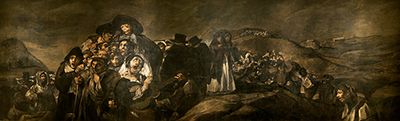
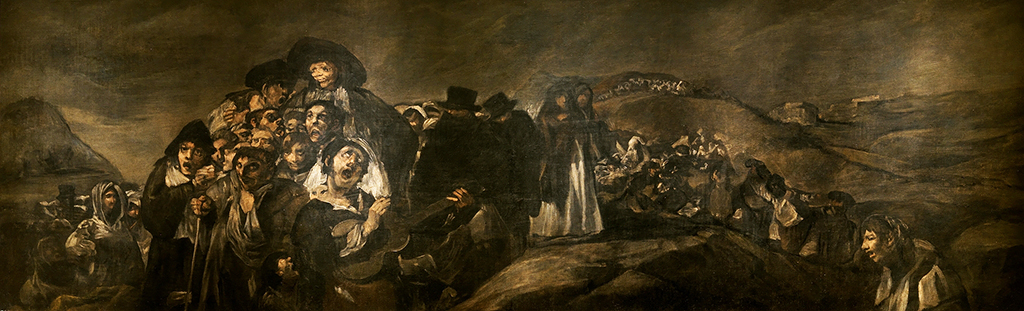
The first sound one might imagine in Francisco de Goya’s A Pilgrimage to San Isidro comes from a guitar. Its player tilts up his face, mouth open, as other faces crowd around him. Some look past him, some seem to join in, and others are barely distinguishable beneath dark hats and coverings. To the right, the gathering thins into a line of people winding through the hills. Painted across more than four metres of wall at Goya’s Quinta del Sordo, the work survives on canvas at the Museo Nacional del Prado. The title invokes Madrid’s feast for its patron saint, but the mood of the gathering is much harder to name. [1] [2]
At a Glance
- Artist and dateFrancisco de Goya, c. 1820–1823.
- Spanish titleLa romería de San Isidro.
- Medium and dimensionsOil mural on dry plaster, transferred to canvas, 138.5 × 436 cm.
- CollectionMuseo Nacional del Prado, Madrid, P000760.
- Original locationGround floor of the Quinta del Sordo, on a long wall facing The Great He-Goat.
- Before transferJean Laurent’s glass negative VN-08123 P, dated 1874 by the Archivo Ruiz Vernacci reproduction.
Works across Goya’s career
The Parasol
1777The Nude Maja
1795–1800Pilgrimage to San Isidro
c. 1820–23Saturn Devouring His Son
c. 1820–23The Dog
c. 1820–23A song at the front of the crowd
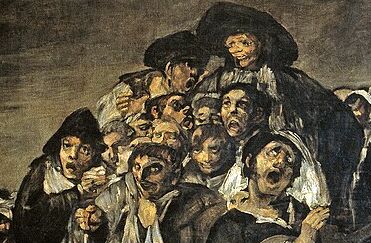
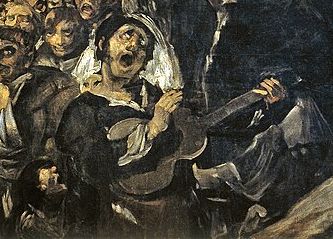
Begin at the lower left, where an uneven rise of shoulders gives way to the first pale faces. The musician is set within the group rather than clear of it. The light across his face and collar brings his lifted chin into view, and the neck of his guitar carries the eye across towards his hand. A neighbouring figure holds a stick. Above and behind the player, a succession of heads presses into the same small area. Rounded cheeks, streaks of lighter paint and blunt dark marks give each face a different shape. A few forms that seem to resolve into faces from across the room quickly lose their outlines when seen up close. [1] [2]
The open mouths are a large part of what makes the group difficult to read. The guitar gives the viewer a reason to hear singing in the scene, yet an exposed row of teeth or a dark oval can also suggest laughter or a cry. The musician’s upward tilt could be the effort of projecting his voice. The same angle makes his face look strained. Compare it with the pallid face higher up, where the gaze seems to range beyond the people immediately below. The visible gestures belong to people close enough to brush against each other, without a single shared expression. [1] [2]
Musicologist Michael Christoforidis places this guitarist within a long interest in the instrument in Goya’s work. The artist had already included it in the 1779 tapestry cartoon Majo with a Guitar. In the exhibition catalogue for the National Gallery of Victoria and Prado, Christoforidis discusses the role of the strummed guitar in Spanish popular song and dance and singles out the pilgrimage as a later setting for the instrument. That history makes the musician at the head of the gathering legible as part of a familiar social world. There is room for a harsher reading of the group. Carlos Foradada interprets it as an intoxicated crowd led by a blind man, as part of a political reading of the two long murals. It is possible to see the open mouths, inclining bodies and erratic expressions that prompt such a reading while leaving the figures’ identities and circumstances open. [4] [5]
Annotated Details from Pilgrimage to San Isidro
Follow the nearest faces and the guitar, then look for the procession further back.
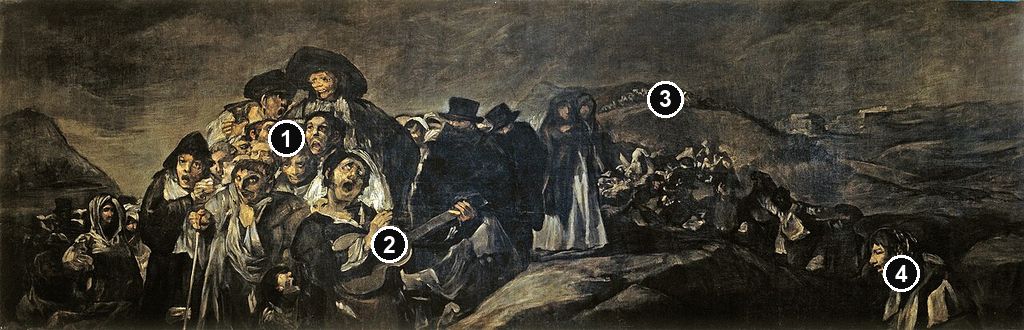
Details from PILGRIMAGE TO SAN ISIDRO
Details from the longer ground-floor mural, Museo Nacional del Prado P000760.
Faces close together
Light picks out individual faces between dark hats and hoods. The figures stand close enough for one head to overlap the next.
A guitar in the foreground
The guitarist’s head tilts upwards. The neck of the instrument points diagonally towards the darker figures behind.
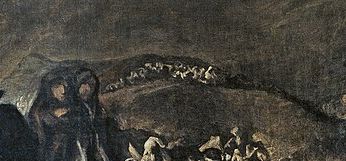
The crowd past the ridge
A short chain of pale marks near the top of the ridge suggests the distant continuation of the gathering.
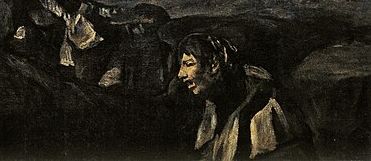
A single figure by the edge
At the lower right, a lit profile appears beside fabric sharply marked with pale stripes.
Following the line through the hills
The procession takes a winding course which can be difficult to trace from the foreground. A dark band of people at the centre is relieved by a pale garment. Beyond it, a knot of small faces and dark heads emerges where the line bends. Some closer figures on the right are cut by the bottom edge of the painting. Farther back, small light strokes indicate figures whose bodies dissolve into the terrain. The eye switches from looking at people to picking out traces of their passage. Around them, earth colours and dull greys spread across the ground and sky. The Fundación Goya en Aragón reads some of the forms at the far right as distant fortifications. They register much less distinctly than the bands of pale paint across the faces at the left. [1] [2]
In the room upstairs, Goya used another winding procession in what the Prado calls Procession of the Holy Office, P000755. The site’s earlier title, Pilgrimage to the Fountain of San Isidro, belongs to that other mural. Its front group fills the right of a considerably narrower canvas, and the figures trail away to the left. In the downstairs Romería the balance runs the other way. The great width leaves room for the group to splinter into smaller episodes before the shadowed country and unsettled sky absorb the details. [1] [6]
Goya on film
Five films explore Goya’s portraits, prints, Black Paintings and painting techniques.
The Duke of Wellington by Goya
The portrait, its military decorations and its later theft.
Watch on YouTubeOpposite The Great He-Goat
The title La romería de San Isidro appears in the inventory associated with Antonio Brugada, which the Prado dates broadly to the mid-nineteenth century. In his 1867 book on Goya, Charles Yriarte described the mural in place on the right as one entered the room, across from The Great He-Goat. His account preserves the experience of turning between two wide gatherings. The dark figure of the goat arrests attention at one end of the Sabbath as a group turns towards it. Across the room a musician occupies much less space than the crowd around him, and the path carries the eye past that cluster. The relationship between the paintings matters even when they are viewed singly, because each used the width of a long wall to organise a gathering in a different way. [1] [7]
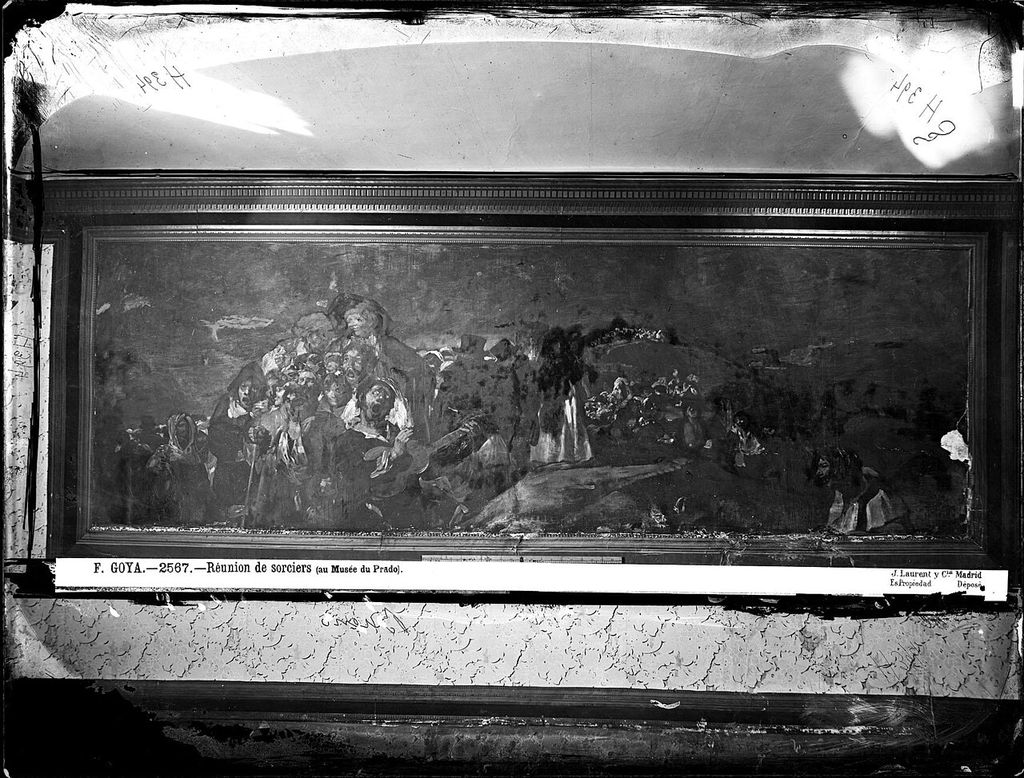
Laurent’s negative shows the painting surrounded by patterned paper, with a measuring scale below. At the far left the lines in the paper meet at what Carlos Teixidor and Francisco Javier Laguna read as an inside corner. They reconstruct the mural set closer to that corner than to the other end of its wall. They also raise the possibility that the painting was already shorter at the right by Laurent’s time. A reconstruction by Carlos Foradada, Carlos Narbaiza, José Javier Luis and Alfonso Burgos situates the pilgrimage between two doors to the garden. It uses a longer room and draws on property records, the early scale model of Madrid and measurements from the photographs. Yriarte’s description supports placing the two murals opposite each other. Their exact distances from corners and openings depend on how the surviving evidence for the Black Paintings is fitted together. [3] [7] [8] [9]
What the photograph and X-rays reveal
The canvas preserves paint lifted from the Quinta wall under Salvador Martínez Cubells. The owner, Baron d’Erlanger, commissioned the work after buying the house in 1873. The Prado dates the removal and restoration between 1874 and 1876. Laurent’s image records an already damaged surface, with small cracks and an apparent loss at the right edge. Comparing it with the canvas, Nigel Glendinning pointed to changes in the tilt and width of a top hat, the contour of a foreground rock and the shape of the hills on the right. He also noted that a light area below the guitarist’s left hand was darker on the canvas. These are especially revealing details to compare because they range from a minute change in emphasis around the instrument to a change in how the landscape encloses the group. The photograph shows how shapes and tones registered under Laurent’s lighting. Its monochrome image leaves the original colours uncertain. [1] [3] [10]
The radiographs studied by Prado conservator Carmen Garrido provide a view into the layers beneath the scene. Garrido identified an earlier landscape with slopes, small figures and what she interpreted as a bridge of three unequal arches on the right. The light areas around it led her to suggest water. Later paint covers the bridge, and some heads in the closer group overlap details of previously painted faces. These findings show the landscape being revised as the composition took shape. Glendinning’s separate suggestion that light patches in Laurent’s photograph could indicate buildings on Madrid’s skyline concerns marks visible on the wall in the nineteenth century. He allowed that the patches could instead be damage. The buried bridge and the possible distant buildings come from different evidence and cannot be combined into a single recovered view of Madrid. [10] [11]
San Isidro in the tapestry sketches
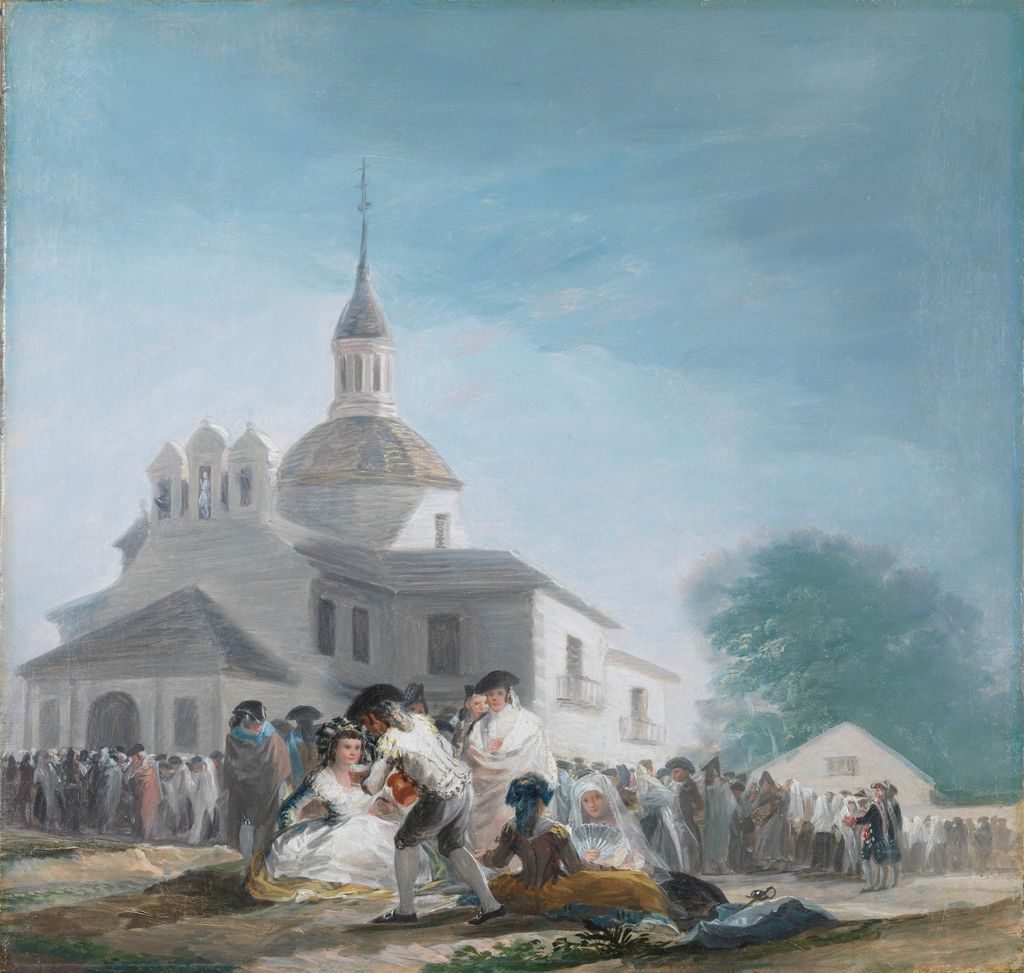
Goya had painted the feast more than thirty years before. In 1788, his oil sketch The Meadow of San Isidro, Prado P000750, spread the gathering across a hillside with a clear prospect of Madrid beyond the Manzanares. Seated groups occupy the foreground. The Royal Palace and the dome of San Francisco el Grande help orient the viewer across the river. The Hermitage of San Isidro, Prado P002783, brings the viewer close to the shrine and shows visitors crowded around the building. Both were oil sketches for a tapestry project for the infantas’ bedroom at El Pardo. A tapestry cartoon would have supplied the full-scale design to the weavers. Work on the decoration stopped after the death of Charles III in December 1788, and both designs remained at the sketch stage. [12] [13]
The oil sketches show different ways of joining the social and devotional sides of a romería, a pilgrimage that also brings people together for a feast. The meadow gives groups room to sit and talk. At the hermitage people converge on a recognisable place, and the white walls make a conspicuous destination for the eye. The later wall painting makes the crowd itself the strongest point of orientation. The people nearest us are lit enough to register individually, and behind them the line marks a route whose destination is difficult to judge. The festival supplies the title and helps explain the presence of music. The experience of being pressed close to the group comes from the composition, and it remains unsettling even without the name of the feast. [2] [12] [13]
Artworks directory
| Name | Date | Medium |
|---|---|---|
| And There’s No Help for It, Plate 15 | Printed 1863 | |
| Asmodea | c. 1820–23 | Wall painting transferred to canvas |
| Boys Inflating a Bladder | 1777–78 | Tapestry cartoon |
| Boys Picking Fruit | 1778 | Tapestry cartoon |
| Bullfight in a Divided Ring | 1825 | Lithograph |
| Card Players | 1777–78 | Tapestry cartoon |
| Card Players (sketch) | 1777–78 | Painted sketch |
| Dance on the Banks of the Manzanares | 1777 | Tapestry cartoon |
| Duel with Cudgels | c. 1820–23 | Wall painting transferred to canvas |
| Heads in a Landscape | c. 1820–23 | Easel painting |
| Judith and Holofernes | c. 1820–23 | Wall painting transferred to canvas |
| Leocadia | c. 1820–23 | Wall painting transferred to canvas |
| Maja and Cloaked Men | 1777 | Tapestry cartoon |
| Maja and Cloaked Men (sketch) | 1777 | Painted sketch |
| Majo Clapping in Time to the Music | 1777 | Drawing |
| Men Reading | c. 1820–23 | Wall painting transferred to canvas |
| Out Hunting for Teeth, Plate 12 | 1799 | Etching, burnished aquatint and burin |
| Picnic in the Countryside (sketch) | 1776–78 | Painted sketch |
| Picnic on the Banks of the Manzanares | 1776 | Tapestry cartoon |
| Pilgrimage to San Isidro | c. 1820–23 | Wall painting transferred to canvas |
| Preparatory study for The Sleep of Reason Produces Monsters | c. 1796–97 | Drawing |
| Procession of the Holy Office | c. 1820–23 | Wall painting transferred to canvas |
| Quarrel at the Cockerel Inn (sketch) | 1777 | Painted sketch |
| Quarrel in the New Tavern | 1777 | Tapestry cartoon |
| Saturn Devouring His Son | c. 1820–23 | Wall painting transferred to canvas |
| Seated Majo Smoking | c. 1776 | Drawing |
| The Dog | c. 1820–23 | Wall painting transferred to canvas |
| The Drinker | 1777 | Tapestry cartoon |
| The Fates | c. 1820–23 | Wall painting transferred to canvas |
| The Great He-Goat | c. 1820–23 | Wall painting transferred to canvas |
| The Kite | 1777–78 | Tapestry cartoon |
| The Parasol | 1777 | Oil on canvas, tapestry cartoon |
| The Second of May 1808 | 1814 | Oil on canvas |
| The Sleep of Reason Produces Monsters, Plate 43 | 1799 | Etching and aquatint |
| The Third of May 1808 | 1814 | Oil on canvas |
| Thou Who Canst Not, Plate 42 | 1799 | Etching and burnished aquatint |
| Three Figures | 1776 | Drawing (lost) |
| Two Old Men | c. 1820–23 | Wall painting transferred to canvas |
| Two Old Men Eating Soup | c. 1820–23 | Wall painting transferred to canvas |
| Two Women and a Man | c. 1820–23 | Wall painting transferred to canvas |
| Universal Language: The Author Dreaming | 1797 | Drawing |
| The Family of Charles IV | 1800 | Oil on canvas |
| Witches’ Sabbath (Osuna painting) | 1797–98 | Oil on canvas |
| The Nude Maja | 1795–1800 | Oil on canvas |
| The Clothed Maja | 1800–07 | Oil on canvas |
| Self-Portrait (Drawing) | c. 1796 | Brush and carbon black ink on laid paper |
| The Swing, Madrid Album B.21 | 1795–97 | Brush and carbon black washes |
| Majas Fighting, a Majo Observing, Madrid Album B.15 | 1796–97 | Brush, grey and black washes on laid paper |
| Majos and Majas Conversing, Madrid Album B.16 | c. 1794–97 | Ink wash on paper |
| Weeping Woman and Three Men, Madrid Album B.17 | 1795–97 | Brush, carbon black washes and black chalk |
| Maja Seated on a Chair and Two Companions Behind, Madrid Album B.18 | 1795–97 | Brush and carbon black washes |
| Girl and Bull, Madrid Album B.23 | 1796–97 | Brush and carbon black washes |
| Lovers Sitting on a Rock, Madrid Album B.24 | 1796–97 | Brush and carbon black washes |
| Mariano Ceballos Riding a Bull | 1825 | Crayon lithograph and scraper |
| Landscape (lifetime impression) | c. 1807–10 | Etching and aquatint |
| Self-Portrait (1815), Prado canvas | 1815 | Oil on canvas |
| Self-Portrait (1815), Academy panel | 1815 | Oil on panel |
| Self-Portrait with Dr Arrieta | 1820 | Oil on canvas |
| Christ Crucified | 1780 | Oil on canvas |
| The Last Communion of Saint Joseph of Calasanz | 1819 | Oil on canvas |
| Christ on the Mount of Olives | 1819 | Oil on panel |
| The Flower Girls, or Spring | 1786–87 | Oil on canvas |
| The Grape Harvest, or Autumn | 1786–87 | Oil on canvas |
| The Snowstorm, or Winter | 1786–87 | Oil on canvas |
| The Threshing Ground, or Summer | 1786–87 | Oil on canvas |
| Picnic on the Banks of the Manzanares | 1776 | Oil on canvas |
| The Kite | 1777–78 | Oil on canvas |
| Dance on the Banks of the Manzanares | 1777 | Oil on canvas |
| A Fight at the Venta Nueva | 1777 | Oil on canvas |
| Blind Man’s Bluff | 1788 | Oil on canvas |
| Dogs on a Lead | 1775 | Oil on canvas |
| Hunting with a Decoy | 1775 | Oil on canvas |
| Hunter Loading His Rifle | 1775 | Oil on canvas |
| The Angler | 1775 | Oil on canvas |
| The Hermitage of San Isidro on His Feast Day | 1788 | Oil on canvas |
| The Meadow of San Isidro | 1788 | Oil on canvas |
| The Straw Manikin | 1791–92 | Oil on canvas |
| Witches’ Flight | c. 1797–98 | Oil on canvas |
| A Scene from ‘The Forcibly Bewitched’ | 1798 | Oil on canvas |
| The Duchess of Alba in Black | 1797 | Oil on canvas |
| The Duchess of Alba in White | 1795 | Oil on canvas |
| Charles III in Hunting Dress | c. 1786 | Oil on canvas |
| The Duke and Duchess of Osuna and Their Children | 1787–88 | Oil on canvas |
| Manuel Osorio Manrique de Zúñiga | 1787–88 | Oil on canvas |
| The Marquesa de Pontejos | c. 1786 | Oil on canvas |
| Equestrian Portrait of the 1st Duke of Wellington | 1812 | Oil on canvas |
| The Duke of Wellington | 1812–14 | Oil on wood |
| Portrait of Ferdinand VII of Spain | 1814 | Oil on canvas |
| Gaspar Melchor de Jovellanos | 1798 | Oil on canvas |
| María Tomasa Palafox y Portocarrero | 1804 | Oil on canvas |
| Señora Sabasa García | c. 1806–11 | Oil on canvas |
| Don Juan Bautista de Muguiro | 1827 | Oil on canvas |
| Doña Isabel de Porcel | Before 1805 | Oil on canvas |
| The Colossus | After 1808 | Oil on canvas |
| The Burial of the Sardine | 1808–12 | Oil on panel |
| The Madhouse | 1808–12 | Oil on panel |
| A Procession of Flagellants | 1808–12 | Oil on panel |
| Portrait of Jacques Galos | 1826 | Oil on canvas |
| Portrait of Mariano Goya, the Artist’s Grandson | 1827 | Oil on canvas |
| Milkmaid of Bordeaux | c. 1827 | Oil on canvas |
| Portrait of Don Juan Antonio Cuervo | 1819 | Oil on canvas |
| María Luisa of Parma (Naples version) | c. 1800 | Oil on canvas |
| The Countess of Baena | 1819 | Oil on canvas |
| The Family of the Infante Don Luis | 1783–84 | Oil on canvas |
| The Holy Family | c. 1787 | Oil on canvas |
| Saint Barbara | c. 1773 | Oil on canvas |
| Saints Justa and Rufina | 1817 | Oil on canvas |
| El Tío Paquete | c. 1819–20 | Oil on canvas |
| The Forge | c. 1815–20 | Oil on canvas |
| Majas on a Balcony (Metropolitan Museum version) | c. 1800–10 | Oil on canvas |
| Maja and Celestina on a Balcony | c. 1808–12 | Oil on canvas |
| The Water Bearer | 1808–12 | Oil on canvas |
| Time and the Old Women | c. 1810 | Oil on canvas |
Frequently Asked Questions
It belongs to the Museo Nacional del Prado in Madrid. The painting is P000760 in the museum’s catalogue. It measures 138.5 × 436 cm after transfer from the wall of the Quinta del Sordo to canvas. [1]
Discussion
Look again at the images and ideas explored in A Pilgrimage to San Isidro. These editorial prompts invite your observations.
Look at the musician first, then pick out the last figures you can see along the hills. At what point does the gathering begin to look like a procession, and which details let you follow it across the canvas?
Reader Insights
What effect does the guitar have on the way you read the group?
Where does the procession seem to disappear into the landscape?
Join the Conversation
Share a detail, comparison or question about A Pilgrimage to San Isidro below.
References
- Museo Nacional del Prado, La romería de San Isidro, P000760, catalogue entry and bibliography. View source.
- Fundación Goya en Aragón, La romería de San Isidro, catalogue entry and colour reproduction. View source.
- Jean Laurent, La romería de San Isidro on the wall of the Quinta del Sordo, glass negative VN-08123 P, Archivo Ruiz Vernacci, Instituto del Patrimonio Cultural de España, digitised reproduction. View source.
- Michael Christoforidis, ‘Goya and Spanish Musical Identity’, in Goya: Drawings from the Prado Museum, National Gallery of Victoria and Museo Nacional del Prado, 2021, especially pp. 144–145. View source.
- Carlos Foradada, ‘El Goya político en las “Pinturas negras”’, interview in El Cuaderno, 2019. View source.
- Fundación Goya en Aragón, Procession of the Holy Office (Paseo del Santo Oficio), P000755, catalogue entry and colour reproduction. See the Prado inventory published in the Boletín Oficial del Estado for the two mural accessions. View source 1. View source 2.
- Charles Yriarte, Goya. Sa vie, son œuvre, Paris, Henri Plon, 1867, pp. 93–94, 140. View source.
- Carlos Teixidor Cadenas and Francisco Javier Laguna Rodríguez, ‘Las Pinturas negras en la Quinta de Goya. Reconstrucción de la planta baja, con las fotografías de J. Laurent de 1874’, in Goya en la Literatura, en la Música y en las Creaciones Audiovisuales, especially pp. 407–411. View source.
- Carlos Foradada, Carlos Narbaiza, José Javier Luis and Alfonso Burgos, ‘Las medidas de la casa de Goya y sus Pinturas negras en su entorno original’, ASRI, no. 20, 2021, pp. 53–82, especially figs. 23–26. View source.
- Nigel Glendinning, ‘The Strange Translation of Goya’s “Black Paintings”’, The Burlington Magazine 117, no. 868, 1975, pp. 465–479, especially p. 474 and fig. 57. View source.
- Carmen Garrido Pérez, ‘Algunas consideraciones sobre la técnica de las Pinturas Negras de Goya’, Boletín del Museo del Prado 5, no. 13, 1984, pp. 4–40, especially pp. 16–18, figs. 24–33. Digitised copy. View source 1. View source 2.
- Fundación Goya en Aragón, The Meadow of San Isidro, Prado P000750. See also Enrique Quintana’s Prado presentation on the sketch. View source 1. View source 2.
- Fundación Goya en Aragón, The Chapel of San Isidro on his Feast Day, Prado P002783. View source.








