


 by Tom Gurney
Tom Gurney BSc (Hons) is an art history expert with over 20 years experience
Published on June 19, 2020 / Updated on November 20, 2026
Email: tomgurney1@gmail.com / Phone: +44 7429 011000
Introduction
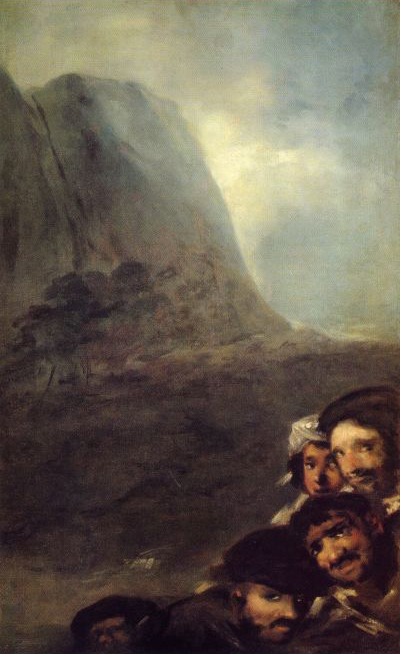
A cliff rises along the left side of Heads in a Landscape. Its upper slopes disappear into cloud, and a pale opening in the sky draws the eye towards the distance. Five faces gather at the lower right, so close that the edges of the painting interrupt the group. The expressions range from watchful to amused. The painting, associated with Francisco de Goya and dated about 1820–1823 by the Fundación Goya en Aragón, is listed as an oil on canvas in a private New York collection. Its resemblance to the Black Paintings has prompted a more particular question. Could this be the picture said to have disappeared from Goya's country house before the rest of the murals were moved? [1] [2]
At a Glance
- TitleHeads in a Landscape (Cabezas en un paisaje), also catalogued as Grupo de cabezas and Capricho con cinco cabezas. [1]
- Artist and dateCatalogued under Francisco de Goya, c. 1820–1823. The attribution has been questioned. [1]
- Medium and dimensionsOil on canvas, 112 × 67 cm. The Fundación classifies it as an easel painting. [1]
- CollectionStanley Moss & Company, New York, as listed in the Fundación catalogue. [1]
- Relationship to the Quinta del SordoProposed identification with a missing painting from the upper room. Its wall origin and position remain unconfirmed. [2] [3]
Works across Goya’s career
The Parasol
1777The Nude Maja
1795–1800Heads in a Landscape
c. 1820–23Saturn Devouring His Son
c. 1820–23The Dog
c. 1820–23Five faces beneath a mountain
Start at the highest face, close to the right edge. A light catches one cheek and one side of the nose under dark headwear. A second person looks out from behind, marked by a lighter head covering. Below them, a face tilts under another dark hat and a sliver of pale collar comes into view. At the bottom, a face under a broad dark brim is cut off by the frame, while the fifth is barely discernible to the left. The eye can travel down this uneven sequence before it registers how little space the whole gathering occupies. The painting makes its people conspicuous by squeezing them together where a landscape painter might have placed an incidental detail. [1]
The left-hand incline occupies much of the height of the picture. Dark marks run down the rock face and a broken band of trees collects at its foot. The slope descends into lighter air on the right, just above the people. That patch of sky suggests a depth that the faces abruptly undo, bringing the viewer close enough to distinguish glances and changes in expression. The hill in front of the mountain is dark enough for the lowest faces and hats to merge with it. From across a room, the picture might first read as weather and terrain. Closer to it, the pale touches at the corner resolve into people. [1]
The closeness of the heads and the partial bodies can recall a casually framed group photograph. The comparison describes the experience of looking, particularly the sense that the foreground continues just out of shot. One figure seems to smile, while another appears intent on whatever has caught the group's attention. The shift between amusement and unease depends in part on how long the viewer spends with the shadowed faces. A single title serves several possible readings because it gives the arrangement of the picture and leaves the circumstances of the encounter open.
Annotated Details from Heads in a Landscape
Look down the slope and across the pale sky before tracing the heads in the corner.
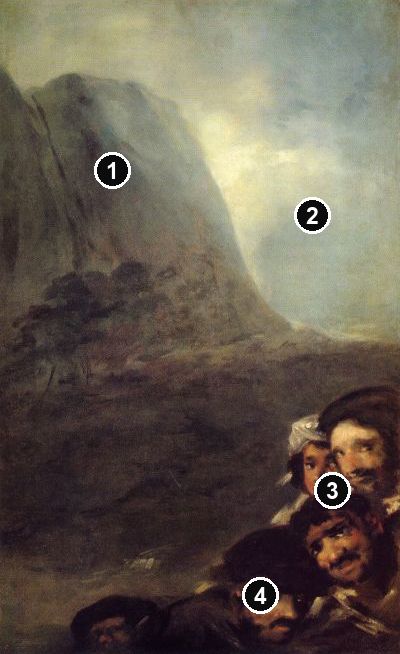
Details from HEADS IN A LANDSCAPE
Details from the canvas recorded in Fundación Goya catalogue 672.
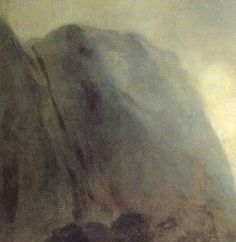
The mountain’s outline
A broken diagonal leads down the mountain into darker ground.
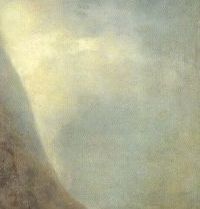
The opening in the clouds
A pale zone of sky opens beyond the dark incline.
The upper figures
Light on two faces separates them from the clouded hillside.
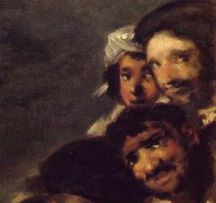
The figures at the edge
The lower shapes crowd into the corner and are interrupted by the edge.
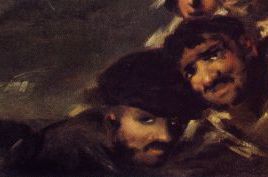
From Vista Alegre to San Telmo
The earliest dated record cited for the composition comes from the Palacio de Vista Alegre near Madrid. An inventory drawn up by Vicente López in 1846 for the collection of María Cristina de Borbón lists a Capricho con cinco cabezas under Goya. Carlos Foradada transcribes the entry under the large salon, with the number 400, dimensions in feet and inches and a valuation of 2,000 reales. When the Duke and Duchess of Montpensier sold the estate to José de Salamanca in 1859, an inventory of effects sent to the Palacio de San Telmo in Seville recorded the five heads with the old number 400 and a new one, 376. That repeated number anchors the movement between collections. It also clarifies a potentially misleading overlap. Salamanca bought the Vista Alegre property, while the five-head picture appears on the contemporary list of material destined for Seville. [2]
José Ignacio Calvo Ruata identifies the work listed as Un grupo de cabezas in the Montpensiers' published catalogue of 1866 with Heads in a Landscape, and notes its uncertain authorship. The title had shed the number of figures by the time of the printed catalogue, but a photograph supplies the visual record. Jean Laurent's 1866 image of the framed painting, numbered 1020 and labelled Groupe de têtes, credits the gallery of San Telmo. The photograph shows the dark mountain and the characteristic cluster of heads at the lower right. Foradada also traces an entry for the group of heads in the 1892 inheritance papers of Antonio María de Orléans y Borbón, son of the Duke and Duchess of Montpensier. [2] [4] [5]
The Fundación's account connects that inheritance with the Italian collector Alessandro Contini Bonacossi and ultimately with Stanley Moss & Company. Foradada reports that the New York oil came from Contini's heirs, while treating the route from the Montpensier family to Contini as conjectural. He also leaves open whether Laurent's framed painting and the surviving canvas are the same object. His estimate of the photographed painted area is 102.5 × 62.3 cm, using the scale in Laurent's photograph. The catalogue dimensions for the New York canvas are 112 × 67 cm. Some of the photographed painting is concealed by the frame. The two measurements describe different things and the discrepancy alone cannot establish whether the work was recut, remounted or is a second version. [1] [2]
Goya on film
Five films explore Goya’s portraits, prints, Black Paintings and painting techniques.
The Duke of Wellington by Goya
The portrait, its military decorations and its later theft.
Watch on YouTubeThe missing painting upstairs
Charles Yriarte described the Quinta del Sordo in a book published in 1867, before the main group of murals was transferred. He reports that the Marquis of Salamanca acquired one painting and had it taken to Vista Alegre. In the account of the upper room on page 94, he describes an absent panel and an adjacent image of a dog's head. His phrasing places the missing work to the left in the pair he has just described. The Fundación notes a suggested position to the left of the room's door. Both accounts put the search close to the entrance, where the direction of approach matters to any drawn plan. Yriarte also reports that the work Salamanca removed might have been painted by Goya's son. The removal story supplies an early lead for the missing mural, but leaves the leap from that mural to the five heads to later scholarship. [1] [3]
The catalogue that the Fundación publishes today links Heads in a Landscape to its Black Paintings series and assigns it the object classification of easel painting. It marks the work as documented under Goya and also records that some authors have questioned its authenticity. As Foradada recounts, José Gudiol accepted it as a Goya, while Pierre Gassier and Juliet Wilson expressed reservations. José Manuel Arnáiz entertained its identification as one of the Quinta pictures. Priscilla Muller proposed a different sequence in which Javier Goya painted an independent canvas to fill a gap left by another work. That hypothesis distinguishes the picture first removed from a picture that might subsequently have occupied the same space. Which object a document records, who painted it, what it was painted on and where it was installed each require their own evidence. [1] [2]
Factum Foundation includes the proposed fifteenth painting in an alternative reconstruction of the upper room. Its project book reproduces the San Telmo photograph alongside a colour image identified as the Stanley Moss canvas and describes an ambition to make a facsimile for the installation. That published comparison gives readers two records of the composition and a proposed room arrangement. The high-resolution recording undertaken with the Prado concerns the fourteen preserved murals. In Heads in a Landscape, the published colour image documents the visible composition of the present work. The historical photograph shows a framed picture in a collection decades after Goya's death. Evidence of the original support would have to come from sources such as a documented removal or technical examination of the edges and paint layers. [2] [5] [6]
What The Dog can tell us
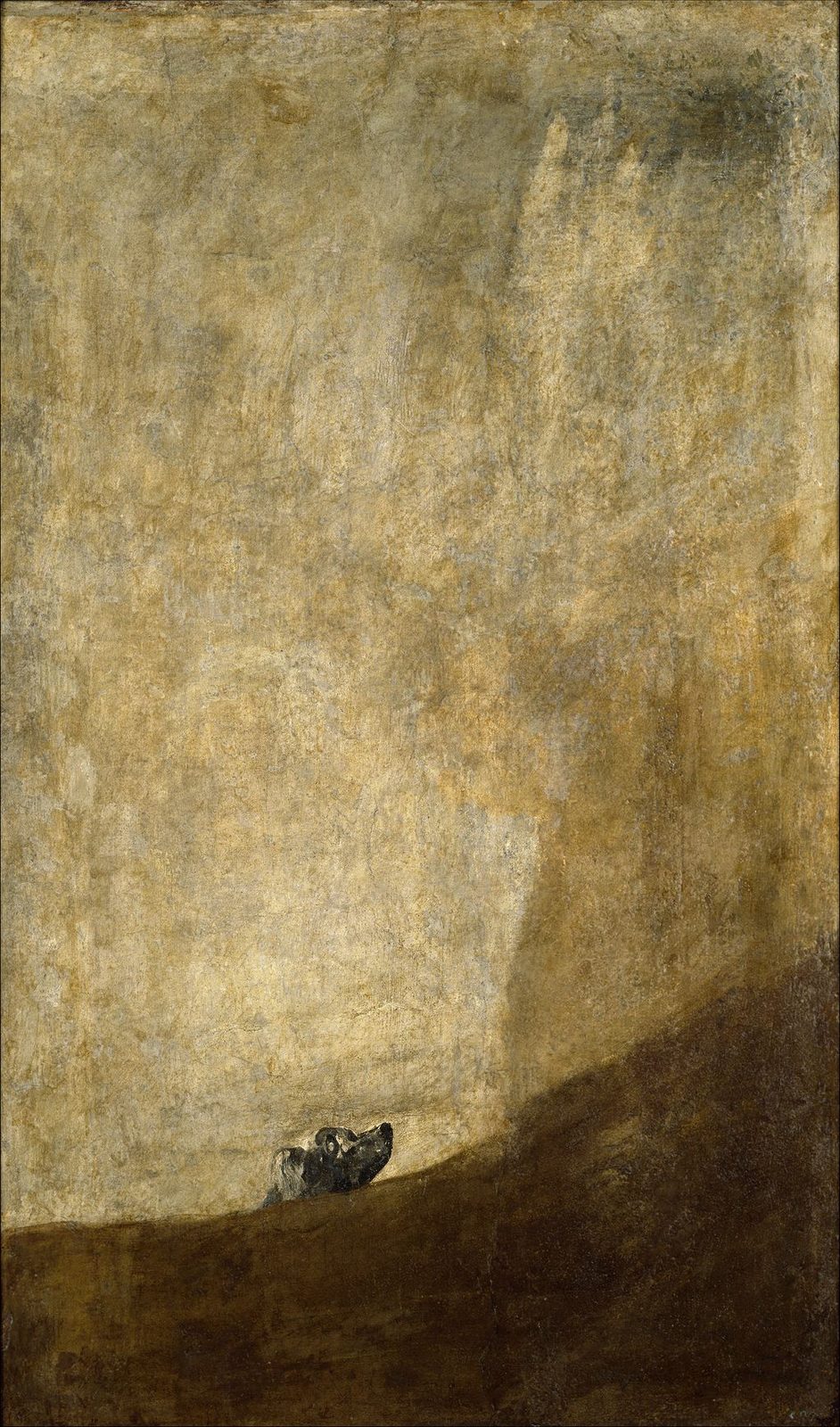
The Dog offers a comparison in both composition and documentation. In both pictures, the expanse above a head or heads takes up most of a tall format. The dog turns upwards into that space, while several of the people in Heads in a Landscape appear to look across the picture plane towards us. Laurent photographed The Dog on the wall of the Quinta before its transfer, with details of the surrounding decoration visible in the image. The Prado records the resulting work as a mural transferred to canvas. The two paintings can be placed next to each other in a reconstruction, but a similar format and a comparable use of pictorial space cannot supply the evidence that survives for the dog alone. [5] [7] [8]
Artworks directory
| Name | Date | Medium |
|---|---|---|
| And There’s No Help for It, Plate 15 | Printed 1863 | |
| Asmodea | c. 1820–23 | Wall painting transferred to canvas |
| Boys Inflating a Bladder | 1777–78 | Tapestry cartoon |
| Boys Picking Fruit | 1778 | Tapestry cartoon |
| Bullfight in a Divided Ring | 1825 | Lithograph |
| Card Players | 1777–78 | Tapestry cartoon |
| Card Players (sketch) | 1777–78 | Painted sketch |
| Dance on the Banks of the Manzanares | 1777 | Tapestry cartoon |
| Duel with Cudgels | c. 1820–23 | Wall painting transferred to canvas |
| Heads in a Landscape | c. 1820–23 | Easel painting |
| Judith and Holofernes | c. 1820–23 | Wall painting transferred to canvas |
| Leocadia | c. 1820–23 | Wall painting transferred to canvas |
| Maja and Cloaked Men | 1777 | Tapestry cartoon |
| Maja and Cloaked Men (sketch) | 1777 | Painted sketch |
| Majo Clapping in Time to the Music | 1777 | Drawing |
| Men Reading | c. 1820–23 | Wall painting transferred to canvas |
| Out Hunting for Teeth, Plate 12 | 1799 | Etching, burnished aquatint and burin |
| Picnic in the Countryside (sketch) | 1776–78 | Painted sketch |
| Picnic on the Banks of the Manzanares | 1776 | Tapestry cartoon |
| Pilgrimage to San Isidro | c. 1820–23 | Wall painting transferred to canvas |
| Preparatory study for The Sleep of Reason Produces Monsters | c. 1796–97 | Drawing |
| Procession of the Holy Office | c. 1820–23 | Wall painting transferred to canvas |
| Quarrel at the Cockerel Inn (sketch) | 1777 | Painted sketch |
| Quarrel in the New Tavern | 1777 | Tapestry cartoon |
| Saturn Devouring His Son | c. 1820–23 | Wall painting transferred to canvas |
| Seated Majo Smoking | c. 1776 | Drawing |
| The Dog | c. 1820–23 | Wall painting transferred to canvas |
| The Drinker | 1777 | Tapestry cartoon |
| The Fates | c. 1820–23 | Wall painting transferred to canvas |
| The Great He-Goat | c. 1820–23 | Wall painting transferred to canvas |
| The Kite | 1777–78 | Tapestry cartoon |
| The Parasol | 1777 | Oil on canvas, tapestry cartoon |
| The Second of May 1808 | 1814 | Oil on canvas |
| The Sleep of Reason Produces Monsters, Plate 43 | 1799 | Etching and aquatint |
| The Third of May 1808 | 1814 | Oil on canvas |
| Thou Who Canst Not, Plate 42 | 1799 | Etching and burnished aquatint |
| Three Figures | 1776 | Drawing (lost) |
| Two Old Men | c. 1820–23 | Wall painting transferred to canvas |
| Two Old Men Eating Soup | c. 1820–23 | Wall painting transferred to canvas |
| Two Women and a Man | c. 1820–23 | Wall painting transferred to canvas |
| Universal Language: The Author Dreaming | 1797 | Drawing |
| The Family of Charles IV | 1800 | Oil on canvas |
| Witches’ Sabbath (Osuna painting) | 1797–98 | Oil on canvas |
| The Nude Maja | 1795–1800 | Oil on canvas |
| The Clothed Maja | 1800–07 | Oil on canvas |
| Self-Portrait (Drawing) | c. 1796 | Brush and carbon black ink on laid paper |
| The Swing, Madrid Album B.21 | 1795–97 | Brush and carbon black washes |
| Majas Fighting, a Majo Observing, Madrid Album B.15 | 1796–97 | Brush, grey and black washes on laid paper |
| Majos and Majas Conversing, Madrid Album B.16 | c. 1794–97 | Ink wash on paper |
| Weeping Woman and Three Men, Madrid Album B.17 | 1795–97 | Brush, carbon black washes and black chalk |
| Maja Seated on a Chair and Two Companions Behind, Madrid Album B.18 | 1795–97 | Brush and carbon black washes |
| Girl and Bull, Madrid Album B.23 | 1796–97 | Brush and carbon black washes |
| Lovers Sitting on a Rock, Madrid Album B.24 | 1796–97 | Brush and carbon black washes |
| Mariano Ceballos Riding a Bull | 1825 | Crayon lithograph and scraper |
| Landscape (lifetime impression) | c. 1807–10 | Etching and aquatint |
| Self-Portrait (1815), Prado canvas | 1815 | Oil on canvas |
| Self-Portrait (1815), Academy panel | 1815 | Oil on panel |
| Self-Portrait with Dr Arrieta | 1820 | Oil on canvas |
| Christ Crucified | 1780 | Oil on canvas |
| The Last Communion of Saint Joseph of Calasanz | 1819 | Oil on canvas |
| Christ on the Mount of Olives | 1819 | Oil on panel |
| The Flower Girls, or Spring | 1786–87 | Oil on canvas |
| The Grape Harvest, or Autumn | 1786–87 | Oil on canvas |
| The Snowstorm, or Winter | 1786–87 | Oil on canvas |
| The Threshing Ground, or Summer | 1786–87 | Oil on canvas |
| Picnic on the Banks of the Manzanares | 1776 | Oil on canvas |
| The Kite | 1777–78 | Oil on canvas |
| Dance on the Banks of the Manzanares | 1777 | Oil on canvas |
| A Fight at the Venta Nueva | 1777 | Oil on canvas |
| Blind Man’s Bluff | 1788 | Oil on canvas |
| Dogs on a Lead | 1775 | Oil on canvas |
| Hunting with a Decoy | 1775 | Oil on canvas |
| Hunter Loading His Rifle | 1775 | Oil on canvas |
| The Angler | 1775 | Oil on canvas |
| The Hermitage of San Isidro on His Feast Day | 1788 | Oil on canvas |
| The Meadow of San Isidro | 1788 | Oil on canvas |
| The Straw Manikin | 1791–92 | Oil on canvas |
| Witches’ Flight | c. 1797–98 | Oil on canvas |
| A Scene from ‘The Forcibly Bewitched’ | 1798 | Oil on canvas |
| The Duchess of Alba in Black | 1797 | Oil on canvas |
| The Duchess of Alba in White | 1795 | Oil on canvas |
| Charles III in Hunting Dress | c. 1786 | Oil on canvas |
| The Duke and Duchess of Osuna and Their Children | 1787–88 | Oil on canvas |
| Manuel Osorio Manrique de Zúñiga | 1787–88 | Oil on canvas |
| The Marquesa de Pontejos | c. 1786 | Oil on canvas |
| Equestrian Portrait of the 1st Duke of Wellington | 1812 | Oil on canvas |
| The Duke of Wellington | 1812–14 | Oil on wood |
| Portrait of Ferdinand VII of Spain | 1814 | Oil on canvas |
| Gaspar Melchor de Jovellanos | 1798 | Oil on canvas |
| María Tomasa Palafox y Portocarrero | 1804 | Oil on canvas |
| Señora Sabasa García | c. 1806–11 | Oil on canvas |
| Don Juan Bautista de Muguiro | 1827 | Oil on canvas |
| Doña Isabel de Porcel | Before 1805 | Oil on canvas |
| The Colossus | After 1808 | Oil on canvas |
| The Burial of the Sardine | 1808–12 | Oil on panel |
| The Madhouse | 1808–12 | Oil on panel |
| A Procession of Flagellants | 1808–12 | Oil on panel |
| Portrait of Jacques Galos | 1826 | Oil on canvas |
| Portrait of Mariano Goya, the Artist’s Grandson | 1827 | Oil on canvas |
| Milkmaid of Bordeaux | c. 1827 | Oil on canvas |
| Portrait of Don Juan Antonio Cuervo | 1819 | Oil on canvas |
| María Luisa of Parma (Naples version) | c. 1800 | Oil on canvas |
| The Countess of Baena | 1819 | Oil on canvas |
| The Family of the Infante Don Luis | 1783–84 | Oil on canvas |
| The Holy Family | c. 1787 | Oil on canvas |
| Saint Barbara | c. 1773 | Oil on canvas |
| Saints Justa and Rufina | 1817 | Oil on canvas |
| El Tío Paquete | c. 1819–20 | Oil on canvas |
| The Forge | c. 1815–20 | Oil on canvas |
| Majas on a Balcony (Metropolitan Museum version) | c. 1800–10 | Oil on canvas |
| Maja and Celestina on a Balcony | c. 1808–12 | Oil on canvas |
| The Water Bearer | 1808–12 | Oil on canvas |
| Time and the Old Women | c. 1810 | Oil on canvas |
Frequently Asked Questions
The published catalogue gives no names for the figures or established meaning for the scene. Their partially visible faces, the overlapping headwear and the different directions of their gazes are the clues the composition offers. [1]
Discussion
Look again at the images and ideas explored in Heads in a Landscape. These editorial prompts invite your observations.
Where does your eye go first, to the clearing sky or to the faces? Follow the edge of the rock down to the group, then reverse the route. Seen from the bottom up, the mountain can seem to take the people by surprise. Seen from the top down, the people are the surprise.
Reader Insights
What effect does the placement of the faces have on your reading of the landscape?
What kind of evidence would connect the canvas more securely to the Quinta?
Join the Conversation
Share a detail, comparison or question about Heads in a Landscape below.
References
- Fundación Goya en Aragón, Heads in a Landscape (Cabezas en un paisaje), catalogue record 672, revised 15 June 2023. View source.
- Carlos Foradada, ‘El interior de la Quinta del Sordo’, AACA Digital, section on Capricho con cinco cabezas and fig. 13. View source.
- Charles Yriarte, Goya: sa biographie, les fresques, les toiles, les tapisseries, les eaux-fortes et le catalogue de l'œuvre, Paris, Henri Plon, 1867, pp. 92–94. View source.
- José Ignacio Calvo Ruata, ‘Coleccionistas de Goya en el siglo XIX’, p. 41 and note 52, citing the 1866 San Telmo catalogue, pp. 18 and 58, and Yriarte, p. 146. View source.
- Factum Foundation, Factum Foundation 2019–2023, pp. 172–173. Includes Laurent's Groupe de têtes, no. 1020, credited to the Instituto del Patrimonio Cultural de España, the Stanley Moss canvas and an alternative upper-floor layout. View source.
- Factum Arte, Digitalización en 3D y color de las Pinturas negras de Francisco de Goya, Museo Nacional del Prado collaboration. View source.
- Museo Nacional del Prado, The Drowning Dog, P000767, collection entry and Black Paintings history. View source.
- Jean Laurent, The Dog photographed at the Quinta del Sordo, glass negative VN-06583 P, Archivo Ruiz Vernacci, Instituto del Patrimonio Cultural de España. View source.







