


 by Tom Gurney
Tom Gurney BSc (Hons) is an art history expert with over 20 years experience
Published on June 19, 2020 / Updated on November 20, 2026
Email: tomgurney1@gmail.com / Phone: +44 7429 011000
Introduction
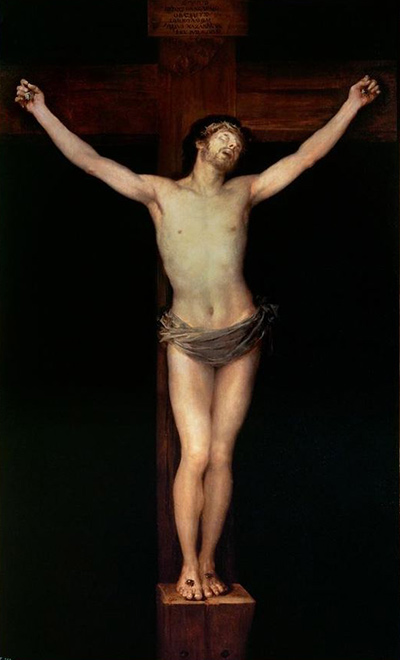
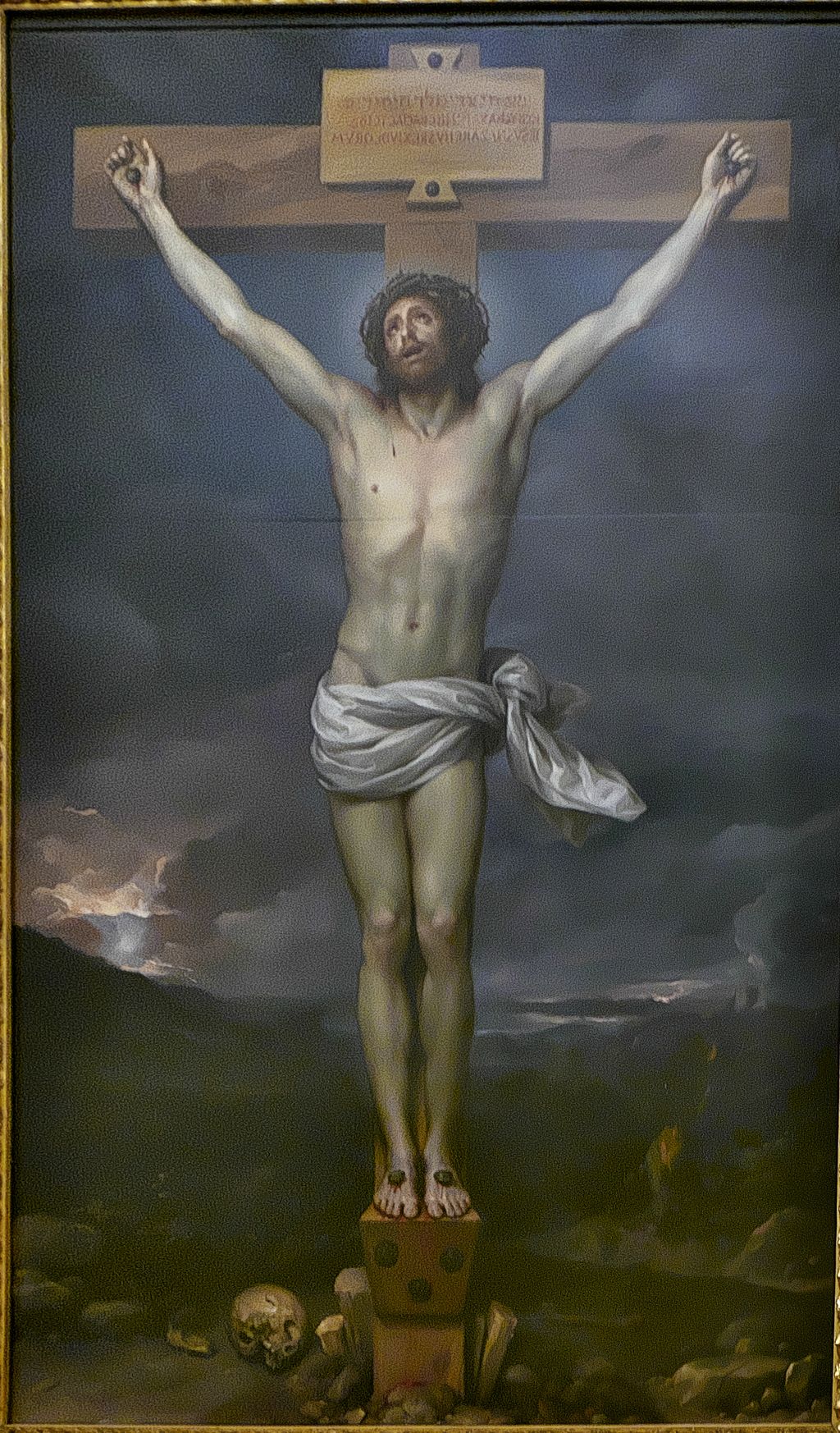
Christ raises his face towards the upper right of the canvas. His fingers curl above the nails and his feet press against a wooden ledge. Light falls across the chest and knees, picking out an almost unbroken stretch of pale skin against the dark. Francisco de Goya painted this life-size figure in 1780 and presented it to the Royal Academy of Fine Arts of San Fernando in Madrid when he applied for membership. The painting now belongs to the Museo Nacional del Prado. [1] [2] [3]
At a Glance
Works across Goya’s career
The Parasol
1777Christ Crucified
1780The Nude Maja
1795–1800Saturn Devouring His Son
c. 1820–23The Dog
c. 1820–23How the figure holds itself
The cross divides the canvas into firm horizontal and vertical lines. Christ’s outstretched arms pull diagonally away from its central beam. They reach nearly to the edges of the picture, while his ankles come close together near the centre. Follow the leg at the viewer’s left from hip to foot. The knee comes forward and catches the light, and the shin has a fuller highlight than its neighbour. The other leg draws back into shadow. At the waist the folds of the grey-brown cloth rise towards the knot on the viewer’s right. That slant makes the slight turn of the hips easier to see. The raised head tilts towards the same side, taking the face off the straight axis of the cross. [1] [2]
There are four nails, one for each hand and each foot. The feet rest side by side on a small block, sometimes called a suppedaneum. Its upper face catches warm light, and the darker wood beneath it makes the ledge read as a projection from the cross. The block helps give the body the appearance of bearing weight. Look at the space between the feet and then at the fingers at either end of the crossbeam. Goya makes these points of attachment small within the picture, but they give the long limbs something definite to pull against. [1] [2]
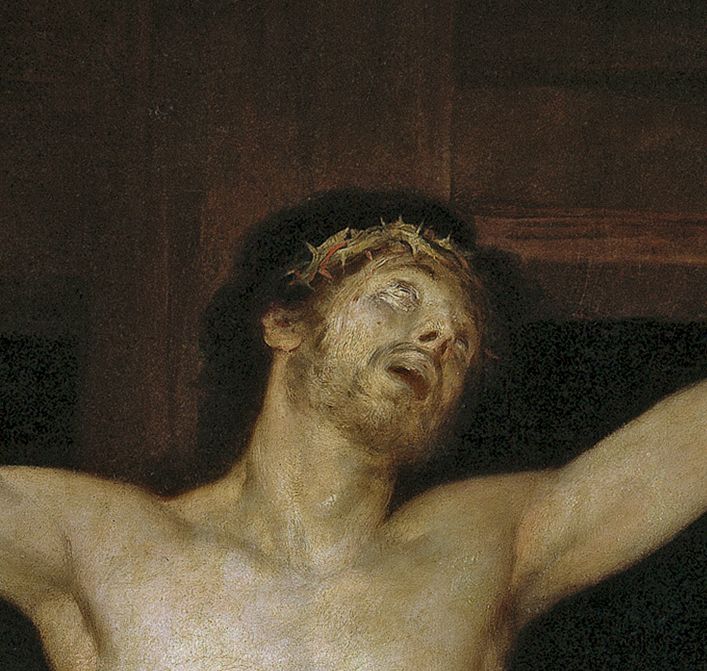
Much of the modelling takes place in intermediate tones. The light on the chest shades through grey and ochre towards the hollow under the arm. The highlight running down the nearer thigh narrows at the knee and broadens again on the shin. The flesh looks smooth even where the painting describes strain. There is little visible blood. The small dark marks at the nails and the creases across the lifted brow carry more of the evidence of suffering. Christ’s open mouth and upturned eyes have led the Prado’s printed catalogue to suggest the moment when he asks why God has forsaken him. The painting leaves the words of that cry to the viewer. [1] [2]
Annotated Details from Christ Crucified
Look at how the light reveals the figure against the cross and the dark background.
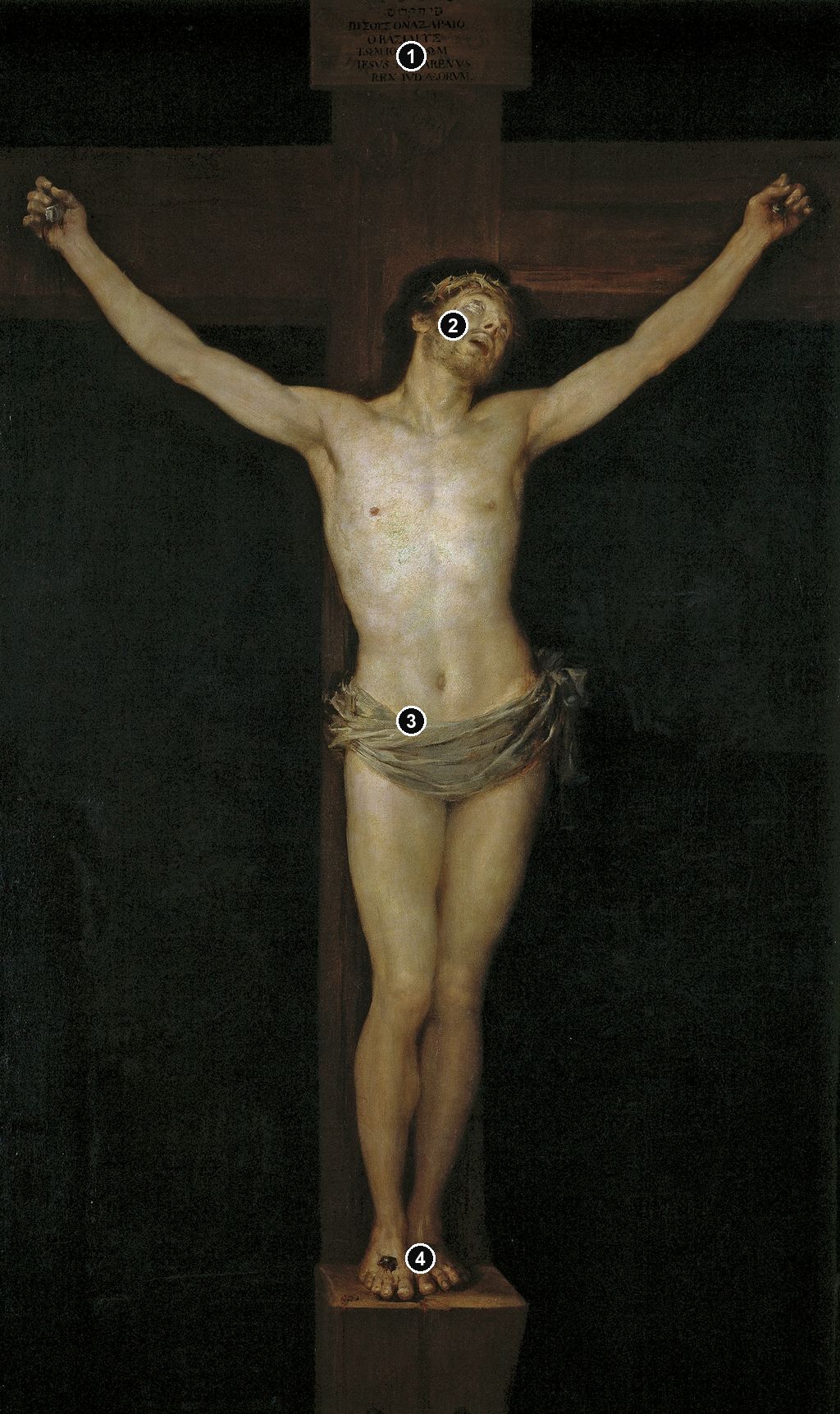
Details from CHRIST CRUCIFIED
Details from the 1780 canvas in the Museo Nacional del Prado (P000745).
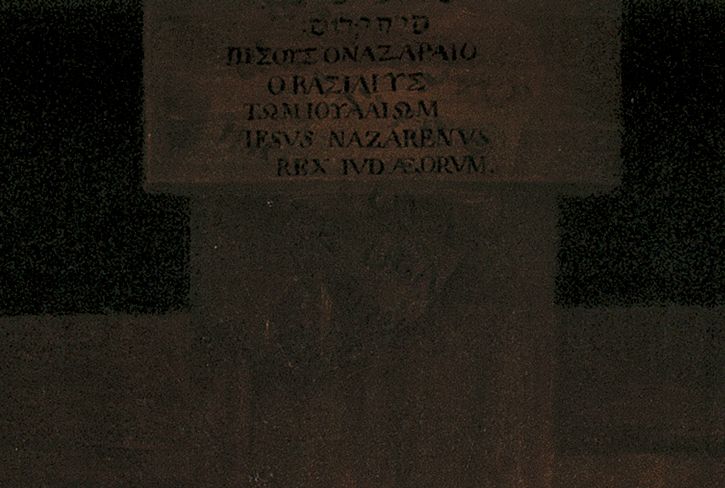
The tablet
Rows of small letters sit at the top of the cross.
The raised face
The head tilts up towards the light, with shadow beneath the cheek.
The folds at the waist
Loose folds and dark edges mark the cloth around the waist.
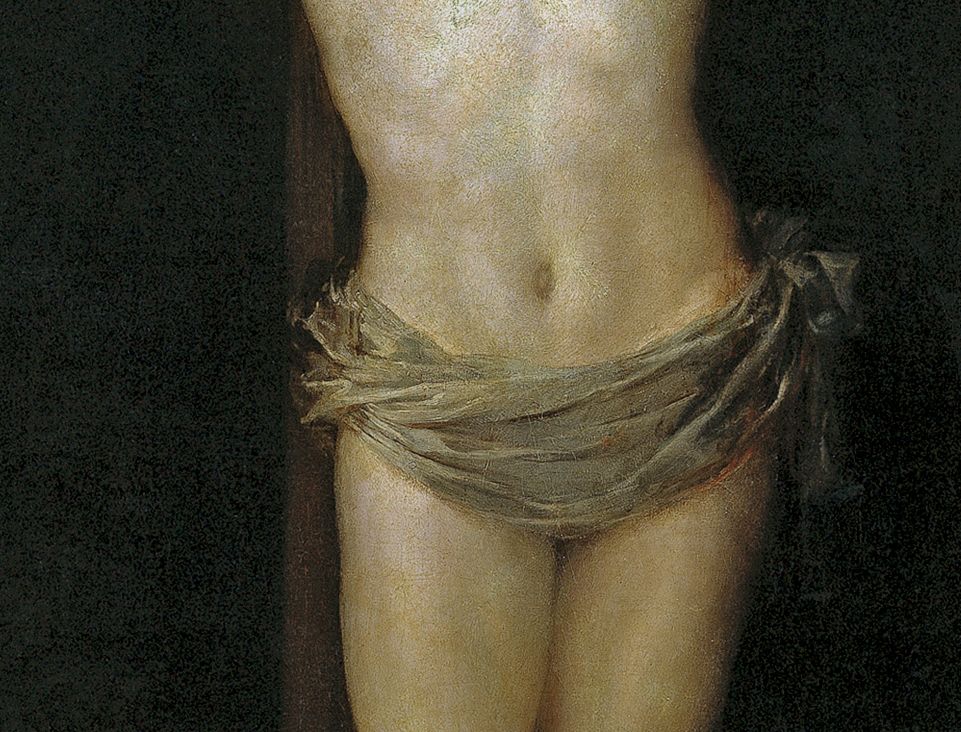
The feet and support
The feet rest side by side on the small ledge, with a nail through each foot.
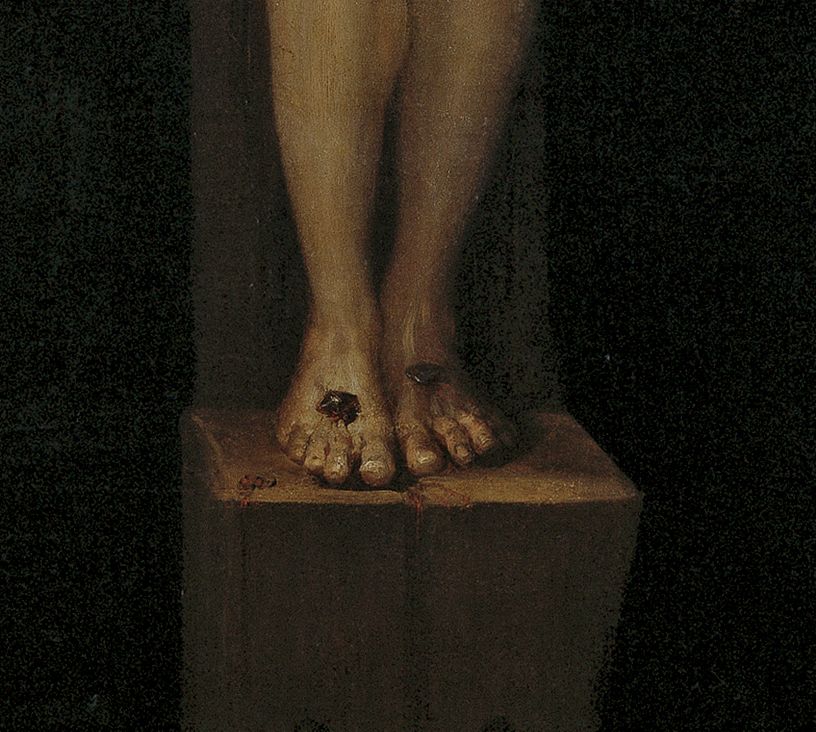
The wood, the darkness and the inscription
The crossbeam is easier to see where its ruddy colour comes through behind the forearms. Below the feet, the end of the cross disappears at the canvas edge without a visible horizon or base in the ground. There are no witnesses or distant buildings to fix our position on Calvary. The glow on the front of the chest and the warmer light on the footrest make the body and the wood seem close to us. Beyond those surfaces the space is difficult to measure. That uncertainty keeps drawing attention back to the points we can locate, from the hands at the widest part of the composition to the face just off its centre. [1] [2]
Above the crossbeam is a small rectangular tablet. Its closely spaced lettering gives Christ’s name and the charge under which he was executed, “Jesus of Nazareth, King of the Jews”, in Hebrew, Greek and Latin. The three languages follow the account of the inscription in the Gospel of John. The board is set high in the frame, on the upright from which the head turns away. Its regular edges and compact writing make it a different kind of detail from the folds of cloth and the changing light on Christ’s body. [2]
The tablet may have looked different when the Academy saw the painting. The art historian José Camón Aznar discussed an earlier, tilted cloth inscription reported beneath the present tablet and proposed that the visible version was a later repaint. He connected that possibility with a complaint Goya made to the Academy in 1816 about the painting’s condition after its transfer to San Francisco el Grande. The connection between the reported underlying design and the church transfer remains Camón Aznar’s interpretation. A slanted inscription on fabric would have given the upper part of the canvas a diagonal of its own, close to the tilt of Christ’s head. [2]
Goya on film
Five films explore Goya’s portraits, prints, Black Paintings and painting techniques.
The Duke of Wellington by Goya
The portrait, its military decorations and its later theft.
Watch on YouTubeThe Crucifixion at Aranjuez
The closest model identified by the Fundación Goya en Aragón is Anton Raphael Mengs’s Christ Crucified, an oil painting on panel made around 1765–68 for Charles III’s bedroom at the Royal Palace of Aranjuez. It remains in the royal collections. Mengs uses a footrest and four nails, a tablet above the cross and a head raised towards heaven. He also includes a landscape, rocks and a skull below the cross. Goya keeps the turn of the head and the placement of the feet while giving the pale figure a broader field of darkness. The position of the footrest is especially revealing in comparison. In the royal painting you can follow the upright towards the ground. In Goya’s canvas the small ledge is almost the last place where you can judge how far the wood projects towards you. [2] [4] [5]
A related drawing by Mengs in the Prado, D003073, already has the uplifted face and open angle of the arms. Its charcoal, black pencil and light accents give the torso volume on toned paper. The proportions differ from those of the finished panel, whose figure is more elongated. The two works show how a painter could preserve the action of the head and arms while adjusting the body that carries it. In Goya’s canvas the pose also depends on small changes, particularly the way one knee takes the light while the other retreats. [1] [5]
The isolated figure also invites comparison with Velázquez’s Christ Crucified, painted for the convent of San Plácido, also in Madrid. Its feet are likewise secured separately above a ledge. Velázquez bows the head and lets the hair obscure part of the face. In Goya’s picture the upper face turns into the light. Comparison with his own drawings shows another choice he had available. In an earlier Italian Notebook study of the subject, now in the Prado, he drew a crucifixion with three nails, a lowered head and traces of an architectural setting. The Fundación suggests a sculpture as a possible model for that sheet. The sketch shows Goya working with a different version of the subject several years before the Academy canvas. [1] [6] [7]
From the Academy to the Prado
On 5 May 1780, Goya signed his application to the Academy. The letter describes him as a pupil of the institution and offers an original painting of the Crucifixion for consideration. On 7 May, the secretary Antonio Ponz recorded the submission of the life-size figure and the unanimous vote to elect Goya an académico de mérito, an Academy member admitted on the strength of his work. The Fundación’s catalogue gives 5 July for delivery, and an older Prado catalogue also prints July. The signed May application and the minutes establish that the painting had been presented by the time of the May vote. The July date in later catalogues gives no firm basis for dating a separate handover. [1] [2] [3] [8] [9]
Five years later the Academy agreed to send the painting to the sacristy of San Francisco el Grande with a group of other canvases. A work that had been scrutinised as evidence of a painter’s skill took its place in a Madrid church. It was removed from the church in 1836 during the confiscation of property from religious institutions and passed to the Museo de la Trinidad. In 1872 that collection was merged with the museum now known as the Prado. The canvas thus travelled from the Academy through a church and a public museum before becoming part of the collection in which it is known today. [2] [3] [10]
Artworks directory
| Name | Date | Medium |
|---|---|---|
| And There’s No Help for It, Plate 15 | Printed 1863 | |
| Asmodea | c. 1820–23 | Wall painting transferred to canvas |
| Boys Inflating a Bladder | 1777–78 | Tapestry cartoon |
| Boys Picking Fruit | 1778 | Tapestry cartoon |
| Bullfight in a Divided Ring | 1825 | Lithograph |
| Card Players | 1777–78 | Tapestry cartoon |
| Card Players (sketch) | 1777–78 | Painted sketch |
| Dance on the Banks of the Manzanares | 1777 | Tapestry cartoon |
| Duel with Cudgels | c. 1820–23 | Wall painting transferred to canvas |
| Heads in a Landscape | c. 1820–23 | Easel painting |
| Judith and Holofernes | c. 1820–23 | Wall painting transferred to canvas |
| Leocadia | c. 1820–23 | Wall painting transferred to canvas |
| Maja and Cloaked Men | 1777 | Tapestry cartoon |
| Maja and Cloaked Men (sketch) | 1777 | Painted sketch |
| Majo Clapping in Time to the Music | 1777 | Drawing |
| Men Reading | c. 1820–23 | Wall painting transferred to canvas |
| Out Hunting for Teeth, Plate 12 | 1799 | Etching, burnished aquatint and burin |
| Picnic in the Countryside (sketch) | 1776–78 | Painted sketch |
| Picnic on the Banks of the Manzanares | 1776 | Tapestry cartoon |
| Pilgrimage to San Isidro | c. 1820–23 | Wall painting transferred to canvas |
| Preparatory study for The Sleep of Reason Produces Monsters | c. 1796–97 | Drawing |
| Procession of the Holy Office | c. 1820–23 | Wall painting transferred to canvas |
| Quarrel at the Cockerel Inn (sketch) | 1777 | Painted sketch |
| Quarrel in the New Tavern | 1777 | Tapestry cartoon |
| Saturn Devouring His Son | c. 1820–23 | Wall painting transferred to canvas |
| Seated Majo Smoking | c. 1776 | Drawing |
| The Dog | c. 1820–23 | Wall painting transferred to canvas |
| The Drinker | 1777 | Tapestry cartoon |
| The Fates | c. 1820–23 | Wall painting transferred to canvas |
| The Great He-Goat | c. 1820–23 | Wall painting transferred to canvas |
| The Kite | 1777–78 | Tapestry cartoon |
| The Parasol | 1777 | Oil on canvas, tapestry cartoon |
| The Second of May 1808 | 1814 | Oil on canvas |
| The Sleep of Reason Produces Monsters, Plate 43 | 1799 | Etching and aquatint |
| The Third of May 1808 | 1814 | Oil on canvas |
| Thou Who Canst Not, Plate 42 | 1799 | Etching and burnished aquatint |
| Three Figures | 1776 | Drawing (lost) |
| Two Old Men | c. 1820–23 | Wall painting transferred to canvas |
| Two Old Men Eating Soup | c. 1820–23 | Wall painting transferred to canvas |
| Two Women and a Man | c. 1820–23 | Wall painting transferred to canvas |
| Universal Language: The Author Dreaming | 1797 | Drawing |
| The Family of Charles IV | 1800 | Oil on canvas |
| Witches’ Sabbath (Osuna painting) | 1797–98 | Oil on canvas |
| The Nude Maja | 1795–1800 | Oil on canvas |
| The Clothed Maja | 1800–07 | Oil on canvas |
| Self-Portrait (Drawing) | c. 1796 | Brush and carbon black ink on laid paper |
| The Swing, Madrid Album B.21 | 1795–97 | Brush and carbon black washes |
| Majas Fighting, a Majo Observing, Madrid Album B.15 | 1796–97 | Brush, grey and black washes on laid paper |
| Majos and Majas Conversing, Madrid Album B.16 | c. 1794–97 | Ink wash on paper |
| Weeping Woman and Three Men, Madrid Album B.17 | 1795–97 | Brush, carbon black washes and black chalk |
| Maja Seated on a Chair and Two Companions Behind, Madrid Album B.18 | 1795–97 | Brush and carbon black washes |
| Girl and Bull, Madrid Album B.23 | 1796–97 | Brush and carbon black washes |
| Lovers Sitting on a Rock, Madrid Album B.24 | 1796–97 | Brush and carbon black washes |
| Mariano Ceballos Riding a Bull | 1825 | Crayon lithograph and scraper |
| Landscape (lifetime impression) | c. 1807–10 | Etching and aquatint |
| Self-Portrait (1815), Prado canvas | 1815 | Oil on canvas |
| Self-Portrait (1815), Academy panel | 1815 | Oil on panel |
| Self-Portrait with Dr Arrieta | 1820 | Oil on canvas |
| Christ Crucified | 1780 | Oil on canvas |
| The Last Communion of Saint Joseph of Calasanz | 1819 | Oil on canvas |
| Christ on the Mount of Olives | 1819 | Oil on panel |
| The Flower Girls, or Spring | 1786–87 | Oil on canvas |
| The Grape Harvest, or Autumn | 1786–87 | Oil on canvas |
| The Snowstorm, or Winter | 1786–87 | Oil on canvas |
| The Threshing Ground, or Summer | 1786–87 | Oil on canvas |
| Picnic on the Banks of the Manzanares | 1776 | Oil on canvas |
| The Kite | 1777–78 | Oil on canvas |
| Dance on the Banks of the Manzanares | 1777 | Oil on canvas |
| A Fight at the Venta Nueva | 1777 | Oil on canvas |
| Blind Man’s Bluff | 1788 | Oil on canvas |
| Dogs on a Lead | 1775 | Oil on canvas |
| Hunting with a Decoy | 1775 | Oil on canvas |
| Hunter Loading His Rifle | 1775 | Oil on canvas |
| The Angler | 1775 | Oil on canvas |
| The Hermitage of San Isidro on His Feast Day | 1788 | Oil on canvas |
| The Meadow of San Isidro | 1788 | Oil on canvas |
| The Straw Manikin | 1791–92 | Oil on canvas |
| Witches’ Flight | c. 1797–98 | Oil on canvas |
| A Scene from ‘The Forcibly Bewitched’ | 1798 | Oil on canvas |
| The Duchess of Alba in Black | 1797 | Oil on canvas |
| The Duchess of Alba in White | 1795 | Oil on canvas |
| Charles III in Hunting Dress | c. 1786 | Oil on canvas |
| The Duke and Duchess of Osuna and Their Children | 1787–88 | Oil on canvas |
| Manuel Osorio Manrique de Zúñiga | 1787–88 | Oil on canvas |
| The Marquesa de Pontejos | c. 1786 | Oil on canvas |
| Equestrian Portrait of the 1st Duke of Wellington | 1812 | Oil on canvas |
| The Duke of Wellington | 1812–14 | Oil on wood |
| Portrait of Ferdinand VII of Spain | 1814 | Oil on canvas |
| Gaspar Melchor de Jovellanos | 1798 | Oil on canvas |
| María Tomasa Palafox y Portocarrero | 1804 | Oil on canvas |
| Señora Sabasa García | c. 1806–11 | Oil on canvas |
| Don Juan Bautista de Muguiro | 1827 | Oil on canvas |
| Doña Isabel de Porcel | Before 1805 | Oil on canvas |
| The Colossus | After 1808 | Oil on canvas |
| The Burial of the Sardine | 1808–12 | Oil on panel |
| The Madhouse | 1808–12 | Oil on panel |
| A Procession of Flagellants | 1808–12 | Oil on panel |
| Portrait of Jacques Galos | 1826 | Oil on canvas |
| Portrait of Mariano Goya, the Artist’s Grandson | 1827 | Oil on canvas |
| Milkmaid of Bordeaux | c. 1827 | Oil on canvas |
| Portrait of Don Juan Antonio Cuervo | 1819 | Oil on canvas |
| María Luisa of Parma (Naples version) | c. 1800 | Oil on canvas |
| The Countess of Baena | 1819 | Oil on canvas |
| The Family of the Infante Don Luis | 1783–84 | Oil on canvas |
| The Holy Family | c. 1787 | Oil on canvas |
| Saint Barbara | c. 1773 | Oil on canvas |
| Saints Justa and Rufina | 1817 | Oil on canvas |
| El Tío Paquete | c. 1819–20 | Oil on canvas |
| The Forge | c. 1815–20 | Oil on canvas |
| Majas on a Balcony (Metropolitan Museum version) | c. 1800–10 | Oil on canvas |
| Maja and Celestina on a Balcony | c. 1808–12 | Oil on canvas |
| The Water Bearer | 1808–12 | Oil on canvas |
| Time and the Old Women | c. 1810 | Oil on canvas |
Frequently Asked Questions
The raised head, open mouth and expression indicate that Christ is alive. The Prado’s printed catalogue suggests the cry of abandonment as one possible reading. [1]
It identifies him as Jesus of Nazareth, King of the Jews. The words appear in three languages, Hebrew, Greek and Latin. [2]
Discussion
Look again at the images and ideas explored in Christ Crucified. These editorial prompts invite your observations.
Look first at the feet on the ledge, then at the hands and the upturned face. Which detail gives you the strongest impression that Christ is still alive? How would you read the pose if Goya had set the cross in a landscape as Mengs did?
Reader Insights
Which details make the figure stand out from the dark around it?
How does Goya change the setting when you compare the canvas with Mengs’s panel?
Join the Conversation
Share a detail, comparison or question about Christ Crucified below.
References
- Museo Nacional del Prado, Cristo crucificado, P000745 and printed collection catalogue, p. 139, no. 745. View source 1. View source 2.
- Fundación Goya en Aragón, Cristo crucificado, object data, painting history and commentary. View source.
- Real Academia de Bellas Artes de San Fernando, “La Academia y Goya”, election and transfer to San Francisco el Grande. View source.
- Patrimonio Nacional, Carlos III. Majestad y Ornato, discussion of the Aranjuez Crucifixion in the entry on Mengs’s Lamentation. View source.
- Ana Hernández Pugh, Dibujos de Manuel Salvador Carmona (1734–1820). Catálogo razonado, pp. 190–91, illustrated comparison of the Aranjuez panel and Mengs drawing. View source.
- Julián Gállego, Cristo crucificado, cat. 28, Museo del Prado exhibition catalogue, Velázquez’s canvas from San Plácido. View source.
- Fundación Goya en Aragón, Cristo en la cruz, D6068/57, Goya’s drawing in the Italian Notebook. View source.
- Real Academia de Bellas Artes de San Fernando, Boletín, second series, no. 59 (1921), p. 149, transcription of Goya’s signed application. View source.
- Real Academia de Bellas Artes de San Fernando, “Goya, académico”, Boletín, second series, no. 68 (1923), transcription of the vote recorded by Antonio Ponz. View source.
- Pedro J. Martínez Plaza, “Donaciones y legados a los museos del Prado, de la Trinidad y de Arte Moderno”, Museo Nacional del Prado, institutional history of the 1872 merger. View source.








