


 by Tom Gurney
Tom Gurney BSc (Hons) is an art history expert with over 20 years experience
Published on June 19, 2020 / Updated on October 14, 2023
Email: tomgurney1@gmail.com / Phone: +44 7429 011000
Christ Crucified: Introduction
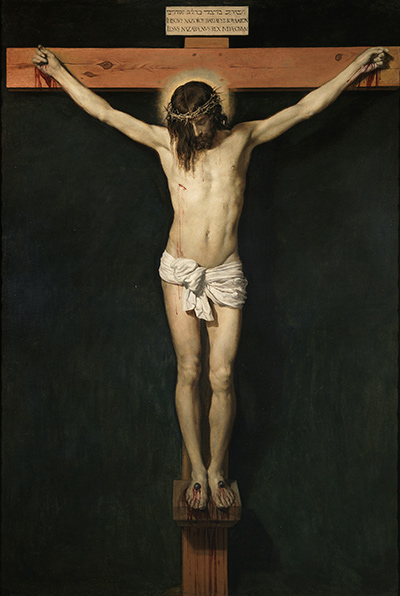
Both feet rest on the same small block of wood, each held in place by a nail. Above them the body rises almost straight until the arms open across the canvas. The head breaks that order. It tips towards the chest, bringing a fall of dark hair across one side of the face. Diego Velázquez gives the figure plenty of light and the face very little. The longer you look, the more this difference matters. The body is close enough to study in detail, while the face turns inward and offers no answering gaze. [1]
The painting is Christ Crucified, also known as the Christ of San Plácido, after the Madrid convent that once housed it. The Museo Nacional del Prado holds it under the inventory number P001167. An oil painting on canvas measuring 248 × 169 cm, it is dated to about 1632 in the Prado's published records. Its dimensions matter to the encounter. The cross nearly spans a picture more than two metres high, and the person on it meets the viewer on the scale of another human body. [1] [2]
At a Glance
- MediumOil on canvas [1]
- CollectionMuseo Nacional del Prado, P001167 [1] [2]
- Related sourcePacheco’s Arte de la pintura discusses the number of nails and how the feet are supported. [3]
Contents
- How the body occupies the cross
- Why there are four nails
- A dark field and a figure in light
- Other ways to look at the Passion
- What is known about San Plácido
- From the convent to the Prado
- What Unamuno saw in the painting
- El Greco’s Crucifixion and the work of the witnesses
- Goya’s Crucifixion and the Academy
- The clock and the images of San Plácido
How the body occupies the cross
Follow the crossbeam from one hand to the other. The outer ends run out of the painted field, so the timber has a breadth beyond the hands even though we never see its full extent. The arms dip from the nails towards the shoulders in two long slopes. Between them the chest and abdomen turn through small gradations of light. Lower down, the knees angle slightly and the feet close the composition over the upright. The cross holds a very regular position in the picture. The flex of the legs and fall of the head make the body on it particular. [1]
The footrest is called a suppedaneum. Its upper surface gives the feet somewhere to bear down, and its lower edge casts a dark bar across the upright. Following the body to this point changes how the arms look. They extend under tension, yet the figure appears to have some purchase beneath it. The withdrawal of the head, the small bending of the knees and the open hands carry much of the sense of weight. The cross continues below the support, right down to the canvas edge. There is no visible point at which it enters the earth. [1]
The light arrives from high on the left and turns gently around the ribs, forearms and thighs. At the waist the white loincloth breaks up the gradual modelling of the body. Its folds gather into a dense knot, with a loose end falling in front of the thighs. Against the gradual changes across the skin, the marks that make up the cloth look abrupt. The white also lies across the main vertical of the body at almost the point where the legs begin. The eye can pass from the hands to the cloth and down to the feet by following changes in material as well as the outline of the figure. [1]
Velázquez gives blood a narrow place within that sequence. There are small traces at the nails, below the crown of thorns and at the wound on Christ's right side, which is on the viewer's left. The thin runs depend on the pale surface beneath them for their visibility. What reads from a distance as a smooth, upright body becomes a wounded one as the details come into focus. The crown works similarly. In the Prado catalogue's large detail, stiff strands cross one another, and individual thorns stand out against the shadowed forehead. At normal viewing distance the crown can look like a continuous band. [1]
The locks falling across the face make its expression unusually hard to read. The sliver of light along the nose leads into features that recede into brown shadow, while the hair extends down towards the shoulder and chest like a dark continuation of the ground. A faint radiance around the crown partly separates the head from the wood behind it. The radiance and the curtain of hair work at different scales. One defines the silhouette from across a room. The other, seen close to, limits how much of a face the painter lets us recover. [1]
More of the cross becomes apparent after the eyes have adjusted to the darkness. Knots and irregular marks lie across the beam, and the edges of the upright remain discernible towards the bottom. The timber has been squared and fitted together. The nail heads, support and sign above the figure give the execution the material particulars of a constructed object. These are among the few things we can locate in space. With the ground below the cross and the horizon out of sight, there is little to turn those particulars into a description of a place. [1]
This work in Velázquez’s career
Christ Crucified (current article)
c. 1632 [2]The Coronation of the Virgin
c. 1635–36 (Finaldi) CatalogueWhy there are four nails
One nail through each foot comes from a particular tradition of representing the Crucifixion. In other images the feet overlap and are pinned with a single nail. Francisco Pacheco, Velázquez's teacher and later his father-in-law, argued for four in all. The end of his Arte de la pintura, published posthumously in 1649, brings together two letters and the responses of learned readers. The first letter is Francisco de Rioja's defence of the four nails, addressed to Pacheco. Pacheco then makes his own case. Both seek authority in a tradition older than the painters of their day. [3] [4]
Their arguments move among texts, objects and images. Rioja reads early Christian descriptions of the wounded hands and feet and brings an example from the Roman playwright Plautus to bear on the historical practice of crucifixion. Pacheco cites the writer and cardinal Robert Bellarmine, who understood the cross to comprise an upright, a crosspiece for the hands and a support under two separately fastened feet. Bellarmine invoked early Christian writers and recalled seeing four nails in images in old manuscript Gospels in Paris. Through evidence of this kind, Pacheco presented the four-nail image as a revival of an ancient practice. The chapters record how he argued for the image's historical and religious authority. [3]
The treatise came into print after the usual date of the Prado painting, but Pacheco had worked on the problem in the studio much earlier. His signed small panel at El Coronil, dated 1611, represents the figure on a wooden cross and gives each foot its own fastening even though the feet cross. By 1614, in the painting now at the Instituto Gómez-Moreno of the Fundación Rodríguez-Acosta in Granada, the feet rest alongside one another on a support. That arrangement also appears in his canvas in the Museo Nacional de Bellas Artes in Buenos Aires. The examples make an important distinction visible. Four nails need not prescribe a single pose. Pacheco himself changed the relative position of the feet while keeping the individual fastenings. [4] [5]
The 1614 painting is also an example of how readily a small painting could suggest a carved crucifix. Pacheco had experience colouring sculpture, including in collaboration with Juan Martínez Montañés. The strongly modelled figure in the Granada picture, which the National Gallery exhibited in The Sacred Made Real, encourages a viewer to imagine an object in relief. Velázquez uses several elements familiar from such precedents, including the independent foot nails, the footrest and a carefully differentiated body against the cross. Scale and lighting give them a different effect. A small image can be taken in as a whole from close range. In Christ Crucified, looking from the bowed head up to the sign or down to the feet requires a perceptible change of attention and, at close range, a movement of the eyes. [1] [4] [6]
The sign is itself another point of contact with Pacheco. It is the titulus, the notice of the charge placed over Christ. John 19 describes the notice identifying Jesus of Nazareth as King of the Jews and says that it was written in Hebrew, Latin and Greek. The Prado painting gives the sign three rows. [7] Its small scale relative to the beam makes the rows register as writing before the eye attends to the wording. Cruz Valdovinos shows that the inscription, like the nails, was a subject of debate around Pacheco. Pacheco's later painted examples could combine the three languages associated with John with opening words associated with other Gospel accounts. Velázquez omits the introductory words that appear in the Latin of Pacheco’s later examples. Rodríguez G. de Ceballos points out that even this learned sign contains spelling irregularities. From a distance, its three rows establish the care given to the historical detail. Up close, the inscription shows some of the difficulties of putting that ambition into paint. [1] [4] [5] [8]
A dark field and a figure in light
The space around the cross looks almost black in the Prado catalogue plate. The outlines of the timber vary in sharpness. At the top the crossbeam has a pronounced silhouette. Lower down the shade of the upright and the background come closer together. The darkness to either side of the waist leaves the figure room to turn through half-tones, while much of the face recedes into the same tonal range as the hair. Reducing the setting makes these small variations consequential. [1]
Darkness here describes the look of the surface. Carmen Garrido, who headed the Prado's technical documentation department, identified calcite as significant to the neutral background of Christ Crucified in her account of Velázquez's practice. She explains that calcite in an oily medium could change the fluidity and consistency of paint and increase its transparency. That is a more specific account of how the dark field was made than the impression of a flat black surrounding the figure. Visible colour and the materials that produce it answer different questions. [9]
Following the 1990 cleaning, Rodríguez G. de Ceballos described irregular greenish touches and subtle shadows cast over the field towards the viewer’s right. The fall of light thus produces a small but discernible depth even without a horizon. On the evidence of Garrido’s ultraviolet examination, as relayed by Rodríguez G. de Ceballos, some traces of blood are less visible than they once were. That makes the apparent restraint of the present surface a matter of condition as well as composition. [9] [8]
Gállego's 1990 catalogue also reviews claims that a landscape or other figures were once discernible in the picture, particularly in discussions of copies and ageing. Such reports leave open the possibility that a copyist supplied scenery. It is possible to read the darkness as an echo of Mark’s account of Christ’s final hours, when darkness covers the land. [10] Its most direct consequence for the composition is to hold the spectator at the same subject. There is no second group of people or illuminated distance for the eye to follow. [1] [9]
The movement of attention is very different in Apollo in the Forge of Vulcan, painted in Rome in 1630. In the forge, uncovered bodies catch the light as the men turn and respond to news. The eye passes from person to person as they absorb it. The broad view of Christ depends just as much on close observation of the shoulders and ribs. An anatomy that helps tell a story in the forge becomes the sole focus of attention in the Crucifixion. Gállego describes the nude as Apollonian, a useful account of its proportions and bearing. The taper of the torso and the smooth transitions of tone leave scope for that reading without identifying a specific antique statue or the artist's model. [1] [11]
Other ways to look at the Passion
At the Prado there is also a painting called Christ on the Cross, P002903. It came from the Convent of the Bernardas Recoletas del Santísimo Sacramento in Madrid and entered the museum in 1946. It measures 100 × 57 cm. The 1990 exhibition catalogue discusses a signature with the date 1631 and expresses reservations about how closely the work corresponds to Velázquez's manner. The signature and the four nails have figured in the painting's attribution history. Its separate number, provenance and format identify the object independently of that debate. [1]
A landscape and sky open out behind the smaller figure. You can follow the entire upright to a patch of earth, where stones and a skull mark the foot of the cross. Christ raises his face, and the steeper angle of the arms makes the pull on the hands easier to see. Both paintings provide a place for the feet and a three-language sign, but those common elements can sustain quite different accounts of the event. The smaller picture lets us locate it in a world and read a face turning towards the sky. The San Plácido painting places us before a body whose head has already fallen. In John’s account Christ bows his head as he dies, and the piercing of his side follows. The small wound in the larger canvas therefore places this image on the far side of the moment of death. [1] [7]
Francisco de Zurbarán's Crucifixion of 1627, now in the Art Institute of Chicago, offers a comparison based on a known place of display. It was made for the Dominican friary of San Pablo in Seville and hung in an alcove above an altar in a chapel adjoining the sacristy. The National Gallery's Sacred Made Real guide explains how the painting took account of its setting. Christ's body and the folds of the loincloth catch light that corresponds to a window on the right, and the background supplies no narrative setting to compete with the illusion of the figure's presence. The Art Institute’s record notes that visitors originally saw the painting through a grille. The effect of the painted body in the alcove depended in part on the conditions under which people entered and looked. [6] [12]
Look at the wood in the two paintings. Zurbarán's cross appears rough-hewn, whereas the just-visible edges of Velázquez's beam suggest worked and fitted timber. The cloth in Zurbarán's painting is sharply articulated, so the folds help the figure take on the illusion of relief above the altar. Velázquez also makes the cloth conspicuous, but gives more of the figure over to gradual shifts of tone and makes the shadowed face a place of withdrawal. The comparison helps account for the force of both works independently of any proposed borrowing between the artists. [1] [6]
Velázquez took another approach in Christ after the Flagellation contemplated by the Christian Soul, NG1148 in the National Gallery, London. The painting shows a moment before the Crucifixion. Christ has collapsed at the column where he was beaten, and a child who embodies the Christian Soul kneels before him. A guardian angel directs the child's attention. The scourges remain in view, and Christ turns towards the child. The National Gallery favours a date of about 1628–29, shortly before the artist’s first Italian journey, drawing in part on the reddish-brown preparation characteristic of his earlier work. Other proposals place the London painting during or shortly after the trip. [13]
The boy in London makes a contemporary devotional practice visible. Worshippers were encouraged to dwell on Christ's suffering and imagine themselves present. The painted child demonstrates an act that the person before the picture might undertake, with the angel helping to bring the encounter about. In the San Plácido canvas the onlooker has no depicted counterpart. The cross faces the viewer directly, without an angel pointing or an attendant showing how to respond. In The Coronation of the Virgin, made for a royal oratory, Velázquez used a cluster of figures, gestures and clouds to give form to a different devotional subject. The San Plácido composition has just the one figure to sustain the act of looking. [1] [13] [14]
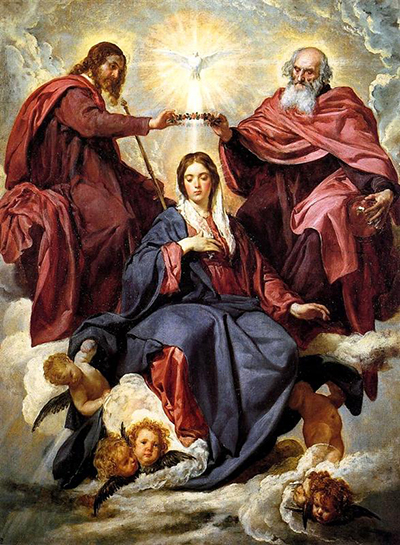
The Coronation of the Virgin. The Coronation gives the body a different role within its religious subject, with figures arranged around the Virgin. Christ Crucified places a single figure against darkness. View Coronation of the Virgin.
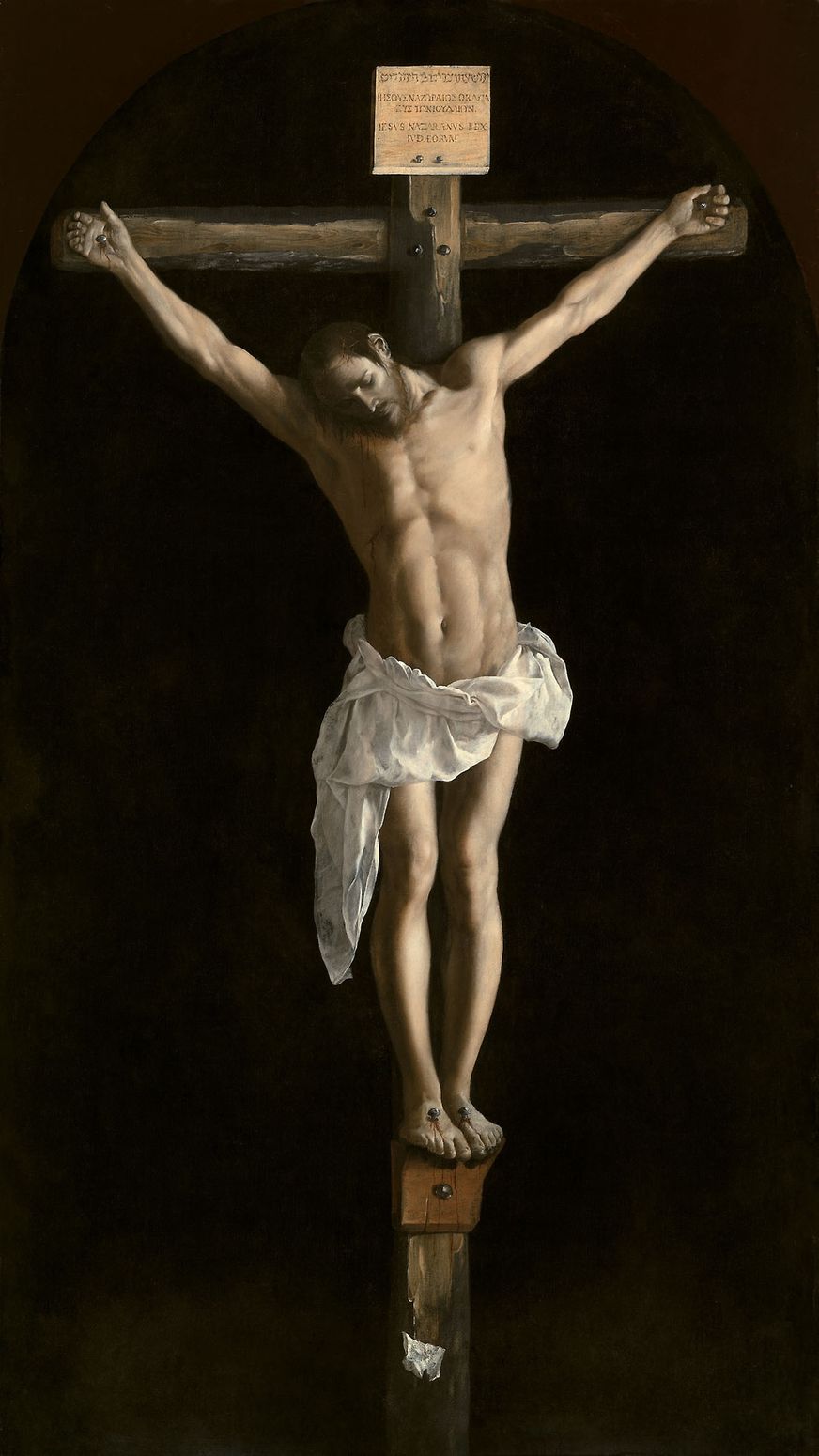
Francisco de Zurbarán, The Crucifixion, 1627, Art Institute of Chicago, 1954.15. The dark surround and strong modelling help explain how the painting could be read like a carved crucifix in a niche. Image source. Public domain. Resized for display.
What is known about San Plácido
Antonio Palomino's early eighteenth-century life of Velázquez describes a life-size painting of Christ dead on the cross in the enclosure of the Benedictine convent of San Plácido in Madrid. He also records a close copy in the church of the Buena Dicha and associates the two nails in the feet with Pacheco's position. [15] Later in the eighteenth century Antonio Ponz recorded the painting in the convent sacristy. These notices tell us where people knew the image and how one early writer understood its form. The circumstances in which it first came to the convent have a less direct paper trail. [1] [16]
Earlier writers sometimes dated the picture to 1638. Palomino discusses it immediately after a portrait of the Duke of Modena painted that year, but his phrase for the period is loose. Rodríguez G. de Ceballos traces the acceptance of about 1632 to Manuel Gómez-Moreno and subsequent scholarship. Read that way, the picture belongs to the early years after Velázquez’s first Italian journey. The broad comparison with the bodies in the forge makes sense within that chronology. The Prado gives the date as approximate. [1] [2] [15] [8]
The story that Philip IV commissioned the picture to atone for a relationship with a nun appears in the 1990 Prado catalogue as a legend. Rodríguez G. de Ceballos traces the affair story to a hostile account of the Count-Duke of Olivares and distinguishes the later suggestion that the story explained the picture. A stronger candidate for the patron is Jerónimo de Villanueva, the prothonotary of Aragon and a founder of the convent. Here too the proposed circumstances vary. An earlier explanation connected a gift from Villanueva with the outcome of the Inquisition’s case involving him and members of the convent. Rodríguez G. de Ceballos proposes a commission in the summer or autumn of 1632, around the time proceedings against Villanueva were interrupted. He connects it with public acts of reparation following a separate case in which Portuguese people of Jewish descent were accused of desecrating a crucifix. In this reading Villanueva’s gift would have been a voluntary act of reparation. The records establish the contemporary proceedings and observances. The connection to Velázquez’s commission remains a hypothesis. [1] [8]
Placement poses a related question. A sacristy was a space associated with the preparation of worship, and a picture within the enclosure had a different audience from one made for an open church. The later witnesses give the painting a specific religious home. Rodríguez G. de Ceballos points out that the sacristy Ponz saw was built later than the painting, as part of the new church constructed between 1655 and 1685. The first arrangement of the canvas and its precise viewing height remain uncertain. The cropping of the cross can make it seem present in the viewer's space, but the composition alone cannot recover the furniture or the architecture in which the first viewers saw it. [1] [16] [8]
From the convent to the Prado
In the early nineteenth century the picture passed to Manuel Godoy, the powerful minister of Charles IV. The historian Isadora Rose-de Viejo assembles records that follow it between private and public collections. A visitor saw it at Godoy's Madrid house in April 1807. Dominique Vivant Denon included it on a list of works selected in 1809 for the Musée Napoléon, but the records put it among the paintings sequestered from Godoy in 1813. A witness in 1814 recalled that Godoy had paid the convent about 60,000 reales along with other concessions. His wording signals that this was a recollection of the price. The dated inventory provides firmer evidence for the painting's presence among Godoy's possessions. [16]
The painting was handed over in 1814 to María Teresa de Borbón, the Countess of Chinchón. She installed it in the oratory of her palace at Boadilla del Monte. A letter from Paris in October 1828, transcribed by Rose-de Viejo, reports that an addition below the painting had been used to fill the oratory's altarpiece opening and was removed before shipment to Paris. The letter offers a glimpse of how an existing large canvas could be fitted to a particular setting. It is a contemporary report about the added section. Establishing the details of that alteration on the surviving support would require material evidence. [16]
The countess offered the picture for sale in Paris between 1826 and 1828. After her death, her brother-in-law and heir the Duke of San Fernando de Quiroga chose the painting and gave it to Fernando VII, who sent it to the Royal Museum, today's Prado, in 1829. By 1834 it was entered in the first gallery as the Crucified Christ known as the Christ of San Plácido. The older name moved with the picture. Even in the royal inventory it remained a way to identify the work, long after it had left the Benedictine convent. [1] [16] [17]
What Unamuno saw in the painting
In 1920 Miguel de Unamuno published El Cristo de Velázquez, a poem in four parts. The opening section invokes the Gospel of John and addresses Christ directly. Unamuno calls the image a “verbo silencioso y blanco”, a silent, white word. He goes on to give this word a language of lines and colours. For the poet, the physical properties of the image become part of an argument about faith and visibility. The pale body is something he can see in front of him and a way of thinking about the presence of Christ after death. [18]
The poem shows how much a viewer can bring to so spare a composition. Its words move beyond the body towards scriptural passages, the meaning of death and the religious imagination of a people. The shadowed head and pale flesh are seventeenth-century pictorial choices to which Unamuno gave a twentieth-century voice. His reading has a concrete starting point that is still available in the Prado. From across a gallery the cross and the body take shape together. Closer to the canvas, the nails come forward, the folds of the cloth change direction, and a few strands of hair are enough to make the face recede. [1] [18]
El Greco’s Crucifixion and the work of the witnesses
El Greco’s Crucifixion in the Prado, P000823, is exactly as wide as Velázquez’s canvas and 64 centimetres taller. It belonged to the altarpiece of the Madrid college of Doña María de Aragón. A royal provision of 10 February 1598, preserved at Simancas, records action to secure up to a thousand ducats from revenues of Doña María’s estate to cover the debt on the altarpiece contract. The document concerns payment for the ensemble. It gives El Greco’s painting a documented architectural destination of a kind that remains elusive for the earliest years of the San Plácido canvas. [19] [20] [21] [22]
El Greco gives the space below the cross to three witnesses. The Virgin and Saint John frame the lower part of the picture, while Mary Magdalene bends in towards the upright. The arms of the people below and the wings and drapery of the angels above repeatedly turn the eye back towards the body. The cross divides the painted field, but colour and gesture carry the eye across that division. In Velázquez the empty intervals under the arms remain open all the way down to the lower edge. The viewer can follow either arm inward towards the head without passing through another figure’s gesture. [19] [22] [23]
The treatment of blood makes that difference particularly clear. In El Greco, the angels and Magdalene attend to blood from the wounds. Leticia Ruiz Gómez reads this as a Eucharistic motif and traces the image’s visual ancestry through medieval sources, Venetian painting and German prints. The action gives the blood a destination within the composition. In Velázquez the trace below the wound at the ribs has no corresponding gesture to pick it out. The eye sees it against the flesh and has to supply the connection between the wound and the sacrificial meaning of the death. [21] [22] [23]
The Council of Trent’s decree on sacred images, adopted in its final session in 1563, gives a period framework for both choices. The council directed bishops to teach that representations of redemption helped the faithful remember and reflect on the articles of faith. It also said that the honour paid before an image passed to the person represented. The decree mentions bodily acts such as uncovering the head and prostration. Read beside the paintings, it brings into view two levels of response. El Greco supplies figures inside the image whose actions direct attention to Christ. Velázquez leaves the physical act of devotion to the person before the canvas. The decree concerns the use of sacred images and gives no prescription for either composition. [22] [23] [24]
Goya’s Crucifixion and the Academy
In a petition dated 5 May 1780, Francisco de Goya described himself as a pupil of the Royal Academy of San Fernando and presented an original painting of the Crucified Christ in support of his application for membership. The Academy records his unanimous election as an academician of merit two days later. His canvas, now in the Prado under the inventory number P000745, establishes a different occasion for an unusually close formal comparison with Velázquez. The petition lets us identify the people Goya sought to convince and the decision he wanted them to make. [25] [26] [27]
Both painters set the light figure and timber against a dark field and support the separately nailed feet on a block. Look at the distance between the knees in Goya’s picture. One leg comes forward, interrupting the vertical line that runs from the torso down the wood. The knees and feet show the shift in depth at the same time as the lifted face carries the eye upwards. In Velázquez, the line through the legs returns the eye to the upright, and the bowed head pulls attention back down towards the body. The shared apparatus of execution accommodates two different distributions of weight and two different directions of attention. [22] [27]
The Fundación Goya en Aragón identifies Anton Raphael Mengs’s Crucifixion for Aranjuez as the iconographic model for Goya. It also records José Camón Aznar’s proposal that the painted plaque now visible above Goya’s figure is a later intervention. The proposal draws on the reported discovery of an inscription painted on a hanging cloth beneath the present plaque. The distinction matters when comparing the two pictures’ signs. The wording can remain recognisable while its imagined support changes from flexible cloth to a rigid tablet. Goya’s petition establishes the function of his canvas in 1780. The foundation’s catalogue gives the model and the state of the inscription as separate questions of interpretation. [25] [27]
The clock and the images of San Plácido
The convent’s later building accounts supply a detail that can be tested independently of the story about Philip IV. In the visitation records for 1674–77, Félix Díaz Moreno found an entry for a tower built to house a clock, at a cost of 150 reales. That is a figure for construction. The royal gift and the death-knell chimes belong to the tradition that later grew around the clock. Carlos García Doncel published a version under the subtitle Tradición in the Semanario Pintoresco Español on 7 July 1839. As Julia María Labrador Ben shows, García Doncel’s own prefatory note acknowledged that he could only give the widely circulated story as he had heard it. Subsequent authors adapted it for verse and the stage. [28] [29]
The building records also identify another image of the dead Christ at San Plácido. During the works of 1662–65 an opening at the foot of the church gave access to a group of spaces that included a sacristy and the Chapel of the Holy Sepulchre. The chapel housed a recumbent Christ carved by Gregorio Fernández. Its painted decoration included Passion scenes by Juan Martín Cabezalero. The chapel was demolished in 1908, but the sculpture survived. The carved body lying in the chapel, the painted episodes on its walls and Velázquez’s upright figure in the canvas recorded at the convent were distinct objects with different ways of presenting Christ’s death. The records chart those later spaces and their furnishings while leaving the original position of Velázquez’s painting open. [22] [28] [30]
Artworks directory
Frequently Asked Questions
Oil on canvas [1]
Pacheco’s Arte de la pintura discusses the number of nails and how the feet are supported. [3]
Follow the crossbeam from one hand to the other. The outer ends run out of the painted field, so the timber has a breadth beyond the hands even though we never see its full extent. The arms dip from the nails towards the shoulders in two long slopes. [1]
Discussion
Look again at the images and ideas explored in Christ Crucified. These editorial prompts invite your observations.
Reader Insights
How do the feet, arms and lowered head distribute the weight of the body across the cross?
Where does the dark ground change how you read the outline of the figure?
Join the Conversation
Share a detail, comparison or question about Christ Crucified below.
References
- Julián Gállego, Museo Nacional del Prado, Velázquez (1990), cat. 28, Cristo crucificado, pp. 180–183, including the head detail, and cat. 27, Cristo en la cruz, pp. 178–179 (Spanish),. View source.
- Museo Nacional del Prado and Centro de Estudios Europa Hispánica, publication agreement for Alrededor de Velázquez: estudios dispersos, list of works, no. 1167, Cristo crucificado, published in Boletín Oficial del Estado (2018, Spanish),. View source.
- Francisco Pacheco, Arte de la pintura (Seville, 1649), book III, chapters XV–XVI, including Francisco de Rioja's letter and Pacheco's reply (Spanish transcription),. View source.
- José Manuel Cruz Valdovinos, ‘On a new Dead Christ on the Cross by Alonso Cano’, Colnaghi Studies Journal, no. 2 (2018), discussion of Pacheco and figs. 5–7 (English and Spanish),. View source.
- Museo Nacional de Bellas Artes, Francisco Pacheco, Cristo en la cruz, catalogue discussion and illustrated detail, pp. 54–55 (Spanish),. View source.
- The National Gallery, The Sacred Made Real: Spanish Painting and Sculpture 1600–1700, exhibition guide (2009), Francisco Pacheco cat. 2/X6151 and Francisco de Zurbarán cat. 25/X6141, Art Institute of Chicago inv. 1954.15,. View source.
- United States Conference of Catholic Bishops, John 19:19–22 and 19:28–37, New American Bible, Revised Edition,. View source.
- Alfonso Rodríguez G. de Ceballos, ‘El Cristo Crucificado de Velázquez: trasfondo histórico-religioso’, Archivo Español de Arte 77, no. 305 (2004), pp. 5–8, 16–19 and figs. 1–2 (Spanish),. View source.
- María del Carmen Garrido Pérez, ‘Velázquez pintando’, Ensayos. Historia y Teoría del Arte 5 (1998–99), especially pp. 174–175, on translucent paint, calcite and neutral backgrounds (Spanish),. View source.
- United States Conference of Catholic Bishops, Mark 15:33–39, New American Bible, Revised Edition,. View source.
- Julián Gállego, Museo Nacional del Prado, Velázquez (1990), cat. 23, La fragua de Vulcano, P001171, pp. 158–162 (Spanish),. View source.
- Art Institute of Chicago, Francisco de Zurbarán, The Crucifixion, 1627, inv. 1954.15, collection record,. View source.
- The National Gallery, Diego Velázquez, Christ after the Flagellation contemplated by the Christian Soul, NG1148, object record and in-depth account,. View source.
- Julián Gállego, Museo Nacional del Prado, Velázquez (1990), cat. 59, La coronación de la Virgen, pp. 348–350 (Spanish),. View source.
- Antonio Palomino, life of Diego Velázquez in El Parnaso español pintoresco laureado (1724), section III, p. 331, transcribed by Sara Ballester Baghdadi for the Universidad Complutense de Madrid (Spanish),. View source.
- Isadora Rose-de Viejo, Suplemento al Catálogo Actualizado de la Colección de Manuel Godoy, SCA 35, pp. 19–20, transcriptions and bibliographical locators for Palomino, Ponz and the early nineteenth-century documents (Spanish),. View source.
- Poder, patrimonio y cultura en España, ‘Cristo crucificado’, P001167, transcription of the royal inventory, first gallery, no. 10, fol. 407r (Spanish),. View source.
- Miguel de Unamuno, El Cristo de Velázquez (Madrid: Calpe, 1920), part I, section I, transcription with links to the scanned edition (Spanish),. View source.
- Museo del Prado and Instituto Cervantes, Citas en Claroscuro, El Greco image gallery, La Crucifixión, inv. 823 and dimensions,. View source.
- Archivo General de Simancas, El Greco en Simancas: el retablo de doña María de Aragón, account of the royal provision of 10 February 1598,. View source.
- Leticia Ruiz Gómez, ‘El uso de estampas en la pintura del Greco’, in Javier Docampo and José Riello, eds., La biblioteca del Greco (Museo Nacional del Prado, 2014), pp. 106–107,. View source.
- Julián Gállego, Velázquez (Museo Nacional del Prado, 1990), cat. 28, Cristo crucificado, pp. 180–183,. View source.
- University of North Texas Libraries, Victor Oppenheim Collection, photograph of El Greco’s The Crucifixion,. View source.
- Council of Trent, session XXV (1563), decree on the invocation of saints, relics and sacred images, J. Waterworth’s English translation, pp. 234–236,. View source.
- Francisco de Goya, petition to the Royal Academy of San Fernando, Madrid, 5 May 1780, in Francisco de Goya. Diplomatario, doc. 30, p. 222,. View source.
- Real Academia de Bellas Artes de San Fernando, ‘La Academia y Goya’, account of the election of 7 May 1780 with an extract from the minutes,. View source.
- Fundación Goya en Aragón, Christ on the Cross, 1780, Prado inv. P00745, illustrated catalogue entry and analysis of the inscription,. View source.
- Félix Díaz Moreno, ‘La iglesia y convento de San Plácido de Madrid: proceso constructivo y destructivo’, Madrid. Revista de arte, geografía e historia 3 (2000), pp. 496–498, 502 and 509 n. 72,. View source.
- Julia María Labrador Ben, ‘La leyenda madrileña del reloj de las monjas de San Plácido y el Semanario Pintoresco Español’, Arbor 188, no. 757 (2012), pp. 855–857,. View source.
- Comunidad de Madrid, Entorno de protección de la Iglesia del Monasterio de Benedictinas de San Plácido, heritage dossier, historical account of the 1662–65 works and surviving sculpture,. View source.







