


 by Tom Gurney
Tom Gurney BSc (Hons) is an art history expert with over 20 years experience
Published on June 19, 2020 / Updated on October 14, 2023
Email: tomgurney1@gmail.com / Phone: +44 7429 011000
Infanta Margarita in a Pink Gown: Introduction
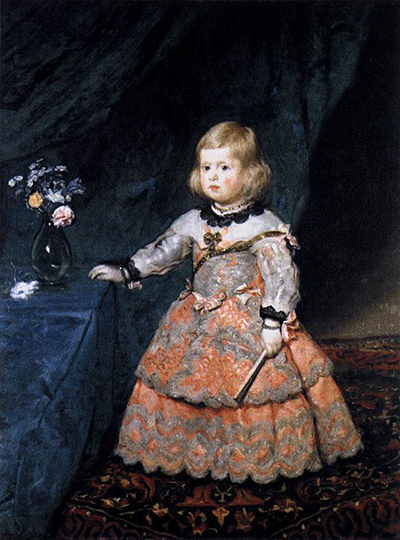
A few white flowers rise beside the little girl in Diego Velázquez’s portrait of Infanta Margarita. The vase beneath them is so dark that its rounded shape almost disappears into the curtain. A spot of white on its front brings the glass forward. Beside it, Margarita reaches out to the edge of a table draped in blue-green cloth. The angle of her sleeve makes it possible to follow that movement from shoulder to fingertips. The Kunsthistorisches Museum in Vienna catalogues the painting as Infanta Margarita (1651–1673) in a Pink Gown, dated 1654. The canvas measures 128 × 99.6 cm and belongs to the Picture Gallery, inventory 321. [1] [2]
At a Glance
- CollectionKunsthistorisches Museum, GG 321 [1]
- Painted1654 [1]
- GiftDocumented at the imperial court in October 1654 [1]
The early Vienna portrait in context
Infanta Margarita in a Pink Gown
1654 [1]The Vienna museum documents the portrait at the imperial court in October.
Contents
- The vase and the table edge
- Where Margarita stands
- A portrait sent to the imperial court
- The Alba version and the copy at Schleißheim
- An eighteenth-century echo
- Margarita in blue and in Las Meninas
The vase and the table edge
The vase is a small still life tucked against the left edge of a court portrait. The large pink bloom hangs low enough to conceal part of the vessel’s neck, while smaller, paler flowers sit higher against the curtain. Look at the widening gap between the leaves and blossoms as the bouquet rises. At the top you can see several little patches of dark between the flower heads. At the base, a narrow streak inside the glass and the light along the curved rim are almost enough to show where the vessel ends. A fallen pale flower on the cloth makes a separate point of light below the bunch. Its position just in front of the vase helps give the surface under both objects some depth. [1] [2]
The cloth changes direction just below Margarita’s right hand. On top of the table it reads as a subdued stretch of colour. Where it drops, long bands of blue-green light turn it into a hanging fabric. The fold that runs diagonally towards the bottom of the canvas helps define the near corner without exposing the structure of the table. The vase sits to the left of that corner and the fingers come down just to its right. Velázquez describes two different kinds of contact with the same surface. The vessel’s rounded base settles into a patch of shadow, while the child’s fingertips curl gently over the edge. [1] [2]
Julián Gállego identified the smaller flowers as daisies in the Prado’s 1990 exhibition catalogue and entertained a symbolic reading of the bouquet. The Kunsthistorisches Museum suggests that the daisies, or marguerites, may play on Margarita’s name. That possibility gives the flowers an additional connection to the sitter. The stems and loose petals have a visible role in the composition too. Their irregular outlines carry the eye upwards through an area that otherwise has only the broad movements of the curtain. The orange and pink blooms bring some of the warmth of Margarita’s dress to the other side of her outstretched hand. [1] [2]
Where Margarita stands
Margarita’s head turns only a little. Her gaze meets ours, and a softly painted edge at the cheek lets a few strands of fair hair catch against it. The narrow collar below the chin gives the head a dark base. There is a similar change at each wrist, where the dark trimming of the sleeves sets off the small area of visible skin. On the right of the painting, her left hand closes around a folded fan. It drops across the skirt at an angle. That narrow diagonal is easy to pick out even where the embroidery beneath it is busiest. [2] [3]
Gállego describes a salmon-coloured dress embroidered in silver, with black lace at the neck and wrists. The effect of the fabric changes as the eye travels down. In the sleeve, highlights gather across the bend of the arm and run along the edge of individual creases. Across the bodice, a chain passes obliquely beneath the ornament at the chest. The skirt spreads out in two wide tiers. Its scalloped lower edge is distinct against the dark carpet, while brighter flecks within the patterned bands sometimes merge with one another. Viewed from a distance, those uneven accents describe the sweep of the skirt. Viewed close up, the marks break up each band into patches of colour and light. [2]
The feet are hidden beneath the hem. A slight change of level in the carpet near the lower edge gives the figure a place to stand, while the carpet pattern continues beyond the outline of her dress. In her study of the portrait, Kunsthistorisches Museum curator Gudrun Swoboda identifies the raised surface as an estrado, a low, carpeted wooden or cork platform used at the Spanish court to provide seating space for queens and infantas. The platform brings a domestic court furnishing into a formal likeness. Its shallow edge and the height of the tabletop give the viewer two different ways to gauge how small Margarita is. [1] [3]
The curtain behind her is easy to overlook, because so little of it catches the light. Its folds slope across the upper left before descending more steeply behind her head. Visible cloth at three levels surrounds her, from the heavy background curtain through the bright corner of the tabletop to the carpet beneath her. Each moves in a different direction. The girl looks almost motionless in their midst, yet the angled arms and the different tasks of her hands keep the stance from settling into symmetry. Swoboda places that formal presentation in a court tradition with Burgundian roots, in which even very young children were shown with the bearing expected of their rank. [1] [2] [3]
A portrait sent to the imperial court
Margarita Teresa was born on 12 July 1651, the first child of Philip IV and his second wife, Mariana of Austria. The 1990 Prado catalogue records a longstanding disagreement over whether to date the pink-gown portrait to 1653 or 1654. It also traces the identification of Margarita, who was once confused with her older half-sister María Teresa. Gállego records that William Stirling proposed Margarita’s name in 1848 and that Carl Justi subsequently upheld the identification against advocates for María Teresa. The Vienna object record now identifies Margarita and dates the painting to 1654. [1] [2]
Margarita’s maternal grandfather, Emperor Ferdinand III, wanted portraits of her. According to the Vienna museum, the Spanish court sent likenesses at intervals of two or three years, and this was the first. The museum’s provenance records the painting at the imperial court from October 1654 as a gift from Philip IV, and in the imperial gallery in Vienna by 1837. The documented gift gives this particular likeness a place within the exchanges between the two Habsburg courts. A portrait could make a child’s appearance familiar at a distance and present her in a form immediately recognisable to relatives who shared the conventions of court portraiture. Margarita went on to marry Leopold I in 1666. [1] [3] [4]
The Alba version and the copy at Schleißheim
The Casa de Alba owns another Infanta Margarita, inventory P.91 at the Palacio de Liria in Madrid. The 1990 Prado catalogue lists it separately as no. 75, gives its dimensions as 115 × 91 cm and records it in the family collection by 1796. The stance, table, fan and patterned costume all recur. The table in the Alba version is empty, leaving the outstretched arm as the most prominent diagonal in that part of the picture. In the larger Vienna painting the flower heads occupy some of that space, and the vase gives the table a second purpose in the composition. [2] [5] [6]
The order in which the two versions were painted has been debated. The Palacio de Liria lists its painting under Velázquez and recounts Francisco Javier Sánchez Cantón’s proposal that it was the portrait made from life, followed by a more spacious treatment for Vienna with flowers added. Gállego records several views, including an autograph repetition and a copy by Velázquez’s son-in-law Juan Bautista Martínez del Mazo. Swoboda describes the Alba picture as probably a version by Mazo, whose work in Velázquez’s studio included copying his paintings, and credits the two painters in her caption. The differences visible from one canvas to the next help identify the objects. Judgements of authorship and sequence involve the wider evidence reviewed by those scholars. [3] [5] [6]
Gállego also mentions a flower-vase version at the New Palace at Schleißheim and points out that it was once reproduced as though it were the Alba portrait. The Bayerische Staatsgemäldesammlungen catalogue its canvas there as a copy after Velázquez, inventory 4214, with provenance from Schloss Dachau. A vase in a reproduction can therefore help distinguish the Madrid painting from the two others, while the collection and inventory establish which specific canvas is in view. [5] [7]
An eighteenth-century echo
Over a century later, Anton Raphael Mengs used a closely related pose for his portrait of Maria Teresa of Bourbon–Two Sicilies, Princess of Naples, now in Vienna. Her hand comes down on a support to the viewer’s left, and the spread of her decorated gown against a dark curtain gives her small figure much of its volume. One shoe emerges at the hem, a detail that makes the stance easier to read as a step. Swoboda identifies an echo of Velázquez’s brushwork in Mengs’s embroidery and lace, and proposes that the painter may have seen the version in the Alba collection while working for the family. His correspondence attests to his admiration for a portrait of Margarita that he saw in Madrid. The particular canvas described in those letters remains unidentified. [3]
Margarita in blue and in Las Meninas
In the later Infanta Margarita Teresa in a Blue Dress, also in Vienna, Margarita’s hand is again near a table at the viewer’s left. In the 1659 painting the spread of the blue and silver dress dominates the space from the waist down. The muff held at the other side adds a soft mass where the closed fan had placed a single slim line in the earlier likeness. Silver accents appear across the larger surface as flecks and clusters, resolving into patterns as the viewer steps away. The museum identifies an eight-year-old in the blue gown and records that the work went to Leopold I together with the portrait of her younger half-brother, Infante Felipe Próspero. The two sets of provenance details place the pink and blue likenesses in different moments of the exchange with Vienna. [1] [2] [4]
Between those pictures Velázquez painted Las Meninas in 1656, now at the Prado. Margarita’s pale dress again makes her easy to locate, but here a kneeling attendant offers her a small vessel and another bends towards her from the opposite side. An exchange of looks or gestures can carry the viewer across the room. In the pink-gown portrait, the eye has a shorter course to take. The vase stands near the end of the extended arm, and Margarita’s resting hand holds that part of the composition in place. At the opposite side of her dress, the fan offers another line for the eye before it comes back to her face. The still life and the small gestures give a solitary figure enough incident to hold a viewer’s attention even when the portrait is seen from across a room. [1] [2] [8]
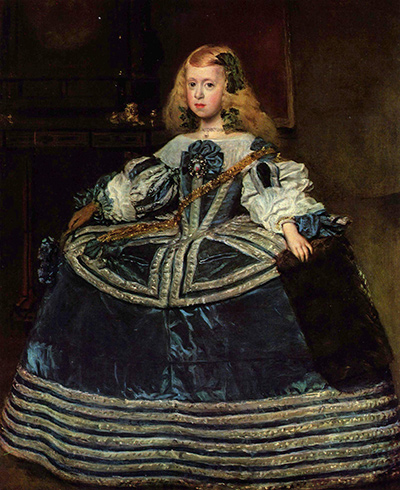
Infanta Margarita in a Blue Dress. The later Vienna portrait makes the blue dress and its broad silhouette the principal shapes below the small face. View Infanta Margarita Teresa in a Blue Dress.
Artworks directory
Frequently Asked Questions
Kunsthistorisches Museum, GG 321 [1]
1654 [1]
The vase is a small still life tucked against the left edge of a court portrait. The large pink bloom hangs low enough to conceal part of the vessel’s neck, while smaller, paler flowers sit higher against the curtain. Look at the widening gap between the leaves and blossoms as the bouquet rises. [1] [2]
Discussion
Look again at the images and ideas explored in Infanta Margarita in a Pink Gown. These editorial prompts invite your observations.
Reader Insights
Where do you first see the dark vase against the curtain?
What changes in the way the table is used when you compare the pink- and blue-dress portraits?
Join the Conversation
Share a detail, comparison or question about Infanta Margarita in a Pink Gown below.
References
- Kunsthistorisches Museum Wien, Infanta Margarita (1651–1673) in a Pink Gown, Diego Rodríguez de Silva y Velázquez, 1654, canvas, Gemäldegalerie 321. English. View source.
- Julián Gállego, La infanta Margarita, catalogue no. 74, in Antonio Domínguez Ortiz, Alfonso E. Pérez Sánchez and Julián Gállego, Velázquez, Museo del Prado and Ministerio de Cultura, 1990, pp. 430–433. Spanish. View source.
- Gudrun Swoboda, “Mengs and Velázquez. The Princess of Naples”, Point of View 29, Kunsthistorisches Museum Wien, 2025, pp. 4–11, especially pp. 6–7, figs. 3–5. English. View source.
- Kunsthistorisches Museum Wien, Infanta Margarita in a Blue Dress, Diego Rodríguez de Silva y Velázquez, 1659, Gemäldegalerie 2130. English. View source.
- Julián Gállego, La infanta Margarita, catalogue no. 75, in Antonio Domínguez Ortiz, Alfonso E. Pérez Sánchez and Julián Gállego, Velázquez, Museo del Prado and Ministerio de Cultura, 1990, pp. 434–435. Spanish. View source.
- Palacio de Liria, Casa de Alba, La Infanta Margarita, oil on canvas, P.91. Spanish. View source.
- Bayerische Staatsgemäldesammlungen, Infantin Margarita von Spanien, copy after Diego Rodríguez de Silva y Velázquez, Staatsgalerie im Neuen Schloss Schleißheim, inventory 4214. German. View source.
- Museo Nacional del Prado, El Museo del Prado en Palencia, entry 2, Las Meninas or The Family of Philip IV, P-1174, 1656. Spanish and English. View source.







