


 by Tom Gurney
Tom Gurney BSc (Hons) is an art history expert with over 20 years experience
Published on June 19, 2020 / Updated on October 14, 2023
Email: tomgurney1@gmail.com / Phone: +44 7429 011000
View of the Grotto Façade at the Villa Medici: Introduction
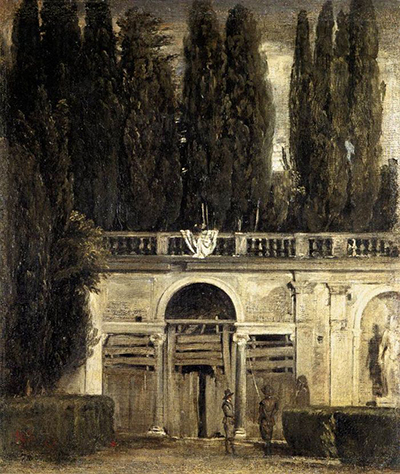
The upper half of Diego Velázquez’s view of the Villa Medici is almost full of trees. Beneath them, a pale balustrade runs across a garden wall until it meets a fold of white cloth. Directly below, boards cross the entrance to a grotto. Their irregular edges are easy to pick out against the dark opening. Velázquez painted this corner of the gardens in oil on canvas, on a surface measuring 48.5 × 43 cm in the description published by Spain’s official gazette. The Museo Nacional del Prado in Madrid holds the painting as P001210 under the title View of the Gardens of the Villa Medici, Rome (Vista del jardín de la Villa Medici en Roma). A Prado exhibition panel dates the picture to about 1630. The boards have led some scholars to place the work almost twenty years later. [1] [2] [3]
At a Glance
- CollectionMuseo Nacional del Prado, P001210 [1] [2]
- Usually datedAround 1630 [1] [2]
- MediumOil on canvas [2] [3]
Dating and recording the Villa Medici views
The boarded grotto
Around 1630 [2]The Prado’s exhibition panel favours a date around the first Italian journey.
Four small landscapes in the royal payment
1634 [2]The account does not identify either Villa Medici view individually.
Both views recorded at the Alcázar
1666 [2]The inventory establishes royal ownership of the companion paintings.
Recorded at the Buen Retiro
1772 [2]The royal records follow the work to a different palace after the Alcázar fire.
Contents
- The arch and the boards
- Light on the stone and cloth
- Why the boarded entrance matters for dating
- What the paint layers add
- From the royal collection to the Prado
The arch and the boards
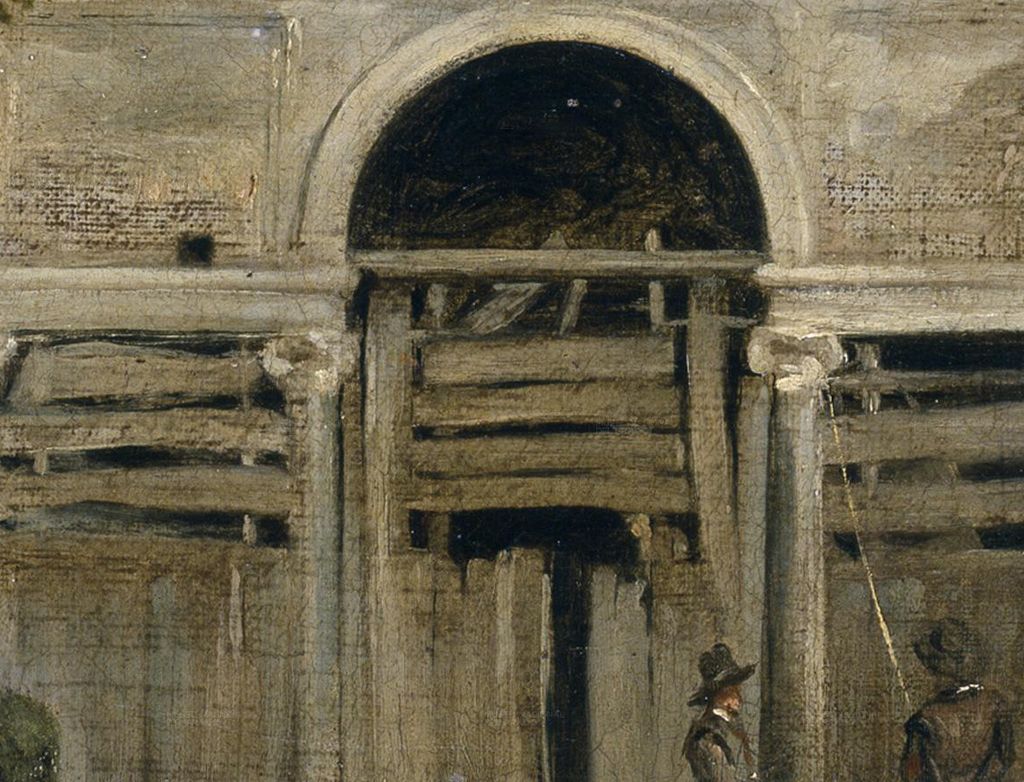
The main opening is nearly central, with lower, flat-topped openings on either side. The curve above the middle is easy to follow, even where the stone colour changes. Two thin supports come down from the spring of the arch towards the path. Across them run the edges of the lintels and, a little below, the ends of the boards that partially fill the openings. A dark space still shows above the central boarding, and further dark gaps appear between the planks. One of the deepest shadows is a narrow vertical at ground level. The repeated lines make it possible to tell where the ordered stonework ends and the rough boarding begins. [2]
This combination of a high arch and lower rectangular openings is called a serliana. Julián Gállego’s Prado catalogue entry illustrates the term with an architectural plate from Sebastiano Serlio’s treatise, published in Venice in 1537. In the diagram the three openings are legible at a glance. In Velázquez’s painting the left-hand edge of the structure comes up against a mass of foliage, and beyond the arch to the right a further recess carries the wall out of the frame. The pale masonry appears in patches. A sharp edge at the crown of the arch gives way to softer marks in the wall around it. The form described by Serlio stays readable even as the edges change with shade, vegetation and the rough timber. [2]
The Spanish term entrada a la gruta means the entrance to the grotto, the arched front we see from the garden. The grotto itself was an artificial chamber beyond it. In accounts of the villa’s architecture, loggia can name the structure at the garden grotto. It can also refer to the loggia on the main villa building, a separate feature. Edmund P. Pillsbury, discussing the redevelopment of the villa after Ferdinando de’ Medici acquired it in 1576, records Glenn M. Andres’s identification of a drawing by Bartolomeo Ammannati as a study for the grotto loggia below the wooded part of the garden. The drawing helps place the feature within the much larger programme of garden building. The planks that fill the seventeenth-century painter’s view belong to a different moment in the site’s history. [2] [3] [4]
Light on the stone and cloth
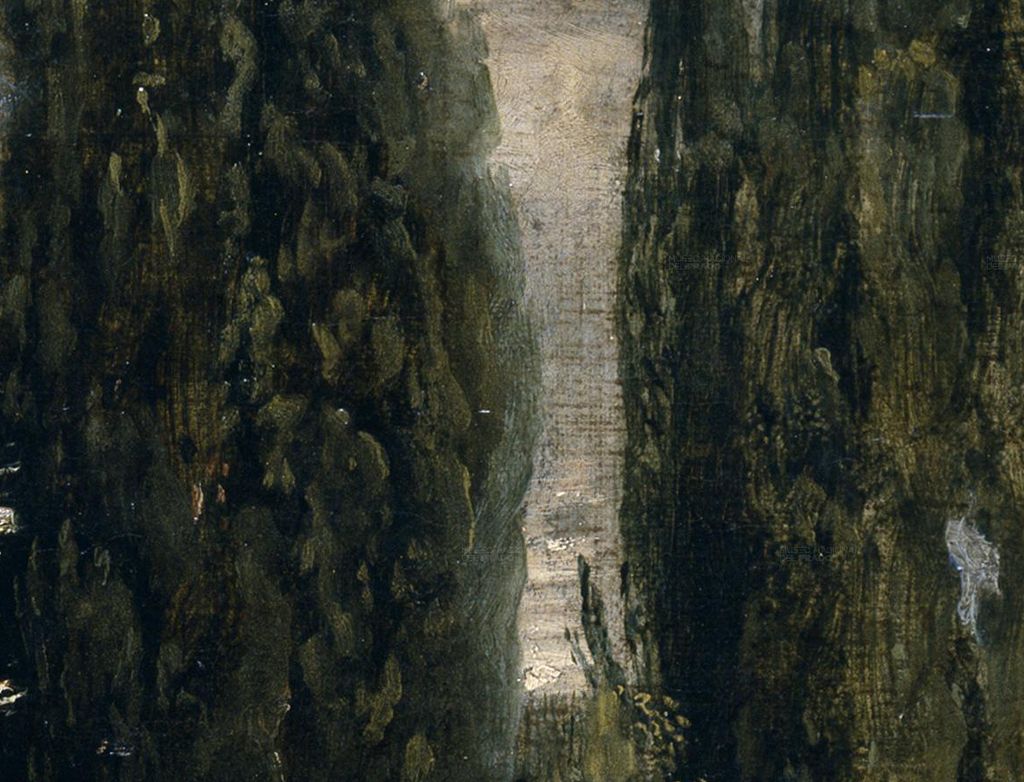
The cypresses rise behind the balustrade and occupy much of the tall canvas. Their tops reach the upper edge and seem to continue above it. In the narrow stretches of sky, one especially pale passage between the trees on the right makes the ragged shapes of the branches easier to see. The cypress forms overlap and bunch together at the left, with a few lighter touches breaking up the dark surface. Lower down, a similar change from dark to light happens when a leafy mass meets the masonry. Some stretches of wall are broad enough to catch the eye as pale areas of colour. Other parts register as thin strokes along an edge or small lights on the uprights beneath the rail. [2]
The cloth hangs over the upper rail near the centre. Its short pale strokes fan out at the top, then gather into pleats and hang below the rhythm of the balusters. Immediately behind it a small form rises into the dark of the trees. Gállego reads this as someone handling linen and suggests that the person may be a servant. On the path below, two small figures stand near the right-hand support of the arch. Their thin marks and touches of light are clearest where they cross the darker boards and the low hedge. Farther to the right a more upright, pale figure stands within the shape of a niche, where Gállego identifies a statue. The low clipped planting and the human figures make the height of the wall easier to judge. The clothes and the subject of any conversation are harder to determine in the few strokes Velázquez gives them. [2]
The painting has also been called La tarde, or The Afternoon. The name suits a picture in which light and shade seem to divide the garden for a short while. The slab under the rail looks bright against the woods, though the half-circle under the arch remains dark. The lighter stretch on the path brings the two blocks of hedge at the bottom into view. The face of the wall then appears to have several depths within a small area, from the projecting rims of the stonework to the gaps in the boards. The title gives a way of thinking about that effect, while the exact hour remains unknown. [2] [3]
Why the boarded entrance matters for dating
Francisco Pacheco, Velázquez’s teacher and father-in-law, records that the artist lived at the Villa Medici for over two months on his first Italian journey. Velázquez sought room at the villa through the Spanish ambassador, the Count of Monterrey. Pacheco explains the appeal of the high, airy situation in summer and of the ancient statues available to copy. It is a good account of how Velázquez obtained the sustained access that might have produced such a familiar view. Pacheco describes the stay without listing this painting among its results. Gállego also pointed to similarities in the handling of the landscape in Joseph’s Bloody Coat, painted on the first trip. Changing from a small landscape within a biblical subject to a canvas devoted to a garden would still allow Velázquez to use brushwork developed at the same period. [2] [5]
The freedom of the brushwork once led critics in the opposite direction. Gállego notes that the Prado’s general catalogue began to favour a second-visit date in 1933, with qualifications, and expressed greater reserve by 1985. In 1981 Enriqueta Harris gave the later date a more specific basis. Drawing on Andres’s research into work at the villa, she brought the boards into the discussion of two repair campaigns. The earlier campaign took place in 1626, well before Velázquez’s first Roman stay. The later one took place in 1648–49, around the time of Cardinal Carlo de’ Medici’s stay. Accounts from February and March 1649 describe masonry and carpentry connected with the grotto and other nearby chambers. They include repairs to walls and to an entrance, provision of shelving for wine and support for a roof in poor condition. [2] [6]
The relevance of the work depends on matching a name in the accounts to an opening in the garden. Gállego explains that Andres discusses several grotto spaces, and reports Harris’s proposal to connect the repairs with the one Velázquez painted. The dated entries establish that repair work took place. The suggestion that this particular entrance was still boarded up when the painter arrived in Rome in May 1649 requires a further inference about how long the work lasted. The published discussion leaves the installation and removal dates of the painted boards unknown. If the match is correct, the boards could place this view within Velázquez’s second Roman stay, from May 1649 to November 1650. The detail is unusually tangible for a dating argument. Its force still depends on matching the painted site to the records and on the length of the closure. [2] [6]
Annotated Details from The Villa Medici Grotto
Choose a numbered detail to see a closer view.
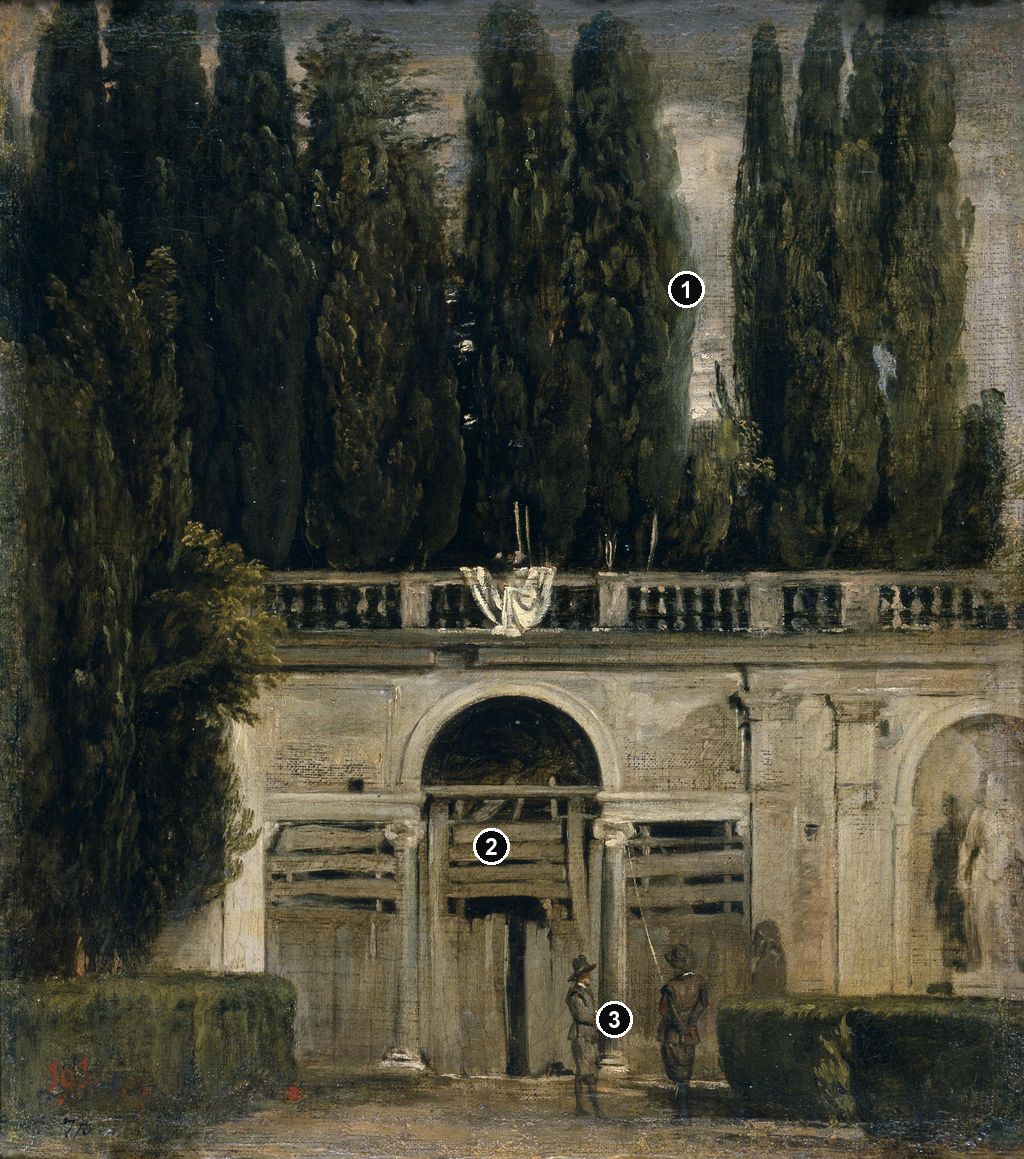
Details from THE VILLA MEDICI GROTTO
The light between the trees
A narrow band of light separates two dark ranks of trees above the stone balustrade. [2]
The boards across the opening
Horizontal slats cross the pale masonry and continue across much of the central opening. The upper recess remains dark. [2]
Two figures at the foot of the wall
Two small figures stand close to the base of the arch. The broad expanse of the wall above helps establish their scale. [2]
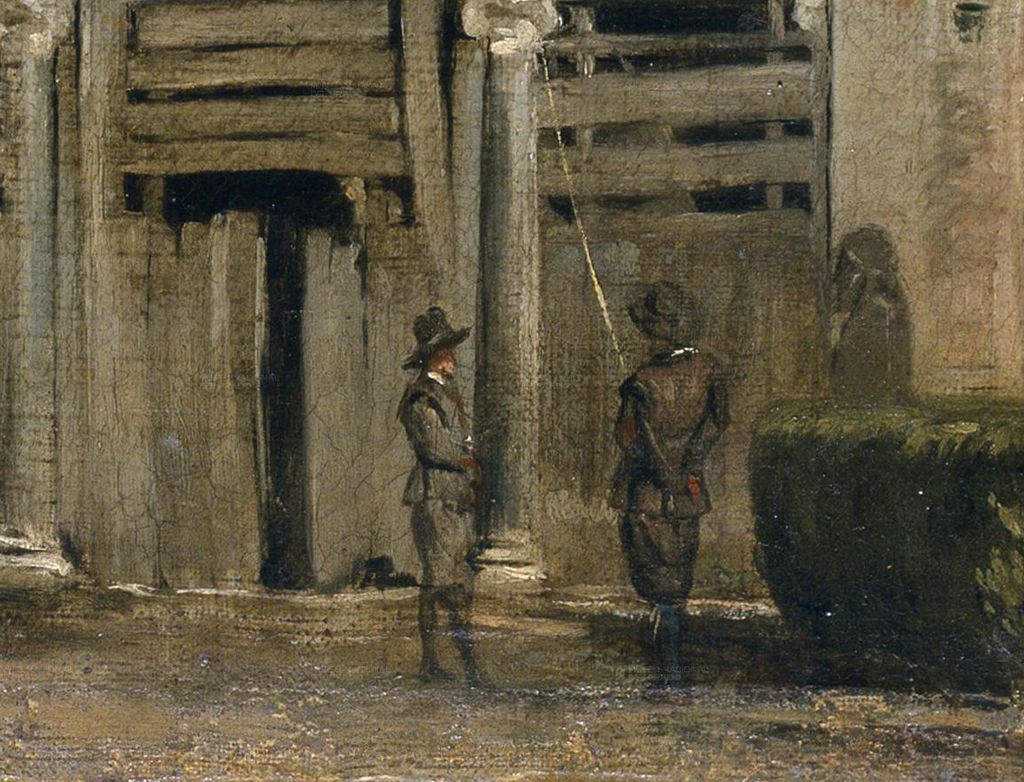
Prado P001210 via Wikimedia Commons, public domain. Numbered labels and detail crops added.
What the paint layers add
The canvas itself offers evidence beyond what a viewer can see in the garden scene. Prado researchers Maite Jover de Celis and Maria Dolores Gayo compared samples from both Villa Medici views and the large Joseph’s Bloody Coat at El Escorial. All three had a brown clay-based preparation on the canvas. In the two small views a pale grey layer made with lead white and charcoal black was applied over it. A layer of this kind gives the painter a different starting tone for judging how dark foliage and bright stone will read together. The researchers distinguish the brown preparation, of a kind also found in Italian painting of the period, from the decision to add a lighter layer. They find the combination consistent with some of Velázquez’s preparations made shortly before his first journey and judge an early date more plausible on the evidence available. [7]
The two dating arguments work at different levels. The study of the grounds tests the picture against what is known of Velázquez’s materials over his career. The repair proposal depends on how closely one feature of the painting matches an episode in the villa’s history. The technical study identifies both small canvases in its sampling notes, although the cross-section shown in the publication comes from the companion work. How much of the work took place outdoors and how many sittings it took remain open. Gállego treats the views as works painted from direct observation, and the broken light and detailed placement of the boards show how closely Velázquez attended to this particular corner of the garden. [2] [7]
From the royal collection to the Prado
A record of payment in 1634 lists four small landscapes among the pictures that Jerónimo de Villanueva bought from Velázquez for Philip IV. If the grotto view was among them, the first Italian journey would be the viable date. Gállego leaves the identification open. The description of the four works gives no individual views or landmarks by which to recognise the grotto. The 1990 catalogue traces the boarded picture itself through Alcázar inventories of 1666, 1686 and 1700. It records that the painting survived the fire of 1734 and was listed at the Buen Retiro in 1772, 1789 and 1794, before passing through the new Royal Palace into the Prado in 1819. By the 1666 inventory the Crown already had both garden paintings. [2] [8]
In the companion View of the Villa Medici in Rome, P001211, the arch stands open to daylight. Ariadne’s reclining figure runs across the base of the opening and the eye can travel over it to the trees beyond. Its arch belongs to a distinct garden structure. In the grotto view, the dark half-circle over the planks and the narrow gap at path level give the smallest glimpses into the interior. The view continues upwards, beyond the edge of the stone rail, into the cypresses. Gállego took the two works together as a study in how the same architectural form can change its appearance. The comparison begins with ordinary details that a person standing in the garden could encounter, down to the way a board leaves a black slit and a cloth interrupts a white rail. [2] [8]
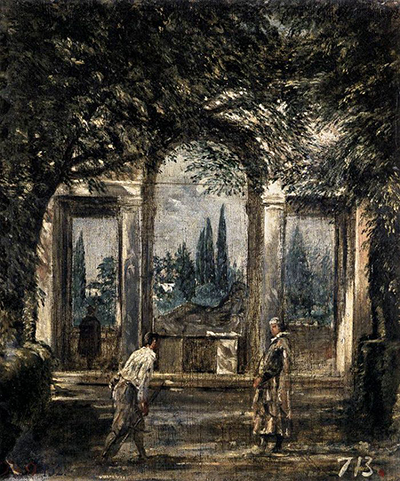
View of the Villa Medici Garden (arched loggia with two foreground figures). In the companion painting, daylight reaches through a different opening across the reclining statue. View View of the Villa Medici in Rome.
Artworks directory
Frequently Asked Questions
The main opening is nearly central, with lower, flat-topped openings on either side. The curve above the middle is easy to follow, even where the stone colour changes. Two thin supports come down from the spring of the arch towards the path. [2]
Discussion
Look again at the images and ideas explored in View of the Grotto Façade at the Villa Medici. These editorial prompts invite your observations.
Reader Insights
Where do the painted marks for boards give way to those for stone?
What would establish when the particular boards in the painting were put up?
Join the Conversation
Share a detail, comparison or question about View of the Grotto Façade at the Villa Medici below.
References
- Museo Nacional del Prado, View of the Gardens of the Villa Medici, Rome, P001210, English collection record. Museo Nacional del Prado, El Museo del Prado en la República Dominicana, exhibition panel for both Villa Medici paintings, no. 1210 at left, c. 1630, Spanish. View source 1. View source 2.
- Julián Gállego, “Vista del jardín de la ‘Villa Medicis’, en Roma,” in Velázquez, Museo del Prado and Ministerio de Cultura, 1990, cat. 64, pp. 374–379, P001210, Spanish. View source.
- Boletín Oficial del Estado, Una mirada laboralista a la pintura del Prado, 2020, pp. 209–210, entry for the grotto view, Spanish. View source.
- Edmund P. Pillsbury, “Ammannati and the Villa Medici in Rome: An Unknown Letter,” Mitteilungen des Kunsthistorischen Institutes in Florenz 19, 1975, pp. 303–306, especially p. 305 and note 11. View source.
- Francisco Pacheco, Arte de la pintura, Seville, 1649, pp. 103–105, “El primer viaje a Italia,” Spanish transcription by Santiago Arroyo Esteban. View source.
- Enriqueta Harris, “Velázquez and the Villa Medici,” The Burlington Magazine 123, no. 942, September 1981, pp. 537–541, publisher’s excerpt. Gállego discusses the repair evidence in [2], pp. 374–377. View source.
- Maite Jover de Celis and Maria Dolores Gayo, “Velázquez and His Choice of Preparatory Layers: Different Place, Different Colour?” in Ground Layers in European Painting 1550–1750, CATS Proceedings V, Archetype Publications, 2020, pp. 44–54, especially pp. 47–48 and notes 23–25. View source.
- Julián Gállego, “Vista del jardín de la ‘Villa Medicis’, en Roma,” in Velázquez, Museo del Prado and Ministerio de Cultura, 1990, cat. 65, pp. 380–383, P001211, Spanish. View source.








