



 by Tom Gurney
Tom Gurney BSc (Hons) is an art history expert with over 20 years experience
Published on June 19, 2020 / Updated on October 14, 2023
Email: tomgurney1@gmail.com / Phone: +44 7429 011000
Diego Velázquez Quotes: Introduction
In a letter to the painter Diego Valentín Díaz, Diego Velázquez said he had come back to Madrid ‘tired from travelling by night and working by day’. He wrote about the royal family's return, judged a bullfight in the Plaza Mayor rather dull without the mounted gentlemen, and asked Díaz to pass on his greetings to someone he had been too busy to see. This is Velázquez writing to a fellow painter in July 1660. The celebrated line about preferring to be first at painting common things comes to us through quite different evidence. Its early versions tell us as much about the writers who recorded it as about Velázquez himself. [1] [2] [3]
At a Glance
- Signed letterTo Diego Valentín Díaz, 3 July 1660 [1]
- Palace recordOath as aposentador, 8 March 1652 [4]
- Early biographyAntonio Palomino, 1724 [2] [5]
Contents
- Velázquez in his own words
- A father's agreement and a king's instruction
- Pacheco on the early kitchen pictures
- The saying about being first at painting common things
- Raphael and Titian in Boschini's Venetian verse
- What later viewers said about Las Meninas
- Velázquez puts his name to a payment
- A sworn judgment with Vicente Carducho
- What Velázquez wrote about Pietro da Cortona
Velázquez in his own words
The letter to Díaz is dated at Madrid on 3 July 1660 and signed ‘Diego de Silua Velásquez’. The painter says he reached the capital at dawn on 26 June, ‘cansado de caminar de noche y trabajar de día’. He was in good health, he assured his correspondent, and had found his household well too. The journey mentioned in the letter belongs to the period of his service as palace aposentador, an office whose grant and oath were separately recorded in 1652. Antonio Palomino's life of Velázquez places the painter at the Franco-Spanish frontier on royal service for the meeting connected with the marriage of María Teresa and Louis XIV. The letter brings that journey down to the scale of one tired traveller. [1] [4] [5]
The account of Madrid makes room for small judgements and the familiar obligations of friendship. Velázquez places the king's arrival on the same day as his own. He reports that the queen met the king at the Casa de Campo and that they went on to Atocha. The account then turns to Wednesday's bullfight. The absence of mounted gentlemen struck him as making for a poor show and reminded him of the festivities in Valladolid, where Díaz lived. Velázquez asks after Díaz and Doña María and explains why he missed seeing their mutual acquaintance Tomás de Peña. The formal closing, in which the writer kisses his correspondent's hand, belongs to the conventions of the letter. The opinion about the bullfight is more particular to the writer and the occasion. [1]
In the record of the 1617 painters' examination in Seville, the notary Pedro del Carpio reports that Velázquez asked the examiners for a certificate and licence to practise, and swore to observe the guild's ordinances. The record attributes those acts to the young painter in the third person. It records the examiners' satisfaction with what he made in their presence and how he answered their questions, but gives us the judgement of the examiners in place of the young painter's answers. The licence allowed him to set up a public shop and take on assistants and apprentices. [6]
A father's agreement and a king's instruction
The apprenticeship contract involves the same young painter, but its initial ‘I’ is Juan Rodríguez, his father. The long list of obligations makes the household as visible as the workshop. Francisco Pacheco was to teach the boy his art fully and provide food, a bed and treatment for short illnesses. The father's obligations included the cost of care if an illness lasted longer than fifteen days. The promised suit of clothes at the end of the term was spelt out down to the shirts, hat and shoes. A record of another kind was made in 1618, when Andrés Miguel entered the marriage and nuptial blessing of Velázquez and Juana de Miranda, Pacheco's daughter, in the parish register of San Miguel. Its wording describes the ceremony in the officiant's voice. [7] [8]
The October 1623 court papers let us hear the official voice of Philip IV. In the order of 6 October, the king says he has had Velázquez received into his service and set his salary at twenty ducats a month. The first order left open whether payment for individual paintings would come in addition to the salary. Pedro de Hoff Huerta raised the point later that month. He had found a precedent for the opposite arrangement, under which the painter Bartolomé González had been paid a salary without separate payment for works. Separate payment gave the painter income tied to the works he delivered, alongside the regular pay attached to his office. On Hoff Huerta's submission of 28 October, the margin records the royal response ‘Está bien y he firmado’, meaning ‘Very well, I have signed it.’ The transcript identifies those words as written by the king. [9]
Pacheco also remembered the appointment. His later account emphasises the encouragement of the Count-Duke of Olivares and describes the salary, the payment for paintings and provision for a doctor and medicines together. The two accounts bring different things into view. Pacheco charts his son-in-law's reception at court, while Hoff Huerta's correspondence shows what had to be settled before a painter could be paid for his work. The biography of Velázquez follows the painter through the court career that began with these exchanges. [9] [10]
Pacheco on the early kitchen pictures
‘If they are painted as my son-in-law paints them’ is Francisco Pacheco's answer to the question of whether bodegones deserve esteem. In Arte de la pintura, published in 1649, he says that Velázquez's work on these pictures and on portraits led to ‘the true imitation of nature’, la verdadera imitación del natural. Pacheco's examples reach back to the ancient painter Peiraikos, who painted shops, food and other humble subjects. They also reach into his own practice. Pacheco recalls making a small painting with two figures from life, flowers and fruit in Madrid in 1625, encouraged by Velázquez's example. His argument allows a reader to see how one practitioner judged another's command of ordinary things. [11]
Look at the earthenware vessel in Old Woman Frying Eggs. Its dark rim and the pale egg white within it demand separate sorts of attention. The rim establishes the shape of a solid pot in the foreground. The egg catches light in a way that suggests a change of state, with parts of the white turning cloudy around the rounded yolks. That painted interval between clear and opaque gives the impression of something happening. Pacheco's account helps explain why such a passage could matter as much to a painter as the description of a face. Each requires a judgement about how light falls on a particular surface. [11] [12]

An Old Woman Cooking Eggs. The kitchen scene gives visual context to Pacheco’s account of Velázquez’s skill in the bodegón. View An Old Woman Cooking Eggs.
The saying about being first at painting common things
National Galleries Scotland's entry for the egg painting cautiously says that Velázquez is reported to have preferred to be the first painter of common objects rather than the second in higher things. An older version appears in Palomino's 1724 life of the artist, after a series of descriptions of early pictures with cookware, food and figures. According to Palomino, when people urged Velázquez to take up more serious subjects and emulate Raphael, the painter replied that he would prefer to be first in that rough manner than second in refinement. The Spanish terms grosería and delicadeza carry a judgement about finish and manner that is obscured when the English line turns wholly on the choice of things to paint. [2] [12]
There is an earlier parallel. In the seventh primor, or lesson, of Baltasar Gracián's El héroe, an unnamed painter deliberately takes up a bold manner. Titian, Raphael and others have reached renown ahead of him. When challenged about his departure from polished painting, he prefers first place in his rough manner to second place in refinement. The example comes amid advice on finding a field in which to excel. Palomino assigns a closely matching reply to Velázquez and makes it part of the story of his kitchen scenes. The similarity gives the saying an early literary history, while leaving open whether Velázquez ever made such a reply. [2] [3]
Raphael and Titian in Boschini's Venetian verse
In La carta del navegar pitoresco, printed in Venice in 1660, Marco Boschini stages an exchange in Rome. Salvator Rosa asks Velázquez what he thinks of Raphael. In the poem Velázquez says he does not care for Raphael, and Rosa replies that they give Raphael the crown. Boschini gives Velázquez the last word on the comparison, ‘Tician xè quel, che porta la bandiera’, or ‘Titian is the one who carries the banner.’ The Venetian wording belongs to Boschini's verse dialogue. His subject is the distinction of Venetian painting, and the approval of a foreign painter of Velázquez's standing serves that purpose. [13]
There is a painted point of comparison in The Spinners. Beyond the figures working at the front, a tapestry shows the abduction of Europa, drawing on the design of Titian's painting that Rubens also copied. Titian's importance is visible in the insistent shape of the bull and the figure on its back, at the far end of a room full of people making and handling textiles. The design has changed scale and medium within the scene. Where Boschini stages a contest for the crown, the painting shows how Velázquez could bring a Venetian composition into his own account of work and myth. [13] [14]
What later viewers said about Las Meninas
Palomino tells another story about a king asking a painter for his judgement. This time Charles II asks Luca Giordano what he thinks of Las Meninas. Giordano's reported answer is ‘la teología de la pintura’, ‘the theology of painting’. Palomino explains the analogy by the pre-eminence then accorded to theology among the branches of knowledge. His own admiration is apparent in the surrounding description. He notices the diminution of the windows, the light that comes from the left and the way the floor looks as though someone could walk over it. Small shifts in scale and illumination explain why the lit figure in the doorway feels so far away from the girls at the front. The grand phrase arrives after a description of a picture that persuades the eye of its depth. [15]
The painter and the biographer have distinct parts in the episode. The answer is assigned to Giordano and the explanation to Palomino, who was writing decades after Velázquez's death. Palomino even imagines what Velázquez could have said, had he been less modest, by borrowing a remark ascribed to Zeuxis about a depiction of Penelope. The ancient painter's boast is introduced as a literary comparison. Antonio Sánchez Jiménez's study of Palomino's writing shows how the biographer drew on conventions from the lives of painters and poets. In the account of Las Meninas, his references to Zeuxis and Giordano place the picture among works whose ability to convince the eye had become a subject of stories in its own right. [15] [16]
In 1855 the Scottish writer William Stirling turned to a more recent invention to describe the same effect. Velázquez, he wrote, seemed to have ‘anticipated the discovery of Daguerre’. Stirling singled out the way the group appeared to have come together by chance. Follow the break in the action in the foreground. An attendant offers a cup, the child looks away and the painter holds his brush poised in mid-air. Those gestures make sense individually, yet they seem to have been caught in the same instant. Palomino had stressed the illusion of being able to enter the room. Stirling's analogy with photography captures the impression of arriving at the room at a particular moment. [15] [17]
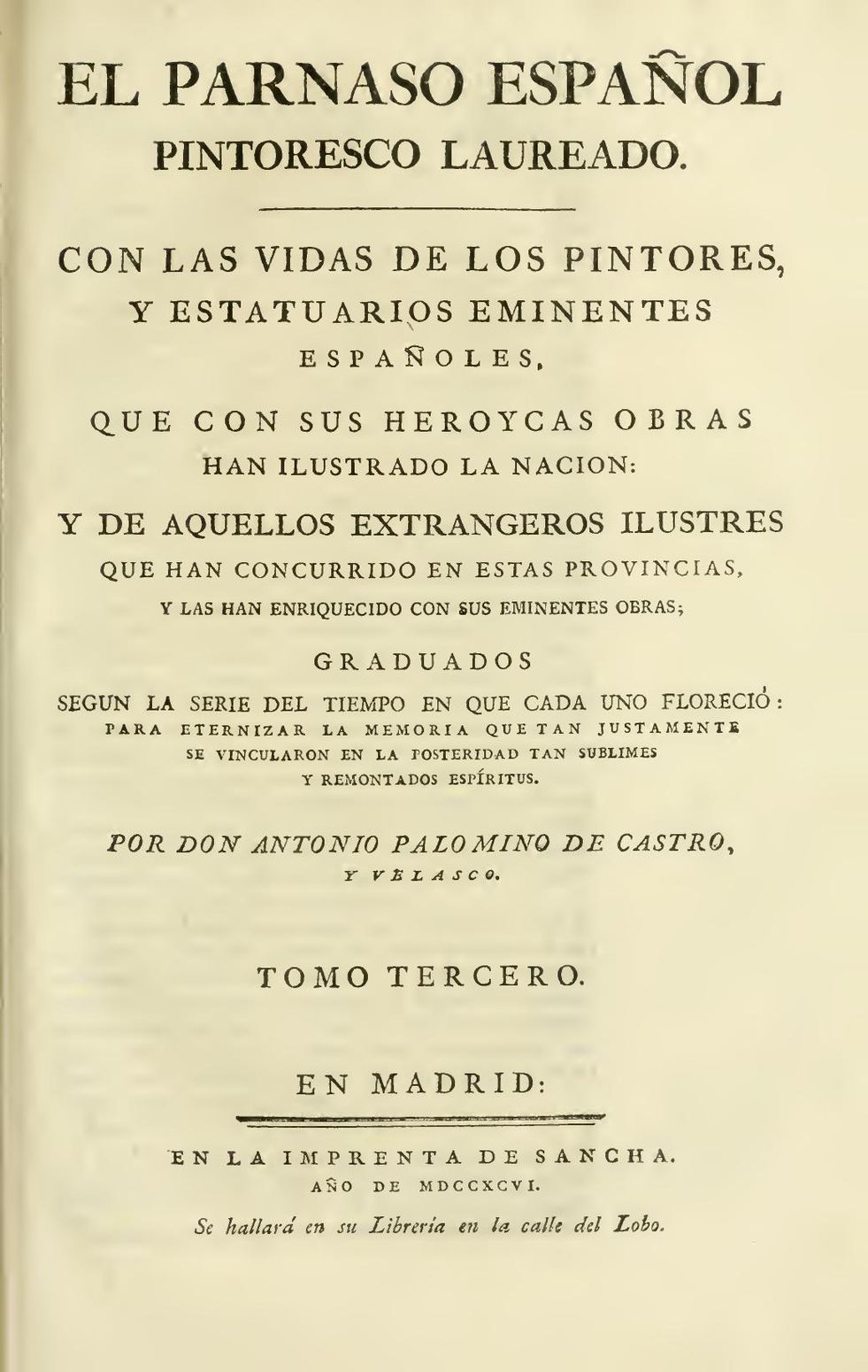
Title page of El Parnaso español pintoresco laureado, the third volume of Antonio Palomino’s El museo pictórico. This later edition transmits the biography in which Palomino records Giordano’s remark about Las Meninas. Image source. Public domain. Scan page rendered and resized for display.
Velázquez puts his name to a payment
‘Digo yo Diego Velasquez’, or ‘I, Diego Velázquez, declare’, opens a receipt dated in Madrid on 4 December 1624. Velázquez identifies himself as the king’s painter and acknowledges receiving 800 reales on account for three portraits. He names the sitters in order: the king, the Count of Olivares and a man he calls Garci Pérez. He names Juan de Genos as the payer and says the money reached him through a man from Burgos. On the other side of the sheet, a note issued on behalf of Doña Antonia de Ipeñarrieta tells the recipient to give the painter 800 reales and says the note can serve in the meantime until he issues a receipt. The two sides record the instruction and Velázquez’s acknowledgment that it had been carried out. [18]
In the same publication, José Ramón Mélida transcribes a further entry dated 6 December. It records 100 reales already given to the painter and explains that a receipt had been lost. That small detail shows why several statements about the same commission might be written on one piece of paper. Each person handling the money needed a record of what they had done. In Velázquez’s own entry, a cuenta means ‘on account’. It tells us how much he acknowledged receiving on that occasion and leaves open the total price. The three names establish whose portraits the payment concerned, while the receipt offers no sizes or descriptions by which a reader could match each one to a surviving canvas. [18]
A sworn judgment with Vicente Carducho
In Madrid on 1 October 1633 the court authorities ordered bailiffs to gather up portraits of the royal family from painters’ houses and from public places. The officials complained about poor likenesses and unsuitable dress. Two days later they appointed Vicente Carducho and Velázquez to examine the pictures and say under oath which could be sold and what should be done with the others. The assignment had consequences for the painters whose stock had been taken. A satisfactory image could circulate again. One judged deficient might have to be partly repainted before its owner could sell it. [19]
The first group contained thirty-seven pictures. The court record gives the two painters’ collective judgment that three large portraits and five small heads were good and ‘conforme al arte’, meaning ‘in keeping with the standards of the art’. Carducho initialled those that passed. In the remaining pictures in that group the faces were to be erased and made again to improve the likeness and bring them up to standard. The judges called for more extensive treatment of one large portrait of the prince. They also examined a second group of forty-seven pictures, in which just four received approval. Among the specific corrections was a change to the colour of the clothes in a portrait of the king wearing green breeches and stockings. [19]
The instructions about faces and clothing show how the painters’ assessment worked. A face could be judged insufficiently like its sitter and made again while other parts of the picture were retained. The colour of a garment could also be judged unsuitable for a public image of the monarch. After recording the decision, the clerk lists six owners he notified of a restriction on making, keeping or selling small portraits of the king and queen. The collective wording matters for quotation. The clerk records what the painters declared together, and distinguishes Carducho’s initials from the joint judgment. He gives no individual exchange from which to recover a remark by Velázquez alone. [19]
What Velázquez wrote about Pietro da Cortona
A letter from Rome to Virgilio Malvezzi, dated 22 November 1649, preserves a judgment that Velázquez did express in his own name. He tells Malvezzi that the individual paintings by Pietro da Cortona he had seen, where little invention was called for, had scarcely impressed him. He thought Cortona made much better use of invention in large compositions. Velázquez remembered knowing him on his first stay in Rome, before Cortona had painted the great ceiling in the Barberini palace. Seeing that work had changed his estimate. He now considered Cortona, as Malvezzi did, ‘abentajado a los demás’, or ‘ahead of the others’. The compliment grew out of a comparison between different kinds of work by the same painter. It also explains why a man who had once made little impression on Velázquez was now worth trying to secure for Spain. [20]
In the same letter Velázquez describes a visit to the Duke of Modena, who had shown him his paintings. The duke asked for the dimensions of a picture Velázquez was seeking for the king’s gallery so he could look for one to send. Velázquez suggests that Malvezzi, if in touch with the duke, might encourage him to give the king something good even if it differed from the requested size. ‘Que siendo bueno se aze lugar’ means roughly ‘if it is good, room can be made for it’. The dimensions were a real part of the search. Velázquez had supplied them and the duke had kept them. The suggestion shows what he was willing to reconsider for a painting he thought worth having. [20]
By 30 April 1650, Velázquez could tell Malvezzi that Cortona had declined to go to Spain even though the Spanish ambassador had spoken to him. Velázquez had already told the ambassador about the person Malvezzi had proposed, identified in the edition as Agostino Mitelli. The letter also says that Velázquez hoped to depart soon and was waiting to hear from the Count of Oñate before he could tell Malvezzi when. Read together, the letters give the November assessment and the April outcome of a particular negotiation. They preserve the painter’s judgment of what Cortona could do on a large scale, his effort to recruit him and the limits of what he could promise his correspondent while the business was still in hand. [20]
Artworks directory
Frequently Asked Questions
The letter to Díaz is dated at Madrid on 3 July 1660 and signed ‘Diego de Silua Velásquez’. The painter says he reached the capital at dawn on 26 June, ‘cansado de caminar de noche y trabajar de día’. He was in good health, he assured his correspondent, and had found his household well too. [1] [4] [5]
The apprenticeship contract involves the same young painter, but its initial ‘I’ is Juan Rodríguez, his father. The long list of obligations makes the household as visible as the workshop. Francisco Pacheco was to teach the boy his art fully and provide food, a bed and treatment for short illnesses. [7] [8]
‘If they are painted as my son-in-law paints them’ is Francisco Pacheco's answer to the question of whether bodegones deserve esteem. In Arte de la pintura , published in 1649, he says that Velázquez's work on these pictures and on portraits led to ‘the true imitation of nature’, la verdadera imitación del natural . Pacheco's examples reach back to the ancient painter Peiraikos, who painted shops, food and other humble subjects. [11]
National Galleries Scotland's entry for the egg painting cautiously says that Velázquez is reported to have preferred to be the first painter of common objects rather than the second in higher things. An older version appears in Palomino's 1724 life of the artist, after a series of descriptions of early pictures with cookware, food and figures. According to Palomino, when people urged Velázquez to take up more serious subjects and emulate Raphael, the painter replied that he would prefer to be first in that rough manner than second in refinement. [2] [12]
Discussion
Look again at the images and ideas explored in Diego Velázquez Quotes. These editorial prompts invite your observations.
Reader Insights
What does the letter to Díaz tell you about Velázquez’s work that an anecdote about his painting does not convey?
Compare how a remark reads in a signed letter and in a story told years later. What can each source establish?
Join the Conversation
Share a detail, comparison or question about Diego Velázquez Quotes below.
References
- Diego Velázquez, letter to Diego Valentín Díaz, Madrid, 3 July 1660 as dated in the closing line. Valladolid, Archivo Diocesano, archivo del Colegio de Niñas Huérfanas, Velázquez Digital, doc. 527, CV 424. Spanish transcription. View source.
- Antonio Palomino, life of Diego Velázquez in El Parnaso español pintoresco laureado, Madrid, 1724, section I, p. 323. Spanish transcription by Sara Ballester Baghdadi. View source.
- Baltasar Gracián, El héroe, ‘Primor VII. Excelencia de primero’, in Obras de Lorenzo Gracián, Antwerp, Gerónimo and Juan Baptista Verdussen, 1669. Spanish transcription, Biblioteca Virtual Miguel de Cervantes. View source.
- Archivo General del Palacio, oath of Velázquez as palace aposentador, 8 March 1652, Expedientes Personales, caja 1084, exp. 9, Velázquez Digital, doc. 385. Spanish transcription. View source.
- Antonio Palomino, life of Diego Velázquez in El Parnaso español pintoresco laureado, Madrid, 1724, section XII, pp. 351–352, on the journey to Irún. Spanish transcription by Sara Ballester Baghdadi. View source.
- Archivo Histórico Provincial de Sevilla, guild examination of Diego Velázquez, 14 March 1617, Protocolos Notariales, leg. 2484, fols. 85v–86v, Varia Velazqueña, vol. II, p. 217. Spanish transcription hosted by the Instituto Andaluz del Patrimonio Histórico. View source.
- Archivo Histórico Provincial de Sevilla, Velázquez's apprenticeship agreement with Francisco Pacheco, notary Pedro del Carpio, Oficio 4, September 1611. The Spanish transcription hosted by the Instituto Andaluz del Patrimonio Histórico records the original as lost. View source.
- Parish archive of San Miguel, Seville, marriage of Diego de Silva Velázquez and Juana de Miranda, 23 April 1618, marriage register 4, fol. 18, Varia Velazqueña, vol. II, p. 218. Spanish transcription hosted by the Instituto Andaluz del Patrimonio Histórico. View source.
- Archivo del Palacio Real de Madrid, royal appointment and remuneration papers, 6, 28 and 30 October 1623, Varia Velazqueña, vol. II, pp. 222–223. Spanish transcriptions hosted by the Instituto Andaluz del Patrimonio Histórico. View source.
- Francisco Pacheco, Arte de la pintura, Seville, Simón Faxardo, 1649, pp. 101–109, first part of the account of Velázquez's arrival at court. Spanish transcription by Santiago Arroyo Esteban. View source.
- Francisco Pacheco, Arte de la pintura, Seville, Simón Faxardo, 1649, book III, chapter VIII, p. 430, discussion of bodegones. Spanish, University of Seville copy, H Arte R.03.T.09. View source.
- National Galleries of Scotland, Diego Velázquez, An Old Woman Cooking Eggs, 1618, NG 2180, object record and gallery commentary. View source.
- Marco Boschini, La carta del navegar pitoresco, Venice, Per li Baba, 1660, ‘Vento primo’, p. 58, dialogue about Raphael and Titian. Venetian text reproduced in William Stirling's Velazquez and his Works, London, John W. Parker and Son, 1855, p. 162. View source.
- Museo Nacional del Prado, ‘Reencuentros. Parada V. Una Corte a nuestro encuentro’, section on Las hilanderas o la fábula de Aracne. Spanish. View source.
- Antonio Palomino, life of Diego Velázquez in El Parnaso español pintoresco laureado, Madrid, 1724, section VII, pp. 342–343. Spanish transcription by Sara Ballester Baghdadi. View source.
- Antonio Sánchez Jiménez, ‘Tradición retórica en las vidas de Antonio Palomino’, Cuadernos de Ilustración y Romanticismo 26, 2020, pp. 317–331. Spanish with English abstract. View source.
- William Stirling, Velazquez and his Works, London, John W. Parker and Son, 1855, p. 173, on Las Meninas. View source.
- Diego Velázquez, receipt for 800 reales, Madrid, 4 December 1624, and associated entries. Archivo de Narros, sec. 1, leg. 135, unnumbered, as cited in José Ramón Mélida, ‘Un recibo de Velázquez’, Revista de Archivos, Bibliotecas y Museos 14, 1906, pp. 173–198, transcription on p. 175. View source.
- Archivo Histórico Nacional, order and sworn assessment of royal portraits by Vicente Carducho and Diego Velázquez, Madrid, 1 and 3 October 1633, Consejos, libros de gobierno de la Sala de Alcaldes de Casa y Corte, 1633, fol. 467. Spanish transcription, Velázquez Digital, doc. 111, CV 91. View source.
- Diego Velázquez, letters to Virgilio Malvezzi, Rome, 22 November 1649 and 30 April 1650. Spanish transcriptions in El viaje del artista en la Edad Moderna. Materiales para su estudio, 2007, pp. 65–66, under ‘Tres cartas de Velázquez a Virgilio Malvezzi’. View source.





