


 by Tom Gurney
Tom Gurney BSc (Hons) is an art history expert with over 20 years experience
Published on June 19, 2020 / Updated on October 14, 2023
Email: tomgurney1@gmail.com / Phone: +44 7429 011000
Aesop: Introduction
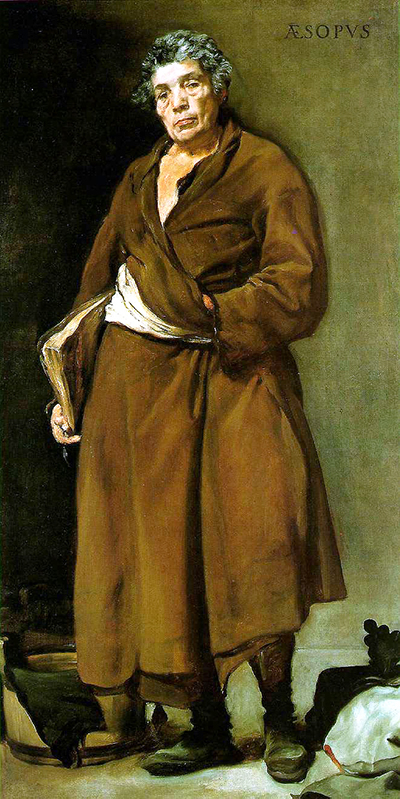
A man in a long brown coat looks out with a book held low at his side. His hand curls around the bottom of the volume, where the pale edges of its pages catch the light. Above his other shoulder, against a wall almost bare of incident, are the letters ÆSOPVS. They name Aesop, the ancient Greek storyteller to whom many animal fables are attributed. Diego Velázquez painted him at the scale of a standing portrait. The oil on canvas measures 179 × 94 cm and is in the Museo Nacional del Prado, Madrid (P001206). It is generally dated to around the end of the 1630s. The Prado’s 1990 exhibition catalogue discusses a date of about 1639–40 and records a range of earlier and later proposals. [1] [2]
At a Glance
- CollectionMuseo Nacional del Prado, P001206 [1] [2]
- Usually datedLate 1630s [1]
- MediumOil on canvas [1] [2]
Contents
- A figure who has stopped in front of us
- What the name and the book tell us
- Aesop, Menippus and Mars at the Torre de la Parada
- From the canvas to Goya’s etching
A figure who has stopped in front of us
The body is slightly turned within the narrow canvas, and the two shoes point in different directions. The one on the left presents much of its length, while the one on the right comes forward so that we see the worn upper of its toe. There is just enough light on the floor to tell where each foot meets it. The hem breaks into long, heavy folds above the dark material wrapped around the lower legs. Across most of the canvas the coat and the room are variations on brown, and the best clues to the body beneath the cloth come from the diagonal pull across the breast and the weight of the sleeve at the bent elbow. [1]
Two pale areas interrupt that mass of cloth. The open neck leaves a triangle of skin below the face, and a length of white fabric is tucked across the waist. It gathers where the arm meets the coat, then narrows as it runs towards the figure’s covered hand. The white cloth makes the body's turn easier to see and directs attention to the position of the arms. One is drawn across the body, with little of the hand visible. The other hangs down far enough for the book to sit at the level of the hip. The stiff edge of the volume and the folds around the waist give the pose much of its structure. [1]
The close view of the face in the Prado catalogue shows how unevenly the light is distributed. Small grey strokes break away from the mass of the hair. The forehead is openly lit, while the eyes sit under shadows of different depths. A few light marks pick out the bridge and tip of the nose and the fuller part of the cheeks. The closed mouth has a warmer touch of colour, small enough to register after the eyes. The head presents itself with the specificity of an individual face. From farther away, where those small differences are harder to pick out, the near-frontal gaze and the length of the standing figure still hold the viewer’s attention. [1]
At each side of the feet Velázquez sets objects close to the edge of the canvas. A low wooden vessel shows its rim and handle at the left, and a pale fold of material enters at the right. Their outlines are less emphatic than the pale page edges under Aesop’s arm. Along with the strip of floor they give the figure somewhere to stand. The background above can then remain largely unoccupied, with enough light at the top right for the letters of the name to be legible. [1]
What the name and the book tell us
The name in Latin letters gives the figure an identity that the face alone could hardly provide. Herodotus, writing in antiquity, mentions Aesop as a teller of stories who had once been enslaved by Iadmon of Samos. This early literary testimony tells us how the Greeks remembered him. The man in the Prado canvas belongs to a different kind of evidence, a seventeenth-century painter’s visual invention about someone from the distant past. A living model could have helped Velázquez shape the head. The identity of any such model remains open. [1] [3]
The book brings the fable tradition into the painting without specifying an episode. You can see the thickness of the paper and the way the hand takes its weight. The cover and pages face away at an angle, with no title to read. The volume gives a familiar physical form to a body of stories transmitted under Aesop’s name. The painter could rely on the inscription to identify the storyteller and spend the rest of the picture showing what it would be like to encounter him. His gaze meets ours while his book stays down at his side. [1] [3]
By Velázquez’s time there were already illustrated Spanish editions of the fables. One of them, printed by Jacobo Cromberger in Seville in 1521, presents Aesop’s life alongside the stories associated with him. Its woodcut of the lion and the mouse brings two moments into the same frame. The lion has the mouse in its grasp in one part of the image, and the mouse frees the trapped lion by gnawing through the ropes in another. That edition shows how directly an illustrated book could tell the story, with both the powerful animal and the small one needed to complete the action. Velázquez gives the canvas over to the man whose name such a book carried. The volume itself stays closed to our view. [4]
The lettering is visible evidence of how the figure has been identified, and the date at which it was painted has its own history of interpretation. Julián Gállego’s catalogue entry reports José Camón Aznar’s proposal that the inscription was added when the work was hung at the Torre de la Parada. The proposal belongs to Camón Aznar’s wider argument for dating the picture to Velázquez’s first Italian journey. Gállego sets it alongside the more usual view that Aesop and Menippus were painted around the same time for the lodge. The early inventory already calls the figure Aesop. It records how the picture was known by then and leaves the dating of the painted letters open. [1] [5]
Aesop, Menippus and Mars at the Torre de la Parada
The Torre de la Parada was Philip IV’s hunting lodge in the hills of El Pardo near Madrid. A royal inventory begun in 1701 and signed in 1703 names Mars, Aesop and Menippus together in its eighth room. In the transcription published by Svetlana Alpers, they form a single entry for three pictures of the same size by Velázquez, each appraised at fifty doubloons. That room also contained a picture of the wedding of Thetis and Peleus and paintings of animals placed over doors and windows. The preceding room’s list includes royal hunting portraits. The inventory helps recover the variety of pictures a visitor might have encountered from room to room. Its entries give room locations by the early eighteenth century. A wall-by-wall account of the lodge when Velázquez worked on the paintings remains elusive. [5]
Menippus (Prado P001207) makes a particularly close visual counterpart to Aesop. The 1990 catalogue gives both canvases the same height and width, and Gállego notes how frequently scholars have treated them as a pair. Both show an ancient writer in plain clothes, identified by lettering near the top. Aesop stands with his grey hair uncovered and carries his book. The satirist Menippus wears a soft hat and draws his cloak across his chest. His back and shoulder take up much of the canvas as he glances around towards us. His books and a roll of paper are down by his boots, beside a jug raised slightly above the floor. One man’s face is almost as frontal as his coat. The other gives us his face by turning back from a body that seems to be moving on. Their book placements make that difference particularly easy to follow. [1] [6]
Mars (Prado P001208) uses nearly the same height and width to gather the body into a much lower pose. The god sits with a knee raised, the weight of his head leaning towards his hand. The gold-coloured helmet puts his forehead and eyes in shadow. Aesop’s uncovered face is one of the brightest passages in his painting, while the armour in Mars first draws the eye to the helmet and then down to the equipment on the floor. Each figure’s possessions establish something about his role. Aesop has his book within the silhouette of the standing figure. Mars is recognisable as a warrior with much of his equipment set down around him. The two paintings share a scale and differ in how they ask us to read a figure at rest. [1] [7]
Gállego’s account treats the three pictures as intended for the lodge. Alpers considers their subjects well suited to a hunting residence and stresses how little the records can tell us about the original intentions, especially for Mars. She connects Aesop with the animal fables represented among the paintings at the Torre. A later inventory of the palace at El Pardo shows how that association could persist in a new setting. A list copied into the 1747 inventory, recording paintings taken there in 1714, places Menippus and Aesop in successive entries as full-length philosophers, each valued at 3,000 reales de vellón. The entry immediately before them describes a painting over a window of the fox-and-stork fable. The earlier inventory’s later annotation sends the two authors to El Pardo and points to a separate room at the Torre for Mars. The picture of Aesop appears in Royal Palace inventories in Madrid in 1772 and 1794 and is recorded by Gállego in the Prado from 1819. [1] [5] [7]
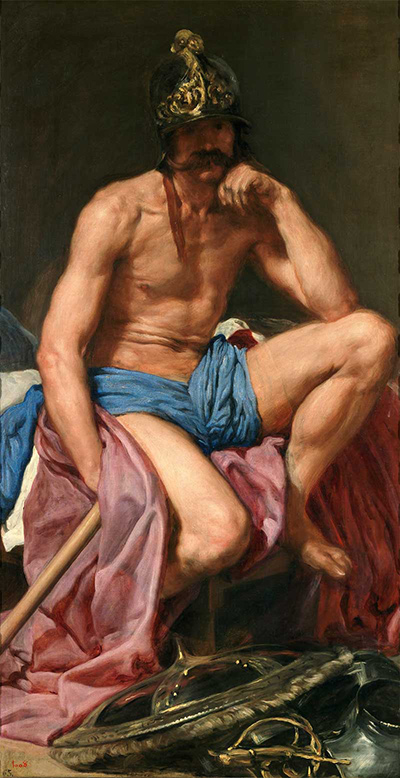
Mars. The Torre de la Parada records connect the two pictures. Compare the book and plain coat with the armour that identifies Mars. View Mars Resting.
From the canvas to Goya’s etching
Francisco de Goya made an etching after Aesop in 1778. The Metropolitan Museum of Art holds a paper impression, accession 31.31.16. The etched plate is the surface from which the ink was transferred to the sheet. The Met lists the plate dimensions as 29.5 × 21.5 cm and the paper dimensions as 41 × 28.7 cm. The caption printed beneath the image credits Velázquez’s original in the Royal Palace in Madrid and identifies the figure as Aesop the fabulist. Its reference to life size describes the figure in the painted original. The dimensions of the Met impression give a sense of how much the image shrank as it moved to a format that could be held in the hand. [8]
The print keeps the name above the shoulder and the diagonal of the white cloth against the coat. Goya uses close horizontal lines behind the figure, with denser patches to the left and open paper at the edge. Smaller groups of strokes gather at the bend of the sleeve and beneath the hand, and a narrow light edge still makes the book visible. Seen together, the two works make it possible to follow the parts of the design that carry across paint and print. A dark line can take over the work of a fold in brown cloth. The relation between Aesop’s low-held book, his tall figure and the letters above him survives even at this smaller scale. [1] [8]
Artworks directory
Frequently Asked Questions
Late 1630s [1]
The body is slightly turned within the narrow canvas, and the two shoes point in different directions. The one on the left presents much of its length, while the one on the right comes forward so that we see the worn upper of its toe. There is just enough light on the floor to tell where each foot meets it. [1]
Discussion
Look again at the images and ideas explored in Aesop. These editorial prompts invite your observations.
Reader Insights
How does the book change the way you read the figure?
What can the Torre inventory tell us about how viewers encountered this painting?
Join the Conversation
Share a detail, comparison or question about Aesop below.
References
- Julián Gállego, “Esopo,” in Velázquez, Museo del Prado and Ministerio de Cultura, 1990, cat. 49, pp. 298–303 (Spanish). View source.
- Museo Nacional del Prado, Esopo (Aesop), P001206. Museo Nacional del Prado and Fundación Bancaria “la Caixa”, Velázquez y el Siglo de Oro, loan agreement, Annex A, no. 8, published by the Boletín Oficial del Estado, 2019 (Spanish). View source 1. View source 2.
- Herodotus, Histories, 2.134.3–4, translated by A. D. Godley, Perseus Digital Library. View source.
- Library of Congress, Taru Spiegel, “Aesop’s Fables at the Library of Congress,” 2017, describing the 1521 Seville edition in the Lessing J. Rosenwald Collection, no. 1279. View source.
- Svetlana Alpers, The Decoration of the Torre de la Parada, Corpus Rubenianum Ludwig Burchard, part IX, 1971, pp. 41–44 and 133–136, Appendix II, Torre de la Parada entries 95–97, pp. 295 and 307–308, and El Pardo entries 19–21, pp. 359 and 362. View source.
- Julián Gállego, “Menipo,” in Velázquez, Museo del Prado and Ministerio de Cultura, 1990, cat. 50, pp. 304–309 (Spanish). View source.
- Julián Gállego, “Marte,” in Velázquez, Museo del Prado and Ministerio de Cultura, 1990, cat. 51, pp. 310–315 (Spanish). View source.
- The Metropolitan Museum of Art, Francisco de Goya, Aesop, after Velázquez, 1778, paper impression 31.31.16. View source.







