


 by Tom Gurney
Tom Gurney BSc (Hons) is an art history expert with over 20 years experience
Published on June 19, 2020 / Updated on October 14, 2023
Email: tomgurney1@gmail.com / Phone: +44 7429 011000
Philip IV as a Hunter: Introduction
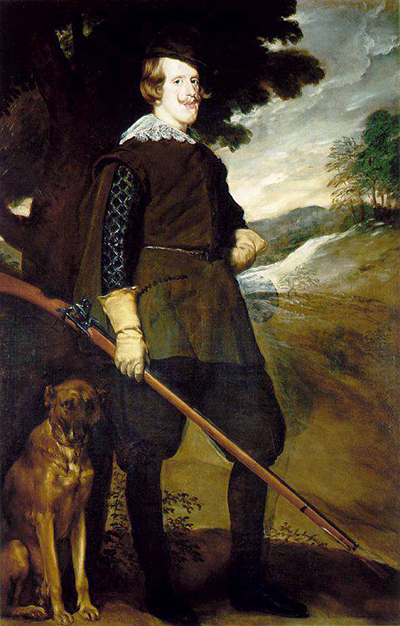
A long gun cuts diagonally across Philip IV’s dark clothes. His gloved right hand holds it low beside his body, just above the head of a seated dog. One shoe points towards us and the other towards the right edge of the canvas. He turns his face towards us, with a broad tree behind his head and an opening across the hills beside him. The bright glove and the pale line of the gun bring the eye down from his face to the dog, which also looks out from the picture. [1]
Velázquez painted this full-length portrait in oil on canvas for the royal hunting lodge of the Torre de la Parada in the woods of El Pardo, near Madrid. The Museo Nacional del Prado identifies it as Felipe IV, cazador, inventory P001184. In the Prado’s 2018 exhibition with the National Museum of Western Art in Tokyo, it was listed as Philip IV in Hunting Dress, dated 1632–34. The Prado’s 1990 exhibition catalogue used 1634–36 and recorded earlier and later proposals. Velázquez revised the figure as he worked, and the dates proposed for its execution leave open when each change was made. [1] [2] [3]
At a Glance
- CollectionMuseo Nacional del Prado, P001184 [2]
- Date in the 2018 exhibition1632–34 [2]
- Original settingTorre de la Parada [1]
Philip IV and the hunters at the Torre de la Parada
The 1990 Prado catalogue instead gives 1634–36.
Ferdinand in hunting dress
1632–34 [3] [6]Ferdinand was one of three royal hunters painted for the lodge.
The prince’s shorter figure has room for more of the tree overhead.
The three hunters in the lodge inventories
1701 and 1747 [5]Each inventory places the three portraits in the same room.
Contents
- The king in hunting dress
- Three hunters at the Torre de la Parada
- What the cloth and the paint reveal
- Two settings for the king’s portrait
The king in hunting dress
The king’s brown tabard makes a wide shape from shoulder to thigh. Loose outer sleeves expose a more elaborate garment underneath. On the arm that holds the gun, small pale strokes pick out a lattice against the dark sleeve, and the glove begins with a wide cuff just below it. Lace spreads across the shoulder and gathers in smaller folds immediately beneath the chin. Julián Gállego identifies it as Flemish lace and describes the colour of the gloves as amber. The collar and sleeve pattern reward a close look, while the gloves and the uninterrupted fall of the outer garment remain legible from farther away. [1]
The face is framed by the dark brim, the curls over each ear and the light collar. The cap merges with the tree at its crown and appears in a narrow rim above the forehead. Philip’s shoulders and hips turn obliquely across the canvas. His far hand is raised at waist level, and his nearer arm drops beside his thigh. Velázquez brings the eyes round to meet us while keeping that oblique stance. The turn is slight enough to retain the profile of the nose and the raised ends of the moustache. The care given to his face makes it the clearest mark of his identity. [1]
The gun runs from the shadowed tree at the left through the glove and down across the lighter ground. Slivers of pale paint at its metal fittings interrupt the warm wooden line. At the bottom, the line draws away from the figure as the two dark shoes settle into the shadow along the ground. The seated dog counterbalances the sweep of the gun. Light runs along its chest and front legs down to the paws, while the dark muzzle falls into the shadow of the tree. Gállego calls it a mastiff and notes its watchful stillness. Its upright legs and broad chest give the king a companion with a substantial presence of its own. [1]
At the king’s left elbow, the ground on the right opens into bands of different depths. A pale ridge and a row of trees catch the light in the middle distance. Behind them, darker hills become cooler towards the open sky. The silvery sky has both lighter streaks and areas of grey. Its changing tone follows the rise and fall of the ground and makes the division between the dense tree at left and the open country at right feel less abrupt. The Museo de Historia de Madrid places these landscapes in the setting of El Pardo and the Guadarrama range. Their appearance gives a court audience recognisable hunting country, even though the individual slopes are difficult to identify. [1] [4]
Three hunters at the Torre de la Parada
The lodge took its name from an earlier royal hunting tower. Philip IV enlarged it in the 1630s and installed paintings on subjects ranging from the hunt to classical mythology. Svetlana Alpers identifies the hunting portraits as a centrepiece of the Galería del Rey, the principal public room. The inventory drawn up for the testament of Charles II groups the portraits of Philip, his brother Ferdinand and his son Baltasar Carlos in its seventh room, with six scenes of hunts including works by Peeter Snayers. A later inventory lists all three royal hunters together in the room explicitly named the King’s Gallery. Those records establish how closely the pictures were associated at the lodge. The room numbers are positions in separate inventory sequences, and the entries do not place each portrait on a particular wall. [5]
The surviving canvases help explain what that grouping offered a viewer. In Cardinal-Infante Ferdinand of Austria as a Hunter, P001186, the tree and the seated dog occupy the right of the canvas. Ferdinand turns his body across the frame and holds the gun with both hands. Its upper end rises into the sky, and the dog lifts its head towards him. The turn of his head towards the viewer and the pattern on his sleeve recall Philip. The animal’s attention and the ascending diagonal send the eye back up to Ferdinand’s figure, where Philip’s descending gun leads the eye towards the ground. [1] [3]
In Prince Baltasar Carlos as a Hunter, P001189, the child occupies the lower part of a canvas almost as tall as the king’s. His cap, lace, gloves and dark outer garment echo the adults’ costume, but the tree canopy takes up more of the space overhead. He holds a smaller gun with one hand, the barrel rising beside his shoulder. A dog lies to his right, on the viewer’s left, and a second dog peers in from the opposite edge. The 1990 catalogue reads the inscription to indicate that he was six and dates the picture to 1635–36. Ferdinand’s portrait is dated 1632–34. An account of his journey records his departure from Madrid for Barcelona in April 1632. A shared destination could bring together portraits begun at different times. [1] [3] [6] [7]
The child’s cap and gloves give him the bearing of an adult hunter, while the broad expanse of sky above him brings out his small stature. Those are particulars of stature, and in the lodge they also made visible a relationship between generations. Gállego points to the place of hunting in a prince’s education, citing the seventeenth-century hunting writer Alonso Martínez de Espinar on its likeness to war. Beside these standing portraits, the pictures of royal hunts gave a different account of the activity. In Alpers’s reading, Snayers often makes the king one relatively small figure in the landscape, even when portraying a conspicuous feat. Velázquez gives him the full height of the foreground. All the action is in the adjustment of a stance and the turn of a head. [1] [5]
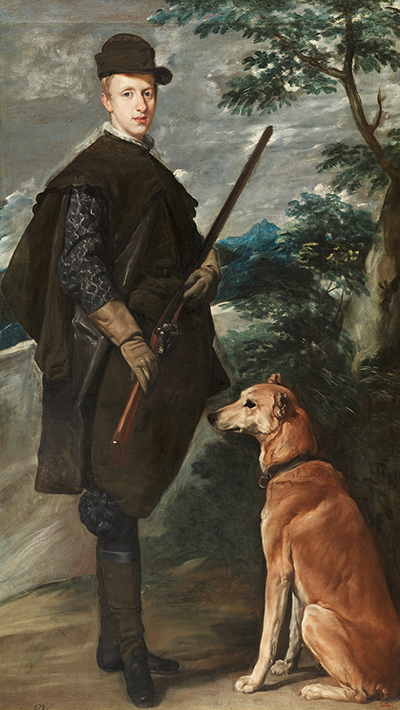
Cardinal-Infante Ferdinand of Austria as a Hunter. The cardinal-infante’s portrait uses the repeated hunting format with a different stance and landscape. View Cardinal-Infante Ferdinand of Austria as a Hunter.
What the cloth and the paint reveal
At nearly two metres tall, the hunting pictures are close to one another in height. The king’s is wider, with more room for the long oblique gun and the view to his side. The 1990 catalogue recorded 191 × 126 cm for Philip, 191 × 107 cm for Ferdinand and 191 × 103 cm for the prince. These are the dimensions as reported together in that publication. Mario Criado Pérez, discussing Carmen Garrido’s technical studies, notes that the two narrower portraits show additions at the top. He proposes that the additional height of Ferdinand’s canvas brought it into line with the king’s. The similar height of the surviving pictures and the evidence that they shared a room make coordination a plausible explanation. The evidence leaves the precise sequence of commissions and the original spacing of the paintings open. [1] [5] [8]
The difference between a painted revision and a physical cut matters here. Gállego reports that cleaning in 1983 brought out changes to Philip’s left hand and leg and showed that the gun barrel had once been longer. It also recovered the silvery cast of the landscape that old varnish had obscured. He wondered whether the dog had been cut back when the picture moved to the New Royal Palace. Criado Pérez reports, on the basis of Garrido’s examination, that the X-ray preserves the characteristic scalloping from tension in the fabric along both side edges. The survival of those edge features weighs against an appreciable cut into the picture on the dog’s side. The animal’s closeness to the border can be read as part of the original arrangement. [1] [8]
A separate portrait at the Musée Goya in Castres helps explain what changed around the head. That canvas belongs to the Louvre, which catalogues it as attributed to Velázquez, inventory MI 292, and dates it to about 1632–34. It has been on deposit in Castres since 1949. In it Philip holds his cap in his left hand and his hair is fully exposed. Jean-Louis Augé reads it as a replica that preserves features from an earlier state of the Prado composition. Gállego notes the possibility that Velázquez gave Philip a cap to bring him closer to the two other royal hunters. On the Madrid canvas, the brim narrows the light part of Philip’s face and makes the head belong more closely to the shade of the tree. The two pictures show what the change accomplished. The reason for the change remains a matter of interpretation. [1] [9] [10]
Two settings for the king’s portrait
In Philip IV on Horseback, P001178, the king’s horse raises both forelegs and lifts his body above a distant landscape. His baton sits against his armour and the red sash brings colour to the highest part of the figure. That portrait took its place in the Hall of Realms at the Buen Retiro alongside other mounted members of his family. Its broad format lets the horse and rider be read together at a distance. At the Torre de la Parada, Philip stands at ground level. His dark clothes absorb the shade from the nearest tree, and his gaze crosses the gun and the dog to meet ours. The two settings called for different kinds of royal presence. The Hall of Realms showed the king in command on horseback. The lodge let visitors recognise him by face, clothing and bearing as the owner of the country in which he hunted. [1] [3] [5]
Philip’s hunting portrait is documented at the Torre through its early eighteenth-century inventories. Gállego cites Torre entries dated 1705 and 1747, followed by Royal Palace records in Madrid in 1772, 1794 and 1814. He places the transfer into the Prado at about 1828. The painting had already attracted the attention of Goya, whose red chalk drawing of about 1778–79 is in the Hamburger Kunsthalle. Goya retained the cap and studied the patterned sleeve, lace and contours of the leg. He abbreviated much of the far landscape. The drawing preserves the division between the dark shelter on the left and the brighter space on the right even as the trees and hills recede into a few marks. [1] [5] [11]
The Castres variant supplied a different route into print. When the Louvre acquired it in 1862, Édouard Manet made an etching after it for the set published by Alfred Cadart that autumn. V. Aebi describes how freely Manet worked from the painting. In the early states of the print, the dog practically disappears into the tree trunk. Manet made it stand out again by the sixth state, the one held by the Musée Goya. The two artists who copied the portrait on paper thus took different routes to the same problem of making the dog visible against the deep shade. Goya’s chalk drawing retains the cap from the later appearance of the Madrid composition. Manet worked from the other version, where the king stands bareheaded. [9] [11] [12]
Artworks directory
Frequently Asked Questions
Museo Nacional del Prado, P001184 [2]
1632–34 [2]
Torre de la Parada [1]
The king’s brown tabard makes a wide shape from shoulder to thigh. Loose outer sleeves expose a more elaborate garment underneath. On the arm that holds the gun, small pale strokes pick out a lattice against the dark sleeve, and the glove begins with a wide cuff just below it. [1]
Discussion
Look again at the images and ideas explored in Philip IV as a Hunter. These editorial prompts invite your observations.
Reader Insights
How does the narrow silhouette of the gun change the way the king’s pose reads?
Which differences stand out when you compare the figures of the king and prince in hunting dress?
Join the Conversation
Share a detail, comparison or question about Philip IV as a Hunter below.
References
- Julián Gállego, Felipe IV, cazador, catalogue no. 43, in Antonio Domínguez Ortiz, Alfonso E. Pérez Sánchez and Julián Gállego, Velázquez, Museo del Prado and Ministerio de Cultura, 1990, pp. 265–269. See also nos. 38, 44 and 45 for the equestrian and companion hunting portraits. Spanish. View source.
- National Museum of Western Art and Museo Nacional del Prado, Velázquez and the Celebration of Painting: The Golden Age in the Museo del Prado, Tokyo exhibition checklist, 2018, item 21, Philip IV in Hunting Dress. English and Japanese. View source.
- Musée du Louvre, Antoon Van Dyck. Catalogue raisonné des tableaux du musée du Louvre, catalogue no. 18, §7 and n. 36, identification and original destination of the three Prado hunting portraits. French. View source.
- Museo de Historia de Madrid, La Torre de la Parada, especially pp. 53–61 and figs. 75–77 and 80. Spanish. View source.
- Svetlana Alpers, The Decoration of the Torre de la Parada, Corpus Rubenianum Ludwig Burchard, part IX, 1971, pp. 122–128 and appendix II, pp. 306 and 338–339, including the transcribed Torre inventories. English. View source.
- Regione Lombardia, Archivio di Etnografia e Storia Sociale, photograph of a detail of Cardinal-Infante Ferdinand of Austria, in Hunting Dress, archival record IMM-SWCX1-0004228, with P001186, the Prado date and exact collection link. Italian. View source.
- Diego de Aedo y Gallart, Viaje del Infante Cardenal D. Fernando de Austria, Antwerp, 1635. The title records the departure from Madrid for Barcelona on 12 April 1632. Universität Wien, Tieck Library bibliographic record. Spanish. View source.
- Mario Criado Pérez, La medida original. El problema de los formatos en la pintura de Velázquez, Universidad de Salamanca, 2011, pp. 101–105, citing Carmen Garrido Pérez, Velázquez. Técnica y evolución, Museo del Prado, 1992, pp. 385–391 and 401. Spanish. View source.
- Musée du Louvre, Philippe IV en chasseur, attributed to Diego Velázquez, MI 292, deposit D 49 3 2, Musée Goya, Castres. French. View source.
- Jean-Louis Augé, Portrait de Philippe IV, Musée Goya collection entry hosted by Occitanie Musées, comparing the Castres and Madrid canvases. French. View source.
- Fundación Goya en Aragón, Francisco de Goya, Philip IV, hunter, c. 1778–79, red chalk on laid paper, Hamburger Kunsthalle inv. 38543. English. View source.
- Musée Goya, Édouard Manet, Portrait de Philippe IV en chasseur d’après Velázquez, 1862, 2010-4-1, collection entry hosted by Occitanie Musées. French. View source.







